What's inside
- Key Takeaways
- Quick Picks
- How Did We Choose These Cabinet Smokers?
- How Do the Six Cabinet Smokers Compare Side by Side?
- What Does Insulation Actually Do for a Smoker?
- How Is a Cabinet Different from an Ordinary Vertical Smoker?
- How Do You Load a Cabinet Smoker for Even Cooking?
- Why Do Sausage and Jerky Makers Gravitate to Insulated Cabinets?
- How Do You Clean a Commercial-Style Cabinet?
- How Much Does Fuel Economy Matter Over a Cabinet’s Life?
- How Do You Choose Between Four Racks, Eight Racks and 120 Pounds?
- Where Can a Commercial Electric Cabinet Live?
- How Does a First Production Cook Run, Hour by Hour?
- How Does an Insulated Cabinet Change Winter Smoking?
- What Should You Inspect in a Cabinet’s Door and Seal?
- Is a Cabinet Smoker a Sensible First Step into Small-Scale Catering?
- How Do You Break In a New Cabinet Smoker?
- Why Not a Pellet Grill Instead of a Cabinet?
- Why Does Rack Spacing Matter More than Rack Count?
- What Mistakes Do Buyers Make with Cabinet Smokers?
- Final Recommendation
- Frequently Asked Questions
- Related Guides
As an Amazon Associate I earn from qualifying purchases. This post may contain affiliate links at no extra cost to you.
cottageverdict.com is reader-supported. When you buy through links on our site, we may earn an affiliate commission.
Where to buy: the six cabinets below are sold through Amazon, and each name links to its listing in the Quick Picks table, the review headings, the comparison table and the check-price buttons, so you can confirm configuration and capacity before ordering. This guide to the best insulated cabinet smokers is built around a single physical idea: a smoker is a box that leaks heat, and insulation is the art of leaking less. An insulated cabinet — a box-style smoker whose walls are built to hold temperature rather than merely contain it — keeps its climate steadier through wind and winter, sips fuel or electricity instead of gulping it, and asks less correction from its cook. That is the promise. The honest complication, which this guide observes strictly, is that insulation must be claimed cabinet by cabinet from the evidence of each listing, not assumed from the box shape.
So the six picks divide into two honest groups. Three are insulated commercial-style electric cabinets in the sense their makers present them: the SmokinTex 1500-CXLD, the HAKKA eight-rack smoke oven and the CLIVIA four-rack digital cabinet. Three are cabinet smokers whose titles claim other virtues — the charcoal-fired Big Wood, the natural gas Broil King vertical, and the EAST OAK electric on its mobility stand — and where their titles do not state insulation, this guide says so in those words rather than borrowing the category’s halo. All six share the cabinet virtues: stacked racks, a front door, a small footprint for their capacity, and food loaded by altitude.
The audience for this guide is the cook moving up from a basic vertical smoker — or the small caterer, the sausage maker, the jerky producer — who cooks often enough that temperature stability and fuel economy have stopped being abstractions. Read the reviews for what each cabinet verifiably is, and the sections after them for how insulation changes cooking in practice.
Key Takeaways
- Insulation is claimed per cabinet in this guide, not per category: the SmokinTex, HAKKA and CLIVIA are presented by their makers as insulated commercial cabinets.
- The Big Wood, Broil King and EAST OAK titles do not state insulation, and their reviews say so explicitly instead of assuming it.
- Three fuel types appear: electric (SmokinTex, HAKKA, CLIVIA, EAST OAK), charcoal (Big Wood) and natural gas (Broil King).
- The SmokinTex 1500-CXLD is the heavyweight: dual 700W elements, NSF certification and a stated 120 lbs capacity aimed at restaurants and catering.
- The CLIVIA publishes the most precise control figures: 86–248°F digital temperature control, a 0–12 hour timer and auto shutoff, in a stainless steel cabinet.
- The HAKKA’s eight racks are the most in this guide, suiting batch producers of sausage, bacon and jerky.
Quick Picks
| Pick | Badge | Why it earns its place |
|---|---|---|
| SmokinTex 1500-CXLD Commercial Electric Smoker | Best Commercial Insulated Cabinet | An NSF-certified insulated commercial cabinet with dual 700W elements and a stated 120 lbs capacity. |
| HAKKA Commercial Electric Smoker 8 Racks | Most Racks in the Guide | A vertical smoke oven with eight racks built for pastrami, sausage, bacon and batch smoking. |
| CLIVIA 4-Rack Digital Commercial Electric Smoker | Best Digital Control Range | A stainless steel cabinet with 86–248°F digital control, a 12-hour timer and auto shutoff. |
| Big Wood Smoker Charcoal Cabinet Smoker | Best Charcoal Cabinet | A heavy-duty charcoal cabinet smoker for cooks who want cabinet layout with a real fire. |
| Broil King Vertical Natural Gas Cabinet Smoker | Best Natural Gas Cabinet | A vertical cabinet plumbed for natural gas, ending bottle management for the plumbed-in patio. |
| EAST OAK 30-inch Electric Smoker with Mobility Stand | Best Mobile Electric Cabinet | 725 square inches, a built-in probe and a side chip loader, on a mobility stand, in Polar Night finish. |
How Did We Choose These Cabinet Smokers?
We began with the cabinet architecture itself: a box or tower with a front-opening door and stacked racks, the format that loads food by altitude and fits serious capacity onto a modest footprint. Within that architecture we required the guide to represent the category honestly, which meant separating the genuinely insulated commercial cabinets from cabinet smokers whose listings make no insulation claim. That separation is this guide’s spine. A buyer shopping this keyword deserves to know which machines are built around insulated walls as their makers present them, and which are excellent cabinets of a more ordinary construction, priced and fuelled differently.
Fuel diversity was deliberate. Electric dominates the insulated commercial world because elements pair naturally with thermostatic control inside a sealed box, and three of our picks plus the EAST OAK run on it. But cabinet smoking also lives on charcoal, where the Big Wood flies the flag for fire-managed cabinet cooking, and on natural gas, where the Broil King’s plumbed supply suits a permanent outdoor kitchen. Capacities were read as stated: the SmokinTex’s 120 lbs is a caterer’s figure, the HAKKA’s eight racks a batch producer’s, the EAST OAK’s 725 square inches a household’s, and where a title gives no capacity — the Big Wood and Broil King — the reviews say so rather than estimating.
Control precision was the third lens. The CLIVIA publishes an exact digital range and timer; the commercial electrics imply thermostatic holding by their class; the charcoal and gas cabinets hand control to the cook in the traditional way. Each is a legitimate philosophy, and the reviews argue them on their own terms.
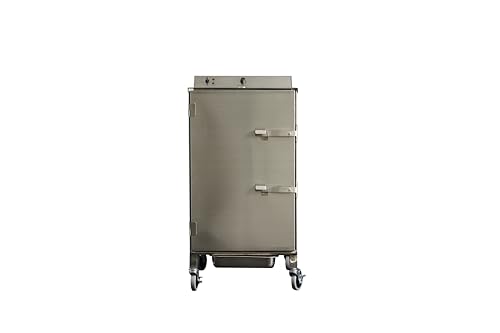
SmokinTex 1500-CXLD Commercial Electric Smoker — Best Commercial Insulated Cabinet
The SmokinTex 1500-CXLD is what the insulated cabinet idea looks like when it grows up and goes to work. Its title stacks professional credentials: dual 700W elements, NSF certification, a stated capacity of 120 lbs, and an intended clientele of restaurants and catering operations. The insulated cabinet construction is the foundation under all of it — a commercial smoker that could not hold temperature economically through a service day would be a liability, and the whole point of this machine’s class is a sealed, insulated box whose elements cycle gently instead of fighting the weather through thin walls.
Dual elements deserve translation. Two 700W elements give the cabinet both recovery power and redundancy of heat distribution: a big, cold, fully loaded box — and 120 lbs of meat is a very full box — drags temperature down at loading, and the CXLD’s combined wattage is sized to pull it back without a long, smoky wallow at low temperatures where food lingers in the danger zone’s neighbourhood. NSF certification speaks a different language: it is the standard commercial kitchens are inspected against, signalling construction and cleanability that satisfy health-code environments, which matters to the caterer and reassures the serious home buyer about build intent.
This is not a casual purchase, and its review should not pretend otherwise. It is a high-capacity, commercially certified insulated cabinet for producers — the smokehouse weekend business, the restaurant smoking its own bacon, the home charcuterie enthusiast whose batches have outgrown recreational equipment. Buyers at household scale should read on; buyers at production scale may not need to.
- Format: insulated commercial electric cabinet
- Elements: dual 700W per the listing title
- Certification: NSF certified
- Capacity: 120 lbs stated in the title
- Audience: restaurants and catering per the title
- Rack count: not stated in the listing
Strengths
- Insulated commercial construction holds temperature economically at scale.
- Dual elements recover heat quickly under full 120 lbs loads.
- NSF certification suits inspected commercial kitchens.
Trade-offs
- Commercial capacity and build exceed most households’ needs.
- Its size and weight demand a permanent station.
- Recreational features like windows and apps are not its language.
Best for: caterers, restaurants and high-volume home producers smoking weekly at scale. Not suited for: occasional family smokers who cook a rack of ribs twice a month.

HAKKA Commercial Electric Smoker 8 Racks — Most Racks in the Guide
The HAKKA, model DSH-S50B, calls itself a vertical smoke oven, and the name is a clue to its working life: eight racks of product, smoked in batches, in an insulated commercial electric cabinet. Its title’s menu is a charcuterie syllabus — pastrami, sausage, bacon, smoked chicken, smoked pork — foods that are produced in quantity, hung or laid across many levels, and sold or stored by the batch. Eight racks is the specification that matters here, double the CLIVIA’s four, and it converts the cabinet from a cooker into a small production line.
Insulation is the silent partner of batch work. A sausage run lasts hours at modest temperatures, and a cabinet that leaks heat cycles its element constantly, swinging the very temperatures that charcuterie asks to be boring. An insulated box steadies that environment and lowers the energy cost of every batch, which is the difference between a hobby’s electricity and a business’s overhead. The title also allows indoor and outdoor home cooking in its positioning — a reminder that electric cabinets, producing smoke in a controlled box, live in garages, workshops and small commercial spaces where a fire-based smoker cannot.
What the title leaves open, this review leaves open: no temperature range is published there, no timer, no capacity in weight. A production buyer should verify those figures in the full listing against the products they make — sausage in particular has opinions about low-temperature control. Judged on its stated evidence, the HAKKA is the batch cabinet: eight racks, insulated commercial intent, and a menu written by someone who smokes for more than applause.
- Format: insulated commercial electric smoke oven, vertical
- Racks: 8 racks per the listing title
- Model: DSH-S50B
- Suggested foods: pastrami, sausage, bacon, smoked chicken and pork
- Temperature range: not given in the listing
- Timer: none stated in the listing
Strengths
- Eight racks give the greatest batch capacity in this guide.
- Insulated cabinet steadiness suits long charcuterie runs.
- Electric operation allows indoor-adjacent placement options.
Trade-offs
- Control figures are not published in the title and need verification.
- Eight racks of product mean eight racks of cleaning.
- Its production orientation is wasted on small family loads.
Best for: sausage, bacon and jerky producers working in batches. Not suited for: households whose largest load is a single chicken.

CLIVIA 4-Rack Digital Commercial Electric Smoker — Best Digital Control Range
The CLIVIA is the precision instrument of the insulated trio, a stainless steel cabinet whose title publishes the figures the HAKKA leaves out: digital temperature control from 86°F to 248°F, a timer running from 0 to 12 hours, and auto shutoff at the end of the programme. Read the low end of that range carefully. Eighty-six degrees Fahrenheit is not barbecue temperature; it is the territory of gentle drying, of holding, of the earliest stages of sausage work and jerky making where the product must lose moisture without cooking. A cabinet that controls down there, inside insulated walls that keep its element’s cycling from swinging the climate, is a tool for the deliberate end of smoking.
Stainless steel construction carries its own argument: it cleans to a shine, shrugs at the corrosion that painted cabinets negotiate with, and suits the jerky, sausage, fish and turkey menu the title names — foods whose production is as much about hygiene as heat. Four racks size the CLIVIA below the HAKKA’s production scale and closer to the serious home producer or the small deli: batches, but household batches. The timer with auto shutoff changes the working pattern from attendance to scheduling — load the cabinet, set the programme, and let the machine conclude the cook and switch itself off, a rhythm that suits overnight jerky runs and weekday smoking around a job.
As one of the three cabinets in this guide presented as insulated, the CLIVIA pairs that construction with the most legible control story here. Buyers choosing within the trio should decide by scale and by menu: the CLIVIA is the choice when the work is precise, the batches are moderate, and the programme matters as much as the smoke.
- Format: insulated digital commercial electric cabinet, stainless steel
- Racks: 4 racks
- Temperature control: 86–248°F digital per the listing title
- Timer: 0–12 hours with auto shutoff
- Suggested foods: jerky, sausage, fish and turkey
- Cooking area: not stated in the listing
Strengths
- The stated 86°F floor opens low-temperature drying work.
- Timer and auto shutoff allow scheduled, unattended finishes.
- Stainless cabinet cleans easily and resists corrosion.
Trade-offs
- Four racks cap batches below the HAKKA’s eight.
- The 248°F ceiling excludes high-heat finishing work.
- No cooking area figure is published in the title.
Best for: jerky and sausage makers who cook by programme and precision. Not suited for: cooks who need high finishing temperatures or eight-rack batches.
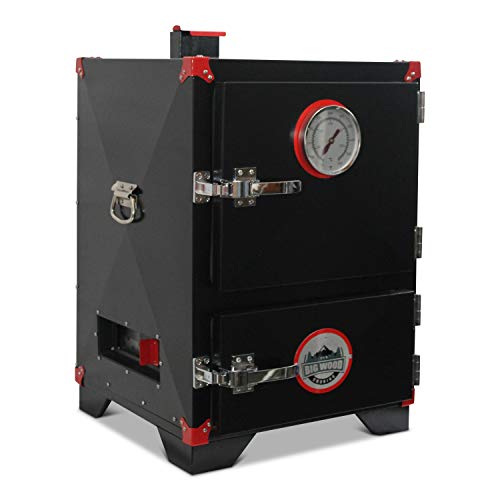
Big Wood Smoker Charcoal Cabinet Smoker — Best Charcoal Cabinet
The Big Wood Smoker is the cabinet for the cook who looked at the electric trio above and missed the fire. Its title is short and physical: a heavy-duty charcoal cabinet smoker for outdoor BBQ cooking, in black. Note what that title does and does not claim, because this guide’s honesty rule turns on it: the Big Wood is a cabinet smoker of heavy-duty construction, and insulation is not stated in the listing. It should be judged as a charcoal cabinet — valued for its fire, its format and its build claim — and not borrowed into the insulated category by association.
Charcoal in a cabinet is a distinct craft from charcoal in a barrel. The fire sits at the cabinet’s base, heat and smoke rise through stacked racks, and the cook manages vents and fuel to hold the tower’s climate. Cabinet walls and a closed door give charcoal a more sheltered environment than an open grill, and a heavy-duty build — the maker’s stated claim — is the charcoal cabinet’s version of thermal ballast: more metal to absorb the fire’s swings and return steadiness to the cook. The flavour argument needs no help: charcoal and wood in a cabinet produce the deepest traditional smoke character in this guide, the one electric elements approximate and gas burners chase.
The trade is attendance. A charcoal cabinet asks its cook to build the fire, read the tower, and feed and adjust across the hours — the same apprenticeship as the offset guide’s, practised vertically. No capacity, rack count or temperature figures appear in the title, so the listing itself must be consulted for dimensions before a buyer commits. For the fire loyalist who wants cabinet convenience without surrendering charcoal, the Big Wood is this guide’s honest answer, insulation neither claimed nor needed for its case.
- Format: charcoal cabinet smoker, black
- Construction: described as heavy duty in the listing title
- Insulation: not stated in the listing
- Capacity: not given in the listing
- Rack count: none stated in the listing
- Fuel: charcoal
Strengths
- Real charcoal fire in a space-efficient cabinet format.
- Heavy-duty construction claim suits long service.
- Cabinet shelter steadies charcoal cooking versus open grills.
Trade-offs
- No insulation is claimed, so winter cooks will feel the weather.
- Charcoal demands fire management across every cook.
- Key dimensions are absent from the title and need checking.
Best for: charcoal loyalists who want the cabinet layout and traditional smoke. Not suited for: cooks seeking set-and-forget electric convenience.
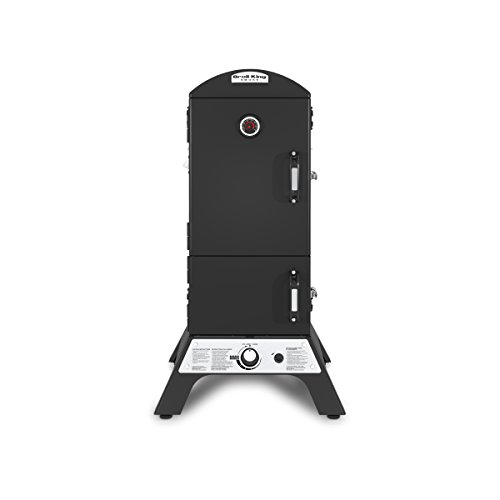
Broil King Vertical Natural Gas Cabinet Smoker — Best Natural Gas Cabinet
Broil King’s vertical cabinet, model family 923617, runs on the fuel nobody else in this guide uses: natural gas. That single fact reorganises the ownership experience. There is no bottle to fill, weigh, swap or run dry at hour nine, because the supply is the house’s own line, plumbed to a permanent outdoor station. For the household with an established outdoor kitchen — or one willing to have a gas line run to where the smoker will live for a decade — natural gas converts smoking from a fuelled expedition into a utility, as available as the kitchen oven and as steady.
Broil King brings a grill maker’s pedigree to the cabinet format, and the title’s brevity mirrors the Dyna-Glo style: vertical natural gas cabinet smoker, black, full stop. Insulation is not stated in the listing, and this guide records that plainly; the Broil King’s case rests on its fuel and its format rather than on insulated construction. Gas heat in a cabinet gives quick recovery after door openings and fine low control through the burner, and a plumbed supply removes the one recurring errand of propane ownership.
The constraints are equally clear. A natural gas cabinet is a fixture, not a portable: it lives where the line is, and households without a line face installation cost and arrangement before the first cook. Renters and movers should look at the bottled or electric picks instead. But for the settled outdoor kitchen, the Broil King answers a question the rest of the guide cannot: what if the fuel simply never ran out?
- Format: vertical cabinet smoker, black
- Fuel: natural gas, plumbed supply
- Model family: 923617
- Insulation: not given in the listing
- Capacity: not stated in the listing
- Rack count: none stated in the listing
Strengths
- Plumbed natural gas ends bottle management entirely.
- Gas heat recovers quickly after the door opens.
- A grill maker’s cabinet suits permanent outdoor kitchens.
Trade-offs
- Requires a natural gas line at the smoker’s station.
- Not portable; the cabinet lives where it is plumbed.
- No insulation or capacity is claimed in the title.
Best for: settled outdoor kitchens with a gas line available. Not suited for: renters, movers or anyone who smokes in more than one location.
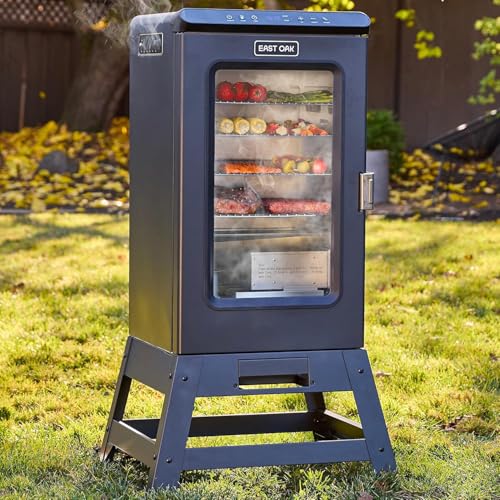
EAST OAK 30-inch Electric Smoker with Mobility Stand — Best Mobile Electric Cabinet
This EAST OAK is a different machine from the windowed model in our electric smokers guide, and the cabinet context reframes it. The title offers 725 square inches of cooking area, a built-in meat probe, a side chip loader credited with up to six times longer uninterrupted smoke, and the distinguishing furniture of this version: a mobility stand, in a finish called Polar Night. It is a household electric cabinet that can be moved — wheeled out for the cook, wheeled back under shelter after — and in a guide full of fixtures and production equipment, that mobility is a genuine philosophy: the smoker as appliance, not installation.
On insulation, the discipline of this guide applies in full: the title does not state insulation, so none is claimed here, and the EAST OAK earns its place on cabinet architecture and equipment rather than on insulated walls. That equipment is well chosen for household work. The probe answers doneness without a door opening; the side loader’s long uninterrupted claim stretches the intervals between chip checks; 725 square inches is the family capacity class that the electric guide established as the sweet spot for weekly smoking.
The mobility stand changes storage economics. A cabinet that rolls can live in a garage and work on a driveway, can follow the shade in summer and the shelter in winter, and can be lent to a neighbour without a furniture-moving expedition. For apartment-adjacent houses, shared yards and garages that double as workshops, that is not a footnote but the deciding feature. Judge it as the household cabinet of the six: not insulated by claim, not commercial by intent, and all the more useful to most readers for both.
- Format: electric cabinet smoker on mobility stand, Polar Night
- Cooking area: 725 square inches
- Probe: built-in meat probe per the listing title
- Chip loading: side loader, up to 6x longer uninterrupted smoke claimed
- Insulation: not given in the listing
- Temperature range: the listing does not publish one
Strengths
- The mobility stand lets the cabinet live stored and work anywhere.
- Probe and long-run chip loader suit unattended household cooks.
- 725 square inches is the proven family capacity class.
Trade-offs
- No insulation is claimed, unlike the commercial trio above.
- No temperature range is published in the title.
- Household scale only; batch producers should look up the page.
Best for: households that store the smoker in a garage and roll it out to cook. Not suited for: commercial producers or buyers specifically seeking insulated walls.
How Do the Six Cabinet Smokers Compare Side by Side?
| Pick | Fuel | Insulation per title | Capacity evidence | Control evidence |
|---|---|---|---|---|
| SmokinTex 1500-CXLD Commercial Electric Smoker | Electric, dual 700W | Insulated commercial cabinet | 120 lbs stated | Commercial thermostatic class |
| HAKKA Commercial Electric Smoker 8 Racks | Electric | Insulated commercial cabinet | 8 racks | Not stated |
| CLIVIA 4-Rack Digital Commercial Electric Smoker | Electric | Insulated commercial cabinet | 4 racks | 86–248°F, 12h timer, auto shutoff |
| Big Wood Smoker Charcoal Cabinet Smoker | Charcoal | Not stated | Not stated | Manual fire management |
| Broil King Vertical Natural Gas Cabinet Smoker | Natural gas | Not stated | Not stated | Burner control |
| EAST OAK 30-inch Electric Smoker with Mobility Stand | Electric | Not stated | 725 sq in | Built-in probe |
What Does Insulation Actually Do for a Smoker?
Picture the cabinet as a house in winter. An uninsulated wall passes heat steadily outward, so the heating system runs often and the rooms near the wall feel the weather. Insulated walls slow that passage: the interior climate holds, the heat source cycles gently, and the corners of the box — the top rack, the door side — stay closer to the set temperature. In a smoker, that translates into three practical goods. First, stability: fewer and smaller swings around the target, which is the difference between meat that cooks in a climate and meat that cooks in a series of corrections. Second, economy: an electric element or a charcoal bed replaces only the heat that escapes, so insulated cabinets consume less of either across a long cook. Third, weather independence: wind and cold tax an insulated box far less, extending the comfortable smoking season and making winter batches — holiday hams, January jerky — routine rather than heroic. These are the goods the commercial trio in this guide is built around, and the standard against which any cabinet’s insulation claim should be weighed.
How Is a Cabinet Different from an Ordinary Vertical Smoker?
The shapes look alike — a tower, a door, stacked racks — and the difference is in the walls and the intent. An ordinary vertical smoker is commonly a single skin of steel: light, inexpensive, and content to let its element or burner fight the outdoors directly. A cabinet smoker in the insulated sense is built like a thermos by comparison, with wall construction designed to hold the climate in, heavier doors that close like appliances, and controls that assume a stable interior worth controlling precisely. The price and weight follow the walls. This is why the guide insists on per-model evidence: a tower silhouette alone guarantees nothing, and three of our six picks wear the silhouette without the title claiming the construction. Buy the silhouette for layout; buy the insulation only where it is actually claimed.
How Do You Load a Cabinet Smoker for Even Cooking?
Altitude is the cabinet’s language, and loading is speaking it deliberately. Heat rises, so the top of the cabinet runs warmest in most designs once the cook settles, while the lowest rack sits nearest the heat source’s direct influence — check your own cabinet’s personality with a couple of probe readings before trusting any general map. Arrange by need: the items wanting the gentlest treatment — fish, cheese-adjacent projects, delicate sausages — go where your cabinet runs mildest; robust roasts take the stronger zones; poultry sits lowest of all so its juices never visit food below it. Leave air lanes between items, because a cabinet is a convection system and a rack paved edge to edge with meat is a roof, not a floor. Rotate levels once during long cooks if your racks allow it, moving the top rack’s contents down and the bottom’s up, and the cabinet’s gradient becomes a tool you use rather than a flaw you endure.
Why Do Sausage and Jerky Makers Gravitate to Insulated Cabinets?
Charcuterie is temperature literature written in meat. A sausage emulsion that warms too fast smears its fat and ruins its texture; a jerky batch dried unevenly cases-hardens outside while staying moist within; a bacon belly cured and smoked over days needs a climate that behaves the same on Tuesday as on Saturday. These are the processes where the insulated cabinet stops being a comfort and becomes an instrument. The walls hold the low temperatures that the CLIVIA’s stated 86°F floor and the commercial electrics’ thermostats aim at, and they hold them for the long, slow hours that drying demands, without the element’s cycling printing itself onto the product as swings. The HAKKA’s eight racks exist for this world’s arithmetic — a batch is dozens of links or pounds of strips, not a dinner — and the SmokinTex’s certification exists for its commerce, the inspected kitchen where the batch becomes a business. Home producers arrive at this category by a recognisable road: a first smoker that could not hold a low temperature steady, a batch lost to a windy night, and the decision that the box itself was the problem. They are usually right.
How Do You Clean a Commercial-Style Cabinet?
Production cabinets accumulate production residue, and their cleaning rhythm is closer to a kitchen’s than to a hobby grill’s. Racks come out after every batch — eight of them on the HAKKA is a sink’s worth of work and should be planned as such — and soak while the cabinet cools. Interior surfaces get wiped down while still warm enough that grease yields, with the seasoned film left intact on walls but every drip route, drain and door channel cleared, because old fat in a warm box is both a flavour and a hygiene problem. The door seal deserves its own inspection: it is the cabinet’s second wall, and a seal fouled with residue or beginning to crack leaks the climate the insulation works to keep. On stainless construction like the CLIVIA’s, the reward for this discipline is a cabinet that returns to a near-clinical state; on any construction, the reward is that the next batch tastes of its own smoke rather than of the last three. Commercial owners build this into the production schedule; home producers should steal the habit wholesale.
How Much Does Fuel Economy Matter Over a Cabinet’s Life?
Enough that frequent cooks should treat it as a purchase criterion rather than a footnote. Every long cook in an uninsulated box pays a weather tax: the element runs longer, the charcoal bed burns faster, the burner cycles more, all to replace heat that contributed nothing to the food. Across a single brisket the tax is small change; across a caterer’s season, or a home producer’s weekly batches over five winters, it compounds into real money and real time — and into temperature stability, which cannot be bought back at any price mid-cook. Insulation is the one efficiency feature that never wears a control panel or needs an update: it works silently on every cook, in every season, for the life of the walls. That is the economic skeleton under this guide’s category, and it is why the insulated trio, whatever their other differences, share a long-term cost argument that the uninsulated cabinets answer with lower purchase commitment instead. Both arguments are honest; the buyer’s cooking frequency decides which one wins.
How Do You Choose Between Four Racks, Eight Racks and 120 Pounds?
The three insulated cabinets state their capacities in three different dialects, and translating them is the buyer’s first job. Racks count levels: four on the CLIVIA, eight on the HAKKA. Levels suit flat and hung batch work — trays of jerky, rows of sausage, bellies of bacon — where the product is many and shallow. Pounds state mass: the SmokinTex’s 120 lbs suits whole-muscle production, the caterer’s load of shoulders, briskets and hams stacked through the cabinet’s volume. Neither dialect converts cleanly into the other without the cabinet’s dimensions, which is why the listings themselves must be consulted for rack spacing — the distance between levels decides whether a level holds jerky strips or a standing turkey. The practical method is to write down your three largest real batches of the past year in both dialects — how many levels, how many pounds — and buy the cabinet that holds the second-largest comfortably. The largest batch of the year is an outlier to be split across two runs; the second-largest is your working life, and it should never require Tetris.
Where Can a Commercial Electric Cabinet Live?
Electric cabinets widen the map of possible smoker locations because they make smoke without an open fire, and their makers say so — the HAKKA’s title contemplates indoor and outdoor cooking alike. The responsible reading of that invitation is ventilation and clearance: a smoking cabinet exhales wood smoke for hours, so wherever it stands, the smoke needs a route out that does not pass through living space, and the cabinet needs the clearances its manual specifies from walls and stored goods. Garages with a door open and a fan’s help, covered work yards, small commercial prep spaces with extraction — these are the natural habitats of the insulated electric class, and they are habitats no charcoal cabinet may enter. That locational freedom is a working feature for the producer whose business lives in a workshop or a rented unit, and it is one more reason the insulated commercial world is electric by default: the fuel and the building tolerate each other.
How Does a First Production Cook Run, Hour by Hour?
Take a batch of sausages in the CLIVIA or the HAKKA as the pattern. The cabinet is loaded cold with the product spaced on its racks, because a cabinet filled evenly from the start heats evenly as it climbs. The programme begins low — the drying stage, where the casings or surfaces lose their surface moisture at gentle heat so that smoke will adhere rather than bead. Smoke is introduced once the surfaces are dry to the touch, and the temperature steps up in stages rather than leaping, because a gradual climb renders and sets without shocking the product. The insulated walls earn their keep across these middle hours, holding each stage while the cook attends to the rest of the business. The final stage brings the product to its target, the programme or the timer ends the cook, and the cabinet’s retained heat becomes a liability to manage — doors opened, product moved to cooling racks promptly, because a well-insulated box keeps cooking long after its element stops. That last lesson, that insulation works in both directions, is the one every new cabinet owner learns exactly once.
How Does an Insulated Cabinet Change Winter Smoking?
Winter is where the category justifies itself in a single cook. An ordinary thin-walled smoker in January is a negotiation with the season: the element or fire works continuously, the top rack and the door side run cold, and the cook plans around the weather’s moods. An insulated cabinet treats January as a scheduling detail. The walls hold the climate the thermostat sets, the racks cook within a narrow band of each other, and a batch of holiday sausage or a midwinter brisket proceeds on the same timetable as its July equivalent, with marginally more patience at preheat. For the producer, this reliability is commercial: the batch promised for Saturday is ready on Saturday. For the home cook, it is the difference between a smoker that hibernates and one that works the full calendar — and a tool used twelve months a year amortises its price very differently from one used five. If your smoking ambitions include the cold half of the year, insulation is not the premium feature of these cabinets; it is the feature.
What Should You Inspect in a Cabinet’s Door and Seal?
When you examine any cabinet in this guide — in a listing’s photographs, in a showroom, on delivery day — spend your attention on the door, because the door is where cabinets succeed or fail as climates. Look for a seal that runs the full perimeter without gaps at the corners, hinges that hold the door’s weight without sag, and a latch or handle that pulls the door into its seal with positive pressure rather than resting against it. Open and close it several times; a good cabinet door feels like a refrigerator’s, with a soft, complete arrival. Check that racks slide without catching and sit level, since a rack that tilts pools juices and crowds one side of its load. On delivery, run the cabinet empty through a heat cycle and watch the door’s perimeter for smoke escape — a wisp at a corner on day one is a warranty conversation, while the same wisp in year three is a seal replacement. These are humble inspections, and they predict a cabinet’s decade more reliably than any feature list.
Is a Cabinet Smoker a Sensible First Step into Small-Scale Catering?
For the cook whose barbecue has begun attracting paying customers, the insulated cabinet is the classic first professional tool, and the reasoning is operational rather than romantic. Catering is a promise about time: the food must be ready, in quantity, at an hour fixed weeks ahead, and a cabinet that holds temperature steadily, loads by the rack and runs on electricity in a prep space is a promise-keeping machine in a way a fire pit, however beloved, is not. The SmokinTex’s NSF certification addresses the regulatory side of that step, since inspected kitchens and permitted operations ask questions that recreational equipment was never built to answer. The HAKKA’s eight racks address throughput, the small producer’s real bottleneck. None of this makes catering easy — the cabinet is one line in a business that also needs permits, cold storage, transport and insurance — but it removes the variable that ruins beginners’ first events, which is the cook itself misbehaving on the day. Buy the cabinet when the orders are real, size it to the second-largest event you serve, and let its steadiness become your reputation’s foundation.
How Do You Break In a New Cabinet Smoker?
Run it empty first, as its manual directs: a full heat cycle with smoke, no food, which burns off manufacturing residues, cures the interior, and — just as valuably — teaches the owner the cabinet’s behaviour before a batch depends on it. Watch how long preheat takes, how the temperature settles, where the racks read relative to the control’s display if you verify with a probe, and how long the box holds heat after shutoff, since an insulated cabinet’s cool-down is a cooking phase in its own right. Then cook something forgiving and familiar — a chicken or a small shoulder in the household machines, a modest sausage batch in the commercial ones — and judge the cabinet by the eating and by your notes. The second cook, informed by the first’s record, is when a cabinet starts to feel like yours. Producers should also establish the cleaning rhythm from the first batch rather than the tenth, because residue habits compound like interest.
Why Not a Pellet Grill Instead of a Cabinet?
It is the comparison every serious buyer in this category eventually makes, and the answer is orientation. A pellet grill is a horizontal all-rounder: it grills, roasts and smokes across a wide grate, burning pellets for both heat and flavour, and it serves the household that wants one machine for everything. A cabinet is a vertical specialist: it stacks batch upon batch in a small footprint, holds low temperatures with a steadiness the charcuterie work in this guide depends on, and does nothing else at all. The pellet grill’s smoke at grilling temperatures is a seasoning; the cabinet’s smoke at smoking temperatures is the process. Households choosing a first and only outdoor cooker often land on the pellet grill and are right to. Producers, batch smokers and second-machine buyers land on the cabinet for the same reason a bakery buys a deck oven after the home oven stops keeping up: specialisation is what volume feels like from the inside.
Why Does Rack Spacing Matter More than Rack Count?
A rack count is a headline; the spacing between racks is the working fact. Levels spaced for trays of jerky will not accept a standing chicken; levels spaced for turkeys waste the cabinet’s height on sausage. Before choosing between the four-rack CLIVIA and the eight-rack HAKKA, a buyer should picture their actual product on the levels: the height of a foil pan of beans, a hung sausage’s length, a brisket’s dome. The listings carry the dimensions that settle this, and five minutes with them prevents the classic cabinet disappointment — plenty of racks, none of them the right distance apart for the food that motivated the purchase. Producers think of it as shelf planning in a shop: the fixture serves the stock, never the reverse.
What Mistakes Do Buyers Make with Cabinet Smokers?
The first is assuming every box-shaped smoker is insulated — the mistake this guide was written to prevent — and paying an insulated price for an ordinary cabinet, or expecting insulated performance from one. The second is buying commercial scale for domestic habits: a 120 lbs capacity cabinet is a magnificent tool that becomes an expensive cupboard if the household smokes six times a year. Third, buyers undervalue the low end of a control range; the CLIVIA’s 86°F floor looks like a footnote until the first jerky or sausage project, when it becomes the entire point. Fourth, charcoal cabinet buyers sometimes expect electric manners, and electric buyers sometimes expect charcoal flavour; the fuels are philosophies, not settings. Fifth, owners neglect door seals and hinges on cabinets that live outdoors, then blame the insulation when the climate leaks through the gaps the walls never controlled. Finally, shoppers skip the listing check on the figures a title omits — rack counts, areas, ranges — and discover the omission at unboxing, when a minute’s reading would have priced it in advance.
Final Recommendation
Within the genuinely insulated field, choose by scale: the SmokinTex 1500-CXLD Commercial Electric Smoker for production and catering weight, the HAKKA Commercial Electric Smoker 8 Racks for batch charcuterie across eight racks, and the CLIVIA 4-Rack Digital Commercial Electric Smoker for precise, programmed, low-temperature work. Beyond the insulated trio, the Big Wood serves the charcoal loyalist, the Broil King the plumbed patio, and the EAST OAK the household that needs its cabinet on wheels. Decide first whether insulation itself is what you are buying — if it is, buy it where it is claimed, and let the first steady winter cook, holding its number while the wind does its worst outside the walls, confirm the choice.
Frequently Asked Questions
Is an insulated cabinet worth it for a home cook?
It depends on frequency and season. A household that smokes monthly through winter will feel insulation’s stability and economy on every cook; a summer-only smoker of occasional ribs will feel mainly its price and weight. The honest threshold is roughly this: if you have ever abandoned a cook because the weather beat your smoker, insulation is aimed at you. If your current smoker’s only enemy is your own schedule, spend the money on the food instead and revisit the question in a year.
Can I use a commercial cabinet like the SmokinTex at home?
Yes, provided the space, power and scale suit your household. NSF-certified commercial cabinets are built for inspected kitchens, and nothing about that prevents domestic use — but a 120 lbs capacity machine is designed for loads most homes rarely assemble, so buy it for production ambitions rather than for prestige. It is also worth planning the delivery: a commercial cabinet arrives as freight, not as a parcel, and its final position should be decided before the truck, not after it.
Why does the CLIVIA’s range start at 86°F?
Because some smoking work is drying rather than cooking. Jerky, sausage preparation and gentle holding live at temperatures below ordinary barbecue heat, and a digital control that reaches down to 86°F lets the cabinet perform that work inside the same insulated box. It is a specialist’s figure that generalist cabinets rarely publish, and it pairs with the timer to make overnight low-temperature runs a scheduled routine rather than a supervised vigil.
Does the EAST OAK on the mobility stand count as insulated?
Its listing title does not claim insulation, so this guide does not claim it either. It is a well-equipped household electric cabinet — probe, side loader, 725 square inches — whose distinguishing feature is mobility. Buyers for whom insulation is the deciding factor should choose among the three commercial cabinets whose presentation includes it.
What fuel is best in a cabinet smoker?
Each fuel in this guide has its constituency. Electric pairs with thermostatic precision and insulated boxes; charcoal gives the deepest traditional smoke and demands the most attention; natural gas offers plumbed convenience and quick recovery for a permanent station. The best fuel is the one whose duties match the life you actually lead around the cabinet. A useful tiebreaker is your existing infrastructure: a patio with a gas line and no spare outlet argues one way, a workshop with power and no gas argues the other, and the cabinet should follow the building as much as the cook.
How do I verify a cabinet’s insulation before buying?
Read the maker’s own description for the specific model rather than the category’s reputation, and look for explicit construction language about insulated walls. Where a title or listing is silent, treat insulation as unconfirmed — exactly as this guide treats the Big Wood, the Broil King and the EAST OAK — and decide on the virtues that are documented.
Do insulated cabinets use less electricity than ordinary electric smokers?
Over a long cook, yes, by the logic of heat loss: the element replaces only the heat that escapes, and insulated walls let less escape. The saving grows with cook length, cold weather and frequency of use, which is why producers feel it in their overhead while an occasional summer smoker may never notice it in a bill.
Can an insulated cabinet also grill or sear?
That is not what these boxes are for. Their ceilings — the CLIVIA’s stated 248°F is representative of the precision class — are smoking temperatures, and their design prizes steadiness over heat. Searing belongs to a grill or a pan; the cabinet’s job is the long, low, even work at which it excels, and pairing the two tools covers the whole menu.
Related Guides
Cabinet shoppers comparing formats will find the compact end of the market covered in our guide to the Best Small Smokers Grill, while the precision theme continues indoors with the Best Digital Alarm Clocks with Temperature Sensor. For the bathroom side of the household, the same evidence-first approach shapes our roundup of the Best Cotton Bamboo Towels.



[…] the firebox, the natural next read is the insulated end of the smoking world in our guide to the Best Insulated Cabinet Smokers, where holding heat is the whole design brief. Indoors, the household that plans long smoke days […]