What's inside
- Key Takeaways
- Quick Picks
- How Did We Choose These Cold-Weather Picks?
- How Do the Six Cold-Weather Picks Compare Side by Side?
- Why Does Cold Weather Defeat an Uninsulated Smoker?
- How Do You Fit a Blanket Without Suffocating the Smoker?
- What Else Helps a Winter Cook Besides Insulation?
- How Do You Measure Your Smoker for a Generic Blanket?
- How Does a Wrapped Pellet Grill Cook Differently in January?
- How Should You Store Insulation Blankets Between Seasons?
- Why Do the Little Chief Smokers Need Help More than Most?
- Should You Insulate a Charcoal Smoker, and How?
- How Can You Tell Whether Your Smoker Needs Insulation?
- What Does a Winter Holiday Cook Look Like, Start to Finish?
- How Do You Choose Between Wrap, Cut-to-Size and Fitted Blankets?
- What Mistakes Do Buyers Make Shopping for Cold Weather?
- Final Recommendation
- Frequently Asked Questions
- Related Guides
As an Amazon Associate I earn from qualifying purchases. This post may contain affiliate links at no extra cost to you.
cottageverdict.com is reader-supported. When you buy through links on our site, we may earn an affiliate commission.
Where to buy: every item below is sold through Amazon, and each name links to its listing in the Quick Picks table, the review headings, the comparison table and the check-price buttons, so you can confirm fit and dimensions before ordering. This guide to the best smokers for cold weather begins with a distinction that decides everything else in it, because the six picks are not six versions of the same thing. One pick is a smoker: the SmokinTex Pitmaster, a stainless steel electric cabinet whose own construction is the cold-weather answer. The other five are not smokers at all, and this guide will never pretend otherwise — they are insulation blankets and jackets, accessories you wrap around a smoker you already own so that its heat stays inside when the season turns. Confusing the two categories is the commonest shopping error in winter smoking, and it ends with a blanket delivered to a household that needed a smoker, or a smoker bought by a household whose real problem was a five-degree temperature sag.
Cold attacks a smoker from every side. The walls radiate the cook’s expensive heat into freezing air, wind strips the surface faster than still cold does, the fuel — element, burner or pellet auger — works continuously just to stand still, and every door opening costs a recovery the machine can ill afford. There are exactly two defences: build the box to resist the season, or dress the box you have. The SmokinTex represents the first defence; the Smokehouse wrap, the MorningRo sheets, the PAWBOSE and the unbranded carbon-felt blanket, and the fitted Traeger blanket represent the second, in fits ranging from one-size wraps to model-specific jackets.
Read the guide by first deciding which problem is yours. If you are buying a smoker for a cold climate, the Pitmaster review and the physics sections are your core reading. If your summer smoker disappoints you every December, the five blankets are a comparative study in materials and fit — foil bubble, carbon felt, wrap-around and tailored — and one of them is very likely the cheapest winter upgrade in all of barbecue.
Key Takeaways
- Only one pick is a smoker: the SmokinTex Pitmaster, a 700W stainless steel electric cabinet on locking wheels.
- The other five picks are insulation blankets — accessories for smokers you already own — and each review says so plainly.
- Two blankets are made for the Big Chief and Little Chief electric smokers: the Smokehouse wrap-around and the MorningRo two-pack of 63 x 25 inch cut-to-size sheets.
- Two are carbon-felt thermal blankets: the PAWBOSE at 35 x 40 inches for pellet grills and smokers, and an unbranded 30 x 40 inch blanket that doubles as a welding and hearth blanket.
- One is tailored: the insulated blanket fitted to the Traeger Pro 22 and 575, Ironwood 650 and Lil’ Tex Elite, as a BAC626 replacement part.
- No temperature-endurance rating is claimed for any blanket beyond what its title states; fit and material are the honest grounds of comparison.
Quick Picks
| Pick | Badge | Why it earns its place |
|---|---|---|
| SmokinTex Pitmaster High-Capacity Electric Smoker | Best Self-Contained Cold-Weather Smoker | A 700W stainless steel electric smoker with temperature control, on locking wheels, built as a complete cold-season machine. |
| Smokehouse Wrap Around Smoker Insulation Blanket | Best Wrap for Big Chief and Little Chief | A one-size wrap-around insulation blanket made for the Big Chief and Little Chief electric smokers. |
| MorningRo Electric Smoker Insulation Blanket 2-Pack | Best Cut-to-Size Two-Pack | Two 63 x 25 inch silver foil bubble sheets, cut to size with hook and loop tape, for Big and Little Chief smokers. |
| PAWBOSE Grill Insulation Blanket | Best Carbon Felt Blanket for Pellet Grills | A 35 x 40 inch trim-to-fit blanket of carbon felt and reflective aluminium foil for pellet grills and smokers. |
| 30 x 40in Grill Thermal Insulated Blanket | Best Multi-Use Thermal Blanket | A 30 x 40 inch carbon felt blanket for winter cooking that also serves stoves, fireplaces and welding work. |
| Grill Insulated Blanket for Traeger Pro 22 | Best Fitted Blanket for Traeger Owners | A tailored thermal insulation blanket for the Traeger Pro 22, 575, Ironwood 650 and Lil’ Tex Elite, replacing BAC626. |
How Did We Choose These Cold-Weather Picks?
We chose to represent the problem honestly rather than to stock the page with six similar smokers. Cold-weather smoking fails in two ways — the machine was never built for the season, or the machine is fine and its heat is escaping — and a useful guide must serve both failures. The SmokinTex Pitmaster anchors the first: a stainless, high-capacity electric smoker from the same maker as the insulated commercial cabinet in our cabinet guide, offered here as the complete-machine answer. The five blankets cover the second failure across the market’s real variety: brand-matched wraps for the enormously popular Chief electrics, Big and Little, generic cut-to-size sheets, carbon-felt thermal blankets in two sizes, and a tailored jacket for the Traeger pellet grills that fill so many cold-climate garages.
Materials were read from titles with care, because a blanket is its material. Silver foil bubble — the MorningRo’s stated construction — insulates by trapped air and reflected radiation and cuts with scissors. Carbon felt — the PAWBOSE’s and the unbranded blanket’s — is a high-temperature textile borrowed from welding protection, tolerant of heat that would destroy lesser fabrics. The fitted Traeger blanket trades universality for exactness. Where a title states dimensions, we compare them; where it states a purpose, we hold the product to it; and where it is silent — no blanket here publishes a laboratory insulation rating in its title — we compare on fit, material and design instead of inventing performance figures.
One rule governed the writing throughout: a blanket is never described as cooking anything. Blankets keep heat; smokers make it. The reviews keep that grammar strict, because readers deserve to know exactly what each purchase does.

SmokinTex Pitmaster High-Capacity Electric Smoker — Best Self-Contained Cold-Weather Smoker
The Pitmaster is the one complete smoker in this guide, and its cold-weather case is built into its body rather than wrapped around it. SmokinTex’s Pitmaster series machine is a 700W stainless steel electric smoker with temperature control, described as high-capacity and portable on locking wheels, for meat, seafood, vegetables and general BBQ. Stainless construction is the winter argument’s foundation: it shrugs at the moisture, freeze-thaw and road-salt air that age painted cabinets, and a SmokinTex box carries the maker’s insulated-cabinet heritage — this is the brand whose commercial 1500-CXLD anchors our insulated cabinet guide — into a wheeled, household-scale machine.
Electric heat is the second winter virtue. An element does not blow out, does not care about wind direction, and under thermostatic control it simply works longer in January than in July, holding the set temperature while the weather does its worst outside the walls. Seven hundred watts is a modest figure beside the dual elements of its commercial sibling, and the honest reading is that this is a household-capacity machine whose winter competence comes from its construction and control rather than from brute power. The locking wheels complete the cold-season practicality: the smoker can live in the garage’s shelter and roll out to its cooking station, then lock in place against a winter patio’s slope and wind.
Choose the Pitmaster when the decision is about the smoker itself — when you need a machine whose answer to cold is intrinsic, in stainless and insulation-minded construction, rather than an accessory’s promise. It is the most complete purchase in this guide and the only one that cooks on its own; the five items after it exist to rescue machines that were never given its advantages.
- Type: complete electric smoker — not an accessory
- Power: 700W per the listing title
- Construction: stainless steel
- Mobility: portable with locking wheels
- Control: temperature control named in the title
- Cooking area: not stated in the listing
Strengths
- A complete smoker whose cold competence is built in, not added on.
- Stainless steel tolerates winter moisture and freeze-thaw storage.
- Locking wheels let it shelter indoors and cook outdoors.
Trade-offs
- 700W is household-scale power; recovery in deep cold takes patience.
- It is the largest commitment in a guide of accessories.
- No cooking area is published in the title to compare directly.
Best for: buyers choosing a smoker for a cold climate from the start. Not suited for: owners whose existing smoker merely needs its heat kept in.

Smokehouse Wrap Around Smoker Insulation Blanket — Best Wrap for Big Chief and Little Chief
To be precise about what this is: a blanket, not a smoker. The Smokehouse Products wrap-around insulation blanket is an accessory sized to fit all, in its title’s words, and made for the Big Chief and its smaller sibling, the Little Chief — the simple, beloved aluminium box smokers that have smoked fish and jerky in cold-climate garages for decades. Those little electrics are famously at the mercy of the season: a modest element in a thin box, asked to hold temperature against a January night, will sag, stretch cook times and burn through its duty cycle. The wrap is the manufacturer’s-ecosystem answer — insulation that goes around the box so the element’s work stays inside it.
The wrap-around form is the point. Rather than a flat sheet the owner must improvise around corners, a wrap is shaped to encircle the smoker, covering the walls where heat escapes while leaving the machine’s operation — its door, its vents, its cord — to be managed as the maker intends. One size fits all, in the title’s phrasing, refers to its fit across the Chief family in both its sizes. For the enormous installed base of those smokers in fishing and hunting country, this is the standard winter accessory, the one passed along in advice between owners.
Its limits are its specificity and its simplicity: it serves the Chief family rather than the whole market, and a wrap offers insulation without the tailored closures of a fitted jacket. But within its brief — keep a Little Chief smoking salmon through a cold snap, keep a Big Chief’s jerky batch on schedule — it is the proven, purpose-made tool, and owners of those smokers should start their winter shopping here.
- Type: insulation blanket accessory — not a smoker
- Fit: one size fits all, for Big Chief and Little Chief electric smokers
- Form: wrap-around design
- Material: not stated in the listing
- Dimensions: not given in the listing
- Maker: Smokehouse Products
Strengths
- Purpose-made for the Chief family of electric smokers.
- Wrap-around form covers the box without improvisation.
- The established accessory for a huge cold-climate installed base.
Trade-offs
- Fits the Chief line rather than smokers generally.
- No material or dimension figures are published in the title.
- It insulates an existing smoker; it cooks nothing by itself.
Best for: Big and Little Chief owners whose cooks sag in cold weather. Not suited for: owners of other brands, or anyone needing an actual smoker.

MorningRo Electric Smoker Insulation Blanket 2-Pack — Best Cut-to-Size Two-Pack
Also a blanket, not a smoker — two of them, in fact. The MorningRo package contains two insulation sheets of 63 x 25 inches each, made of silver foil bubble material with hook and loop tape, designed to be cut to size for the Chief smokers, Big and Little, with the title’s stated aims of saving energy and keeping heat. Where the Smokehouse wrap arrives pre-shaped, the MorningRo arrives as material and method: measure your smoker, cut the sheet, fasten it with the tape. That difference suits a particular owner — the one whose smoker is a Chief, or close enough in size that a tailored sheet beats a generic wrap, and who would rather fit insulation exactly than accept a standard shape.
Foil bubble insulation works by two mechanisms its name describes: the bubble layer traps air, and trapped air is the insulator in most lightweight materials; the foil faces reflect radiant heat back toward the box. It is light, inexpensive, and cuts with household scissors, which is why it appears in everything from water-heater jackets to greenhouse kits. Two sheets at 63 x 25 inches give enough material to wrap a Chief-class box with seams to spare, or to double-layer the coldest wall, or to keep a spare against the day the first sheet’s tape tires.
The trade-offs are the DIY bargain’s usual ones: the fit is your workmanship, the fastening is tape rather than tailored closures, and foil bubble wants care around direct heat — it insulates the box’s exterior, and the maker’s instructions about placement deserve reading. For the handy owner of a Chief or a similarly sized electric, it is the most adaptable insulation in this guide, and the two-pack makes it the easiest to recommend experimenting with.
- Type: insulation blanket accessory — not a smoker
- Contents: 2 sheets, 63 x 25 inches each
- Material: silver foil bubble per the listing title
- Fastening: hook and loop tape
- Fit: cut to size; compatible with the Big and Little Chief smokers
- Stated aims: saves energy, keeps heat
Strengths
- Cut-to-size sheets adapt to the exact box you own.
- Two sheets allow full wraps, double layers or a spare.
- Foil bubble is light, inexpensive and easy to work.
Trade-offs
- The quality of fit depends on the owner’s measuring and cutting.
- Tape fastening is less finished than a tailored jacket.
- Made around the Chief sizes; very large smokers need more material.
Best for: handy owners of Chief-class electrics who want an exact DIY fit. Not suited for: buyers wanting a ready-made, model-specific jacket.

PAWBOSE Grill Insulation Blanket — Best Carbon Felt Blanket for Pellet Grills
An accessory again, stated plainly: the PAWBOSE is a thermal cover blanket, 35 x 40 inches in black, built from carbon felt and reflective aluminium foil, intended to help pellet grills and smokers retain heat, with a trim-to-fit design. Its audience is the pellet owner, and its material is its argument. Carbon felt is a welder’s textile — a mat that tolerates serious heat without melting or burning — laminated here with reflective foil so the blanket both resists the grill’s warmth and returns radiant heat to the lid it covers. Pellet grills are the winter cook’s paradox: automated and willing, but built with broad, thin lids that shed heat across a large area, so the auger feeds pellets into the weather all winter. A blanket over the lid attacks exactly that loss.
Trim-to-fit is the design’s flexibility and its demand. At 35 x 40 inches the blanket covers the lid of a mid-size pellet grill or the body of a cabinet smoker, and the owner trims it around handles, chimneys and hinges to their machine’s geography. Pellet owners should note the discipline the whole category requires: a blanket dresses the cooking chamber’s exterior, and vents, exhausts and air intakes must stay clear for the grill to breathe and burn cleanly — the maker’s placement guidance is part of the product. Used correctly, the payoff the title claims is heat retention, which in pellet terms translates directly into pellets not burned and temperatures held steadier in wind.
Against the fitted Traeger blanket below, the PAWBOSE trades exactness for universality: one blanket, many machines, your scissors. Against the foil-bubble MorningRo, it trades lightness for heat tolerance and durability. Pellet owners whose grill is not a Traeger, and owners of mixed fleets, will find this the adaptable middle of the blanket market.
- Type: insulation blanket accessory — not a smoker
- Size: 35 x 40 inches
- Materials: carbon felt and reflective aluminium foil
- Audience: pellet grills and smokers per the listing title
- Design: trim-to-fit
- Colour: black
Strengths
- Carbon felt tolerates heat that would damage lesser fabrics.
- Trim-to-fit adapts one blanket to many grills and smokers.
- Foil layer reflects radiant heat back to the cooking chamber.
Trade-offs
- Fit quality depends on the owner’s trimming.
- Vents and intakes must be kept clear when fitting.
- A flat blanket lacks a tailored jacket’s closures and finish.
Best for: pellet grill owners outside the Traeger ecosystem, and mixed fleets. Not suited for: buyers wanting a no-work, model-exact fit.

30 x 40in Grill Thermal Insulated Blanket — Best Multi-Use Thermal Blanket
This unbranded blanket is the generalist of the five accessories: a 30 x 40 inch carbon felt thermal blanket whose title addresses winter cooking and smoker insulation, and then keeps going — heat shield, welding blanket, protection for stoves, fireplaces, welders and plumbers. That breadth is honest about the material. Carbon felt mats are workshop staples precisely because they do not care what the heat source is; they lie between heat and whatever needs protecting from it, or wrap around whatever needs its heat kept. On a smoker in winter, the job is insulation duty like the PAWBOSE’s, at a slightly smaller size; around the house, the same mat shields a hearth, a workbench or a pipe run.
The smaller 30 x 40 footprint suits cabinet electrics and compact smokers better than broad pellet lids, and the multi-use brief suits the household that balks at a single-purpose purchase: this blanket earns its storage space in July as a welding and hearth mat and in January as the smoker’s coat. What it does not offer is any smoker-specific tailoring — no shaped fit, no fastening system named in the title — so its winter deployment is draping and wrapping by the owner’s arrangement, with the same vent discipline the PAWBOSE review described.
Judge it as the utility player: not the best-fitted blanket in this guide for any single smoker, but the only one whose usefulness survives the season’s end, and for many households that is the deciding virtue. Its title makes no temperature rating claims, and neither does this review; carbon felt’s reputation is the evidence, and the buyer’s own heat sources will grade it.
- Type: thermal blanket accessory — not a smoker
- Size: 30 x 40 inches
- Material: carbon felt per the listing title
- Uses named: winter cooking, stove, fireplace, welders, plumbers
- Fastening system: not stated in the listing
- Brand: none stated in the listing
Strengths
- One mat serves smoker, hearth and workshop duties year-round.
- Carbon felt construction suits high-heat neighbourhoods.
- The compact size fits cabinet electrics and small smokers well.
Trade-offs
- No smoker-specific fit, shaping or fasteners are claimed.
- Smaller than the PAWBOSE for broad pellet grill lids.
- Unbranded, with a shorter product history to consult.
Best for: households wanting one thermal mat for smoker and workshop alike. Not suited for: owners wanting a fitted, fastened smoker jacket.
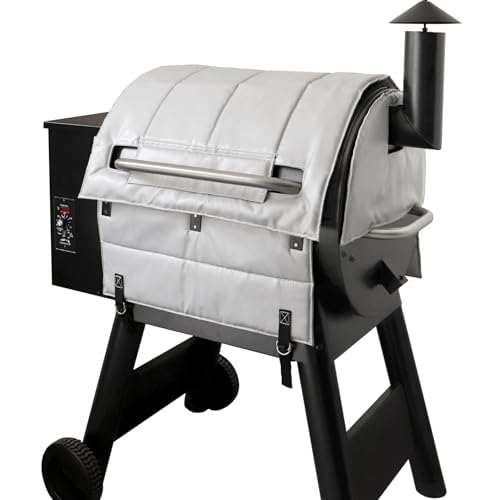
Grill Insulated Blanket for Traeger Pro 22 — Best Fitted Blanket for Traeger Owners
The last accessory is the tailored one. This insulated blanket is made for specific Traeger pellet grills — the Pro 22 and Pro 575, the Ironwood 650 and the Lil’ Tex Elite are named in its title — and it is offered as a replacement for Traeger’s own BAC626 insulation part. That positioning tells the experienced pellet owner everything: Traeger itself sells insulation for these grills because pellet grills in cold climates burn noticeably more fuel and hold temperature less evenly, and this blanket is the aftermarket answer shaped to the same lids, with the same cutouts and contours the factory part observes.
A fitted blanket’s virtues are the flat blankets’ vices inverted. There is nothing to trim, nothing to improvise: the jacket follows the lid’s shape, leaves the chimney and handle their room, and goes on and off in moments, which matters more than it sounds — an insulation layer that takes ten fussy minutes to arrange will be left in the garage in February, while one that drops on in seconds gets used every cook. For the Traeger owner, winter pellet consumption is the measurable stake: a pellet grill holding temperature against a cold wind feeds its auger constantly, and the blanket’s retained heat is paid back in pellets unburned across every long cook of the season.
Its limit is written in its title: it fits the named Traegers and no others, and owners of different pellet grills should take the PAWBOSE route instead. It is also, to keep this guide’s grammar strict, an accessory — it will make a Pro 22 a winter-competent smoker, but the smoker is the Traeger you already own. Within that honest brief, it is the most finished cold-weather product in this guide.
- Type: fitted insulation blanket accessory — not a smoker
- Fits: Traeger Pro 22, Pro 575, Ironwood 650, Lil’ Tex Elite
- Role: replacement for Traeger BAC626 insulation part
- Material: not given in the listing
- Dimensions: not stated in the listing
- Design: tailored to the named lids
Strengths
- Model-exact fit with no trimming or improvisation.
- On and off in moments, so it actually gets used all winter.
- Matches the factory insulation part’s role for these grills.
Trade-offs
- Fits only the Traeger models named in the title.
- No material specification is published in the title.
- Useless to owners of other brands’ pellet grills.
Best for: owners of the named Traeger grills cooking through winter. Not suited for: any other brand’s owners, or anyone shopping for a smoker itself.
How Do the Six Cold-Weather Picks Compare Side by Side?
| Pick | What it is | Fit or format | Material evidence |
|---|---|---|---|
| SmokinTex Pitmaster High-Capacity Electric Smoker | A complete smoker | Stainless cabinet on locking wheels | Stainless steel construction |
| Smokehouse Wrap Around Smoker Insulation Blanket | Blanket accessory | Wrap-around, Big and Little Chief | Not stated |
| MorningRo Electric Smoker Insulation Blanket 2-Pack | Blanket accessory, 2 sheets | 63 x 25 in each, cut to size | Silver foil bubble |
| PAWBOSE Grill Insulation Blanket | Blanket accessory | 35 x 40 in, trim-to-fit | Carbon felt and aluminium foil |
| 30 x 40in Grill Thermal Insulated Blanket | Blanket accessory | 30 x 40 in, multi-use | Carbon felt |
| Grill Insulated Blanket for Traeger Pro 22 | Blanket accessory | Fitted to named Traeger models | Not stated |
Why Does Cold Weather Defeat an Uninsulated Smoker?
Because a smoker is a heated box in a cold room, and the room always wins eventually. Heat leaves through the walls at a rate set by the temperature difference across them; double the difference — a 225°F cook on a 25°F night — and the walls pass roughly twice the heat of a mild evening, which the fuel source must replace continuously just to hold the line. Wind compounds the theft by stripping the warm boundary layer from the exterior, which is why a breezy 35°F afternoon can cook worse than a still 20°F one. Thin walls and broad lids maximise the loss, which is why small electrics sag and pellet grills over-consume in winter. Insulation, whether built into a cabinet like the SmokinTex’s class or wrapped on as a blanket, attacks the single variable that matters: the wall’s willingness to pass heat. Slow the wall, and the same fuel that failed in December holds temperature like it is October.
How Do You Fit a Blanket Without Suffocating the Smoker?
Insulation goes on the outside of the cooking chamber, and the smoker’s breathing stays sacred. Every smoker moves air: pellet grills draw combustion air and exhaust through their chimney, electrics vent smoke and moisture, and a blanket that seals an intake or caps an exhaust will ruin the cook and can damage the machine. Fit the blanket to the chamber’s walls and lid, keep every vent, stack and intake visibly clear, and check the maker’s placement guidance for your specific product before the first cook rather than after a strange one. Leave the controller, the hopper’s moving parts and any door you need during the cook accessible — a blanket that must be removed to add chips will be removed and not replaced at hour three. After fitting, run a short supervised cook and watch the temperature behaviour: the blanket should make the machine steadier and thriftier, and any new instability is a fitting problem to solve on the ground, not a mystery to accept.
What Else Helps a Winter Cook Besides Insulation?
Shelter, fullness and patience. A windbreak that respects the maker’s clearances — a wall’s lee, a fence corner — is worth degrees no fuel can buy, and it protects flame-based machines most of all. A full smoker holds its climate better than a nearly empty one, because the food’s thermal mass is insulation from the inside; winter is the season to smoke the neighbours’ ribs alongside yours. Preheat longer than summer habits suggest, open the door with a plan and a timer’s discipline, and keep the finished food’s holding arrangement ready so the cook’s end is brisk. For pellet owners, dry pellets and a hopper kept out of the damp preserve the fuel’s energy; for electric owners, a sound outdoor outlet and a dry connection keep the element honest. None of these replaces insulation; all of them multiply it.
How Do You Measure Your Smoker for a Generic Blanket?
Measure the chamber you intend to cover, not the machine’s overall silhouette. The blanket’s job is the cooking box or the lid, so take the lid’s length and width for a pellet grill, or the cabinet’s height and girth for an electric box, and compare them against the sheet’s stated dimensions — 35 x 40 inches for the PAWBOSE, 30 x 40 for the unbranded carbon felt, 63 x 25 per sheet for the MorningRo pair. Allow for the wrap’s path around corners and for fastening overlap; a sheet that exactly equals the girth will not close. Note what must stay exposed — chimney, vents, handles, controller, hopper lid — and sketch the blanket’s footprint around them before cutting anything, because carbon felt and foil bubble both forgive a second measurement and neither forgives a first cut in the wrong place. Owners of the named Traegers and the Chief family can skip this exercise entirely; the fitted and wrap products exist precisely to spare it.
How Does a Wrapped Pellet Grill Cook Differently in January?
The difference announces itself in the first hour. An unwrapped pellet grill on a cold, windy day cycles its auger almost continuously, chasing a temperature that leaks as fast as the fire replaces it, and the cook watches the pellet level fall with a landlord’s anxiety. Wrap the lid, and the same grill settles: the controller’s corrections shrink, the temperature trace flattens, and the hopper’s contents start lasting the way they did in October. The food notices too — a steadier chamber means bark that sets evenly and a stall that behaves like the textbook’s rather than the weather’s. The cook’s duties change in one respect: vigilance about the retained heat at the end, because a well-wrapped grill cools slowly, and food left inside while the hosts gather will keep cooking in the warmth the blanket so helpfully saved. Winter pellet cooking with a blanket is not a different technique; it is the summer technique, restored.
How Should You Store Insulation Blankets Between Seasons?
Clean, dry and flat or loosely rolled is the whole prescription, and each word earns its place. Clean, because a blanket stored with grease and smoke residue on its faces carries last winter’s flavours and attracts the garage’s tenants. Dry, because foil bubble and felt alike mildew in a damp fold and because a wet blanket insulates poorly on its first cold day of the new season. Flat or loosely rolled, because hard creases crack foil laminates and compress felt’s loft where the fold sat all summer. Store the blanket with the smoker’s other seasonal kit — the cover, the winter gloves, the spare probe — so October’s first cold snap finds everything in one place. A blanket cared for this way serves for years; the materials are durable, and it is storage, far more than use, that ages them.
Why Do the Little Chief Smokers Need Help More than Most?
Because their design is a summer poem that winter reads harshly. The Chief family of electric smokers are simple aluminium boxes with modest elements, beloved for fish, jerky and cheese-adjacent work precisely because they run cool and gentle. Every virtue in that sentence is a winter liability: aluminium conducts heat away eagerly, the box is thin, the element’s output is sized for gentleness, and the products they smoke — a batch of salmon, a load of jerky — are exactly the long, low cooks that give cold air the most hours to steal from. It is no accident that two of this guide’s five blankets address the Chief family by name, nor that a whole folklore of improvised Chief insulation — boxes, blankets, garage corners — predates the commercial wraps. The Smokehouse wrap and the MorningRo sheets simply professionalise what Chief owners in cold country have always done, and a new Chief owner in a northern state should budget for one of them as part of the smoker’s real cost.
Should You Insulate a Charcoal Smoker, and How?
Charcoal is the fuel this guide’s blanket selection serves least directly, and the reasons are instructive. A charcoal fire breathes through vents at both ends of its cook, its temperatures run higher at the firebox than an electric’s walls ever see, and its cook is already managing airflow as the primary control — wrapping such a machine risks interfering with the breathing that is its technique. The carbon-felt blankets here, with their welding heritage, are the only ones whose material belongs anywhere near charcoal heat, and even they belong on a chamber’s exterior with vents scrupulously clear, under the maker’s guidance. Most charcoal owners solve winter differently: with wind shelter, with the kamado’s insulated walls if they own one, or with the bargain offset’s philosophy of simply feeding the fire more. This guide’s honest counsel is that the blanket market is built for electric and pellet machines, and charcoal cooks should spend their winter money on shelter and fuel first.
How Can You Tell Whether Your Smoker Needs Insulation?
Diagnose before you buy, with three observations any owner can make on the next cold cook. First, watch the fuel: an electric element that never cycles off, a pellet auger that feeds almost continuously, a burner that cannot be turned down without losing temperature — all are signatures of a box losing heat as fast as its source replaces it. Second, watch the spread: if the top rack and the door side cook noticeably slower than the middle, the walls are taxing the edges of your food. Third, watch the weather’s vote: if a windy evening moves your cook times more than the menu does, the box is negotiating with the outdoors on every cook. A smoker failing one of these tests mildly wants shelter and scheduling; a smoker failing all three, in a household that cooks through winter, is asking for the blanket — or, if it is due for replacement anyway, for a machine like the Pitmaster whose construction answers the diagnosis permanently. The blanket sellers will not perform this diagnosis for you, which is why this guide insists on it.
What Does a Winter Holiday Cook Look Like, Start to Finish?
Take the December ham, the cold-season cook this guide quietly revolves around. The day begins with the smoker sheltered and, if it wears one, blanketed before preheat — insulation fitted cold, so the whole climb to temperature happens inside the wrap’s protection rather than leaking away first. Preheat runs long, and the cook treats the cabinet’s steadiness, once reached, as the true starting gun. The ham goes in with its probe set, the door closes, and the winter discipline takes over: checks by probe and by clock rather than by curiosity, the blanket left undisturbed, the cook’s visits brief and purposeful. The wrapped machine holds its number through the afternoon’s falling temperature in a way its summer self never needed to, and the fuel — pellets, chips, electricity — is spent on the ham rather than on the weather. At the end, the food comes out promptly, because the insulated box will keep cooking it in retained heat while the family gathers. The ham arrives at the table as evidence that winter was a setting, not an obstacle — which is the entire promise of every product in this guide, kept.
How Do You Choose Between Wrap, Cut-to-Size and Fitted Blankets?
By how standard your smoker is and how much fitting work you enjoy. The fitted jacket — the Traeger blanket here — is the zero-effort answer for the exact models it names, and the wrong answer for everything else; if your grill is on its list, the decision is already made. The wrap — the Smokehouse — is the ready-made answer for its family, trading the jacket’s tailored closures for a shape designed around the Chief boxes. The cut-to-size and trim-to-fit sheets — MorningRo and PAWBOSE — are the universal answers, priced in your own measuring and cutting, and they are the only route for the market’s long tail of machines no one tailors for. The unbranded carbon-felt blanket stands slightly apart, chosen when the mat’s life beyond the smoker matters as much as its winter duty. A useful tiebreaker is frequency: a household smoking weekly all winter will amortise a fitted jacket’s convenience by February, while the twice-a-winter cook is rationally served by a trimmed sheet. All four routes deliver the same physics; they differ in labour, finish and fit, and those are honest grounds on which to choose.
What Mistakes Do Buyers Make Shopping for Cold Weather?
The first is the category error this guide opened with: ordering a blanket when the household needed a smoker, or buying a new smoker when a blanket would have rescued the old one. The second is assuming a universal blanket fits universally — the fitted Traeger jacket and the Chief wraps exist because shapes differ, and a buyer should measure their machine against any generic sheet’s stated dimensions before ordering. Third, owners fit insulation over vents and intakes and then blame the blanket for a smoker that suddenly burns dirty or swings. Fourth, shoppers chase temperature ratings that titles do not state; the honest comparisons are material, size and fit, and this guide has made them on exactly those grounds. Fifth, winter cooks forget that insulation works on the schedule too — a wrapped smoker preheats into a steadier cook, but it also holds heat after shutdown, so finished food should be moved out promptly rather than left to overcook in the retained warmth. Finally, buyers insulate the smoker and ignore the cook: warm layers, a windbreak for the human, and a headlamp for the dark afternoon are part of the same purchase, spiritually if not financially.
Final Recommendation
Decide which of the two cold-weather problems is yours, and the guide resolves itself. If you are choosing the smoker itself for a cold climate, choose the SmokinTex Pitmaster High-Capacity Electric Smoker and let stainless construction and electric control carry the season. If your Traeger is the machine drinking pellets all winter, the Grill Insulated Blanket for Traeger Pro 22 is the finished, fitted answer; if your pellet grill wears another badge, take the PAWBOSE Grill Insulation Blanket and trim it to your lid. Chief owners should wrap with the Smokehouse or cut the MorningRo sheets to size, and the household that loves a multi-tool will keep the carbon-felt blanket busy all year. Wrap the box, shelter the cook, and January becomes a smoking month like any other — which, for those of us who plan holidays around brisket, is the whole point of owning any of it.
Frequently Asked Questions
Is an insulation blanket a substitute for buying an insulated smoker?
No, and the difference matters. A blanket improves the smoker you have — sometimes dramatically — by slowing its heat loss. An insulated smoker builds that resistance into its walls, along with the seals, door and controls designed around it. Owners happy with their machine’s size and fuel should blanket it; shoppers choosing a machine for a cold climate should weigh built-in construction first. There is also a middle truth worth stating: a good blanket on a good smoker can outperform a mediocre insulated smoker, because insulation is a system of walls, seals and fit, and the blanket upgrades two of the three on a machine whose seals were already sound.
Will a blanket really reduce pellet consumption in winter?
By the logic of heat loss, yes: a pellet grill holds temperature by burning pellets, so heat retained by a blanket is fuel the auger never has to replace. The saving is largest on long cooks in cold, windy weather — exactly the cooks where uninsulated pellet grills over-consume most visibly. This guide claims the mechanism, not a percentage, because no title here publishes one. Owners who track their pellet use can measure their own figure across two comparable cooks, wrapped and unwrapped, and most find the difference plain enough in the hopper that no laboratory is required to believe it.
Can I leave an insulation blanket on all year?
You can, but summer usually argues against it: insulation that helps in January slows cooling and preheating adjustments in July, and a blanket left on through the warm season ages in the sun for no benefit. Most owners treat blankets as seasonal equipment, fitted when the cold arrives and stored clean and dry when it leaves. The exception is the shaded, cool-climate household whose summer is another region’s spring; there, a blanket can live on the smoker most of the year, and the owner’s judgement about their own weather outranks any general rule in this guide.
Which blanket fits a Big Chief smoker?
Two picks in this guide address the Chief family directly: the Smokehouse wrap-around, purpose-made for the two Chief sizes, and the MorningRo two-pack of cut-to-size sheets, which names compatibility with both of those long-running electric smokers from Smokehouse Products. Choose the wrap for a ready-made fit and the sheets for an exact, do-it-yourself one. Owners of the smaller Little Chief in particular should not skip insulation as an afterthought: its gentle element and thin aluminium box are the most weather-exposed combination in this entire batch of guides, and its classic cold-smoked and low-smoked products are the ones with the longest hours to protect.
Are carbon felt blankets safe near a hot smoker?
Carbon felt is a high-temperature textile developed for welding and heat-shield work, which is why both carbon-felt picks here are marketed around hot equipment. Safe use still means following the maker’s placement guidance: on the chamber’s exterior as directed, clear of exhausts, intakes and any open flame path, and never as a substitute for the clearances the smoker’s own manual requires. When in doubt, the conservative sequence is a short supervised cook at moderate temperature first, watching how the blanket and the machine behave together, before trusting the pairing to a long winter brisket.
What temperature can these blankets withstand?
The titles in this guide do not publish temperature-endurance ratings for the blankets, so this guide does not invent any. Judge the products by their stated materials and purposes — carbon felt’s welding heritage, foil bubble’s insulation role, the fitted jacket’s factory-part equivalence — and consult the full listing and the maker for any figure your application requires.
Can I make my own insulation instead of buying a blanket?
Owners have improvised for decades — the Chief folklore in this guide is proof — and a handy household can certainly wrap a smoker in suitable material. The commercial products earn their place on fit, fastening and materials chosen for heat: foil bubble that cuts cleanly, carbon felt that tolerates the neighbourhood, a jacket tailored to a lid. Improvisation must respect the same rules — exterior only, vents clear, nothing combustible near heat — and for many owners the modest cost of the made product buys back the afternoon the homemade one would consume. There is also resale and warranty common sense to weigh: a maker’s own accessory, like the wrap made for the Chief line or the part matched to the Traeger’s BAC626, carries none of the guesswork about whether the pairing was ever intended.
Does wind or cold matter more to a smoker?
Wind, in most real gardens. Still cold lowers the temperature around the box uniformly, and a thermostat or a fire simply works harder against a steady tax. Wind strips heat unevenly, worries flames, and changes its mind by the minute, which is why the same smoker can hold beautifully on a still freezing night and struggle on a gusty mild one. Insulation helps against both; shelter is the wind-specific half of the cure. This is also why blanket fit matters in a gale: a wrap or jacket that stays where it was fitted, rather than flapping at a corner and pumping cold air underneath, keeps its promise when the weather is doing its worst.
When should I put the blanket on — before or after preheating?
Before, in almost every case. Fitting the insulation while the smoker is cold lets the whole preheat happen behind the blanket’s protection, so the fuel you spend climbing to temperature is spent once rather than twice. It is also simply safer and easier to handle wraps, sheets and jackets around a cold machine, adjusting fit and checking vents without hot surfaces negotiating back. The one adjustment to make after the cook begins is a quick visual pass once the smoker is at temperature, confirming nothing has shifted against a vent or settled onto a surface it should not touch. Make that pass with gloves on, even in January, because a blanket doing its job sits over a properly hot box.
Will insulation help in mild weather too?
Modestly, yes — steadiness is not a winter-only virtue. A wrapped smoker in a breezy spring still swings less and sips less fuel than its unwrapped self, and cooks who value a flat temperature trace keep their blankets on well past the last frost. The benefit simply shrinks as the weather’s tax shrinks, which is why most owners retire the blanket for the warm months rather than because it stops working. Shoulder seasons — the windy weeks of March and November — are arguably where a blanket earns its most surprising keep, turning marginal smoking days into genuinely good ones without any change whatsoever to the machine itself or to the cook’s own familiar routine at any point in the year, spring through to winter.
Related Guides
Readers arriving from the alarm-clock side of the household may enjoy the contrast of the Best Bedroom Analog Alarm Clocks, while summer planning lives in our roundup of the Best Turkish Cotton Beach Towels. For the cold-season cook’s feet between patio trips, the companion guide to the Best Leather Slippers completes the picture.


