What's inside
- Key Takeaways
- Quick Picks
- How Did We Choose These Propane Smokers?
- How Do the Six Propane Smokers Compare Side by Side?
- How Do You Manage a Propane Bottle Through a Long Cook?
- Why Does Wind Matter More to a Gas Smoker Than to an Electric One?
- How Do You Stay Safe Around a Gas Smoker?
- How Do You Run a First Cook on a Propane Cabinet?
- Which Foods Belong on Which Rack in a Vertical Cabinet?
- How Do You Know the Cabinet Temperature Is Telling the Truth?
- How Should You Maintain a Burner and Chip Box?
- Should You Use Chips or Chunks in a Gas Cabinet?
- How Do You Plan a Propane Smoke for Guests?
- What Changes When You Smoke in Cold Weather on Gas?
- How Do You Choose Between a 36-Inch and a 40-Inch Cabinet?
- Which Accessories Does a Propane Smoker Genuinely Need?
- How Does a Vertical Propane Smoker Actually Cook?
- How Do You Store a Propane Smoker Between Seasons?
- What Mistakes Do Buyers Make with Propane Smokers?
- Final Recommendation
- Frequently Asked Questions
- Related Guides
As an Amazon Associate I earn from qualifying purchases. This post may contain affiliate links at no extra cost to you.
cottageverdict.com is reader-supported. When you buy through links on our site, we may earn an affiliate commission.
Where to buy: the six cabinets below are sold through Amazon, and each pick’s name links to its listing in the Quick Picks table, the detailed review headings, the comparison table and the check-price buttons, so you can verify the current configuration before ordering. This guide to the best propane gas smokers is written for the cook who wants real fire without a power cord. A propane smoker burns bottled gas through a burner at the cabinet’s base, heating a wood chip box that smoulders above it, and that simple arrangement buys three things electric cabinets cannot offer: fast heat recovery after the door opens, complete independence from outdoor outlets, and the ability to smoke in a field, at a campsite or at the far end of a garden where no extension lead reaches.
All six picks are vertical cabinets, the shape that suits propane best, because heat and smoke rise naturally through stacked racks and the burner sits where rising heat wants to start. They range from a spare, established 36-inch Dyna-Glo to a 983 square inch Pit Boss with a stated temperature range, and they divide by control philosophy: one thermostat-regulated Masterbuilt that manages its own flame, several manually adjusted burners that ask the cook to be the thermostat, and a pair of value cabinets whose titles emphasise covers, racks and shelves rather than electronics. There is not a microchip worth mentioning in most of this guide, and for many buyers that is the attraction.
Choosing among them comes down to how much of the temperature work you want to do yourself, how much food you load at once, and whether a cover is included for a cabinet that will live outdoors. The reviews below argue each case from the listing titles — cooking area where stated, rack counts, control type, chip arrangement, included accessories — and the sections after them cover bottle management, wind, safety and the habits that make gas smoking repeatable rather than approximate.
Key Takeaways
- Every pick is a vertical propane cabinet; none needs an electrical outlet, so placement follows the gas bottle, not the cord.
- The largest stated cooking space is the Pit Boss 3-Series at 983 square inches across four racks, with a published range of 100°F to 300°F.
- The Masterbuilt ThermoTemp is the control outlier: its title names analog temperature control built around a thermostat that manages the burner for you.
- Two value cabinets — the three-shelf model with cover and the Maison Backyards — include covers in their listings, which matters for outdoor storage.
- Rack counts are stated for the Pit Boss (four racks), the Maison Backyards (four chrome-coated racks) and the two three-shelf cabinets.
- Propane’s core advantage is heat recovery: a gas burner restores cabinet temperature far faster than an electric element after the door opens.
Quick Picks
| Pick | Badge | Why it earns its place |
|---|---|---|
| Masterbuilt 40-inch ThermoTemp Propane Smoker | Best Thermostat-Controlled Propane Smoker | A 960 square inch cabinet whose ThermoTemp system regulates the burner to hold the temperature you set. |
| Dyna-Glo 36-inch Vertical LP Gas Smoker | Best Established Vertical Cabinet | The long-running 36-inch vertical LP cabinet in black powder coat, a straightforward burner-and-chips design. |
| Pit Boss 3-Series Propane Gas Vertical Smoker | Largest Cooking Space | 983 square inches on four racks with an HVR controller, a wood chip tray and a stated 100°F to 300°F range. |
| Propane Smoker with Cover Vertical 3-Shelf | Best Cover Included | A heavy-duty vertical cabinet with three removable racks and a cover in the box for outdoor living. |
| Maison Backyards 4-Rack Vertical Propane Smoker | Best Rack-and-Tray Setup | Four chrome-coated racks, adjustable heat control, a drip tray and a weather-resistant cover. |
| Propane Smoker Vertical Three Removable Shelves | Best Simple Three-Shelf Cabinet | Three removable shelves and a fitted thermometer in a plain black vertical cabinet for backyard smoking. |
How Did We Choose These Propane Smokers?
We restricted the guide to vertical LP cabinets because that is the propane format with a coherent comparison: same heat path, same chip arrangement, same style of door and racks. Drum and offset propane designs exist, but they cook differently enough that ranking them against cabinets would mislead. Within the vertical field we then looked for a spread of control types, because control is the live question in gas smoking. A manual burner makes the cook the thermostat — cheap, repairable, and demanding. A thermostat-regulated burner like Masterbuilt’s ThermoTemp attempts to give gas the set-and-hold behaviour people associate with electric cabinets, and whether that matters to you is the first decision in this guide.
Capacity was judged by stated cooking area where a title provides it and by rack count where it does not. The Pit Boss publishes 983 square inches and the big Masterbuilt 960, figures that put both in the entertaining class. The Dyna-Glo’s title gives its 36-inch height and finish but no area, and the two value cabinets give shelf counts instead; we report those facts as they stand rather than converting shelf counts into invented areas. Included equipment was weighed honestly: a cover sounds like a footnote until a cabinet has spent one winter outdoors, at which point it becomes the difference between a smoker and a rust project. Chip delivery — tray, box or pan — was noted from titles where stated, since chip access decides how smoky refills are.
Finally, we favoured machines whose titles describe a complete smoking system: burner, chip provision, water or drip management where named, racks, and a way to read temperature. The unnamed cabinets here are judged by exactly the same standard as the famous ones, on exactly the evidence available, which is the only fair way to write about them.

Masterbuilt 40-inch ThermoTemp Propane Smoker — Best Thermostat-Controlled Propane Smoker
The ThermoTemp, model MB20051316, exists to answer propane’s oldest criticism. A manual gas smoker holds temperature the way a campfire holds a conversation — approximately, and only while someone pays attention. Masterbuilt’s answer is a thermostat: the title names analog temperature control, and the ThermoTemp concept is that the burner is regulated to hold the dialled temperature rather than burning at a fixed rate while the weather does what it wants. For the cook who loves gas heat but hates babysitting a valve through a breezy afternoon, that is not a detail; it is the entire product.
The cabinet around the system is the large one: 40 inches, 960 cooking square inches, black. That is entertaining capacity, four levels of food between burner and vent, enough for the reunion briskets and the holiday hams. Gas heat brings a working advantage at this size — when you open a big cabinet to load or wrap, a burner restores temperature with an urgency an electric element cannot match, so the schedule survives your interventions. The analog control presentation suits the machine’s philosophy: a dial and a gauge rather than an app, legible at a glance from across the patio, with nothing to pair, charge or update.
What the title does not specify, we will not invent: rack count is not given in the listing, and neither is a probe or window. The ThermoTemp’s buyer is purchasing regulated gas heat in a big cabinet, and should judge it on that. If your smoking life involves long cooks in changeable weather, and you have watched a manual burner’s temperature wander with every gust, this is the propane smoker designed with your frustration in mind.
- Format: vertical propane cabinet, 40-inch, black
- Cooking area: 960 square inches
- Control: analog temperature control, ThermoTemp thermostat regulation
- Model: MB20051316
- Rack count: not stated in the listing
- Meat probe: not given in the listing
Strengths
- Thermostat regulation holds a set temperature without constant valve work.
- 960 square inches handles crowd-scale cooks in one load.
- Gas heat recovers quickly after loading, wrapping or basting.
Trade-offs
- The large cabinet needs storage room and a level outdoor station.
- No rack count is published in the title, so check the listing layout.
- Thermostat systems add a component a plain burner does not have.
Best for: gas loyalists who cook long and often in changeable weather. Not suited for: cooks who want the smallest, simplest burner cabinet available.
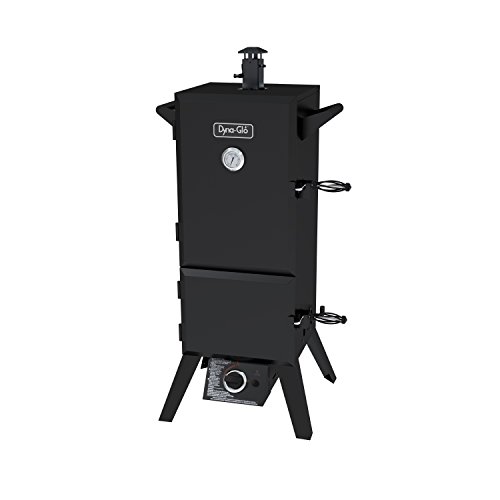
Dyna-Glo 36-inch Vertical LP Gas Smoker — Best Established Vertical Cabinet
Some product titles read like a specification sheet; the Dyna-Glo DGY784BDP’s title reads like a name and an address. Thirty-six inch vertical LP gas smoker, black powder coat. That spareness is itself information: this is a long-established cabinet design that sells on familiarity, a tall box with a burner at the bottom, a chip box above it, racks up the middle and a door you open with intent. Generations of backyard cooks learned gas smoking on cabinets of exactly this pattern, and the pattern persists because it works — heat rises, smoke follows, food cooks.
Powder coat is the detail the title does offer, and it is the right detail for a steel box that lives outside. A powder-coated finish resists the rust creep that eats painted cabinets from every scratch and seam, and on a 36-inch cabinet — big enough for family smoking, small enough to wheel into a garage corner — longevity of the shell is most of the value proposition. A vertical LP cabinet has almost nothing to wear out besides its burner and its finish, and a buyer choosing this class of machine is choosing a decade-scale appliance rather than a gadget.
The honest limitations follow from the title’s silence. No cooking area is published there, no rack count, no control system beyond what a manual LP burner implies. The cook is the thermostat on a machine like this, adjusting the valve against the door thermometer and the weather, and many experienced smokers prefer exactly that arrangement because every part of it can be understood, cleaned and replaced with hand tools. Choose the Dyna-Glo if you want the established pattern from an established maker and you are comfortable running the fire yourself.
- Format: vertical LP gas cabinet, 36-inch
- Finish: black powder coat
- Model: DGY784BDP
- Cooking area: none stated in the listing
- Rack count: not stated in the listing
- Control type: not given in the listing
Strengths
- An established vertical design with a long market history.
- Powder coat finish suits permanent outdoor storage.
- Simple burner-and-chips mechanics are easy to understand and maintain.
Trade-offs
- The title publishes no capacity figure, so verify dimensions in the listing.
- Manual control means the cook manages temperature against the weather.
- No included accessories are named in the title.
Best for: traditionalists who want a proven cabinet and enjoy running the burner themselves. Not suited for: buyers who want published capacities and automated control.

Pit Boss 3-Series Propane Gas Vertical Smoker — Largest Cooking Space
The propane Pit Boss 3-Series publishes the numbers its electric sibling publishes, and they lead this guide: 983 square inches of cooking space on four racks, the largest stated area here, with a temperature range given outright as 100°F to 300°F. That low floor deserves attention in a gas cabinet, because holding genuinely low heat on a burner is harder than holding it on an element — burners want to burn. A stated range beginning at 100°F signals a control system, here named as the HVR controller, designed to sip gas at low settings for jerky, fish and warming work, then climb to 300°F for poultry and finishing.
The wood chip tray keeps smoke production in the same cabinet conversation as the electric model, and four racks at this total area means each level is genuinely wide — whole briskets lie flat, ribs need no trimming to fit, and a dozen chicken halves distribute without touching. Touching food smokes unevenly; spacious food, evenly. For the cook whose smoking is measured in events — the team party, the church picnic, the freezer-filling autumn weekend — this is the cabinet in the guide sized to the habit.
Its trade-offs are the trade-offs of size and of a stated specification: the cabinet is a large object to house, and a controller-managed burner is a more complex system than a plain valve, with more to keep clean and correctly assembled. No cover is named in the title, so outdoor storage wants one sourced separately. But for the buyer who comparison-shops by published figures, the Pit Boss propane makes the easiest case in the guide to read: biggest area, stated range, four racks, named controller.
- Format: vertical propane cabinet, black
- Cooking area: 983 square inches, 4 racks
- Temperature range: 100°F to 300°F per the listing title
- Control: HVR controller
- Smoke source: wood chip tray
- Cover: not stated in the listing
Strengths
- The largest stated cooking space in this guide, across four racks.
- A published 100°F floor suits low-temperature projects on gas.
- Named controller and tray make the specification easy to verify.
Trade-offs
- Its size demands a dedicated outdoor station and storage plan.
- No cover is named, so budget for one if it lives outside.
- Controller-managed burning is more complex than a plain valve.
Best for: event-scale cooks who want gas heat and published numbers. Not suited for: balcony smokers or minimalists with a two-rib habit.

Propane Smoker with Cover Vertical 3-Shelf — Best Cover Included
This unnamed cabinet leads its title with the two words experienced outdoor cooks look for first: with cover. A vertical propane smoker described as heavy duty, with three removable smoking racks and a cover included, in black. The proposition is completeness at the value end of the market — a machine that arrives with its weather protection in the same box, so it can take up outdoor residence immediately instead of beginning its life under a tarp while its owner remembers to order protection separately.
Three removable racks define its cooking style. Removability is the working feature: shelves that lift out let you reconfigure the cabinet around the food — two racks removed for a tall turkey, all three in for jerky and wings — and they come to the sink for cleaning instead of being scrubbed in place through a door. Heavy duty is the title’s construction claim, and on a value cabinet the honest reading is that the maker is competing on steel and sturdiness rather than on electronics, of which this title names none. The cook runs the burner; the cabinet provides the box, the shelves and the shelter.
Judge this pick by the life it will lead. If your smoker will stand outside through seasons, the included cover is not a bonus but a budget line already paid. If you want published capacities and control systems, the titles above this one speak that language and this one does not — its cooking area is not given in the listing, and neither is a temperature range. What it offers is the complete, simple, sheltered cabinet, and for a first propane smoker bought to learn on, that completeness is a rational place to start.
- Format: vertical propane cabinet, black
- Racks: 3 removable smoking racks
- Cover: included per the listing title
- Construction: described as heavy duty in the title
- Cooking area: not given in the listing
- Temperature range: none stated in the listing
Strengths
- The included cover protects an outdoor-stored cabinet from day one.
- Removable racks reconfigure around tall or bulky foods.
- A simple, electronics-free design keeps the mechanics transparent.
Trade-offs
- No capacity or temperature figures are published in the title.
- Three racks cap the load below the four-rack cabinets here.
- An unbranded listing offers less model history to research.
Best for: first-time propane buyers whose smoker will live outdoors year-round. Not suited for: specification shoppers who want published areas and ranges.

Maison Backyards 4-Rack Vertical Propane Smoker — Best Rack-and-Tray Setup
Maison Backyards writes the most domestic title in the guide, and its details are chosen like a host’s rather than an engineer’s: four chrome-coated racks, adjustable heat control, propane power, a drip tray, and a weather-resistant cover, aimed squarely at meat, ribs and fish. Read as a list of the things that annoy smoker owners, it answers them in order — rack capacity, heat management, dripping grease, and weather. The drip tray is the connoisseur’s detail. In a vertical cabinet, everything above drips on everything below, which is sometimes a feature (beans under brisket) and often a mess; a dedicated tray gives the cook control over where the fat ends up and makes the post-cook cleanup a tray-washing instead of a cabinet-scraping.
Four chrome-coated racks match the rack count of the Pit Boss, and chrome coating is the surface that releases food and cleans willingly — the same practical argument as in the electric guide, worth more here because gas cabinets run hotter at the base and bake drippings on harder. Adjustable heat control is stated plainly, without a published range; the cook sets the flame to the cook, which is the traditional gas arrangement, and the cover being weather-resistant rather than merely included suggests it is meant to stay on the cabinet between cooks outdoors.
The Maison is the middle path of this guide: more appointed than the plain three-shelf cabinets, less specification-driven than the Pit Boss, less automated than the ThermoTemp. Its cooking area is not stated in the listing, so a buyer comparing pure capacity should verify dimensions, but a buyer comparing completeness of kit — racks, tray, cover, control — will find this title answers more of the checklist than any rival at its end of the market.
- Format: vertical propane cabinet
- Racks: 4 chrome-coated racks
- Control: adjustable heat control per the listing title
- Drip management: drip tray included
- Cover: weather-resistant cover included
- Cooking area: not stated in the listing
Strengths
- Four coated racks plus a drip tray form a complete cooking kit.
- The weather-resistant cover suits permanent outdoor placement.
- Adjustable heat keeps control simple and direct.
Trade-offs
- No cooking area is published in the title to compare directly.
- No temperature range is stated for the adjustable control.
- A newer brand name carries a shorter public track record.
Best for: hosts who value a complete kit — racks, tray and cover — over raw specifications. Not suited for: buyers who rank cabinets purely by published square inches.

Propane Smoker Vertical Three Removable Shelves — Best Simple Three-Shelf Cabinet
The plainest title in the guide belongs to a cabinet that knows its job: a vertical propane smoker with three removable shelves and a thermometer, for BBQ and backyards, in black. The thermometer earns its mention. On a manually controlled gas cabinet, the door thermometer is the instrument panel — the single gauge by which the cook trims the burner — and a cabinet that names it in the title understands its own method. Three removable shelves give the same reconfiguration freedom as its cover-included rival above: shelves out for a tall bird, shelves in for a full load of ribs, shelves to the sink afterwards.
Comparisons within the value end are instructive. Against the other three-shelf cabinet, this one names a thermometer and no cover; the other names a cover and no thermometer. Neither is an oversight so much as a different guess about what the buyer already owns — many households have a cover from a previous grill, while a thermometer cannot be improvised. Against the Maison, this cabinet trades the fourth rack, the drip tray and the cover for simplicity. These are honest trades, legible from the titles, and a buyer can choose among them with open eyes.
What you cannot learn from this title is capacity, range or burner detail, none of which is stated, and a careful buyer will open the listing to check dimensions against the foods they cook. What you can learn is intent: this is the unadorned backyard cabinet, the one bought to smoke dinner rather than to anchor a specification debate, and there is a long tradition of excellent barbecue emerging from exactly such boxes in exactly such backyards.
- Format: vertical propane cabinet, black
- Shelves: three removable shelves
- Temperature reading: thermometer fitted per the listing title
- Cooking area: not given in the listing
- Cover: none stated in the listing
- Drip tray: not stated in the listing
Strengths
- A fitted thermometer supports manual burner control properly.
- Removable shelves adapt the cabinet to tall or bulky loads.
- The unadorned design concentrates the budget on the cabinet itself.
Trade-offs
- No cover is named, so outdoor storage needs one sourced separately.
- Capacity and range figures are absent from the title.
- Three shelves cap simultaneous loads below four-rack models.
Best for: backyard cooks who want the simplest complete cabinet with a thermometer. Not suited for: buyers who need a cover and drip tray in the same box.
How Do the Six Propane Smokers Compare Side by Side?
| Pick | Stated capacity | Control | Racks or shelves | Included extras named |
|---|---|---|---|---|
| Masterbuilt 40-inch ThermoTemp Propane Smoker | 960 sq in | Analog, thermostat-regulated | Not stated | None named |
| Dyna-Glo 36-inch Vertical LP Gas Smoker | Not stated | Manual burner | Not stated | Powder coat finish |
| Pit Boss 3-Series Propane Gas Vertical Smoker | 983 sq in | HVR controller, 100–300°F | 4 racks | Wood chip tray |
| Propane Smoker with Cover Vertical 3-Shelf | Not stated | Manual burner | 3 removable racks | Cover |
| Maison Backyards 4-Rack Vertical Propane Smoker | Not stated | Adjustable heat | 4 chrome-coated racks | Drip tray, weather-resistant cover |
| Propane Smoker Vertical Three Removable Shelves | Not stated | Manual burner, thermometer | 3 removable shelves | Thermometer |
How Do You Manage a Propane Bottle Through a Long Cook?
Gas smoking’s only fuel anxiety is the bottle, and it is manageable with arithmetic and one habit. The habit is the spare: a second filled bottle standing by turns a mid-cook empty from a ruined brisket into a two-minute interruption, and it costs nothing but the deposit you were going to pay eventually. The arithmetic is consumption: a smoker burner sips compared with a grill burner, because it holds low temperatures rather than searing, so a standard bottle lasts through many long cooks — but “many” is not a number you want to test at hour nine of an overnight shoulder. Weigh the bottle, or use the warm-water trick down its side to feel the fuel line, before any cook longer than a few hours. Keep the bottle upright, outdoors, connected with a sound hose you inspect for cracks each season, and store the spare away from the cabinet’s heat. Treated this way, propane is the most forgettable fuel in smoking, which is high praise for a fuel.
Why Does Wind Matter More to a Gas Smoker Than to an Electric One?
A burner is a flame, and a flame in moving air is a negotiation. Wind across a vertical cabinet’s vents steals heat unevenly, cools one side of the box, and can worry a low flame at exactly the settings long smokes use. Electric elements shrug at weather that has a gas cook repositioning the cabinet at midnight. The mitigations are placement and mass: site the smoker in the lee of a wall or fence with the clearances the maker requires, keep the door facing away from the prevailing gusts, and favour a full cabinet over an empty one, because loaded racks and a water pan are thermal ballast that smooth the swings. This is also the honest context for the ThermoTemp’s existence — a thermostat-regulated burner compensates for weather automatically, trimming its own flame against the cooling that wind causes, which is why cooks in exposed, breezy gardens should weight it heavily in their decision.
How Do You Stay Safe Around a Gas Smoker?
Propane safety is a short list practised every time, not a long list read once. Leak-check connections with soapy water when you change a bottle or start a season; bubbles are instructions to stop and refit. Keep the cabinet outdoors and vented, never in a garage or enclosed porch, because a smoker produces smoke and combustion gases for hours at a stretch. Give the burner and chip box room: no storage of the spare bottle, solvents or paper goods under or beside a hot cabinet. Light the burner by the maker’s sequence, and if it does not light, wait and ventilate before trying again rather than repeatedly striking into accumulated gas. At the end of the cook, close the bottle valve first and let the line burn clear, then close the controls. None of this is exotic; it is the same discipline as a gas grill, extended over longer hours, and it becomes automatic within a few cooks.
How Do You Run a First Cook on a Propane Cabinet?
Begin with the maker’s seasoning run: an empty, oiled-interior burn with chips, which cures the box and teaches you the burner’s personality at smoking temperatures. Note how the valve’s positions map to cabinet temperatures on a calm day, because on a manual cabinet those notes are your control system. For the first food cook, pick the forgiving tutor — pork shoulder — set the chip box with a modest load, fill the water pan if your cabinet uses one, and let the cabinet settle at temperature for a full half hour before the meat enters. Gas heat is eager; the settling period is what converts eagerness into steadiness. During the cook, change one variable at a time: trim the burner in small movements and wait fifteen minutes to judge each, because a big cabinet’s temperature responds with a lag, and chasing the gauge with large adjustments is how oscillations are born. Record the day — weather, valve settings, chip timing — in a notebook that lives with the smoker. By the third cook, that notebook is worth more than any single feature in this guide.
Which Foods Belong on Which Rack in a Vertical Cabinet?
A vertical smoker is a small climate with floors. Heat and smoke rise from the burner, so the lower racks run hotter and catch drips from above, while the upper racks cook gentler and cleaner. Arrange the load like a building’s tenants. The food that wants the most heat and can baste its neighbours — a pork shoulder, a brisket — goes low or in the middle, positioned over a tray or pan if you want its drippings caught for beans. Poultry belongs where it cannot drip onto food that will be served without further cooking, which in practice means the lowest level of all, below everything else, a food-safety rule that outranks every flavour argument. Delicate and quick items — fish fillets, sausages near the end of their cook, vegetables, cheese projects at low settings — live upstairs, where the climate is milder and the cook can retrieve them without dismantling the cabinet. Jerky and wings, cooked in quantity, spread across every rack with space between pieces, because crowded pieces steam rather than smoke. When you load with this map in mind, the cabinet’s shape stops being a compromise and becomes the tool it was designed to be.
How Do You Know the Cabinet Temperature Is Telling the Truth?
Door thermometers are honest instruments in a dishonest location: they read the air where they sit, which may be inches from the door and degrees away from the air at the rack where the food cooks. Treat the fitted gauge — like the one named in the three-shelf cabinet’s title — as a trend instrument rather than a laboratory reading. It tells you the cabinet is rising, falling or holding, and for burner management that is most of the job. For the cook itself, verify with a probe: one probe clipped at rack level for air temperature, one in the thickest part of the meat. The first time you run both, expect disagreement between gauge and probe, and from then on you will know your cabinet’s personal offset — the number you add or subtract mentally whenever you glance at the door. Every smoker has such an offset, including the expensive ones, and learning yours is a rite of passage that converts guesswork into craft. Recheck it each season, because gauges age and seals compress.
How Should You Maintain a Burner and Chip Box?
Gas cabinets fail in humble ways, and humble maintenance prevents nearly all of them. The burner’s ports clog with rust scale, grease vapour residue and the occasional insect nest; a soft brush and a visual inspection each season keep the flame’s ring even, and an even ring is what even cabinet heat is made of. The chip box or tray wants its ash emptied and its warping checked — a tray that no longer sits flat smoulders unevenly. Hoses and regulator connections age in sunlight; flex the hose and look for cracking, and replace on suspicion rather than on evidence. Inside the cabinet, the same philosophy as electric applies: racks washed, drip routes kept clear, walls wiped of flaking buildup but left seasoned. Keep the vent moving freely, because a vent gummed half-shut changes the cabinet’s draw and therefore its temperature behaviour. An hour of this attention each spring, and an hour before the big autumn cooks, is the whole programme — one reason propane cabinets remain in service for decades while more electronic tools cycle through owners.
Should You Use Chips or Chunks in a Gas Cabinet?
Gas cabinets are usually fed chips in a box or tray over the burner, and chips suit the fuel: they ignite quickly in the burner’s heat, smoke early, and burn out on a rhythm the cook can plan refills around. Chunks smoulder longer and suit long cooks, but in a small chip box they may not fit, and a chunk that touches the burner directly can flare rather than smoulder. The practical craft is timing. The first chip load does the flavour work that matters most, because meat takes smoke most readily while its surface is cool and moist in the early hours; later loads add diminishing returns. Reload when the smoke thins rather than by the clock, and keep loads modest — the harsh white billow of an overloaded box is as unwelcome over gas as over an element. Species guidance mirrors any smoker: hickory for pork with a restrained hand, fruitwoods for poultry and fish, oak as the all-purpose middle. What changes with gas is only the delivery, not the menu.
How Do You Plan a Propane Smoke for Guests?
Work backwards from the table and pad every estimate. A shoulder that should take eight hours gets started ten hours before serving, because the cabinet will be opened for loading, the weather will do something, and finished meat rests and holds far better than unfinished meat hurries. Gas gives you one scheduling superpower: recovery. When you open the cabinet to wrap, mop or rearrange, the burner restores temperature quickly, so interventions cost minutes rather than the long climbs an electric element needs. Build the menu around the cabinet’s floors — the long cook low and central, quicker items joining upstairs in the final hours, sides that can hold joining last. Fill the bottle check and the spare bottle into the plan the day before, not the morning of. And decide in advance what done looks like for each item in probe temperatures and tenderness, because a house full of guests is the worst environment in which to improvise doneness. The cook who plans this way spends the party on the patio with a drink, which was the point of buying the smoker.
What Changes When You Smoke in Cold Weather on Gas?
Cold air turns a vertical cabinet into a chimney in a wind tunnel: the box loses heat through every wall, the burner works harder, and the bottle’s pressure sags as its contents chill. Gas still outperforms the alternatives here, because the burner has reserve output an element lacks, but the cook changes character. Expect longer preheats, higher consumption, and a cabinet that rewards being full — thermal mass is insulation from the inside. Shelter becomes the main skill: a windbreak that respects clearances transforms a January cook, and the thermostat-regulated ThermoTemp earns renewed respect in these conditions because it compensates continuously rather than at the cook’s frozen-fingered intervals. Keep the spare bottle somewhere merely cold rather than arctic if you can, open the door with a plan rather than curiosity, and add an hour to every estimate you made in July. Winter smoking is not a hardship post; some of the best barbecue of the year happens in it, because a cook who smokes in February is cooking for love.
How Do You Choose Between a 36-Inch and a 40-Inch Cabinet?
The height classes in this guide map to habits. A 36-inch cabinet like the Dyna-Glo is the family instrument: tall enough for stacked racks of ribs and a turkey, compact enough to store against a garage wall and light enough to reposition as the garden changes. A 40-inch cabinet — the Masterbuilt ThermoTemp’s class, with its 960 stated square inches — is the entertaining instrument, and its extra volume only earns its footprint when the loads are genuinely large or genuinely tall: standing rib roasts, multiple briskets, a ham above a turkey. Between the classes, ask what your four largest annual cooks look like. If they are family dinners with guests, the 36-inch class and the four-rack Maison cover them with room to spare. If two of them are events, the big cabinets stop being indulgences. Remember also that a larger cabinet burns more gas to hold temperature when nearly empty, so the cook who mostly smokes one chicken pays a small tax on every modest dinner for capacity used twice a year. Size is a subscription, not a one-time decision.
Which Accessories Does a Propane Smoker Genuinely Need?
Four things, in order. First, a dual-probe thermometer, because cabinet air and meat temperature are the cook’s two vital signs and only one of these six cabinets even names a thermometer in its title. Second, the spare bottle already argued for, with a gauge or the discipline to weigh. Third, a cover for any cabinet that lacks one in its listing — the two value cabinets that include covers understand the assignment — because weather is the main enemy of a steel box’s second decade. Fourth, heat-resistant gloves and a wide spatula-and-tongs kit sized for moving whole shoulders, since the moment of lifting a finished brisket is not the moment to discover your tools are salad tongs. Everything beyond that list — rib racks, hanging hooks, extra chip boxes, a dedicated side table — is legitimate but optional, best bought after your third cook has shown you which specific annoyance it solves. Accessories purchased against a named annoyance get used; accessories purchased against a catalogue get stored.
How Does a Vertical Propane Smoker Actually Cook?
Follow a calorie. The burner at the base burns propane and heats the cabinet air and the chip box above it; the chips smoulder and release smoke into that rising air; the air climbs past the water or drip arrangements, past each rack of food, surrendering heat and depositing smoke compounds as it goes, and exits the top vent cooler and spent. Every design choice in these six cabinets is a comment on that journey. The vent’s openness sets the draw — too closed and smoke stagnates and turns stale on the food, too open and heat escapes faster than the burner should chase it. The water pan, where fitted, humidifies the air and buffers its temperature, because moist air over a shoulder keeps the surface from drying into armour before the interior renders. Rack spacing sets how evenly each floor shares the flow. Even the door seal is a character in the story, since a leaking seal is a second, unplanned vent at the worst location. When a cook disappoints, diagnose it as a journey problem — draw, humidity, spacing, seal — before blaming the meat, because the meat is rarely the variable that changed.
How Do You Store a Propane Smoker Between Seasons?
Put it away clean, dry and disconnected, and it will greet spring like a colleague rather than a project. The last cook of the season ends with a hotter burn-off, racks washed rather than wiped, the chip box emptied of ash, and the drip routes cleared, because stored grease turns rancid and invites tenants. Disconnect the bottle and store it outdoors, upright and shaded, never in the garage beside the cabinet it fed. The cabinet itself goes under its cover — included with two of these picks, an essential purchase for the rest — in the driest spot available, ideally raised slightly so its base stays out of standing water. A sheet of notes in the door, recording the season’s gauge offset, valve habits and the one repair you promised yourself, is the kindness experienced owners do their future selves. Spring then begins with a leak check and a seasoning burn instead of a restoration.
What Mistakes Do Buyers Make with Propane Smokers?
The commonest mistake is running out of gas mid-cook, an entirely preventable failure that a spare bottle abolishes. The second is siting the cabinet in the wind and blaming the machine for temperature swings that placement caused. Third, buyers compare cabinets by headline capacity alone and ignore control: a manual burner and a thermostat-regulated burner are different relationships with the cook, and the cheaper cabinet that demands your attention hourly is not cheaper in any currency you enjoy spending. Fourth, new owners neglect the cover question until the first winter has marked the steel — two picks here include covers, and the others want one bought alongside. Fifth, cooks overload the chip box chasing stronger smoke, producing the same harsh, billowing smoke that afflicts electric cabinets, when a steady smoulder was the goal. Finally, buyers forget that a thermometer on the door reads cabinet air, not meat; a probe thermometer for the food itself remains essential equipment whichever of these six stands on your patio.
Final Recommendation
For most propane buyers, the Masterbuilt 40-inch ThermoTemp Propane Smoker is the recommendation: gas heat with thermostat manners, in a 960 square inch cabinet sized for real gatherings. If published numbers guide you and bigger is better, the Pit Boss 3-Series Propane Gas Vertical Smoker offers 983 square inches and a stated range. If you are equipping a first outdoor station, the Maison Backyards 4-Rack Vertical Propane Smoker arrives with racks, tray and cover in one box. The Dyna-Glo remains the established traditionalist’s cabinet, and the two three-shelf models serve the buyer who wants the simple box, with or without its cover included. Pick the control style you will actually enjoy living with, keep a spare bottle by the cabinet, and your first windless Sunday shoulder will explain the rest.
Frequently Asked Questions
How long does a propane bottle last in a smoker?
Far longer than in a grill, because smoking holds low temperatures and the burner cycles gently rather than roaring. Expect many long cooks from a standard bottle, but verify the level before any cook you cannot afford to interrupt, and keep a filled spare as insurance rather than as an admission of pessimism. A simple gauge fitted to the bottle, or the habit of weighing it before big cooks, converts fuel from a worry into a known quantity, and known quantities are the theme of every relaxed cook in this guide.
Can a propane smoker work in winter?
Yes, and gas is arguably the winter fuel, since a burner has the output to fight cold air in a way that strains an electric element. Wind shelter matters more than the thermometer reading, and cooks run longer in deep cold, so plan the schedule and the bottle accordingly. A full cabinet holds its climate better than a nearly empty one, which is a fine excuse to smoke the neighbours’ ribs alongside your own.
Do propane smokers need a water pan?
Many vertical cabinets include one, and it serves two purposes: it adds moisture to the cabinet air and it acts as thermal ballast that steadies temperature swings. Whether a specific model includes one is a listing detail — the titles in this guide name a drip tray for the Maison Backyards but do not enumerate water pans, so check before assuming.
What is the difference between the ThermoTemp and a manual burner?
A manual burner burns at the rate you set and the cabinet temperature floats with weather and load. The ThermoTemp’s thermostat regulates the burner against a set temperature, trimming the flame as conditions change. The first is simpler and cheaper to maintain; the second asks less of the cook during long, breezy smokes.
Can I convert one of these smokers to natural gas?
Do not assume so. These are LP cabinets designed around bottled propane pressure and burner sizing, and conversion is only legitimate where the maker explicitly offers it. If your home has a natural gas line and you want it used, shop for a cabinet built and rated for that fuel from the start.
Why choose propane over electric at all?
Heat recovery and freedom. A burner restores temperature quickly after the door opens, runs anywhere a bottle can stand, and holds no dependence on outdoor outlets or cord runs. In exchange, you manage fuel and flame. Cooks who value those strengths and accept those duties are the propane audience, and they rarely go back.
Is a vertical propane smoker good for a beginner?
Yes, with one honest caveat: the beginner is the thermostat on a manual cabinet, and learning to trim a burner is a skill measured in cooks, not minutes. The forgiving path is a pork shoulder first, a notebook second, and guests third. Beginners who want the machine to manage temperature while they learn everything else should look at the ThermoTemp’s thermostat regulation or at electric cabinets, then return to manual gas later if the fire-tending itch appears.
How do I stop the bottom rack from cooking faster than the top?
Accept the gradient and cook with it instead of against it. Put the thickest, most forgiving items low, rotate racks once midway through very long cooks if your cabinet’s racks allow it, and use a water pan or drip tray as a heat shield between burner and food. In a well-loaded cabinet the gradient shrinks, because the food itself becomes the baffle — one more reason these machines cook best neither empty nor crammed, but full and spaced.
Related Guides
Readers weighing fuel choices against the plug-in alternative will find the natural comparison in our guide to the Best Offset Smokers for Bargain, where charcoal and fire management take centre stage. Inside the house, the same household might be choosing a gentler start to the day with the Best Alarm Clocks with Radios, and warm-weather plans continue with the Best Extra Large Beach Towels.


