What's inside
- Where to Buy a Grill-Top Pizza Oven, and Why Your Existing Grill Does the Hard Part
- Key Takeaways
- Quick Picks
- How Did We Choose These Six Grill-Top Ovens?
- Side by Side: How the Six Chambers Differ
- Why Does a Chamber Bake Better Than a Stone Alone on the Same Grill?
- What Should You Check on Your Grill Before Ordering Any of These?
- How Do You Actually Bake a Pizza in a Grill-Top Chamber?
- Which Mistakes Ruin Most First Grill-Top Pizza Nights?
- Gas, Charcoal or Pellets: Which Grill Makes the Best Host for a Pizza Chamber?
- How Big a Pizza Do You Honestly Bake? Sizing the Chamber Without Self-Deception
- How Should You Clean and Store a Grill-Top Chamber Between Seasons?
- What Dough and Topping Habits Suit a Grill-Top Bake?
- How Long Will a Grill-Top Chamber Last, and What Wears Out First?
- Final Recommendation
- Frequently Asked Questions
- Related Guides
As an Amazon Associate I earn from qualifying purchases. This post may contain affiliate links at no extra cost to you.
cottageverdict.com is reader-supported. When you buy through links on our site, we may earn an affiliate commission.
Where to Buy a Grill-Top Pizza Oven, and Why Your Existing Grill Does the Hard Part
The best pizza ovens for grills are not ovens at all in the freestanding sense — they are hooded baking chambers that sit on the grate of a grill you already own and borrow its burners, its charcoal bed or its pellet fire to do the heating. That single fact shapes everything about buying one, and it is why this guide is organised around fit and fuel rather than around brand loyalty. Every pick below is sold through its Amazon listing, and the name of each pick links to that listing so you can check price on Amazon and confirm the current title wording before you commit. Read the titles the way we did: they are the manufacturer’s own statement of what the box fits, what it includes and how big a pizza it takes, and where a title stays silent on a detail we flag that silence instead of guessing.
Six grill-top chambers made the cut, and they divide neatly by the grill underneath them. Two come from BakerStone, but they belong to different series and should never be confused with each other: the Original, the long-running design that ships with a dust cover, and the newer Basic 12-inch, a five-sided stone chamber that arrives with a wood pizza peel and a turning peel in the box. One is a width-adjustable metal kit from Skyflame that stretches across most gas grills and doubles as a pellet grill conversion. One is Cuisinart’s kit, which leans on included tools — a peel and a cordierite stone — to make the first bake easy. One, from Stanbroil, is built specifically for pellet grills and claims compatibility with more than sixty models. And one is an insert made by Masterbuilt for exactly one grill family, the Gravity Series, and no other grill on earth.
That last point deserves emphasis before we go further, because compatibility is the whole game in this category. A grill-top pizza oven that does not sit securely on your grate, or that leaves a wide gap for heat to escape around its base, will bake worse than the grill alone would with a plain stone. Measure your grate before you fall in love with any box in this list. Note whether your grill is gas, charcoal or pellet fired, because two of these six picks only make sense on one fuel type. And if you are still deciding between a grill-top chamber and a dedicated countertop machine, our companion guide to Best Pizza Deck Ovens covers the plug-in side of the pizza world, where the oven brings its own heat and the grill is not involved at all.
Key Takeaways
- A grill-top pizza oven is a chamber, not a cooker: your grill supplies every unit of heat, so the grill’s burner strength or charcoal bed decides the ceiling temperature, not the box.
- The Masterbuilt insert fits the Gravity Series and nothing else — it is the most capable-looking pick here and the easiest one to buy by mistake.
- BakerStone sells two different series in this list: the Original with its dust cover, and the Basic 12-inch with a five-sided stone chamber and two peels included. They are not the same product at two prices.
- The Skyflame kit adjusts from 20 to 30 inches wide, which makes it the flexible answer for an odd-sized gas grill and a workable pellet grill conversion.
- The Stanbroil attachment is the pellet-grill specialist, claiming fit across more than sixty Traeger, Pit Boss and other pellet models, with a 13-inch stone.
- Only some listing titles state a pizza size; where a title is silent, our spec boxes say so plainly rather than borrowing a number from a different model.
Quick Picks
| Grill-top chamber | Badge | Why it earns its place |
|---|---|---|
| BakerStone Original Grill Top Pizza Oven | The Established Original | The long-running BakerStone chamber, sold with a dust cover for storage between pizza nights. |
| BakerStone Basic 12-Inch Grill Top Pizza Oven | Best Starter Bundle | A five-sided stone chamber in the Basic series that includes both a wood pizza peel and a turning peel. |
| Skyflame Universal Metal Pizza Oven Kit | Widest Fit Range | Adjusts from 20 to 30 inches across, suiting most gas grills and converting pellet grills. |
| Cuisinart Grill Top Pizza Oven Kit | Tools Included | Ships as a make-your-own-pie set with a pizza peel and a cordierite stone in the box. |
| Stanbroil Pellet Grill Pizza Oven Attachment | Pellet Grill Specialist | Built for Traeger, Pit Boss and more, claiming sixty-plus compatible models and a 13-inch stone. |
| Masterbuilt Gravity Series Pizza Oven Insert | Gravity Series Only | A brand-made insert with a ceramic stone that fits the Gravity Series and no other grill. |
How Did We Choose These Six Grill-Top Ovens?
We started from the listing titles, because in this category the title is a compatibility document. Each pick had to state, in its own title, what kind of grill it sits on or what it includes; a chamber whose title could not tell us its host grill or its pizza size had to offer something else concrete, like an included peel or a stated fit range, to stay in the running. We then sorted the six by host: general gas and charcoal grills, pellet grills specifically, and one single grill family. That sorting is the honest structure of this market, and any guide that mixes the three without flagging them is setting readers up for a return shipment.
We also weighed what arrives in the box. A grill-top chamber is only half a pizza station; you still need a way to launch the pie and turn it mid-bake. Kits that include a peel, like the BakerStone Basic and the Cuisinart, lower the real cost of the first pizza night even if the chamber itself is unremarkable, and we credited them for it. Finally, we treated every unstated specification as unstated. Several of these titles never mention a maximum temperature, and none of them should be credited with one, because the grill underneath — not the chamber — sets that number in practice.
One more filter deserves stating, because it quietly removed more products than any other: honesty about the host. The market is full of chambers photographed on a gas grill, described with the word “universal,” and dimensioned for exactly one grate size that the listing never prints. We kept only picks whose titles give the buyer something checkable — a fit range, a named grill family, a stated stone size, a named material, a listed accessory — because a purchase you can verify against your own grill is the entire point of this category. Where a pick’s checkable facts were thin, we said so in its review rather than quietly dropping it, since a thin title on a known brand is still useful information for a careful buyer.

BakerStone Original Grill Top Pizza Oven — The Established Original
The Original is the chamber that defined this category for home grillers: a portable baking oven that parks on the grate of a gas or charcoal grill, traps the rising heat under a low ceiling, and turns an ordinary barbecue into something that can blister a crust. BakerStone sells it as part of the Original Series, and the listing title confirms the detail owners tend to care about after the third or fourth cook — it comes with a dust cover, so the chamber can live on a patio shelf or hang in the garage without collecting a season of grime between pizza nights.
What the title does not give you is a pizza diameter, and we will not invent one. BakerStone’s silence here matters because buyers routinely assume the Original and the Basic 12-inch further down this page share a chamber size; they are different series with different tooling, and the only size claim in this pair belongs to the Basic. Treat the Original as the choice for a cook who already owns peels, already knows their grill runs hot and even, and wants the established chamber design with proper storage protection rather than a bundle of accessories.
There is also a longevity argument for the Original that newer chambers have to earn rather than inherit. A grill-top oven lives a brutal life: it heat-cycles from cold to fierce and back every session, sits in weather, and gets knocked around with the tongs and brushes. The Original design has been through that cycle in thousands of backyards for years, which means its failure modes are known quantities rather than surprises. When a product category is this dependent on a simple idea — a box, a stone, trapped heat — the mature version of the idea is rarely a bad purchase, and the dust cover signals a maker who expects the chamber to be owned for a long time rather than replaced next season.
- Format: grill-top baking chamber for an existing outdoor grill
- Series: Original Series
- Included protection: dust cover stated in the listing title
- Pizza diameter: not stated in the listing title — confirm the chamber opening against your usual pizza size before ordering
- Heat source: your grill’s burners or charcoal bed; the chamber itself has no burner
- Buying channel: sold via its Amazon listing — check price on Amazon under the BakerStone Original Grill Top Pizza Oven name
Strengths
- The design has the longest track record of any chamber in this roundup.
- A dust cover is included, which suits grills that live outdoors year-round.
- Portable format moves between a home patio and a campsite grill without fuss.
Trade-offs
- No peel is named in the title, so budget for launching tools if you own none.
- The listing title states no pizza size, which forces a measuring step before buying.
- Like every chamber here, results rise and fall with the grill underneath it.
Best for: experienced grill owners who already own pizza tools and want the proven chamber. Not suited for: anyone who needs a stated pizza diameter confirmed before spending money.

BakerStone Basic 12-Inch Grill Top Pizza Oven — Best Starter Bundle
Do not let the shared surname fool you: the Basic is a separate BakerStone series from the Original above, built around a five-sided stone baking chamber sized for 12-inch pizzas. Stone on the floor alone is common in this category; stone wrapping more of the chamber is the Basic’s argument, because heat radiating from several sides bakes the top of the pie while the floor handles the base, narrowing the gap between a grill-top bake and a dedicated oven’s.
The bundle thinking continues in the box. The title states that a wood pizza peel and a turning peel are both included — the two tools a beginner otherwise has to buy separately and guess at. A wood peel is the forgiving launcher, since raw dough releases from wood more willingly than from metal, and a small turning peel is what lets you rotate the pie mid-bake without dragging it out of the chamber and dumping its heat. For a first-time buyer, that pairing is worth more than a marginal difference in chamber steel.
One honest caveat about five-sided stone: it makes the preheat non-negotiable. Stone surrounding the pizza stores more heat than a floor alone, but it also takes longer to saturate, and a Basic rushed into service after ten minutes will bake its first pie unevenly — lively floor, lazy walls. Give it the full preheat and the design pays you back across a run of pizzas, because all that stored heat is what keeps the fourth bake as brisk as the first. Buyers cooking for a crowd, where pizzas leave the chamber in a steady procession, will feel that advantage more than a couple baking a single pie on a Tuesday.
- Format: grill-top chamber in BakerStone’s Basic Series
- Chamber: five-sided stone baking chamber
- Pizza size: 12 inches, as stated in the listing title
- Included tools: wood pizza peel and turning peel
- Suggested settings named in the title: backyard, patio, camping and barbecue use
- Buying channel: the Basic 12-Inch is listed on Amazon, where you can check price on Amazon before deciding
Strengths
- Both peels a beginner needs are in the box, correctly specialised by task.
- The five-sided stone chamber surrounds the pizza with radiant heat.
- A stated 12-inch capacity removes the guesswork the Original leaves open.
Trade-offs
- Twelve inches caps the pizza size; family pies baked in halves will not fit whole.
- No storage cover is named in this title, unlike the Original above.
- Stone on five sides makes the chamber heavier to lift on and off the grate.
Best for: first-time grill-top buyers who own no pizza tools yet. Not suited for: cooks who regularly stretch dough beyond twelve inches.

Skyflame Universal Metal Pizza Oven Kit — Widest Fit Range
Skyflame’s answer to the fit problem is adjustability. The kit is a metal pizza oven box whose width adjusts from 20 to 30 inches, a range the title states outright, and that spread covers the grate widths of most gas grills a household is likely to own. Instead of gambling that a fixed-width chamber matches your grill, you set the box to your grate — a small mechanical kindness that matters every single time the oven goes on and comes off.
The second half of the title is easy to skim past and should not be: the same kit is sold as a pellet grill conversion. Pellet grills are wonderful smokers and indifferent pizza ovens in stock form, because their heat is indirect and their lids are tall. A low metal chamber parked over the fire area concentrates what heat there is into a baking space. If your household runs both a gas grill and a pellet grill, this is the one pick in the six that can plausibly serve both, moving between hosts instead of being married to one grate.
Think about who benefits most from that adjustability beyond the odd-sized grill. It is the household between grills — the couple whose ageing four-burner will be replaced within a year or two, and who reasonably refuse to buy a chamber fitted to a grill that is leaving. A fixed chamber is a bet on your current grate; the Skyflame is a bet on your next one too. The same logic serves the tailgater and the holiday-home cook, whose “grill” changes with the postcode. Portability in this category is usually a claim about weight; here it is a claim about geometry, and geometry is the version that survives contact with real life.
- Format: metal grill-top pizza oven box
- Width: adjustable from 20 to 30 inches, per the listing title
- Stated fit: most gas grills
- Second role: pellet grill conversion kit
- Pizza diameter: not given in the listing title — measure the chamber against your dough size
- Buying channel: available through Amazon — check price on Amazon on the Skyflame Universal Metal Pizza Oven Kit listing
Strengths
- Adjustable width sidesteps the fixed-chamber fit gamble entirely.
- One kit can serve a gas grill and convert a pellet grill.
- Metal construction shrugs off the knocks of being stored with grill tools.
Trade-offs
- No stone or peel is named in the title, so the baking surface setup is on you.
- An adjustable box has seams a one-piece chamber does not; heat retention depends on careful setup.
- The title states no pizza diameter, so large-pie cooks must verify dimensions.
Best for: households with an unusually sized gas grill, or with both gas and pellet grills. Not suited for: anyone starting from zero tools, who needs a peel and a stone in the same box.
Cuisinart Grill Top Pizza Oven Kit — Tools Included
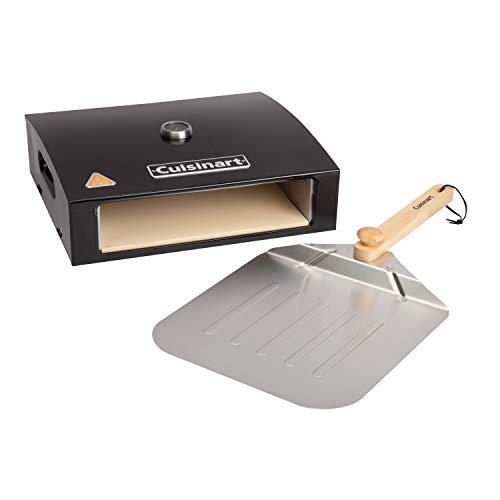
Cuisinart approaches the grill-top idea as a kit rather than a chamber, and the listing title reads like a packing list for a first pizza night: a portable grill-top baking oven, a pizza peel, and a cordierite stone. Cordierite is the stone material worth wanting — it tolerates the thermal shock of a cold pie landing on a hot surface far better than ceramic, which is exactly the stress a grill-top stone faces when the lid opens and the temperature swings.
The framing in the title is “make your own pie,” and that is the right way to understand this pick’s place in the six. It is the least specialised chamber here and the most complete evening: a family that owns a grill and nothing else pizza-related can open one box and bake. What it does not claim is equally clear — no pizza diameter is stated, no fit range is promised, and no particular grill family is named. It is a generalist kit for a standard grill, and it should be bought as exactly that.
Cuisinart’s brand position cuts both ways and deserves a plain sentence. This is a general kitchenware maker applying its accessory playbook to the grill, not a pizza specialist chasing the last degree of performance — and for the buyer this kit targets, that is a feature. Instructions will be clear, the stone will be a standard size, and the whole purchase feels like buying a kettle rather than joining a hobby. The trade is ceiling: a household that catches the pizza bug seriously will outgrow a generalist kit within a season and start eyeing the chambers above and below it in this list. Buy it as a well-made first step, not as a final answer.
- Format: portable grill-top pizza oven kit
- Stone material: cordierite, as named in the listing title
- Included tool: pizza peel
- Pizza diameter: the listing title does not state one — check the product dimensions against your grill grate
- Positioning: a make-your-own-pie accessory set for backyard pizzas
- Buying channel: sold on Amazon — the Cuisinart Grill Top Pizza Oven Kit page is where to check price on Amazon
Strengths
- Cordierite stone handles grill temperature swings better than plain ceramic.
- A peel is included, so the first bake needs no extra shopping trip.
- Cuisinart’s accessory ecosystem makes replacement stones easy to source.
Trade-offs
- No stated pizza size or fit range means measuring your grill is mandatory.
- A single included peel means launching and turning share one tool.
- Generalist design offers no pellet-grill or single-brand optimisation.
Best for: families buying one box to start making pizzas on a standard grill. Not suited for: pellet grill owners, who should look at the Stanbroil below.

Stanbroil Pellet Grill Pizza Oven Attachment — Pellet Grill Specialist
Pellet grills cook low and slow beautifully and bake pizza reluctantly, because the fire pot sits off to one side or under a drip plate and the cooking chamber is built for smoke circulation, not for a fierce, focused bake. Stanbroil’s attachment attacks that mismatch directly. The title names Traeger and Pit Boss, claims fit across more than sixty pellet grill models, and describes the two pieces of engineering that make it work: adjustable support brackets that let the attachment sit correctly on different grate layouts, and a heat-capturing extension that funnels the fire’s output up into the baking chamber instead of letting it wander the barrel.
The included stone is 13 inches, a size stated plainly in the title, which suits the personal and medium pizzas most pellet owners actually cook. There is a discipline point here worth stating for the whole category: a pellet grill’s controller reports the barrel temperature, not the stone temperature inside an attachment, so the first few bakes in this chamber are calibration bakes. That is not a flaw in the Stanbroil — it is the physics of borrowing heat — but buyers who expect the dial and the stone to agree will be confused until they learn the offset on their own grill.
There is a flavour footnote pellet owners will appreciate. A pellet grill at pizza temperatures is burning its pellets hard and clean, so the gentle smoke kiss it gives a brisket at low heat mostly disappears at bake heat — what remains is a faint wood-fired note rather than a smoke flavour. Set expectations accordingly: the Stanbroil gives you the convenience of the pellet platform and a whisper of the fire, not the full wood-oven character. Owners who want that character in full have a different shopping list; owners who want Friday pizza from the grill already plumbed into their routine have found their pick.
- Format: pizza oven attachment designed for pellet grills
- Stated compatibility: Traeger, Pit Boss and more — over 60 pellet grill models
- Fit hardware: adjustable support brackets
- Heat management: heat-capturing extension for faster heating
- Stone size: 13 inches, per the listing title
- Buying channel: listed on Amazon — check price on Amazon under the Stanbroil Pellet Grill Pizza Oven Attachment name
Strengths
- The broadest stated model compatibility of any pick in this roundup.
- The heat-capturing extension addresses the pellet grill’s real weakness.
- Adjustable brackets acknowledge that pellet grates vary by brand and size.
Trade-offs
- Useless on a gas or charcoal grill — this is a pellet-only attachment.
- Stone temperature and grill controller readings will not match; expect calibration bakes.
- No peel is named in the title, so launching tools are a separate purchase.
Best for: Traeger and Pit Boss owners who want pizza from the grill they already smoke on. Not suited for: anyone whose grill burns gas or charcoal.

Masterbuilt Gravity Series Pizza Oven Insert — Gravity Series Only
Here is the pick that demands the boldest warning in this guide: this insert fits Masterbuilt Gravity Series grills, and it fits nothing else. Not other Masterbuilt models, not other charcoal grills, not a gas grill with the grate removed and optimism applied. The Gravity Series feeds charcoal from a gravity hopper through a digitally controlled fan, which gives it unusually steady, dial-set heat for a charcoal cooker — and Masterbuilt designed this insert, model MB20181722, to plug into that system as a first-party accessory. If you own a Gravity Series grill, it is arguably the most integrated option in this entire roundup. If you do not, it is a paperweight with a pizza stone.
The construction details in the title support the integrated reading: a ceramic pizza stone, a porcelain-coated exterior and a stainless steel interior. Porcelain coating is what a manufacturer chooses when an accessory will live at charcoal-grill temperatures and weather; stainless inside is what you choose when the surface must shrug off flour, ash and the occasional cheese overflow. None of that rescues the insert on the wrong grill — the fit is the product. Check your grill’s series name on its data plate before this pick is allowed anywhere near your cart.
It is worth pausing on why a first-party insert can outperform a universal chamber when the fit is right. A universal box must tolerate every grate it might meet, so it sits high, seals loosely and leaves its heat management to chance. An insert designed for one grill can sit exactly where the maker intended, draw on the hopper-fed charcoal fire the way the grill’s own airflow was engineered, and turn the fan controller into a genuine pizza-oven thermostat. That is a real performance argument, not brand vanity — and it is available only to Gravity Series households, which is why this pick is simultaneously the easiest recommendation in the guide and the easiest one to get wrong.
- Format: first-party pizza oven insert accessory
- Compatibility: Masterbuilt Gravity Series grills only — no other grill family
- Model: MB20181722
- Stone: ceramic pizza stone included
- Construction: porcelain-coated exterior, stainless steel interior
- Buying channel: the insert is sold through Amazon — check price on Amazon on the Masterbuilt Gravity Series Pizza Oven Insert listing
Strengths
- Designed by the grill’s own maker, so fit and heat behaviour are engineered, not approximated.
- Porcelain-coated exterior suits permanent outdoor duty.
- Pairs with the Gravity Series’ fan-controlled charcoal heat for steady bakes.
Trade-offs
- Fits one grill family exclusively; a grill upgrade orphans the insert.
- Ceramic stone is less shock-tolerant than the cordierite in the Cuisinart kit.
- The title states no pizza diameter, so verify the stone against your dough.
Best for: Gravity Series owners, full stop — for them it may be the best pick here. Not suited for: every other grill owner, however tempting the build quality looks.
Side by Side: How the Six Chambers Differ
| Chamber | Host grill | Stated pizza size | What is in the box |
|---|---|---|---|
| BakerStone Original Grill Top Pizza Oven | General gas or charcoal grill | Not stated in title | Chamber and dust cover |
| BakerStone Basic 12-Inch Grill Top Pizza Oven | General grill top | 12 inches | Five-sided stone chamber, wood peel, turning peel |
| Skyflame Universal Metal Pizza Oven Kit | Most gas grills; pellet conversion | Not stated in title | Metal box, adjustable 20–30 inch width |
| Cuisinart Grill Top Pizza Oven Kit | General grill top | Not stated in title | Oven kit, peel, cordierite stone |
| Stanbroil Pellet Grill Pizza Oven Attachment | Pellet grills, 60+ models claimed | 13-inch stone | Attachment, brackets, heat-capturing extension, stone |
| Masterbuilt Gravity Series Pizza Oven Insert | Gravity Series only | Not stated in title | Insert with ceramic stone, model MB20181722 |
Why Does a Chamber Bake Better Than a Stone Alone on the Same Grill?
A bare stone on a grill grate solves only half the pizza problem. The stone gives the base fierce conductive heat, but the top of the pie is cooked by the grill’s open air, which escapes every time you lift the lid and never concentrates above the cheese in the first place. The result is the classic grill-pizza compromise: a crisp bottom under a pale, underdone top, or a finished top over a scorched base if you compensate by waiting. A chamber fixes the geometry. Its low ceiling sits close above the pizza, trapping a layer of very hot air and reflecting radiant heat down onto the toppings, so base and top finish in the same few minutes.
The chamber also buys you recovery. Grilling is a lid-open, lid-closed rhythm, and each opening dumps the heat you had banked. A stone-and-chamber combination stores energy in mass — the stone, and in the BakerStone Basic’s case stone on five sides — so the temperature sag after launching a cold, wet dough ball is shallower and the climb back is quicker. None of this turns a weak grill into a strong one. A small two-burner gas grill will still struggle to keep a chamber genuinely hot across four consecutive pizzas. But on a grill with heat to spare, the chamber is what converts raw burner output into an actual bake.
There is a wind argument too, and patio cooks in exposed gardens will feel it immediately. An open grill on a breezy evening loses heat sideways as fast as the burners make it, and the flame pattern leans and flickers. A chamber walls the bake off from the weather: the pizza sits inside a small, sheltered room whose climate the grill controls, rather than on an open grate at the mercy of every gust. It is an unglamorous benefit that never appears in a listing title, yet on a blustery night it can be the difference between a bake that behaves and one that wanders. If your cooking spot is windy, weight the chamber format itself — any of these six — more heavily in your decision.
What Should You Check on Your Grill Before Ordering Any of These?
Start with a tape measure, not a shopping cart. Measure the grate’s width and depth with the lid closed, then measure the vertical clearance between the grate and the highest point of the closed lid — a chamber that fits the grate but fouls the lid is a chamber you will use once. The Skyflame’s stated 20-to-30-inch adjustable width exists precisely because grate widths vary so much; if your grill falls outside even that range, no pick in this list should be forced onto it.
Next, be honest about your grill’s heat. Run it empty at full power for fifteen minutes and see what the lid thermometer claims, knowing that dial reads optimistically. A grill that cannot hold a strong, steady temperature will bake pizza slowly in any chamber, and slow pizza is soggy pizza. Charcoal users should think about bed depth and replenishment: a chamber bake across a family pizza night needs a charcoal bed that stays fierce for the better part of an hour. Pellet owners should confirm their exact model against the Stanbroil’s compatibility claim rather than assuming the brand name alone guarantees fit. And Gravity Series owners — the lucky few with a first-party option — should confirm the series, not just the Masterbuilt badge, because the insert’s whole value is its exact fit.
Finally, inventory your tools. If you own no peel, the kits that include one — the BakerStone Basic with two, the Cuisinart with one — close a gap you would otherwise discover with a topped, unbaked pizza in your hands and no way to move it. A peel is not an optional garnish in this format; it is the only safe bridge between your work surface and a stone sitting at full grill heat, and tongs, spatulas and improvised cardboard all fail that job in ways that end with toppings in the charcoal. If your chosen chamber includes no peel, order one in the same breath as the chamber, sized a little narrower than the chamber mouth you measured a moment ago. Households that roast their own beans between pizza nights, incidentally, tend to enjoy the same gear-first mindset we apply in our guide to Best Coffee Roasters Machines: in both hobbies, the honest specification matters more than the marketing adjective, and the tool you already own shapes what you should buy next.
How Do You Actually Bake a Pizza in a Grill-Top Chamber?
Set the chamber on the cold grate, centred over the burners or the charcoal bed, and preheat everything together — chamber, stone and grill — for a good twenty to thirty minutes at your grill’s full output. A stone that has not heat-soaked will steal the bake from the base of your first pizza no matter how hot the air above it feels. While the grill climbs, stretch your dough on a floured peel, top it more lightly than instinct suggests, and keep the sauce away from the rim so the launch stays clean.
Launch with a short, confident shuffle, close the lid, and resist opening it for the first two minutes. Then rotate the pie a half turn with the turning peel — grill heat is never perfectly even, and the side nearest the hottest burner will always run ahead. Most grill-top bakes finish in a window of a few minutes once the chamber is properly hot; judge by the crust’s underside colour and the cheese’s bubbling, not by a timer. Between pizzas, close the lid and give the stone a couple of minutes to recover its heat before the next launch. Wipe the stone with a dry brush while it is hot, never with water, and let the whole assembly cool on the grill before the chamber goes back under its cover or onto its shelf.
Which Mistakes Ruin Most First Grill-Top Pizza Nights?
The commonest mistake is buying for a grill you do not own. It happens in two directions: the Masterbuilt insert ordered for a non-Gravity grill, and a fixed-width chamber ordered for a grate it overhangs, leaking heat at both ends. The second mistake is skipping the preheat — launching onto a lukewarm stone because the lid thermometer looked encouraging, then blaming the chamber for a gummy base. The third is overloading the pizza. A grill-top chamber bakes fast and hot; a pie buried under wet vegetables steams itself before it can crisp, and no chamber design rescues it.
Two quieter mistakes deserve mention. One is using the grill’s lid thermometer as a stone thermometer; they measure different worlds, and the gap between them is where underbaked crusts come from. The other is forgetting that the chamber stays dangerously hot long after the grill is off — it should cool where it sits, be handled with grill gloves, and be stored only when cold, ideally under the Original’s dust cover or an equivalent. A household that also runs a pressure washer for patio cleanup after a cookout will recognise the pattern from our guide to Best Pressure Washers with Onboard Detergent Tanks: the equipment rewards a methodical setup and punishes improvisation in exactly the same way.
Gas, Charcoal or Pellets: Which Grill Makes the Best Host for a Pizza Chamber?
Gas is the straightforward host. Burners respond in seconds, hold a setting without attention, and let you run a chamber bake on a weeknight without a fire-building ritual. The cost is character: a gas-heated chamber bakes cleanly and neutrally, and the pizza tastes of its toppings and its crust rather than of its fuel. For most households that is the right trade, and it is why the general chambers in this roundup — the BakerStones and the Cuisinart — implicitly assume a gas grill underneath them even when their titles stay diplomatically silent.
Charcoal is the romantic host and the demanding one. A deep, well-lit charcoal bed gives a chamber a fierce, radiant quality that gas struggles to match, and the crust picks up a whisper of the fire. But charcoal heat is a curve, not a setting: it peaks and declines, and the cook manages the bake by managing the bed — banking coals, adding fuel between pizzas, learning where the hot side lives. The Gravity Series exists to tame exactly that curve with its fan and hopper, which is why its first-party insert is such a coherent product. On a kettle grill, expect the best pizzas of your life and the worst, sometimes in the same session.
Pellets are the convenient host with an asterisk. The grill lights itself, holds its set temperature and asks nothing of you — but its heat was designed for slow smoking, spread thin across a wide barrel. A pellet grill without an attachment bakes pizza the way an oven with the door ajar bakes pizza. The Stanbroil’s heat-capturing extension is the fix, concentrating the fire’s output where the stone sits. With it, the pellet platform becomes a legitimate pizza host, trading a little peak fierceness for the lowest-effort bake in this entire guide.
How Big a Pizza Do You Honestly Bake? Sizing the Chamber Without Self-Deception
Buyers shop for the pizza they imagine and cook the pizza they can handle. A sixteen-inch pie sounds like the obvious ambition until you have launched one: big dough is harder to stretch evenly, harder to top without sagging, and dramatically harder to slide off a peel in one confident motion. Most home cooks settle, happily and permanently, at ten to twelve inches — which is why the stated sizes in this roundup matter less than buyers fear. The BakerStone Basic’s 12-inch chamber and the Stanbroil’s 13-inch stone cover the realistic centre of home pizza making, and neither should be dismissed as small.
There is a second sizing question nobody asks until the chamber is on the grate: the opening, not the floor. A chamber can have a floor wide enough for a pizza and a mouth too low or too narrow to launch it at a comfortable angle, especially with a loaded peel. Where a listing title gives no dimensions at all — true of the Original, the Skyflame and the Cuisinart here — the product page’s dimension table is required reading, checked against both your dough size and your peel width. Thirty seconds with those numbers prevents the particular misery of a chamber that fits the grill, fits the pizza, and fits nothing in between.
How Should You Clean and Store a Grill-Top Chamber Between Seasons?
The stone asks for the least care and receives the most abuse. Never wash it with water while hot, never soak it, and never use soap — a dry brush and the heat of the next preheat are its cleaning cycle, burning off what the brush leaves. Dark stains on a pizza stone are not dirt; they are seasoning, and a stone scrubbed back to showroom paleness has been harmed, not helped. The chamber body wants the opposite treatment: ash and flour dust brushed out once cold, a wipe of the exterior, and a check that no grease has pooled where it can smoke through the next bake.
Storage decides how many seasons you get. A chamber left uncovered on an outdoor grill through a wet winter will rust at its seams and stain its stone with mildew, however good its coating — the Original’s included dust cover is a small feature with an outsized effect on lifespan, and owners of the other five picks should improvise an equivalent. Store the stone dry, store the chamber off the ground, and if the whole assembly winters in a garage, a sheet of cardboard between stone and shelf keeps both happier. Ten minutes of this in October is the difference between a spring preheat and a spring replacement.
What Dough and Topping Habits Suit a Grill-Top Bake?
Grill-top chambers bake hot and fast compared with a kitchen oven, and the dough should be mixed with that in mind. A dough at moderate hydration — wet enough to stretch without tearing, dry enough to release from the peel without a fight — behaves best; very wet doughs that shine in a steel pan will glue themselves to a peel under chamber pressure. Let the dough come fully to room temperature before stretching, because cold dough springs back, fights the stretch, and tempts you into rolling it flat, which crushes the airy rim that a fierce bake is supposed to inflate.
Toppings should be treated as cargo, not as a showcase. Cheese goes on in a thinner layer than feels generous, because the chamber’s radiant ceiling melts and browns it quickly, and excess cheese becomes excess water. Vegetables with high moisture — fresh tomatoes, mushrooms, peppers — repay a few minutes of pre-cooking or a spell on paper towels; raw, they weep into the crust faster than the stone can crisp it. Sauce should be thick rather than runny, spread thin, and kept off the outer rim, where it would glue the pie to the peel. None of this is chamber-specific fussiness; it is the arithmetic of a short, hot bake, where there is no long oven session in which mistakes can dry out and forgive themselves.
Finally, build a small ritual around the launch itself. Semolina or a light dusting of flour on the peel, a shake test before you walk to the grill — the topped pie should shimmy freely — and one decisive motion at the chamber mouth. Hesitation at the launch is responsible for more ruined grill pizzas than any equipment shortcoming in this roundup, and it is the one variable entirely within the cook’s control. Practise the launch once with an untopped dough if you are new; the sacrificed crust is cheap tuition.
How Long Will a Grill-Top Chamber Last, and What Wears Out First?
The stone is the consumable. Stones crack — from thermal shock, from a dropped corner, from one careless cold-water rinse — and a cracked stone usually still bakes acceptably for a while, but it is living on borrowed time. This is a quiet argument for the Cuisinart’s cordierite, which tolerates shock better than plain ceramic, and for treating any chamber’s stone as a part you may one day replace rather than a lifetime component. Check that a replacement stone exists for your chamber’s dimensions before the original fails, not after.
The metalwork ages more gracefully. Paint and coatings near the fire line will dull and eventually flake; seams gather rust if storage is damp; adjustable mechanisms like the Skyflame’s width sliders want an occasional brush-out so ash does not cement them in place. None of these is fatal, and a chamber body should outlast several stones. The realistic ownership picture is a body that serves for years, a stone replaced perhaps once, and tools — peels especially, if wooden — replaced as they char and thin. Budget your expectations that way and no part of the purchase will disappoint you.
Final Recommendation
Match the chamber to the grill first and to your ambitions second, and this category becomes simple. Gravity Series owners should buy the Masterbuilt insert without a second thought — it is the only first-party fit here. Pellet grill owners should buy the Stanbroil and spend their first session learning its temperature offset. Gas grill owners with an awkward grate should take the Skyflame’s adjustable width, beginners with no tools should take the BakerStone Basic and its two peels, and cooks who simply want one complete box should take the Cuisinart kit. The Original remains the pick for the experienced hand who values the established design and its dust cover over bundled accessories. Choose the chamber your grill would choose, and Friday night takes care of itself.
Frequently Asked Questions
Will a grill-top pizza oven work on any grill?
No. General chambers like the two BakerStone models and the Cuisinart kit suit most standard gas and charcoal grills, but the Stanbroil is built only for pellet grills and the Masterbuilt insert fits only the Gravity Series. Measure your grate and confirm the host type before ordering.
What temperature will my grill-top pizza oven reach?
The chamber has no burner of its own, so the ceiling is set by your grill, your fuel and your preheat patience. None of the six listing titles here states a maximum temperature, and we do not assign one — a strong grill, fully heat-soaked, is what produces a fast bake.
Do I need a peel, or can I build the pizza on the stone?
You need a peel. Building a pizza directly on a screaming-hot stone inside a chamber is impractical and hard on the dough. The BakerStone Basic includes a wood peel and a turning peel, and the Cuisinart kit includes a peel; the other picks assume you own launching tools.
What is the difference between the BakerStone Original and the Basic?
They are different series. The Original is the long-running chamber and ships with a dust cover, but its title states no pizza size. The Basic is a 12-inch design with a five-sided stone chamber and includes a wood pizza peel and a turning peel. Neither is simply a trim level of the other.
Can I leave the chamber on the grill between uses?
You can, but it will weather faster. The Original’s included dust cover exists for exactly this storage pattern. Whatever the chamber, let it cool fully before covering, and never quench a hot stone with water.
Is a grill-top chamber better than a dedicated countertop pizza oven?
It is different, not better. A chamber borrows a powerful heat source you already own and stores on a shelf; a countertop oven brings its own heat, works in any weather and asks nothing of your grill. Households that grill weekly get more from a chamber; households that rarely grill should not buy a grill accessory as their pizza solution.
Related Guides
Readers comparing every route to a better homemade pizza — freestanding ovens, countertop machines and grill-top chambers alike — will find the full landscape in our roundup of Best Pizza Ovens, which is the natural starting point before narrowing to the grill-top specialists covered here.


