What's inside
- Buying at 4000 PSI: Where the Pro Machines Are Sold, and What Their Listings Must State
- Key Takeaways
- Quick Picks
- How We Fenced the Professional Class
- Pro-Class Machines in One Table
- Triplex Pumps: The Machine Under the Machine
- Four Thousand PSI Will Damage Your Property: The Mandatory Section
- Flow at the Professional Level: Why 3.5 to 4.0 GPM Changes the Work Itself
- A Professional Wash Sequence for Concrete, Masonry and Heavy Plant
- Pro-Class Mistakes That Cost Real Money
- Engines at the Professional Level: What GX, CRX and the Rest of the Badges Mean
- Hoses, Frames and the Working Radius: The Logistics Nobody Photographs
- Ownership Economics: What the Professional Class Really Costs Across Five Years
- Surface Cleaners and the Pro Accessory Shelf
- Detergents at Scale: Injection, Dwell and Why Heat Changes the Chemistry
- Crewing the Machine: Training a Second Pair of Hands
- Final Recommendation
- Frequently Asked Questions
- Related Guides
As an Amazon Associate I earn from qualifying purchases. This post may contain affiliate links at no extra cost to you.
cottageverdict.com is reader-supported. When you buy through links on our site, we may earn an affiliate commission.
Buying at 4000 PSI: Where the Pro Machines Are Sold, and What Their Listings Must State
The best 4000 PSI pressure washers are not bigger versions of the machines in a homeowner’s garage; they are a different class of equipment that happens to share a silhouette. All six picks here are sold through Amazon, each name below links to its listing so you can check price on Amazon and verify the stated specification yourself, and the specification is the point: at this level a listing earns trust by naming its pump, its engine and its hose, because those are the components a professional is actually buying. Five of the six are cold-water machines built around triplex pumps and commercial engines, with outputs from 4,000 to 4,400 PSI and flows from 3.5 to 4.0 GPM. The sixth is something else entirely — a hot-water machine with a diesel-fired heater — and this guide flags it as a different trade every time it appears, because a buyer who mistakes it for a stronger version of the other five has misunderstood the purchase completely.
Who buys this class? Contractors washing fleets, drives and commercial concrete; farms and workshops with yards, machinery and livestock housing to keep; property managers with car parks and bin stores; and a minority of homeowners with very large, very hard surfaces and the judgement to match. It is the same readership that buys commercial refrigeration and other trade equipment without blinking — the buyers who, elsewhere on this site, work through Best Commercial Deep Freezers with a tape measure and a duty cycle in mind. If your washing life is a car and a patio, this page is not your page, and the guide says so as a service rather than a snub: the residential class will serve you better, cost you less, and forgive you more.
One warning belongs at the top, not buried in a later section, and it is repeated in full further down: at 4,000 PSI and above, a pressure washer stops being a cleaning tool that can damage things and becomes a cutting tool that can clean things. It will etch concrete if held still, strip paint by intention or by accident, carve softwood like a chisel, shatter ageing mortar, and injure skin in ways that require surgeons. Buy this class for work that needs it, learn its discipline before its throttle, and it will pay for itself; buy it as a toy and it will invoice you in repairs.
Key Takeaways
- This is the professional and semi-professional class: triplex pumps on five listings’ evidence, commercial engines, 50-foot hoses and steel or aluminium trade frames.
- Flow jumps a class too — 3.5 to 4.0 GPM against the residential field’s 2.3 to 2.6 — and at this level flow is what turns pressure into production.
- Surface damage is not a footnote at 4,000 PSI; it is a central operating fact, and this guide treats it as one.
- The Powerhorse is a hot-water, diesel-heated commercial machine for grease and oil work — a different trade from the five cold-water picks, not a stronger sibling.
- The VEVOR’s listing names a copper pump rather than a triplex design; we report its wording exactly and do not upgrade it.
- Four of the six are Simpson PowerShot-family machines; the meaningful differences are pump brand, frame material and engine, laid out in the comparison table.
Quick Picks
| Washer | Pump and engine | Built for |
|---|---|---|
| Simpson PowerShot 4000 | AAA triplex, Honda GX270 | The class benchmark — 3.5 GPM with a 50-foot Monster hose. |
| Simpson PowerShot 4400 | AAA triplex, CRX 420cc | The most stated output in the six, on a welded steel frame. |
| Simpson Aluminum 4200 | CAT triplex, Honda GX390 | A premium pump in a corrosion-proof aluminium frame. |
| Simpson PowerShot 4200 | AAA triplex, Honda GX390 | The steel-frame counterpart to the aluminium machine. |
| VEVOR 4400 | Copper pump, per its listing | The value challenger at a stated 4400 PSI and 4.0 GPM. |
| Powerhorse Hot Water 4000 | Triplex, Senci engine, diesel heater | Hot-water degreasing for commercial and farm work. |
How We Fenced the Professional Class
The gate for this guide was a stated output at or above 4,000 PSI paired with a specification a professional would recognise: a named pump, a named or sized engine, a hose length fit for working around vehicles and buildings. That gate admitted four Simpson machines from the maker’s professional family, one value challenger from VEVOR, and one hot-water specialist from Powerhorse — a spread that mirrors the real market at this level, where one or two trade brands dominate and the interesting questions are about pumps, frames and heat rather than logos. We excluded machines that reach 4,000 PSI in a headline while dressing a residential pump in professional numbers; the pump, at this class, is the machine, and a listing that will not name it is telling you something.
We also kept the class honest about its label. “Pro” is the most abused word in the equipment world — kitchens suffer it too, where pro-style is a finish rather than a duty rating, as the discussion in Best 30-Inch Pro Gas Kitchen Ranges makes plain — and the defence is the same in both categories: read the components, not the adjective. A triplex pump with a commercial engine and a trade frame is professional by construction whatever the badge says; a sealed axial pump at a high pressure figure is a residential machine wearing a number. The six below were chosen by construction. Their maintenance, their dangers and their economics are all professional-grade facts, and the rest of this guide treats them that way.
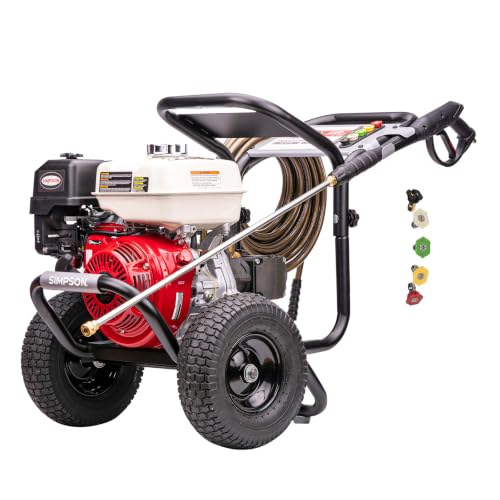
Simpson PowerShot 4000 — The Class Benchmark
The PowerShot 4000 is the machine this category is measured against, and its listing states the full professional grammar: 4000 PSI at 3.5 GPM, a Honda GX270 engine, an AAA triplex pump, a 50-foot Monster hose, five nozzles and a steel frame, marked for professionals and 49-state compliant. Every element of that sentence is a decision a contractor recognises. The GX-series Honda is the small-engine world’s commercial standard, chosen for starting manners and parts availability rather than novelty. The triplex pump is the serviceable heart — seals and valves that can be renewed instead of a unit that gets discarded. And the 50-foot hose is the difference between a machine that works a site and a machine that gets dragged around one, tripping its own operator over the evidence.
Its output pairing is the class’s balanced form: the lowest pressure figure in this guide, if 4,000 PSI can be called low, married to a flow that still doubles the residential field’s rinsing power. In practice this is the machine for sustained flatwork — commercial concrete, long drives, workshop yards — where the day is measured in square metres and the pump’s serviceability decides whether year three looks like year one. Buy the benchmark if your work is real and recurring; it is the least exciting pick here and the one the professionals in the listings’ own language would recognise as home.
- Stated output: 4000 PSI and 3.5 GPM, per the listing title
- Engine: Honda GX270, as named in the title
- Pump: AAA triplex, stated in the title
- Kit per title: 50-foot Monster hose, five nozzles, steel frame; 49-state compliant
- To verify the PowerShot 4000’s current specification, check price on Amazon under its listing
Strengths
- The complete professional grammar — pump, engine, hose — stated in one title.
- Triplex serviceability protects a multi-year working life.
- Fifty feet of hose works a site without moving the machine.
Trade-offs
- The lowest flow in this guide — still a class above residential, but the ceiling matters on the widest work.
- Steel frame weight is real when loading a vehicle alone.
- Professional maintenance discipline is part of the purchase.
Best for: contractors and property work with recurring flatwork. Not suited for: any purely domestic chore list.
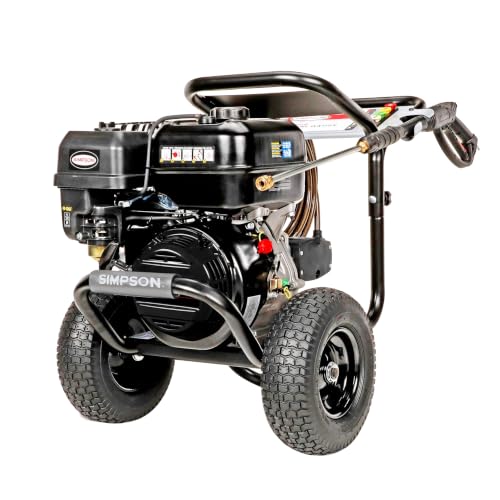
Simpson PowerShot 4400 — The Most Output in the Six
The PowerShot 4400 takes the family’s formula and turns every dial: a stated 4400 PSI at 4.0 GPM, a CRX 420cc engine, an AAA triplex pump, a 50-foot hose, five nozzles and a welded steel frame. That pairing — the joint-highest pressure in the guide with the joint-highest flow — produces the largest cleaning-unit arithmetic here by a clear margin, and it is aimed at the work where arithmetic is destiny: stripping failing coatings, restoring neglected commercial concrete, cutting through the accumulated grime of working yards. The welded frame language matters at this output, because a machine producing this much force vibrates like it means it, and welds, unlike bolts, do not loosen their way across a season of hard days.
The CRX engine is Simpson’s own commercial line rather than a Honda, which divides buyers by loyalty and by parts network; the specification itself — 420cc driving a triplex at full class output — is unambiguous. What the extra output buys must be stated plainly alongside what it risks: at 4400 PSI the margin between cleaning and damage is the operator’s technique and nothing else, and the mandatory damage section below was written with this machine open on the desk. Choose it when the work list contains genuine stripping and restoration; for routine washing, its own 4000-class sibling does the same day at a gentler register.
- Stated output: 4400 PSI and 4.0 GPM — the strongest pairing in this guide
- Engine: CRX 420cc, as named in the title
- Pump: AAA triplex, stated in the title
- Kit per title: 50-foot hose, five nozzles, welded steel frame; 49-state compliant
- For the PowerShot 4400 as currently listed, check price on Amazon via its name above
Strengths
- Maximum stated cleaning power in the six, pressure and flow together.
- Welded frame suits sustained, vibrating work.
- Triplex pump keeps the power serviceable for years.
Trade-offs
- The least forgiving machine here around any delicate surface.
- Heaviest duty cycle expectations — maintenance is not optional.
- Output is surplus for ordinary washing, however satisfying the figures.
Best for: restoration, stripping and the heaviest commercial flatwork. Not suited for: routine washing, beginners, or anywhere near a car you like.

Simpson Aluminum 4200 — CAT Pump, Aircraft Manners
The Aluminum 4200 makes two premium choices and names them both: a stated 4200 PSI at 4.0 GPM, a Honda GX390 engine, a CAT triplex pump, a 50-foot hose and five nozzles on an aluminium frame. CAT is the pump name professionals say the way chefs say a knife brand — the industry’s reference for triplex longevity — and its presence moves this machine’s argument from output to endurance: the seals, valves and machining that decide whether a pump is a five-year or a fifteen-year companion. The GX390 is the larger Honda commercial engine, sized to drive that pump at full flow without straining, and the pairing reads like a specification written by someone who intended to be washing with the same machine in a decade.
The aluminium frame is the second argument, and it is about corrosion and carrying rather than strength theatre. A washer lives wet, works wet and is stored damp more often than its owner admits; aluminium simply declines to rust, and it trims weight against the steel frames every time the machine is loaded into a vehicle. Against its steel PowerShot 4200 sibling below — same stated output, same engine family — the choice is precisely this: pay for the CAT pump and the alloy frame, or take the AAA pump and steel and keep the difference. Neither answer is wrong; they are answers for owners who keep machines for different lengths of time.
- Stated output: 4200 PSI and 4.0 GPM, per the listing title
- Engine: Honda GX390, as named in the title
- Pump: CAT triplex — the premium pump fitment in this guide
- Kit per title: 50-foot hose, five nozzles, aluminium frame; 49-state compliant
- To compare the Aluminum 4200’s current offer, check price on Amazon on its listing
Strengths
- CAT triplex pump is the endurance pick of the six.
- Aluminium frame cannot rust and loads lighter than steel.
- Full class flow at 4.0 GPM with a commercial Honda.
Trade-offs
- Premium components price it at the considered end of the class.
- Aluminium dislikes impacts that steel shrugs off.
- Its longevity argument only pays out across years of real use.
Best for: long-keeping professionals, coastal and wet-duty work. Not suited for: short-horizon buyers who will not keep it long enough to collect the endurance dividend.

Simpson PowerShot 4200 — The Steel-Frame Twin
Read the PowerShot 4200’s listing beside its aluminium sibling and the family strategy snaps into focus: the same stated 4200 PSI at 4.0 GPM, the same Honda GX390 engine, an AAA triplex pump in place of the CAT, a 50-foot hose and five nozzles, and a welded steel frame in place of the alloy. This is the working professional’s version of the same output — the machine for the operator who values the frame’s indifference to knocks, the AAA pump’s own solid serviceability, and a lower entry figure, over the premium pump and rust-proofing of its twin. Welded steel is the traditional material of this class for a reason: it tolerates the loading ramp, the site drop and the decade of vibration, and it can be repaired by any welder in any town.
Choosing between the twins is therefore an exercise in self-knowledge. The machine that will live on a vehicle, work daily and sleep in a damp store argues aluminium and CAT. The machine that will work hard, travel between sites and meet the occasional accident argues steel and AAA. What neither twin argues about is the class itself: full flow, full pressure, a pump you can rebuild, and a hose that reaches. In a guide of specialists, this is the general-purpose professional — the pick with no thesis except competence at full size.
- Stated output: 4200 PSI and 4.0 GPM, per the listing title
- Engine: Honda GX390, as named in the title
- Pump: AAA triplex, stated in the title
- Kit per title: 50-foot hose, five nozzles, welded steel frame; 49-state compliant
- For the PowerShot 4200’s present listing terms, check price on Amazon under its name
Strengths
- Full class output with the traditional steel-frame toughness.
- AAA triplex keeps service parts within the maker’s own family.
- The GX390 and 4.0 GPM pairing suits long production days.
Trade-offs
- Steel will rust where its coating is breached — storage discipline applies.
- Heavier to load than the aluminium twin.
- Shares its sibling’s unforgiving nature around delicate surfaces.
Best for: site-working professionals who prize repairability and frame toughness. Not suited for: owners who store machines damp and expect the frame to forgive it.

VEVOR 4400 — The Value Challenger, Read Carefully
The VEVOR arrives with the joint-highest stated figures in the guide — 4400 PSI and 4.0 GPM — a spray gun and extension wand, and five quick-connect nozzles, at the value position this brand habitually occupies. It also arrives with the listing this guide reads most carefully, because its title describes the pump as a copper pump and does not use the word triplex. We report that exactly: copper construction in a pump speaks to its internals’ corrosion behaviour, but the professional class’s defining trait is the triplex architecture with its serviceable seals and valves, and a listing that does not claim that architecture should not be credited with it by a reviewer’s optimism. The honest position is that the VEVOR states professional output while describing its pump in residential-adjacent language, and the buyer should weigh the full listing and documentation with that tension in mind.
Its title also aims the machine at cars, homes, driveways and patios — a domestic duty list at a professional output, which this guide must flag rather than repeat uncritically: 4400 PSI is not a car-washing specification in any hands, and the mandatory damage section below applies to this pick with full force. Where the VEVOR makes its legitimate case is as the entry ticket for a buyer with genuine heavy flatwork, a tight budget and the mechanical sympathy to maintain a value machine attentively. Bought with open eyes, it is a challenger; bought on its headline alone, it is the riskiest purchase in the six.
- Stated output: 4400 PSI and 4.0 GPM, as printed in the listing title
- Pump: described in the title as a copper pump — the title does not claim a triplex design
- Kit per title: spray gun and extension wand, five quick-connect nozzles
- Engine: the listing title does not name an engine — verify it in the manufacturer documentation
- To read the VEVOR’s full current listing before judging, check price on Amazon via the name above
Strengths
- Joint-highest stated output at the value end of the class.
- Extension wand included for reach work.
- Quick-connect nozzle set covers the standard patterns.
Trade-offs
- Pump architecture is not claimed as triplex in the title.
- Its title’s domestic duty list understates the respect 4400 PSI demands.
- No engine is named in the listing title.
Best for: budget-bound buyers with real flatwork and mechanical sympathy. Not suited for: anyone intending to wash vehicles at its stated output, or buyers who need a documented triplex pump.

Powerhorse Hot Water 4000 — A Different Trade Entirely
Stop and reset your expectations, because this machine shares only its pressure class with the five above. The Powerhorse is a gas hot-water pressure washer with a diesel-fired heater, stating 4000 PSI at 4 GPM, a Senci engine, a triplex pump, a 150°F temperature rise, downstream detergent injection, and an explicit commercial-use positioning. The heater is the machine: a diesel burner that raises the water’s temperature on its way to the nozzle, turning the washer from a mechanical tool into a chemical one. Hot water melts what cold water merely pushes — grease, oil, fat, the black biological films of food and farm environments — and for workshops, commercial kitchens’ exteriors, fleet yards, abattoir and dairy washdowns, and any surface where the soil is petroleum or protein, heat is not an upgrade. It is the entire method.
The costs of the method are equally distinct: two fuels to manage, a burner to maintain, a heavier and more complex machine to store and move, and a purchase that only arithmetic on greasy work can justify. Downstream detergent injection, named in the title, suits the trade — chemicals applied after the pump, at low pressure, in volume — and the 150°F rise figure is the honest way to state hot-water performance, as a lift over inlet temperature rather than an absolute promise. If your work is ordinary dirt, this machine is an expensive way to make it warm. If your work is grease, nothing else in this guide does your job at all, and the comparison is not between the Powerhorse and the Simpsons but between the Powerhorse and a scrubbing brush.
- Stated output: 4000 PSI and 4 GPM, per the listing title
- Heat: diesel-fired heater with a stated 150°F temperature rise
- Pump: triplex, as named in the title; engine: Senci
- Detergent: downstream injection, per the title; positioning: commercial use
- To study the Powerhorse’s current commercial listing, check price on Amazon under its own name
Strengths
- The only hot-water machine here — grease and oil work is its monopoly.
- Triplex pump and commercial positioning match its trade.
- Downstream injection applies detergent the professional way.
Trade-offs
- Two fuels, a burner to service, and the heaviest ownership burden in the six.
- Pointless expense for ordinary dirt and domestic work.
- Heat adds its own safety discipline to pressure’s.
Best for: workshops, farms, fleets and food-adjacent commercial washdowns. Not suited for: driveways, decks, vehicles’ paint, or any purely domestic list.
Pro-Class Machines in One Table
| Washer | Output as listed | Pump | Frame and hose |
|---|---|---|---|
| Simpson PowerShot 4000 | 4000 PSI · 3.5 GPM | AAA triplex | Steel frame, 50-ft Monster hose |
| Simpson PowerShot 4400 | 4400 PSI · 4.0 GPM | AAA triplex | Welded steel frame, 50-ft hose |
| Simpson Aluminum 4200 | 4200 PSI · 4.0 GPM | CAT triplex | Aluminium frame, 50-ft hose |
| Simpson PowerShot 4200 | 4200 PSI · 4.0 GPM | AAA triplex | Welded steel frame, 50-ft hose |
| VEVOR 4400 | 4400 PSI · 4.0 GPM | Copper pump, per title | Frame not stated in title |
| Powerhorse Hot Water 4000 | 4000 PSI · 4 GPM, hot | Triplex | Commercial hot-water unit, diesel heater |
Triplex Pumps: The Machine Under the Machine
Strip the badges from this class and the pump is what remains. A triplex pump drives three pistons from a crankshaft bathed in oil, exactly as an engine drives its own, and that architecture buys the three things professionals actually pay for: smoothness, because three pistons overlap their strokes into a steadier jet; serviceability, because seals, valves and packings are replaceable wear parts rather than a sealed unit’s death sentence; and longevity measured in thousands of hours for owners who keep the oil honest. The AAA and CAT names in these listings are the class’s two dialects of that idea — the maker’s own professional line and the industry’s reference brand — and the ownership rhythm is identical either way: check the oil as you check the engine’s, change it on the maker’s schedule, feed the pump clean water through its inlet filter, and never, ever let it run dry or sit in frost with water in its veins.
This is also where the class boundary truly lives. The residential machines in Best Gas Pressure Washers use axial pumps that serve a household’s Saturdays admirably and are replaced, not rebuilt, at the end of their lives. Neither design is a fraud; they are answers to different hour-counts. But a buyer at 4,000 PSI is signing up for the triplex rhythm whether they know it or not, and the one pick here whose listing does not claim that architecture — the VEVOR, with its copper pump wording — should be bought, if at all, with that difference priced into the decision. At this level, the pump is not a component. It is the purchase, and the engine and frame are its life-support system.
Four Thousand PSI Will Damage Your Property: The Mandatory Section
Read this before the throttle, not after the first scar. At the outputs in this guide, a zero-degree or narrow jet held close will cut softwood like a saw, strip paint to the substrate in a single pass, etch concrete into permanent pale tracks, drive water through window seals and behind siding, shatter old mortar, and tear the surface of asphalt. On skin it is worse: a pressure injection injury can look like a small puncture while driving water and debris deep into tissue, and it is a surgical emergency, not a first-aid event. These are not edge cases collected from careless forums; they are the ordinary physics of the class, available to any operator in any moment of inattention, which is why professionals treat the gun like a powered blade — never pointed at anything not intended as a target, never left charged and unattended, never handed to the curious.
The protective discipline is technique, and it is learnable: start every new surface far away with the widest fan and close the distance only as the surface proves it can take it; keep the jet moving always, because a stationary jet at this class is a drill; test in the corner that history will forgive; and keep every part of every person — feet in boots included — out of the jet’s line and its ricochet. Decks, vehicles, painted surfaces and anything with a membrane or a finish should meet this class rarely, briefly, at distance, or not at all; most have a residential machine waiting to do their work safely. The force is the product. Respect is the operating system it runs on.
Flow at the Professional Level: Why 3.5 to 4.0 GPM Changes the Work Itself
Pressure gets the headlines at this class, but flow does the production. Four gallons a minute is a river compared with a household machine’s stream: it floats debris out of expansion joints instead of relocating it, keeps a wide surface-cleaner attachment fed at full pattern strength, rinses a wall in single passes, and turns a fleet wash from a per-vehicle project into a line. It also imposes the class’s least-discussed requirement — a water supply that can sustain it. A professional washer starved by a weak tap cavitates, and cavitation eats pumps from the inside with microscopic violence; sites with doubtful supply need a buffer tank or a supply check before the machine is blamed for its own thirst. The PowerShot 4000’s 3.5 GPM, the lowest here, is in this light a deliberate specification: the gentlest drinker of the class, and the one most likely to live happily on an ordinary commercial supply.
Flow also changes the safety arithmetic, which is why it belongs in a serious guide. More water at pressure means more energy in the ricochet, more slurry underfoot, more weight in a charged hose dragging at the operator’s arm across a long day. Production and fatigue rise together, and the professional’s answer is rotation, footing and hose management rather than bravado. Judge the six by their pairings, not their pressure alone: the 4400’s maximum arithmetic, the 4200 twins’ balance, the 4000’s restraint and the Powerhorse’s heat are four different theories of how a working day should feel.
One more flow consequence hides in the detergent work: at four gallons a minute, chemical application and rinsing separate into distinct passes with distinct nozzles, because the flow that rinses so magnificently also dilutes and removes soap faster than dwell allows. Professionals therefore soap with the machine throttled to its soap setting or with a dedicated low-pressure pass, and treat the full-flow rinse as the second act rather than the whole play. The residential habit of one nozzle for everything survives contact with this class for exactly one job, after which the operator’s notebook — every pro keeps one, in a phone or in a head — gains its first entry: flow is a tool with settings, not a tap left open.
A Professional Wash Sequence for Concrete, Masonry and Heavy Plant
Walk the site before the engine starts. Note the drainage — where will thousands of litres of dirty water go, and what will it carry with it — the delicate neighbours of the work area, the electrical fittings, the surfaces that get a test patch and the ones that get a wide berth. Set the machine where its 50-foot hose reaches the whole field so it will not be moved hot and running. Start water through the system before the engine, confirm the supply sustains the flow without the note of strain, and begin on the least delicate area to let your hands remember the machine’s temper before the work that matters.
On concrete, pre-treat the worst staining with detergent and dwell time rather than pressure; then work in lanes with the surface cleaner or the middle fan, overlapping steadily, keeping the jet in motion and the slurry moving toward drainage. On masonry, soften everything — wider fan, longer distance, patience with the dwell — because old mortar is a surface that experiences this class as weather accelerated a thousandfold. On plant and machinery, the sequence is degrease first where grease rules, which is the Powerhorse’s entire argument, then detail the delicate zones by hand rather than by jet. Shut down as deliberately as you started: pressure bled before disconnects, oil and water checked while the day’s evidence is fresh, and the machine stored dry, because the professional’s next job begins at this one’s shutdown.
Pro-Class Mistakes That Cost Real Money
The expensive mistakes at this level share a theme: the machine was treated as a bigger toy instead of a smaller industrial plant. Holding a jet still to admire its power etches the signature of that admiration into concrete permanently. Washing a customer’s painted surface at flatwork distance transfers the cost of the paint to the operator. Skipping the supply check cavitates a pump whose replacement costs more than the job paid. Running a triplex on last season’s oil, or on no oil because the sight glass was never learned, converts a fifteen-year pump into a two-year one. And lending the machine — to a neighbour, a relative, a new hand without the damage section read aloud — is the mistake that produces injuries instead of invoices, which is worse.
A quieter error is buying the class for status. A 4400 PSI machine washing a domestic drive is not a premium experience; it is a liability with a recoil, slower in careful hands than a residential machine would be because every pass must be negotiated. The professionals this guide serves buy force the way they buy any plant: against a work list, a maintenance rhythm and an honest hour-count. Anything else is theatre with a pull cord.
Engines at the Professional Level: What GX, CRX and the Rest of the Badges Mean
Four of these listings name their engines, and the names sort the class. Honda’s GX line — the GX270 in the benchmark, the GX390 in the 4200 twins — is the commercial small-engine standard against which the category is priced: overhead-valve industrial engines built for daily starting, long hours and a parts network that reaches any town with a mower shop. Choosing a GX is choosing the certainty that a recoil starter, a carburettor kit or a governor spring exists within a day’s drive for the next decade, which, for a machine bought to work, is a specification as real as pressure. Simpson’s CRX engines, fitted to the 4400, are the maker’s own commercial answer — built to the same duty argument, with the parts question answered through the brand’s dealer network instead of Honda’s. The Senci engine in the Powerhorse serves a machine whose centre of gravity is its burner, and the VEVOR’s title, notably, names no engine at all, which this guide records as one more entry in that pick’s ledger of things a buyer must verify elsewhere.
The operating disciplines are common to all of them and stricter than the residential habit: oil checked at every session because these engines work at tilt and at length; air filters serviced on schedule because a washer’s engine breathes its own work’s dust; fuel kept fresh or stabilised because commercial carburettors are no more fond of stale petrol than small ones; and valves and governors left to the service schedule rather than to curiosity. An engine at this class is not the machine’s accessory. It is half the purchase, and the listings that name theirs are telling you they know it.
Hoses, Frames and the Working Radius: The Logistics Nobody Photographs
Fifty feet of hose appears in four listings here, and it deserves more respect than a bullet point gives it. A 50-foot working radius means the machine parks once — beside the water supply, on level ground, clear of the work — and the operator’s world becomes the circle the hose describes: a vehicle and a half in every direction, a house wall and its return, a yard and its gate. Inside that circle, work is continuous; outside it, work is relocation. The hose itself at this class is a serious object, built to hold professional pressure across that length, heavy enough that its management — coiling without kinks, keeping it out of the jet’s own line, off sharp edges that worry its jacket — is a genuine part of the craft. A damaged high-pressure hose does not leak politely; it whips, and the inspection habit before each session is the professional’s quiet ritual.
Frames divide the class’s character. Welded steel, on the PowerShot 4400 and 4200, is the site material: heavy, repairable, indifferent to being the thing everything else leans on. Aluminium, on the 4200’s premium twin, trades a measure of that indifference for corrosion immunity and loading weight — the frame for the machine that lives on a vehicle and works near the sea or the salt. The benchmark’s steel frame and the VEVOR’s unstated frame sit at the poles of information as much as material. None of this photographs well, and all of it decides whether the machine is a pleasure or a grievance in year four, which is why this guide spends words on the skeleton while the catalogue spends them on the skin.
Ownership Economics: What the Professional Class Really Costs Across Five Years
The purchase price of a pro washer is the first of four ledgers. The second is maintenance, and it is real money spent gladly: pump oil and engine oil on schedule, seal and valve kits at their intervals, inlet filters, hose replacements when the jacket tires, and the occasional professional service for owners who prefer their Sundays ungreased. The third ledger is consumables of the work itself — detergents in trade quantities, fuel for engine and, in the Powerhorse’s case, burner, nozzles worn by grit into fans that no longer match their markings. The fourth ledger is the one that justifies the other three: the work the machine replaces. A contractor’s washer pays against hired labour and rental fees; a farm’s against contractor callouts; a property manager’s against the slow visible decline of every hard surface they own. On any honest five-year accounting where the work exists, the class is cheap. Where the work does not exist, it is the most expensive garden ornament in this entire guide series.
That asymmetry is the guide’s closing economic advice: buy the hour-count, not the headline. A machine that will run two hundred hours a year should be the best pump you can justify — the CAT-fitted aluminium Simpson exists for exactly that owner — while a machine that will run twenty hours a year on a large rural property can honourably be the benchmark, the steel twin, or even the open-eyed VEVOR. The Powerhorse’s ledger is separate and simpler: it pays only in grease, and where grease is the daily enemy it pays quickly. Match the machine to the hours and the soil, and the economics of this class stop being a gamble and become what they are for the professionals who live by them — arithmetic.
Surface Cleaners and the Pro Accessory Shelf
At this class, the gun and lance are only the beginning of the toolkit, and one attachment rewrites flatwork entirely: the surface cleaner, a hooded disc whose spinning bar carries two jets in a level, even pass. On a 4.0 GPM machine it transforms concrete work — no zebra stripes, no wand-arm fatigue deciding the finish, just a steady walk and a uniformly cleaned field — and it is the first accessory any flatwork professional buys, ahead of every other extra in the catalogue. Its discipline is pace: walk too fast and the bar’s overlap thins into spirals; walk steadily and the disc does the most honest work in the trade. Beyond it, the pro shelf holds extension wands for height without ladders, turbo nozzles for the spots that laugh at fans — used at this class with doubled respect — and gutter and drain attachments that turn the machine’s force down awkward paths a lance cannot follow.
The unglamorous accessories matter as much: spare O-rings and inlet filters by the handful, because a pro machine stopped by a perished ring is a day-rate lost to a coin-sized part; quick couplers that survive grit; a spare length of hose against the day the working length meets a sharp edge. And the maintenance shelf — pump oil, seal kits bought before they are needed, a log book or its phone-note equivalent recording hours and services — is the true mark of the professional owner, distinguishing the operator whose machine is plant from the one whose machine is a purchase. Budget the shelf with the machine; at this class, the accessories are not upsells but the difference between owning output and owning a photograph of it.
Detergents at Scale: Injection, Dwell and Why Heat Changes the Chemistry
Professional washing is half chemistry, and the class’s detergent systems divide by where the chemical meets the water. Downstream injection — the Powerhorse’s stated method — draws detergent into the line after the pump, at low pressure, protecting the pump’s seals from chemistry and allowing generous application volumes; it is the trade’s default for building and fleet work. Machines without a stated injection system rely on the soap nozzle and siphon arrangements familiar from the residential class, workable but slower at scale. Either way, the discipline is dwell: detergent is applied, given its minutes to loosen the soil’s binder, and rinsed before it dries — a choreography that at 4.0 GPM becomes a two-zone rhythm, one area soaking while another is rinsed, the operator conducting chemistry and water in alternation.
Heat rewrites the chemistry’s terms, which is the Powerhorse’s whole thesis restated in detergent language. Hot water lowers the chemical burden on grease — less product, shorter dwell, cleaner rinse — because temperature itself is doing the solvent’s work on fats and oils. Cold-water professionals compensate with stronger chemistry and longer dwell, which is effective on dirt and film but merely persistent on petroleum soil. The environmental ledger belongs in a serious guide too: professional volumes of detergent and dirty water go somewhere, and drainage planning — keeping wash water and its load out of storm drains and watercourses, following local rules for trade work — is part of the professional’s licence to operate at this scale. Force, chemistry, drainage: the class’s full discipline, of which pressure is only the loudest third.
Crewing the Machine: Training a Second Pair of Hands
Professional machines rarely stay one-person tools, and the handover is where the class’s accidents breed. A second operator inherits the output without inheriting the owner’s caution, so the training has to be explicit rather than assumed: the damage section of this guide read aloud, the test-patch habit demonstrated on something forgiving, the shutdown sequence — pressure bled, trigger discipline, hose respect — performed under supervision before it is performed alone. The gun is never passed charged; the machine is never left running in a bystander’s reach; the words for stop are agreed before the engine makes conversation impossible. None of this is bureaucracy. It is the difference between a crew that shares a machine for a decade and a crew that shares an incident.
There is a subtler training in pace. New hands wash the way new drivers drive — in bursts of attention and fatigue — and at 4,000 PSI fatigue writes itself into surfaces. Rotate operators on long flatwork before tiredness arrives rather than after it announces itself in a striped lane, and assign the delicate zones to the freshest judgement on the crew, not the most senior ego. The machine does not know who holds it. The work shows who held it, and a professional outfit is one where the showing is uniformly good because the training was uniformly serious.
Keep a written handover habit as the crew grows: hours run, oil state, any seal weeping noticed, any hose jacket scuffed, recorded where the next operator will actually see it. Five lines in a shared note outlast any memory, and they convert the machine’s condition from folklore into fact. Fleets run on such notes; a two-person crew with one expensive washer is a fleet in miniature, and it earns the same discipline at a smaller scale.
Final Recommendation
Buy the PowerShot 4000 if you want the class in its benchmark form — the complete professional specification with the gentlest thirst — and the PowerShot 4400 if your work list genuinely includes stripping and restoration at maximum arithmetic. Keep machines for a decade? The Aluminum 4200’s CAT pump and rust-proof frame are the connoisseur’s answer; work sites roughly and value repairability, and its steel twin makes the same argument in a harder hat. The VEVOR is the open-eyed budget route into heavy flatwork, bought for its stated output with its pump wording understood. And the Powerhorse stands alone: if your soil is grease, it is not the sixth pick but the only one. Choose by the work, maintain like a professional, and let the force stay what it was bought to be — a servant with a long memory and no sense of humour.
Frequently Asked Questions
Who should actually buy a 4000 PSI pressure washer?
Contractors, farms, workshops, property managers and the rare homeowner with extensive hard surfaces and professional judgement. If your list is a car, a deck and a patio, the residential class serves you better and forgives you more — this guide links to it above and means the recommendation.
What does a triplex pump need that an axial pump does not?
Oil discipline: level checks, scheduled changes, clean inlet water, frost protection and seals renewed as wear parts across its life. In exchange it offers thousands of service hours and rebuildability. It is an engine’s maintenance rhythm applied to a pump, and it is the real price of this class.
Can these machines wash a car or a wooden deck?
They can damage both faster than you can react. At wide fans and long distances, a skilled operator can rinse a vehicle, but the class exists for harder work and the risk-reward is poor; decks in particular should meet residential machines instead. This guide’s damage section is not decoration.
Why is the hot-water machine in a pressure guide at all?
Because its pressure class is 4000 PSI and its buyers cross-shop this shelf — but it is a different trade: diesel-heated water for grease, oil and commercial washdowns. We flag it as such at every mention so no reader mistakes it for a stronger cold-water machine.
How long will a triplex-pump machine actually last?
With its maintenance kept — oil honest, water clean, frost excluded, seals renewed as they wear — a triplex machine of this class is a decade-scale purchase, and the listings here include pumps, the CAT above all, with professional reputations built on exactly that horizon. The honest variable is never the casting; it is the owner. The same machine in neglected hands — stale oil, gritty water, a winter spent full and frozen — can be tired in two seasons, which is why this guide repeats the maintenance rhythm in nearly every section: at the professional level, longevity is not a specification you buy but a practice you keep, and the listings’ stated components merely give that practice something worth keeping. Buy the pump you will maintain, maintain the pump you bought, and the question answers itself in year ten.
Is the VEVOR’s pump a triplex?
Its listing title describes a copper pump and does not claim a triplex design, so this guide does not claim one for it. Buyers for whom triplex architecture is the point — it is the class’s defining trait — should choose among the five listings that state it or verify the VEVOR’s documentation directly.
Related Guides
Professional cleaning has a finishing side: the metal patio furniture that survives a washdown still deserves choosing well in the first place, which is the province of Best Metal Patio Swivel Chairs — buy furniture that tolerates real cleaning, clean it with a class-appropriate machine, and the commercial and domestic sides of this site shake hands.


