What's inside
- Buying a Wood-Fired Oven: Where These Six Are Sold, and How to Read Their Listings
- Key Takeaways
- Quick Picks
- How We Chose Six Ovens That Genuinely Burn Wood
- How the Six Wood Burners Stack Up
- Fire Management Is the Whole Craft: Building, Feeding and Reading a Small Fire
- Hardwood, Pellets and Chunks: Choosing Fuel That Burns the Way You Cook
- A First Wood-Fired Session, Walked Through Slowly
- Smoke, Neighbours and Siting: Where a Wood Oven Should Live
- Wood-Fired Mistakes That Smoke Out Beginners
- The Second Layer, Taken Seriously: What a Removable Rack Actually Cooks
- Seasoning, Cleaning and Putting a Wood Oven Away for Winter
- What Size Firebox Suits Your Household? Reading the 12-Inch and 16-Inch Divide
- Reading Heat Without Instruments: Flour, Hands and the Look of the Stone
- The True Cost of Wood: Money, Storage and the Evenings You Get Back
- The Second Shift: Bread, Roasts and the Cooling Oven After Pizza Night
- Final Recommendation
- Frequently Asked Questions
- Related Guides
As an Amazon Associate I earn from qualifying purchases. This post may contain affiliate links at no extra cost to you.
cottageverdict.com is reader-supported. When you buy through links on our site, we may earn an affiliate commission.
Buying a Wood-Fired Oven: Where These Six Are Sold, and How to Read Their Listings
The best wood-fired pizza ovens ask more of their owners than any other appliance in the garden, and they repay more, too — but only owners who walk in with their eyes open. All six ovens in this guide are sold through Amazon, and each pick’s name below links to its listing so you can check price on Amazon and study the exact wording of its title before money moves. That wording matters unusually much in this category. A wood-fired oven’s title tells you what it burns, what arrives in the box, and occasionally what temperature it claims to reach; it just as often stays silent on heat and stone size, and where a title is silent our spec boxes say so plainly instead of borrowing figures from a sibling model. Wood ovens are also the category where included accessories change the real price: a peel, a cover and a cooking rack are working equipment, not garnish, and several of these listings bundle them while others leave you to shop separately.
One boundary before the picks. This guide is about ovens that genuinely burn wood or wood pellets as their primary act. Two of the six are multi-fuel designs whose listings mention other fuel compatibilities; where that is so, we judge them on their wood and pellet behaviour, because that is the promise of this page, and we do not credit them with gas performance we are not reviewing. Readers who want the full fuel spectrum compared in one place — gas, electric and dual-fuel alongside wood — will find it in the general roundup; this page assumes you have already decided that fire is the point. What follows is for the cook who wants to build a small, fierce fire, read its mood, and bake a pizza that tastes faintly of the wood it was cooked over.
It is also worth saying, before enthusiasm carries anyone away, that wood-fired cooking is a skill with a visible learning curve. Your first fire will be too smoky, your second too timid, and somewhere around the fifth session the whole thing will click into a rhythm that feels obvious in hindsight. The six ovens below differ in how kindly they treat that curve: some forgive, some automate, and one — the big two-layer PIZZELLO — simply gives you a large, honest firebox and expects you to grow into it. Choose for the cook you will be in month three, not the cook you are on day one, but do not choose an oven whose demands you will resent by week two.
Key Takeaways
- Fire management is the product: every oven here succeeds or fails on how its firebox, airflow and chimney let you build and hold a clean, hot fire.
- Only one listing in the six, the WOOCIT, states a temperature figure — 720°F — in its title; the rest leave heat unstated, and our spec boxes mark that honestly.
- The Mimiuo is the automation pick: a wood pellet oven with an automatic rotating stone that turns the pizza for you.
- Two-layer designs from PIZZELLO and Giantex add a removable cooking rack, giving the fire a second job beyond pizza.
- Bundled kit varies widely — peels and covers are included with several picks, so compare the whole box, not just the oven.
- Dry fuel is non-negotiable; no oven in this guide can rescue damp wood, and most beginner failures trace back to the fuel pile, not the firebox.
Quick Picks
| Oven | Burns | What it does best |
|---|---|---|
| BIG HORN OUTDOORS 12 Multi-Fuel | Wood and pellets, among its three fuel modes | Flexibility for cooks who want wood flavour with pellet convenience nearby. |
| EDOSTORY Wood-Fired | Wood | A complete camping-ready kit with peel, grill rack and waterproof cover. |
| PIZZELLO 16 Wood Fired | Wood | The biggest stone in the guide plus a second cooking layer. |
| Giantex Wood Fired | Wood | A traditional two-layer oven on folding legs for portable setups. |
| Mimiuo Auto-Rotating Pellet | Wood pellets | A spinning stone that rotates the pizza through the heat for you. |
| WOOCIT 12 Multi-Fuel | Wood, with propane possible | A compact 12-inch oven whose title states a 720°F reach. |
How We Chose Six Ovens That Genuinely Burn Wood
The first filter was honesty of category. The market is full of ovens that wear a wood-fired label while treating wood as a decorative afterthought — a token tray, a flavour suggestion. We kept only ovens whose listings present wood or pellets as a primary fuel and whose designs give the fire a real firebox to live in. The second filter was completeness of the cooking system: a stone in the box, a way to move pizza in and out, and a structure that sheds weather rather than collecting it. The third filter was variety of approach, because wood cooking has more than one legitimate philosophy. A pellet oven that rotates its stone automatically and a two-layer hardwood oven on folding legs are answers to different questions, and a useful guide keeps both.
We also weighed the learning curve each oven implies. Fire management is a craft of small corrections — fuel size, fuel timing, door discipline — and an oven can either teach it gently, with forgiving airflow and a forgiving stone, or demand it all at once. Neither is wrong; they suit different buyers, and the reviews below say plainly which is which. What we excluded, deliberately, were the gas-first ovens from the general roundup — the Koda, the Karu and their kin are reviewed elsewhere on the site, and no pick is shared between that guide and this one. The electric countertop branch of the family sits apart as well, in Best Indoor Pizza Ovens, for readers whose pizza nights happen under a roof. A reader should be able to trust that this page’s six are here for their fire, not recycled for convenience.
A last note on evidence. Wood-oven listings are the sparsest in the pizza category — several titles here give no temperature and no stone dimension — so this guide leans on configuration: firebox style, layers, included tools, fuel format. Those are the facts the titles actually contain, and they turn out to be the facts that predict ownership satisfaction in this category better than a borrowed temperature figure would.

BIG HORN OUTDOORS 12 Multi-Fuel — Three Fuels, Wood First
The BIG HORN 12 describes itself in its listing as a 3-in-1 multi-fuel outdoor oven — wood-fired, with gas and electric compatibility, and pellet capability named in the title as well. On this page we care about the wood and pellet personality, and it is a credible one: a 12-inch portable format aimed at backyards, camping and tailgating, in black. Twelve inches is the personal-pizza class, and in a wood oven that size is a feature rather than a compromise, because a small firebox reaches fierce heat quickly and sips fuel while it does it. A big oven fed with a small fire is a sad appliance; a compact oven fed properly is a forge.
The flexibility cuts both ways, and the review should say so. A household that burns wood on Saturdays can fall back on pellets when the wood pile is damp, and that redundancy rescues more pizza nights than any single feature in this guide. But a multi-fuel firebox is a compromise shape — designed to accept several fuels respectably rather than one fuel perfectly — and the purist who wants a firebox drawn around hardwood alone may find the dedicated wood ovens below more single-minded. For the camper and the experimenter, though, this is the forgiving doorway into wood cooking: several ways to make fire, a size that travels, and no fuel that can strand you.
- Fuel judged here: wood and pellets, per the listing’s multi-fuel description
- Format: 12-inch portable oven for backyard, camping and tailgating
- Peak temperature: the listing title gives no figure — the manufacturer documentation is where to confirm it
- Finish: black
- To review the BIG HORN 12’s present listing bundle, check price on Amazon via the name above
Strengths
- Pellet fallback rescues evenings when the wood supply fails.
- Compact firebox heats fast and uses little fuel per session.
- Portable format genuinely suits camping and tailgate cooking.
Trade-offs
- A jack-of-all-fuels firebox will not out-specialise a dedicated wood oven.
- Twelve-inch pizzas cap the size of a gathering it can serve at once.
- No temperature figure appears in the listing title.
Best for: campers and first-time wood cooks who want a pellet safety net. Not suited for: purists who want a firebox designed around hardwood alone.

EDOSTORY Wood-Fired — The Camper’s Complete Kit
EDOSTORY’s listing is refreshingly plain about what it is: an outdoor wood-fired pizza oven and patio pizza maker for the backyard, sold with a pizza stone, a pizza peel, a grill rack and a waterproof cover, with camping named among its habitats. That bundle tells a story about intent. The grill rack widens the fire’s employment beyond pizza — a tray of vegetables, a small grill session while the stone heats — and the waterproof cover concedes that this oven will live outdoors and travel, so it may as well be dressed for both. In a category where several rivals sell you a bare shell and a shopping list, a box that contains the working kit deserves credit for honesty about the total purchase.
The listing does not state a stone size or a temperature, and we will not supply either from imagination. What can be assessed from the configuration is the oven’s character: a dedicated wood burner with no second fuel to hide behind, which means its firebox lives or dies on its own design, and its owners should expect the classic wood learning curve in full — fire building, smoke reading, the patience of letting a fire settle into coals before the first launch. Buyers who want that craft, taught by an oven with no shortcuts, will find this the most traditional proposition in the six after the Giantex. Buyers who want the fire managed for them should keep scrolling toward the pellet end of the guide.
- Fuel: wood, as the listing’s wood-fired description states
- Included per title: pizza stone, pizza peel, grill rack and waterproof cover
- Stone size: not given in the listing title — verify the dimension in the manufacturer documentation
- Intended ground: backyard and camping
- For the EDOSTORY kit as currently listed, check price on Amazon under its name
Strengths
- The most camping-minded bundle in the guide, cover included.
- Grill rack gives the fire a second job while the stone heats.
- Dedicated wood design with no fuel compromises.
Trade-offs
- No stone size or temperature is stated in the title.
- The full traditional learning curve applies — no automation anywhere.
- Accessory quality in bundled kits rarely matches standalone tools.
Best for: campers and traditionalists who want one box with everything in it. Not suited for: buyers who want stated specifications before they commit.

PIZZELLO 16 Wood Fired — The Big Two-Layer Firebox
Sixteen inches changes a wood oven’s social role. The PIZZELLO 16 is a wood-fired, two-layer outdoor oven in black, sold with its stone, a pizza peel, a cover and a removable cooking rack, and aimed at camping, backyard and barbecue duty. The second layer is the design’s argument: while a pizza bakes on the stone, the rack above can hold a pan of peppers, a tray of chicken pieces finishing in the heat, or tomorrow’s flatbread warming through — the fire earns its keep twice in the same session. For a household that cooks for a crowd, that parallel capacity matters more than another fifty degrees of ceiling heat, because the bottleneck at a gathering is never temperature; it is throughput.
Size cuts the other way in fuel and patience. A 16-inch oven has a larger fire to build and a larger stone to saturate, so the preheat ritual is longer and the wood pile shrinks faster than it does beside a 12-inch rival. The first sessions with an oven this size teach scale: bigger fuel pieces, a fire built in stages rather than all at once, and a stone temperature read in zones, since a large stone over a live fire is a landscape of hotter and cooler ground that the cook learns to use — fierce centre for the first minute, gentler edge for finishing. That is advanced firecraft, and it is exactly the craft this oven exists to teach. If the description excites rather than daunts you, this is your pick.
- Fuel: wood
- Format: 16-inch, two-layer design with removable cooking rack
- Included per title: stone, pizza peel and cover
- Peak temperature: not printed in the listing title — confirm it in the manufacturer documentation
- To compare the PIZZELLO 16’s current offer, check price on Amazon on its listing
Strengths
- Largest stone in this guide, sized for sharing pizzas.
- Second layer cooks a side dish in the same fire.
- Peel and cover included, softening the total cost of starting.
Trade-offs
- Longer preheat and heavier fuel appetite than the 12-inch ovens.
- A large stone’s heat zones demand more from the cook.
- The biggest footprint here; storage needs planning.
Best for: crowd cooks who will use the second layer every session. Not suited for: solo cooks or anyone short on storage space.

Giantex Wood Fired — Folding Legs, Old-School Fire
The Giantex is the guide’s traditionalist in portable clothing: a two-layer wood-fired outdoor oven with a 12-inch pizza stone, sold with a waterproof cover, a pizza peel and a removable cooking rack, standing on folding legs and aimed at camping, barbecue and party duty. Folding legs sound like a footnote until you have loaded an oven into a car or carried one across a field; they are the difference between an oven that travels and an oven that is merely light enough to travel in theory. The two-layer layout mirrors the big PIZZELLO’s logic at a smaller scale — pizza below, something else above — which suits the way small gatherings actually eat: a pie, a tray of something grilled, another pie.
Twelve inches of stone over a wood fire is the classic apprenticeship format, and the Giantex leans into it without automation or apology. The fire you build is the heat you get; the rack rewards the cook who plans a session rather than a single dish; the cover concedes the oven will live outdoors between parties. What the listing does not give you is a temperature claim, and in a traditional oven that omission is almost philosophical — the fire’s heat is a condition you create, not a specification the factory ships. Judge this pick by its configuration and its portability, and learn its fire the way generations of outdoor cooks have: by burning, watching and adjusting.
- Fuel: wood
- Stone: 12-inch, per the listing title
- Structure: two-layer, folding legs, removable cooking rack
- Included per title: waterproof cover and pizza peel
- For the Giantex as currently bundled, check price on Amazon via its listing
Strengths
- Folding legs make it the most genuinely portable two-layer oven here.
- Rack and stone together suit session cooking, not just single pies.
- Cover and peel included from the start.
Trade-offs
- No temperature figure is stated in the title.
- Twelve-inch stone limits pizza size for larger groups.
- Folding hardware is one more thing to check and tighten seasonally.
Best for: mobile traditionalists who cook at campsites and garden parties alike. Not suited for: cooks who want automation or a stated heat specification.

Mimiuo Auto-Rotating Pellet — The Fire That Turns the Pizza for You
Every wood-oven guide needs one heretic, and the Mimiuo is ours: a wood pellet pizza oven whose stone rotates automatically, listed at 40 lbs, claiming a 60-second bake with its stone, and sold as a complete kit with the automatic spinning system, stone, peel and cover. Understand what the rotation solves. The central clumsiness of small wood ovens is uneven heat — the side of the pizza nearest the fire races ahead of the far side — and the classic cure is the cook’s turning peel, applied at the right second. The Mimiuo mechanises that judgement: the pizza revolves continuously through the heat zones, evening itself out while the cook watches rather than intervenes. Purists will call it cheating. Hosts feeding eight people will call it the only reason pizza night survived.
Pellets are the other half of its temperament. A pellet fire is wood, but wood processed into uniformity: consistent size, consistent dryness, consistent burn. That consistency trades away the romance of splitting and stacking hardwood, and it buys back predictability — the same fire on a damp November evening as on a dry June one, with less smoke drama while it lights. The 60-second bake claim is printed in the title and we report it as the manufacturer’s claim, with the standing rider that such figures assume a fully heated stone. What the title does not state is a peak temperature, and for a rotating pellet oven the honest measure is the bake itself rather than a ceiling figure. This is the pick for the cook who loves wood flavour and has made peace with letting a motor do the turning.
- Fuel: wood pellets
- Distinguishing system: automatic rotating stone, per the listing title
- Stated claim: 60-second bake with stone, as printed in the title; listed weight 40 lbs
- Included per title: spinning system, stone, peel and cover
- To see the Mimiuo’s current kit and listing, check price on Amazon under its name
Strengths
- Rotation removes the hardest beginner skill — the mid-bake turn.
- Pellet fuel delivers the same fire in any weather or season.
- Complete tool kit in the box, peel and cover included.
Trade-offs
- A motor is a moving part that a traditional oven simply does not have.
- Pellet supply is a purchase, not a woodpile — no free fuel from the garden.
- No peak temperature appears in the listing title.
Best for: hosts and beginners who want wood flavour without fire-drama. Not suited for: traditionalists for whom tending the fire is the entire point.
WOOCIT 12 Multi-Fuel — A Stated 720°F in a Compact Shell
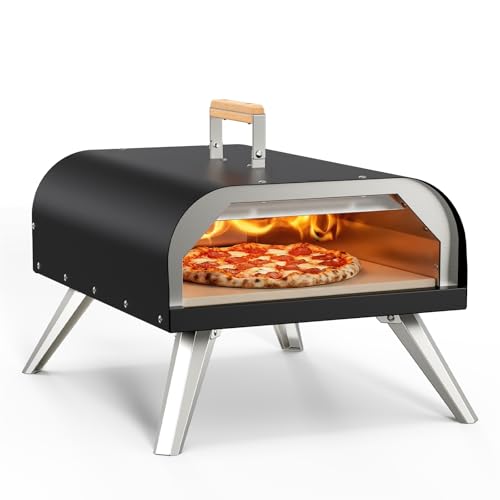
The WOOCIT earns attention first for a rarity in this category: its listing title actually commits to a number, describing a 12-inch multi-fuel outdoor oven that reaches 720°F, working as a wood or propane pizza cooker, portable for backyard, camping and tailgating — with the propane burner sold separately, as the title itself notes. That last clause matters and we repeat it deliberately: buy this oven for its wood fire, and treat the propane path as an accessory decision for another day, because the burner is not in the box. Judged as a wood oven, the WOOCIT is a compact, honest proposition — a stated heat reach that sits comfortably in the range where New York-style and hybrid crusts thrive, in the portable 12-inch class that heats quickly and travels well.
Seven hundred and twenty degrees deserves context rather than disappointment. The Neapolitan fringe chases higher figures, but the broad middle of home pizza — topped family pies, foldable slices, flatbreads — bakes beautifully in the low-to-mid 700s, with more margin for error and less carbonised rim. A compact oven that states its reach plainly is also easier to buy wisely than a larger oven that states nothing: you know the bargain you are making. The WOOCIT’s bargain is size and candour in exchange for ceiling and included kit — no peel or cover is named in its title, so budget for the tools separately, as with any bare-oven listing.
- Fuel judged here: wood; propane possible via a burner the title notes is sold separately
- Format: 12-inch portable oven
- Stated reach: 720°F, as printed in the listing title — the only stated figure in this guide
- Included kit: no peel or cover is named in the title — plan to add the basics
- For the WOOCIT’s current listing terms, check price on Amazon before ordering
Strengths
- A stated temperature figure lets buyers judge with open eyes.
- Compact format heats quickly and travels easily.
- An optional propane path exists later for owners who want it.
Trade-offs
- The propane burner is a separate purchase, not an included mode.
- Its stated ceiling sits below the Neapolitan fringe’s ambitions.
- Tools and cover are not named in the listing — extra shopping required.
Best for: campers and realists who value a stated spec and a small footprint. Not suited for: buyers expecting a complete kit or the highest heat class.
How the Six Wood Burners Stack Up
| Oven | Fuel as listed | Stone or capacity | Signature feature |
|---|---|---|---|
| BIG HORN OUTDOORS 12 Multi-Fuel | Wood and pellets among three modes | 12-inch class | Pellet fallback inside a portable shell |
| EDOSTORY Wood-Fired | Wood | Size not stated in title | Grill rack and waterproof cover bundled |
| PIZZELLO 16 Wood Fired | Wood | 16-inch, two layers | Removable rack doubles the fire’s output |
| Giantex Wood Fired | Wood | 12-inch, two layers | Folding legs for genuine travel |
| Mimiuo Auto-Rotating Pellet | Wood pellets | Rotating stone; listed at 40 lbs | Automatic spinning evens the bake |
| WOOCIT 12 Multi-Fuel | Wood first | 12-inch | Stated 720°F reach in the title |
Fire Management Is the Whole Craft: Building, Feeding and Reading a Small Fire
Everything else in this guide is commentary on one skill. A pizza fire is built in stages: a small, bright kindling fire first, allowed to establish real flame; then wrist-thick pieces, added as the earlier ones catch; then a steady working fire pushed to the side or back of the firebox so that flame rolls across the oven’s ceiling while the stone below absorbs the heat. The beginner’s instinct — build the biggest fire immediately — produces the classic failure: a roaring, smoky furnace whose stone is still cold in the middle, because flame heats air quickly and stone slowly. Time, not violence, saturates a stone. Give the fire its stages and the oven becomes calm: bright flame, thin smoke, a stone that has drunk the heat down to its core.
Feeding is a rhythm, not an event. Small pieces, added little and often, hold a fire in its clean-burning band; a large log dropped on a settled fire smothers it into smoke and drops the temperature it was meant to raise. Read the smoke as your instrument panel: white, billowing smoke means wet fuel or a starved fire; a thin blue-grey shimmer means clean combustion; no smoke and a wavering flame means the fire is eating itself and wants feeding within the minute. The door or opening is your other control — every peek is a heat tax, and every unnecessary opening resets the stone’s climb. Experienced wood cooks look lazy from the outside. They are not lazy; they are declining to interfere with a system that punishes interference.
Hardwood, Pellets and Chunks: Choosing Fuel That Burns the Way You Cook
Dryness outranks species. A piece of oak at high moisture will smoke, spit and underperform beside a piece of humble pine burned truly dry — though for pizza ovens the hardwoods earn their reputation on the second axis, density: dense wood burns longer per piece, throws steadier coals, and asks less often to be fed. Fruitwoods bring a gentler smoke that flatters delicate toppings; oak and beech bring stamina. What matters most is the supply chain of your own garden: a fuel you can source dry, store dry and cut to firebox size will beat a theoretically superior wood that arrives damp and stays that way. Pellets, the Mimiuo’s diet, abolish the whole question by manufacturing uniformity — every pellet the same size and dryness — which is why pellet fires behave like appliances while hardwood fires behave like weather.
Size your fuel to the firebox, not to the log store. Small ovens want small splits: pieces you can add two at a time without dismantling the fire’s structure. Keep a session’s worth beside the oven in a dry box, because walking to the woodpile mid-bake is how stones cool and pizzas wait. And respect the ash: a thin bed insulates and protects, a deep bed chokes airflow, so rake and remove between sessions rather than letting the firebox fill with the archaeology of previous evenings. Cooks who move between outdoor fire and indoor roasting will recognise the same discipline in Best Countertop Ovens for Roasting, where heat management is electric but the principle — know your heat source’s temperament — is identical.
A First Wood-Fired Session, Walked Through Slowly
Choose a calm evening and a forgiving menu: two or three plain pizzas, dough you have made before, no audience beyond family. Build the fire in stages as described above and let the oven heat far longer than feels necessary — the first session’s stone saturation teaches you your oven’s true preheat time, a number you will use all season. While the fire settles, stretch the first dough and keep toppings dry and sparse. Launch when the smoke has thinned to a shimmer and the flame is rolling rather than billowing, and expect imperfection: the first pie is tuition. Turn it when the fire-side edge colours, retrieve it a touch early rather than a touch late, and write down — actually write down — what the fire looked like and how long the bake took.
Between pizzas, feed the fire one small piece and close the oven while you build the next pie; the rhythm of bake, feed, build, launch will assemble itself by the third pizza. Finish the session by letting the fire die down on its own rather than dousing it, and leave ash removal for the cold morning after. Then, on some later evening when rain closes the garden entirely, remember that the indoor branch of this hobby exists too — the electric countertop ovens covered elsewhere on this site keep pizza night alive when the wood pile is soaked and the sky is worse. The two disciplines are cousins, not rivals.
Smoke, Neighbours and Siting: Where a Wood Oven Should Live
A wood oven announces itself. Even a clean fire perfumes the garden, and a badly managed one fumigates the street, so siting is a social decision as much as a thermal one. Place the oven where its chimney smoke rises clear of your own windows and, as far as your plot allows, downwind of the neighbours you like. Check local rules before the first fire rather than after the first complaint: some municipalities treat outdoor ovens under open-burning rules, and some housing developments restrict solid fuel entirely. None of that is a reason for gloom — it is a reason for the clean-burning discipline this guide keeps returning to, because a well-run pizza fire produces remarkably little smoke once it is hot, and most neighbour friction comes from the smoky lighting phase, which a dry kindling start shortens to minutes.
The ground beneath matters too. Sparks and embers fall; a stone, gravel or paved standing area is the right floor, not decking you love or grass in a dry August. Keep a metal bucket for ash, a clear working space for the peel’s swing, and a route to the kitchen that does not pass through the children’s game. Two-layer ovens like the PIZZELLO and Giantex add one more siting thought: their racks invite longer cooking sessions, which means the cook stands by the fire longer — put the oven where standing is pleasant, in sight of the table, not exiled behind the shed.
Wood-Fired Mistakes That Smoke Out Beginners
Damp fuel is the first and commonest, and it disguises itself as an oven fault: endless smoke, reluctant heat, a stone that never quite arrives. The second is the bonfire fallacy — a fire built for spectacle rather than for the stone, roaring early and collapsing just as the first pizza launches. Third is feeding in lumps: long neglect followed by a log avalanche, which swings the oven between starvation and smothering and produces a different pizza every time. Fourth is launching by the clock instead of by the fire — the oven is ready when the smoke thins and the stone has had its time, and no timer knows your fuel, your weather or your firebox the way your eyes can learn to.
A fifth mistake is subtler: judging the whole category by the first two sessions. Wood cooking front-loads its difficulty; the fifth fire is unrecognisably easier than the first, and owners who quit at two never meet the oven they actually bought. Finally, do not store a wood oven wet, ash and all, under a cover that traps the damp against the steel — clean it cold, dry it, and let air move. The ovens in this guide are simple machines; nearly all of their failures are fuel, water or patience wearing a disguise.
The Second Layer, Taken Seriously: What a Removable Rack Actually Cooks
Two of the six ovens — the PIZZELLO 16 and the Giantex — carry a removable cooking rack that creates a second layer, and EDOSTORY bundles a grill rack as well, so the idea deserves more than a bullet point. A rack above or beside the main chamber harvests heat that would otherwise leave through the chimney, and it changes a pizza session into a small wood-fired kitchen. The natural repertoire is anything that loves fierce, dry heat and forgives imprecise timing: blistered peppers that slump into sweetness, corn in its husk, sausages rendering over the fire’s edge, a cast-iron pan of mushrooms, flatbreads that puff and spot in a minute. While the stone below handles pizzas in sequence, the rack handles the rest of the meal in parallel, and the cook stops being a single-dish attendant and becomes the manager of a small, hot economy.
There is technique in it. The rack runs hotter and less evenly than the stone, closer to the flame’s path, so it suits robust foods and punishes delicate ones; a tray of cherry tomatoes is a joy, a fillet of fish is a gamble. Rotate pans as you rotate pizzas, keep a glove that you trust, and remember that everything on the rack drips downward — position accordingly, so that sausage fat baptises the fire and not the next pizza’s stone. Used this way, the second layer is also the answer to the wood oven’s oldest criticism, that it burns a serious fire to cook a light meal. A fire that produces pizza, grilled vegetables and a pan of something sizzling has earned its woodpile. Owners who never lift the rack out of its wrapping, by contrast, bought a feature and stored it; if that sounds like your household, the simpler single-layer ovens in this guide will serve you just as honestly for less.
Seasoning, Cleaning and Putting a Wood Oven Away for Winter
A wood oven’s first fire should be a small one, and not because of superstition. New stones and new steel both benefit from a gentle curing burn that drives off moisture and manufacturing residues before the first full-temperature session; an oven slammed straight to maximum heat from the crate can crack a stone that would have lasted a decade. After that, the care regime is mostly restraint. Ash comes out cold, with a metal scoop into a metal container, never into anything plastic and never the same evening it burned. The stone is brushed, never washed — water and detergent are a stone’s enemies, soaking into its pores and threatening it with steam fractures at the next firing — and stains on the stone are ignored with the serenity they deserve.
The shell wants drying more than polishing: a cover that fits, like the waterproof covers bundled with the EDOSTORY, PIZZELLO, Giantex and Mimiuo, is a genuine longevity feature rather than a bonus, because a steel oven stored dry outlasts a finer oven stored damp by years. Before winter, run one last hot, clean fire to dry the interior thoroughly, empty the ash completely — damp ash is corrosive company for steel — and check folding legs, hinges and rack fittings while the oven is cold and the light is good. Pellet owners add one step: empty the pellet store, because pellets absorb moisture across a winter and swell into a paste that no auger forgives. None of this is burdensome. It is the same seasonal rhythm as putting away garden furniture, and it is the difference between an oven that opens its fifth spring like its first and one that opens it as a restoration project.
What Size Firebox Suits Your Household? Reading the 12-Inch and 16-Inch Divide
This guide splits cleanly at size: four ovens in the 12-inch class and one — the PIZZELLO — at sixteen, with the EDOSTORY’s dimension unstated in its listing. The divide is not about quality; it is about the physics of fire and the sociology of dinner. A 12-inch oven heats its small stone quickly, burns modest fuel, and bakes personal pizzas in sequence, which suits households that eat in waves and camps that cook under a sky. Its fire is a sprint: easy to light, easy to hold, quick to forgive. A 16-inch oven is a commitment of fuel and time in exchange for sharing-size pizzas and a stone with genuine heat zones to exploit — the experienced cook’s instrument, and the gathering’s centrepiece.
The honest test is your last three pizza nights, not your next party. If the household’s pattern is two people and a film, the big oven’s preheat will quietly tax every session until sessions become rarer, and rarity is how ovens die. If the pattern is six relatives and a long table, the small oven’s sequence will bottleneck the evening and its cook will spend it apologising beside the fire. There is also the matter of the fire itself: a larger firebox swallows larger fuel and holds a longer working fire, while a compact box wants small splits fed often — two different physical relationships with the woodpile, and worth picturing your own hands doing before you choose. Size, in this category, is temperament wearing a tape measure.
Reading Heat Without Instruments: Flour, Hands and the Look of the Stone
Most of these ovens ship without a thermometer named in their listings, which sounds like a deprivation until you learn that wood cooks read heat the way sailors read weather — by signs. The oldest test is flour: scatter a pinch on the stone and watch. If it browns gently over twenty seconds, the stone is in the friendly middle range; if it blackens almost on contact, you are at fierce heat and should launch decisively or let the fire settle; if it barely colours, the stone is still drinking and the fire wants time, not dough. A second sign is the oven’s own complexion: soot on the interior roof burns away as the oven reaches full working heat, so a roof that has cleaned itself to pale is announcing readiness more honestly than any dial. A third is the flame’s shape — long, lazy, rolling flame licking across the ceiling is a baking fire; short, furious jets are a fire still building its bed of coals.
Your hand, held near — never in — the oven’s mouth, becomes a rough gauge with practice, feeling the difference between warmth and the push of radiant heat that means business. None of this replaces an infrared thermometer for the cook who wants repeatability, and adding one is the cheapest upgrade in this entire guide. But learning the signs matters even with instruments, because a wood fire is a moving target: the number you measured falls while you build the pizza, rises while it bakes, and the signs tell you which direction it is travelling. That sense of direction — is my oven climbing, holding or fading — is the real instrument of wood cooking, and it is why the fifth session feels so different from the first. The fire has not changed. Your reading of it has.
The True Cost of Wood: Money, Storage and the Evenings You Get Back
A wood oven’s purchase price buys the machine; its ownership price is paid in three other currencies. The first is money, and it is smaller than people fear: a household burning seasoned hardwood bought by the bag spends modestly per session, and a household with its own supply of prunings and stormfall spends nearly nothing but effort. The second currency is space — a dry fuel store near the oven, an ash container, room for the oven itself under cover — and in a small garden that space is genuinely contested, which is one honest reason the compact ovens in this guide exist. The third currency is time: the staged lighting, the longer preheat, the morning-after ash. Wood cooking is slower to start than gas by design, and no oven in this guide can repeal that.
What the currencies buy back is harder to price. A wood fire gives a garden an event rather than an appliance cycle — people gather around a fire in a way they never gather around a gas burner, and pizza night becomes the evening’s entertainment instead of merely its catering. The flavour is real but it is honestly the smaller prize; the larger one is the ritual, and rituals are what households keep. This is why the recommendation logic of this guide keeps returning to temperament: the household that experiences the lighting ritual as a pleasure will cook weekly and consider the oven cheap at any price, while the household that experiences it as a chore will cook monthly and consider the same oven a garden ornament. Both households are right about themselves. The six picks differ mainly in how much ritual they demand — the Mimiuo least, the big PIZZELLO most — and choosing well is mostly a matter of pricing your own patience honestly.
The Second Shift: Bread, Roasts and the Cooling Oven After Pizza Night
A wood oven’s evening does not end with the last pizza, because a saturated stone and a dying fire hold hours of declining heat, and traditional cooks have always taxed that decline. The sequence writes itself: pizzas at full fierce heat first; then flatbreads and rack dishes as the fire settles; then, with the fire raked out or burned down to embers, the oven becomes a roaster for a chicken or a tray of roots that wants steady, enveloping warmth; and finally, at the gentle end of the curve, loaves of bread go in to bake in the stored heat, emerging with the kind of crust that only a masonry-hearted chamber gives. Not every oven in this guide is built for the full sequence — the compact 12-inch ovens cool faster than the big PIZZELLO, and the pellet Mimiuo follows its own logic — but every wood oven offers some version of the second shift, and planning for it transforms the economics of the fire. One lighting, three courses.
There is a morning-after version too. An oven that held bread heat at midnight may still be warm at dawn, and in households that bake regularly the rhythm of firing once for two days’ cooking is the oldest pattern in this entire category — older than pizza itself. Even if your ambitions stop at pizza, knowing the curve exists changes how you cook: you stop treating the preheat as a cost and start treating it as capital, spent across the whole evening rather than on a single course. That mental shift, more than any accessory, is what separates the owners who fire their ovens weekly from the owners who fire them on birthdays. Readers still deciding whether fire is even their fuel will find the wider field — gas, electric and dual-fuel beside wood — weighed in Best Pizza Ovens, and there is no shame in letting that comparison talk you out of the woodpile; better a gas oven used weekly than a wood oven admired monthly.
Final Recommendation
Choose by temperament. The cook who wants the craft in its classic form, at a size that travels, should take the Giantex and its folding legs; the cook feeding crowds should take the PIZZELLO 16 and put its second layer to work every session. EDOSTORY’s bundle suits the camper who wants one box and no shopping list. The BIG HORN 12 is the flexible doorway — wood when you want it, pellets when the pile fails — and the WOOCIT is the honest compact for buyers who like a stated figure. The Mimiuo stands apart as the automation answer, wood flavour with the turning done for you, and there is no shame in that answer at all. A wood oven rewards the household that shows up for it, fire after fire, until one evening the smoke runs thin and blue and the crust comes out blistered — and the whole learning curve suddenly reads as the price of admission you were happy to pay.
Frequently Asked Questions
What wood should I burn in a pizza oven?
Dry hardwood is the standard answer — oak, beech and fruitwoods all serve well — but dryness matters more than species. Fuel should be seasoned, stored under cover and split small enough for a compact firebox. Avoid treated, painted or resinous softwood offcuts; they foul the oven and the flavour alike.
How long does a wood pizza oven take to heat?
Longer than the flame suggests. The fire can look ready while the stone is still drinking heat, and most of these ovens reward a patient, staged preheat measured in tens of minutes. Your first sessions will calibrate your own oven; write the time down and trust it thereafter.
Are pellets really wood-fired?
Yes — pellets are compressed wood with no flame but wood behind them, and a pellet oven like the Mimiuo produces genuine wood-fire flavour with appliance-like consistency. What pellets remove is not authenticity but variance: the fire behaves the same in all weathers, which some cooks prize and others miss.
Can I use a wood-fired oven in a small garden?
Usually, with discipline. A clean-burning fire, a sensible position away from windows, and a check of local rules cover most situations. The compact 12-inch ovens in this guide — the BIG HORN, the Giantex, the WOOCIT — were designed with small plots and campsites in mind.
Do wood-fired ovens work in winter?
They work beautifully, with two adjustments. Cold air and cold steel lengthen the preheat, so build the fire earlier and let the stone saturate without rushing it; and wind becomes a real variable, stealing heat from the oven’s mouth and worrying the flame, so a sheltered position earns its keep from November onward. The reward is disproportionate: a fierce little fire in a cold garden, pizzas eaten indoors with the smell of woodsmoke still in your jumper, is one of the great small pleasures of owning one of these ovens. Several owners in cold climates report winter sessions as their favourites of the year — the fire matters more when the night is dark at five. Just keep the fuel store dry, because winter-damp wood is the one opponent no oven in this guide can out-cook.
Why do most listings here not state a temperature?
Because a wood fire’s heat is a condition the cook creates, not a factory setting, and many manufacturers decline to print a figure they cannot guarantee. This guide reports stated figures where they exist — the WOOCIT’s 720°F — and marks the rest as unstated rather than inventing numbers.
Related Guides
Fire cooking has a slower, smokier branch that shares this guide’s fuel and much of its craft: Best Wood Smokers for BBQ follows the same hardwood discipline at low temperatures over long hours. Master the small fierce fire here, and the long gentle one there will feel like family.


