What's inside
- Ground Rules of the Stick-Burning List
- The Offset Six in Brief
- How This Field Was Chosen, and What Was Refused
- The Six on Their Stated Numbers
- Fire Is the Ingredient: Splits, Smoke Quality, and the Thin Blue Line
- The Pellet Question, Answered Fairly and in Prose Only
- Running an Offset Without Ruining Dinner or the Smoker
- The Woodpile: Sourcing, Splitting, and Seasoning Your Fuel
- Anatomy of a Brisket Day on an Offset
- Cold Weather, Wind, and the Smoker’s Enemies
- Backyard Blunders That Waste Good Wood
- Final Recommendation
- The Modification Culture: Gaskets, Plates, and Knowing When to Stop
- Your First Five Cooks: A Progression That Teaches the Fire
- Assembly, Clearances, and the Safety Paragraph That Matters
- Questions From Beside the Firebox
- Related Guides
As an Amazon Associate I earn from qualifying purchases. This post may contain affiliate links at no extra cost to you.
cottageverdict.com is reader-supported. When you buy through links on our site, we may earn an affiliate commission.
How these smokers reach you: each offset below is sold through its Amazon listing, where you can check price on Amazon and — just as important with freight-weight steel — read the delivery and assembly terms before ordering. An offset smoker arrives as a heavy box of steel parts; know whose driveway it lands on and whose afternoon assembles it.
The best wood smokers for BBQ are not appliances in the modern sense, and this guide will not pretend otherwise. Every pick below is an offset smoker: a horizontal cooking chamber with a firebox bolted to its side, built to burn split logs or charcoal, demanding that a human being tend its fire for the length of the cook. No pellets, no auger, no app, no thermostat doing the thinking — pellet grills are a different fuel system and a different philosophy, and they appear in this guide only as prose contrast, never as picks. What the offset offers in exchange for its labour is the thing pellet convenience cannot counterfeit: meat cooked in the actual smoke of actual wood, managed by a cook who learns fire the way musicians learn an instrument, by practice, failure, and afternoons.
The field divides by airflow. Three Oklahoma Joe’s models anchor the mainstream — the Highland, the Longhorn in reverse-flow configuration, and the Laredo 1100 — because the brand has done more than any other to put real offsets in ordinary backyards. A Dyna-Glo vertical offset answers the small patio with height instead of length. Char-Griller’s Smokin Pro brings the dual-damper, side-firebox tradition at 1,130 square inches of stated cooking area, and a heavy-steel VEVOR with six adjustable grates closes the list as the value-led wildcard. Stated cooking areas run from 900 to 1,130 square inches where titles give them — and this guide will explain why that number, worshipped by marketing, is one of the least honest figures in barbecue.
Who should read on? Anyone who has eaten brisket from a stick-burner and understood that the flavour was a place as much as a recipe — the bark, the smoke ring, the rendered fat — and who has the weekends to chase it. Who should not: anyone whose honest self-assessment says the fire-tending will become a chore by the third cook, because an offset resented is an offset rusting, and the pellet prose below will point those readers to their happier machine without a whisper of shame. Barbecue rewards the matched pair of cook and cooker, and matching is this guide’s whole method. Cooks who enjoy heavy steel and slow craft in the kitchen as well will find a kindred patience in Best Commercial Pasta Machines, where the machinery is likewise honest, manual in spirit, and indifferent to shortcuts.
Ground Rules of the Stick-Burning List
- Every pick burns split logs or charcoal in an offset firebox. No pellet grill appears as a pick — pellets are a different fuel system, covered in prose only.
- Stated cooking areas, where titles give them: Highland 900, Longhorn 1060, Laredo 1100, Smokin Pro 1,130 square inches.
- Reverse flow is named by exactly one pick — the Longhorn — and it changes how heat and smoke travel the chamber.
- The Dyna-Glo is the vertical exception: its chamber stands up, trading footprint for height.
- No title here promises set-and-forget cooking, because no offset can keep that promise honestly.
The Offset Six in Brief
| Smoker | Our tag | The case in one line |
|---|---|---|
| Oklahoma Joe’s Highland Offset | The classic starter offset | Nine hundred square inches of traditional offset layout from the backyard’s defining brand. |
| Oklahoma Joe’s Longhorn Reverse Flow | Even-heat flagship | Reverse-flow baffling evens the chamber for cooks who hate hot spots. |
| Oklahoma Joe’s Laredo 1100 | Big-chamber sibling | The largest stated area in the Oklahoma Joe’s trio, in the same traditional layout. |
| Dyna-Glo Wide Body Vertical Offset | Small-patio vertical | A wide-body vertical chamber that cooks upward where ground space is scarce. |
| Char-Griller Smokin Pro | Damper-tuner’s grill-smoker | Dual damper control and a warming rack across 1,130 stated square inches. |
| VEVOR Offset Smoker | Heavy-steel value wildcard | Six adjustable grates, a thermometer, and air vents in heavy-duty steel. |
How This Field Was Chosen, and What Was Refused
The screen was a single question of fuel and geometry: does the title describe an offset smoker that burns wood or charcoal in a side firebox? That question admitted the six below and refused a crowd of worthy machines on principle — pellet grills, however excellent, because their fuel arrives as manufactured pellets fed by an auger and their smoke is a managed by-product rather than the cook’s raw material; electric and propane smokers, because their heat is not fire; and kettle grills with smoking accessories, because an accessory is not an architecture. The refusal is not a ranking of worth. It is a definition, kept cleanly, because “wood smoker” must mean the wood is the point.
One more piece of scene-setting belongs here, because first-time offset buyers consistently misjudge it: these are outdoor instruments with an outdoor footprint and an outdoor appetite for storage. The smoker itself wants its pitch; the woodpile wants a dry, raised home of its own; the charcoal, the tools, the water pan, and the cook’s chair all colonise the surrounding metre. A household should walk its intended site with a tape and a honest eye before ordering the larger bodies in this guide — the Longhorn and the Smokin Pro especially — because a smoker that crowds its patio will be resented in exact proportion to its size, and resentment, as this guide keeps saying, is how offsets die.
Within the six, the ordering follows the backyard’s real decision tree. The Highland is the tradition’s front door. The Longhorn answers the tradition’s chief complaint — uneven heat — with reverse-flow engineering. The Laredo serves the cook who already knows the layout and simply needs more of it. The Dyna-Glo solves the patio that cannot fit a horizontal chamber. The Smokin Pro splits the difference between grill and smoker for households that want one steel body doing both. And the VEVOR is the specification-led gamble for buyers who read steel and grates the way others read badges. As throughout this programme, titles’ silences are recorded in the spec boxes — steel thickness, the single most consequential figure in offset life, is stated by almost nobody, and this guide says so rather than guessing at gauges.

Oklahoma Joe’s Highland Offset — The classic starter offset
The Highland is the offset most backyard cooks start on, and its title is a model of plain speaking: offset charcoal smoker grill, 900 square inches of cooking area, black. The layout is the tradition itself — firebox low on the right, long horizontal chamber, chimney at the far end — so heat and smoke are drawn across the meat by the stack’s pull, entering hot near the fire and leaving cooler at the far end. That gradient is the offset’s character and its curriculum: the new cook learns to rotate meat, to read the chamber’s hot and gentle zones, and to manage a fire in splits rather than in settings. Nine hundred square inches hosts a couple of briskets or a small crowd’s worth of ribs, which is to say it hosts the cooks this tradition is actually made by.
As a grill, the same body sears over charcoal in the main chamber, which makes the Highland the one-steel answer for households whose barbecue life is mostly grilling with a smoking ambition growing inside it. What the title does not state is steel thickness — the figure that decides how the chamber holds heat in wind and how many winters it survives — and buyers should hunt it in the documentation and the listing’s detail, because in offsets, mass is destiny. Season the steel before the first cook, keep the firebox’s ash cleared so air reaches the coals, and the Highland will teach its owner the whole craft at a scale a backyard can hold.
- Layout: traditional offset, side firebox, horizontal chamber
- Fuel as titled: charcoal — and the offset format burns split logs as its native craft
- Stated cooking area: 900 sq. in.
- Finish: black, per the listing title
- Steel thickness: the listing title does not state it — the manufacturer’s documentation is where the gauge is confirmed
- Acquiring the Oklahoma Joe’s Highland Offset: its Amazon listing carries it — check price on Amazon there and read the assembly terms before the box ships
Strengths
- The canonical layout from the brand that defined the backyard offset.
- Nine hundred square inches covers family cooks and first briskets honestly.
- It grills as readily as it smokes, suiting mixed barbecue households.
Trade-offs
- The traditional layout’s hot-to-cool gradient must be learned, not switched off.
- Unstated steel gauge leaves the longevity question to documentation.
- Like every offset, it wants a tender of the fire for the whole cook.
Best for: newcomers to stick-burning who want the tradition in its classic form. Not suited for: cooks who want even heat without learning fire management — read the Longhorn next.

Oklahoma Joe’s Longhorn Reverse Flow — Even-heat flagship
Reverse flow is the offset’s great refinement, and the Longhorn is its mainstream monument: 1060 square inches, titled plainly as a reverse flow offset charcoal smoker and grill. The engineering deserves the sentence it takes to explain. In a traditional offset, smoke enters the chamber beside the firebox and exits at the far chimney, cooling as it travels, so the fire end cooks fiercer than the far end. A reverse-flow design routes the smoke under a baffle plate to the far end first, then back across the meat to a chimney near the firebox — the long path evens the temperature, and the baffle itself becomes a radiant surface that smooths the chamber’s moods. Cooks who have fought hot spots with foil and rotation will feel the difference in their shoulders before they taste it in the brisket.
The Longhorn’s size suits the cook a season or two into the craft, the one whose Highland-era successes have created a waiting list. Reverse flow does not abolish fire management — splits still burn, ash still accumulates, wind still argues — but it removes the layout’s built-in unevenness so the cook’s attention can go to the fire itself, which is where it belongs. The title again omits steel thickness, and the same documentation hunt applies; at this size and ambition level, the gauge question matters even more, because a large chamber in thin steel is a sail in the wind’s hands. For the serious backyard, this is the guide’s flagship for a reason.
- Layout: reverse flow offset — smoke travels under a baffle, then back across the chamber
- Fuel as titled: charcoal, in a format built for wood splits
- Stated cooking area: 1060 sq. in.
- Finish: black, per the listing title
- Steel thickness: not given in the listing title — confirm the gauge in the manufacturer’s documentation
- Acquiring the Oklahoma Joe’s Longhorn Reverse Flow: sold via Amazon — check price on Amazon at the listing and plan the assembly space in advance
Strengths
- Reverse-flow baffling delivers the most even chamber in this guide.
- A 1060 square inch chamber feeds a genuine crowd without a second cooker.
- It grows with the cook: the refinement matters more the longer the cooks get.
Trade-offs
- It is the largest commitment of steel, space, and budget among the Oklahoma Joe’s trio.
- Reverse flow adds a baffle to clean and a more deliberate firebox routine.
- Thin-steel risk must be excluded via documentation, as with its siblings.
Best for: committed offset cooks who cook for crowds and hate hot spots. Not suited for: small patios or first-time smokers, for whom it is simply too much instrument.

Oklahoma Joe’s Laredo 1100 — Big-chamber sibling
The Laredo’s title is the shortest of the trio — Laredo Series 1100 offset charcoal smoker and grill, 1100 square inches, black — and its proposition is the simplest: the traditional layout, more of it. Eleven hundred square inches is the largest stated area among the Oklahoma Joe’s models here, in the classic configuration whose gradient the Highland teaches. For the cook who already manages fire confidently and whose problem is purely arithmetic — four racks of ribs where two used to do, a whole packer brisket beside the beans — the Laredo is the answer that does not ask them to relearn anything except scale. Bigger chambers hold their temperature with a certain momentum once established, and they forgive a slightly lazy hour at the fire better than small ones do.
Scale cuts the other way in two respects the title cannot show. A larger chamber takes longer to bring to temperature and eats more wood across a long cook, so the Laredo’s owner should think in terms of a woodpile, not a bag of splits bought on the morning. And its footprint is a patio decision: measure the space with the firebox door’s swing and the cook’s working room included, not just the body’s silhouette. Steel thickness, once more, is a documentation question — at 1100 square inches, it is the question on which the purchase stands or falls. Judged as what it is, the tradition at full size, the Laredo completes the trio honestly.
- Layout: traditional offset, side firebox
- Fuel as titled: charcoal, with the format’s native wood-split craft
- Stated cooking area: 1100 sq. in. — the trio’s largest
- Finish: black, per the listing title
- Steel thickness: the listing title leaves it unstated — the manufacturer’s documentation holds the figure
- Acquiring the Oklahoma Joe’s Laredo 1100: available through Amazon — check price on Amazon on its listing before committing the patio space
Strengths
- The largest Oklahoma Joe’s chamber here, in the layout experienced cooks already know.
- Thermal momentum steadies long cooks once the chamber is established.
- It grills and smokes across a genuinely crowd-sized area.
Trade-offs
- More chamber means more wood, more warm-up, and more patio.
- The traditional gradient remains; reverse-flow evenness is the Longhorn’s, not this one’s.
- Its size is wasted on households that cook for four.
Best for: experienced offset cooks whose limiting factor is chamber area. Not suited for: beginners, who should learn the fire on the Highland’s scale.

Dyna-Glo Wide Body Vertical Offset — Small-patio vertical
Every other smoker in this guide lies down; the Dyna-Glo stands up. Its title — Wide Body Vertical Offset Charcoal Smoker, model DGO1890BDC-D, black — describes a chamber that stacks its cooking space in height above an offset firebox, and the format is a genuine answer to a real constraint: the balcony, the narrow patio, the yard where a horizontal offset’s length simply has nowhere to go. Vertical chambers cook on multiple grate levels, and heat rising through them gives each level a slightly different character — a gradient in the vertical plane that experienced owners exploit by placing the forgiving cuts high and the delicate ones where the heat is kindest.
Wide body is the compensating phrase: the chamber is broader than the skinny verticals of memory, so briskets and racks lie flatter and the format’s capacity is honest rather than nominal. The title states no cooking area, which for a multi-level vertical is arguably the least useful number anyway — level count and grate dimensions, from the documentation, are the figures to plan with. Vertical offsets ask a different tending rhythm: the fire is managed at the base, doors open level by level, and a tall chamber in wind behaves like a chimney with opinions. For the space-poor cook who refuses to surrender the stick-burning craft to a smaller fuel, this is the guide’s most resourceful pick. Households furnishing the rest of a serious cooking life may cross-read Best Commercial Embroidery Machines with a smile — different craft, same devotion to machines that reward skill.
- Layout: vertical offset — stacked chamber above a side firebox
- Model: DGO1890BDC-D, per the listing title
- Fuel as titled: charcoal, in the offset wood-burning format
- Stated cooking area: the listing title gives none — grate dimensions and level count live in the manufacturer’s documentation
- Finish: black, per the title
- Acquiring the Dyna-Glo Wide Body Vertical Offset: listed on Amazon — check price on Amazon there and measure your patio’s height clearance as well as its floor
Strengths
- It brings true offset cooking to patios a horizontal chamber cannot fit.
- Multiple levels let different cuts ride different heights of heat.
- The wide body keeps its capacity usable rather than merely tall.
Trade-offs
- Vertical gradients must be learned level by level, like a new instrument.
- No stated cooking area makes capacity planning a documentation task.
- Tall chambers catch wind and need a sheltered, stable pitch.
Best for: space-limited cooks committed to real wood fire. Not suited for: cooks who want one vast flat grate for whole packer briskets side by side.

Char-Griller Smokin Pro — Damper-tuner’s grill-smoker
Char-Griller’s Smokin Pro carries the most complete title in this guide, and it reads like a love letter to control: a charcoal grill and offset smoker with a side fire box, dual damper control, a chrome-plated steel warming rack, and 1,130 cooking square inches, model CG30044223, in black. Dual dampers are the detail a fire-keeper seizes on — one governing the air entering the firebox, one the draw leaving the chimney — because fire management in an offset is, at bottom, air management, and two controls give the cook a finer hand on temperature than any single vent. The warming rack adds a gentle zone above the main grate, for holding finished cuts, warming sauces in their pots, and keeping the beans in the smoke’s neighbourhood without the chamber’s full force.
At 1,130 stated square inches it is the largest area in the guide, and its grill-first heritage shows in the proposition: this is the body for households whose Saturdays are burgers and steaks as often as briskets, with the firebox converting the same steel into a smoker when the day allows. The title does not state steel thickness — the standing documentation question of this entire category — and the chrome warming rack’s finish will ask for the same rust vigilance as any plated steel outdoors. But as a specification of intent, no title here promises the cook more agency, and agency is the offset tradition’s whole theology.
- Layout: offset smoker with side fire box, grill and smoker in one body
- Model: CG30044223, per the listing title
- Fire control: dual damper control, per the title
- Extras named: chrome-plated steel warming rack
- Stated cooking area: 1,130 square inches — the guide’s largest
- Steel thickness: not stated in the listing title — verify the gauge in the manufacturer’s documentation
- Acquiring the Char-Griller Smokin Pro: sold through Amazon — check price on Amazon at its listing, and budget assembly time for a big body
Strengths
- Dual dampers give the finest fire control of any title here.
- The largest stated cooking area, plus a warming rack’s gentle zone.
- A genuine grill-smoker double life suits mixed barbecue households.
Trade-offs
- Chrome-plated components need rust vigilance in outdoor life.
- Its grill heritage means smoking purists must still learn its chamber’s gradient.
- Big steel, big footprint — the patio must be measured, not assumed.
Best for: hands-on cooks who want damper-level control and grill versatility in one body. Not suited for: cooks seeking reverse-flow evenness, which remains the Longhorn’s argument.
VEVOR Offset Smoker — Heavy-steel value wildcard
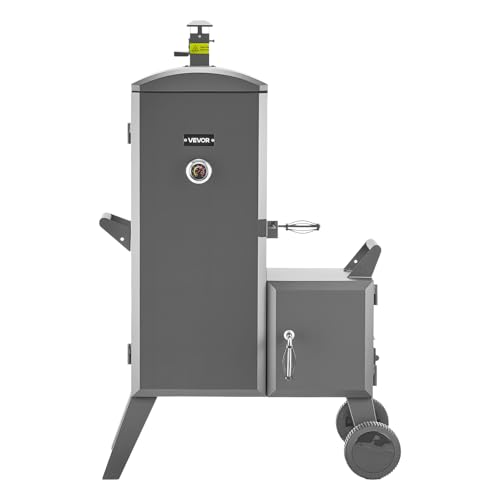
VEVOR’s title leads with the two words offset buyers care about most and hear least: heavy-duty steel. The full listing of claims runs to a side firebox, a movable body, six adjustable grates, a thermometer, and air vents, aimed at backyard and patio party cooking. Six adjustable grates is a chamber-flexibility claim worth pausing on — grate height and spacing decide whether the cook can set a tall butt high in gentle heat or crowd ribs across levels — and a fitted thermometer, however basic, acknowledges that chamber temperature is information a cook should not have to guess. Movable matters more than it sounds: an offset that can be wheeled into shelter lives longer than one that winters where it stands.
The wildcard element is the standing one for value-led steel: the title asserts heavy-duty without stating a gauge, and the documentation must convert the adjective into a number before the steel can be compared with the Oklahoma Joe’s bodies. VEVOR’s catalogue breadth means parts and support follow a different pattern from the barbecue specialists’, which experienced buyers will weigh calmly. On stated intent, though, this is a thoughtfully specced offset — adjustable grates, vents, a gauge on the lid, wheels under the weight — offered at the value end of a category where the mainstream names ask more for less adjustability. Specification-led buyers who verify the steel will know exactly what they own, which is more than adjective-led buyers ever do.
- Layout: offset smoker with side firebox, movable body
- Construction as titled: heavy-duty steel — gauge to be confirmed in the manufacturer’s documentation
- Grates: 6 adjustable grates, per the listing title
- Instrumentation and airflow: thermometer and air vents named in the title
- Stated cooking area: the listing title gives none — plan from the documentation’s grate dimensions
- Acquiring the VEVOR Offset Smoker: available via Amazon — check price on Amazon on the listing after the steel gauge is verified
Strengths
- Six adjustable grates give unusual chamber flexibility at its position in the market.
- Wheels and shelter-ability extend an offset’s working life materially.
- A fitted thermometer and named vents show the spec was written by someone who cooks.
Trade-offs
- Heavy-duty is an adjective until documentation supplies the gauge.
- No stated cooking area complicates crowd planning from the title alone.
- Value-brand support patterns differ from the barbecue specialists’.
Best for: specification-led buyers who will verify the steel and value adjustability. Not suited for: badge-led buyers who want the tradition’s established names.
The Six on Their Stated Numbers
| Smoker | Layout | Area as titled | Distinguishing claim |
|---|---|---|---|
| Oklahoma Joe’s Highland | Traditional offset | 900 sq. in. | The classic layout |
| Oklahoma Joe’s Longhorn | Reverse flow offset | 1060 sq. in. | Baffled, even heat path |
| Oklahoma Joe’s Laredo 1100 | Traditional offset | 1100 sq. in. | The trio’s largest chamber |
| Dyna-Glo Wide Body | Vertical offset | Not stated | Stacked levels, small footprint |
| Char-Griller Smokin Pro | Offset with side fire box | 1,130 sq. in. | Dual damper control |
| VEVOR Offset | Offset, movable | Not stated | Six adjustable grates |
Read the area column with the scepticism the next section teaches: it counts grates the way estate agents count rooms, generously and by their own rules, and it says nothing about the steel, the seals, or the fire — the things that actually cook.
Fire Is the Ingredient: Splits, Smoke Quality, and the Thin Blue Line
Everything in an offset reduces to combustion. The cook’s material is split wood — oak for its steady, neutral heat, hickory for assertion, fruitwoods for sweetness — seasoned until it burns clean, and sized to the firebox so each piece catches fully rather than smouldering at the edges. The smoke that flavours meat is the nearly invisible kind, the thin blue shimmer above the stack that signals complete combustion; the thick white billow of a choked fire carries the bitter compounds that ruin bark and reputations. Managing toward that shimmer is the craft: a small, hot fire fed little and often beats a large, lazy one, and the firebox door and dampers — the Smokin Pro’s dual controls exist for exactly this — are played like a stove’s burners, by air rather than by dial.
Charcoal’s role in these titles deserves its prose. Every pick is titled as a charcoal smoker, and charcoal is the tradition’s scaffolding: a bed of lit charcoal gives the firebox its stable base, into which splits are fed for smoke and flavour. Many cooks run their offsets exactly so — charcoal for the coal bed’s reliability, wood for the soul — while purists burn splits alone and accept the wider temperature swings as the price of authenticity. Neither camp is wrong, and the beginner is wise to start with the scaffolding: a charcoal base forgives the learning curve, and the wood still writes its name across the meat. What matters is that the heat source is real fire, tended by a person, which is the line this guide drew at the start and the line that separates every pick here from the pellet world.
The Pellet Question, Answered Fairly and in Prose Only
Pellet grills are good machines, and this guide’s refusal to pick one is a definition, not a verdict. A pellet grill burns compressed sawdust pellets fed by an electric auger to a thermostat’s command; the cook sets a temperature and the machine holds it, producing consistent, gentle smoke and freeing the afternoon entirely. For weeknight ribs, for the household that wants smoke flavour without a fire-tending hobby, for anyone whose Saturdays are spoken for — the pellet grill is not a compromise but the correct tool, and no honest guide should sneer at it. It is excluded here because the search was for wood smokers, and a pellet grill’s relationship to wood is that of a photograph to a landscape: related, derived, and not the thing itself.
The flavour difference is real but should be stated precisely. Stick-burned barbecue carries a deeper, more complex smoke character, the product of whole wood combusting across a range of temperatures in a human-managed fire; pellet smoke is cleaner and lighter, which some palates prefer and competition judges increasingly reward for its consistency. The labour difference is not subtle at all: an offset asks for a split every half hour or so across a brisket’s long cook, through the night if the brisket is large, and that asking is either the hobby’s joy or its deal-breaker. Choose by the afternoon you want to have, repeated fifty times — that is the only honest test, and both answers are respectable. Restaurant kitchens facing the same labour-versus-craft equation at commercial scale will recognise it from Best Coffee Machines for Restaurants, where the manual machine and the automatic one divide the counters the same way.
Running an Offset Without Ruining Dinner or the Smoker
Season before you smoke. A new offset’s interior carries manufacturing oils that belong in a burn-off fire, not on a brisket: run the chamber hot and empty for several hours, wipe the grates with a high-heat oil as it cools, and let that first fire also teach you the firebox’s appetite and the stack’s draw. Thereafter, the rituals are few and absolute. Clear the firebox’s ash after every cook, because ash holds moisture against steel and chokes the next fire’s air. Keep the cooking chamber’s grease from pooling where it can flare or turn rancid. Oil the grates while they are warm from a cook, and shelter the body — a cover, a garage corner, the VEVOR’s wheels earning their keep — because an offset’s enemy is not use but weather.
During the cook, the disciplines are thermal. Preheat the chamber fully before meat enters; a cold chamber’s walls steal the first hour’s heat. Keep the stack damper open and govern the fire at the intake, since a choked exhaust makes the bitter smoke this guide warned about. Open the chamber rarely and briefly — every inspection costs heat the fire must repay — and trust a thermometer’s probe in the meat over a schedule’s promise. Rest what you cook, wrapped and held warm, for the unglamorous interval that turns good brisket into the kind people remember. None of this is technique for its own sake; it is the operating manual of every machine in this guide, written once for all six.
The Woodpile: Sourcing, Splitting, and Seasoning Your Fuel
An offset is only as good as its woodpile, and the pile is a project with a calendar. Split wood seasons by drying — months of air and sun after splitting, until the pieces are light for their size, bark loosening, ends checked with cracks, and a struck pair rings rather than thuds. Green or damp wood is the single largest cause of the bitter, smouldering cooks that give beginners their discouraging first season, and no smoker in this guide can rescue it, because the flaw enters with the fuel. Buy splits by the stacked volume from a supplier who can name the species and the felling season, or split your own if the trees and the winters allow; either way, the pile should be raised off the ground, covered on top, and open at the sides to the wind.
Sizing is the pile’s second discipline. Splits should match the firebox — in these backyard offsets, pieces roughly the length of a forearm and the thickness of a wrist burn in the small, hot pattern the craft prefers. Oversized rounds smoulder at their cores and tempt the cook into the choked, white-smoke fire; kindling-thin pieces vanish before they coal. Keep two sizes by the smoker: the cooking splits, and a handful of smaller kindling for reviving a fire that has burned lower than intended. A hatchet by the pile and a moisture meter in the drawer are the tradition’s only real instruments, and both together cost less than one ruined brisket.
Species strategy can stay simple for the first year. Build the repertoire on one steady wood — oak where it grows, otherwise the region’s reliable hardwood — and learn the firebox’s behaviour on it before experimenting. Then introduce a second species as an accent, in the last hours of a cook, the way a cook finishes a sauce: hickory to deepen pork, cherry to redden and sweeten poultry’s skin. Barbecue regions argue their woods the way wine regions argue grapes, and the arguments are part of the pleasure — but they are arguments among people who first learned to burn one wood cleanly.
Anatomy of a Brisket Day on an Offset
The brisket is the offset’s examination, and its timeline teaches the format better than any manual. The fire is lit before dawn — a charcoal base, then splits — and the chamber is given its full preheat while the meat, trimmed and seasoned the night before, loses its fridge chill on the counter. The first hours are the smoke’s working hours, when the meat’s surface is cool and receptive and the cook’s only job is the thin blue line: small splits, steady air, no peeking. By mid-morning the bark has set — dark, firm, fragrant — and the cook wraps or rides through the stall, the long plateau where evaporating moisture holds the temperature hostage and beginners panic. The offset cook does not panic; the offset cook adds a split and makes coffee.
Afternoon belongs to patience and probes. The meat is done not at a temperature but at a tenderness — the probe sliding in with the resistance of warm butter — and the resting that follows, wrapped and held, is as much a part of the cook as the fire was. Total elapsed time will be somewhere in the low teens of hours, of which the cook was actively working for perhaps ninety minutes, distributed in the half-hourly rhythm of splits. That distribution is the offset’s truth: it does not ask for labour so much as for presence, and the households that thrive with these six smokers are the ones whose Saturdays have room for presence — a garden to potter in, a book, a family orbiting the smoke. The brisket is the excuse; the day is the product.
Cold Weather, Wind, and the Smoker’s Enemies
Wind is the offset’s chief adversary, stealing heat from the chamber’s walls and arguing with the stack’s draw, and every owner learns to pitch the smoker in shelter — firebox oriented so gusts do not blow straight into its intake, a fence or wall breaking the prevailing weather. Cold itself is a lesser problem than its reputation: a hot fire in a sound chamber holds temperature in winter perfectly well, at the price of more wood, and winter smoking has its devotees for exactly the reason summer cooks flee the kitchen — the cook stands by a fire, in the cold, doing something ancient, while the house stays cool. Rain is the true misery, cooling the steel and soaking the woodpile’s top layer, and it is defeated by preparation rather than character: a sheltered pitch, dry splits under cover, and the humility to postpone a cook the weather has genuinely claimed.
Steel thickness returns here in its practical form. A heavy chamber wall is a flywheel, smoothing the temperature’s swings when a gust hits or a door opens; a light wall transmits every disturbance to the meat. Since the titles in this guide leave gauges unstated, the winter-minded buyer should treat the documentation hunt as a cold-weather question specifically — and every buyer should plan the smoker’s pitch with the same care as its purchase, because placement is the modification that costs nothing and changes everything.
Backyard Blunders That Waste Good Wood
The first is buying by square inches, the category’s emptiest number: area counts every grate at its most generous, while cooks live by usable area at smoking temperature, which depends on steel, seals, and airflow — the unglamorous figures the titles mostly omit. The second is thick white smoke mistaken for flavour, the beginner’s signature error, cured by a smaller, hotter fire and patience. The third is the unseasoned first cook, brisket sacrificed to factory oil. The fourth is neglecting ash and weather until rust writes the smoker’s ending early — offsets die of neglect in gardens, not of use at fires.
Fifth, do not buy the Longhorn’s scale for a Highland household, or the Highland for a crowd: chamber size should match the cooks you actually host, because an oversized chamber burns extra wood to heat empty air on every small cook. Sixth, respect the fire’s neighbourhood — an offset is a live-fire appliance that wants clearance from fences, decking, and overhangs, a stable level pitch, and a cook who stays on the property while it burns. The romance of the all-night brisket includes the alarm clock; that, too, is part of the tradition being bought.
Final Recommendation
Start where the tradition starts: the Highland, unless your patio forbids its length, in which case the Dyna-Glo’s vertical takes the same craft upward. Graduate to the Longhorn when hot spots have become your personal enemy and crowds your habit, or take the Laredo when the layout is loved and only the area runs out. Choose the Smokin Pro if your Saturdays split between grilling and smoking and your hands want dampers to play, and the VEVOR if you will verify its steel and prize its adjustable grates. Above all, buy the fire you will actually tend — because the best wood smoker is the one still smoking, tended and seasoned and blackened with use, on the hundredth Saturday after the novelty wore off.
The Modification Culture: Gaskets, Plates, and Knowing When to Stop
Offset owners modify their smokers the way sailors modify boats, and a new buyer should know the culture’s honest core before its excesses. The worthwhile modifications answer the physics this guide has described: felt or rope gaskets on the chamber and firebox doors, sealing the leaks that bleed heat and smoke; a baffle or tuning arrangement in traditional-layout chambers, borrowing a little of the Longhorn’s evenness; a stack extension where draw is weak. Each is cheap, reversible, and aimed at the fire’s behaviour rather than the smoker’s appearance. The culture’s excesses — cosmetic chrome, gadgetry that measures everything except whether the cook is paying attention — can be admired at other people’s pits and safely skipped at one’s own.
Two cautions govern all of it. Modify after the smoker is known, not before: a season of stock cooks teaches where your specific unit leaks and drifts, and a gasket fitted to an imagined leak is decoration. And modify reversibly, especially in the warranty’s early life, because a drilled hole is a commitment and a clamped or felted seal is a conversation. The smokers in this guide were chosen as complete instruments; the modifications are for the second season, when the cook and the chamber have grievances against each other that only the cook can name.
Your First Five Cooks: A Progression That Teaches the Fire
Begin with chicken halves, the tradition’s kindest lesson: a short cook, forgiving meat, and smoke flavour that announces itself clearly, so the new cook learns the fire’s rhythm in an afternoon with dinner as the reward. Follow with ribs, which extend the cook and introduce wrapping and tenderness judgement at a scale that fits in one hand. Third, a pork butt — the most forgiving of the long cooks, nearly impossible to ruin, and the brisket’s rehearsal in every skill except difficulty. Fourth, the brisket itself, on a day with nothing scheduled after it. Fifth, repeat whichever cook disappointed you, because the tradition’s real curriculum is iteration: the same cut, the same wood, one variable changed, and a notebook that remembers what the palate forgets.
Across all five, keep the notebook. Record the wood, the weather, the fire’s behaviour, the timings, and the result in the plainest language you own. Five cooks of notes will teach more than fifty videos, because they describe your smoker, your woodpile, and your wind — the three variables no one else’s content can know. By the fifth cook the offset will have stopped being a purchase and become a practice, which is the transformation this entire guide has been describing.
Assembly, Clearances, and the Safety Paragraph That Matters
An offset arrives as a flat-packed argument in steel, and its assembly deserves an unhurried afternoon, a second pair of hands for the chamber’s lift onto its legs, and the discipline to tighten everything in the order the manual prescribes. Seams that will leak smoke for a decade are made or prevented at this stage: mating surfaces aligned before bolts are torqued, the firebox seated squarely, the stack fitted true. Run the seasoning burn described earlier before any food is involved, and use it to find the leaks your gaskets will later address — smoke escaping at a door’s corner is information, delivered free, exactly once at the ideal moment.
Placement is a safety decision before it is a convenience one. The smoker wants a level, non-combustible surface, clear space around the firebox’s door swing and the cook’s working side, and distance from fences, siding, overhangs, and the house’s open windows, which will otherwise admit the cook’s triumph as the bedroom’s atmosphere. Local rules on open fires vary and govern; children and pets are briefed by the simple expedient of a marked boundary during cooks, because a firebox door at shin height is at exactly a toddler’s eye level. Ash disposal closes the safety loop: embers hide in ash for a day and more, so ash goes into a metal container with a lid, on a non-combustible surface, and nowhere near the woodpile it could so easily introduce itself to. The tradition is old, and its safety habits are part of its inheritance — keep them with the same pride as the brisket method.
Questions From Beside the Firebox
What wood should a beginner burn first?
Oak, if it is available, because it burns steadily and its smoke is forgiving — present without bullying the meat. Add hickory in pieces for pork when confidence grows, and fruitwoods such as apple or cherry for poultry and ribs where sweetness flatters. Whatever the species, it must be seasoned and dry; green wood smoulders into the bitter smoke every beginner is warned about.
How often does an offset need tending during a long cook?
Expect to feed the fire in small splits roughly every half hour to forty-five minutes, with brief checks between, adjusted for wind, wood, and chamber size. That rhythm is the craft’s defining commitment — plan the day around it, with the cook’s chair, book, and refreshments stationed accordingly, rather than resenting it as an interruption.
Why is reverse flow considered better?
It is considered more even, which is a specific virtue rather than a universal one. By routing smoke beneath a baffle before it crosses the meat, a reverse-flow chamber narrows the temperature difference between its ends, so less rotation is needed. Traditional-layout cooks counter that the gradient is a tool — hot end for searing finishes, cool end for holding — and both philosophies produce great barbecue in practiced hands.
Can these smokers grill as well as smoke?
The titles say so for most: the Oklahoma Joe’s trio and the Char-Griller are titled as smoker grills, with charcoal grilling in the main chamber over direct heat. The Dyna-Glo’s vertical format and the VEVOR’s title emphasise smoking, so grill-led households should weight the dual-life models. One steel body doing both is the backyard economy most families actually need.
Do I need a water pan in an offset?
Many cooks run one, placed where the fire’s heat enters the chamber, where it steadies temperature swings and adds humidity that helps smoke cling to the meat’s surface. Others find their chambers moist enough from the meat itself and skip it. Treat it as an experiment your notebook can settle in two cooks rather than a doctrine — the offset tradition’s only real doctrine is clean fire.
What is the stall, and should I wrap through it?
The stall is the long plateau in a big cut’s temperature, caused by evaporative cooling at the meat’s surface balancing the chamber’s heat. It is normal, it can last hours, and it ends on its own. Wrapping the meat in foil or butcher paper speeds the passage and softens the bark’s crust; riding it out unwrapped keeps the bark firmer and costs time and wood. Neither is the correct answer — they are the tradition’s two dialects, and your notebook, after a cook of each, will tell you which one your household speaks.
How long will an offset smoker last?
As long as its steel and its owner’s habits agree. Kept sheltered, ash cleared, grates oiled, and rust touched early, a sound offset cooks for many years; left weathered with a firebox full of damp ash, the same steel can perforate in a few seasons. Because titles rarely state the gauge, the documentation check before buying — and the shelter habit after — are the two halves of longevity.
Related Guides
For the ground the smoker stands on and the outdoor room around it, Best Affordable Outdoor Rugs covers the patio layer that completes a cooking corner — read it when the steel is placed and the space around it deserves the same care.


