What's inside
- Key Takeaways
- Quick Picks
- How Were These Brewers Chosen for Dining-Room Reality?
- Best Coffee Machines for Restaurants, Pot Against Pot
- Pourover or Plumbed: Which Refill Religion Should a Restaurant Choose?
- How Long Can Brewed Coffee Honestly Sit Before It Embarrasses the Kitchen?
- What Does the Health Inspector Care About That the Menu Never Mentions?
- How Does Coffee Service Shape a Dining Room’s Economics?
- Which Beans Survive the Warmer, and How Should a Restaurant Buy Them?
- What Should the Second Station Look Like When One Brewer Stops Being Enough?
- Which Buying Mistakes Do Restaurants Make With Coffee Equipment?
- How Should Servers Be Trained to Run the Coffee Station?
- Why Do Breakfast Rooms and Dinner Rooms Need Different Coffee Logic?
- Final Recommendation
- Frequently Asked Questions
- Related Guides
As an Amazon Associate I earn from qualifying purchases. This post may contain affiliate links at no extra cost to you.
cottageverdict.com is reader-supported. When you buy through links on our site, we may earn an affiliate commission.
Restaurant coffee is a volume business disguised as a beverage. The best coffee machines for restaurants are not the machines that make the most interesting cup; they are the machines that make the four-hundredth cup of the day taste like the first, at the speed a dining room actually orders. In a diner, a family kitchen, or a hotel breakfast room, coffee moves by the pot and the urn, not by the shot — refills are a service rhythm, tables turn on it, and the server carrying a fresh carafe is doing more for the room’s mood than any dessert trolley. So this guide is drip-led and urn-led on purpose. Espresso appears only as context, because the restaurants that shop this page overwhelmingly sell brewed coffee by the river, not espresso by the trickle.
A word about how to buy from this list, because restaurant purchasing has its own channel logic: all six machines below are sold through Amazon, each pick linked to its own listing, which suits restaurants fine — a brewer that dies on a Friday can be replaced without a sales rep’s calendar getting involved. The homework sits with the buyer instead. Warmers, carafes, water connections, and counter runs are all specified in the titles and spec boxes here; measure your pass counter before you fall for a dual-head machine, because a brewer that does not fit under the shelf fits nowhere at all.
The honesty convention of this guide is simple and it governs every number that follows: figures are quoted only where the listing title states them. Cup capacities, carafe counts, warmer counts, and the one throughput rating on the page all come from titles. Where a title keeps quiet — brew time, element wattage, footprint — the spec box marks the silence rather than papering over it, because a restaurant buyer planning a service station around an invented number is worse off than one planning around a known blank.
Key Takeaways
- Two BUNN pourover brewers anchor the list: the VPR, a 14.4-litre class machine in stainless and black, and the VP17-1SS, a single-warmer pourover for smaller rooms.
- The NUPANT dual drip brewer is the throughput pick — its title claims 200 cups an hour, a 7.2-litre auto-filling system on a water line, four carafes, and four warmers.
- The VEVOR dual-head brewer splits the difference: 24-cup class brewing across two heads, with four glass carafes and four decanter warmer plates included.
- The SYBO 100-cup urn is the banquet and breakfast-room instrument — a 16-litre percolating urn for service where coffee is poured by guests or from a station, not brewed to order.
- Pourover machines (the BUNNs and the SYBO 12-cup) need no plumbing and can be repositioned overnight; plumbed auto-fill machines trade that freedom for never running dry mid-service.
Quick Picks
| Brewer | Station it runs | Reason it is on this page |
|---|---|---|
| BUNN VPR Pourover | The diner pass | The classic restaurant pourover in a 14.4-litre class, stainless and black, with no plumbing to install. |
| BUNN VP17-1SS | Small-room service | A single-warmer pourover brewer for restaurants whose coffee trade is steady rather than huge. |
| VEVOR Dual-Head 24-Cup Brewer | Two-pot rush coverage | Dual heads, four carafes, and four warmer plates so regular and decaf never share a pot. |
| SYBO 12-Cup Pour Over | Compact counter brewing | ETL certified, with a reusable brew basket, spray head, and two glass carafes in the box. |
| SYBO 100-Cup Urn | Banquets and breakfast rooms | A 16-litre, 100-cup percolating urn built for catering-scale service. |
| NUPANT Dual Drip Brewer | High-volume auto-fill | Water-line fed, rated in its title at 200 cups an hour, with four carafes and four warmers. |
How Were These Brewers Chosen for Dining-Room Reality?
The first filter was service pattern, not specification. A restaurant brewer earns its place by surviving the brunch rush and the Tuesday lull with equal grace: brewing fast enough that a fresh pot is never the reason a table waits, and holding coffee kindly enough that the pot brewed at eleven still pours respectably at noon. Every pick below was read against that double duty, and machines that were merely large — big without a service idea behind them — did not make the page.
The second filter was the refill question, which splits the list in two. Pourover brewers ask a human to carry water to them, and in exchange they can be installed anywhere with an outlet and repositioned when the room changes. Auto-filling brewers on a water line ask for plumbing once and then remove the refill errand forever. Neither answer is wrong; they are answers for different buildings and different staffing. Restaurants that also run events away from the dining room should note how often the mobile trade solves the same problem with carried equipment — the thinking in Best Coffee Machines for a Mobile Business about matching machine to venue transfers surprisingly well to banquet work.
A note on what did not decide anything: styling. Restaurant brewers are working equipment that happens to be visible, and every pick here is stainless or stainless-and-black because that is what survives a commercial room, not because this guide has a position on dining-room fashion. A brewer that photographs beautifully and cleans badly will be hated by the closing shift within a month, and the closing shift’s opinion, in the long run, is the one that decides how the coffee tastes.
The third filter was carafe logistics. Coffee in a restaurant lives in glass carafes that get dropped, thermal pots that get lost between stations, and urns that get rolled. Titles that state how many carafes and warmers are in the box were favoured, because the second carafe is not an accessory in a dining room — it is the difference between brewing ahead and brewing behind. A brewer sold with one carafe and no warmers is a brewer whose true price includes a shopping trip the listing does not mention.

BUNN VPR Pourover — The diner standard, no plumbing required
The VPR is the brewer a generation of American diners was built around, and its title tells the story plainly: a Pour-O-Matic VPR coffee brewer in the 14.4-litre class, finished in stainless steel and black. Pourover means the water goes in by hand, pot by pot, and that apparent limitation is the machine’s strategic strength. There is no water line to run, no plumber to schedule, and no fixed position the brewer is married to. A restaurant can open with the VPR on the pass, move it to a service station in the spring, and lend it to the function room in December, and the machine will not object to any of it.
What a restaurant buys with a BUNN of this class is predictability. The pourover format has been refined over decades of diner service into something close to a kitchen appliance archetype: fill, brew, pour, repeat, with a spray pattern and brew basket geometry that the industry settled on because it works at volume. Servers learn it in an afternoon. New hires cannot really misconfigure it, because there is almost nothing to configure, and in a business where the coffee machine is operated by whoever is nearest, “almost nothing to configure” is a quality feature.
The honest costs are labour and ceiling. Every pot begins with a person carrying water, and during a slammed brunch that person is a server who should be carrying plates instead. Nor does a pourover brewer hold a candle to an auto-fill machine’s raw readiness across a long banquet. The VPR is the right answer for the enormous middle of the restaurant world — rooms doing strong, steady coffee trade without a banquet business attached — and it stays the right answer for years, which is more than most equipment purchases can claim.
One more consideration belongs in a buyer’s notebook: glassware discipline. Pourover diners run on glass decanters, and decanters break with the regularity of weather. Keep spares on the shelf, retire the ones with chipped lips before a guest finds the chip, and the VPR’s ecosystem stays cheap and cheerful. Restaurants that cannot keep glass intact — outdoor venues, high-turnover casual rooms with student staff — should read the thermal and urn picks below with extra attention before defaulting to the classic.
It is worth saying plainly why this older format still leads the guide. Restaurant equipment earns trust in decades, and the pourover BUNN pattern has been failing, being repaired, and being replaced like-for-like in American dining rooms longer than most of its competitors have existed. Parts, service knowledge, and staff familiarity follow that installed base. A first restaurant, with a hundred other gambles on its books, is entitled to choose the coffee machine that is not one of them.
- Format: pourover drip brewer — water added by hand, no water line needed
- Class: 14.4 litres as stated in the listing title
- Finish: stainless steel and black
- Warmers and included carafes: the listing title does not enumerate them — confirm the package contents on the product page
- Brew-cycle time: not given in the listing title; judge it by the pourover class rather than a promised figure
- Ordering note: the BUNN VPR Pourover — Amazon’s listing for this model shows the current package.
Strengths
- No plumbing means installation is a countertop decision, not a building project.
- A mature, widely understood format that any server can run correctly on day one.
- Portability lets the same brewer serve the dining room, the pass, or a function space as the week demands.
Trade-offs
- Manual water filling taxes staff time precisely when the room is busiest.
- Throughput is bounded by the pourover rhythm; banquet-scale demand outruns it.
- Glass decanter breakage is a recurring small cost of the format.
Best for: diners, family restaurants, and cafés-with-tables whose coffee trade is strong and steady. Not suited for: banquet operations or any room where coffee must appear in urn quantities without a human fetching water.

BUNN VP17-1SS — One warmer, small room, no drama
The VP17-1SS is the VPR’s smaller sibling with a clearly stated shape: a pourover coffee brewer with one warmer, in stainless steel, listed under its full model designation 13300.0001. That single warmer defines its restaurant. This is the brewer for the bistro doing forty covers, the sandwich shop with a loyal coffee crowd, the bed-and-breakfast dining room where breakfast is an occasion rather than a rush. One pot brews while one pot rides the warmer to the tables, and the rhythm of a small room is perfectly matched by that two-pot waltz.
There is a discipline argument for choosing small on purpose. A restaurant that brews a modest pot often serves fresher coffee than a restaurant that brews a huge pot rarely, because coffee’s enemy is time on heat, not batch size. The VP17’s scale forces the good habit: brew, serve, brew again. Rooms that have suffered through the last-cup-of-a-stale-pot problem — and every diner guest has tasted that cup — should recognise the single-warmer format as a freshness strategy wearing an equipment costume.
Stainless construction matters in this class more than buyers expect. A small restaurant’s brewer sits in public view, often on the pass or a side station where guests can see it, and stainless reads as clean even when the shift has been long. It also survives the chemical reality of a working kitchen — degreasers, sanitiser splash, the occasional collision with a tray — without the finish complaints that plague painted appliances in commercial rooms.
The ceiling is the same honesty as its sibling’s, drawn tighter. One warmer means one holding pot; a sudden coach party will expose that arithmetic rudely. Restaurants should buy this machine for the room they have, with the VPR or the dual-head picks below as the documented promotion path if covers grow. Bought at the right scale, it is the least regrettable money on this page.
- Format: pourover drip brewer with 1 warmer
- Model: BUNN 13300.0001 VP17-1SS, per the listing title
- Finish: stainless steel, silver
- Carafe count in the box: the title does not state it — verify before assuming a spare is included
- Water connection: none; pourover filling by hand
- Ordering note: the BUNN VP17-1SS — check its Amazon page for the current included accessories.
Strengths
- Small-batch rhythm keeps coffee fresher than oversized brewers idling on warmers.
- Stainless build suits guest-visible stations and commercial cleaning habits.
- The simplest possible install: an outlet, a counter, and a water jug.
Trade-offs
- One warmer caps the room at one holding pot during service.
- Manual filling still applies — no auto-fill convenience at any price here.
- Success tempts growth, and growth will outgrow it sooner than the bigger picks.
Best for: bistros, small dining rooms, and breakfast services where freshness beats volume. Not suited for: high-cover restaurants or any service where two pots must always be in play.

VEVOR Dual-Head 24-Cup Brewer — Two heads, four pots, decaf solved
The VEVOR’s title is a small manifesto: a commercial drip coffee maker in the 24-cup class with dual heads, sold with four glass carafes and four decanter warmer plates, in stainless steel, aimed at restaurants, offices, and homes. Dual heads change the politics of a restaurant’s coffee station. Regular and decaf stop competing for the same brewer, because each has its own head; a fresh pot can brew while a holding pot serves, on both sides of that divide at once. Anyone who has watched a server apologise to a decaf drinker for the fourth time in a shift understands that this is not a luxury feature.
Four warmers and four carafes in the box is the second half of the argument, and it is rarer than it should be. The machine arrives as a complete station rather than a starter kit — brew two, hold more, rotate through service without a carafe ever becoming the bottleneck. For a restaurant equipping a coffee station from nothing, that completeness has a cash value that a cheaper head-only brewer conceals until the accessory order is placed.
Stainless construction and the dual-head layout do impose a footprint, and the buyer should measure the service station with the carafes in place, not from the machine’s bare dimensions. Glass, again, is the format’s tax: four carafes in rotation means breakage is a budget line, not a surprise. Restaurants with clumsy service patterns should price spare carafes into the first order and store them where the station’s staff can reach them mid-service.
Positioned honestly, this is the middleweight champion of the list: more station than a single pourover, less infrastructure than the plumbed auto-fill at the end of the guide. Restaurants whose coffee trade is brisk at breakfast and lunch, with a real decaf constituency and no banquet urn work, will find the dual-head layout answering questions they did not know their old brewer was asking.
- Format: dual-head commercial drip brewer, 24-cup class
- Included: 4 glass carafes and 4 decanter warmer plates, per the title
- Construction: stainless steel
- Water supply: the listing title does not specify a plumbed connection — confirm the fill method on the product page
- Intended settings per title: restaurant, office, and home
- Ordering note: the VEVOR Dual-Head 24-Cup Brewer — its Amazon listing details the full station package.
Strengths
- Dual heads give regular and decaf separate brewing lives, ending the shared-pot compromise.
- Four carafes and four warmers arrive in the box — a complete station on day one.
- Brewing and holding happen simultaneously across the station, which is the brunch rush in miniature.
Trade-offs
- Glass carafes in fourfold rotation mean a standing breakage budget.
- The station footprint, carafes included, is the largest of the countertop picks here.
- Fill method is not stated in the title, so the plumbing question needs a product-page check.
Best for: mid-size restaurants with a genuine decaf trade and a defined coffee station. Not suited for: cramped passes where a single-pot brewer is already a squeeze.
SYBO 12-Cup Pour Over — The certified compact with a reusable basket
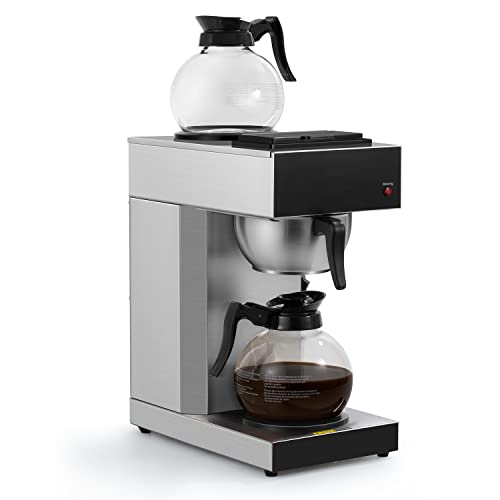
The SYBO SF-CB-2GA arrives with the most paperwork-forward title on this page: a 12-cup commercial pour over coffee maker, ETL certified, in stainless steel, with a reusable brew basket, a spray head, fast brewing, and two glass carafes included. Certification is not a glamorous selling point, but restaurant buyers should care about it more than home buyers do. Health inspectors and insurers both take an interest in commercial electrical equipment, and an ETL mark is the machine’s way of answering their questions before they are asked. In a home kitchen that is a nicety; in a licensed dining room it can be the whole conversation.
The reusable brew basket deserves its own paragraph, because it changes the machine’s running-cost shape. Paper filters are a forever expense and a stocking chore — trivial per pot, relentless per year. A reusable basket removes the line item and the 7 a.m. discovery that the filters ran out on Saturday. The trade is a rinsing habit: reusable baskets reward a rinse after every brew and punish neglect with a slow build-up that eventually flavours the coffee. Restaurants with a pot-washer routine already in place will find the habit free; restaurants without one should think honestly about which cost they would rather pay.
Two carafes in the box and a spray head worth naming round out the picture. The spray head is the extraction detail — even water distribution over the grounds is what separates a brewer from a kettle with plumbing — and SYBO’s title bothers to mention it, which counts in the machine’s favour under this guide’s title-first rules. Fast brewing is claimed in the title without a figure attached, so treat it as a class claim rather than a stopwatch promise.
Scale is the boundary. Twelve cups is a small restaurant’s pot, a café-restaurant hybrid’s second station, or a staff-room upgrade — not a banquet answer. Read it as the compact, certified, low-running-cost option for rooms whose coffee trade is real but proportionate, and it stands up well against larger machines asked to idle below their capacity.
- Format: 12-cup commercial pour over brewer, model SF-CB-2GA
- Certification: ETL certified, per the listing title
- Filter: reusable brew basket; spray head named in the title
- Included: 2 glass carafes
- Brew speed: described as fast in the title, with no timed figure stated
- Ordering note: the SYBO 12-Cup Pour Over — Amazon carries this model with its current bundle.
Strengths
- ETL certification answers inspector and insurer questions in advance.
- Reusable basket deletes a permanent consumable from the shopping list.
- Two carafes included means the brew-serve rotation works from the first day.
Trade-offs
- Twelve-cup scale suits small rooms and second stations, not banquet trade.
- The reusable basket demands a rinsing discipline paper filters never asked for.
- Glass carafes carry the usual breakage tax of the format.
Best for: small restaurants and hybrid cafés that want certified equipment and low running costs. Not suited for: high-volume rooms where a 12-cup pot is a rounding error.
SYBO 100-Cup Urn — Sixteen litres of breakfast-room patience
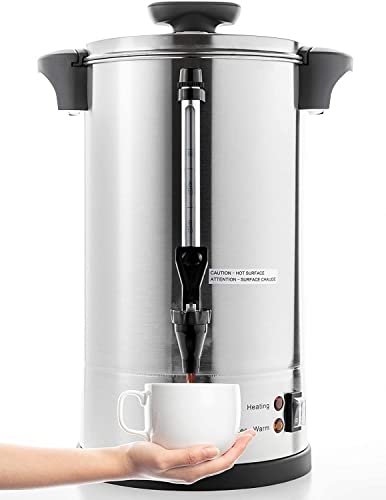
Every restaurant guide needs one machine that thinks in events rather than orders, and the SYBO SR-CP-100B is it: a commercial-grade stainless steel percolating coffee maker and hot water urn for catering, rated at 100 cups and 16 litres, in a metallic finish. An urn inverts the restaurant coffee problem. Instead of brewing small amounts constantly against demand, you brew one enormous amount once, before the doors open, and then spend the service pouring. For hotel breakfast rooms, wedding venues, conference catering, and the Sunday brunch that behaves like a wedding, that inversion is the difference between a coffee station and a coffee queue.
Percolation is the honest word in the title, and it deserves a clear-eyed sentence. A percolating urn recirculates coffee through the grounds, producing a bold, hot, crowd-pleasing cup that is nobody’s idea of a delicate extraction. Banquet guests are not scoring extraction; they want coffee that is hot, strong, and there. Judged by the standards of its actual job — a hundred cups, held well, served fast — the percolator urn is not a compromise but a specialisation, and restaurants should buy it as one rather than apologising for it.
The dual identity in the title, coffee maker and hot water urn, is operationally real. The same vessel that serves coffee at breakfast can serve hot water for tea at a conference, and venues that host both kinds of event get two appliances’ work from one footprint and one storage corner. Sixteen litres also means the urn is a piece of furniture when full — site it where it will serve, fill it there, and do not plan on carrying it anywhere until it is empty and cool.
Cleaning is the urn’s standing obligation. A vessel that holds coffee for hours builds residue that flavours tomorrow’s batch if the scrub is skipped, and percolator stems and baskets need the same attention as the tank. Venues that assign urn cleaning to the closing checklist get years of faithful service; venues that treat the urn as self-cleaning discover, around event three, why the coffee tastes like event two.
- Format: percolating coffee urn and hot water urn
- Capacity: 100 cups / 16L, as stated in the listing title
- Model: SYBO SR-CP-100B
- Construction: stainless steel, metallic finish
- Brew method note: percolation — a bold banquet extraction, not a drip profile
- Ordering note: the SYBO 100-Cup Urn — see the Amazon listing for this model’s current terms.
Strengths
- One pre-service brew covers event-scale demand without a mid-service brewing queue.
- Hot-water duty doubles the vessel’s usefulness across tea and conference work.
- Stainless construction suits both the buffet line’s appearance and its cleaning regime.
Trade-offs
- Percolated coffee is a banquet profile; drip purists will taste the difference.
- Full, it is effectively furniture — placement is a decision, not an adjustment.
- Residue discipline is mandatory; a neglected urn flavours everything after it.
Best for: hotels, banquet venues, caterers, and brunch rooms serving crowds from a station. Not suited for: à la carte restaurants where coffee is brewed to order by the pot.

NUPANT Dual Drip Brewer — The water-line machine that never waits to be filled
The NUPANT closes the list with the biggest claim any title on this page makes: a dual drip commercial coffee maker on a water line, rated at 200 cups an hour, with a 7.2-litre auto-filling system, four carafes, and four warmers, in stainless steel. Take the rating as a title claim rather than a tested figure — this guide quotes titles, it does not stopwatch them — but even discounted generously, the architecture is unmistakable. This is a brewer designed so that water, the ingredient every other machine on the page waits for, simply arrives.
Auto-filling changes staffing mathematics. The pourover picks above spend server minutes on water; this machine spends none, because the line feeds it. Across a four-hour brunch, those reclaimed minutes are a shift’s worth of table touches, and the coffee station stops being a place where staff disappear to. Dual brewing sides repeat the VEVOR’s regular-and-decaf diplomacy at higher volume, and four warmers keep the rotation deep enough that a fresh pot is a plan rather than a hope.
The installation is the price of admission, and it should be priced honestly. A water line means a plumber, a shut-off valve the staff can find, and a filtration conversation in any district where the tap water fights back — scale is the long-term tax on every plumbed brewer, and the time to negotiate it is before the line goes in. Restaurants in leased premises should also confirm that the landlord shares their enthusiasm for a new water connection, a five-minute conversation that is much harder after the hole is drilled.
Who should buy it? The restaurant whose coffee trade has outgrown pourover patience: the high-cover diner, the hotel restaurant doing its own breakfast service, the canteen feeding a workforce against a clock. For those rooms the NUPANT is not an upgrade to the BUNNs so much as a different species — infrastructure rather than appliance — and it should be budgeted, installed, and maintained with the respect infrastructure deserves.
- Format: dual drip commercial brewer with water-line connection
- Stated throughput: 200 cups per hour, per the listing title
- System volume: 7.2L auto-filling
- Included: 4 carafes and 4 warmers, per the title
- Construction: stainless steel
- Ordering note: the NUPANT Dual Drip Brewer — Amazon’s page for this model lists the connection requirements.
Strengths
- Auto-fill on a water line removes the refill errand from service entirely.
- The stated 200-cup hourly rating is the highest throughput language on this page.
- Dual sides plus four warmers sustain a regular/decaf rotation at real volume.
Trade-offs
- Plumbing, filtration, and landlord consent are part of the true purchase price.
- Fixed installation ends the pourover freedom to reposition the station overnight.
- Small rooms will pay for capacity their covers never use.
Best for: high-cover restaurants, hotel breakfast services, and canteens brewing against the clock. Not suited for: small dining rooms or any site where the coffee station moves with the seasons.
Best Coffee Machines for Restaurants, Pot Against Pot
| Machine | Water story | What the title promises | Room it fits |
|---|---|---|---|
| BUNN VPR Pourover | Hand-filled | 14.4-litre class pourover | The classic diner pass |
| BUNN VP17-1SS | Hand-filled | Pourover with 1 warmer | Bistros and small rooms |
| VEVOR Dual-Head 24-Cup Brewer | Confirm on listing | 4 carafes, 4 warmer plates | Mid-size rooms with decaf trade |
| SYBO 12-Cup Pour Over | Hand-filled | ETL certified, 2 carafes | Compact certified stations |
| SYBO 100-Cup Urn | Filled once, pre-service | 100 cups / 16L percolator | Banquets and breakfast rooms |
| NUPANT Dual Drip Brewer | Water line, auto-fill | 200 cups/hour, 7.2L system | High-cover, clock-driven rooms |
Pourover or Plumbed: Which Refill Religion Should a Restaurant Choose?
The decision is really about where a restaurant keeps its flexibility. Pourover brewers keep it in the room: the station can move, multiply, or shrink with nothing more than strong staff and an outlet map. Plumbed brewers spend that flexibility once, at installation, and buy back time every service thereafter. A young restaurant still discovering its layout should stay pourover; a settled restaurant with a fixed station and a known rush should plumb, and should stop re-litigating the decision every time a server carries a jug.
Staffing is the tiebreaker most buyers miss. A pourover station consumes attention in small, constant sips — a jug here, a pot check there — which a well-staffed room barely notices and a thin-staffed room feels as a constant low-grade theft. The restaurants that suffer most with pourover are not the smallest but the leanest: two servers, forty covers, and a brewer that wants a third pair of hands. Count hands before counting cups.
There is also a resilience argument for keeping one pourover machine in any plumbed house. Water lines get shut off for building work; auto-fill systems occasionally wait on a part. A hand-filled brewer in the back is the coffee equivalent of a spare tyre — unglamorous, rarely used, and the only thing anyone talks about on the day it saves service. Several restaurants run the NUPANT as the station and a VPR as the understudy, and sleep better for it.
How Long Can Brewed Coffee Honestly Sit Before It Embarrasses the Kitchen?
Shorter than most dining rooms pretend. Brewed coffee on a warmer plate is in slow decline from the moment the brew finishes; the first half hour is kind, the second is negotiable, and beyond that the pot is living on the room’s forgiveness. Warmer plates accelerate the decline by cooking the coffee gently and continuously, which is why high-turnover rooms — where a pot’s whole life is twenty minutes — can use warmers happily while slow rooms cannot.
The practical rules are boring and effective. Brew smaller pots more often in quiet dayparts, which is the VP17’s whole design philosophy. Date pots with a grease pencil or a timer card so “fresh” is a fact rather than a server’s guess. And never marry pots — topping a half-old pot with fresh brew produces a full pot of old-tasting coffee and saves nothing but thirty seconds. Kitchens police the age of everything else they serve; coffee deserves the same disrespect for optimism. The same freshness discipline, incidentally, is why the back-of-house conversation about volume equipment — the thinking behind Best Dishwashers With Black Panels on matching capacity to a real service load — applies to brewers word for word: buy for the covers you serve, then work the machine at the rhythm it was sized for.
What Does the Health Inspector Care About That the Menu Never Mentions?
Certification, cleanability, and water. The SYBO 12-cup’s ETL mark speaks to the first; every pick here should be assessed for the second before purchase — can the brew basket, carafe, and urn stem actually be scrubbed by the person closing tonight, with the chemicals the restaurant already stocks? Machines with awkward, residue-hiding geometries get cleaned badly and then not at all, and coffee residue is a flavour problem long before it is a compliance one.
Water is the third leg. Restaurant districts vary enormously in mineral content, and a plumbed brewer fed hard water will scale its boiler and spray head until brew temperatures and flow both sag. Filtration sized to the brewer’s throughput is not an upsell in hard-water postcodes; it is the difference between a five-year machine and a two-year one. Pourover houses are not exempt — the jug just moves the scaling problem from a line to a kettle, where at least it can be seen.
How Does Coffee Service Shape a Dining Room’s Economics?
Coffee is the highest-margin liquid most restaurants sell and the one they think about least. The ingredient cost of a pot is small; the real economics live in the refill. A table drinking a second pot is a table staying for dessert conversation, ordering the thing they were debating, and leaving with the warm feeling that becomes a return visit. A table waiting eight minutes for a refill because the brewer is mid-cycle and the spare pot was never brewed is a table doing arithmetic about the bill instead. Brewers, in other words, are retention equipment, and their throughput should be evaluated the way a kitchen evaluates its pass: by what happens to the room when it slows down.
That framing changes the purchase maths. The gap between a single-warmer pourover and a dual-head station looks like equipment money; measured against a month of lost second pots and unhurried desserts never ordered, it can look like the cheapest marketing the restaurant owns. Conversely, an urn bought for a banquet program that never materialises is not a bargain at any discount — it is storage with a power cord. The discipline is to cost the machine against the service pattern it will actually meet, which is why this guide keeps returning to till history rather than aspiration.
There is a labour footnote too. Coffee service is usually server labour, and server labour is the scarcest resource in the room at peak. Every design choice that removes a step from the refill loop — auto-fill instead of jug trips, a warmer beside the pass instead of across the kitchen, an urn guests pour themselves at a breakfast station — returns minutes to the floor. Restaurants that cost their brewers including the minutes, not just the money, consistently buy one size more sensibly than restaurants that shop on price alone.
Which Beans Survive the Warmer, and How Should a Restaurant Buy Them?
Drip coffee at restaurant scale is a different beverage from café drip, and the bean buying should admit it. The pot will sit; the cup will be drunk with food, often with milk and sugar, by people who want it recognisably coffee rather than delicately floral. Medium roasts with a forgiving extraction window are the workhorses here — they taste like themselves across a range of brew strengths and survive twenty minutes of warmth without turning on the drinker. The exquisite single-origin that shines for exactly four minutes in a pour-over bar is wasted money in a warmer pot, and it will be blamed on the brewer.
Consistency of supply beats brilliance of supply. A restaurant should choose a roaster who can deliver the same blend, ground or whole, on the restaurant’s ordering rhythm without drama, and should resist rotating guest beans through the house pot. Regulars experience the house coffee as part of the room’s identity; a pot that changes personality monthly reads as carelessness, not adventure. Save experimentation for a specials board with a small brewer of its own — the SYBO 12-cup would run a guest-bean program charmingly — and keep the main line boring in the best sense.
Decaf deserves a buying policy rather than an afterthought. Decaf drinkers are disproportionately loyal, disproportionately likely to be the person who chose the restaurant for a group, and completely unable to be fobbed off with a pot brewed at noon and warmed into the evening. Buy decaf in smaller quantities, brew it in smaller pots more often, and give it a dedicated head or brewer where volume justifies one — the dual-head picks exist largely because this paragraph is true. A restaurant that treats decaf as a first-class program will be rewarded by the most grateful constituency in the dining room.
Storage closes the loop. Beans and ground coffee should live away from the pass’s heat and the dish pit’s steam, in sealed containers, in quantities matched to a week’s trade rather than a quarter’s optimism. Stale inputs make every brewer on this page look worse than it is, and no equipment purchase can outrun them.
What Should the Second Station Look Like When One Brewer Stops Being Enough?
Growth rarely announces itself as a single leap; it arrives as a Friday that felt tight, then a month of tight Fridays. The correct response is usually not a bigger brewer but a second role. A dining room that adds a breakfast service needs an urn’s batch logic, not a faster pot. A room whose decaf complaints are rising needs a second head or a small dedicated brewer, not more warmers for the coffee it already makes well. Diagnose the bottleneck by drink type and daypart before spending, because each bottleneck has a different cheapest cure.
Placement matters as much as the machine. A second station near the dining room’s far end shortens every refill walk in the building, and servers will use the station that is near them and improvise around the one that is not. This is why the pourover picks retain value in grown restaurants: a VPR can colonise a new service point in an afternoon, with no plumbing and no permission from the building, and turn a distant corner of the room into covered territory.
The mature setup in many mid-size restaurants ends up looking like this guide’s table of contents: a plumbed or dual-head brewer as the engine, a pourover as the flexible understudy and satellite, and an urn that appears for events and breakfast crowds. None of the three makes the others redundant, because each was bought against a different hour of the week. Restaurants shopping for their second machine should therefore resist the urge to simply buy another of the first — duplication is only the right answer when the bottleneck is genuinely identical twins of demand.
Which Buying Mistakes Do Restaurants Make With Coffee Equipment?
The commonest is buying the brewer for the busiest imagined day and letting it sulk, oversized, through the other three hundred. The second is the reverse — a charming small brewer asked to serve a room that doubled its covers, brewing in a permanent state of apology. Both errors come from the same root: purchasing against a fantasy covers figure instead of the till’s actual history. Pull three months of coffee sales before you pull out a card.
Neglecting the carafe economy ranks next. Glass breaks, warmers get claimed by the soup station, and a brewer bought as a system quietly degrades into a single pot and a queue. Budget spares in the first order. Restaurants also under-plan the decaf question — a second head, a second pot, or a small dedicated brewer — until the decaf regulars, who are loyal and vocal, start voting with their feet. And in the kitchen itself, the same volume logic governs fresh pasta service, where the motorised rollers in Best Electric Pasta Machines reward exactly the same discipline: match the machine’s rhythm to the covers, or the machine will set the menu’s pace for you.
Finally, restaurants forget the closing shift. Brewers live or die by whether the last person at night rinses the basket, empties the urn, and wipes the warmer plates. Equipment chosen without asking “can a tired human clean this in four minutes?” will be cleaned in zero minutes, and the morning coffee will say so.
How Should Servers Be Trained to Run the Coffee Station?
Every machine in this guide is simple; coffee service still fails, because the failure is rarely mechanical. It is the pot nobody started, the decaf nobody mentioned was low, the urn nobody checked before the coach party sat down. Training should therefore be choreographic rather than technical: who starts the first pot, who owns the station at each daypart, what “low” means in pots rather than feelings, and what a server says to a table when the honest answer is four minutes. Rooms that write those four answers down stop having coffee problems that are actually communication problems.
The refill round is a service skill with its own etiquette. The best dining rooms treat coffee as a patrol rather than a request — the carafe circulates before cups are empty, the offer is made without interrupting conversation, and the check-back after a fresh pot is poured is the room’s easiest chance to catch a problem with the meal while it can still be fixed. Equipment supports that choreography or fights it: warmers near the pass shorten the patrol, a station across a crowded kitchen lengthens it, and an urn at a breakfast buffet removes the patrol entirely and replaces it with a stocking rhythm. Choose the machine that makes the choreography you want physically easy, because staff will always, eventually, do the physically easy thing.
New-hire training should include the closing ritual by name. Rinse the basket, empty and wash the carafes, scrub the urn when it has served, wipe the warmers, and set the station so the morning shift inherits a clean stage. Five minutes at night buys the first pot of the day its freshness, and the restaurants with the best morning coffee are almost never the ones with the best machines — they are the ones where last night’s closer and this morning’s opener are effectively on the same team.
Why Do Breakfast Rooms and Dinner Rooms Need Different Coffee Logic?
Breakfast is a beverage service with food attached; dinner is a food service with beverages attached, and the coffee equipment should know the difference. At breakfast, coffee is the main event’s opening act and its constant companion — guests drink it before food, with food, and instead of food, and they judge the room by its temperature and availability. That is urn and auto-fill country: batch logic, self-serve stations, and brewers sized so that no guest ever meets an empty pot. The SYBO urn and the NUPANT were practically designed in a breakfast room.
At dinner, coffee arrives at the end, in smaller quantities, often as the companion to dessert or the excuse to linger. Freshness outranks volume, and a small pot brewed at eight o’clock will beat a large pot brewed at six and defended ever since. Dinner-led restaurants should therefore resist breakfast-sized equipment: the VP17’s modest rhythm, or a single head of a dual brewer, serves the evening’s actual pattern, and the money saved buys the dessert program a better trolley.
Rooms that do both services — the hotel restaurant is the archetype — need the fleet thinking this guide has argued for throughout: batch capacity for the morning, small-pot freshness for the evening, and at least one machine that can cross between the two without embarrassment. That is not extravagance; it is the equipment finally matching the timetable the kitchen already keeps for everything else it serves.
Final Recommendation
Match the water to the room. Small and steady rooms should take the VP17 or the SYBO 12-cup and enjoy coffee that is always young; the classic diner pass belongs to the VPR; rooms with a real decaf constituency and a fixed station should step up to the VEVOR’s dual heads; venues serving crowds should let the SYBO urn think in events; and high-cover rooms tired of the jug errand should plumb in the NUPANT and never carry water again. Buy the size your till history describes, keep one pourover as the understudy, and the dining room’s coffee will quietly stop being a topic of conversation — which, for a restaurant, is the highest praise a brewer can earn — the room remembers the meal, the welcome, and the feeling of being looked after, and the coffee simply never gives anyone a reason to remember it for the wrong thing.
Frequently Asked Questions
Why is there no espresso machine in a restaurant coffee guide?
Because the restaurants this page serves sell brewed coffee by the pot. Espresso-led restaurants exist, but they shop with café logic — groups, boilers, baristas — and are better served by café guidance. Here, espresso is context; drip and urn volume is the subject. A restaurant that adds a small espresso offer later can treat it as a separate, café-style purchase rather than a reason to compromise the drip station that carries the room every day.
How many warmers does a restaurant actually need?
Enough to hold one pot per coffee type in play — typically regular and decaf — plus the pot currently serving. That arithmetic is why the dual-head, four-warmer stations exist. A single warmer suits rooms serving one coffee at a time, honestly counted.
Is a percolating urn’s coffee worse than drip?
It is different: bolder, hotter, and built for holding. For banquet and breakfast-room service, where coffee is poured across hours by many hands, that profile is a feature. For a small dining room brewing to order, drip’s delicacy wins — which is why both formats are on this page.
What does ETL certification mean for a restaurant buyer?
It means the machine has been tested to recognised safety standards by an accredited laboratory — the kind of evidence health inspectors and insurers like to see for commercial electrical equipment. It is not a quality score, but in a licensed premises it is often a practical requirement.
Should a restaurant filter the water for a plumbed brewer?
In hard-water areas, yes, as a condition of the machine’s lifespan. Scale attacks boilers and spray heads silently and shows up as sagging temperature and flow. Filtration sized to the brewer’s throughput is cheap insurance compared with descaling callouts.
Can one of these brewers handle a wedding at an outside venue?
The urn can — that is its native habitat, provided it is filled and brewed where it will serve. The pourover BUNNs travel well too, needing only an outlet. The plumbed NUPANT, by definition, stays home.
Related Guides
Restaurants building a cold-drinks program to sit beside the coffee station should read Best Coffee Machines for Iced Coffee, which covers the machines that handle the cold side of the menu with the same honesty about what their titles do and do not claim.


