What's inside
- Key Takeaways
- Quick Picks
- What Makes a Hot Brewer Good Over Ice?
- The Cold Lineup at a Glance
- How Do You Keep Iced Coffee From Tasting Watered Down?
- Which Format Wins for Iced Coffee: Pods, Grounds, or a Carafe?
- What Goes Wrong When People Ice Coffee at Home?
- Can These Machines Handle a Heatwave Week?
- Iced Coffee Meets the Rest of the Kitchen
- The Ice Itself: Cubes, Crushed, and Coffee Ice
- Sweetening Iced Coffee Without the Grit
- Iced Coffee for a Crowd: a Host’s Playbook
- What About Iced Lattes and Milk Drinks?
- Storing and Reheating: the Leftover Rules
- Reading the Calendar: When Iced Machines Earn Their Counter Space
- Travel Mugs, Commutes, and the Iced Morning Run
- A Skeptic’s Pass Over Iced Coffee Marketing
- Cleaning a Machine That Lives on Ice All Summer
- One Glass, Made Well: a House Method
- Decaf and Low-Acid Drinkers Are Welcome Here
- The Afternoon Ritual: Iced Coffee as a Day’s Hinge
- Final Recommendation
- Frequently Asked Questions
- Related Guides
As an Amazon Associate I earn from qualifying purchases. This post may contain affiliate links at no extra cost to you.
cottageverdict.com is reader-supported. When you buy through links on our site, we may earn an affiliate commission.
Where to buy: Amazon stocks every brewer in this roundup, and the shortlist table plus each review heading link to the matching listing. Iced-capable machines are frequently sold in seasonal bundles with pitchers or travel cups, so read what the box contains on the day you order — the brewer stays the same, the extras drift — and rely on the purchase note in each spec box to reach the current listing for that model.
Iced coffee fails in a predictable way at home: a perfectly decent hot cup, poured over a glass of cubes, melts half the ice on contact and arrives at the table tasting like coffee-flavored water. The best coffee machines for iced coffee exist to solve that one problem, and they solve it three different ways. Some brew a concentrated shot calibrated to survive the ice. Some brew hot coffee in a full carafe for a household that will ice it glass by glass. And one pick here, the Ninja CM371, cheats the calendar with a rapid cold brew mode that produces a cold-extracted drink in minutes rather than the overnight steep of a traditional pitcher. Understanding which trick you actually want matters more than any feature list, because a concentrate brewer and a carafe brewer serve different kitchens.
A boundary worth drawing before the picks: iced coffee and cold brew are cousins, not twins. Iced coffee starts hot and meets ice; cold brew never gets hot at all, steeping or extracting cold for a smoother, lower-acid profile. This guide covers machines that brew hot and serve cold, plus rapid-brew designs that blur the line. If your heart belongs to the slow, cold-steeped end of the spectrum, the dedicated roundup at Best Cold Brew Coffee Machines covers electric cold brewers in depth, and nothing in this guide pretends to replace it. What the machines below promise is a cold glass on a hot afternoon without planning yesterday.
The six picks split along honest lines. Two are flexible single-serve machines that accept pods and grounds. One is a two-way Keurig that adds a carafe for crowds. One is a classic two-way drip machine with an iced setting. One is a mini built for dorms and RVs. And one, the Homecraft, is really an iced tea maker that moonlights for coffee — included because its double-insulated pitcher solves the serving problem better than machines costing far more, and because sweet tea households deserve a nod in any iced drinks guide.
Key Takeaways
- Iced coffee here means brewed hot, served cold — the machine’s job is concentration, so the ice dilutes the drink to strength instead of below it.
- The Ninja CM371 is the most versatile pick, with four brew styles, eight sizes, a 12-cup carafe, and a rapid cold brew mode for impatient drinkers.
- Carafe models — the Keurig K-Duo and the Hamilton Beach 2-Way — suit households icing several glasses across an afternoon.
- The Tastyle Mini covers pods and grounds in a travel-sized body aimed at dorms, offices, and RV counters.
- The Homecraft pitcher maker is the budget path for sweet tea first and cold brew coffee second, with insulation that keeps a batch cold at the table.
- Ice quality is half the recipe: large, fresh cubes melt slower and protect any of these machines’ work.
Quick Picks
| Brewer | How it handles the cold | Buy it if |
|---|---|---|
| Keurig K-Duo Hot & Iced Single Serve & Carafe Coffee Maker (Gen 2) | Pods for one, carafe for many, with MultiStream saturation and a 72oz reservoir feeding both sides. | Your house swings between solo mornings and weekend crowds |
| Tastyle Mini Single Serve Hot and Iced Coffee Maker | A mini that takes K Cups and grounds across 6 to 14 ounce brews, with a recipe book for iced variations. | You brew in a dorm, RV, or one-person office nook |
| Ninja Pods & Grounds Iced Coffee Maker PB041ST | Single-serve over-ice brewing for pods or grounds, sized from a 6 ounce cup to a 24 ounce travel mug. | You want one machine fluent in both pods and fresh grounds |
| Ninja Hot & Iced XL Coffee Maker with Rapid Cold Brew CM371 | Four brew styles including rapid cold brew, eight sizes, and a 12-cup carafe in one footprint. | Your household cannot agree on one kind of coffee |
| Hamilton Beach 2-Way Drip Coffee Maker & Single Serve (Hot & Iced) | A 12 cup glass carafe on one side, single-serve hot and iced on the other, with an AquaFlow showerhead. | You want traditional drip value with an iced option attached |
| Homecraft Electric Iced Tea Maker for Sweet Tea and Cold Brew Coffee | Brews into a double-insulated pitcher that goes from machine to table without sweating or warming fast. | Sweet tea leads and coffee follows in your kitchen |
What Makes a Hot Brewer Good Over Ice?
Three qualities separate a machine that merely tolerates ice from one designed for it. The first is concentration control: an over-ice brew uses less water against the same coffee, so the melting cubes finish the dilution the machine deliberately left undone. The second is size honesty — an iced drink lives in a tall glass or travel mug, so brew sizes must reach 14, even 24 ounces, rather than topping out at a mug’s modest 10. The third is speed of service, because iced coffee is usually a response to heat and impatience; a machine that makes you brew, chill, and then ice adds a fridge wait that defeats the purpose on a July afternoon.
Beyond those, we weighed format flexibility — pods for speed, grounds for economy and taste, carafes for groups — and reservoir capacity, since iced drinks consume water and ice at a pace hot coffee never matches. Every figure in the spec boxes comes from the listing title of that brewer. When a title leaves a detail unspoken, the box marks it for checking rather than inventing a number, because iced settings and brew styles are exactly the features sellers describe loosely and buyers regret assuming.

Keurig K-Duo Hot & Iced Single Serve & Carafe Coffee Maker (Gen 2) — Pods on Weekdays, a Carafe on Saturdays
The K-Duo answers the most common household split in coffee: one person, one pod, no fuss on a Tuesday; a table full of people on Saturday who would empty a pod budget by brunch. Its single-serve side runs the familiar K-Cup routine, while the carafe side brews a pot for the crowd, and a 72oz reservoir — the largest water supply in this guide — feeds both without the constant refills that plague two-machine setups. MultiStream Technology carries over from Keurig’s better single-serve models, saturating grounds more evenly than a single needle stream.
The Hot & Iced name promises the carafe side can serve the summer version of that crowd, and that is where this machine earns its slot here rather than in a general Keurig roundup. A household that ices coffee by the pitcher — brewed in the morning, glasses filled across a hot afternoon — needs volume more than it needs a concentrated single shot. The Gen 2 designation signals the current revision of the Duo line, worth confirming on the listing since earlier generations circulate in the same search results wearing similar names. What the Duo does not do is grounds-based single servings; its solo side is pods only, so households wanting fresh-ground single cups should look at the two Ninjas below.
- Formats: single-serve pods plus carafe brewing
- Reservoir: 72oz, shared across both sides
- Extraction: MultiStream Technology
- Generation: Gen 2, per the listing title
- Carafe size: not printed in the listing title — confirm the cup count on the product page
- Households comparing the Duo generations can check price on Amazon on the Gen 2 listing.
Strengths
- One machine covers the solo pod ritual and the group carafe without doubling counter space.
- 72oz reservoir is the most generous water supply among these six picks.
- MultiStream saturation lifts pod extraction above basic single-needle brewing.
Trade-offs
- Single-serve side is pods only — no fresh-ground solo cups.
- Two brewing systems mean two sets of parts to rinse and descale.
- Its footprint is a family-sized commitment on a small counter.
Best for: mixed households whose coffee volume swings wildly between weekdays and weekends. Not suited for: solo drinkers, who would use half the machine, or grounds-only purists.
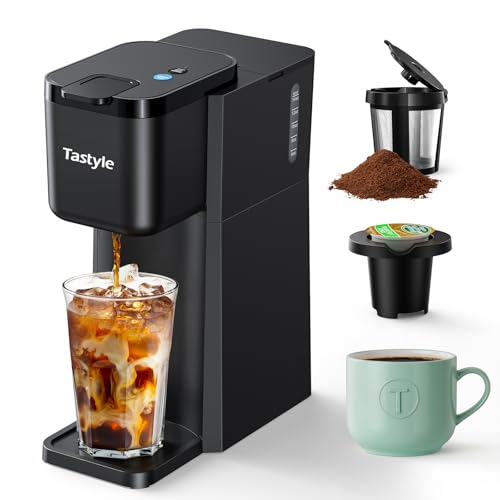
Tastyle Mini Single Serve Hot and Iced Coffee Maker — The Dorm-and-RV Iced Specialist
The Tastyle Mini is built for the counters other machines cannot use: the dorm desk corner, the RV galley, the office nook, the guest-room dresser. Its listing names those spaces outright — home, travel, RV, office, dorm — and the hardware backs the claim. It brews from 6 to 14 ounces, accepts both K Cups and loose ground coffee, and runs on standard 120V power, the detail RV owners check first because a machine that demands unusual power is a machine that stays home.
The included recipe book is a small but telling extra: this maker expects its owner to experiment with iced drinks rather than merely tolerate them, and a guided set of ratios helps a beginner land a sweetened iced coffee that is not a melted mess on the first try. The 14-ounce ceiling matters for iced service specifically — a tall glass packed with ice needs that headroom where a hot mug never does. Limits are the usual mini limits: one serving at a time, a modest water supply suited to its single-cup mission, and no carafe ambitions whatsoever. Within its brief, though, it is the most complete small-space answer in this guide, and the only pick designed from the start for people whose kitchen is also their bedroom, office, or vehicle.
- Brew sizes: 6 to 14 ounces
- Formats: K Cup pods and ground coffee
- Power: 120V, per the listing title (model K310IC, version 2.0)
- Extras: recipe book included
- Reservoir size: the listing title does not state it — look it up on the product page before ordering
- Dorm-bound buyers can check price on Amazon under the Tastyle Mini listing.
Strengths
- Pods and grounds in one travel-sized body doubles its usefulness in temporary spaces.
- 14oz top size fits a proper iced glass with room for the cubes.
- Recipe book shortens the trial-and-error phase for iced drinks.
Trade-offs
- Strictly one cup at a time — no help during a gathering.
- Mini scale means frequent water refills across a day of heavy use.
- No carafe or batch mode hiding anywhere in its repertoire.
Best for: students, RV travelers, and single-cup drinkers in tight quarters. Not suited for: families or anyone brewing for a table.

Ninja Pods & Grounds Iced Coffee Maker PB041ST — Fluent in Pods and Grounds Alike
Ninja built the PB041ST around a refusal: it will not make you choose a format religion. The same machine brews K-Cup pods when the morning is a sprint and fresh grounds when the morning allows the better cup, and its whole design leans toward the iced glass — brew sizes run from a 6-ounce cup to a 24-ounce travel mug, the widest span in this guide, because iced drinks live in big vessels. A 56-ounce reservoir supports that ambition without constant trips to the tap.
The compact design claim in its listing deserves respect rather than eye-rolling: a machine offering two formats and travel-mug sizes usually sprawls, and Ninja kept this one counter-friendly in its Stone finish. For the iced drinker specifically, the over-ice logic of a dedicated Ninja brew style concentrates the extraction so the cubes dilute the drink toward strength. What it will not do is brew a pot — there is no carafe hiding in this design, and households wanting batch coffee should take the CM371 or the K-Duo seriously instead. As a personal brewer for someone whose allegiance alternates between a pod drawer and a bag of beans depending on the day, it is the most diplomatic machine here.
- Brew sizes: 6 ounce cup up to 24 ounce travel mug
- Formats: K-Cup pods and ground coffee
- Reservoir: 56 ounces
- Finish: Stone (PB041ST)
- Carafe: none — single-serve only by design
- To compare the Stone finish against other listings, check price on Amazon for the PB041ST.
Strengths
- Widest size range here, reaching the 24oz travel mug iced drinks demand.
- Pod and ground brewing end the format argument in mixed-preference homes.
- 56oz reservoir is substantial for a single-serve machine.
Trade-offs
- No carafe mode for groups, full stop.
- Two format systems mean two adapters or baskets to keep track of.
- Travel-mug brewing still asks you to supply the ice discipline yourself.
Best for: individuals who alternate pods and grounds and drink iced coffee from big cups. Not suited for: households needing a pot on the table.

Ninja Hot & Iced XL Coffee Maker with Rapid Cold Brew CM371 — Four Styles, One Argument Settled
The CM371 is the maximalist of this guide: four brew styles, eight sizes from a small cup to a travel mug, single-serve brewing, and a 12-cup carafe, all hanging off a removable reservoir. Its headline trick is Rapid Cold Brew, which produces a cold-brew-style drink in a fraction of the traditional steep — the one feature in this roundup that lets an iced coffee machine poach on cold brew’s territory without a pitcher waiting overnight in the fridge. For households split between a hot-coffee traditionalist, an iced-coffee devotee, and a cold brew convert, this is the only pick that ends the negotiation without buying two machines.
That versatility carries the usual tax: more styles mean more settings to learn, and a newcomer will brew a few wrong-style cups before the menu becomes muscle memory. The removable reservoir is a thoughtful touch at this scale, since a machine serving carafe volumes drinks water at a rate that makes jug-filling miserable. Single-serve and carafe duties in one body also mean the machine must be plumbed into your routine in two ways — pods or grounds for one, batch grounds for the pot. If your household genuinely spans the styles, no other pick here covers the map. If you drink exactly one kind of coffee, the CM371’s range is a parade of features you will walk past every morning on the way to your one button.
- Brew styles: 4, including Rapid Cold Brew
- Sizes: 8, from small cup to travel mug
- Carafe: 12-cup, included in the listing’s description
- Reservoir: removable (capacity not printed in the title — verify it on the page)
- Formats: single-serve and carafe brewing in one machine
- Versatility hunters can check price on Amazon on the CM371 listing.
Strengths
- Rapid Cold Brew collapses an overnight wait into a same-afternoon drink.
- Carafe plus single-serve covers both the crowd and the commuter.
- Eight sizes fit everything from a tasting cup to a travel mug.
Trade-offs
- The style menu takes a week of mornings to learn properly.
- Jack-of-all-styles design is wasted on one-drink households.
- Rapid cold brew is its own method — purists of the slow steep will taste the difference.
Best for: divided households and variety seekers who refuse a second machine. Not suited for: single-style drinkers who value one-button simplicity.

Hamilton Beach 2-Way Drip Coffee Maker & Single Serve (Hot & Iced) — The Traditionalist’s Two-Way
Hamilton Beach has sold the two-way concept for years — a full drip carafe on one side of the machine, a single-serve brewer on the other — and this generation adds the words that earn it a place here: hot and iced on the single-serve side. The carafe is a 12-cup glass pot fed by an AquaFlow showerhead, the brand’s name for spreading water across the grounds bed rather than drilling one hot hole through the middle, and an auto pause-and-pour function lets an impatient drinker pull the pot mid-brew without a countertop flood.
The Kitchen Makeover Blue finish signals who this machine courts: buyers refreshing a kitchen who want one appliance to retire both the old drip maker and the pod machine envy. Its single-serve side typically works with grounds or soft pods rather than locking you into one pod ecosystem — check the listing’s current description for the exact format, since the title does not spell it out. Against the K-Duo, the Hamilton Beach trades pod convenience for drip tradition and, usually, a friendlier shelf position in the range. Against the Ninjas, it trades brew-style wizardry for a carafe-first design that older coffee drinkers find immediately legible. It is the least futuristic pick here and, for many kitchens, the most familiar.
- Carafe: 12-cup glass, with AquaFlow showerhead
- Single-serve side: hot and iced capable, per the listing title
- Mid-brew access: auto pause and pour
- Finish: Kitchen Makeover Blue (model family 47502J)
- Single-serve format detail: not spelled out in the listing title — read the product description to confirm pod or grounds
- Traditionalists can check price on Amazon for the Hamilton Beach 2-Way in blue.
Strengths
- Proven two-way layout that drip drinkers understand instantly.
- Showerhead water distribution improves carafe extraction over single-stream designs.
- Pause-and-pour serves the first cup before the pot finishes.
Trade-offs
- Iced ability lives on the single-serve side, not the carafe side.
- Less extraction technology than the Ninja models offer.
- Blue finish is a commitment — it will be the loudest object on the counter.
Best for: drip-loyal households wanting an iced option without changing religions. Not suited for: pod-ecosystem devotees or minimalist counters.

Homecraft Electric Iced Tea Maker for Sweet Tea and Cold Brew Coffee — The Pitcher That Goes to the Table
Every other pick in this guide brews into a cup or a carafe and leaves serving to you. The Homecraft brews into a double-insulated pitcher that is the serving vessel — carry it to the porch, set it on the table, and the insulation keeps the batch cold while the outside stays dry enough not to ring the wood. Its first language is sweet tea, stated plainly in the listing, and its second is cold brew coffee, which makes it the one pick here working the steep-and-serve tradition rather than the brew-hot-and-ice method the rest of the guide covers.
That honesty about identity is its charm and its limit. As a coffee machine it asks you to accept pitcher logic: batches, not cups; planning, not impulse; fridge space given over to a waiting pitcher. In return it delivers the smoothest, least diluted route to a big cold batch in this entire roundup, at a scale porch gatherings actually consume. Small, per its listing, and unpretentious, it is also the pick most likely to be bought for tea and borrowed for coffee all summer. Households whose iced coffee habit is really a sweet tea habit with a coffee sideline will find this the most truthful machine on the page.
- Primary role: electric iced tea maker for sweet tea
- Secondary role: cold brew coffee, per the listing title
- Vessel: double-insulated pitcher included
- Size class: small, per the listing
- Pitcher capacity: not printed in the listing title — check the ounces on the product page
- Porch hosts can check price on Amazon under the Homecraft pitcher listing.
Strengths
- Insulated pitcher solves serving and storage in one object.
- Batch scale suits gatherings better than any single-serve design.
- Tea-first design makes it a two-season, two-drink appliance.
Trade-offs
- No single-cup or hot coffee ability at all.
- Pitcher method requires planning ahead, not impulse brewing.
- Claims a permanent fridge shelf while a batch waits.
Best for: sweet tea households, porch hosts, and batch cold brew drinkers. Not suited for: anyone wanting a hot cup or a spontaneous single glass.
The Cold Lineup at a Glance
| Brewer | Serves | Cold method | Defining trait |
|---|---|---|---|
| Keurig K-Duo (Gen 2) | One pod or a carafe | Hot brew, iced by the glass or pot | 72oz shared reservoir |
| Tastyle Mini | One 6–14oz cup | Hot and iced single brews | Pods plus grounds, travel-ready |
| Ninja PB041ST | One 6–24oz cup | Over-ice concentration | Widest single-serve size span |
| Ninja CM371 | One cup or 12-cup carafe | Over-ice plus rapid cold brew | Four brew styles |
| Hamilton Beach 2-Way | 12-cup carafe or one cup | Iced on the single-serve side | AquaFlow showerhead drip |
| Homecraft Pitcher Maker | A pitcher’s worth | Steeped cold brew and iced tea | Double-insulated serving pitcher |
How Do You Keep Iced Coffee From Tasting Watered Down?
Start before the machine: freeze a tray of coffee cubes from yesterday’s leftover brew, and the melting ice becomes more coffee instead of less. Brew at the machine’s iced or strongest setting when it offers one, because the concentrate logic only works if you actually engage it — pouring a standard cup over ice is the failure mode this entire category exists to replace. Sweeten while the coffee is hot if you sweeten at all, since sugar dissolves reluctantly in cold liquid and syrup added early integrates instead of pooling at the glass’s bottom. And chill the glass, not just the drink, on the hottest days; a room-temperature heavy glass donates its warmth to the first half of your drink.
Milk timing matters more than most recipes admit. Adding cold milk to a just-brewed iced coffee is fine; adding the coffee to a glass where milk and ice already wait gives a gentler temperature shock and prettier layering, but dilutes identically — choose by ritual, not by myth. What genuinely protects flavor is drinking the glass within the hour. Iced coffee is a perishable performance: the ice keeps melting, the aromatics keep flattening, and the second half of a nursed-all-afternoon glass will never match the first ten minutes. Make smaller glasses more often — the single-serve picks here exist precisely for that rhythm. Readers whose mornings run on one personal cup before anything else might also browse Best Personal Coffee Machines, where the focus narrows to solo hot brewing in small spaces.
Which Format Wins for Iced Coffee: Pods, Grounds, or a Carafe?
Pods win on repeatability. The dose is fixed, the iced setting is calibrated to it, and the tenth glass tastes like the first — valuable when a household includes someone who notices drift. Grounds win on economics and ceiling: fresh coffee, dosed a little heavy for the ice to come, produces the best glass in this guide’s universe, and the Ninja models’ grounds modes let a careful drinker prove it. The cost is variance — your scoop is not a laboratory instrument, and Monday’s glass will differ slightly from Friday’s. Carafes win on hospitality arithmetic. Nobody wants to run a single-serve machine six times while guests hold empty glasses, and a carafe of strong coffee beside a bucket of ice turns iced coffee into a self-serve station.
The honest answer for most homes is layered: a flexible machine for daily single glasses, and the social knowledge that a strong carafe plus ice covers the barbecue. That is why the two-way designs — the K-Duo and the Hamilton Beach — keep appearing in this category year after year despite doing neither job with a specialist’s finesse. They cover the calendar: the solitary Tuesday glass and the crowded Saturday afternoon, from one footprint and one water reservoir.
What Goes Wrong When People Ice Coffee at Home?
The canonical error is brewing a normal-strength cup and icing it, then blaming the machine for a drink that was diluted by design. Second is old ice: cubes that have lived in a freezer for a month beside open food absorb odors and donate them to your drink, a flaw no brewer can outrun — fresh ice, from a covered tray or a frequently cycled bin, is an ingredient, not a garnish. Third is brewing into a glass never meant for thermal shock; thin glassware can crack when near-boiling coffee lands on cold cubes, so brew into a heat-safe vessel and pour over ice in the serving glass when the drinkware is delicate. Fourth is sweetening cold with granulated sugar and stirring forever, which teaches people their iced coffee is gritty when it is merely under-dissolved.
A fifth mistake is treating the iced setting as a marketing sticker and never reading what it changes on your model — on some machines it adjusts water volume, on others brew temperature pacing, and knowing which helps you dose correctly. Finally, people abandon the carafe of leftover iced coffee to the fridge for three days and wonder why it tastes tired by Wednesday. Brewed coffee, hot or cold, is a fresh food with a short prime; yesterday’s glass is fine, the day after’s is a compromise, and beyond that you are drinking a memory of coffee.
Can These Machines Handle a Heatwave Week?
A heatwave changes coffee from a morning ritual into all-day hydration’s caffeinated cousin, and machines reveal their stamina then. Reservoir size becomes the headline spec: the K-Duo’s 72 ounces and the Ninja PB041ST’s 56 both support a day of repeated glasses without the tap becoming a second job, while the mini Tastyle asks for a refill rhythm that suits one person’s desk rather than a houseful of overheated relatives. Ice supply becomes the second bottleneck — no brewer in this guide makes ice, and a household drinking iced coffee at heatwave pace will empty a freezer tray cycle by mid-afternoon. The pragmatic households run a bag of ice in the freezer as backup and treat the machine and the ice as one system.
Heat also argues for the pitcher logic of the Homecraft and the carafe modes: brewing one strong batch in the cool of the morning and icing glasses from it all day beats running a hot machine at noon in a kitchen that is already struggling. Cold drinks stationed in the fridge, a shaded porch, and a machine that rests during the worst hours — that is the heatwave pattern these brewers serve best, and it is a planning pattern more than a purchasing one.
Iced Coffee Meets the Rest of the Kitchen
An iced coffee habit quietly reorganizes a kitchen: tall glasses migrate to the front of the cupboard, a tray colonizes the freezer, and the counter’s coffee corner grows a second vessel for ice. It also changes the social geography of summer work at home — the afternoon glass becomes a small ceremony that pairs with whatever project occupies the table. In houses where that project is fabric and thread, an iced glass sweats considerately far from the work, unlike a steaming mug; readers outfitting a dual-purpose kitchen table might enjoy Best Mechanical Sewing Machines for Quilting for the other half of that table’s life. The drinks station and the work station coexist best when each respects the other’s territory — ice and condensation on one side, fabric and pins on the other, and a cold glass as the bridge between a morning of making drinks and an afternoon of making things.
The Ice Itself: Cubes, Crushed, and Coffee Ice
Every machine in this guide brews the coffee; none of them brews the other half of the drink. Ice is an ingredient with its own quality ladder, and climbing it costs nothing but forethought. Large cubes melt slowly because their surface area is small relative to their volume, which protects a drink you intend to savor. Crushed ice chills fastest and dilutes fastest, suiting drinks built strong and drunk quickly. The freezer’s automatic cubes sit in the middle, perfectly serviceable when fresh and faintly stale when they have shared a freezer with open food for weeks. Coffee ice — yesterday’s brew frozen in a tray — removes dilution from the equation altogether, at the cost of a tray’s worth of freezer Tetris and a slightly muddy melt in the glass’s final third.
Water quality in the ice matters as much as water quality in the brew, since by the end of the glass a third of what you drink was ice. Households with heavily chlorinated tap water often notice the taste arrives via the cubes, not the coffee. Freezing filtered water for the coffee tray is a two-minute habit with an outsized payoff across a summer. And a covered tray or a bin with a lid is not fussiness — it is the difference between ice that tastes like nothing and ice that tastes like last month’s frozen onions.
Sweetening Iced Coffee Without the Grit
Sugar’s reluctance to dissolve in cold liquid has ruined more homemade iced coffee than weak brewing ever did. The fixes are simple and worth adopting as house rules. Simple syrup — sugar dissolved in hot water and kept in a fridge bottle — integrates instantly and lets each drinker dose their own glass. Sweetening the hot brew directly, before it meets ice, uses the coffee’s own heat to do the dissolving and works for drinkers who take every glass the same way. Honey and agave behave like syrups and stir in cleanly. Brown sugar dissolved hot adds a caramel depth that white sugar cannot, which is why so many café iced drinks taste faintly of toffee.
What does not work is patience-testing granulated sugar in a cold glass, which settles into a crunchy sediment that sweetens only the final sip — backwards. Nor does powdered sweetener dusted on top, which floats, clumps, and flavors nothing evenly. The machines here give you a hot moment at the start of every iced drink; use that moment for the sugar, and the rest of the glass takes care of itself. Drinkers who prefer unsweetened coffee can skip this entire discipline, though they usually become the household’s designated syrup-maker for everyone else.
Iced Coffee for a Crowd: a Host’s Playbook
Serving iced coffee to six people exposes the difference between the picks more honestly than any spec sheet. The single-serve machines turn the host into a short-order cook, brewing glass by glass while conversation happens elsewhere. The carafe machines and the Homecraft pitcher invert the labor: ten minutes of morning work, then a self-serve station — carafe or pitcher, a bucket of ice, glasses, syrup, milk — that runs itself through the afternoon. Experienced hosts brew the batch stronger than they personally like it, knowing ice and milk will mediate, and they set out a small card or simply announce the station, because guests hesitate to operate an unfamiliar machine but happily pour from a pitcher.
Quantity planning follows a simple rhythm: a 12-cup carafe yields roughly eight generous iced glasses once ice claims its share of each glass, and a second batch brewed as the first empties keeps the station alive without a gap. The K-Duo’s shared reservoir earns its keep here, since a mid-party refill is a sink trip nobody notices. Leftover batch coffee should be refrigerated promptly and treated as tomorrow’s coffee ice — frozen into trays, it becomes the next gathering’s secret ingredient, and the cycle of hospitality closes neatly.
What About Iced Lattes and Milk Drinks?
None of these six machines is an espresso maker, and none froths milk, yet iced lattes happen in their kitchens daily — because an iced latte is mostly cold milk and ice with a strong coffee core, and a concentrated brew from any of these picks supplies that core respectably. The technique: brew the smallest, strongest setting into a heat-safe cup, sweeten while hot, then pour over a tall glass filled with ice and cold milk. The result will not match a café’s espresso-based drink in intensity, and chasing that match with drip-strength coffee leads to a milky glass where coffee is a rumor. Doubling the coffee — two pod cycles at the small size, or a grounds dose at the generous end — closes most of the gap.
Readers who discover, through a summer of these improvisations, that the iced latte is their true drink should treat that discovery as buying information: your next machine is an espresso maker with a steam wand, and the latte guide elsewhere in this batch covers that territory. Until then, the brewers here make a credible cold milk coffee, especially the Ninja models whose size range reaches the tall glasses these drinks inhabit.
Storing and Reheating: the Leftover Rules
Iced coffee leftovers obey stricter rules than their hot counterparts because the drink is usually already diluted and sweetened — two clocks ticking instead of one. Unsweetened, undiluted cold coffee keeps its dignity for about a day in a sealed fridge container; sweetened and milk-mixed glasses are same-day drinks, full stop. Reheating yesterday’s iced coffee produces a hot cup that tastes like a compromise remembered, and while it is safe and caffeinated, nobody has ever praised it. The better afterlives for leftovers are the freezer tray, as coffee ice, or a coffee-based dessert — poured over ice cream, the tired batch becomes an affogato’s rough country cousin and tastes intentional.
Carafe discipline helps at the source: brew the batch size your household will actually finish that day, using the single-serve side for the one extra glass rather than a second full pot out of optimism. The two-way machines make this restraint easy, which is an underappreciated part of their design — the right amount of coffee is a feature, and it is one the maximalist CM371, with eight sizes, arguably serves best of all.
Reading the Calendar: When Iced Machines Earn Their Counter Space
A fair objection to this entire category is seasonal: why devote counter space to a cold-drink talent in a kitchen that shivers half the year? The picks answer it by refusing to be one-season machines. Every brewer here except the Homecraft makes hot coffee as its day job — the Duo and Hamilton Beach are full drip-and-single-serve systems, the Ninjas brew hot in multiple styles, the Tastyle does both in miniature. The iced capability is a summer mode on a year-round appliance, not a separate gadget demanding storage in October. That dual citizenship is the category’s real design brief, and it is why the guide weighs hot performance — carafe quality, size range, reservoir sense — alongside the cold tricks.
The Homecraft is the exception that tests the rule, and it survives because its pitcher also serves the year: iced tea in July, cold brew in August, and a chilled batch vessel whenever a household needs one. Even so, buyers in cold climates should weigh its seasonality honestly against a two-way machine’s twelve-month usefulness. Climate is a spec, even if no listing prints it.
Travel Mugs, Commutes, and the Iced Morning Run
The iced coffee commute has its own physics: a drink that must survive forty minutes in a cup holder, arriving cold and undiluted at a desk. Brew sizes reaching 24 ounces, as the Ninja PB041ST offers, exist for this ritual — fill the mug with ice to the brim, brew the concentrated size over it, lid it, and the melt across the commute lands the drink at drinking strength near arrival. Insulated steel mugs outperform plastic here by a wide margin, and pre-chilling the mug while you dress is a free upgrade. Pod drinkers using the K-Duo’s single-serve side should brew the largest pod size the mug accepts rather than two small ones, since a single extraction over fresh ice shocks the drink cold in one pass.
Desk workers without a commute have the opposite luxury: the Tastyle Mini on the desk itself, brewing a fresh glass at the moment of wanting rather than transporting one. Offices frown on carafes but tolerate a mini, and the afternoon iced glass it produces — made at 3 p.m., steps from the chair — beats the café run in cost, time, and the willpower required to skip the pastry case.
A Skeptic’s Pass Over Iced Coffee Marketing
Iced labels sell machines, so read them with the same suspicion you would bring to any seasonal claim. A brewer calling itself an iced coffee maker may simply be a standard machine whose marketing department noticed July; the ones worth their shelf adjust something real — water volume against the dose, brew concentration, or size range reaching tall-glass territory. Check which of those your candidate actually does, using the listing’s own stated sizes and styles rather than its adjectives. The picks here were chosen because their titles document a mechanism: a named iced mode, a rapid cold brew style, sizes up to 24 ounces, a carafe for batch icing, or an insulated pitcher that keeps a steeped batch cold.
Accessories deserve the same scrutiny. Bundled pitchers, travel cups, and recipe books rotate in and out of listings, and a bundle photographed in spring may ship leaner by autumn. The brewer is the durable decision; treat every extra as a bonus to verify in the box contents, not a reason to choose one machine over another. That discipline — mechanism over adjective, machine over bundle — will steer you right through this category and most others.
Cleaning a Machine That Lives on Ice All Summer
Iced coffee service is wetter than hot coffee service, and the mess shows it: condensation rings under glasses, syrup drips on the drip tray, milk splashes that sour quietly in summer heat. The drip trays on these machines earn a rinse every few days in July rather than the weekly wipe a hot-only routine allows, and any milk-adjacent spill deserves same-day attention because a warm kitchen incubates smells fast. Descaling still matters — summer households brew more, so mineral accumulates faster than the calendar suggests — and the removable reservoirs on the Ninja models make the rinse-and-refill habit easy enough to actually keep.
The pitcher and carafe vessels want their own discipline. Coffee oils film glass slowly, and an iced batch served from a filmed carafe picks up a stale note that drinkers blame on the beans. A bottle brush and hot soapy water after each batch day, plus an occasional deep clean of the insulated pitcher’s lid seals, keeps the Homecraft and the carafes honest. None of this is burdensome; it is simply the summer version of the same respect you would show a hot brewer in January.
One Glass, Made Well: a House Method
For readers who want a starting ritual before they develop their own, here is the method this guide’s logic converges on. Fill a tall, heat-safe glass with fresh ice to the top — not halfway, the top. Brew the machine’s iced or strongest setting at the size just below the glass’s brim, sweetening the hot stream if you take sugar. Rest the glass for one full minute while the temperature settles and the first melt does its diluting work. Add cold milk if the drink takes it, stir once with a long spoon, and taste before adding anything else, because most homemade iced coffee is over-corrected by drinkers who season a glass they have not yet sampled. Adjust the next glass, not this one, and write nothing down — your palate will remember the ratio your household prefers within three mornings.
Decaf and Low-Acid Drinkers Are Welcome Here
Iced coffee’s cold serving temperature forgives what hot cups expose, which makes this category quietly friendly to decaf drinkers and to anyone whose stomach negotiates with acidity. Cold dilution softens edges, milk rounds further, and a decaf pod or grounds dose brewed on an iced setting produces a glass whose pleasure does not depend on caffeine at all — useful for the evening glass that a hot decaf never quite justifies. Drinkers chasing the lowest-acid glass in this guide should lean on the CM371’s rapid cold brew or the Homecraft’s steeped pitcher, since cold extraction pulls fewer of the compounds that make hot coffee bite. The rest of the lineup serves decaf faithfully through the pod and grounds ecosystems, and a household that stocks one decaf option in the caddy has covered the guest most hosts forget.
The Afternoon Ritual: Iced Coffee as a Day’s Hinge
Hot coffee opens a day; iced coffee, in the houses that adopt it, hinges one. The 3 p.m. glass is a deliberate pause with a preparation ritual short enough to fit a work break and ceremonial enough to mark it — ice, the machine’s cold setting, the tall glass, the first cold sip at the window. That hinge function explains the category’s loyalty better than caffeine does: drinkers are not buying a beverage so much as a sanctioned interruption, and the machine that makes the interruption frictionless — a mini on the desk, a Ninja within reach — becomes furniture in the day’s architecture. Households choosing among these picks would do well to ask where the hinge belongs: at the kitchen counter on a work-from-home afternoon, at the desk, or on the porch at the day’s end, and let the answer pick the machine’s size and station.
Final Recommendation
If one machine must cover a household’s whole iced coffee life, take the Ninja CM371: its over-ice brewing handles the daily glass, the rapid cold brew answers the cold brew craving without an overnight plan, and the 12-cup carafe hosts the crowd. Pod households should choose the Keurig K-Duo for its shared 72oz reservoir and Saturday capacity, while drip loyalists get the same two-way logic from the Hamilton Beach with a showerhead-fed carafe. The Ninja PB041ST is the connoisseur’s single-serve pick, fluent in pods and grounds across the widest size range here, and the Tastyle Mini owns the dorm, RV, and desk niche outright. Keep the Homecraft in mind if your summer runs on sweet tea with coffee as the second act. Whichever you choose, engage the iced setting, mind your ice, and drink the glass while it is still itself — a cold coffee made with intent, in the minutes before the afternoon softens it.
Frequently Asked Questions
Is iced coffee just hot coffee poured over ice?
At its worst, yes — and that is the watery version this category exists to fix. Machines with a dedicated iced function brew a concentrated cup calibrated so melting ice dilutes it to proper strength. The technique is old; the machines simply automate the ratio.
How is rapid cold brew different from true cold brew?
Traditional cold brew steeps grounds in cold water for many hours, extracting slowly and gently. Rapid cold brew, as on the Ninja CM371, uses the machine’s own process to reach a similar smooth, low-acid style in minutes. The results are close cousins; devoted slow-steep drinkers may still prefer the pitcher method’s depth.
Can I brew iced coffee the night before?
You can brew a strong batch, chill it covered in the fridge, and ice it the next day — carafe models and the Homecraft pitcher suit this rhythm well. Expect the best flavor within a day; by the third day the drink tastes noticeably tired.
Do I need special glasses for iced coffee?
You need heat-aware ones. Brew into a heat-safe vessel, and if your serving glasses are thin or vintage, pour the hot coffee over the ice rather than dropping ice into hot coffee, and avoid shocking delicate glass with a direct near-boiling stream onto cold cubes.
Why does my iced coffee taste sour some days?
Usually under-extraction or dilution imbalance: too little coffee for the water, or a standard brew drowned by ice. Use the iced or strong setting, dose grounds generously if your machine allows, and check that old ice is not donating freezer flavors to the glass.
Which pick works best in an RV?
The Tastyle Mini, whose listing explicitly names RV use and standard 120V power, with a size range that covers a proper iced glass. Its one-cup pace matches RV life, where counter and water are both rationed.
Related Guides
Iced coffee on the road or at the campsite needs cold storage to match, and our roundup of Best Portable Fridge Freezers covers the units that keep milk, ice, and yesterday’s cold batch properly chilled wherever the summer takes you.


