What's inside
- Key Takeaways
- Quick Picks
- How We Chose These Picks
- How Do the Six Grind and Brew Machines Compare at a Glance?
- How Do You Clean a Grind and Brew Machine Properly?
- Blade or Burr: Which Grinder Belongs in a Coffee Maker?
- Thermal Carafe or Glass: Which Is Easier to Live With?
- How Do Programmable Timers Change a Grind and Brew Morning?
- Why Does My Fresh-Ground Coffee Still Taste Stale or Bitter?
- How Should You Store Beans for a Grind and Brew Machine?
- How Do You Brew for Guests With a Grind and Brew Machine?
- What Does Easy to Clean Really Mean When You Own One?
- How Loud Is the Grind, and How Do You Live With It?
- How Do Water and Filters Shape the Cup in These Machines?
- How Do You Choose Between 10 and 12 Cups — and What Is a Cup?
- What Mistakes Do Grind and Brew Buyers Make Most Often?
- Final Recommendation
- How Do You Deep-Clean a Machine That Already Tastes Tired?
- How Does a Grind and Brew Machine Fit a Small Kitchen?
- Frequently Asked Questions
- How Do You Get Decaf and Regular From One Machine Without Cross-Taste?
- What Should You Do in the First Week With a New Grind and Brew Machine?
- Related Guides
As an Amazon Associate I earn from qualifying purchases. This post may contain affiliate links at no extra cost to you.
cottageverdict.com is reader-supported. When you buy through links on our site, we may earn an affiliate commission.
Where to buy: every machine in this guide is sold on Amazon, with each pick linked to its listing so you can confirm capacity, carafe type and what the grinder actually is. One pick is not like the others — the AIRMSEN is a single serve grind and brew machine, labelled as such throughout, while the other five brew full drip carafes.
The best coffee makers with grinder and easy to clean design solve two problems that fight each other. Fresh-ground coffee tastes better than pre-ground that has sat open for a week, but a built-in grinder adds exactly the parts — a chamber, a chute, blades or burrs — where old grounds and oils hide and turn tomorrow’s cup stale. A grind and brew machine is therefore only as good as its cleaning story: how the chamber opens, how the basket lifts out, how the carafe washes, and whether the whole routine takes two minutes or twenty.
This guide reads the category through that double lens. Five of the picks are full-size drip machines from 10 to 12 cups, spanning a blade-grinder Cuisinart, Breville’s more exacting Grind Control, a touchscreen Gevi, an Elite Gourmet with grind texture levels and a SECPOEDR with a long keep-warm. The sixth, from AIRMSEN, grinds and brews a single serving and accepts pods as well — a different format entirely, included for the solo drinker and labelled honestly wherever it appears.
Key Takeaways
- Fresh grinding improves the cup only when old grounds are cleaned out — the easy-clean design is the flavour feature.
- Blade grinders are simpler to rinse; burr-style systems grind more evenly but ask for a brush-out routine.
- Five picks here brew 10 to 12 cup drip carafes; the AIRMSEN is a single serve machine and a different format.
- Thermal carafes keep coffee hot without a warming plate’s stewing effect, and they wash like a flask.
- Programmable timers let the machine do its noisy grinding before your alarm, not after.
- Descaling and grinder cleaning are two separate chores; a clean machine needs both on the calendar.
Quick Picks
| Pick | Badge | Why it earns its place |
|---|---|---|
| Cuisinart Grind and Brew 12-Cup Coffee Maker DGB-400 | Best All-Round Grind and Brew | A 12-cup automatic drip machine with a built-in blade grinder and 24-hour programming. |
| Breville Grind Control Coffee Maker BDC650BSS | Best for Coffee Purists | Grind control with a thermal carafe in brushed stainless, brewing from a single cup to a full carafe. |
| Gevi 10-Cup Grind and Brew Coffee Maker | Best Touchscreen Model | A 10-cup all-in-one with a touch screen and programmable brewing. |
| Elite Gourmet 12-Cup Coffee Maker with Grinder | Best Grind Texture Choice | Coarse and fine grind levels, 24-hour auto brew and a glass carafe with keep warm. |
| SECPOEDR Grind and Brew Coffee Maker 10-Cup | Best Long Keep Warm | A 10-cup programmable grind and brew with a two-hour keep warm for slow mornings. |
| AIRMSEN Grind and Brew Single Serve Coffee Maker | Single Serve Format — Different Class | Grinds and brews one serving at a time and also accepts coffee pods and grounds. |
How We Chose These Picks
Cleaning access led the shortlist, because it is half the title of this guide. We favoured machines whose grinding and brewing path can be opened, rinsed and dried by an ordinary owner on an ordinary morning — removable baskets, chambers that present themselves rather than hiding behind the water tank, and carafes that a hand or a brush can actually reach into. Where a listing describes the grinder type, we named it; the Cuisinart’s blade grinder is stated in its listing, and each review below sticks to what its listing supports.
Brewing range came second: capacity, programmability, keep-warm behaviour and strength control, weighed for real households rather than for feature-count contests. The AIRMSEN was included deliberately and labelled as a different format, because a one-person household reading a grind and brew guide deserves to know the single serve route exists. Every pick was confirmed against the live catalogue entry held for this site before a link was attached to it.

Cuisinart Grind and Brew 12-Cup Coffee Maker DGB-400 — Best All-Round Grind and Brew
Cuisinart’s DGB-400 is the category’s reference machine: a 12-cup automatic drip brewer with a built-in blade grinder and 24-hour programmability, so the grinding, the brewing and the waking can be arranged in whichever order your household prefers. Blade grinding is the simpler technology — a spinning blade chops beans in a small chamber — and its cleaning story is equally simple, since the chamber and lid can be wiped and rinsed without the brush archaeology a burr set eventually demands.
The honest trade of a blade is evenness. The grounds it produces vary in size more than a burr system’s do, and a practised palate can taste that as a slightly less precise cup. Most households, coming from week-old pre-ground coffee, will taste only the improvement: beans ground seconds before water touches them. Keep the chamber dry before loading beans, empty it fully between different roasts, and run the machine’s brew path clean on the rhythm this guide’s cleaning section sets out, and the DGB-400 delivers the category’s promise in its most approachable form.
- Capacity: 12-cup drip carafe
- Grinder: built-in blade grinder
- Programming: 24-hour programmable
- Format: automatic grind and brew drip machine
Strengths
- Blade chamber is quick to wipe and rinse clean
- Full 12-cup capacity suits families and gatherings
- Programmable start moves the noise before the alarm
Trade-offs
- Blade grounds are less even than burr grounds
- Chamber must be dry before beans go in
- Large footprint beside a compact drip machine
Best for: households wanting fresh-ground drip coffee with minimal fuss. Not suited for: purists chasing café-level grind precision.

Breville Grind Control Coffee Maker BDC650BSS — Best for Coffee Purists
Breville’s Grind Control approaches the category from the opposite end: control first. Finished in brushed stainless steel with a thermal carafe, it grinds and brews fresh drip coffee in quantities that run from a single cup up to the full carafe, adjusting the grind and dose to the amount being brewed. That flexibility makes it the natural pick for a household divided between one careful cup on weekdays and a full thermal carafe for weekend guests.
The thermal carafe changes both the coffee and the cleaning. Coffee held in an insulated carafe stays hot without sitting on a warming plate slowly stewing, so the last cup tastes closer to the first; the carafe itself washes like a flask, with a bottle brush doing the honest work. The grinder side asks more of the owner than the Cuisinart’s blade chamber — a regular brush-out of the grind path is the price of the more even result — and the machine’s price of admission, in money and in counter presence, is the highest in this line-up. Purists will call both prices fair.
- Capacity: single cup to full thermal carafe
- Carafe: thermal, brushed stainless steel body
- Design focus: grind control matched to brew size
- Format: grind and brew drip machine
Strengths
- Brews one cup or a carafe from the same machine
- Thermal carafe protects the last cup’s flavour
- Grind control suits drinkers who taste differences
Trade-offs
- Grind path needs a regular brush-out routine
- Premium positioning among these picks
- Thermal carafe needs a bottle brush to clean well
Best for: coffee-focused households that brew varied amounts. Not suited for: buyers wanting the simplest possible cleaning routine.

Gevi 10-Cup Grind and Brew Coffee Maker — Best Touchscreen Model
Gevi’s 10-cup machine presents the grind and brew idea through a touch screen, with programmable brewing in an all-in-one body. The interface will divide opinion productively: drinkers who like a clear digital panel, with settings visible at a glance, will find the machine modern and legible, while households that prefer a dial they can turn with wet hands should note the preference before ordering. Ten cups is the thoughtful middle capacity — a family pot without the DGB-400’s larger footprint.
For cleaning, the all-in-one format means the same disciplines as its rivals: the grind chamber emptied and wiped, the basket rinsed, the carafe washed rather than merely rinsed, and descaling kept on schedule so the touch screen’s promises are met by the water path behind it. Gevi is a younger name in this company, so read the listing’s warranty and support lines with the care this guide recommends for any newer brand. Buyers who do will find a well-specified machine aimed squarely at the modern kitchen.
- Capacity: 10-cup drip carafe
- Interface: touch screen
- Programming: programmable brew
- Format: all-in-one grind and brew
Strengths
- Touch panel keeps settings legible at a glance
- Ten-cup size balances capacity and footprint
- Programmable start for weekday mornings
Trade-offs
- Touch controls divide opinion in wet kitchens
- Newer brand — verify support details
- Grinder type not headlined in the listing
Best for: modern kitchens that like a digital interface. Not suited for: buyers who prefer purely mechanical controls.

Elite Gourmet 12-Cup Coffee Maker with Grinder — Best Grind Texture Choice
Elite Gourmet’s 12-cup machine earns its place with one specific idea: grind levels. The listing offers coarse and fine settings from its built-in grinder, which gives the owner a lever most blade machines omit — a coarser grind for a gentler, cleaner cup, a finer grind when a bolder extraction is wanted. Around that idea sit the family essentials: 24-hour auto brew programming, a glass carafe and a keep-warm function for households whose mornings arrive in shifts.
Glass carafes clean the easiest of any in this guide, since they tolerate a proper wash, show their own state honestly and pair with the warming plate that keeps the second hour’s coffee hot at a small cost to its freshness. The grind-level feature adds one cleaning nuance: switching between coarse and fine across different beans leaves a mixed residue in the chamber, so a wipe between roasts keeps each setting tasting like itself. For a 12-cup family machine with a genuine point of difference, this is a well-judged package.
- Capacity: 12-cup glass carafe
- Grinder: built-in, coarse and fine levels
- Programming: 24-hour auto brew, keep warm
- Format: grind and brew drip machine
Strengths
- Grind texture levels are a real point of difference
- Glass carafe is the easiest here to wash well
- Auto brew plus keep warm suits staggered mornings
Trade-offs
- Warming plate slowly stews coffee held too long
- Chamber wants a wipe when switching roasts
- Glass carafe is the fragile option in busy kitchens
Best for: families who will actually use grind texture choice. Not suited for: households that leave coffee sitting for hours.

SECPOEDR Grind and Brew Coffee Maker 10-Cup — Best Long Keep Warm
SECPOEDR’s 10-cup grind and brew machine headlines a two-hour keep warm, the longest stated in this line-up, wrapped in a programmable package. That feature speaks to a recognisable household: coffee brewed once, early, then drawn on by different people across a long morning — the shift worker, the student, the parent on the school run, each arriving at the carafe at their own hour. A two-hour window serves that pattern without the constant re-brewing that fragments a kitchen.
Keep warm honestly, though: coffee held hot declines, and two hours is a convenience to use rather than a target to hit. The households that will love this machine brew the pot they need and finish it inside the window. On cleaning, the routine matches the category — chamber, basket, carafe, descale — and the brand is one of the newer names here, so the listing’s support and warranty details deserve the usual careful read before ordering. For the staggered-morning household, the headline feature is not a gimmick; it is the schedule, built in.
- Capacity: 10-cup drip carafe
- Keep warm: 2 hours
- Programming: programmable grind and brew
- Format: drip machine with built-in grinder
Strengths
- Two-hour keep warm serves staggered households
- Programmable brewing for early starts
- Ten-cup capacity suits a family pot
Trade-offs
- Held coffee declines across the full window
- Newer brand — check warranty details first
- Fewer headline controls than the touchscreen rival
Best for: households whose mornings arrive in shifts. Not suited for: drinkers who finish a pot within the hour anyway.
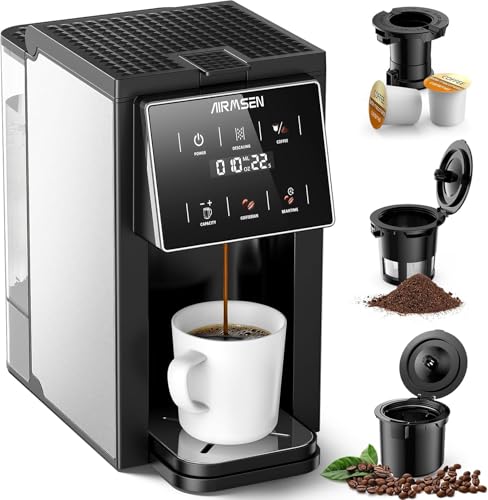
AIRMSEN Grind and Brew Single Serve Coffee Maker — Single Serve Format — Different Class
Format first, in the largest type this review can manage: the AIRMSEN is a single serve grind and brew machine, not a drip carafe brewer like the five picks above it. It grinds beans for one serving at a time and, unusually, also accepts coffee pods and loose grounds, so a solo drinker can move between fresh-ground mornings and pod-speed mornings without owning two machines. Judged as a carafe brewer it would be a category error; judged as a personal machine, it is one of the most flexible small brewers in this guide’s wider family.
Single serve grinding has a genuine freshness argument: every cup’s beans are ground for that cup alone, with no carafe sitting warm and no grounds measured for a pot that will be half poured away. The cleaning story shrinks with the format — a small chamber, a small basket, a mug rather than a carafe to wash — though the chamber still wants the same dry-before-beans discipline as its big siblings. Buy it for a desk, a studio or a one-coffee household, and let the five drip machines above serve the families they were built for.
- Capacity: single serve — not a carafe brewer
- Format: grind and brew, plus pods and grounds
- Grinder: built-in, sized for one serving
- Role: personal machine for solo drinkers
Strengths
- Fresh grinding scaled to exactly one cup
- Pods and grounds accepted alongside beans
- Smallest cleaning routine in this guide
Trade-offs
- One serving at a time — no carafe for guests
- Different format from the guide’s five drip picks
- Per-cup ritual repeats for every drink
Best for: solo drinkers who want fresh-ground single cups. Not suited for: families or anyone brewing for a table.
How Do the Six Grind and Brew Machines Compare at a Glance?
| Model | Capacity | Carafe / format | Standout trait |
|---|---|---|---|
| Cuisinart Grind and Brew 12-Cup Coffee Maker DGB-400 | 12 cups | Drip carafe | Blade grinder, 24-hour programming |
| Breville Grind Control Coffee Maker BDC650BSS | Single cup to carafe | Thermal carafe | Grind control per brew size |
| Gevi 10-Cup Grind and Brew Coffee Maker | 10 cups | Drip carafe | Touch screen interface |
| Elite Gourmet 12-Cup Coffee Maker with Grinder | 12 cups | Glass carafe | Coarse and fine grind levels |
| SECPOEDR Grind and Brew Coffee Maker 10-Cup | 10 cups | Drip carafe | Two-hour keep warm |
| AIRMSEN Grind and Brew Single Serve Coffee Maker | Single serve | No carafe — cup brewing | Grinds per cup; pods and grounds too |
How Do You Clean a Grind and Brew Machine Properly?
Work in the order the coffee travels. After brewing, discard the grounds promptly rather than letting them sit warm and damp in the basket, because a basket left full perfumes the next pot before it starts. Rinse the basket and the carafe in hot water, wash the carafe with a soft sponge — glass tolerates this best, thermal carafes want a bottle brush — and leave both to dry with air moving through them rather than sealed and steaming.
The grinder path is the part owners skip, and the part that decides whether month three tastes like week one. Empty the chamber completely, wipe it with a dry or barely damp cloth to lift the fine dust and oils, and brush the chute where grounds travel toward the basket, since that narrow passage hoards old coffee more faithfully than anywhere else in the machine. Never load beans into a wet chamber: moisture turns fresh grounds into paste, coats the blades or burrs and starts the stale cycle you are trying to prevent. A dry machine, wiped after each use and washed weekly, keeps the grind honest.
Monthly, run the deeper routine. Wash every removable part the manual allows in warm soapy water, dry each piece fully before reassembly, and descale the water path on the maker’s schedule — a separate chore from grinder cleaning, since scale lives in the boiler and pipes while grounds live in the chamber and chute. Owners who treat the two chores as one calendar entry, on the first weekend of the month, rarely meet the stale, slow machine that gives this category an undeserved reputation.
Blade or Burr: Which Grinder Belongs in a Coffee Maker?
A blade grinder is a propeller in a cup. It is cheap, compact and nearly indestructible, it rinses clean in seconds, and it produces grounds of mixed sizes — fine dust beside coarse fragments. In a drip brewer that mixture extracts unevenly in theory, yet in practice the jump from stale pre-ground to fresh blade-ground is the largest single improvement most households ever taste. The Cuisinart in this guide flies the blade flag, and its cleaning simplicity is a genuine part of its appeal.
Burr systems crush beans between abrasive surfaces at a set gap, producing far more uniform grounds and a more repeatable cup, which is the world the Breville Grind Control aims at. The costs are mechanical: burrs and their chutes collect fine grounds and oils in more places, the cleaning routine involves a brush and a little patience, and the machine carrying them costs more to buy. Neither technology is a trick. Choose the blade for the easiest ownership, the burr-style system for the most controlled cup, and be honest about which drinker lives in your kitchen.
Whichever you choose, grind fresh and grind only what you brew. Ground coffee stales in hours at a rate whole beans take weeks to match, so a grinder that runs for each pot — or, in the AIRMSEN’s case, for each cup — is not a luxury feature. It is the entire argument for these machines, and cleaning is simply how you keep the argument true.
Thermal Carafe or Glass: Which Is Easier to Live With?
Glass carafes, like the Elite Gourmet’s in this guide, sit on a warming plate and keep coffee hot by gentle continuous heat. They clean beautifully — visible, washable, dishwasher-tolerant in many cases — and they show the coffee level at a glance. Their weakness is flavour over time: an hour on the plate is fine, two hours is a stew, and the keep-warm features on machines like the SECPOEDR should be read as a window of convenience rather than a promise about the last cup.
Thermal carafes hold heat by insulation instead of by cooking, so coffee kept in one tastes closer to fresh for longer, and there is no plate to remember to switch off. The cleaning trade is reach: a thermal carafe’s narrow neck wants a bottle brush and a little technique, and its interior state hides from a casual glance. Households that brew and linger should choose thermal; households that brew, drink and wash up promptly can enjoy glass and its easy honesty.
Either way, wash the carafe rather than rinsing it. Coffee oils coat the walls invisibly and turn rancid politely, and a carafe that looks clean can still donate yesterday’s flavour to this morning’s fresh pot. A weekly wash with a little bicarbonate in warm water resets both glass and thermal interiors to neutral.
How Do Programmable Timers Change a Grind and Brew Morning?
The grinder is the loudest thirty seconds in the kitchen, and a programmable machine lets you choose when those thirty seconds happen. Set the Cuisinart or Elite Gourmet the night before and the household wakes to brewed coffee rather than to a small jet engine at dawn — a mercy in homes with thin walls, sleeping babies or a partner on a different shift. The beans, water and filter wait loaded, and the machine does the noisy, splashy work unattended.
Programming carries one freshness caveat and one safety habit. The caveat: beans loaded the night before sit in the chamber for hours, which is harmless for whole beans but a reason not to pre-grind — not that these machines would let you. The habit: a programmed machine should stand on a clear, dry counter with its carafe correctly seated, because it will brew to an empty kitchen, and a mis-seated carafe at 5 a.m. is a flood discovered at six.
Households that programme daily also clean differently. The basket gets emptied in the evening as part of the loading ritual, which turns out to be the healthiest routine of all: yesterday’s grounds never sit overnight, and the machine starts each cycle clean by construction. The timer, used this way, is a cleaning feature in disguise.
Why Does My Fresh-Ground Coffee Still Taste Stale or Bitter?
Stale notes in a grind and brew cup almost always trace back to residue rather than beans. Old grounds in the chute, oils in the chamber, a carafe washed by hope — each donates a little of last week to this morning. Work the cleaning routine in this guide for one week before blaming a new bag of beans, and most stale cups resolve. Bitter cups point elsewhere: water too hot for too long on too fine a grind, a keep-warm plate holding the pot past its welcome, or beans roasted darker than the drinker’s actual taste.
Weak cups have their own short list. The dose may be low for the water volume, the grind may be too coarse for the brew time — the Elite Gourmet’s texture levels exist for exactly this adjustment — or scale may be slowing and cooling the water path. Adjust one variable at a time, in the order of dose, grind, then descale, and keep a note on the fridge for a week. Coffee machines reward methodical owners quickly, because each variable announces its effect in the very next pot.
Finally, interrogate the beans themselves. Fresh grinding cannot resurrect stale beans, and a bag open for a month in a warm kitchen will brew a month-old cup through the finest machine in this guide. Buy beans in quantities your household finishes while they are lively, store them sealed and cool, and let the grinder do the rest.
How Should You Store Beans for a Grind and Brew Machine?
Whole beans are the stable form of coffee, and they ask for a boring home: sealed, cool, dark and dry. An opaque airtight container in a cupboard away from the oven serves better than the machine’s own chamber, which should be loaded per brew or per programme rather than used as a silo. Beans stored in the chamber sit in a warm, humid neighbourhood above a water tank, ageing faster and perfuming the plastic for the next roast.
Buy to your household’s pace. A bag finished within a few weeks of opening will out-brew a bargain bag nursed for two months, through any machine in this guide. Freeze beans only in well-sealed portions you will use within days of thawing, and let a portion come fully to room temperature before the bag opens, so condensation forms on the bag rather than on the beans.
Switching roasts deserves one habit: run the chamber empty — a brief grind cycle with nothing in it, or a thorough wipe — between beans. The last grams of a dark roast will otherwise season the first pot of a light one, and the drinker who bought the light roast for its clarity will wonder where it went.
How Do You Brew for Guests With a Grind and Brew Machine?
Guests expose the difference between capacity and throughput. A 12-cup carafe is not twelve café cups; it is roughly six generous mugs, and a table of six adults will empty it before the conversation warms. Brew the first pot as guests arrive, grind for the second as the first is poured, and let the keep-warm window carry the table through dessert rather than stretching one heroic pot across an entire evening.
The Breville’s single-cup-to-carafe range offers the other strategy: a carafe for the table, then individual cups brewed to order for the guest who wants decaf, a smaller cup or a later one. The AIRMSEN inverts the problem entirely — as a single serve machine it brews each guest’s cup fresh, at the cost of a small ceremony per cup, which at a dinner party can become part of the theatre if the host enjoys it and a bottleneck if they do not.
Whatever the machine, guests taste freshness more than they taste equipment. Beans ground in front of them, water fresh in the tank, a carafe washed that day — those are the details that make a home coffee taste like an occasion, and every pick in this guide can deliver them in the hands of a host who plans one pot ahead.
What Does Easy to Clean Really Mean When You Own One?
It means the routine fits inside a real morning. A machine whose basket lifts out in one motion gets rinsed; a machine whose grounds must be excavated gets left until Friday. A chamber that opens fully gets wiped; a chute that hides gets forgotten until the cup complains. When you compare the picks in this guide, read the cleaning story as a design philosophy: Cuisinart’s blade chamber at the simple end, Breville’s controlled grind path asking a brush and rewarding it, the glass carafe that shows its own dirt and the thermal one that hides it until the brush goes in.
It also means the machine forgives. Filters that can be permanent rather than paper, parts that tolerate the dishwasher where the manual allows, surfaces that wipe without special cloths — these small mercies decide whether a machine is still being cleaned properly in year three. The most advanced brewer in this guide is worth less, by year three, than the simplest one that its owner actually maintains.
Set the routine on day one, while enthusiasm is high: grounds out after every brew, chamber wiped dry, carafe washed weekly, descale and deep clean monthly. Habits formed in the first fortnight are the ones still running when the machine is old, and they are the reason one household’s five-year-old brewer tastes new while another’s tastes tired at Christmas.
How Loud Is the Grind, and How Do You Live With It?
Thirty seconds of grinding is the loudest event in most kitchens before breakfast, and it deserves planning rather than complaint. Blade chambers like the Cuisinart’s produce a high, brief whine; burr-style systems grind with a lower, crunching note for a little longer. Neither is a defect, but in a flat with a sleeping baby, a night-shift partner or paper-thin walls, the timing of those thirty seconds decides whether the machine is loved or resented.
The programmable picks in this guide offer the elegant solution: let the machine grind before the household’s alarm, so the noise lands in sleep’s shallows rather than at its end, or set the brew for the moment the first person is already up and dressed. Households without a timer can grind the evening’s decaf and the morning’s beans at a sociable hour only if they accept pre-ground coffee for the morning — which surrenders the machine’s whole point. Better to schedule the noise than to silence it by compromising the coffee.
Placement softens what scheduling cannot. A machine standing on a solid counter, away from the corner where two walls amplify sound like a speaker cabinet, grinds more quietly than the same machine on a hollow surface. A folded cloth beneath is not a solution — stability matters — but choosing the counter spot with ears as well as eyes is a legitimate part of setting up any grind and brew machine.
How Do Water and Filters Shape the Cup in These Machines?
Coffee is mostly water, and the freshness advantage of grinding in-machine can be quietly cancelled by stale or heavily chlorinated water from a tank filled last week. Fill with fresh water for each brew or each programme, wash the tank weekly, and if your tap water tastes strongly of its treatment, a simple filter jug will lift every pot the machine makes. Hard water adds the second tax: scale in the boiler and spray head, which is why descaling appears so often in this guide’s advice.
Filters divide into paper and permanent. Paper gives the cleanest, brightest cup and traps more of the fine sediment that blade grinders especially produce, at the cost of a consumable to buy and bin. Permanent mesh filters save the consumable and let more oils and fines through, which some drinkers taste as body and others as muddiness. Neither is the correct choice; they are two cups wearing the same name, and a household should try both in its first month and keep the one it prefers.
What is not optional is changing or washing the filter on rhythm. A paper filter left in the basket grows yesterday’s flavour into today’s pot, and a permanent filter unwashed for a week does the same with more confidence. The basket-and-filter step of the cleaning routine is the cheapest flavour insurance in the whole machine.
How Do You Choose Between 10 and 12 Cups — and What Is a Cup?
Coffee maker cups are a unit of tradition rather than thirst: roughly a small mug’s worth, so a 12-cup carafe pours about six generous mugs and a 10-cup about five. Households should translate before they buy. A couple drinking one mug each, with a second cup for one of them, lives comfortably in a 10-cup machine brewed half full — though half pots extract a little differently and deserve a slightly finer grind or a touch more coffee to taste right.
Families, offices and entertaining households should size for the surge, not the average: the morning everyone is home, the dinner with six adults, the work-from-home day with a deadline. The Cuisinart and Elite Gourmet at 12 cups carry those surges; the Gevi and SECPOEDR at 10 cups suit households whose surges stop at five mugs. The Breville sidesteps the arithmetic by brewing a single cup or a carafe from the same body, which is why divided households keep choosing it.
Remember that capacity you never use still costs counter space and cleaning time. The right size is the largest pot your household brews in a normal week, plus one guest — not the largest pot you brewed once, at a memorable Christmas, three years ago.
What Mistakes Do Grind and Brew Buyers Make Most Often?
Expecting the grinder to fix stale beans leads the list, followed by the cleaning shortcuts this guide has catalogued: grounds left sitting, chambers loaded wet, chutes never brushed, carafes rinsed rather than washed, descaling postponed until the machine slows. A subtler mistake is format confusion — ordering the AIRMSEN for a family breakfast table, or a 12-cup drip machine for a solo flat — because grind and brew describes a mechanism, not a size, and this guide labels the difference wherever it appears.
Buyers also over-read capacity and under-read the keep-warm. Twelve cups is six mugs; a two-hour keep warm is a window, not a recommendation. Match the machine to the household’s real mornings — how many drinkers, how staggered, how much patience for a brush — and the category delivers exactly what it promises: the freshest drip coffee a home can make without a separate grinder, kept honest by a two-minute routine.
Final Recommendation
Most households should start with the Cuisinart Grind and Brew 12-Cup Coffee Maker DGB-400, whose blade chamber is the easiest grinder here to keep clean and whose programmability suits family life. Step up to the Breville Grind Control Coffee Maker BDC650BSS if you taste grind differences and brew varied amounts, choose the Elite Gourmet 12-Cup Coffee Maker with Grinder for grind texture levels in a family pot, and remember the AIRMSEN only if a single serve format is truly your household’s shape.
Whichever machine earns the counter, the bargain is the same: it grinds, you clean — briefly, dryly and on schedule. Keep that side of the bargain and every pot will taste like the beans were bought yesterday, because as far as the grinder is concerned, they were. There is a particular pleasure in a kitchen that runs this way: the smell of beans ground seconds before the water, a carafe that pours clean to the last cup, and a machine that asks for two minutes of care in exchange for doing the skilled work itself. That pleasure, repeated daily, is what this category sells at its best — and it is entirely within reach of any household willing to wipe a chamber and wash a carafe.
How Do You Deep-Clean a Machine That Already Tastes Tired?
Rescue is possible, and it follows the coffee’s path in order. Start at the carafe: a long soak with warm water and bicarbonate, scrubbed with a brush, until a white cloth wiped inside comes away clean. Move to the basket and filter, washed hot and soapy and dried fully. Then the grinder: empty it, wipe the chamber, brush the chute patiently, and repeat until the brush comes out carrying this week’s coffee rather than last month’s.
Descale the water path next, following the manual, and run two full water-only brews afterwards to clear the system. Brew a sacrificial half pot with fresh beans and taste it honestly; most tired machines recover at this point, because their problem was archaeology rather than engineering. If the cup still tastes of the machine after that full routine, inspect for a part that has absorbed flavour beyond washing — a tired permanent filter is the usual suspect — and replace the cheapest suspect first.
Then keep the rescue from being needed again by adopting the daily and monthly rhythm this guide has described. A deep clean is a reset, not a routine, and the households that schedule the small routines are the ones that never have to perform the large one.
How Does a Grind and Brew Machine Fit a Small Kitchen?
The honest answer is that it trades the footprint of two appliances for one larger one, and in most small kitchens that trade wins. A separate grinder and drip machine occupy two spots, two cords and two cleaning routines; a combined machine occupies one spot the size of a small toaster oven and asks to be cleaned in one place. Measure the height under your cabinets before ordering, because these machines stand taller than plain drip brewers and their lids need room to open for beans and water.
Counter choreography matters as much as dimensions. The machine wants a home near water and near the mugs, with the bean container within the same reach, and it wants to stay there: a combined brewer dragged out of a cupboard each morning will be sold within the year, while one with a permanent, convenient station becomes invisible infrastructure. The AIRMSEN, at single serve scale, is the exception that fits the genuinely tiny kitchen or the desk, which is the role its format was designed for.
Small kitchens also amplify the cleaning argument. In a compact space, one machine washed in one sink, with one set of parts drying on one rack, is a materially simpler life than two appliances competing for the draining board. Easy to clean, in a small kitchen, is not a preference; it is the whole design brief.
Frequently Asked Questions
Is a built-in grinder better than a separate grinder?
It is more convenient and takes less counter space, and for drip coffee the results satisfy most households completely, morning after morning, without a separate appliance humming on the counter or a second cleaning routine competing for the same two minutes. A separate burr grinder still offers finer control for drinkers who brew several ways. The built-in’s real advantage is behavioural: because grinding is automatic, it happens for every pot, which is where the freshness is won.
How often should I clean the grinder chamber?
Wipe it after every use, once it is empty and dry, and give the chute a brush at the same time, while the machine is still warm from brewing and the residue lifts away at the first touch rather than setting hard overnight. Wash removable parts weekly and run the deeper clean plus a descale about monthly, adjusted for how hard your water is and how much coffee the machine makes. The routine takes minutes; the stale flavour it prevents takes weeks to scrub out.
Can I use pre-ground coffee in a grind and brew machine?
Most drip models in this guide can brew pre-ground coffee with the grinder switched off or bypassed, which is useful for decaf evenings, for a gifted bag of grounds, or for the week the bean order fails to arrive and the household refuses to face the morning uncaffeinated. Check your model’s manual for its exact setting. The AIRMSEN accepts grounds and pods directly, since its single serve format was designed around that flexibility.
Why is the AIRMSEN in a carafe coffee maker guide?
Because it genuinely grinds and brews, and solo households reading this guide deserve the option presented honestly rather than discovering the format from a misleading headline — but it is a single serve machine, not a 10 or 12 cup drip brewer, and no reading of its listing should pretend otherwise. It is labelled as a different format in its badge, its spec box and its review, so you can choose it knowingly or pass it by with equal clarity.
Can I grind beans for tea or spices in the built-in grinder?
Do not. The grinder in these machines is a coffee component, and anything strongly flavoured ground in it — spices above all — will season the chamber and chute for many pots to come, while oily or hard items can damage the mechanism and void whatever goodwill the warranty offered. Keep a separate, inexpensive grinder for the spice experiments and let the coffee machine stay a coffee machine. The same restraint applies to rice, sugar and the other folk remedies sometimes suggested for cleaning a grinder: the wipe, the brush and the descale in this guide clean these machines without feeding them anything they were not built to grind.
How fine should I grind for a drip grind and brew machine?
Aim for the middle of the machine’s range as your starting point — a medium grind suited to drip brewing, roughly the texture of coarse sand — then adjust by taste over several pots: finer if the cup tastes thin and sour, coarser if it tastes harsh and bitter, giving each change at least two pots before judging it, because a single pot can mislead through a stale filter, a different bean age or a carafe that was not washed as well as it might have been. Where the machine offers texture levels, like the Elite Gourmet in this guide, change one level at a time and keep the beans and dose constant, so the cup can tell you what the change actually did rather than leaving you to guess among three variables altered in a single hopeful morning.
Does a thermal carafe keep coffee fresh longer?
It keeps coffee hot without a warming plate, so the flavour holds up better over an hour or two than coffee stewing on heat, and the household that brews once and drinks slowly across a morning will taste that difference in the final cup most of all. It does not stop coffee from ageing altogether, and its narrow neck needs a bottle brush to clean well. Brew the amount your household will drink inside a couple of hours either way.
How Do You Get Decaf and Regular From One Machine Without Cross-Taste?
Households divided by caffeine need a small protocol. Brew the regular pot first, then empty the basket completely, wipe the chamber if beans are changing, and brew the decaf with a fresh filter; grounds cling, and a decaf drinker who is avoiding caffeine for medical or sleep reasons deserves better than the last two grams of the morning’s regular roast hiding in the chute. Where the divide is permanent and daily, the single serve AIRMSEN earns a second look as the household’s decaf station, leaving the carafe machine to the regular drinkers entirely.
Label the carafes if two pots ever coexist, because decaf and regular look identical and the household member who guesses wrong will have a wide-awake midnight or a very slow morning. A coloured band on one handle is the traditional solution, and like most traditional solutions it survives because it works. The deeper point is the one this guide keeps making: these machines reward small systems, and a two-coffee household is simply a system with one extra rule.
What Should You Do in the First Week With a New Grind and Brew Machine?
Treat week one as calibration. Brew the first pot exactly as the manual directs, with beans you already know, and taste it against your memory of those beans from your old method; that baseline tells you what the machine does neutrally. Then change one thing at a time across the week — the dose, the grind level where offered, the brew size — and note which change your household actually prefers, because the favourite setting discovered in week one tends to remain the setting in year three.
Run the cleaning routine from the first day, even while it feels excessive, so the habit forms before the first excuse does. Register the warranty, photograph the model plate, and keep the manual with the bean container rather than in a drawer of good intentions. By the end of the week you should know your beans’ dose, your preferred setting, your machine’s sounds and the exact two minutes its cleaning takes. Everything after that is simply coffee, which is what the machine was for.
Related Guides
For the rest of the home this machine serves, from the hallway the robot patrols to the dishes the coffee cups will join by noon and the oven whose thermometer earns its keep at dinner on the evenings that begin with a properly fresh pot and end with a table that lingered long after the carafe finally emptied and the last cup had gone pleasantly cold in a hand that forgot it for conversation worth forgetting a drink for, see our companion guides, written for the same household and its ordinary mornings, to Best Corner Cleaning Robot Vacuums, Best Portable 18 Inch Dishwashers and Best Meat Thermometers for Oven, each held to the same standard of honest labelling, stated capacities and formats named as plainly as we have named them here.


