What's inside
- Key Takeaways
- Quick Picks
- How Did We Choose These 10-Cup Machines — and Two Step-Ups?
- How Do the Six Compare on Capacity, Carafe and Control?
- Why Is 10 Cups the Sweet Spot for Most Homes?
- Thermal Versus Glass at the 10-Cup Size?
- How Well Do These Machines Brew Small Batches?
- What Programming Actually Matters at Breakfast?
- How Do You Keep a 10-Cup Machine Tasting Clean?
- How Should You Measure Your Counter Before Ordering?
- How Do You Brew for a Household That Wakes in Waves?
- What Coffee-to-Water Ratio Should a 10-Cup Machine Use?
- How Should You Choose Between This Guide’s Step-Ups and a True 10-Cup?
- What Accessories Does a 10-Cup Household Need?
- How Do These Machines Handle Decaf and Mixed Households?
- When Is 10 Cups the Wrong Size Altogether?
- How Do You Get a Second Morning Out of the Same Machine?
- What Should You Check on the Listing Before Ordering a 10-Cup Machine?
- How Does a 10-Cup Machine Serve an Office or Shared Kitchen?
- Why Do Owners Keep a 10-Cup Machine for So Long?
- What Mistakes Do 10-Cup Buyers Make Most Often?
- Final Recommendation
- Frequently Asked Questions
- Related Guides
As an Amazon Associate I earn from qualifying purchases. This post may contain affiliate links at no extra cost to you.
cottageverdict.com is reader-supported. When you buy through links on our site, we may earn an affiliate commission.
Where to buy: all six machines below are sold through Amazon, and their names in the Quick Picks table, the detailed sections and the comparison table link to their listings so you can check price on Amazon and confirm carafe type and dimensions before ordering. The best 10-cup home coffee machines occupy the most honest size in drip coffee: enough for a family’s morning and a modest gathering, not so much that a couple is forever brewing half-pots or pouring the last third away at noon. This guide covers four true 10-cup machines and — labelled clearly as step-ups wherever they appear — two 12-cup models for households whose ’10-cup’ mornings regularly turn out to be bigger.
Ten cups in coffeemaker language is roughly a litre and a half of brewed coffee: about four generous mugs. That translation matters, because the number on the box is not a mug count, and households that understand it buy the right size the first time. Within the true 10-cup group, the decisions are about how the coffee is held — an insulated thermal carafe against glass carafes on warming plates — whether the machine grinds its own beans, and how the controls handle programming, strength selection and the small-batch mornings when only two cups are wanted.
The two step-up picks are included deliberately and transparently. The Ninja CE251 and the larger Mr. Coffee are 12-cup machines, marked as step-ups in their sections, the table and the recommendations, for households that host often or drink in waves across a long morning. They are not smuggled in as 10-cup models, and readers who want exactly ten cups should shortlist the first four picks and treat the step-ups as the answer to a different, larger question.
Programmability runs through the whole group: every pick can be set the night before, most offer a stronger-brew option, and several pause the flow so a first cup can be poured mid-brew. Those shared virtues mean the choice turns on carafe philosophy, footprint and the grinder question — the Gevi is the only machine here that grinds beans in-house — and each pick’s section argues its own case on those terms.
Counter reality closes the introduction: a 10-cup machine is the largest appliance many kitchens can host without negotiation, and its water tank, carafe handle and lid all need working room. The sections after the picks cover measuring, small batches, cleaning and the arithmetic of cups, so the machine that arrives fits the kitchen and the household that ordered it.
Key Takeaways
- Four picks are true 10-cup machines; the Ninja CE251 and the larger Mr. Coffee are clearly labelled 12-cup step-ups for bigger mornings.
- Ten coffeemaker cups equal roughly four generous mugs — buy for mugs, not for the number on the box.
- The Mr. Coffee 10-Cup’s insulated thermal carafe is the only plate-free design among the true 10-cup picks, keeping coffee hot without stewing it.
- The Gevi is the group’s only grind-and-brew model, for households that want fresh-ground beans inside a 10-cup footprint.
- SHARDOR and the compact 10-cup programmable model cover the straightforward glass-carafe brief with regular and strong settings.
- Every pick is programmable, so the differences that matter are carafe style, grinder, footprint and small-batch behaviour.
Quick Picks
| Pick | Badge | Why it earns its place |
|---|---|---|
| Mr. Coffee 10-Cup Programmable Thermal Carafe | Best True 10-Cup, Thermal Carafe | An insulated thermal carafe, a strong brew selector and hotter, faster brewing in a genuinely 10-cup programmable machine. |
| SHARDOR 10-Cup Programmable Coffee Maker | Best Straightforward Glass-Carafe 10-Cup | Regular and strong brewing, a permanent filter and auto shut-off in a silver 10-cup machine for home and office. |
| Gevi 10-Cup Grind & Brew Coffee Maker | Best 10-Cup That Grinds Its Own Beans | A built-in grinder, touch screen and programmable brewing in a 10-cup glass-carafe machine with a reusable filter. |
| 10 Cup Programmable Coffee Maker Regular & Strong | Best Compact 10-Cup for Small Kitchens | Pause-and-serve, keep-warm and a heat-resistant glass carafe in a compact programmable design for home and office. |
| Ninja Fresh Brew Coffee Maker 12 Cup CE251 | Step-Up Pick: 12-Cup for Bigger Mornings | A labelled 12-cup step-up: classic and rich brew styles, a 70oz removable reservoir, small-batch function and 24-hour delay. |
| Mr. Coffee 12-Cup Programmable Coffeemaker | Step-Up Pick: Simple 12-Cup Classic | A labelled 12-cup step-up with brew-now-or-later programming, grab-a-cup pause and a water window — the simple big-pot classic. |
How Did We Choose These 10-Cup Machines — and Two Step-Ups?
We began with capacity honesty: manufacturer-stated capacity from each listing, sorted into true 10-cup machines and the two 12-cup step-ups, which are flagged as such everywhere they appear rather than rounded down for convenience. A guide that blurs its own headline size teaches readers to distrust every other number in it.
Within the 10-cup group we weighted carafe design first, because it decides how the morning’s second half tastes: thermal insulation, glass with a warming plate, and stated keep-warm behaviour were compared against typical household drinking windows. Programming depth, strength selection, auto-pause and footprint followed, and the Gevi’s built-in grinder was treated as a category of its own rather than a bonus point, since it changes the household’s bean buying entirely.
Finally, each machine was matched to the household pattern it serves best — thermal for slow mornings, glass for drink-it-now homes, the grinder model for freshness seekers, the step-ups for hosts — and the recommendations keep those matches explicit instead of crowning a single winner for everyone.
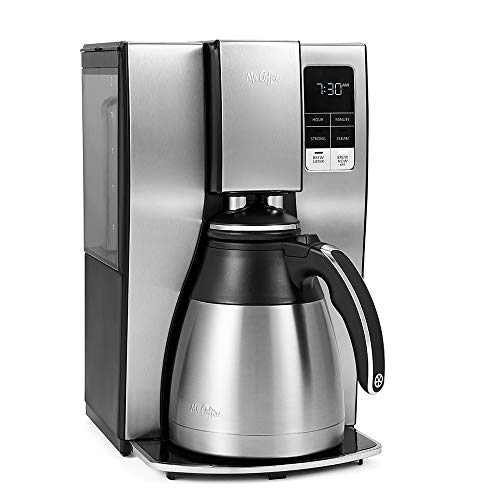
Mr. Coffee 10-Cup Programmable Thermal Carafe — Best True 10-Cup, Thermal Carafe
The thermal carafe makes this the connoisseur’s true 10-cup pick. Instead of parking brewed coffee on a hot plate — where it slowly stews — the Mr. Coffee brews into an insulated carafe that holds temperature by keeping heat in, so the cup poured at nine tastes like the cup poured at eight, only calmer. The listing adds a strong brew selector for households that like their coffee assertive, an auto-pause for the impatient first cup, and a claim of brewing hotter and faster, which addresses the two classic drip complaints in a single phrase.
Thermal carafes ask two small adaptations: pre-warm the carafe with hot water on cold mornings so it does not steal the first pot’s heat, and accept that you judge the remaining level by weight rather than by sight. In exchange, the carafe travels — to the table, the desk, the garden — and keeps serving without a cord, which quietly changes where a household drinks its coffee. No other true 10-cup pick here offers that freedom.
Choose it for slow, staggered mornings and for drinkers who can taste warming-plate stewing and resent it. Households that drink a pot within the half hour gain little over glass, and households wanting fresh grinding should look at the Gevi; for the classic 10-cup brief executed with the best holding technology in the group, this is the machine.
One small ritual unlocks the carafe’s best work: fill it with hot tap water while the machine is being loaded, then empty it the moment brewing starts. A pre-warmed thermal carafe in a cold kitchen can hold a pot at serving temperature through an entire slow morning, while an unwarmed one spends the first pot’s heat on its own steel. It is a twenty-second habit that owners of this pick describe, accurately, as the difference between good and remarkable holding.
- 10-cup insulated thermal carafe
- Strong brew selector
- Programmable brewing
- Auto pause for mid-brew pouring
- Brews hotter and faster (listing claim)
Strengths
- No warming plate, so no stewed second hour
- Carafe serves anywhere, cordlessly
- Strong setting suits assertive tastes
Trade-offs
- Carafe level is judged by weight, not sight
- Pre-warming helps in cold kitchens
- No built-in grinder
Best for: slow, staggered households that savour a pot over hours.
Not suited for: drinkers who finish a pot immediately or want grinding built in.

SHARDOR 10-Cup Programmable Coffee Maker — Best Straightforward Glass-Carafe 10-Cup
The SHARDOR is the uncomplicated centre of the 10-cup market: a programmable drip machine with regular and strong brew settings, a permanent filter, auto shut-off and a silver finish the listing pitches at homes and offices alike. The permanent filter is its quietly radical feature — it deletes the paper-filter errand from the household’s life, and with it the morning discovery that the filters ran out yesterday. Rinse it, reuse it, and the machine’s running costs collapse to coffee and water.
Regular-and-strong selection covers the realistic range of household preference without a laboratory of settings, and programmability delivers the category’s essential pleasure: coffee waiting when the alarm goes off, brewed from a machine set the night before in under a minute. Auto shut-off closes the safety loop for households that leave for work wondering whether the plate is still on — a small feature that ends a very common low-grade anxiety.
Against the Mr. Coffee thermal it trades holding quality for visibility and simplicity: you can see the level, the plate keeps it hot, and the coffee should be drunk on the schedule glass carafes assume. For offices, shared kitchens and homes that drink promptly, that trade is correct, and the SHARDOR makes it at the group’s most straightforward specification.
Its office suitability deserves a fuller note: shared machines die of ambiguity — nobody descaled it, nobody rinsed the filter, everybody assumed somebody had. The SHARDOR’s simplicity is an asset in that setting because its routine can be written on a card and taped to the wall: rinse filter, fill to the line, one button. Machines that a whole office can operate identically are machines that survive offices, and the permanent filter removes the supply argument that kills shared coffee by Thursday.
- 10-cup programmable drip brewing
- Regular and strong brew settings
- Permanent filter included
- Auto shut-off
- Silver finish for home and office
Strengths
- Permanent filter ends paper purchases
- Simple strength choice suits shared machines
- Auto shut-off suits offices and busy homes
Trade-offs
- Glass carafe on a plate stews coffee held long
- No thermal option or grinder
- Fewer refinements than the Mr. Coffee thermal
Best for: homes and offices wanting a simple programmable 10-cup pot.
Not suited for: slow drinkers who hold coffee for hours.

Gevi 10-Cup Grind & Brew Coffee Maker — Best 10-Cup That Grinds Its Own Beans
Judged purely as a 10-cup machine — this guide’s brief — the Gevi holds a distinction none of the other true 10-cup picks can claim: it grinds. The built-in grinder feeds a 10-cup glass carafe from a 1.5L tank, with touch-screen controls, programmable brewing, a 90-minute warm plate and a reusable filter. For a household that wants fresh-ground flavour without surrendering counter space to a separate grinder, this is the only address in the group, and its capacity honesty — a real ten cups, not a step-up — keeps it squarely inside this guide’s promise.
The capacity framing changes how the grinder should be judged. In a 10-cup household, beans turn over at a civilised pace: the hopper’s contents are days old, not weeks, and the freshness the grinder delivers is real rather than theoretical. The warm plate’s ninety minutes matches the size too — a 10-cup pot in a typical home is a morning’s drink, finished while the plate’s holding is still kind to it.
Touch controls and the reusable filter complete a machine aimed at kitchens being modernised as a whole. Choose it over the SHARDOR when grinding matters, over the Mr. Coffee thermal when the pot is drunk promptly, and accept the glass carafe’s terms as the price of the group’s only grinder at this size.
From the capacity angle, the Gevi also makes a subtle freshness argument its rivals cannot: a 10-cup grind-and-brew’s hopper empties at a pace that suits bean freshness, so the grinding advantage is not undermined by a month of beans ageing above the machine. Size and freshness, usually traded against each other, here reinforce — one more reason this pick anchors the modern end of the true 10-cup group.
- Built-in grinder at a true 10-cup size
- Glass carafe, 1.5L tank
- Touch screen controls
- Programmable brewing
- 90-minute warm plate
- Reusable filter included
Strengths
- Only fresh-grinding option among the 10-cup picks
- Reusable filter cuts running costs
- Touch interface suits modern kitchens
Trade-offs
- Glass carafe rather than thermal holding
- Grinder chamber needs regular brushing
- Grinder type not specified in the listing
Best for: freshness-first households committed to the 10-cup size.
Not suited for: thermal-carafe drinkers or large gatherings.

10 Cup Programmable Coffee Maker Regular & Strong — Best Compact 10-Cup for Small Kitchens
This unbranded 10-cup machine competes on footprint and essentials: programmable brewing with regular and strong options, pause-and-serve for the mid-brew cup, a keep-warm function, a heat-resistant glass carafe, a permanent filter, auto shut-off and a compact body the listing aims at home offices and small kitchens. In a category where machines grow by features, a model that asks how little counter a full 10-cup capacity can occupy is asking a question many flats and studios genuinely need answered.
Pause-and-serve is its most-used feature in real life, because the first cup of a programmed pot is always wanted before the last drop falls; a drip-stop that works cleanly is worth more than a second strength setting. The permanent filter and auto shut-off repeat the group’s sensible economy and safety notes, and the compact claim should be verified against your counter’s depth and the cupboard height above it, as with every pick here.
Its listing is light on brand story, and this guide treats it accordingly: a specification-led purchase for buyers who measure their kitchen, check the listed functions against their routine and prefer not to pay for a badge. On those terms — true 10-cup capacity, the right functions, the smallest claim on the counter — it makes a rational case that glossier rivals have to work to beat.
Compactness should be understood as a system property rather than a single measurement: a smaller body that still accepts a full-size carafe pour, a lid that opens within standard cupboard clearance and controls readable without bending. Where a small kitchen’s alternative is a machine banished to a cupboard and retrieved daily — a routine that ends in the machine being left in the cupboard — a compact model that earns permanent counter residence is the genuinely larger convenience.
- True 10-cup programmable brewing
- Regular and strong settings
- Pause and serve drip stop
- Heat-resistant glass carafe
- Permanent filter, auto shut-off
- Compact home-office footprint
Strengths
- Compact body suits small counters
- Pause-and-serve serves the impatient first cup
- Full essential function set without frills
Trade-offs
- Unbranded listing with a thinner track record
- Glass carafe on a plate, no thermal option
- No grinder or touchscreen refinements
Best for: small kitchens wanting full 10-cup capacity in minimal space.
Not suited for: brand-loyal buyers or thermal-carafe seekers.

Ninja Fresh Brew Coffee Maker 12 Cup CE251 — Step-Up Pick: 12-Cup for Bigger Mornings
Label first, as promised: the Ninja CE251 is a 12-cup machine, included here as a step-up for households whose real mornings exceed ten cups. What justifies its place is how gracefully it handles the sizes below its maximum — a small-batch function exists precisely so that a 12-cup machine can brew a few cups properly rather than as a diluted afterthought, which makes the CE251 a legitimate answer for households that live at ten cups on weekdays and twelve when family descends.
Its specification is the richest among the step-ups: programmable brewing with classic and rich brew styles — the rich setting being Ninja’s answer to drinkers who find standard drip thin — a 70oz removable water reservoir that fills at the sink instead of by jug at the machine, a glass carafe, an adjustable warming plate and a 24-hour delay brew. The removable reservoir alone earns friends in any kitchen where the machine lives under cupboards that block jug-pouring into a fixed tank.
Buy it as what it is: a larger, more capable machine for households honest about their volume, not as a 10-cup machine with a rounding error. If your mornings are truly ten cups and your counter is tight, the four picks above serve you better; if ten cups regularly runs dry by the second round, this step-up ends the shortage with style.
The CE251’s rich brew setting also reframes the step-up decision for strong-coffee households: a family that finds 10-cup machines’ output thin often compensates by over-dosing grounds, which wastes coffee and clogs baskets. A machine that enriches extraction by design — and brews the household’s true twelve cups — can be the more economical step despite its size, because every pot is brewed as intended rather than as a workaround.
- STEP-UP: 12-cup glass carafe capacity
- Classic and rich brew styles
- 70oz removable water reservoir
- Small-batch function
- 24-hour delay brew, adjustable warming plate
- Programmable, stainless accents
Strengths
- Small-batch mode keeps a big machine honest at low volumes
- Removable reservoir is easy to fill anywhere
- Rich brew answers thin-drip complaints
Trade-offs
- It is a 12-cup machine — larger footprint than this guide’s brief
- Glass carafe on a plate stews held coffee
- More capacity than true 10-cup households need
Best for: households at ten cups on weekdays and twelve at weekends.
Not suited for: strict 10-cup buyers or minimal counters.

Mr. Coffee 12-Cup Programmable Coffeemaker — Step-Up Pick: Simple 12-Cup Classic
The second step-up is the simplest machine in this entire guide, and its label is again explicit: this Mr. Coffee brews 12 cups. Its virtues are the foundational ones, executed without ornament — a programmable brew-later feature so the pot is ready when you are, a grab-a-cup auto pause, a visible water window so the tank’s state is never a guess, an LED display and an easy-clean filter arrangement. For a household stepping up from ten cups because mornings grew — teenagers, grandparents moving in, a home business’s worth of drinkers — it adds capacity without adding a learning curve.
The water window deserves its mention because it prevents the category’s silliest failure: a programmed brew attempted with yesterday’s water level, producing a pot of hot regret. Visibility is a feature, and this machine’s design keeps the essentials — water, time, readiness — glanceable from across the kitchen, which is where a big household actually manages its coffee from.
As with the Ninja, buy it under its true description. It is the step-up for households that value simplicity at twelve cups, where the Ninja is the step-up for households that value brew styles and a removable reservoir. Strictly-10-cup shoppers should return to the thermal Mr. Coffee at the top of this guide, which shares the badge and serves the smaller brief with the better carafe.
There is a generational comfort to this step-up that specifications miss: it operates the way the coffee makers of thirty years did, improved — set the clock, set the timer, coffee happens. For households buying on behalf of parents or grandparents who want capacity without a touchscreen apprenticeship, that continuity is the feature, and the water window’s plain visibility respects eyes and habits that menus on screens do not.
- STEP-UP: 12-cup programmable capacity
- Brew now or brew later scheduling
- Grab-a-cup auto pause
- Water window for level checks
- Programmable LED display
- Easy-clean filter design
Strengths
- Simplest controls among the step-ups
- Water window prevents empty-tank brews
- Familiar Mr. Coffee operation for upgraders
Trade-offs
- A 12-cup machine, beyond this guide’s core brief
- Glass carafe holding, no thermal option
- Fewest brew-style adjustments here
Best for: growing households wanting simple 12-cup programming.
Not suited for: households that truly drink ten cups or fewer.
How Do the Six Compare on Capacity, Carafe and Control?
The capacity column is deliberately blunt: four machines are 10-cup, two are labelled 12-cup step-ups. After size, compare carafe philosophy, then controls.
| Pick | Badge | Capacity and carafe | Control and extras |
|---|---|---|---|
| Mr. Coffee 10-Cup Programmable Thermal Carafe | Best True 10-Cup, Thermal Carafe | 10-cup thermal carafe, programmable | Strong brew selector, auto pause |
| SHARDOR 10-Cup Programmable Coffee Maker | Best Straightforward Glass-Carafe 10-Cup | 10-cup glass carafe, programmable | Regular and strong, permanent filter |
| Gevi 10-Cup Grind & Brew Coffee Maker | Best 10-Cup That Grinds Its Own Beans | 10-cup grind and brew, glass carafe | Touch screen, reusable filter, 90-min plate |
| 10 Cup Programmable Coffee Maker Regular & Strong | Best Compact 10-Cup for Small Kitchens | 10-cup compact, glass carafe | Pause and serve, regular and strong |
| Ninja Fresh Brew Coffee Maker 12 Cup CE251 | Step-Up Pick: 12-Cup for Bigger Mornings | STEP-UP 12-cup, glass carafe | Rich brew, removable 70oz reservoir |
| Mr. Coffee 12-Cup Programmable Coffeemaker | Step-Up Pick: Simple 12-Cup Classic | STEP-UP 12-cup, programmable | Brew later, auto pause, water window |
Why Is 10 Cups the Sweet Spot for Most Homes?
Because it matches the arithmetic of real mornings. Four generous mugs cover a couple’s two each, a family’s one each with a top-up, or a small gathering without a second brew — and a pot that size is finished while it still tastes like itself. Twelve cups begins to outstay its welcome in households under four drinkers, while five-cup machines turn every guest into a logistics problem. Ten is where capacity, freshness and counter footprint intersect for the median home, which is why manufacturers build so many machines at exactly this size.
The size also disciplines buying: a 10-cup machine’s tank, carafe and footprint are all moderate, so it fits standard counters under standard cupboards, fills at any sink and stores without a dedicated appliance garage. Households that genuinely outgrow it have the two labelled step-ups in this guide; households tempted to outgrow it speculatively should brew at ten for a season first and count the mornings the pot actually ran dry.
Manufacturers’ cup measures assume a modest serving, so translate before judging: if your household drinks from very large mugs, your ’10-cup’ machine is a three-mug machine, and the step-ups stop being indulgences and become the correct size. Mug honesty is the whole secret of capacity satisfaction.
Thermal Versus Glass at the 10-Cup Size?
The group’s one thermal carafe — the Mr. Coffee 10-Cup’s — changes the pot’s second hour from a decline into a plateau: no plate cooking the coffee, no stewed bitterness accumulating, and a carafe that can leave the machine and sit on the table or desk. At ten cups, where a pot is often brewed to be drunk across a morning rather than at a sitting, that plateau is worth real money to households whose schedule staggers.
Glass answers with visibility and simplicity: the level is obvious, the carafe is light, replacements are cheap, and the warming plate keeps the coffee at temperature for the ninety minutes to two hours in which it remains worth drinking. The Gevi, SHARDOR and compact pick all take this route, and for households that brew, drink and rinse within the hour, glass loses nothing that matters.
Decide by the clock, not by fashion. Pot finished within the hour: glass, and save the difference. Pot nursed across a morning: thermal, and enjoy the second cup tasting like the first. The step-up machines are glass-and-plate designs, so high-volume slow drinkers face a genuine trade between capacity and holding quality — and should consider brewing their twelve cups in two fresh ten-cup acts instead.
How Well Do These Machines Brew Small Batches?
A 10-cup machine asked for two cups faces physics: a shallow bed of grounds under a showerhead tuned for depth extracts unevenly, and the result can taste thin or sour. The honest mitigations are the strong-brew settings most of these picks offer — slowing or enriching the small brew — and using the machine’s minimum quantity respectfully rather than brewing a token cup through a full-size basket.
The Ninja step-up formalises the answer with its small-batch function, one of the strongest arguments for stepping up in a household whose demand swings wildly between two cups and twelve. Among the true 10-cup picks, the strong settings on the Mr. Coffee thermal and SHARDOR are the small-batch tools, and they work best when the household accepts a slightly longer brew as the price of a richer small pot.
If small batches are your daily pattern rather than an occasional one, reconsider the size itself: a household brewing two cups every morning owns the wrong headline capacity, and a smaller machine — or a single-serve model — will make those two cups better than any 10-cup compromise. Buy the machine for the daily brew; let gatherings be the improvisation, not the other way round.
What Programming Actually Matters at Breakfast?
The essential program is one: start time. Every pick here offers it, and it delivers the category’s core pleasure — coffee that exists when you reach the kitchen. Beyond that, the features rank by household: auto-pause serves the impatient first cup and appears across the group; strong settings serve taste; auto shut-off serves safety and the peace of mind of people who leave home at a run.
Delay windows and clock design matter more than feature counts. A 24-hour delay, as on the Ninja step-up, covers every realistic schedule; a clear display, like the step-up Mr. Coffee’s LED, prevents the 11 p.m. squinting that leads to a 3 a.m. brew. When comparing two similar machines, choose the one whose programming you can set correctly while tired — that is the interface test that predicts years of successful mornings.
Set the machine as part of the evening kitchen routine rather than as a separate task: rinse, load, fill, program, in the same pass as the dishwasher. Rituals that ride on existing rituals survive; rituals that stand alone are abandoned by February.
How Do You Keep a 10-Cup Machine Tasting Clean?
Daily, the work is thirty seconds: grounds out, carafe rinsed, basket rinsed, a wipe where coffee splashed. The permanent and reusable filters on the SHARDOR, Gevi and compact pick make this lighter still — no paper to bin, just a rinse — while paper-filter users should compost or bin grounds promptly, because a basket left full overnight seasons the next pot with yesterday’s stale oils.
Weekly, wash the carafe and basket with unscented detergent and rinse thoroughly; scented residues are a real and common cause of ‘the machine tastes funny’ reports. Thermal carafes need the same wash despite their sealed virtues, and a narrow brush reaches where hands cannot. Monthly or as prompted, descale: scale slows the water, cools the brew and thins the cup, and at the 10-cup size the whole cycle is a small, easily scheduled task.
The grinder-equipped Gevi adds one motion: brush its chamber and chute every few days so old grounds do not season new beans. That single extra habit is the entire maintenance price of the group’s only fresh-grinding option, and it is a fair price, openly stated.
How Should You Measure Your Counter Before Ordering?
Measure three dimensions and one motion. Height first, including the clearance to open the lid and lift the tank or carafe vertically — the dimension most often missed, because machines are measured closed and used open. Depth second, including the carafe handle’s pull-forward room and the cord’s exit. Width third, with breathing space from walls and neighbouring appliances, since these machines vent steam as they brew.
The motion is your own: stand where you will stand each morning and mime the routine — fill, load, lift the carafe, pour. If any step requires reaching over the machine or around a cupboard door, the placement will irritate daily, and irritation is what quietly retires appliances. The compact 10-cup pick exists for counters that fail this test at standard sizes; the step-ups demand the most generous envelopes and should be measured for twice.
Finally, place the machine near water and away from where steam will damage cupboard undersides over years. A foot of lateral thinking at purchase time prevents the slow, invisible harm that makes a good machine look like a bad neighbour.
How Do You Brew for a Household That Wakes in Waves?
Staggered households are the 10-cup size’s home turf, and the strategy is to brew once, hold well and serve in turns. That is the thermal Mr. Coffee’s exact scenario, and its carafe can even migrate to the breakfast table for the second wave rather than waiting on the machine. Glass-carafe households should brew closer to the main wave and let early risers take a smaller first pot through the strong setting, rather than holding a full pot from the first alarm to the last.
Communication finishes what technology starts: a note of the brew time on the machine — or simply the household’s shared knowledge that coffee lands at six thirty — prevents the wasteful double-brew, where a second person, unsure whether the pot is fresh, makes another. Ten cups brewed once and trusted serve a staggered house better than ten cups brewed twice and doubted.
If the waves stretch beyond two hours, split the difference: brew ten, and let the final wave’s drinker make a small fresh pot rather than resurrecting the morning’s remains. Freshness is cheaper than the disappointment of a stewed cup at the start of a workday.
What Coffee-to-Water Ratio Should a 10-Cup Machine Use?
Start from the widely used middle: roughly one to two tablespoons of ground coffee per coffeemaker cup, adjusted as a household constant rather than a daily guess. The strong settings on these machines then become a seasoning rather than a rescue — a notch for the mornings that need it — instead of a permanent correction for chronic under-dosing, which wastes the setting’s purpose and the coffee both.
Measure for a week, however the household measures — scoop, spoon or scale — and write the winning dose on a card kept with the beans. Drip coffee’s great virtue is repeatability, and a 10-cup machine with a recorded dose delivers the same pot on a tired Tuesday as on a careful Sunday. Variety, when wanted, should enter through the bean, not through random scoops.
Grind freshness interacts with dose: the Gevi’s fresh-ground output often tastes fuller at the same dose, because fresh grounds give up their flavour more completely. Households switching to it should resist immediately increasing the dose; taste the first week at the old measure and let the grinder make its case.
How Should You Choose Between This Guide’s Step-Ups and a True 10-Cup?
Count three things over one honest week: the mugs your household drinks before noon, the mornings the pot ran dry, and the mornings a third of the pot was poured away. If dry mornings outnumber poured-away mornings, step up; if the sink receives more coffee than the family does, stay at ten or go smaller. This arithmetic, performed with real mugs, settles the question better than any capacity debate conducted in the abstract.
Consider also who the step-up serves. A household growing by people — teenagers reaching coffee age, family moving in — is stepping up permanently and should buy the capacity without regret. A household hosting six weekends a year is stepping up occasionally, and a true 10-cup machine plus a second brew cycle serves those weekends while fitting the other forty-six weeks better.
Counter space votes last and sometimes decisively: a 12-cup machine that crowds the kitchen’s working surface taxes every meal cooked beside it, all year, to save a second brew on occasional mornings. The step-up must earn its footprint daily, not merely its capacity occasionally.
What Accessories Does a 10-Cup Household Need?
Very few, which is part of the size’s charm. A spare carafe is the highest-value insurance in drip coffee, because carafes are the one component households actually break, and a machine without its carafe is a sculpture until the replacement arrives — for the popular models here, replacements are easy to find, which is itself a reason to favour established designs. A small brush for baskets and, on the Gevi, the grinder chamber completes the working kit.
Coffee storage matters more than gadgets: a sealed container near the machine, a scoop that lives in it, and beans bought at a pace the household finishes fresh. A water filter jug, in hard-water districts, protects the machine and the flavour together, and pays for itself in descaling intervals alone.
Resist the accessory spiral — warmers, towers, organisers — until the routine has run for a month and revealed its actual friction. Most 10-cup households discover their friction was never equipment at all, but the evening load-up habit, which no purchase can install.
How Do These Machines Handle Decaf and Mixed Households?
A carafe machine brews one coffee at a time, so mixed regular-and-decaf households must negotiate by schedule or by vessel. The common treaty: the programmed morning pot is the majority’s coffee, and decaf drinkers brew a small second pot — where the strong setting and a respectful minimum fill make a decent half-pot — or keep a small separate brewer. The step-up Mr. Coffee’s brew-later simplicity suits households that run two scheduled pots a day, morning regular and evening decaf.
Label the carafe when both exist in a day; more family coffee tragedies involve a decaf drinker caffeinated at 9 p.m. than any machine failure in this guide. A strip of tape and a marker on the carafe handle is the entire technology required, and it has never once needed descaling.
The Gevi’s hopper commits its household to one bean at a time, so mixed households choosing it should plan the decaf as pre-ground through the machine’s ground-coffee routine where used, or accept the schedule treaty like everyone else. No machine in this group dissolves the one-pot-one-coffee law; the good ones make the treaty painless.
When Is 10 Cups the Wrong Size Altogether?
When the household is one person drinking one mug, the size is a monument to optimism, and a single-serve machine will make that mug fresher every day of the year. When the household is six adults drinking two mugs each before work, ten cups is a first shift rather than a supply, and the honest purchase is the largest machine the counter holds or a commercial-style brewer beyond this guide’s scope.
When the drinking pattern is espresso-based — cappuccinos at dawn, shots after dinner — no drip machine of any size answers, and the household should spend its budget where its taste actually lives. Size questions are really pattern questions wearing a number, and the number should be chosen last, after the pattern has been described honestly.
For the broad middle — couples, families, small gatherings, offices of a handful — ten cups remains what this guide found it: the size that asks the fewest compromises of the most households, which is why getting its carafe, controls and step-up decisions right is worth a guide of this length.
How Do You Get a Second Morning Out of the Same Machine?
Households that work from home drink in two shifts — the waking pot and the late-morning pot — and a 10-cup machine serves that rhythm best when the second brew is treated as its own event rather than a top-up of the first. Rinse the carafe, fresh grounds, fresh water: the second pot then tastes like a decision instead of a residue, and the machine’s programmability can even be set for it on days when the schedule is fixed.
The thermal carafe complicates this pleasantly by keeping shift one drinkable into shift two, which tempts households to skip the second brew — sometimes rightly, on the Mr. Coffee’s plateau of quality, and sometimes past the point where freshness has quietly left. Taste before deciding; the carafe’s honesty about temperature does not extend to aromatics, which fade on their own schedule regardless of insulation.
Weekend second mornings — the slow brunch pot after the early risers’ pot — reward the same discipline. A household that brews twice, smaller and fresher, drinks better coffee all day than one that brews once and defends the pot, and the 10-cup size is precisely the size at which two brews remain convenient rather than burdensome.
What Should You Check on the Listing Before Ordering a 10-Cup Machine?
Confirm the capacity claim’s basis and the carafe type in the listing’s own words — thermal or glass is a construction fact, not a trim level, and it cannot be changed after delivery. Check the stated keep-warm behaviour and whether a strong setting and auto-pause are genuinely listed, since those three features decide most of the daily experience and are cheap for sellers to imply and embarrassing to discover absent.
Measure against the listing’s dimensions with the lid-open height added, and confirm the tank’s filling method suits your sink and your cupboard layout; the Ninja step-up’s removable reservoir exists because this check fails so often for fixed tanks under low cupboards. Verify the filter type — permanent, reusable or paper — so the first morning is not spent improvising with a paper towel, an experiment no household should repeat.
Finally, confirm which of this guide’s descriptions the listing supports for step-up models: if you are buying the Ninja or the larger Mr. Coffee, you are buying twelve cups, and the listing, your counter and your expectations should all agree on that number before the box arrives.
How Does a 10-Cup Machine Serve an Office or Shared Kitchen?
Shared spaces reward the same virtues as families, amplified: simple programming everyone can set, a carafe everyone can pour without dripping, and a cleaning routine short enough to be written on a card. The SHARDOR’s permanent filter and auto shut-off were designed for exactly this, and the compact pick’s small footprint suits the kitchenette where the machine competes with a kettle and a microwave for the only counter.
The social contract matters more than the specification: a rota for descaling, a shared bean fund or an agreement that the person who finishes the pot rinses the carafe. Machines in shared kitchens rarely die of wear; they die of diffused responsibility, and the models that survive are the ones whose care can be divided into tasks small enough to be owned by name.
Capacity honesty helps here too — an office of eight coffee drinkers is a 12-cup step-up office wearing a 10-cup wish, and buying the step-up openly, as this guide labels it, ends the mid-morning empty-pot dispute that otherwise becomes a daily ritual of its own.
Why Do Owners Keep a 10-Cup Machine for So Long?
Because the size stops being a decision. Once a household’s machine matches its mornings, coffee leaves the list of things to think about, and appliances that leave that list are kept until they die — which, for a drip machine with a simple water path and a descaling habit, can be a very long time. The models in this group are all built on that mature, repairable idea: a heater, a pump or gravity path, a basket, a carafe, and nothing that requires a software update to make breakfast.
Longevity also compounds value quietly: a machine bought for a family’s decade delivers its cost across thousands of pots, until the price per cup of the appliance itself rounds to nothing and only the beans register. That arithmetic favours buying the right carafe and the right size once, over buying cheaply twice — the lesson most long-term owners volunteer when asked.
When replacement finally comes, households overwhelmingly buy the same size again, which is the market’s own verdict on this guide’s premise. Ten cups is not a compromise between small and large; for most homes it is simply the answer, arrived at and kept.
What Mistakes Do 10-Cup Buyers Make Most Often?
Sizing, holding and habit errors account for nearly every disappointed 10-cup owner.
- Reading ’10-cup’ as ten mugs, then finding the pot serves four generous mugs and blaming the machine for the manufacturer’s traditional measure.
- Buying a 12-cup step-up ‘just in case’ for a household that drinks six cups, and brewing weak, oversized pots daily for a gathering that comes twice a year.
- Holding glass-carafe coffee on its plate for three hours and judging the machine by a stewed cup it was never designed to serve.
- Brewing two cups through a full-size basket without using the strong setting, then concluding the machine makes thin coffee.
- Skipping descaling until the brew slows and cools, converting a ten-minute routine into a flavour problem blamed on the beans.
Final Recommendation
Buy the size your mornings actually are, and this group rewards you at every level. For the classic brief executed best, the Mr. Coffee 10-Cup Programmable Thermal Carafe leads the true 10-cup field with holding quality nothing else here matches. Freshness seekers should choose the Gevi 10-Cup Grind & Brew Coffee Maker, the only grinder at this size, and households that honestly outgrew ten cups should step up without guilt to the Ninja Fresh Brew Coffee Maker 12 Cup CE251, labelled and loved as the 12-cup machine it is.
Measure the counter, count the mugs, descale when the calendar says so, and a 10-cup machine will do the quietest, most reliable job in the kitchen — turning yesterday evening’s ninety seconds of preparation into this morning’s first good decision, already poured.
Frequently Asked Questions
How many mugs does a 10-cup coffee maker actually fill?
About four generous mugs. Coffeemaker cups are a traditional measure of roughly five to six ounces, so a 10-cup carafe holds around a litre and a half. Households drinking from very large mugs should count their mugs honestly and may belong with the labelled 12-cup step-ups.
Is a thermal carafe worth it at this size?
For households that drink a pot across more than an hour, yes — the Mr. Coffee thermal keeps the second hour tasting like the first, without a warming plate’s stewing. For brew-and-drink households, glass and a plate serve the same morning for less.
Which 10-cup machine grinds beans?
Only the Gevi among the true 10-cup picks; it is a full grind-and-brew machine with a touch screen and reusable filter. The other picks brew from ground coffee, and households wanting grinding at larger sizes should note the step-ups here do not grind either.
Are the Ninja and the larger Mr. Coffee really 10-cup machines?
No, and this guide labels them as what they are: 12-cup step-ups, included for households whose mornings exceed ten cups. They appear as step-ups in their sections, the comparison table and the recommendations, never as 10-cup models.
Can a 10-cup machine brew just two cups well?
Reasonably, with help: use the strong-brew setting where fitted, respect the machine’s minimum fill, and accept a slightly longer brew. The Ninja step-up’s small-batch function does this best; households brewing two cups daily as their main pattern should consider a smaller machine altogether.
How often should a 10-cup machine be descaled?
Every one to three months depending on water hardness and use, or whenever brewing slows noticeably. Filtered water stretches the interval and improves flavour; the cycle itself is brief at this size and protects both taste and the machine’s heating system.
Related Guides
If your coffee setup is still evolving, these neighbouring guides cover the adjacent sizes and styles: Best Affordable Coffee Machines Best Baby Washing Machines Best Affordable Sewing Machines


