What's inside
- Key Takeaways
- Quick Picks
- How Did We Choose Affordable Machines Without Chasing the Lowest Tag?
- How Do the Six Compare Side by Side?
- What Does Affordable Actually Buy You in a Coffee Maker?
- Is a Timer Just a Gimmick, or the Whole Point?
- Glass Carafe and Hot Plate, or Something Better?
- How Much Difference Can a Shower Head Make?
- Should Your Affordable Machine Grind the Beans Too?
- How Do You Keep a Budget Brewer Tasting Clean?
- What Size Pot Does Your Household Honestly Need?
- What Ratio of Coffee to Water Should a Budget Machine Use?
- How Do You Choose Between Ten Cups and Twelve?
- What Should You Do in the First Week With a New Machine?
- Is Iced Coffee a Fair Test of a Cheap Drip Machine?
- Which Accessories Are Worth Buying Alongside a Cheap Machine?
- Can One of These Machines Serve a Small Office?
- Which Mistakes Make a Cheap Coffee Maker Taste Expensive to Own?
- Final Recommendation
- Frequently Asked Questions
- Related Guides
As an Amazon Associate I earn from qualifying purchases. This post may contain affiliate links at no extra cost to you.
cottageverdict.com is reader-supported. When you buy through links on our site, we may earn an affiliate commission.
Where to buy: all six machines below are sold on Amazon, and the linked names in the Quick Picks table and the detailed sections lead to the matching listing, where you can check price on Amazon and confirm carafe size, filter type, and timer features before ordering. If you are hunting for the best affordable coffee machines, the useful question is not which brewer costs least on the day you shop, because drip machines trade places in sales constantly. The useful question is which brewer still makes sense a year later, when the novelty has gone and only the morning routine remains.
Affordable drip coffee is a solved problem in the best sense. A simple heating element, a shower head over a basket, and a glass carafe will produce a perfectly decent pot, and the six machines here all clear that bar. What separates them is everything around the brewing itself: whether a timer lets you set the pot up the night before, whether a permanent filter saves you buying paper forever, whether the carafe pours without dribbling down its own side, and whether a strong-brew setting exists for the mornings when regular tastes like a rumour.
This guide deliberately mixes formats. Four picks are countertop drip machines in the ten-to-twelve-cup range that suit households and shared kitchens. One grinds whole beans before brewing, which is the single biggest flavour upgrade available at this end of the market. One brews a single mug at a time for people who live alone and resent washing a carafe. Read by your household size first and by features second, because an affordable machine that matches how you actually drink coffee beats a fancier one that fights your routine.
Key Takeaways
- Programmability is the feature worth paying for at this level: setting coffee up the night before changes weekday mornings more than any brew-temperature claim.
- A permanent filter quietly saves money every single week and removes the empty-box-of-filters failure that ruins rushed mornings.
- Grind-and-brew is the one genuine flavour leap in this group, because beans ground seconds before water hits them taste fresher than any pre-ground brick.
- Carafe behaviour matters more than carafe looks; a spout that dribbles will annoy you roughly twice a day for years.
- Single-serve machines suit true solo drinkers, while everyone sharing a pot should stay with a ten-cup or larger drip brewer.
Quick Picks
| Pick | Badge | Why it earns its place |
|---|---|---|
| SHARDOR 10-Cup Programmable Coffee Maker | Best All-Round Value | A ten-cup programmable drip machine with a permanent filter and a strong-brew option, covering the whole checklist without fuss. |
| Mr. Coffee 12-Cup Programmable Coffeemaker | Best Familiar Name | The classic twelve-cup Mr. Coffee formula: Brew Later timing, grab-a-cup pause, and a water window you can actually read. |
| BELLA 12-Cup Programmable Coffee Maker Surf | Best-Looking Budget Pot | BELLA pairs a twelve-cup programmable brewer with a no-drip carafe and a surf finish that earns its counter space visually. |
| BLACK+DECKER 12-Cup Drip Coffee Maker Vortex | Best Extraction Trick | The Vortex shower head spins water over the grounds for fuller saturation, with Sneak-A-Cup and auto shutoff on a twelve-cup frame. |
| AIRMSEN Coffee Maker with Grinder 5-Cup | Best Grind-and-Brew Value | A built-in grinder with three settings and a 24-hour delay timer in a five-cup footprint made for small households and offices. |
| RAINBEAN Single Serve Coffee Maker Programmable Timer | Best One-Mug Timer | A programmable single-serve brewer for ground coffee, with auto start and shutoff and a 14-ounce cup ceiling. |
How Did We Choose Affordable Machines Without Chasing the Lowest Tag?
Every pick had to be a machine a household could plausibly run daily for years: a standard drip format or a clearly defined alternative, parts you can rinse in a sink, and controls a guest could work out without a manual. We weighted the timer, the filter arrangement, and the carafe more heavily than styling, because those three things decide whether a budget brewer feels cheap or merely inexpensive. Machines whose only virtue was a rock-bottom listing were left out; a brewer you replace in eighteen months is the expensive option wearing a disguise.
We also insisted on variety of approach. Two of these are straightforward programmable drip machines from different makers, one adds a colourful design-led twist, one uses a vortex shower head to wet the grounds more evenly, one grinds beans in-house, and one abandons the carafe entirely. That spread means the recommendations that follow are really six different answers to the question of what affordable should mean, and the right one depends on whether you value convenience, flavour, or sheer simplicity most.

SHARDOR 10-Cup Programmable Coffee Maker — Best All-Round Value
The SHARDOR is the machine we would hand to someone who asked for affordable coffee without any further opinions. It brews ten cups, which in real mug terms means four generous mugs or a small household’s full morning, and it covers the features that matter at this level: programmable timing so the pot can be ready when you are, a regular-or-strong choice for days when the regular setting tastes thin, and a permanent filter that ends the paper-filter subscription quietly running in the background of your kitchen budget.
Living with it is unremarkable in the good way. The silver finish shrugs off the splashes that show cruelly on glossy black plastic, the carafe handle stays cool enough to grab half-asleep, and auto shut-off removes the low-grade worry of a hot plate left on through a workday. Ten cups is also a forgiving size: big enough for guests, small enough that a two-person household is not brewing a litre to throw half away.
Its ceiling is the ceiling of its class. There is no grinder, no thermal carafe, and no way to brew a half pot with a dedicated small-batch mode beyond simply using less water and grounds, which works but asks you to keep the ratio consistent yourself. For most buyers those absences are exactly why the price stays sensible, and the coffee itself, brewed strong with fresh grounds, is better than plenty of machines that cost noticeably more.
- Capacity: 10 cups, a comfortable fit for three to four mug drinkers
- Brew choice: regular and strong settings on the same basket
- Filter: permanent filter included, so paper becomes optional
- Timing: programmable start for night-before setup
- Safety: auto shut-off when the cycle and warming period end
Strengths
- Covers the full everyday checklist in one plain machine
- Permanent filter removes a recurring consumable cost
- Strong setting rescues pre-ground coffee that tastes flat
Trade-offs
- Glass carafe means the warming plate is doing the heat keeping
- No built-in grinder for whole-bean households
- Ten cups may feel small for large weekend gatherings
Best for: households wanting one sensible drip machine that does everything adequately and asks for almost nothing back.
Not suited for: espresso drinkers, or anyone determined to keep coffee hot for hours without a warming plate.

Mr. Coffee 12-Cup Programmable Coffeemaker — Best Familiar Name
Mr. Coffee built its reputation on machines exactly like this one, and the formula has barely changed because it does not need to. Twelve cups of capacity, a Brew Later function that is genuinely simple to set, and a grab-a-cup pause that lets an impatient first riser pull a mug mid-cycle without the basket dripping onto the hot plate. The programmable LED display is the opposite of fashionable and all the better for it: big, plain, and legible from across a dim kitchen.
The details that keep this machine in kitchens for years are humble ones. The water window shows the fill level without guesswork, the filter basket lifts out for rinsing instead of demanding to be scrubbed in place, and replacement carafes for this brand are among the easiest to find when the inevitable sink accident happens. That last point matters more at the affordable end than anywhere else, because a cheap machine with an unreplaceable carafe is one clumsy morning away from the bin.
Where it shows its price is in refinement rather than function. There is no strength selector with real conviction behind it, no thermal carafe option in this configuration, and the plastics feel like what they are. Judge it as an appliance rather than an object of desire and it is hard to fault: it makes a full pot, on a timer, for a household, without drama, and it has done so in various badges for a very long time.
- Capacity: 12 cups, the largest straightforward pot in this guide
- Timing: Brew Later feature for scheduled morning pots
- Pause: Grab-A-Cup auto pause for mid-brew mugs
- Visibility: water window for honest fill levels
- Cleaning: lift-out filter basket that rinses under the tap
Strengths
- Dead-simple controls a guest can operate unaided
- Huge installed base makes carafes and parts easy to source
- Full twelve-cup pot suits families and shared houses
Trade-offs
- No meaningful brew-strength control beyond coffee dose
- Glass carafe plus hot plate can stew the last cup
- Styling is purely functional and proud of it
Best for: families who want the biggest simple pot from a brand any shop can support.
Not suited for: solo drinkers, who will brew small amounts in a big machine and taste the compromise.

BELLA 12-Cup Programmable Coffee Maker Surf — Best-Looking Budget Pot
Most affordable coffee makers look like they were designed by the accounting department, so the BELLA in its surf finish is a small act of rebellion. It is a full twelve-cup programmable machine underneath the colour, with a glass carafe the listing describes as no-drip, which is the claim we care about most: budget carafes are notorious for dribbling down the outside of the pot and pooling under it, and a spout shaped to prevent that is a daily quality-of-life feature disguised as a detail.
The colour does practical work too. Pale finishes show coffee splashes less than black gloss does, and in a bright kitchen this machine reads as a chosen object rather than an appliance you apologise for. Programmability is present and correct, so the night-before ritual works exactly as it does on the plainer machines here; nothing about the design-first approach costs you the timer.
The honest trade is that you are choosing with your eyes, and you should admit it and enjoy it. The brew system is conventional drip, the carafe is glass rather than thermal, and there is no grinder hiding under the lid. If two machines tie on function, the one you like looking at wins every morning, and for renters furnishing a first kitchen or anyone styling a coffee corner on a budget, that is a legitimate deciding factor rather than a frivolous one.
- Capacity: 12 cups in a glass carafe
- Carafe claim: no-drip spout design for cleaner pouring
- Finish: Surf colourway instead of standard black or steel
- Timing: programmable start for set-and-forget mornings
- Format: conventional drip basket, paper or basket filters
Strengths
- Genuinely attractive on an open counter or shelf
- No-drip carafe claim addresses the classic budget annoyance
- Full-size pot under the designer finish
Trade-offs
- No strength settings or grinder to grow into
- Glass carafe needs the warming plate to stay hot
- Colour choice is love-it-or-not with no neutral fallback in this listing
Best for: first kitchens, renters, and anyone whose coffee corner is on display and whose budget is not.
Not suited for: buyers who keep appliances in cupboards and would rather pay for features than finish.

BLACK+DECKER 12-Cup Drip Coffee Maker Vortex — Best Extraction Trick
BLACK+DECKER’s contribution to the affordable end is a genuinely interesting brew head. The Vortex system showers water over the grounds in a swirling pattern rather than dripping it through one apologetic hole in the middle of the basket, and uneven saturation is the quiet flaw of nearly every cheap drip machine: the centre of the basket over-extracts while the edges barely get wet. A shower head that spreads the water is the correct engineering answer, and finding it at this price is the reason this machine earns its place.
Around that trick sits a complete twelve-cup package: programmable timer, a Sneak-A-Cup feature that pauses the flow when you pull the carafe, and auto shutoff for peace of mind. The result is a pot that tastes noticeably more even than the class average when you use the same coffee you have always used, which is the fairest test there is. If your current budget brewer makes coffee that is somehow both bitter and weak, this is the upgrade aimed precisely at you.
It remains a glass-carafe drip machine with the class limits that implies, and the vortex head is one more part to rinse grounds out of occasionally. The controls are push-button plain rather than delightful. None of that dents the core proposition: among affordable machines, this one spends its money inside the brew basket, where the flavour is, instead of on a touchscreen you will use twice.
- Capacity: 12 cups with a glass carafe
- Brew head: Vortex shower designed to saturate grounds evenly
- Timing: programmable start for morning pots
- Pause: Sneak-A-Cup stops flow when the carafe is pulled
- Safety: auto shutoff after the warming period
Strengths
- Better grounds saturation than single-point drip rivals
- Full-size pot with timer and pause included
- Spends its budget on extraction rather than decoration
Trade-offs
- Shower head needs an occasional rinse to stay clear
- No thermal carafe or grinder at this level
- Even extraction cannot rescue stale pre-ground coffee entirely
Best for: drinkers whose current cheap machine makes uneven, bitter-weak coffee and who want the fix without a big spend.
Not suited for: anyone chasing espresso-style drinks or café gadgetry.
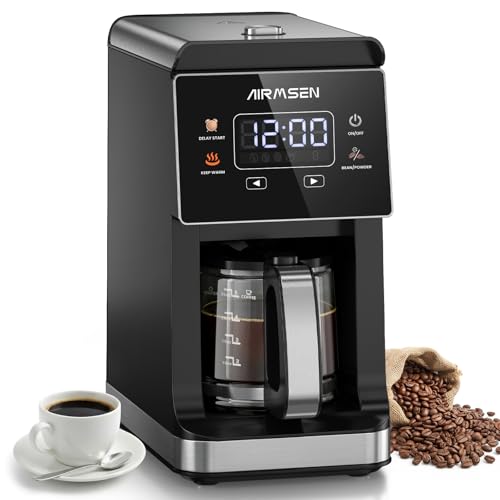
AIRMSEN Coffee Maker with Grinder 5-Cup — Best Grind-and-Brew Value
The AIRMSEN is the flavour pick of this guide, and the reason fits in one sentence: it grinds the beans immediately before brewing them. Coffee begins losing its brightest aromatics within minutes of grinding, so the brick of pre-ground that has sat open for a fortnight cannot compete with whole beans ground inside the machine moments before the water arrives. Three grind settings let you nudge finer or coarser as you learn a bean, and the 24-hour delay timer means the grinding happens at dawn rather than demanding you stand there doing it.
Five cups is the honest size for one or two drinkers, and the compact footprint suits the home offices and small counters the listing aims at. A glass carafe and a two-hour keep-warm round out a package that behaves like a much more expensive category of machine. Waking to the brief whirr of the grinder followed by the smell of genuinely fresh coffee is an alarm clock for the nose, and plenty of owners set the timer for exactly that effect.
Grinders add chores. The grind chamber needs brushing out, oily beans can clump where dry ones flow, and the machine is louder at start-up than any plain drip brewer. Capacity is the other ceiling: five cups will not serve a brunch table. Accept those terms and this is the affordable machine that tastes least affordable, which for a two-person household is the trade that matters.
- Capacity: 5 cups, sized for one or two drinkers
- Grinder: built in, with three grind settings
- Timing: 24-hour delay brew for fresh-ground mornings
- Carafe: glass, with a two-hour auto keep-warm
- Controls: touch panel rather than dials and buttons
Strengths
- Fresh-ground flavour no pre-ground rival here can match
- Timer plus grinder means waking to just-ground coffee
- Compact body suits desks, studios, and small counters
Trade-offs
- Grinder chamber needs regular brushing and care
- Five-cup ceiling rules out entertaining with it
- Dawn grinding is audible through a thin studio wall
Best for: one-or-two-person households who buy whole beans and want them ground at the moment of brewing.
Not suited for: large families, or light sleepers setting a timer in a studio flat.

RAINBEAN Single Serve Coffee Maker Programmable Timer — Best One-Mug Timer
The RAINBEAN starts from a different premise: that a carafe is a burden when only one person drinks. It brews a single cup of ground coffee, up to fourteen ounces for a travel mug, directly into the cup, and it does so on a programmable timer with auto start and auto shutoff. Set it up before bed with water and grounds, and the morning version of you presses nothing at all; the coffee simply exists when you reach the kitchen, which is a small mercy that compounds daily.
Single-serve machines live or die on honesty about who they suit. This one uses ground coffee rather than pods, which keeps the per-cup cost low and the bin free of plastic capsules, and 700 watts of quick brewing means the cup arrives fast once the cycle starts. For a dorm room, a workshop bench, a guest room, or the office desk of someone who guards their mug fiercely, the format is not a compromise at all; it is the correct tool.
The limits are structural. There is one cup, then you start again, so couples with synchronised mornings will queue. There is no carafe to keep a second helping warm, and no way to serve visitors beyond brewing cup by cup like a patient barista. Buy it as a personal appliance and it delights; buy it as a household machine and it will feel like a queue at a tiny café.
- Capacity: single servings up to 14 ounces
- Coffee format: ground coffee, no pods required
- Timing: programmable auto start and auto shutoff
- Power: 700W quick brewing for a fast single cup
- Footprint: countertop single-serve, no carafe to store
Strengths
- Timer makes a personal cup appear without any morning effort
- Ground coffee keeps running costs and waste low
- Travel-mug capacity covers the commute-cup use case
Trade-offs
- strictly one cup at a time, with no keep-warm
- No way to brew for guests except sequentially
- Small water capacity means frequent refilling
Best for: solo drinkers, dorm rooms, and desk setups where one good mug is the whole requirement.
Not suited for: couples, families, or anyone who hosts brunch.
How Do the Six Compare Side by Side?
| Pick | Format | Headline trait | Watch out for |
|---|---|---|---|
| SHARDOR 10-Cup Programmable Coffee Maker | 12-cup drip, glass carafe | Programmable, permanent filter, strong option | Glass carafe cools once the plate switches off |
| Mr. Coffee 12-Cup Programmable Coffeemaker | 12-cup drip, glass carafe | Brew Later timer and grab-a-cup pause | No real strength control beyond dosing |
| BELLA 12-Cup Programmable Coffee Maker Surf | 12-cup drip, glass carafe | No-drip carafe in a coloured finish | Design-led; brew system is conventional |
| BLACK+DECKER 12-Cup Drip Coffee Maker Vortex | 12-cup drip, glass carafe | Vortex shower head for even saturation | Shower head needs periodic rinsing |
| AIRMSEN Coffee Maker with Grinder 5-Cup | 5-cup grind and brew | Built-in grinder, three settings, delay timer | Grinder care and small capacity |
| RAINBEAN Single Serve Coffee Maker Programmable Timer | Single serve, ground coffee | Programmable timer, 14 oz maximum cup | One cup at a time, no keep-warm |
What Does Affordable Actually Buy You in a Coffee Maker?
A drip coffee maker is one of the few appliances where the budget version performs the core job almost as well as the premium one, because the core job is heating water and pouring it over grounds. What money normally buys is everything adjacent: thermal carafes instead of hot plates, better shower heads, metal where plastic would do, quieter pumps, and controls that feel pleasant. The six machines here were chosen because each one spends its limited budget on one adjacent thing that genuinely matters, whether that is a timer, a filter, a grinder, or a spout that does not dribble.
The trap at this end of the market is the machine that spends on none of those things and competes purely on a low number in the listing. Such machines brew, technically, but they tend to arrive with carafes that pour badly, baskets that are miserable to clean, and timers so fiddly that owners stop using them within a month. A coffee maker is used more often than almost any other appliance you own, so small daily frictions multiply faster than the savings. Affordable should mean simple and durable, not stripped and annoying.
There is also a running-cost side to the word affordable that sticker comparisons miss. Paper filters, pod capsules, and replacement carafes all tax you weekly or occasionally, and a machine with a permanent filter and an easy-to-replace carafe can quietly undercut a cheaper rival within a year. Two picks here attack running costs directly: the SHARDOR with its permanent filter, and the RAINBEAN by using loose ground coffee instead of pods. When you compare machines, compare the year, not the day.
Is a Timer Just a Gimmick, or the Whole Point?
Ask owners of programmable machines what they would give up last and the timer wins with embarrassing consistency. The reason is not laziness; it is sequencing. A weekday morning is a chain of small tasks performed while half awake, and removing grinding, measuring, filling, and waiting from that chain changes the emotional texture of the whole hour. Coffee that is simply there when you arrive in the kitchen feels like a service someone provides for you, and the someone is last night’s you, who had ten calm minutes to set it up.
The timer also disciplines your coffee making in a way that improves the cup. Setting up the night before means measuring grounds with a clear head, filling the reservoir to a deliberate line, and using the same ratio every day instead of eyeballing scoops through sleep. Consistency is the least glamorous variable in coffee and the one that explains most of the difference between a good pot and a disappointing one from the same machine and the same beans.
There are two honest cautions. Grounds sitting in a basket overnight are fine, but grounds sitting in a basket through a hot kitchen day are not, so timer users should set up in the evening rather than the morning before. And a timer is only as good as its interface: if setting yours requires a sequence you must look up, you will stop, which is why the plain LED clocks on the Mr. Coffee and the simple panels here are features rather than shortcomings.
Glass Carafe and Hot Plate, or Something Better?
Every full-size pick in this guide uses a glass carafe on a warming plate, and it is worth being clear-eyed about what that means. For the first twenty minutes, the coffee is at its best. Across the following hour, the plate keeps it hot while slowly cooking it, and the last cup from a pot that has sat for two hours will taste stewed no matter how good the first one was. This is not a defect of these particular machines; it is the physics of the format at this price.
The practical responses are behavioural rather than financial. Brew the amount you will drink within the hour rather than filling to the line out of optimism. If your household drinks in shifts, consider the strong-brew setting a partial remedy, since a slightly stronger pot tolerates dilution and time a little better. Or decant the finished pot into a thermal jug you already own the moment brewing ends, which costs nothing and rescues the second half of every pot from the plate entirely.
Notice that the two smaller picks sidestep the problem by design. The AIRMSEN keeps coffee warm for a stated two hours but brews only five cups, which most households finish inside the safe window, and the RAINBEAN eliminates storage altogether by brewing one cup that is drunk immediately. Choosing a smaller machine is, among other things, a way of refusing to pay the hot-plate tax at all.
How Much Difference Can a Shower Head Make?
Drip brewing looks simple from outside the basket and is quietly complicated inside it. Water that enters through a single central hole drills a channel through the middle of the grounds, over-extracting that column into bitterness while the outer ring stays under-wetted and contributes a thin, sour note. The result is the classic cheap-pot paradox of coffee that tastes bitter and weak at the same time, and no amount of expensive beans fixes a distribution problem.
A shower head that spreads water across the whole basket, as the BLACK+DECKER Vortex attempts with its swirling pattern, attacks the problem at its source. More even wetting means the whole bed of grounds gives up its flavour at roughly the same rate, and the cup tastes rounder without any change in beans, ratio, or water. It is the same principle café machines apply with precision boilers and dispersion screens, executed here in moulded plastic at a fraction of the cost.
You can help any machine, shower head or not, with two free habits. Give the basket a gentle shake after adding grounds so the bed sits level rather than mounded, and let the first bloom of water wet the grounds for a moment before the full flow if your machine allows a pause. Neither habit costs anything, and together with an even shower they close most of the gap between a budget pot and a far pricier one.
Should Your Affordable Machine Grind the Beans Too?
Grinding just before brewing is the largest single flavour improvement available to a home drinker, larger than water temperature tweaks, larger than filter material, larger than most machine upgrades. Whole beans protect their aromatic compounds inside a hard shell; the moment that shell is broken, the clock starts, and pre-ground coffee bought in a bag has been running that clock for weeks before it reaches your kitchen. A grind-and-brew machine like the AIRMSEN simply refuses to start the clock until the water is ready.
The costs are real and worth listing plainly. Grinders are the loudest part of any morning machine, they add a chamber that collects oils and fines and needs brushing, and they introduce a moving part that a plain drip machine does not have. Capacity also shrinks, because the grinder occupies space a bigger basket could have used. These are exactly the reasons the other five picks exist: plenty of households would rather buy good pre-ground coffee, brew it carefully, and enjoy the silence.
Our advice is to decide by household size and bean habit rather than by ideology. If you already buy whole beans and drink in ones and twos, the grind-and-brew route gives you café-adjacent freshness from a five-cup box. If you drink by the potful with a family, a twelve-cup drip machine and a separate grinder used on weekends will serve you better than a small integrated unit working beyond its design.
How Do You Keep a Budget Brewer Tasting Clean?
Mineral scale is the slow assassin of affordable coffee makers, because the same heating element that makes them cheap also makes them enthusiastic scale collectors. As limescale coats the element, brew temperature drops, cycles lengthen, and the coffee drifts thin and sour over months so gradual that owners blame the beans. A monthly descale with a manufacturer-approved solution, or a vinegar cycle followed by two plain-water rinses where the manual allows it, restores most machines to their first-month performance.
The daily habits matter almost as much. Rinse the carafe and basket the day they are used rather than letting coffee oils bake on overnight, because old oils go rancid and will season every fresh pot with a stale note no fresh bean can outrun. Wipe the shower head area weekly; it lives in steam and collects a film that drips back into the basket. And run the machine’s full cycle with plain water if it has sat unused through a holiday, since a reservoir left wet for a fortnight does not improve in the dark.
None of this requires products beyond a descaler and a soft cloth, and none of it takes more than minutes. The difference between a budget machine that tastes good in year three and one that tastes tired in year one is almost never the machine. It is whether somebody rinsed the basket.
What Size Pot Does Your Household Honestly Need?
Manufacturer cups are small, roughly five ounces, so a twelve-cup machine makes about eight real mugs and a ten-cup makes six or seven. Households consistently overbuy capacity because a full pot feels like hospitality, then spend years brewing half pots in baskets designed for full ones, with the thin results that follow. The honest calculation is your busiest ordinary morning, not the annual brunch: how many mugs leave the kitchen between waking and leaving, plus one for the person who always wants a second.
Singles and couples are the worst served by the standard twelve-cup format and the best served by this guide’s smaller picks. The five-cup AIRMSEN brews a full basket at a size two people actually finish, and the RAINBEAN removes the pot from the equation entirely. Both will taste better in daily use than a big machine run at a third of its design load, because drip baskets extract most evenly when they are properly filled.
Large households should read the same logic in reverse. A ten-cup machine that must run twice every morning is not affordable in time, and the second pot never tastes like the first. The twelve-cup Mr. Coffee and BLACK+DECKER exist for you, and their extra capacity costs nothing in flavour when the basket is genuinely full. Match the machine to the load and the load will reward you every single day.
What Ratio of Coffee to Water Should a Budget Machine Use?
A drip machine cannot rescue a wrong ratio, and the ratio is where most home coffee quietly fails. A sensible starting point for the full-size picks here is roughly one heaped tablespoon of ground coffee per mug of water, adjusted across a week of mornings until the cup tastes full without turning harsh. The discipline that matters is not the exact number but the repetition: the same scoop, the same fill line, the same beans, so that when you change one thing you can taste what the change did. Timer users get this discipline free, because the evening setup is measured by an awake person rather than improvised by a sleeping one wearing a dressing gown.
Small machines obey the same logic at a smaller scale. The five-cup grind-and-brew and the single-serve pick both punish casual dosing more visibly, because there is less coffee in the cup to hide behind. If your single mug tastes thin, the answer is almost never a new machine; it is another spoonful, a finer setting where the machine offers one, or fresher coffee. Keep a notebook for one week, the least glamorous coffee accessory in existence, and write down what you did on the mornings the cup was right. That page will improve your coffee more permanently than any purchase in this guide.
Water deserves its sentence too. Heavily chlorinated tap water makes its presence known in a light roast, and a simple jug filter, already owned by many households for drinking water, takes the edge off without any new appliance. Do not use distilled water, which brews flat because coffee extraction needs some mineral content to work against. Ordinary filtered tap water, a consistent ratio, and beans bought in quantities you finish within a few weeks: that trio is the entire secret life of good budget coffee.
How Do You Choose Between Ten Cups and Twelve?
The ten-cup and twelve-cup picks in this guide differ by roughly two mugs, and the decision between them is really about the shape of your busiest ordinary morning. Count the mugs that leave your kitchen on a normal workday, add one for the person who always returns for a second, and then ask whether weekend guests are a weekly reality or a monthly one. If the honest total is six mugs or fewer, the ten-cup machine will brew fuller baskets and better coffee across the year, because drip extraction rewards a properly filled basket every single day.
Twelve cups earns its place in houses where the pot is a shared resource: families with staggered departures, shared houses with a communal morning, home workers whose partner also drinks at a desk. In those kitchens the extra capacity is not headroom but the main event, and running a ten-cup machine twice is a worse outcome than owning the larger pot, because the second brew never lands when people want it and the first has already begun to stew.
There is a storage footnote that decides ties. A twelve-cup carafe is taller and its machine usually broader, and in a kitchen where the brewer lives under wall cupboards, the clearance to lift the lid and fill the reservoir can matter more than the capacity inside it. Measure the vertical space where the machine will live, lid fully open, before choosing. The right size is the one that fits the household and the cupboard at the same time.
What Should You Do in the First Week With a New Machine?
Run two full cycles of plain water before the first coffee, because new machines carry the faint taste of their own manufacture and the first pot will tell you about the factory rather than the beans. Then brew your usual coffee at your usual ratio and resist changing anything for three days. A new machine needs a baseline before it needs opinions, and most early disappointment is a familiar recipe meeting an unfamiliar basket shape, which a small dose adjustment fixes by the end of the week.
Use that week to learn the machine’s particular timings. Note how long the cycle takes, how hot the first cup is at the moment you usually drink it, and how the last cup tastes at the moment you usually reach it. Those three observations tell you whether to set the timer earlier, brew a smaller amount, or decant into a thermal jug, and they personalise the machine to your household in a way no review, including this one, can do from outside your kitchen.
Finally, start the maintenance clock while the machine is new and the habit is cheap. Mark a monthly descale date on whatever calendar the household actually reads, rinse the basket and carafe daily from day one, and keep the manual somewhere findable. A budget machine’s whole economic argument depends on it lasting, and lasting is mostly a routine established in the first week rather than a quality installed at the factory.
Is Iced Coffee a Fair Test of a Cheap Drip Machine?
Several households will judge these machines partly by their summer behaviour, so it is worth setting expectations. A standard drip brewer makes hot coffee, and iced coffee made from it is best brewed strong and poured over ice immediately, where the dilution of melting ice is part of the recipe rather than an accident. The strong settings on the SHARDOR and the general principle of a higher coffee dose both serve this purpose, and a pot brewed double-strength over a jug of ice is a genuinely refreshing drink rather than a compromise with a straw in it.
What these machines will not do is cold brew, which is a different extraction entirely, made with time and cold water in a jar in the fridge, and no drip machine at any price performs it. Nor will the hot plate help you here; coffee destined for ice should leave the machine the moment it finishes, because stewed coffee chilled is merely cold stewed coffee. Brew, pour over fresh ice, and drink within the hour, and the affordable drip machine covers summer as competently as it covers January.
Which Accessories Are Worth Buying Alongside a Cheap Machine?
Very few, and that restraint is part of staying affordable. The one purchase that reliably improves every machine in this guide is a simple scale or a dedicated scoop used consistently, because measured coffee beats guessed coffee regardless of the brewer around it. If your machine lacks a permanent filter and you brew daily, a reusable filter matched to its basket pays for itself in paper savings within months and removes the empty-box morning from your life entirely. A thermal jug, if your household drinks slowly, rescues the second half of every pot from the warming plate for less than the difference between these machines and the next price tier.
Beyond that short list, accessory money is usually better saved toward beans. A descaling solution is a maintenance necessity rather than an accessory and should be bought without debate. But upgraded carafes for machines that pour well already, novelty timers for machines that have timers, and premium paper filters for a drinker who cannot taste the difference are all ways of spending the machine’s price twice without drinking any better. The affordable philosophy that chose these six machines applies to their entourage too: buy what changes the cup, skip what changes only the receipt.
One exception deserves naming for the grind-and-brew and single-serve owners. Whole beans for the AIRMSEN should be bought in small, frequent quantities, because its entire advantage is freshness and a giant bag ageing in a cupboard surrenders it. The RAINBEAN’s owner should keep a dedicated mug that lives by the machine, the right height for its spout and the right size for its maximum brew, because a personal machine deserves a personal cup and the pairing prevents the one spill this format is prone to.
Can One of These Machines Serve a Small Office?
Yes, and the office is where several of these formats quietly live their best lives. A ten or twelve-cup programmable machine in a small workplace covers the morning round without a facilities department, and the timer means the first arrival is not the unpaid barista. The grind-and-brew pick suits the office that buys good beans and drinks in twos, while the single-serve belongs on the desk of the person whose mug is a personality trait. Choose by headcount exactly as you would at home, keep the descale date on the office calendar rather than in one person’s memory, and the affordable machine will outlast several office chairs.
Which Mistakes Make a Cheap Coffee Maker Taste Expensive to Own?
- Buying on the sticker alone. The cheapest listing in the category often omits the timer, the permanent filter, or the replaceable carafe, and each omission bills you later in money or in mornings.
- Filling to the line out of habit. A full pot that sits on a hot plate for two hours teaches you to dislike a machine that would have shone at the size you actually drink.
- Never descaling. Scale quietly lowers brew temperature month by month, and owners replace beans, then machines, when a descale cycle was the whole problem.
- Leaving grounds in the basket overnight after brewing. Wet spent grounds grow stale fast and perfume the next pot; empty the basket when you pour the last cup, not tomorrow.
- Choosing pods for a household pot habit. A family drinking four mugs a day pays a steep per-cup toll in capsule formats that a drip machine with ground coffee avoids entirely.
Final Recommendation
Affordable coffee is not a compromise category when you buy by routine rather than by listing order. The strongest all-round choice here is the SHARDOR 10-Cup Programmable Coffee Maker, which covers timing, capacity, a permanent filter, and a strong setting in one unpretentious box, and which most households could run happily for years. If even, generous extraction from ordinary pre-ground coffee is your priority, the BLACK+DECKER 12-Cup Drip Coffee Maker Vortex puts its money inside the brew basket where the flavour is decided. Households of one or two who buy whole beans should look hardest at the AIRMSEN Coffee Maker with Grinder 5-Cup, because fresh grinding is the one upgrade in this guide that you can taste in every single cup.
Whichever direction you choose, spend the first week learning your machine’s ratio and keep it, descale on a calendar rather than on a suspicion, and brew the amount your household truly drinks. Do that, and an affordable brewer stops feeling like the cheap option and starts feeling like the correct one, which is the moment a kitchen appliance has done its whole job.
Frequently Asked Questions
Can an affordable drip machine make genuinely good coffee?
Yes, provided the basics are respected: fresh coffee, a sensible ratio, a level bed of grounds, and water that actually reaches the basket hot. The machines here differ in extraction evenness and convenience, but none of them is prevented by its price from making a clean, satisfying pot. Most bad budget coffee is a ratio or staleness problem wearing a machine costume.
Is a permanent filter better than paper?
It is cheaper and produces a slightly fuller cup, because metal mesh lets fine particles and oils through that paper traps. Paper gives a cleaner, brighter cup and makes cleanup a matter of lifting the filter out. The SHARDOR includes a permanent filter, and nothing stops you using paper in it on days you prefer the cleaner style.
How long should a budget coffee maker last?
A simple drip machine has few moving parts and should run for years of daily use if it is descaled regularly and the carafe survives. The carafe, not the electrics, is the usual point of failure, which is why brands with easily replaced carafes, like the Mr. Coffee here, are a quietly smart affordable buy.
Does the strong-brew setting actually do anything?
On machines like the SHARDOR it slows or pulses the water flow so the grounds get longer contact time, which extracts more and produces a heavier cup from the same dose. It is not magic and cannot rescue stale coffee, but with fresh pre-ground it makes a perceptible difference, particularly for drinkers who add milk.
Is grind-and-brew worth the extra noise?
For whole-bean drinkers in small households, yes: the freshness gain is the largest available at this price, and the AIRMSEN keeps the footprint small. If your household drinks by the potful or your kitchen adjoins a light sleeper’s bedroom, a plain drip machine and a separate grinder used at civilised hours is the kinder arrangement.
What is the cheapest way to improve the coffee I already make?
Descale the machine, weigh or consistently measure your grounds for a week, and stop leaving the pot on the hot plate. Those three changes cost almost nothing and routinely transform the output of a brewer its owner was about to replace, which is the most affordable upgrade in this entire guide.
Related Guides
If your mornings are getting an upgrade, these companion guides cover the neighbouring decisions, from waking-up brewers to the machines that share a counter with them: Best Alarm Clock Coffee Machines Best Baby Sound Machines Best Basic Sewing Machines


