What's inside
- Key Takeaways
- Quick Picks
- How Did We Choose Sound Machines Specifically for Babies?
- How Do the Six Compare Side by Side?
- Where Exactly Should a Sound Machine Sit in the Nursery?
- How Loud Is Loud Enough, and How Loud Is Too Loud?
- White, Pink or Brown: Which Noise Suits a Nursery?
- Should the Sound Run All Night or on a Timer?
- How Do Night Lights Help, and When Do They Hinder?
- What Role Can a Sound Machine Play in a Bedtime Routine?
- How Should You Handle Sound Machines When Travelling With a Baby?
- When Should a Family Stop Using a Nursery Sound Machine?
- How Do You Introduce a Sound Machine to a Baby Who Already Sleeps Without One?
- What About Twins, Siblings and Shared Rooms?
- How Should Grandparents and Babysitters Use the Nursery Machine?
- Can a Sound Machine Live in the Parents’ Room Too?
- What Should You Check in the First Week With a New Machine?
- How Do Sound Machines Fit Alongside Safe Sleep Basics?
- Why Do Some Babies Prefer Nature Sounds Over Steady Noise?
- How Do You Keep a Nursery Machine Clean and Working for Years?
- What Is the Difference Between a Registry Gift Machine and One You Choose Yourself?
- How Does a Sound Machine Help During the Newborn Weeks Specifically?
- What Mistakes Do Parents Make With Baby Sound Machines?
- Final Recommendation
- Frequently Asked Questions
- Related Guides
As an Amazon Associate I earn from qualifying purchases. This post may contain affiliate links at no extra cost to you.
cottageverdict.com is reader-supported. When you buy through links on our site, we may earn an affiliate commission.
Where to buy: the six machines below are all sold through Amazon, and the pick names in the Quick Picks table, the detailed sections and the comparison table link to their listings so you can check price on Amazon on the day you shop — worthwhile with the best baby sound machines, because nursery models are refreshed often and last season’s favourite is regularly replaced by a near-identical successor.
A sound machine for a baby does one unglamorous job: it lays a steady, boring wash of sound under the noises of a real house — a kettle, a doorbell, an older sibling, a dog announcing the post — so that everyday sounds stop arriving as sudden events in a quiet room. It does not teach a baby to sleep, it does not fix a feeding problem, and no honest guide should promise that it will transform your nights. What it can do is remove one common reason a lightly sleeping baby surfaces between sleep cycles, and that modest, repeatable help is what parents are actually buying.
Safety and placement shape every recommendation here. The consistent, common-sense guidance for nursery sound is to keep the volume modest — roughly conversation level or quieter at the cot — to place the machine across the room rather than in or on the cot, and to keep cords and small devices well out of a baby’s reach. Every pick below is assessed with that placement in mind: how finely its volume can be trimmed at the low end matters more in a nursery than how loud it can go.
The six divide by philosophy. Dreamegg and the smaller Momcozy are portable battery travellers. The smart Momcozy and the Hatch build lights, routines and app control around the sound. Kipcush and the Brown Noise machine are plug-in all-rounders with big sound libraries and colour-changing lights. All six are judged as nursery tools first — low-volume manners, night-time usability in the dark, and lights that soothe rather than stimulate.
Key Takeaways
- Place any nursery sound machine across the room from the cot, never inside it, and keep the volume modest — fine low-end volume control matters more than maximum loudness.
- The Hatch and the smart Momcozy add routine-building lights and app control for parents who want the same wind-down sequence every night.
- Dreamegg’s battery portable is the travel and power-cut insurance of the group, small enough for a changing bag.
- Kipcush pairs 30 sounds with an eight-colour night light and a memory function that restores last night’s settings.
- The Brown Noise machine’s 36 volume levels give the finest low-volume trimming here — useful when a nursery shares a wall with the parents’ room.
- No sound machine replaces safe sleep basics: a clear cot, baby on their back, and a room at a comfortable temperature come first, always.
Quick Picks
| Pick | Badge | Why it earns its place |
|---|---|---|
| Dreamegg Portable Noise Machine | Best Portable for Travel and Pram | A classic white portable with 21 soothing sounds and a powerful rechargeable battery, built for the pram, the car seat run and the nursery shelf alike. |
| Momcozy Smart Baby Sound Machine | Best Smart Nursery Hub | A smart nursery hub: 34 soothing sounds, an egg-shaped night light, app remote control and sleep-trainer routines as your baby becomes a toddler. |
| Hatch Baby Sound Machine & Night Light | Best Routine Builder | A routine builder in putty tones — white noise, a night light and time-to-rise features for the toddler years, with a period of sleep support included. |
| Kipcush White Noise Machine 30 Sounds | Best Simple Plug-In With Memory | Thirty sounds, an eight-colour night light and a memory function in a simple plug-in unit that remembers exactly how last night was set. |
| Momcozy Sound Machine for Baby 20 Sounds | Best Touch-Light Portable | A portable 20-sound machine with a touch-controlled warm light, timer and memory — the one designed to move between nursery, travel cot and grandparents. |
| Brown Noise Sound Machine 30 Sounds Night Light | Best Fine Volume Control | Thirty sounds including brown noise, twelve light colours, 36 volume levels and five timers — the fine-adjustment specialist of the group. |
How Did We Choose Sound Machines Specifically for Babies?
We filtered for nursery manners first. A machine for a baby’s room needs volume that can be set genuinely low and adjusted in small steps, controls a parent can operate one-handed in the dark without lighting up the room, and a night light — if it has one — that glows warmly instead of flashing through a disco cycle at 3 a.m. Machines that failed those tests, however impressive their sound libraries, did not make this list.
Second, we valued memory and timers. The middle-of-the-night test of any nursery gadget is whether it resumes last night’s exact settings after being switched off, bumped or unplugged by a cleaner. Memory functions, sensible timer options and auto-dim displays sound like small print; at 4 a.m. they are the difference between a tool and another problem to solve while holding a crying baby.
Finally, we kept the claims honest. Sound machines are comfort devices. Research and paediatric guidance treat them as optional aids to be used sensibly — moderate volume, sensible distance — not as therapy, and nothing in this guide credits a machine with treating colic, reflux, sleep disorders or anything else a listing might hint at. What we can recommend is build, control, sound quality and fit for a family’s actual nights.

Dreamegg Portable Noise Machine — Best Portable for Travel and Pram
The Dreamegg’s nursery career usually begins outside the nursery. It is a small, classic-white portable with 21 soothing sounds and a battery the listing describes as powerful, which makes it the machine parents clip to a pram for a walk, drop in a changing bag for a café nap, or carry to a hotel room where the corridor noise is nobody’s friend. In a category full of plug-in bedside boxes, genuine portability is a philosophy: the sound follows the baby, not the room.
At home it earns its shelf space as the household’s second machine — the one that travels to grandparents, covers a power cut without drama, and lets the main nursery unit stay parked and configured. Twenty-one sounds is a middle-sized library, and for babies that is usually plenty, because most families settle on one or two favourites within a week and never browse again. What matters is that the favourite is there, at a volume that trims low, night after night.
Battery power also removes the cord question entirely for travel cots and pram use, though the standing nursery rule still applies: across the room from the cot, not in it, however cute and small the machine is. Charge it with the evening bottles, treat it as part of the going-out kit, and the Dreamegg becomes less a gadget than a piece of the baby’s portable environment — familiar sound, anywhere on earth.
One small habit protects this machine’s whole value: charge it on a schedule rather than on a warning. A portable that dies at midnight in a strange hotel room teaches the lesson once, permanently. Topped up with the evening feed equipment, the Dreamegg simply becomes part of the household’s travelling furniture, and its 21 sounds turn out to be the same two or three beloved ones, faithfully repeated in every postcode.
- Listed sounds: 21 soothing sounds
- Power: rechargeable battery, described as powerful in the listing
- Audience in listing: baby and adult
- Use cases in listing: office, sleeping, home, travel, registry gift
- Colour: classic white
Strengths
- True battery portability for pram, travel and power cuts.
- No cord near the cot when running on battery.
- Small and light enough to live in a changing bag.
Trade-offs
- Battery needs a charging routine or it dies at the worst hour.
- 21 sounds is fewer than the big plug-in libraries.
- Small unit is easy to misplace between trips.
Best for: families who travel, visit grandparents often, or want a battery backup beside a plug-in nursery machine.
Not suited for: parents wanting app control, routines and a statement night light in one device.

Momcozy Smart Baby Sound Machine — Best Smart Nursery Hub
Momcozy’s smart machine is built for parents who run the nursery from their phone and feel no shame about it. The listing promises 34 soothing sleep sounds, a night light in an egg form, app remote control, a timer and personal sleep-routine features with a toddler sleep-trainer alarm clock angle. In practice that means the wind-down sequence — dim warm light, favourite sound, set volume — can be triggered from the sofa without opening the nursery door and resetting a nearly asleep baby with a shaft of hallway light.
The sleep-trainer element extends the machine’s life beyond the baby stage this guide is named for. A light that signals ‘still night’ and later ‘morning now’ gives toddlers a rule they can see, and a machine bought for a newborn that still has a job at age three has justified its shelf space several times over. The egg light’s soft glow suits night feeds and nappy changes, bright enough to work by, dim enough not to announce daytime to a baby you hope will resettle.
App control cuts both ways, and the trade-off deserves stating. Phone-dependent features are wonderful until the phone is flat, the app updates at midnight, or a grandparent babysits without the login. Check that the machine’s essential functions — sound on, volume, light — remain reachable on the device itself, and treat the app as a remote control rather than the only key to the nursery.
The routine features reward a single thoughtful setup evening. Programme the wind-down in the order your family actually does things — not the order a leaflet imagines — and the machine starts repaying the effort the very next night. Households with a second caregiver should walk them through the app once, in daylight, so the system survives a parent’s night away without a phone call at bedtime.
- Listed sounds: 34 soothing sleep sounds
- Control: app remote control plus on-device use
- Light: egg-shaped night light
- Extras in listing: timer, personal sleep routine, toddler sleep trainer alarm
- Positioning: white noise machine for nursery and toddler rooms
Strengths
- App control avoids opening the nursery door at night.
- Sleep-trainer light grows with the child into toddlerhood.
- Large 34-sound library under one warm light.
Trade-offs
- Smart features depend on phone, app and home network behaving.
- More setup than a simple plug-in-and-press machine.
- Egg light brightness may still need positioning care in tiny rooms.
Best for: connected-home parents who want routines, app control and a light that doubles as a toddler sleep trainer.
Not suited for: anyone who wants a nursery device with zero apps, accounts or updates involved.

Hatch Baby Sound Machine & Night Light — Best Routine Builder
The Hatch arrives in a putty finish that looks designed rather than medical, and its listing sells a system rather than a noise box: white noise, a night light, a routine builder, a toddler and kid time-to-rise alarm clock, and a period of sleep support bundled with the purchase. The routine builder is the heart of it. Parents programme the sequence — this colour and sound means winding down, this one means night, this one means morning may begin — and the machine repeats it with a consistency no tired adult can match.
That consistency is the genuine product. Babies and toddlers read patterns, and a light-and-sound ritual that never varies becomes a cue the whole evening can hang on: bath, book, Hatch glows, sound settles, door closes. The time-to-rise side then repays the investment at the other end of childhood, when a four-year-old can be taught that the light, not enthusiasm, decides when the household wakes.
Two honest cautions. A routine system asks for a setup evening and a degree of app involvement that simple-machine families may not want, and its strengths only appear when the routine is actually used nightly — as a plain white-noise box it is an expensive way to buy a hum. Buy it as a ritual you intend to keep, place it across the room as with every machine here, and it becomes the nursery’s quiet stage manager.
Judge the Hatch across a month, not a weekend. Its value compounds as the routine becomes the child’s own expectation, carried by light and sound rather than by parental negotiation. Families who move house, travel or welcome a sibling mid-childhood often find the programmed ritual is the one piece of the old evening that can be recreated exactly, anywhere, on the first night.
- Functions in listing: white noise machine, night light, routine builder
- Growing-up feature: toddler and kid time-to-rise alarm clock
- Included in listing: 3 months of sleep support
- Finish: Putty
- Positioning: registry essential for nurseries
Strengths
- Programmable routines give the evening an unvarying cue.
- Time-to-rise light extends usefulness for years.
- Calm, furniture-like design suits adult-facing nurseries.
Trade-offs
- Full value requires setup and nightly routine discipline.
- App-led system will not suit minimalists.
- Premium positioning among nursery sound machines.
Best for: parents who love a fixed bedtime ritual and want one device from newborn nights to toddler mornings.
Not suited for: families wanting a cheap, simple, set-it-and-forget-it hum.
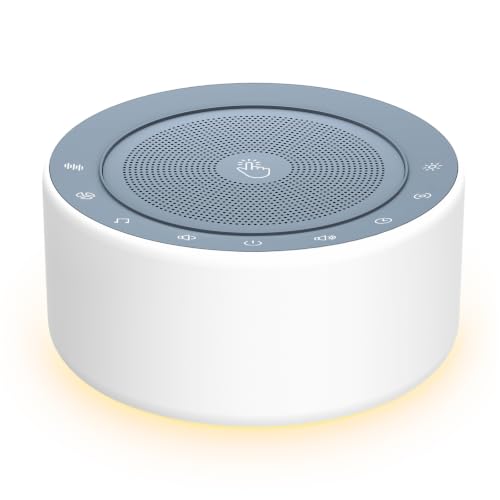
Kipcush White Noise Machine 30 Sounds — Best Simple Plug-In With Memory
Kipcush builds the straightforward nursery machine and builds it well: 30 soothing sounds, an eight-colour night light, a memory function, and marketing that addresses babies and adults in the same breath. The memory function is the feature parents will bless most. Whatever combination of sound, volume and light saw the baby off last night is the combination that returns tonight, without a bleary parent re-creating it by feel at the bedside.
Thirty sounds covers the nursery canon generously — the steady noises that mask household clatter, the gentler natural textures some babies prefer — and the eight-colour light lets a family choose a warm, dim shade for night feeds and keep it there. Used with restraint, the light is a tool: one colour, low brightness, same every night, so it reads as part of the room rather than entertainment hung above the cot.
There is no app and no routine empire here, which many households will count as a strength. The Kipcush plugs in, remembers, and plays. Its compromises are the plug-in compromises: it lives where the socket is, travels less happily than the battery machines, and its light show must be tamed by the parent rather than by software. For a main nursery machine on a shelf across from the cot, those are easy terms to accept.
Simplicity ages well in a nursery. Buttons that work in the dark, settings that return unbidden, a light that stays the colour you chose — none of it photographs as innovation, and all of it is what a parent actually touches at 3 a.m. The Kipcush understands its assignment: be the same machine tonight that you were last night, and ask for nothing in return.
- Listed sounds: 30 soothing sounds
- Light: 8-colour night light
- Memory: memory function restores previous settings
- Audience in listing: baby and adults
- Type: plug-in sleep sound machine
Strengths
- Memory function restores last night’s exact setup.
- Generous sound library without app complexity.
- Night light colour can be fixed to one calm shade.
Trade-offs
- Plug-in design ties it to a socket and a shelf.
- No app or routine scheduling for connected-home fans.
- Colour light needs parental restraint to stay soothing.
Best for: parents wanting a dependable main nursery machine that remembers settings and skips the smart-home fuss.
Not suited for: frequent travellers who need battery power above all.

Momcozy Sound Machine for Baby 20 Sounds — Best Touch-Light Portable
The second Momcozy in this group takes the opposite road from its smart sibling: 20 soothing sounds, a touch-controlled warm light, portability, a timer and memory, pitched by its listing as a travel companion and nursery essential for kids and adults alike. The touch light is its signature. A drowsy parent can tap the machine itself to raise or soften a warm glow for a feed or a nappy change, no phone, no app, no bright screen in a dark room.
Twenty sounds is the honest size of library most families actually use, and the portability is real: this is the machine that moves between the nursery shelf, the travel cot at a friend’s house and the grandparents’ spare room, carrying its remembered settings with it thanks to the memory function. A baby who sleeps to the same sound in three houses is a baby whose sleep travels, and that continuity is worth more than twenty extra sound files nobody selects.
Set expectations by its size. A compact portable will not fill a large room with sound the way the big plug-ins do, and its warm light is a night light, not a lamp. Within its brief — close, warm, familiar, movable — it is one of the most likeable designs here, and for smaller nurseries it may be all the sound machine a family ever needs.
The touch light quietly changes night feeds. Instead of a phone torch or a ceiling light, a tap gives you a warm pool to work in, and another tap takes it away. Babies fed in near-darkness resettle more easily than babies fed under full light, and parents do too — a small mercy that repeats itself several times a night for months.
- Listed sounds: 20 soothing sounds
- Light: touch-controlled warm light
- Functions in listing: timer and memory
- Form: portable white noise machine
- Audience in listing: kids and adults; travel companion positioning
Strengths
- Touch warm light works without a phone in the dark.
- Portable with memory, so settings travel with the baby.
- Simple control scheme suits babysitters and grandparents.
Trade-offs
- Compact output suits small rooms better than large ones.
- Smaller library than the 30-plus sound machines.
- Light is for night tasks, not for reading in bed.
Best for: families wanting one warm-light machine that moves between nursery, travel cot and grandparents’ house.
Not suited for: large nurseries needing room-filling volume from a single unit.
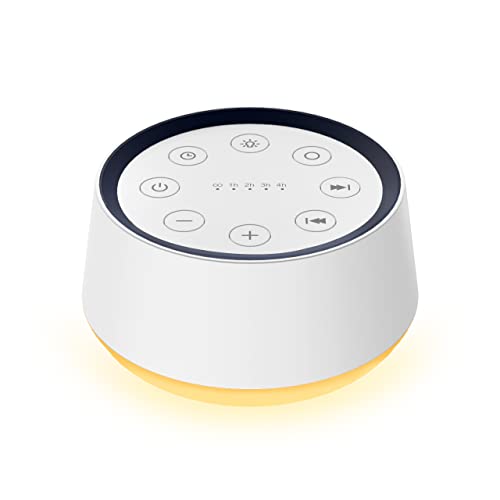
Brown Noise Sound Machine 30 Sounds Night Light — Best Fine Volume Control
This machine’s listing reads like a specification for parents who think in adjustments: 30 soothing sounds, twelve colours of night light, a memory function, five timers and — the detail that earns its badge — 36 volume levels. In a nursery, volume granularity is safety equipment in disguise. The difference between a sound that sits under a baby’s sleep and one that presses on it can be a single coarse step on a lesser machine; thirty-six steps let you land exactly on the quiet wash you intended.
Brown noise itself deserves its nursery moment. Lower and rumblier than classic white noise, it masks the bass-heavy sounds of real houses — footsteps, doors, a washing machine’s spin through the floor — particularly well, and some babies plainly settle to it faster. Having it alongside twenty-nine other sounds, with a memory function to keep the winning combination, makes this a machine a family can tune to one particular baby in one particular thin-walled flat.
The twelve-colour light is the feature to handle with the most discipline: choose one warm colour, set it low, and let the machine’s other virtues do the work. Timers in five flavours let the sound bow out after the baby is deeply asleep or run all night, as your household prefers. For parents who have read this far and recognised themselves as adjusters, this is your machine.
Thirty-six volume steps sound like excess until a grandparent babysits and sets the machine by feel. Fine steps forgive imprecise hands: somewhere within a notch or two of last night is close enough that the baby never notices the substitution. On coarse machines, one click is a different room. In a nursery, that granularity is not luxury; it is tolerance built into the dial.
- Listed sounds: 30 soothing sounds including brown noise
- Volume: 36 levels
- Light: 12 colours of night light
- Timers: 5 timer options, memory function included
- Audiences in listing: adults, baby, kids; home, office, travel
Strengths
- 36 volume levels allow genuinely fine low-volume tuning.
- Brown noise masks low household sounds especially well.
- Five timers and memory suit varied family routines.
Trade-offs
- Twelve light colours invite fiddling; restraint required.
- Control richness means a longer first-evening setup.
- Travel use possible but it is happiest as a room machine.
Best for: parents in thin-walled homes who want precise, low, rumbly sound tuned exactly to their baby and their building.
Not suited for: minimalists who want two buttons and no decisions.
How Do the Six Compare Side by Side?
| Pick | Badge | Key specification | Watch out for |
|---|---|---|---|
| Dreamegg Portable | Best Portable for Travel and Pram | 21 sounds, battery powered | Library smaller than plug-in rivals; keep it charged. |
| Momcozy Smart | Best Smart Nursery Hub | 34 sounds, app control, egg light | Smart features need phone and network cooperation. |
| Hatch Baby | Best Routine Builder | Routine builder, time-to-rise light | Value depends on actually using the routines. |
| Kipcush 30 Sounds | Best Simple Plug-In With Memory | 30 sounds, 8-colour light, memory | Plug-in only; light colours need taming. |
| Momcozy 20 Sounds | Best Touch-Light Portable | 20 sounds, touch warm light, portable | Compact output for smaller rooms. |
| Brown Noise 30 Sounds | Best Fine Volume Control | 30 sounds, 36 volume levels, 5 timers | Most controls to set up on night one. |
Where Exactly Should a Sound Machine Sit in the Nursery?
Across the room from the cot is the short answer, and it survives every variation of nursery layout. Distance does two jobs at once: it keeps the sound level at the baby’s ears gentler than the level at the machine, and it keeps the device, its buttons and any cord physically out of the cot’s world as the baby grows into a grabbing, standing, cord-curious toddler. On a dresser or shelf, a couple of metres away, pointed at the room rather than at the cot, is the arrangement that works.
Height and surface matter in smaller ways. A machine on a soft surface can sound muffled and run warm; a machine at the edge of a shelf above a cot is a falling hazard dressed as convenience. Give it a stable, boring home of its own, route any cord down and away where small hands and cruising toddlers cannot find it, and then leave it alone. The best nursery technology is the kind you stop noticing by the second week.
How Loud Is Loud Enough, and How Loud Is Too Loud?
Think in comparisons rather than numbers. The sound at the cot should feel like a quiet shower running in the next room, or soft conversation — present, steady, and easy to talk over without raising your voice. If you find yourself speaking up to be heard over the machine while standing at the cot, it is too loud, whatever the dial says. Fine-grained volume controls, like the 36 levels on the Brown Noise machine, exist precisely because the right level is a narrow landing zone, not a rough guess.
Distance is your second volume control and the safer one. Moving a machine from the cot’s rail to the far dresser drops the level at the baby’s ears considerably without changing the masking effect in the room much at all. Set the machine at its place across the room, walk to the cot, and judge from there — never by how it sounds with your ear beside the speaker while you set it.
White, Pink or Brown: Which Noise Suits a Nursery?
The colours describe how a noise distributes its energy. White noise spreads it evenly and sounds bright and hissy, like untuned radio static; it masks sharp, high sounds — a doorbell, a dog’s bark — very effectively. Pink noise softens the high end and sounds more like steady rain. Brown noise leans into the low frequencies, a rumble closer to a distant waterfall or a car journey, and it is often the best mask for footsteps, bass and building sounds travelling through floors.
Babies, being people, have preferences that no chart predicts. The practical approach is to try each colour your machine offers for a few nights at the same modest volume and watch the pattern: which one sees the baby resettle most easily after the normal midnight stirrings? Most machines here offer several colours inside their libraries, so the experiment costs nothing but a little patience during the first fortnight.
Should the Sound Run All Night or on a Timer?
Both arrangements have honest logic. Running all night keeps the acoustic environment identical at 2 a.m. and 4 a.m., so the lighter sleep of the small hours happens against the same background the baby fell asleep to — and household noises at dawn are masked when sleep is at its most fragile. Timers, meanwhile, suit families who prefer the room to fall truly quiet once the baby is deeply asleep, and they trim electricity use and any parental worry about all-night sound to zero.
The machines here mostly offer both, with timers from thirty minutes to several hours and continuous modes besides. A sensible experiment: use a timer for the first weeks and note whether wake-ups cluster just after the sound stops. If they do, your baby is telling you the masking was doing real work, and continuous play at a modest volume is the kinder setting for your household.
How Do Night Lights Help, and When Do They Hinder?
A nursery night light is for the adults. It exists so a parent can find the cot, check a sleeping face, change a nappy and feed without switching on an overhead light that announces morning to everyone in the room. Warm, dim and low is the specification that serves that purpose — enough to work by, never enough to play by. The egg light on the smart Momcozy and the touch light on its smaller sibling are shaped exactly around those night tasks.
Lights hinder when they become entertainment or information. Bright colours cycling above a cot give a waking baby something fascinating to watch instead of resettling, and a light bright enough to read by will shorten everyone’s night. Choose one warm shade, set it low, keep it in the same place, and let it be furniture. If your machine offers twelve colours, the correct number to use across a childhood is probably two: one for night feeds now, one for the toddler’s chosen ‘big kid’ glow later.
What Role Can a Sound Machine Play in a Bedtime Routine?
A supporting one, and supporting roles win evenings. A routine is a sequence a baby learns to predict — feed, bath, pyjamas, book, cot, sound — and the machine’s entrance at the same point every night turns it into a cue: this sound means the day is over. Machines with routine builders, like the Hatch, formalise that cue with light changes, but the cue works with any machine switched on at the same moment in the same order.
Keep the routine short enough to survive bad days. Twenty unhurried minutes beats an elaborate hour that collapses whenever visitors, travel or a second child intervene. And protect the routine’s portability: the families who fare best on holiday are those whose routine’s essential props fit in a bag — which is why a battery machine playing the home sound in a strange room is such a quietly powerful travel tool.
How Should You Handle Sound Machines When Travelling With a Baby?
Bring the sound, change everything else. Travel disrupts a baby’s sleep through unfamiliar light, smells, surfaces and noises; the one element you can reproduce exactly is the acoustic one. A battery portable — the Dreamegg above all, or the smaller Momcozy — playing the home favourite at the home volume turns a hotel room, a caravan or a spare bed at your sister’s into somewhere the baby has, in one important sense, slept before.
Mind the practicalities. Charge or pack the cable, place the machine across the travel cot just as at home, and resist the holiday temptation to turn it up to cover a lively hotel corridor — move it closer to the door instead, so it masks at the point of entry while staying modest at the cot. On the first night home, the same sound closes the trip’s loop, and most babies accept the story that nothing really changed.
When Should a Family Stop Using a Nursery Sound Machine?
Whenever it stops earning its place — there is no deadline written anywhere that matters. Many children keep a sound machine into the toddler and preschool years, where its job quietly changes: masking a new sibling’s night feeds, covering street noise in a first big-kid bedroom, signalling that the room is now in night mode. Machines with time-to-rise lights, like the Hatch and the smart Momcozy, are designed for exactly that second career.
If you do phase it out, fade rather than amputate. Lower the volume a notch every few nights, or shorten the timer, and a child who has slept with sound for two years will barely register the change across a fortnight. And if the machine migrates to the parents’ room afterwards — as the all-rounder models here cheerfully will — that is not a failure of weaning. That is a household appliance retiring to lighter duties.
How Do You Introduce a Sound Machine to a Baby Who Already Sleeps Without One?
Start at the easiest sleep of the day, not the hardest. A lunchtime nap in a bright, noisy house is where masking proves itself fastest, and a baby who accepts the sound then will rarely object when it joins the evening. Keep the volume modest from the first use; introducing it quietly and consistently beats introducing it loudly and apologetically.
Give the experiment a fortnight before judging. Sleep is variable for a hundred reasons, and one bad night proves nothing in either direction. If, across two weeks, the baby surfaces less often at the predictable noisy moments — the front door, the older child’s bath, the dog’s evening opinions — the machine is doing its job and has earned its shelf.
What About Twins, Siblings and Shared Rooms?
One machine, placed sensibly, usually serves a shared room better than two competing ones. Position it so both sleepers get the benefit — roughly equidistant, across the room from both cots — and choose the sound by the lighter sleeper’s preference, since the deeper sleeper will accept almost anything steady. Volume judged at the nearer cot protects the closer baby.
Where siblings of different ages share, the machine’s timer becomes diplomacy: sound for the baby’s early bedtime, fading before the older child’s story ends, or running quietly beneath both. The routine machines can formalise that choreography, but a simple remembered setting and a household agreement about doors and hallway voices achieve most of it.
How Should Grandparents and Babysitters Use the Nursery Machine?
Leave the machine exactly as you use it, and leave a three-line note: which sound, roughly how loud, light on or off. The memory functions on several picks here exist for precisely this evening — the machine itself remembers what a well-meaning grandparent cannot be expected to. Ask them to change nothing but the on switch, and the baby’s night survives your night out intact.
If the baby is sleeping at the grandparents’ house instead, send the portable and the same three-line note. Familiar sound is the cheapest form of continuity you can pack, and a baby who settles in a strange room because one thing sounds like home will make believers of the whole family by breakfast.
Can a Sound Machine Live in the Parents’ Room Too?
Several machines here are explicitly pitched at adults as well as babies, and dual citizenship is realistic. The Kipcush and the Brown Noise machine will mask a partner’s snoring-adjacent noises, a street-facing bedroom or a shift worker’s daytime sleep with the same steadiness they bring to a nursery. Buying one good machine that serves the nursery now and the parents’ room later is sound household economics.
Just reset your habits when it moves. Adult rooms tolerate — and often want — higher volumes and brighter light settings than a nursery should ever see. When the machine changes rooms, change the settings deliberately, and if it ever returns to a child’s room, return the volume to nursery modesty first and check it at the cot.
What Should You Check in the First Week With a New Machine?
Three things, all at the cot, all in the dark. First, the level: stand where the baby sleeps and confirm you can talk comfortably over the sound. Second, the light: check from the doorway whether the glow reads as a gentle pool or as a small television, and dim or reposition accordingly. Third, the reset test: switch the machine off and on, and confirm it returns to your settings — because a cleaner, a toddler or a power flicker will perform that test for real soon enough.
Note also how the machine behaves at the edges of the night. Does its display glow through the room? Do its buttons click loudly enough to matter? Does a timer’s end arrive as a gentle fade or a sudden silence that a light sleeper notices? A week of ordinary nights reveals more than any feature list, and it reveals it while returns are still easy.
How Do Sound Machines Fit Alongside Safe Sleep Basics?
Underneath them, in every sense. The foundations of infant sleep safety are a clear, firm, flat sleep surface, the baby placed on their back, a smoke-free room at a comfortable temperature and nothing soft or loose in the cot. A sound machine touches none of those things and substitutes for none of them; it is an acoustic comfort layered over a safe setup, chosen and placed so it never intrudes into the sleep space itself.
That ordering is worth keeping in mind when shopping, because marketing sometimes blurs it. Buy the cot and the mattress with your serious money and your full attention. Buy the sound machine as what it is — a pleasant, practical accessory that makes a safe room sound calmer — and you will have its role exactly right.
Why Do Some Babies Prefer Nature Sounds Over Steady Noise?
Steady noise is the reliable mask, but it is not the only texture a baby can love. Rain, waves and gentle wind carry slow variation that some babies find settling, perhaps because the womb itself was not a silent or a static place. Machines with larger libraries — the Momcozy smart unit’s 34 sounds, Kipcush’s 30 — let a family test that preference without buying a second device.
The caution with nature sounds is looping. A short recording repeated all night can develop a rhythm a light sleeper learns to anticipate, and a recognisable bird call at 4 a.m. is information, not masking. If your baby favours a nature track, listen to a full cycle yourself before committing the night to it, and prefer the longest, plainest version the machine offers.
How Do You Keep a Nursery Machine Clean and Working for Years?
Dust is the main enemy, and it is a lazy one. A sound machine on a nursery shelf inhales the room’s fluff through its speaker grille for years, and a monthly wipe with a dry cloth, plus a gentle vacuum of the grille when you clean the room, keeps both the sound and the cooling honest. Keep liquids — bottles, humidifier overspray, the mysterious sticky film of nursery life — away from the unit, and check any cable for damage as your baby graduates into a mobile, investigative toddler.
Beyond that, these are forgiving devices. Battery portables appreciate being charged rather than stored flat and forgotten in a drawer for a year; plug-in machines appreciate a socket that is not shared with a flickering charger. Treat the machine like the small appliance it is, and there is no reason the unit bought for a newborn should not still be humming in a teenager’s revision room.
What Is the Difference Between a Registry Gift Machine and One You Choose Yourself?
Sound machines are registry staples — the Dreamegg and Hatch both lean into gift positioning — because they are useful, compact and free of sizing questions. A gifted machine deserves the same checks as a chosen one: set its volume at the cot yourself, place it across the room, and do not let gratitude talk you into a brighter light or a louder setting than your own judgement chose. The giver bought you a tool, not instructions.
If you are the giver, choose boring virtues: memory, fine volume steps, a warm light, a brand whose replacement cable will exist in three years. The parents will not remember which of forty sounds you enabled; they will remember, at 3 a.m., that the machine came back on exactly as it was. That is the gift actually being given.
How Does a Sound Machine Help During the Newborn Weeks Specifically?
The newborn weeks are when the house is at its least predictable: visitors at odd hours, meals cooked at midnight, a parent showering whenever the baby finally sleeps. A steady sound in the nursery irons some of that chaos flat, letting adults live at normal volume in their own home instead of conducting the fortnight in whispers. That freedom — to run a tap, answer a door, laugh in the kitchen — is a real part of what families are buying.
It also gives different caregivers a shared tool. Whoever settles the baby — parent, grandparent, night nanny, exhausted friend — switches on the same sound at the same point in the routine, and the baby gets one consistent message from a rotating cast. In weeks when almost nothing else about the day is consistent, that small reliability carries weight.
What Mistakes Do Parents Make With Baby Sound Machines?
Placing the machine in or on the cot is the first and most important. It looks convenient and photographs beautifully, and it puts the sound source at its loudest possible distance from the baby’s ears while introducing a hard object and possibly a cord into the sleep space. Across the room is not a suggestion in this guide; it is the arrangement every pick was chosen to work within.
Volume creep is the second. A machine set a little louder each week — to cover a party, a storm, a barking dog — ends the month playing at levels nobody chose deliberately. Set it once, at the cot, by ear, at a level you can talk over, and then treat the dial as finished. If a particular night is genuinely loud, move the machine nearer the door rather than turning the whole room up.
Third is buying the library instead of the machine. Forty sounds you will never use are worth less than the memory function, the low-end volume control and the light you can operate half-asleep. Babies settle on a favourite quickly; parents live with the controls for years. Choose for the controls.
Finally, expect proportionately. A sound machine smooths the edges of a night; it does not repair a schedule, a feeding issue or an overtired baby, and believing a listing that implies otherwise sets parents up to blame a decent product — or themselves — unfairly. Use it as one kind layer in a safe, consistent sleep setup, and it will do its modest job well.
Final Recommendation
For most nurseries, the Kipcush or the Brown Noise machine covers the brief completely: a shelf across from the cot, a remembered setting, a sound tuned low and left alone. Families building a ritual should look at the Hatch, connected households at the smart Momcozy, and anyone whose baby sleeps in many places should start with a portable and add a room machine later if the need proves real.
Buy for your actual nights — the size of the room, the thinness of the walls, the number of houses your baby sleeps in — and not for the longest feature list. Set the volume once, at the cot, at a level you can talk over, and then let the machine become the least interesting part of the evening.
Our nursery shortlist would begin with the Kipcush 30-sound machine for remembered simplicity, add the Dreamegg portable for every night spent away from home, and consider the Brown Noise 30-sound machine where thin walls demand the finest low-volume tuning.
A quiet room is a gift you arrange once; a well-chosen sound machine is simply how you keep it, night after ordinary night.
Frequently Asked Questions
Is it safe for a baby to sleep with a sound machine on all night?
Used sensibly, a sound machine is a common nursery comfort: keep the volume modest at the cot — a level you can comfortably talk over — place the machine across the room rather than in or on the cot, and keep cords out of reach. If you have any concern about your own baby’s hearing or sleep, your paediatrician is the right person to ask, not a product listing.
How far from the cot should the machine be?
Across the room is the working rule — on a dresser or shelf a couple of metres from the cot, on a stable surface, with any cord routed away from small hands. Distance lowers the level at the baby’s ears while keeping the masking effect in the room.
Which sound do babies like best?
There is no universal winner. Many settle to white noise, some prefer the lower rumble of brown noise, others like gentle nature sounds. Try each type your machine offers for a few nights at the same modest volume and keep the one your baby resettles most easily with.
Do I need a machine with a night light?
Only if your night feeds and changes would benefit — a warm, dim light lets you work without switching on the main light and waking the room fully. If your nursery already has a suitable dim light, a sound-only setup is perfectly fine, and brightness restraint matters more than colour choice.
Can a sound machine help my baby sleep through the night?
It can help mask the household noises that disturb light sleep, which is one piece of the puzzle. It cannot fix hunger, discomfort, illness or a schedule that needs adjusting, and no machine should be bought on a promise that it will make a baby sleep through. Treat it as a comfort aid inside a safe, consistent routine.
Should I buy a portable or a plug-in machine first?
If your baby sleeps mostly at home, a plug-in with a memory function is the workhorse. If your weeks involve grandparents, travel or childcare in other houses, start with a battery portable so the familiar sound travels, and add a room machine later only if you find you want one.
Related Guides
When the nursery finally sleeps, the rest of the household has its own projects waiting, and these guides pick up where the night feeds leave off: Best Sound Machines for Adults Best Beginner Serger Sewing Machines Best Automated Coffee Machines



[…] waking-up brewers to the machines that share a counter with them: Best Alarm Clock Coffee Machines Best Baby Sound Machines Best Basic Sewing […]