What's inside
- Where to buy these hand woven rugs
- Quick Picks
- How these picks were chosen
- The six rugs, reviewed one at a time
- Constructions compared, without the blur
- Which natural fibre belongs in which room?
- Living with natural fibres, month by month
- Reading a listing the way a maker would
- Three rooms, three different answers
- Common mistakes
- Texture, from flat field to popcorn
- What hand construction asks, and what it returns
- Final recommendation
- Frequently asked questions
As an Amazon Associate I earn from qualifying purchases. This post may contain affiliate links at no extra cost to you.
As an Amazon Associate, cottageverdict.com earns from qualifying purchases.
There is a particular pleasure in a rug that still carries the evidence of the hands that made it: a popcorn knot that sits a fraction higher than its neighbour, a jute strand that darkens where the fibre ran thicker, an edge that breathes instead of marching in a machine-straight line. Shoppers searching for the best hand woven rugs are usually chasing exactly that character, but the phrase covers more ground than most listings admit. On this page, four picks state hand woven or handwoven construction in their own titles. One pick — the SAFAVIEH entry — describes itself instead as jute knotted, a related but distinct way of building a rug, and it is described that way throughout this guide rather than borrowed into the hand woven label. The closing pick, from HOMEMONDE, is a jute cotton runner whose title speaks of its fibres, its reversible build, and its natural colour, and it is presented on those terms. Keeping those distinctions straight is not pedantry; the construction decides how a rug flexes, how it wears at the edges, and how it feels under bare feet at seven in the morning.
Fibre divides the list just as sharply. Two picks are built around jute blended with cotton, one is entirely wool by its title, one pairs jute with a braided construction, one mixes jute and cotton in a large natural ivory field, and the SAFAVIEH knotted rug is jute through and through. Wool brings spring and warmth; jute brings a dry, grounded texture and a plant-fibre honesty that suits farmhouse and bohemian rooms; cotton softens jute’s handshake and lightens its weight. Sizes run from a five-by-seven-foot-six knotted rug up to a nine-by-twelve jute cotton field large enough to anchor a whole living room. Read the reviews with your room’s dimensions and your household’s tolerance for natural-fibre shedding and texture in mind, because a hand-built rug asks a little more of its owner than a synthetic one — and gives back a kind of presence no uniform pile can imitate.
A word about sizes before the details begin. Hand-built textiles are measured the way they are made — by a person, at a loom or a worktable — and a rug titled at eight by ten feet should be understood as that size within the small tolerance of handwork, not as a machined panel guaranteed to the eighth of an inch. Wise buyers leave a little forgiveness in their floor plan: a border that can absorb an inch either way, a furniture arrangement that does not depend on the rug ending at one exact board. That forgiveness is not a compromise. It is the same tolerance you would extend to a hand-thrown pot or a hand-stitched quilt, and it belongs to the same family of objects — things whose slight departures from the ruler are the receipt proving a person made them.
Where to buy these hand woven rugs
Each pick below is sold on Amazon, and the link attached to every review takes you to that rug’s own listing so you can confirm size options and current details. The Scandilivin wool popcorn rug opens the list, an ivory eight-by-ten whose title promises one hundred percent wool, hand woven in a knit popcorn texture. Its stablemate follows, a Scandilivin jute cotton piece in natural beige at nine by twelve, hand woven for farmhouse-leaning rooms. The SAFAVIEH knotted jute rug comes third, the smallest of the six and the only one built by knotting rather than weaving. KEMA’s braided jute entry, six by nine and reversible, sits fourth. GRUHUM’s Aasha rug, a jute cotton handwoven piece in natural ivory at eight by ten, is fifth. HOMEMONDE’s reversible jute cotton runner-format rug, five by eight, closes the page. Together they form a fair cross-section of what hand construction actually looks like at retail: varied, fibrous, and gloriously imperfect.
Quick Picks
| Pick | Best for | Standout detail from the listing title |
|---|---|---|
| Scandilivin Wool Popcorn Rug 8×10 | Texture lovers who want all-wool warmth | 100% wool, hand woven knit popcorn texture, ivory, 8 by 10 feet |
| Scandilivin Jute Cotton Rug 9×12 | Large farmhouse living rooms | Jute cotton, hand woven, natural beige, 9 by 12 feet |
| SAFAVIEH Jute Knotted Rug | A durable natural-fibre rug for busy rooms | Jute knotted construction, 5 by 7 feet 6 inches, three-quarter-inch pile |
| KEMA Jute Braided Hand Woven Rug | Reversible flexibility in bedrooms and living rooms | Jute braided, hand woven, 6 by 9 feet, reversible |
| GRUHUM Aasha Jute Cotton Rug | A big, pale natural field at 8 by 10 | Jute cotton, handwoven, natural ivory, 8 by 10 feet |
| HOMEMONDE Jute Cotton Runner Rug | Entryways and living spaces needing a reversible mat | Jute cotton, 5 by 8 feet, reversible, natural colour |
How these picks were chosen
Construction language came first, and it was read literally. A pick could only be described as hand woven in this guide when its own title used the words hand woven or handwoven — a rule that admits the two Scandilivin rugs, the KEMA braided rug, and the GRUHUM Aasha, and that politely excludes the SAFAVIEH knotted rug from the label while still earning it a place on the page for shoppers comparing natural-fibre builds. The HOMEMONDE runner is treated by what its title emphasises: jute and cotton fibres, a rectangular runner format, reversibility, and a natural boho farmhouse palette. This literal reading protects buyers, because weaving, knotting, and braiding distribute tension through a rug differently, and a shopper paying for one construction deserves to know when they are looking at another.
Fibre came second, again strictly as titled. Wool appears in the first pick’s title as its entire fibre content. Jute anchors four of the six titles, usually beside cotton, which tempers jute’s coarseness. No fibre was assigned to any rug whose title withheld it. Size came third: the list deliberately spans from the SAFAVIEH’s five-by-seven-and-a-half footprint to the nine-by-twelve Scandilivin, so that a reader furnishing a reading corner and a reader furnishing an open living room both find a candidate. Rooms named in the titles — living room, bedroom, kitchen, hallway, entryway, dining room, office — were treated as the makers’ own suggestions rather than as limits, since a natural-fibre rug’s real constraints are traffic, moisture, and furniture weight, not the label on the door. Finally, care language was noted where a title offered it: easy care appears in the SAFAVIEH and KEMA titles, and its absence elsewhere is left visible rather than smoothed over.
The six rugs, reviewed one at a time

Scandilivin Wool Popcorn Rug 8×10
Popcorn is the right word for this surface: a knit, bobbled texture that turns a plain ivory field into something your feet investigate with every step. The title commits fully — one hundred percent wool, hand woven, eight by ten feet, in ivory — and aims the rug at living rooms, bedrooms, kitchens, hallways, and entryways in contemporary and farmhouse settings. Wool changes the contract between rug and room. It insulates, so a bedroom floor loses its morning shock; it springs back underfoot rather than lying flat and tired; and it takes dye softly, which is why ivory wool reads warm where ivory synthetics can read grey. The popcorn knit adds a second layer of interest, catching light in small shadows across the surface, so the rug decorates by texture rather than by pattern — a useful trick in rooms where the furniture already carries the visual noise.
- Fibre: 100% wool, per the title
- Construction: hand woven, knit popcorn texture
- Size: 8 by 10 feet
- Colour: ivory
- Rooms named: living room, bedroom, kitchen, hallway, entryway
Strengths
- All-wool construction brings warmth and resilience that plant fibres cannot match.
- The popcorn texture decorates without a pattern, suiting busy rooms.
- Eight by ten is a generous, furniture-anchoring size for main living spaces.
Trade-offs
- Ivory is an unforgiving colour anywhere near kitchens, muddy paws, or toddlers with juice.
- A raised knit texture asks more of vacuuming than a flat weave does.
- Wool in a kitchen-named role will meet grease; placement within that room needs thought.
Place this rug where its texture can be the room’s quiet event: under a coffee table on pale boards, beside a bed where bare feet land first, or in a sitting room whose palette runs to linen, timber, and restraint. The title’s inclusion of the kitchen deserves a raised eyebrow and a practical response — if you follow that suggestion, choose the stretch of kitchen floor farthest from the stove, where the rug plays the role of a warm runner rather than a splash target. Hand woven wool also rewards a pad beneath it, both for grip and to cushion the knit against point loads from chair legs. Owners who brush a hand across it daily will notice the surface settling and evening out over its first weeks, a normal part of a hand-built textile finding its final form in a real room.
Best for: texture-first decorators who want the warmth of an all-wool, hand woven field in a living room or bedroom. Not suited for: spill-central kitchens or anyone committed to a perfectly uniform surface. If ivory popcorn sounds like your room’s missing layer, Check price on Amazon and linger on the listing’s texture photographs before deciding.

Scandilivin Jute Cotton Rug 9×12
Nine by twelve is not a rug size; it is a flooring decision. This second Scandilivin entry pairs jute with cotton in a hand woven field of natural beige, aimed by its title at living rooms, bedrooms, hallways, and entryways dressed in rustic, vintage, or bohemian moods. At this scale the rug stops being an accent and becomes the room’s ground plane — sofas sit on it, coffee tables centre on it, and the border of bare floor around it becomes a frame. Jute supplies the dry, fibrous character and the natural colour variation; cotton, woven through it, softens the surface and helps the large sheet of textile drape and settle rather than standing stiff like a mat. Natural beige is the diplomat of the natural-fibre world, warming cool rooms and calming warm ones, and it hides the everyday dust of a lived-in house with uncommon grace.
- Fibres: jute and cotton, per the title
- Construction: hand woven
- Size: 9 by 12 feet
- Colour: natural beige
- Styles named: farmhouse, rustic, vintage, bohemian
Strengths
- The nine-by-twelve field anchors a full living-room furniture arrangement on one textile.
- Cotton woven through jute takes the scratch out of the plant fibre’s texture.
- Natural beige forgives dust and pairs with nearly every wood tone.
Trade-offs
- A rug this size is heavy to move for cleaning and impossible to shift casually.
- Jute dislikes standing water, so entryway duty in a wet climate needs a mat in front of it.
- Its quiet, patternless surface may feel plain in a room that lacks texture elsewhere.
Committing to a rug of this scale deserves a rehearsal: outline the nine-by-twelve rectangle on your floor with tape and live around the outline for a day. Check that front furniture legs land on the rug, that doors clear it, and that the walkway from door to sofa crosses it rather than skirting its edge. The hand woven build means the edges will have a handmade softness rather than a machined ruler line, which suits the rustic and bohemian rooms the title names and looks less at home in a sharply minimal interior. In a bedroom, the same size lets the rug extend generously on both sides of a large bed, giving two sleepers a fibrous landing instead of a cold board. Households browsing natural-fibre options for smaller rooms as well might compare notes with Best Rag Rugs, where hand-built construction shows up at far more modest dimensions.
Best for: large living rooms and master bedrooms that need one natural, hand woven ground plane. Not suited for: small rooms, damp entryways, or anyone who rearranges furniture monthly. Measure twice, tape the outline once, then Check price on Amazon when the rectangle feels right.
SAFAVIEH Jute Knotted Rug
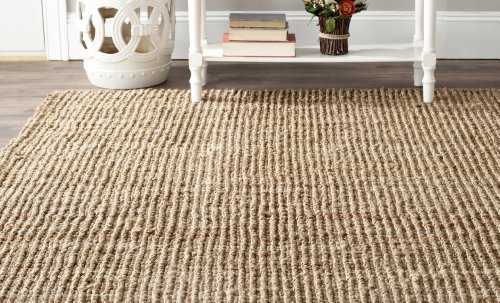
Honesty first: this rug is knotted, not woven, and its title says so plainly — a natural fibre area rug of knotted jute, five feet by seven feet six inches, with a three-quarter-inch pile. Knotting builds a rug knot by knot, producing a denser, more cushioned hand feel than a flat weave, and the stated pile height confirms that this is the plushest natural-fibre surface on the page. SAFAVIEH dresses the listing in practical language: durable, kid and pet friendly, easy care, aimed at living rooms, dining rooms, and offices. The natural colour keeps the jute’s own golden-brown variation in charge of the decoration. For a household that arrived on this page wanting hand construction in spirit — fibre, texture, a rug built by a labour-intensive method — but needs a forgiving, hard-wearing piece for a room where children build blanket forts and dogs supervise, this knotted entry may be the most sensible purchase here.
- Fibre: jute fibres, per the title
- Construction: knotted — described as such, not as woven
- Size: 5 feet by 7 feet 6 inches
- Pile: three-quarter inch, per the title
- Care and household notes in title: easy care, durable, kid and pet friendly
Strengths
- The three-quarter-inch pile gives natural fibre a cushioned feel rarely found in flat weaves.
- Kid and pet friendly positioning matches the rug’s durable, easy care billing.
- The five-by-seven-and-a-half size fits dining sets and desk zones neatly.
Trade-offs
- Shoppers set on a woven construction should note the knotted build and choose accordingly.
- A raised pile under dining chairs can resist chair movement more than a flat weave would.
- Jute’s texture, even knotted, stays firmer than wool or synthetic plush under bare feet.
Under a dining table, this rug’s dimensions make sense: the smaller footprint tucks beneath a table and its chairs without flooding the room, and the pile deadens the scrape and chatter of a family meal. In an office, the same pile softens a desk zone and the natural colour keeps a work room from feeling corporate. The easy care claim is the maker’s own, and it sits comfortably beside jute’s general reputation for shrugging off dry dirt — though, as with every jute piece here, standing liquid remains the fibre’s enemy, so a spilled water bowl should be blotted quickly rather than left to soak toward the backing. Treat the knotted construction as this rug’s identity rather than a footnote, and it stops being the odd one out and becomes the page’s practical anchor.
Best for: busy living rooms, dining rooms, and home offices wanting cushioned natural fibre with easy care billing. Not suited for: buyers whose brief strictly requires a woven build. Practical households start here — Check price on Amazon and check the pile height against your chair legs and door clearances.

KEMA Jute Braided Hand Woven Rug
Braiding is weaving’s sturdy cousin: strands plaited over and under until the textile gains a rope-like resilience. KEMA’s title stacks its descriptors openly — jute, braided, hand woven — across a six-by-nine-foot natural-coloured rug that is reversible, bohemian in styling, and billed as easy care for indoor and outdoor home décor. Reversibility is more than a bullet point in a braided rug. It doubles the surface life, lets you flip away a season of fading or a stubborn mark, and suits a construction whose two faces genuinely resemble each other. Six by nine is the flexible middle size of this page: large enough to define a seating area or slide under a bed with borders to spare, small enough that one person can still roll it, carry it, and relay it after cleaning without recruiting the household.
- Fibre: jute, per the title
- Construction: braided and hand woven, per the title
- Size: 6 by 9 feet
- Colour: natural
- Notable traits in title: reversible, easy care, indoor outdoor décor framing
Strengths
- Two usable faces effectively give the rug a second life when the first face tires.
- Braided jute tolerates being rolled, moved, and relayed better than stiffer constructions.
- The middleweight size suits bedrooms, where it can run under the bed and out both sides.
Trade-offs
- Braided texture reads rustic; sleek contemporary rooms may find it too ropey.
- The title’s indoor outdoor framing should not invite leaving jute in the rain.
- Reversible rugs still need a pad for grip, since neither face is a backing.
The bedroom case deserves a moment. A six-by-nine laid across the bed’s lower two-thirds gives both sleepers a fibrous margin, and flipping the rug each season spreads the foot traffic that concentrates at the bedside. In a living room, the braided surface brings a tactile, almost coastal roughness that plays well against smooth leather, painted wood, and linen upholstery. About that indoor outdoor wording: read it as the maker’s décor framing rather than a weatherproofing promise. Jute is a plant fibre that drinks water and dries slowly, so a covered porch in a dry spell is one thing and an open patio through autumn is quite another. Kept sensibly dry and flipped occasionally, a braided jute rug like this one ages into its room, softening at the surface while the braid holds the structure together.
Best for: bedrooms and relaxed living rooms that want a reversible, braided jute rug with genuine hand woven billing. Not suited for: wet patios or ultra-sleek interiors. Flip-friendly and forgiving, it rewards a look — Check price on Amazon and picture both faces against your floorboards.

GRUHUM Aasha Jute Cotton Rug
The GRUHUM Aasha keeps its title short and lets the essentials carry it: a jute cotton area rug, eight by ten feet, natural ivory, handwoven, and described as a large rug. That brevity is itself information. Where other listings crowd their titles with room lists and style labels, this one states fibre, size, colour, and construction and stops — which suits the rug’s likely role as a calm, pale foundation rather than a patterned centrepiece. Natural ivory in a jute cotton blend reads lighter and softer than raw jute’s golden tone, because the cotton lightens both the colour and the hand feel. At eight by ten, the Aasha matches the wool popcorn rug’s footprint while offering a completely different temperament: flat where the popcorn is bobbled, plant-fibred where the other is wool, quiet where the other performs.
- Fibres: jute and cotton, per the title
- Construction: handwoven, per the title
- Size: 8 by 10 feet
- Colour: natural ivory
- Additional detail in title: the listing keeps further specifics beyond the points above out of its title
Strengths
- The pale natural ivory brightens rooms while keeping natural fibre variation visible.
- Eight by ten anchors standard living-room layouts without overwhelming them.
- A flat, patternless field lets furniture and art hold the room’s attention.
Trade-offs
- A pale plant-fibre rug shows soil readily and asks for prompt spot attention.
- The spare title leaves care and pile questions to be answered on the listing page.
- Jute cotton lacks wool’s spring, so the underfoot feel is grounded rather than cushioned.
Consider the Aasha as the room’s canvas. On dark floorboards it lifts the whole palette; under a patterned sofa it refuses to compete; in a rental with tired floors it covers generously while remaining neutral enough to move house with you. The jute cotton blend walks a middle line on texture — smoother than pure jute, less plush than wool — which many households find is exactly the compromise bare feet prefer in warm months. Because the title is terse, the listing page carries more than usual weight: read its care guidance and any construction notes there before ordering, and plan on a rug pad, since large flat weaves earn their stability from what lies beneath them. Shoppers comparing pale natural rugs across categories often also glance at Best Non Shedding Towels for the same fibre-first thinking applied to the bathroom, where shedding behaviour matters as much as colour.
Best for: calm, light interiors needing a large handwoven foundation in natural ivory. Not suited for: households wanting a cushioned pile or a stain-hiding pattern. If a quiet pale field is the brief, Check price on Amazon and read the listing’s fuller details with care.

HOMEMONDE Jute Cotton Runner Rug
HOMEMONDE closes the page with a rectangular jute cotton rug in runner spirit: five by eight feet, natural in colour, reversible, and framed by its title for the front door, living room, bedroom, and entryway, indoors and outdoors, in a boho farmhouse voice. A note on labelling, in keeping with this guide’s literal approach: this pick is presented here for its fibres, its reversible mat build, and its natural colour, and it is not folded into the hand woven claims made for the Scandilivin, KEMA, and GRUHUM pieces above. What it offers instead is versatility of placement. Five by eight is an in-between size — longer than a mat, narrower than a room rug — and that shape slips into the spaces other rugs serve badly: the stretch beside a bed, the run inside a front door, the border along a kitchen’s working wall, or the landing where a hallway widens.
- Fibres: jute and cotton, per the title
- Format: rectangular runner-style rug, 5 by 8 feet
- Colour: natural
- Notable traits in title: reversible mat, boho farmhouse styling, indoor outdoor framing
- Rooms named: living room, bedroom, entryway, front door area
Strengths
- The elongated five-by-eight shape serves bedsides, entries, and wall runs that square rugs waste.
- Reversibility spreads wear and offers a fresher face after a season of grit.
- Natural jute cotton suits the farmhouse and boho interiors the title names.
Trade-offs
- As an entryway piece in jute cotton, it needs a rougher mat outside the door to take the worst of wet weather.
- The in-between size can look lost if asked to anchor a full seating arrangement alone.
- Like the KEMA, its indoor outdoor framing is décor language, not an invitation to leave plant fibre in the rain.
Think of this rug as a connector. It links the bed to the wardrobe, the front door to the hall, the sofa’s edge to the bookshelf wall — the routes feet actually travel. Natural fibre along those routes does quiet practical work: it catches the day’s dust where the dust is dropped, warms the first steps of the morning, and softens the acoustics of hard-floored passages. The reversible build doubles the value in exactly those high-traffic lines, since the face that meets the shoes can be rested. If your home has one awkward long space that no standard rug has ever fit, measure it against five by eight before you look anywhere else; in-between sizes exist precisely because in-between spaces are everywhere.
Best for: bedsides, entryways, and long wall runs needing a reversible natural jute cotton piece. Not suited for: serving as the sole anchor of a large seating group. Owners of awkward hallways, take note — Check price on Amazon and hold the five-by-eight outline up against your trickiest stretch of floor.
Constructions compared, without the blur
| Pick | Construction as titled | Fibre as titled | Size |
|---|---|---|---|
| Scandilivin Wool Popcorn Rug 8×10 | Hand woven, knit popcorn | 100% wool | 8×10 ft |
| Scandilivin Jute Cotton Rug 9×12 | Hand woven | Jute cotton | 9×12 ft |
| SAFAVIEH Jute Knotted Rug | Jute knotted | Jute | 5 x 7 ft 6 in |
| KEMA Jute Braided Hand Woven Rug | Braided, hand woven | Jute | 6×9 ft |
| GRUHUM Aasha Jute Cotton Rug | Handwoven | Jute cotton | 8×10 ft |
| HOMEMONDE Jute Cotton Runner Rug | Reversible runner-format mat | Jute cotton | 5×8 ft |
The table is the page’s argument in miniature. Hand woven is a specific claim, carried by four of the six titles, and this guide has kept it attached to exactly those four. Knotted and braided and reversible-runner constructions stand beside it as legitimate ways to build a natural-fibre rug, each with its own feel and its own best room. A shopper who understands which construction they are buying will almost always be happier a year later than a shopper who bought a photograph and a vague artisanal glow.
Which natural fibre belongs in which room?
Is wool worth choosing over jute?
Choose wool when the rug’s job includes comfort and warmth: bedrooms, reading corners, and living rooms where people sit on the floor. The popcorn rug’s all-wool title makes it the page’s only entry in that class, and wool’s natural spring means the surface recovers from footprints and furniture in a way plant fibres do not attempt. Choose jute when the job is grounding a room visually and texturally at a larger scale or a firmer feel — the big Scandilivin field and the GRUHUM Aasha both work this way. Jute asks for drier conditions and rewards them with a crisp, architectural presence. The blends sit between: jute cotton softens jute’s edge, which is why the blended picks suit bedrooms and entries where bare feet meet the rug daily.
How large should a hand-built rug be?
Large enough that the furniture’s front legs rest on it, small enough that a border of floor still frames it. In practice, that means an eight-by-ten or nine-by-twelve for a living room arrangement, a six-by-nine under a bed or a smaller seating group, and the five-by-eight runner format for the routes between rooms. Hand-built rugs carry softly irregular edges, so leave a slightly more generous floor border than you would for a machined rug; the handmade line looks intentional against open floor and cramped against a skirting board. When torn between two sizes, most households are happier sizing up, because a too-small natural rug reads as a mat that wandered in from another room.
What should sit underneath?
A pad, in almost every case. None of these titles describes a built-in backing, and flat natural-fibre rugs on smooth floors will travel without one — slowly, an inch a week, until the rug’s corner is climbing the skirting. A pad also protects the rug itself, absorbing the friction between textile and floor that wears fibres from beneath, and it adds a whisper of cushion that makes a flat weave feel deliberate rather than thin. Reversible picks benefit most visibly, since a pad lets both faces serve as the top while the pad stays put as the permanent grip layer. Cut the pad a couple of inches smaller than the rug on every side so it hides completely.
Living with natural fibres, month by month
The first month with a jute or wool rug involves a settling-in that synthetic rugs skip. Loose surface fibres lift and shed lightly at the start — this is the textile releasing the short ends left by its making, not coming apart, and regular gentle vacuuming walks it through the phase. Edges relax from their shipping roll, corners that curled begin to lie down, and the surface colour evens as light and traffic distribute themselves. Weighing a reluctant corner with a stack of books for a few nights is a perfectly respectable part of the process. By the second month the rug should look less like a product and more like a possession, its high-traffic paths subtly polished, its quieter corners still fresh.
Vacuuming technique adjusts to construction. Flat woven fields accept a straightforward pass and give up their dust willingly. The braided KEMA prefers suction that follows the plait rather than scrubbing across it, and the popcorn knit rewards a slower hand, since its raised knots hold surface grit in their valleys where a rushed pass skates over. The knotted SAFAVIEH, with real pile to search, is the one entry here where a deeper clean reaches furthest — and also the one where grit left sitting does the most quiet damage, ground between knot and foundation by daily feet. A small handheld sweep between vacuuming days suits all six: natural fibres release dry surface dirt easily when it is dealt with promptly, and resist it stubbornly once traffic has pressed it home.
Moisture is the one lifelong rule. Jute and its blends stiffen and can mark if they stay wet, and wool, while more forgiving, still prefers to dry promptly. Keep these rugs out of bathrooms and away from the splash radius of sinks; give an entryway rug a rougher partner mat outside the door; and lift and air any natural rug that has taken a soaking, on both faces, before it returns to the floor. Sunlight, too, writes on natural fibres over seasons — a rug in a bright room will mellow unevenly if one half lives in sun and the other under a sofa, which is another quiet argument for the reversible picks and for rotating any rug twice a year. None of this is fragility; it is the ordinary care a plant or animal fibre asks in exchange for ageing gracefully instead of merely wearing out. Readers furnishing a nursery next might detour through Best Newborn Bath Tubs afterwards — a different room entirely, but the same habit of reading what a product actually claims before it joins the household.
Reading a listing the way a maker would
A maker reads a rug title backwards, starting from the fibre and ending at the adjectives. Fibre tells them what the rug can survive: wool forgives, jute endures dryly, cotton softens and lightens. Construction comes next, because it decides the rug’s skeleton — a weave flexes as one sheet, a braid rolls like a rope, a knot stacks into pile. Only after those two facts are fixed do size and colour deserve attention, since a beautiful colour in the wrong fibre is a disappointment scheduled for next season. The titles on this page reward that backwards reading. They state their fibres plainly, they name their constructions with unusual honesty, and they leave their style words — farmhouse, boho, contemporary — where style words belong, at the end, as suggestions rather than specifications.
Pay attention, too, to what a short title implies. The GRUHUM Aasha’s title is the briefest here, and brevity in a listing usually means the maker expects the photographs and the detail sections to do the persuading. That is neither a virtue nor a warning by itself, but it does change your homework: with a terse title, the listing page’s care notes and construction details carry the weight that a longer title would have carried for you. The SAFAVIEH title sits at the opposite pole, dense with practical claims — durability, easy care, a household with children and pets in mind, a measured pile height. A dense title invites verification just as much as a brief one invites reading; in both cases the disciplined shopper treats the title as the opening statement, not the whole trial.
Edges deserve a sentence of their own, because edges are where hand construction announces itself and where rugs live or die. In a woven rug, the edge is the weave turning back on itself or being bound; in a braid, it is the plait curving at the turn; in a knotted rug, it is the border where the pile gives way to the foundation. When you examine listing photographs, look at the corners first. A corner that sits flat and square in the photograph will usually behave in your room. A corner already lifting in the maker’s own styled image is telling you, politely and in advance, exactly what it plans to do on your floor.
Weight is the unlisted specification that governs daily life with a big rug. A nine-by-twelve in any fibre is a two-person lift and a serious roll; a six-by-nine can be managed alone; a five-by-eight runner-format piece can be carried under one arm. Before ordering the largest size your room can hold, ask who will move this rug when the floor beneath it needs cleaning, because floors under rugs do need cleaning, and a rug that nobody can lift becomes a rug under which dust retires permanently. The romance of hand construction survives contact with reality much better when the household has honestly assigned the lifting.
Three rooms, three different answers
Picture a farmhouse living room first: wide boards, a linen sofa, a timber coffee table, light arriving in quantity. This room wants scale and dryness — the nine-by-twelve Scandilivin jute cotton, its natural beige warming the boards and its hand woven field giving the furniture a single ground to gather on. A pattern would fight the room’s materials; a pile would soften its lines. The flat woven field does neither, and the border of bare board around it becomes part of the composition, the way a frame is part of a painting.
Now a small city bedroom, where the floor is half hidden by the bed and the rug’s real audience is two pairs of bare feet at dawn. Here the KEMA braided rug or the HOMEMONDE runner-format piece earns its place, laid so the long margin runs where feet land. Texture matters more than scale in this room, and reversibility matters more than either, because a bedroom rug absorbs a quiet, constant wear along one narrow path — exactly the wear pattern that flipping was invented to defeat. The wool popcorn rug also argues its case here, on warmth: if the bedroom is the coldest room in the home, its all-wool surface beside the bed may be worth more than any other trait on this page.
Finally, a household office that doubles as a guest room and triples as the dog’s afternoon headquarters. Practicality takes the chair here, and the SAFAVIEH knotted rug’s title reads like it was written for this room: durable, easy care, kid and pet friendly, a pile that deadens the room’s echo on calls. The natural jute colour hides the honest dirt of a multi-use room, and the smaller footprint leaves floor visible around the edges, which keeps a small room from feeling carpeted wall to wall. Three rooms, three constructions, three fibres — the page’s variety is not indecision; it is a map of how differently real rooms live.
Common mistakes
Calling every artisanal rug hand woven. Knotted, braided, tufted, and woven constructions feel different, wear different, and cost different amounts of labour. A buyer who cannot say which construction they own cannot care for it properly or judge whether its price was fair. Read titles literally — as this guide has — and let each construction stand under its own name.
Sending jute to do a bathroom’s job. Plant fibres and standing water are enemies, yet jute rugs keep being laid in steamy bathrooms and in front of kitchen sinks because they look wonderful in photographs. Within months the fibre stiffens and darkens at the wet edge. Keep jute in the dry rooms it suits, and let washable synthetics or cotton take the splash zones.
Skipping the pad to save a little money. The pad is not an accessory; on smooth floors it is the rug’s braking system and its wear layer in one. A hand-built rug that creeps, bunches at the door swing, and grinds against boards will age years in a single season. Buy the pad with the rug, cut it smaller than the rug, and forget about it — which is exactly what a good pad lets you do.
Judging a natural rug in its first week. Early shedding, a shipping crease, a corner with ambitions — these are the normal opening chapter of a hand-built textile, not defects. Owners who panic and return a rug on day three miss the settled, characterful surface that arrives by week six. Give the rug its settling period, vacuum gently and often, and judge it by its second month.
Placing pale natural fibre under a dining table. Ivory and natural beige are beautiful until the first red-sauce evening. Dining zones grind food into fibres with chair legs and foot traffic, and pale plant fibre holds the memory. Under dining tables, choose the page’s most forgiving entries and accept the cleaning rhythm, or move the pale beauties to bedrooms and sitting rooms where their colour can survive.
Texture, from flat field to popcorn
Run a hand mentally across this page and you travel a full spectrum. At the smooth end sit the flat woven fields — the big Scandilivin jute cotton and the GRUHUM Aasha — whose surfaces read as colour and fibre rather than relief. Furniture glides on them, chair legs sit level, and a room’s other textures get to speak. In the middle stands the braided KEMA, where the texture is structural rhythm: the eye follows the plait the way it follows brickwork, and the surface feels organised rather than soft. The knotted SAFAVIEH lifts off the floor by three quarters of an inch, trading the flat fields’ glide for a cushioned, sound-absorbing presence. And at the far end the wool popcorn rug turns texture into the entire decoration, a field of small knots that bare feet read like Braille.
Choosing a point on that spectrum is really choosing how a room behaves. Flat fields suit rooms in motion — dining spaces, offices with rolling chairs, living rooms rearranged for gatherings. Raised textures suit rooms of rest, where furniture stays put and feet arrive bare. Households with both kinds of room often end up, over years, with one rug from each end of the spectrum, and there is no contradiction in that: the flat rug works for a living, the textured rug waits for a landing. What rarely works is forcing one texture to do both jobs — the popcorn knit under a dining table, the flat field asked to warm a cold bedroom — because each failure gets blamed on the rug rather than on the assignment.
What hand construction asks, and what it returns
The honest ledger of a hand-built rug has two columns. In the asking column: a settling period instead of instant perfection, a pad bought alongside, a stricter rule about water than any synthetic rug imposes, and a tolerance for small irregularities that a machine would never ship. In the returning column: a surface with genuine variation that does not repeat like a printed pattern, fibres that age by mellowing rather than by crushing into traffic lanes, edges and corners with a made quality that guests notice without knowing why, and — not least — a rug whose construction you can actually name and explain, because its title told the truth and you read it properly. Households that value the second column happily pay the first. Households that do not are better served elsewhere, and there is no snobbery in saying so; a rug should match its owner’s patience as precisely as it matches the room’s dimensions.
There is also a longevity argument that rarely appears in listings. Constructions built from continuous fibre and mechanical interlock — a weave, a braid, a knot — tend to fail slowly and visibly, fraying at an edge or thinning at a path, giving their owners warning and often a repair option. Bonded and glued constructions tend to fail suddenly, by delamination, and give neither. A hand-built natural rug bought for a room it suits can therefore be the longer-lived purchase even when it is not the cheaper one, provided its owner honours the dry-room rule and the pad. That is the quiet mathematics underneath this whole category, and it is why the construction words in a title matter more than the style words that surround them.
Final recommendation
If the brief is a true hand woven rug with maximum warmth, the Scandilivin wool popcorn piece stands alone on this page — all wool, hand woven, and textured enough to carry a room. For a large, calm, plant-fibre foundation, choose between the nine-by-twelve Scandilivin jute cotton for scale and the eight-by-ten GRUHUM Aasha for paleness. The KEMA braided rug is the flexible household player, reversible and mid-sized, while the HOMEMONDE runner-format piece solves the long, awkward spaces the others cannot. And the SAFAVIEH knotted rug, honestly labelled and proudly practical, is the pick for families who want natural fibre with a cushioned pile and easy care billing in the busiest room of the house. None of the six is a wrong answer; each is a different answer to the question of how a rug should be built and what it should be built from.
One last practical note applies to whichever pick you choose: photograph your room’s floor, with measurements marked, before the rug arrives, and keep the photograph. When the rug is down and settled, the comparison will show you exactly how the textile changed the room’s proportions and light — and if you ever furnish a second room in the same spirit, that record becomes the most useful shopping document you own, worth more than any saved listing or screenshot.
Frequently asked questions
Does hand woven mean the rug will be perfectly even?
No, and that is rather the point. Hand construction leaves small variations in tension, texture, and edge line that machine production irons out. Most owners come to read those variations as the rug’s signature. If your room’s style depends on ruler-straight precision, a hand-built rug will quietly bother you every day, and a machined rug in a natural-look fibre may suit you better.
How do I clean a jute or jute cotton rug?
Start dry: regular vacuuming without aggressive beater action, and prompt blotting of any spill before it reaches the backing. Two titles here carry easy care wording — the SAFAVIEH knotted rug and the KEMA braided rug — but even those claims belong to their listings, so follow the care guidance on the specific listing you buy. The universal rule is to keep plant fibre from staying wet.
Which of these rugs works best with pets?
The SAFAVIEH entry is the only title here that says kid and pet friendly outright, pairing that claim with durability and easy care language, and its knotted pile tolerates a busy household’s rhythm. For the woven picks, tight flat weaves release hair more easily than raised textures like the popcorn knit, and any natural rug in a pet household benefits from the pad-and-vacuum routine described above.
Can a reversible rug really be used on both sides?
Yes — the KEMA and HOMEMONDE titles both describe reversible builds, and braided and flat constructions are the ones where both faces genuinely serve. Flip seasonally to spread wear and light exposure, and keep the pad beneath whichever face is down. A reversible rug is not two rugs, but it ages like it has a spare life in reserve.
Will a hand-built rug work under a desk chair that rolls?
Flat is the answer. The woven fields — the Scandilivin jute cotton and the GRUHUM Aasha — let castors travel without climbing in and out of texture, and a pad beneath keeps the rug from being dragged by the chair’s daily migration. Raised surfaces fight the wheels: the popcorn knit and the knotted pile both resist rolling and wear unevenly where castors pivot. If your desk chair is the busiest furniture in the room, choose the flattest construction your room can love.
Why do two rugs here share a brand and a size but feel like different products?
Because fibre and texture outweigh brand and dimensions. The two Scandilivin entries share a maker, yet one is all wool with a popcorn knit at eight by ten and the other is jute cotton at nine by twelve; the two GRUHUM-scale pale fields differ from them again. Read fibre first, construction second, size third — brand is merely the signature on the work.
A hand-built rug is a slow purchase in the best sense: chosen by fibre and construction, settled over weeks, and kept for years — pick the one whose making you can describe, and it will keep describing your room back to you.


