What's inside
- Where to buy these RV patio mats
- Quick picks for the pitch
- How these picks were chosen
- The six mats laid side by side
- How to choose an RV patio mat for the way you actually tour
- Pitch craft: getting a big mat to behave
- Why the awning floor changes the whole trip
- Common mistakes when buying an RV patio rug
- Final recommendation
- Questions people ask about RV patio rugs
As an Amazon Associate I earn from qualifying purchases. This post may contain affiliate links at no extra cost to you.
As an Amazon Associate, cottageverdict.com earns from qualifying purchases.
An RV awning creates a roof, but it does not create a room — the ground decides that, and on most pitches the ground is gravel, dust, damp grass or cracked hardstanding. That is why best rv patio rugs is really a search for a floor: a large outdoor mat that unrolls outside the door and turns a parking place into the space where the trip actually gets lived. The six mats here are big. Four of them measure nine by eighteen feet, one stretches to ten by twenty, and even the smallest, at eleven by eight, is a room-sized sheet beside an awning. None of them is an indoor rug in any sense, and none pretends to be; they are woven plastic or mesh ground coverings, built to be rained on, walked on in boots, hosed down and folded into a storage bay.
Five of the six share a family resemblance: woven plastic — described in the titles as plastic straw, woven plastic or polypropylene — forming a flat, reversible mat that sheds water and shakes clean. The sixth, the CGEAR, is built differently, and this guide will keep returning to that difference because it changes what the mat is for. The CGEAR title describes an original sand-free outdoor mat, a mesh-style construction designed so that sand and dirt fall through it instead of collecting on top. On a beach pitch that is a genuinely different tool from a woven plastic mat, which holds its surface and asks to be swept. Neither approach is better in the abstract; they answer different ground.
Within the five woven mats, the distinctions are practical ones. The Vocray stands apart on stated construction, its title naming a 240GSM HDPE mesh, breathable and lightweight, at the largest size here. The EEZ RV mat is the only one whose title bundles hardware — a large storage bag and six sets of stakes and washers — which tells you its maker expects it to be pegged down and packed away as a system. The Alfolo emphasises a tightly woven build and easy cleaning; the fifame and the long-established Stylish Camping mat stake their claims on the classic reversible plastic straw formula at the classic nine-by-eighteen size. Read on with your own pitch in mind: its surface, its wind, and the bay the mat must fold into.
Where to buy these RV patio mats
All six are sold on Amazon, and each review below links to its own listing in the order the mats were shortlisted.
Alfolo leads with a nine-by-eighteen that its title calls tightly woven and easy to clean, for campers who prize a neat surface.
The fifame nine-by-eighteen is the straightforward reversible all-rounder, aimed at everything from trailer pitches to beach days.
Vocray offers the biggest floor here, ten by twenty, with a breathable mesh construction its title specifies in unusual detail.
Stylish Camping is the veteran design, a polypropylene reversible mat in black and white with a long track record in the category.
EEZ RV packages its nine-by-eighteen with a storage bag and stakes, for owners who peg down and pack up by routine.
CGEAR closes the list with the sand-free specialist, sized eleven by eight in Boulder Gray, for beach and dusty pitches.
Quick picks for the pitch
| Pick | Best for | Detail that defines it in the title |
|---|---|---|
| Alfolo RV Outdoor Rug 9×18 | Neat, easy-clean awning floors | Tightly woven plastic straw, reversible, 9 x 18 ft |
| fifame Outdoor Rug 9×18 | General-purpose camping and patio use | Plastic woven, waterproof per title, reversible, 9 x 18 ft |
| Vocray RV Outdoor Mat 10×20 | The largest awning spaces | 240GSM HDPE mesh, breathable, foldable, 10 x 20 ft |
| Stylish Camping Reversible Mat 9×18 | Classic black-and-white pitch styling | Polypropylene plastic straw, reversible, 9 x 18 ft |
| EEZ RV Outdoor Mat 9×18 | Owners who stake down and store systematically | Heavy duty per title, with storage bag and 6 stake sets |
| CGEAR Sand-Free RV Mat | Beach and sand-prone pitches | Sand-free design, 11 x 8 ft, Boulder Gray |
How these picks were chosen
Scale was the entry ticket. A mat for an RV pitch must floor the awning’s shade, and that means dimensions in the nine-by-eighteen class rather than patio sizes; every pick here meets that scale, with the CGEAR’s eleven by eight accepted because its sand-free specialism serves a smaller, specific pitch brilliantly. Shoppers who arrived here from smaller garden mats, such as those gathered under Best Supima Cotton Towels‘ neighbouring home categories, should recalibrate: these are ground sheets the size of rooms, and the storage bay, not the wardrobe, is where they live.
Construction came next, and it splits the list honestly in two. Five titles describe woven plastic in one wording or another — straw, woven plastic, polypropylene — a surface that holds together as a sheet, sheds rain and sweeps clean. One title, Vocray’s, specifies an HDPE mesh at a stated weight of 240GSM, breathable by design. And the CGEAR’s sand-free construction is a mesh philosophy taken further, built to let particles pass through. The reviews keep those three constructions distinct, because a buyer choosing between a surface that holds dirt for sweeping and one that lets dirt fall through is choosing a cleaning religion, not a colour.
Pack-down practicality formed the third test. Titles that promise foldable, lightweight or portable behaviour earned their emphasis, and the EEZ RV’s included bag and stakes were treated as a real differentiator — the only pick whose title sells the whole routine of staking and storing, not just the mat. Colour, by contrast, was left as a matter of taste: grey, blue-grey, black and white and Boulder Gray divide the list without ranking it.
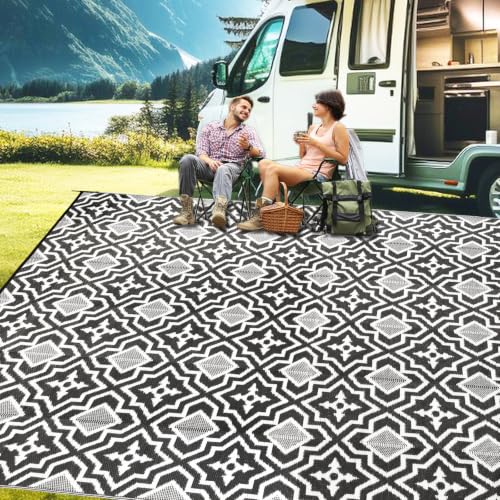
Alfolo RV Outdoor Rug 9×18
Alfolo’s title leans on two promises: a tightly woven plastic straw construction, and a mat that cleans easily. At nine by eighteen feet, reversible and described as waterproof, it is pitched at RV, deck, camping and pool use, with RV essentials named outright. Tight weaving matters on a pitch mat more than marketing usually admits. A tighter weave presents a smoother face to chair legs and bare feet, gives dirt fewer pockets to lodge in, and tends to lie flatter at the edges — the three qualities that separate a mat that feels like a floor from one that feels like a tarpaulin with ambitions.
- Construction as listed: tightly woven plastic straw
- Footprint as listed: 9 by 18 feet
- Faces as listed: reversible
- Upkeep as listed: cleans easily
Strengths
- The tight weave is the right priority for a mat that will host dining chairs and daily traffic.
- Easy cleaning is claimed in the title itself, matching the hose-and-shake reality of pitch life.
- Nine by eighteen covers a full awning span with room for a table and chairs inside the boundary.
Trade-offs
- A full-size mat is a bulky fold; solo travellers will feel its pack size in a small bay.
- The title offers no storage bag, so packing gear must come from your own kit.
- Like all woven plastic, it will not cushion hardstanding the way a thick textile would.
Picture the Alfolo across a week on a gravel pitch. Day one, it turns ankle-turning stones into a level living room. Midweek, crumbs and dust sit on the tight surface where a broom finds them in one pass, and a spilled drink hoses away without a stain story. By the weekend the mat has become invisible infrastructure — which is the highest compliment pitch equipment can earn. Its pool mention in the title is a hint worth taking: around water, a woven plastic surface that drains and dries beats any absorbent alternative, and families rotating between campsite pools and pitches will use this mat in both worlds without thinking twice.
Best for: full-time awning living on mixed surfaces, especially gravel and decking, where a tight, tidy surface matters. Not suited for: minimalists with tiny storage bays, or beach campers whose first enemy is sand rather than dirt.
One more scenario flatters the Alfolo: the family that eats outside. Crumbs, sauce and the archaeology of a children’s tea all land on the mat, and a tight weave keeps that debris on the surface where a brush pan finishes it in seconds. Looser weaves let the small stuff drop into the texture and stay there, grey and faintly regrettable, for the rest of the trip. If your awning is primarily a dining room, tightness of weave is not a detail — it is the feature you will thank every single evening, fork in one hand and dustpan in the other.
Its reversibility also suits dining duty, because one face can be designated the everyday surface while the other is kept for the evening guests arrive at the pitch. Small disciplines like that are how a mat still looks cared-for in its third season, and the Alfolo’s tidy-minded title suggests a maker who expects exactly that kind of owner.
See the Alfolo 9×18 mat on Amazon

fifame Outdoor Rug 9×18
The fifame keeps its pitch simple: a plastic woven patio mat, nine by eighteen, waterproof and reversible according to its title, offered for outdoors, RV, patio, backyard, deck, picnic, beach, trailer and camping. That long list of settings is the point. This is the generalist of the group, a mat that refuses to specialise and instead covers the whole map of places a large outdoor mat gets used. Households that split their mat’s life between a home patio in spring, a trailer pitch in summer and a beach week in between will recognise their own pattern in that list.
- Construction as listed: plastic woven
- Footprint as listed: 9 by 18 feet
- Faces as listed: reversible mats, per the title
- Weather wording as listed: waterproof
Strengths
- The broadest stated range of uses in this list, from deck to beach to trailer.
- Reversible faces double the styling options and spread the wear.
- The classic size fits standard awnings without overhang drama.
Trade-offs
- A generalist offers no special weapon against sand, unlike the CGEAR below.
- The title names no storage or staking extras, so the routine gear is on you.
- Colour detail is thinner in this title than in some rivals, so check the listing imagery carefully.
There is an underrated virtue in a mat that asks nothing special of its owner. The fifame’s proposition is the category’s original one: unroll a clean, dry, defined floor wherever you park, live on it, shake it, hose it, roll it away. For first-time RV owners building their kit, that simplicity is a feature — one less system to learn while everything else about pitch life is new. For home use, nine by eighteen is large enough to floor a serious patio dining arrangement, so the same mat can audition at home before it ever travels, which is how many owners discover whether the size suits their life before committing it to the bay.
Best for: first large-mat buyers and households whose mat must serve patio, pitch and beach in rotation. Not suited for: sand specialists or owners who want staking and storage hardware bundled in the box.
The beach line in the fifame’s long list of settings deserves respect rather than a shrug. A nine-by-eighteen woven mat at the beach becomes a headquarters: towels, bags, cool boxes and children all organise themselves around its border, and sand — while it will sit on a woven surface and need shaking off — at least stays visible and sweepable rather than grinding into a textile. Families who have tried to run a beach day from towels alone know the chaos the mat replaces. One large, washable, sand-shedding floor is the difference between a camp and a scatter.
Back home, the same mat under a patio set earns a second salary. Many owners of generalist mats like this one report that the mat’s home weeks outnumber its touring weeks, and that the purchase justified itself in the garden before the van ever moved. A specialist mat cannot make that claim; a generalist makes it effortlessly, which is the fifame’s quiet case for your money.
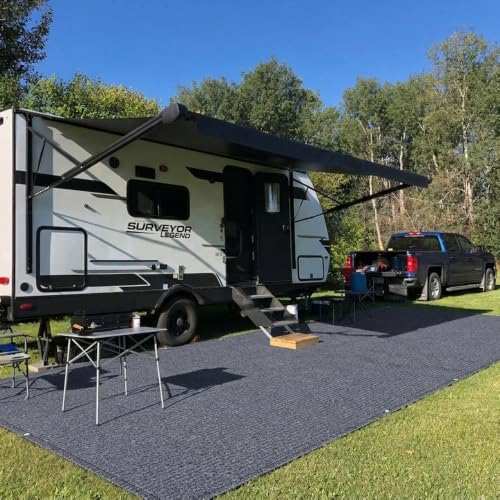
Vocray RV Outdoor Mat 10×20
Vocray brings the biggest floor and the most specific construction note in this guide: ten by twenty feet of mat, described in its title as 240GSM HDPE mesh — breathable, lightweight, foldable and portable, in blue-gray, for camper, motorhome, trailer, picnic and pet area use. Two hundred square feet is a serious outdoor room, enough for a dining set, loungers and a dog’s territory all at once, and the mesh construction changes the mat’s relationship with the ground beneath it. A breathable mesh lets air and moisture pass rather than sealing the grass under a plastic sheet, which grass — and campsite owners — generally prefer during longer stays.
- Construction as listed: 240GSM HDPE mesh
- Footprint as listed: 10 by 20 feet
- Colour as listed: blue-gray
- Handling as listed: lightweight, foldable, portable
Strengths
- The largest coverage here, for the biggest awnings and longest motorhomes.
- A stated mesh weight and material gives buyers a specification to compare, rare in this category.
- Breathability suits longer stays on grass, where sealed plastic can sour the ground beneath.
Trade-offs
- Ten by twenty is too much mat for small pitches, where it will fold under itself or invade the neighbour’s grass.
- A mesh surface feels different underfoot from a tight woven sheet — airier, less floor-like.
- Folding two hundred square feet neatly is a two-person habit to learn.
The pet-area mention in the title deserves attention, because it signals how the maker imagines this mat working: as a defined, washable territory. Mesh that breathes and hoses clean makes a sensible exercise and lounging zone for dogs at a pitch, where the alternative is mud. Motorhome owners with the bay space to carry it will find the Vocray the only pick here that truly matches a large rig’s awning span; everyone else should measure their pitch discipline honestly, because an oversized mat is a daily wrestling match. Chosen at the right scale, though, this is the pick that turns a parking bay into a smallholding.
Best for: large motorhomes, long stays on grass, and campers who want a breathable, specified mesh at maximum size. Not suited for: small pitches, compact campers, or anyone who folds and stows alone in a hurry.
The stated weight — 240GSM — invites a word of explanation for buyers new to mesh. Grams per square metre is simply how much material sits in a given area of the mat, and in mesh terms it signals substance: enough body to lie flat and resist tearing at stake points, without the sealed heaviness of a solid sheet. Vocray is the only maker in this list that publishes such a figure in its title, and that transparency deserves credit in a category that usually prefers adjectives to numbers. Buyers comparing mesh mats elsewhere now have a benchmark to demand.
Blue-gray, its colour, is chosen with similar intelligence. It echoes the tones of awning fabric, gravel and overcast northern skies, so the largest mat here is also, paradoxically, one of the least visually loud. Two hundred square feet of a shouting colour would dominate any pitch; two hundred square feet of blue-gray simply establishes the ground and lets the rig, the chairs and the people supply the colour.
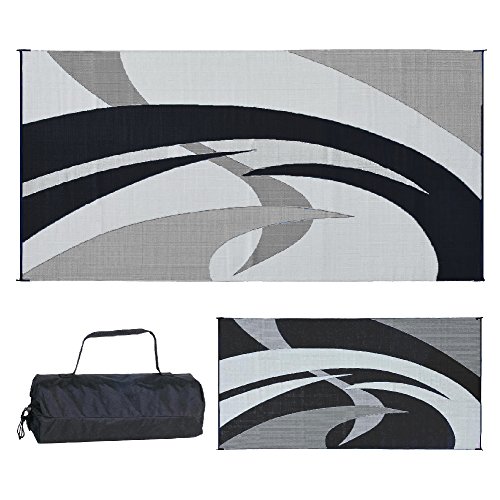
Stylish Camping Reversible Mat 9×18
Stylish Camping’s mat is the elder of this list: a nine-by-eighteen reversible mat in plastic straw, its title naming polypropylene directly, in black and white, for outdoors, RV, patio, backyard, picnic and beach. Longevity in a category counts for something. Designs that survive season after season of campsite retail usually do so because the formula is right — a durable polypropylene weave, a graphic pattern that hides the campsite’s worst, and a size that became the standard because it fits the standard awning. Black and white under an awning is a styling decision as much as a practical one: it makes the pitch look deliberate, the way a striped windbreak does.
- Construction as listed: plastic straw, polypropylene
- Footprint as listed: 9 by 18 feet
- Colour as listed: black and white
- Faces as listed: reversible
Strengths
- Polypropylene is named in the title, the proven material of the classic pitch mat.
- Black and white gives a pitch instant structure and photographs crisply.
- The nine-by-eighteen format is the awning standard this category grew around.
Trade-offs
- The white sections will show mud honestly and ask for regular hosing to stay smart.
- No fold, bag or stake claims appear in the title, so judge extras by the full listing.
- Traditional styling will not tempt buyers hunting for a contemporary pattern.
There is a social side to this mat. On a crowded site, a black-and-white floor under the awning marks your territory with unusual clarity — children find their way back to it, neighbours read its edges, and the pitch keeps its shape in everyone’s mind. Underfoot it delivers the classic woven-plastic bargain: firm, dry, sweepable, indifferent to rain. Owners who value the proven over the novel will feel at home here, and the mat’s long presence in the market means the pattern of its wear — where it scuffs, how it folds — is the known quantity that newer designs still have to prove.
Best for: traditionalists wanting the classic polypropylene pitch mat in a graphic colourway. Not suited for: buyers who want bundled hardware or a soft, contemporary colour palette.
Black and white has one more campsite virtue: visibility after dark. A pale-bordered mat edge catches torchlight and lantern glow, so the boundary of your floor stays legible when people move around the pitch at night with mugs in hand. It is a small safety grace that dark mats cannot offer, and on unlit rural sites it is felt nightly. The same contrast that stylists love at noon turns out to be the practical camper’s friend at midnight.
Owners should simply budget the hose time that white demands. The bargain is explicit: the crispest-looking pitch floor in this guide, maintained by the most regular rinsing. For campers who already hose the mat as part of their Sunday pack-down, the cost is zero and the reward is a pitch that always looks newly arrived. For campers who pack in a rush and rinse never, the grey and blue-grey options will forgive what this one will not.
Check the Stylish Camping mat on Amazon

EEZ RV Outdoor Mat 9×18
EEZ RV sells a routine as much as a mat. The title describes a nine-by-eighteen heavy duty reversible mat in grey, durable in the maker’s wording, and — uniquely in this list — states that it comes with a large storage bag and six sets of stakes and washers. Anyone who has watched a big mat lift and flap in a coastal wind understands why stakes matter: a pegged corner is the difference between a floor and a sail. And anyone who has tried to fold two hundred square feet of mat into an undersized sack understands why a bag sized by the maker, rather than improvised at home, changes pack-up day from a wrestling bout into a task.
- Construction as listed: heavy duty reversible mat
- Footprint as listed: 9 by 18 feet
- Colour as listed: grey
- Included as listed: large storage bag; 6 sets of stakes and washers
Strengths
- Stakes and washers in the box answer the wind problem that every large mat eventually meets.
- A maker-sized storage bag makes the pack-away routine realistic for one person.
- Grey is the diplomat’s colour on a pitch, hiding dust and matching every rig.
Trade-offs
- Stakes need ground that accepts them; on pure hardstanding they sit unused.
- The title does not specify the mat’s woven material as precisely as some rivals do.
- Grey restraint will not satisfy campers who decorate their pitch boldly.
Think of this pick as the choice of the systematic traveller — the one whose awning goes up the same way every time, whose mat is staked against the evening wind before the chairs come out, and whose departure morning runs to a checklist. The included hardware signals that the maker has lived that routine and priced the whole of it, not just the textile. On exposed sites, that completeness is worth more than a prettier pattern. On sheltered, soft pitches where stakes are unnecessary, its advantage narrows to the bag — which, after your first muddy pack-up without one, may still be argument enough.
Best for: exposed pitches, coastal campers and organised owners who stake down and store by system. Not suited for: hardstanding-only tourers, or buyers choosing primarily on pattern and colour.
The stakes deserve a closer thought, because their value compounds. A staked mat does not merely stay put in wind; it stays aligned. Unstaked mats creep — a centimetre a day under traffic, until the doorway strip has migrated and the awning poles no longer match the mat’s edges. Pegging fixes the mat’s geography for the whole stay, so the pitch you arrange on day one is the pitch you still inhabit on day seven. Tourers who stay a week or more per site will feel that stability as a daily, low-level pleasure that one-night stoppers never notice.
The washers in the kit matter too, spreading the stake’s load so the mat’s edge is gripped rather than pierced and torn. It is the kind of detail that reveals whether a maker has actually watched a mat fail in weather. EEZ RV plainly has, and has packed the remedy in the box rather than selling it as an accessory — a completeness that this guide counts as the pick’s defining generosity.
Look at the EEZ RV mat and kit listing

CGEAR Sand-Free RV Mat
Now for the mat that plays a different sport. CGEAR’s title describes an original sand-free outdoor mat, sized eleven by eight feet in Boulder Gray, for RV, camper, camping and outdoor living. The sand-free idea, as the name states, is a construction that lets sand and loose dirt fall through the mat rather than accumulating on its surface — the eternal beach-camp problem that woven plastic mats solve only by sweeping. Anyone who has camped on sand will picture it instantly: every footstep delivers a fresh dusting onto a conventional mat, and by evening the floor is grit. A mat that sheds that grit downward, continuously, changes the texture of the whole stay.
- Design as listed: original sand-free outdoor mat
- Footprint as listed: 11 by 8 feet
- Colour as listed: Boulder Gray
- Settings as listed: RV, camper, camping, outdoor living
Strengths
- The sand-free concept answers the beach pitch’s central misery directly, without sweeping.
- Eleven by eight is a manageable size for smaller rigs and shorter stays.
- Boulder Gray is a dusty, forgiving tone that suits arid and coastal ground alike.
Trade-offs
- It is the smallest floor here, so big awning households will find it short.
- A through-falling design is a specialist tool; on gravel or decking its signature trick matters less.
- Small items dropped on it — screws, earrings, game pieces — may follow the sand downward.
Judge the CGEAR by the ground you haunt. On sand, shell grit and dusty desert hardpan, its construction is not a gimmick but a daily mercy, and its smaller footprint suits the compact rigs that frequent beach sites. On a grassy inland pitch, the woven mats above will feel more like a floor and less like a sieve, and their larger sizes will serve a family better. This is the clearest illustration in the whole guide of construction dictating purpose: five mats hold a surface, one mat clears one. The wise buyer names their enemy — mud, wind, or sand — and lets the enemy choose the mat.
Best for: beach campers, desert tourers and compact rigs plagued by sand and grit. Not suited for: large awning households, or gravel pitches where a tight woven surface serves better.
Boulder Gray, the CGEAR’s colour, is worth a sentence of appreciation. It is the colour of the ground the mat is designed for — stone, dust, dry earth, weathered shell — so the mat visually disappears into its workplace instead of announcing itself. On a beach pitch that restraint looks elegant; on a desert stop it looks inevitable. Makers of sand-country equipment learn this palette the hard way, and CGEAR’s choice signals a brand that designs from the pitch backward rather than from the catalogue forward.
Its eleven-by-eight footprint also makes it the handiest second mat in this guide. Owners of large rigs sometimes carry a small mat for overnight stops, when unrolling nine by eighteen feels like moving house for a single sleep. The CGEAR fills that role while adding its sand-clearing trick, so a two-mat household — big woven for the long stays, CGEAR for the beaches and the quick stops — is a coherent strategy rather than an indulgence.
See the CGEAR sand-free mat on Amazon
It is worth pausing on the word reversible, which appears in title after title here, because on a pitch it means more than a second pattern. A reversible mat can be flipped when one face is muddy and guests are imminent — a thirty-second renovation. It can be rotated end to end so the doorway wear lands on fresh weave. And when one side finally fades after seasons of sun, the mat is not done; it has a second face and a second career. In a product category where everything else is measured in feet and grams, reversibility is the closest thing to a two-for-one that exists, and every woven pick in this guide offers it.
Foldability deserves the same respect. A mat that folds to a disciplined parcel, rather than rolling into a nine-foot sausage, fits the rectangular bays that RVs actually provide. The titles that claim foldable behaviour are claiming compatibility with real storage geometry, and buyers should test that claim on arrival day: fold the mat, measure the parcel, and check it against the bay before the first trip depends on it.
The six mats laid side by side
| Mat | Size from title | Construction as titled | Signature point |
|---|---|---|---|
| Alfolo RV Outdoor Rug 9×18 | 9 x 18 ft | Tightly woven plastic straw | Easy cleaning |
| fifame Outdoor Rug 9×18 | 9 x 18 ft | Plastic woven | Widest stated range of uses |
| Vocray RV Outdoor Mat 10×20 | 10 x 20 ft | 240GSM HDPE mesh | Largest, breathable |
| Stylish Camping Reversible Mat 9×18 | 9 x 18 ft | Plastic straw, polypropylene | Classic black and white |
| EEZ RV Outdoor Mat 9×18 | 9 x 18 ft | Heavy duty reversible | Bag and stakes included |
| CGEAR Sand-Free RV Mat | 11 x 8 ft | Sand-free design | Sand falls through |
The table makes the real structure of the choice visible: four mats compete on the same size and similar weaves, one competes on scale and breathability, and one competes on an entirely different idea of what a mat should do with dirt. Start with the idea, then the size, then the colour — in that order — and the list shortens itself.
How to choose an RV patio mat for the way you actually tour
What ground do you camp on most?
Let your calendar answer. Predominantly grass sites favour a breathable construction or a woven mat you lift and air regularly; gravel and hardstanding favour a tight weave that bridges stones and sweeps clean; sand favours the CGEAR’s through-falling design above everything else in this guide. A mat bought for the ground you wish you camped on will spend its life being wrong, while a mat bought for your real ground becomes invisible within a day of every arrival.
How big is your awning — and your storage bay?
Measure both, because the mat must satisfy each. The awning sets the useful ceiling: a mat much larger than the shade line wastes material on sun-baked margins, while one much smaller leaves the doorway — the highest-traffic square of the pitch — unprotected. The bay sets the practical ceiling, since a folded nine-by-eighteen is a substantial parcel. The Vocray’s ten by twenty is glorious under the right awning and a storage feud in the wrong bay. If you tour in a compact camper, the CGEAR’s eleven by eight may be the only honest fit, and its specialism then becomes a bonus rather than a compromise. The same measure-twice discipline governs softer travel gear too, as the shortlists behind Best Zero Twist Towels remind anyone packing a linen cupboard into a van.
How much routine will you honestly keep?
Every large mat asks for a routine: shake, hose, dry, fold. The EEZ RV’s bag and stakes suit owners who enjoy a system and will run it every time. The looser-living will prefer a mat whose whole care regime is a broom and a hose. Be truthful at this question, because the best mat in this list is the one whose routine matches yours — the finest weave in the world cannot help a mat that is packed away damp and dirty after every trip.
How long will a mat like this actually last?
Longevity in this category is mostly a story of habits rather than materials. Woven polypropylene and HDPE mesh are both indifferent to rain and rot, so the enemies are abrasion, sharp furniture feet, dragging instead of lifting, and damp storage. A mat that is shaken, dried, folded rather than screwed up, and kept out of the bay’s sharpest company will serve for many seasons; a mat abused on all four counts can look tired in one. The titles here make no lifespan promises, and this guide makes none on their behalf — the honest statement is that the constructions are proven and the variable is the owner.
Should the mat go under the awning poles or inside them?
Inside the line of the poles is the usual arrangement, keeping the mat’s edges within the roof’s drip line so the living area stays as dry as the awning can make it. Where a mat is larger than the awning — the Vocray under a modest canopy, for instance — the exposed margin simply becomes a terrace, which many owners enjoy deliberately rather than by accident.
Pitch craft: getting a big mat to behave
A few habits separate serene pitches from flapping ones. Lay the mat before the furniture, not after, and let it settle in the sun for a while so folds relax. Weight the corners with the heaviest kit first — water carrier, cool box, chair pile — and stake where the ground and the kit allow, especially on the windward edge. Keep the doorway strip clear of clutter, because that strip takes ten times the traffic of any other square and wears its welcome out fastest. When rain threatens, remember that woven plastic and mesh both drain; the puddle problem belongs to groundsheets, not to these open constructions. On departure, dry beats clean: a mat folded merely dirty will survive to be hosed at home, while a mat folded wet carries its damp into the bay and shares it with everything stored nearby. Travellers who master that single rule — dry before bay — extend the pleasant life of any pick in this guide more than any product feature can.
Dogs deserve their own paragraph in any honest guide to pitch mats, because a dog reorganises a pitch around itself. A large mat gives the dog a territory that is visibly its own — cooler than gravel in the sun, cleaner than grass after rain, and defined enough that a lead clipped at the awning gives the dog a world rather than a tether point. Woven plastic and mesh both hose clean after the inevitable muddy-paw mornings, and the Vocray’s title names pet areas outright. Owners travelling with dogs should weigh that use as heavily as the dining use, since the dog will spend more hours on the mat than anyone.
Children run a close second in mat hours. A defined mat is a play surface that parents can survey at a glance, a crawling zone off the gravel, a stage for the endless theatre of small people on holiday. The larger mats here earn their size in that service alone: nine by eighteen feet is a childhood country, with borders everyone can see. When the pitch floor doubles as the nursery floor, the case for the biggest mat your bay accepts makes itself.
Winter storage is the last chapter of a mat’s year, and it is written in November whether the owner plans it or not. The correct final chapter is short: hose the mat on the last dry day, let it dry completely in the open air, fold it loosely along its existing creases, and store it somewhere dry with nothing sharp resting on it. The incorrect chapter — folded damp in October, discovered in April — produces the smell and the staining that owners then attribute to the material. Every pick in this guide, from the humblest woven mat to the sand-free specialist, deserves the short correct chapter, and repays it by emerging in spring ready to unroll into the new season’s first pitch without a rehabilitation programme.
There is also a mid-season kindness worth adopting: the occasional lift. On a long stay, raising the mat for an hour on a dry day lets the ground beneath breathe, lets trapped leaves and grit be swept away, and resets the mat’s position before creep becomes visible. Grass sites in particular thank you for it. Five minutes of lifting buys a healthier pitch and a cleaner mat, and it is the habit that most clearly separates the mats that look new in year three from the ones that look archaeological.
Why the awning floor changes the whole trip
Ask returning tourers what upgraded their trips most and few name the vehicle. They name the living arrangements: the chairs, the lights, and above all the floor. A mat converts the awning’s shade into a room with edges, and rooms organise behaviour — shoes come off at a threshold, meals happen at a table rather than on laps, children play in a defined clean zone, and the evening gathers instead of dispersing. Without a floor, the awning is a canopy over dirt, and the van’s interior absorbs all the living and all the grit that comes with it. With one, the interior stays a bedroom and a kitchen, and the trip gains a sitting room it never had. That is the transformation these six products sell, in five woven dialects and one mesh one, and it is why a category with such an unglamorous name commands such loyalty among people who tour.
A note on neighbours, because pitch mats are social objects. A mat defines your territory calmly, completely and in a language every camper reads at a glance from across the site, and on tight sites that definition prevents the slow territorial creep that causes friction — chairs migrate, guy ropes wander, children expand. The mat says, without a word, where your living room ends. Several owners buy a larger mat than their awning strictly needs for exactly this diplomatic reason, accepting the storage cost as the price of a clearly bounded pitch. It is not the worst reason in this guide, and on festival fields and beach sites it may be the best one.
Hospitality, too, changes with a floor. Fellow campers accept an invitation onto a mat in a way they never quite accept an invitation onto gravel; the mat signals that sitting down will be clean, dry and comfortable, and conversations lengthen accordingly. Many of the friendships that touring is famous for begin on somebody’s awning floor, and the mat under those first evenings rarely gets the credit it deserves. If your touring is social — rallies, family convoys, the long communal evenings of a seasonal pitch — treat the mat as furniture for guests as much as flooring for yourselves, and size it for the company you hope to keep, not merely the family you travel with.
Common mistakes when buying an RV patio rug
Calling it a rug and expecting a rug’s softness is the founding error. These are outdoor mats: flat, firm, weatherproof ground coverings. Bare feet adapt within a day, but expectations should arrive already adapted.
Buying the largest size as a reflex fills storage bays and overflows small pitches. Ten by twenty is a magnificent floor and a genuine burden; buy the size your awning and your bay both vote for.
Ignoring the sand question until the first beach trip strands woven-mat owners with a broom in hand all week. If sand is your regular ground, the construction choice outranks every other feature in this guide.
Packing the mat away damp, even once, teaches owners why every experienced tourer repeats the dry-first rule. The smell that results gets blamed on the mat and forgiven by no one.
Finally, forgetting the wind. A two-hundred-square-foot sheet of anything is a sail awaiting a gust; corners weighted or staked from the first evening is the habit that prevents the midnight chase across a dark campsite.
Evenings are when a pitch mat earns its keep most quietly. As the light goes, the temperature of bare ground drops and the damp begins to rise through grass and gravel alike; a mat interrupts both, holding a dry, comparatively warm surface under chairs and feet while the dew settles everywhere else. Barefoot trips between van and awning — the kettle run, the last check on the dog — stay comfortable hours longer than they would on raw ground. Nobody buys a mat for that reason in the shop, and everybody mentions it by the third trip. It is the kind of benefit that only reveals itself in use, which is why experienced tourers speak about their mats with an affection that puzzles the uninitiated until their own first dewy evening.
One final test before you order, and it costs nothing: stand in your awning’s shade at home, look at the ground your mat must civilise, and say out loud what that ground does to you — grit in the van, mud on the steps, stones through the groundsheet, sand in the bed. The sentence you say is the specification. Write that sentence down if it helps, and match it honestly against the constructions in this guide, the sizes in this guide and the routines you know you will keep — tight weave for tidiness, mesh for breathability and grass, sand-free for sand — and the choice will already have made itself by the time you reach the listings.
And spare a thought for the mat’s journey home at the end of the season, because a mat that travels well in October is a mat that will be welcomed back in April. The owners who hose, dry and fold on the final pitch — rather than promising themselves they will do it in the driveway — are the owners whose mats arrive at the first spring site looking like equipment rather than archaeology. Build that final half hour into your last day’s plan, the way you build in the drive home, and every pick in this guide will repay the discipline.
Bring a small hand brush in the mat’s bag or bay, whatever else you forget: thirty unhurried seconds with a brush each morning, kettle on and site still quiet, keeps any of these surfaces ahead of the day’s dust, crumbs and tracked-in grit, and it is, by a wide margin, the cheapest luxury on the whole pitch.
Final recommendation
Name your ground and the list resolves itself. For the classic all-round pitch, the fifame or the Stylish Camping deliver the proven nine-by-eighteen woven formula, the latter with the sharper look. For the tidiest surface, Alfolo’s tight weave leads. For maximum room on grass, the Vocray stands alone at ten by twenty with a breathable mesh. For system and security, EEZ RV brings the bag and stakes. And for sand — the ground that defeats every other design here — the CGEAR is not merely the best pick in this guide but the only pick built for the problem.
Before the final word, a word about buying for the rig you have rather than the rig you admire. Catalogue photographs show the largest mats under the largest awnings on empty, photogenic pitches. Your pitch will be smaller, your bay will be fuller, and your neighbour will be closer. The mat that serves that reality — measured against your awning, your bay and your ground — is the best mat in this guide for you, whatever its position in the running order.
Questions people ask about RV patio rugs
Are these really rugs, or something else?
Something else, honestly: large woven plastic or mesh mats for outdoor ground. The word rug survives in the titles, but the products are pitch floors — weatherproof, hose-clean and foldable — and they should be bought with that understanding.
Will a mat kill the grass under it?
Any covering shades grass, and long stays in one spot will yellow it. A breathable mesh such as the Vocray’s is the gentlest option named here, and moving or lifting the mat during long stays helps any design. Many sites have their own rules about ground coverings, so check before a long stay.
How do I stop a big mat blowing away?
Weight the corners with kit, use furniture as ballast, and stake where the ground accepts it — the EEZ RV includes stakes and washers for exactly this. On hardstanding, corner weights do the work stakes cannot.
Can these mats be used at home on a patio?
Yes — several titles name patio and deck use directly. A nine-by-eighteen is a large home patio floor, so measure first; the same mat can serve the garden all spring and the pitch all summer.
Why does this guide avoid prices and star ratings?
Both shift too quickly on live listings to print responsibly. What does not shift — size, construction and stated features — is what these reviews are built on, and it is enough to choose well. The same standard shapes bigger buying decisions too, as the guides behind Best Soaking Tubs For 2 show in a very different corner of the home.
What about rain pooling on top of the mat?
Woven and mesh constructions drain rather than pool, because their surfaces are open by design; water passes through to the ground, which is why these mats can stay out in weather that would ruin a textile. A heavy downpour will still leave the pitch wet — the mat manages the surface, not the climate — but it will not hold a lake the way a solid sheet does.
Can I drive or park on one of these mats?
They are living-space floors, not ground protection for vehicles, and nothing in these titles pitches them at wheels. Keep them for the awning zone, where feet, chairs and tables are the traffic they were built for.
Park level, stake the corners against the evening breeze, unroll the floor your trip deserves, and let the awning do the rest — because the right mat, on the right ground, turns a parking place into the room everyone remembers long after the route itself, the site fees and even the weather have been forgotten, because rooms are what trips are actually made of.


