What's inside
- Key Takeaways
- Quick Picks
- How Did We Choose These 2×4 Rugs?
- Comparison Table
- How Low Does the Pile Need to Be for a Doorway Rug?
- How Should You Wash a Small Rug Without Wrecking Its Backing?
- Where Else Does a 2×4 Rug Earn Its Keep?
- How Do Modern and Transitional Patterns Differ at This Scale?
- How Should You Coordinate a 2×4 Rug With the Room Around It?
- What About Pets, Children and Floors You Do Not Own?
- How Long Should a Washable Entry Rug Last, and When Is It Done?
- How Do You Choose Between Two Rugs That Both Seem Right?
- How Do the Seasons Change What a 2×4 Rug Has to Survive?
- How Should You Lay a Small Rug in a Kitchen Without Creating a Trip Edge?
- What Mistakes Do Buyers Make With Small Rugs?
- Final Recommendation
- Frequently Asked Questions
- Related Guides
As an Amazon Associate I earn from qualifying purchases. This post may contain affiliate links at no extra cost to you.
cottageverdict.com is reader-supported. When you buy through links on our site, we may earn an affiliate commission.
Where to buy: each linked name opens its Amazon listing, where you can check price on Amazon and confirm the exact dimensions, backing type and care instructions before ordering. The best 2×4 modern and transitional rugs work the hardest eight square feet in the house. A rug this size lives where life actually enters: inside the front door, along the kitchen sink run, beside a bed, at the foot of a hallway where shoes, paws, drips and dropped toast all arrive daily. It is too small to be precious and too visible to be an afterthought.
Modern and transitional styling suits the size particularly well. Modern patterns — abstracts, soft geometry, washed-out motifs — hide the evidence of a working doorway better than a formal medallion ever could, while transitional designs borrow traditional borders and motifs and relax them into colours that sit comfortably beside both a farmhouse bench and a minimalist console. At 2×4, the rug is an accent with a job, and the pattern’s first duty is camouflage.
Three practical tests governed this guide. The first is the door test: a rug at an entry must be low enough in pile for the door to swing over it without dragging, day after day, in all weathers. The second is the wash test: a small rug that cannot go into a machine will slowly become a record of every muddy season, so washability carries real weight here. The third is the stay-put test: a small rug on hard flooring travels unless its backing grips, and a travelling rug at a doorway is a hazard wearing a pattern.
It is worth saying plainly why this category rewards care in choosing, because a 2×4 rug looks like the smallest decision in a home and behaves like one of the most consequential. It is the furnishing touched most often, seen at the exact moment of arrival and departure, and responsible — through its grip and its edges — for a share of household safety that large, static area rugs never carry. A household can forgive a mediocre sofa for years; a doorway rug that slides, curls or stays dirty announces itself daily, which is why the six below were chosen by doorway logic first and decorative logic second.
All six picks below are washable by their makers’ listings, and all six address grip in one way or another, but they differ in pile, padding and personality more than their shared footprint suggests. One is a medium-pile power-loomed accent from a heritage brand. One hides memory foam inside a runner’s body. One leans on a rubber backing. Read for the doorway, kitchen or bedside you actually have, because at this size the right rug is the one matched to its eight square feet of life.
Key Takeaways
- Measure your door’s swing clearance before buying; low pile is what lets a 2×4 rug live under a door’s arc.
- All six picks here are machine washable per their listings, which matters more at entry size than anywhere else in the house.
- The SAFAVIEH Loft 300 is the medium-pile exception at a half inch, and its true size is 2 feet 3 inches by 4 feet.
- Memory foam, in the Amearea runner, trades a slimmer profile for the kindest landing beside a bed or sink.
- Rubber backing, as on the IOHOUZE, is the most literal answer to a rug that wanders on tile.
- Abstract patterns in grey, beige and blue-grey forgive the daily evidence of a working doorway.
Quick Picks
| Pick | Badge | Why it stands out |
|---|---|---|
| HILORUUG 2×4 Washable Entryway Rug | Best for Busy Entries | A black-and-grey abstract in low pile that treats front-door traffic as its natural habitat. |
| AMADA 2×4 Modern Abstract Washable Rug | Best Deep Blue Accent | Dark blue modern abstraction that gives a pale hallway one confident note of colour. |
| Amearea Modern Washable Runner Rug 2×4 | Softest Underfoot | Memory foam inside a washable runner, built for bare feet at sinks and bedsides. |
| SAFAVIEH Loft 300 Washable Accent Rug 2×4 | Best Medium Pile | A power-loomed ivory solid with a half inch of pile for rooms that want softness over camouflage. |
| IOHOUZE Abstract Runner Rug 2×4 | Best Rubber Backing | A rubber-backed faux-wool look printed runner that stays where a doorway puts it. |
| Washable 2×4 Runner Rug Non-Slip | Best Neutral Abstract | Blue-grey low-pile abstraction that disappears politely into almost any scheme. |
How Did We Choose These 2×4 Rugs?
We shopped the size the way a doorway experiences it. Every candidate had to be a true small rug — two by four feet or a breath larger — rather than a cut-down area rug, because proportions, edging and backing all change at this scale. Then we applied the door test on paper: listings that described low pile, low profile or thin construction rose, and anything shaggy was set aside regardless of its looks, because a rug a door cannot clear is a rug that gets folded, kicked and finally removed.
Washability was the second gate, and we read care claims carefully. At entry size, a rug meets mud, salt, pet accidents and kitchen drips in its first month. A rug that can be lifted with one hand and put through a machine earns its place in a way a spot-clean-only rug cannot, however beautiful. All six survivors carry machine-washable positioning in their listings, though we still advise reading the maker’s exact cycle guidance, since washable describes a spectrum of temperatures and loads.
Grip was the third gate, judged by construction. Some of these rugs use rubber backing; others rely on non-slip treatments or the friction of their own build. Each approach works until it doesn’t — rubber can stiffen over years of hot washes, treatments fade — so the notes under each pick describe which mechanism that rug uses, letting you match the mechanism to your floor: tile, hardwood, laminate and vinyl each hold a rug differently.
We also discounted, mentally, for the gap between a listing photograph and a hallway. Small rugs are photographed from above, perfectly lit, on empty floors; they live at ankle height, in mixed light, under the visual competition of shoes and skirting boards. Patterns that read as tasteful abstraction from above can read as noise from standing height, so we favoured designs whose effect survives being seen at a glance, at an angle, while carrying groceries — which is the only way a doorway rug is ever actually seen.
Style came last and still mattered. Modern and transitional patterns were favoured because they hide wear, but we kept one solid ivory in the list for the rooms where pattern is the problem, and we favoured palettes — black-grey, deep blue, beige-grey — that coordinate with the doors, benches and kitchen cabinets these rugs will actually live beside.
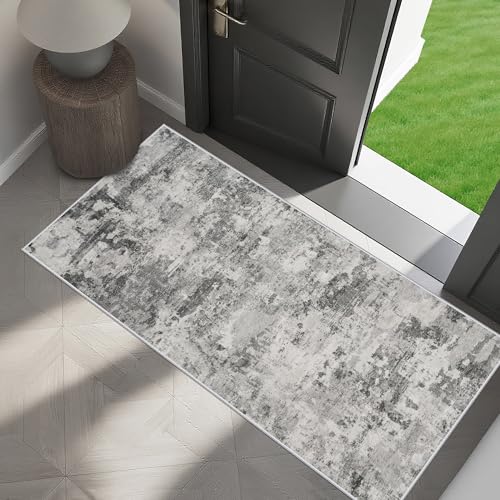
HILORUUG 2×4 Washable Entryway Rug — Best for Busy Entries
The HILORUUG makes no apology for being a doorway rug. Its listing describes a washable, non-slip, low-pile small carpet in a black and grey abstract, stain resistant and aimed at kitchens, bathrooms and entrances in homes with elderly residents, pets and families — which is to say, homes where the floor works for a living. The abstract pattern is the first line of defence: swirls of charcoal and grey break up the visual evidence of grit and paw prints between washes, so the rug looks respectable on day six, not just on day one.
Low pile is the second line. A door swinging over this rug meets a surface it can clear, and a vacuum passes over it without the wrestling match a deeper pile starts. Low pile also dries faster after washing, which matters in a household where the entry rug is needed back on duty the same evening it went into the machine.
Households with elderly family members will read its listing’s mention of that audience correctly: a flat, grippy, washable rug at the door is a fall-prevention device as much as a furnishing, provided its edges lie flat and its backing still bites. Check both monthly, the way you would check a bath mat’s suction, because the rug’s safety value lives entirely in those two unglamorous properties and fades exactly as they do.
Positioning matters with a pattern this directional. The abstract reads best laid lengthwise along the traffic path, guiding the eye down a hallway or across an entry, and the black-grey palette pairs naturally with the dark hardware, boot trays and coat hooks that furnish real entrances. In a pale, quiet hallway it will be the darkest note in the room; plan for that rather than being surprised by it, because a deliberate dark anchor at the door looks designed, while an accidental one looks like a spill.
- Size: 2×4 feet, per the listing
- Pile: low, door-clearing profile
- Pattern: modern abstract in black and grey
- Care: machine washable per the maker
- Grip: non-slip positioning for hard floors
Strengths
- The charcoal abstract hides entryway grit between washes better than any solid could.
- Low pile clears swinging doors and vacuums in seconds.
- Stain-resistant positioning suits pet households and winter slush alike.
Trade-offs
- The dark palette shows pale lint and pet hair from light-coloured animals.
- Low pile offers little cushion for anyone standing long at a sink.
- Its bold pattern may argue with a strongly patterned floor or wallpaper.
Best for: front doors, back doors and hallways with heavy daily traffic. Not suited for: anyone wanting a soft, cushioned landing beside the bed.

AMADA 2×4 Modern Abstract Washable Rug — Best Deep Blue Accent
Most small rugs apologise for existing; the AMADA introduces colour instead. Its dark blue modern abstract brings the one confident note many hallways lack, and at two by four feet the commitment is perfectly sized: enough blue to register as a decision, not so much that it redecorates the room around itself. The listing positions it across entryways, hallways, kitchens, bedrooms and offices, and describes a printed pattern that is non-slip, soft and stain resistant, machine washable into the bargain.
Printed construction explains several of its virtues. A print sits on a low, even surface rather than rising in tufts, so the rug stays slim under doors, lies flat at its corners sooner than a woven rug does, and carries intricate abstraction without the price of weaving it. The trade is depth: a printed pattern has a flatter visual texture than a loomed one, which most buyers at this size and purpose will never notice at floor level, in motion, in a hallway.
Dark blue is a forgiving colour for a working rug in its own right, nearly as good as charcoal at swallowing shoe-borne evidence, and it flatters the woods and whites it will meet: oak floors warm it, white skirting sets it off, and grey walls give it a coastal calm. Kitchens with navy cabinetry, currently everywhere, will find it looks less like an accessory and more like a plan.
- Size: 2×4 feet, per the listing
- Colour: dark blue modern abstract print
- Profile: low and flat for door clearance
- Care: machine washable per the maker
- Grip: non-slip positioning in the listing
Strengths
- Deep blue delivers real colour while still hiding daily dirt.
- The printed surface lies flat quickly and clears low door swings.
- Versatile positioning across entry, kitchen, bedroom and office.
Trade-offs
- A printed pattern lacks the textural depth of a woven rug up close.
- Strong blue will fight rooms already committed to warm reds or oranges.
- Low profile means minimal padding underfoot at standing workstations.
Best for: pale hallways and navy-accented kitchens needing one washable note of colour. Not suited for: rooms decorated in warm, earthy palettes that blue would cool down.

Amearea Modern Washable Runner Rug 2×4 — Softest Underfoot
The Amearea hides its distinguishing feature inside: memory foam. Its listing describes a washable 2×4 runner with a foam core, in black, aimed at bedrooms, hallways, entryways, children’s rooms and laundry rooms. Foam changes what a small rug is for. Instead of merely covering the floor and catching dirt, this one cushions the two places a household stands still the longest: beside the bed at the day’s two ends, and along the sink or laundry run where standing is the whole activity.
Bare feet are the constituency here. A foam runner at a bedside turns the first step of a winter morning from a negotiation into a non-event, and along a kitchen sink it eases the standing that meal preparation quietly accumulates. Parents will also read the children’s-room positioning correctly: a padded, low, washable rectangle is a sensible landing for small people who fall over professionally.
Nurses, teachers and retail workers — anyone whose job is standing — tend to understand this rug fastest, because they already own the logic from their workplaces, where anti-fatigue mats are standard equipment rather than luxuries. A foam runner at the kitchen sink is the domestic version of the same idea, scaled to a home and disguised as décor, and the people who stand for a living rarely go back to hard floors at home once they have tried the alternative.
The foam asks for two considerations in return. Thickness, even modest foam thickness, is the enemy of door clearance, so this runner belongs where no door swings across it — bedsides, sink runs, laundry fronts — rather than in the front door’s arc. And foam and washing machines have a negotiated relationship: the maker lists it as washable, but gentle cycles and patient drying will keep the core springy longer than aggressive heat ever will. Treat it as the softest tool in this guide rather than the toughest, and it will repay the distinction.
- Size: 2×4 feet, per the listing
- Core: memory foam cushioning
- Colour listed: black, modern styling
- Care: washable per the maker, gently handled
- Grip: non-slip positioning for indoor floors
Strengths
- Foam cushioning makes bedsides and sink runs kinder to stand on.
- Washable construction keeps a padded rug practical around children.
- The black modern look suits bedrooms and laundry rooms equally.
Trade-offs
- Foam thickness rules it out of a low door’s swing path.
- The core prefers gentle washing and slow drying to stay springy.
- Less suited to gritty front-door duty than the flat picks here.
Best for: bedsides, nursery floors, laundry rooms and long standing stretches at sinks. Not suited for: the front doorway, where doors swing and grit arrives by the gram.
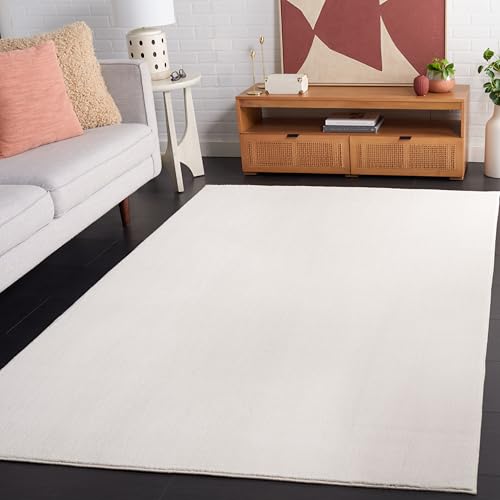
SAFAVIEH Loft 300 Washable Accent Rug 2×4 — Best Medium Pile
Safavieh is the established name in this list, and the Loft 300 shows what a heritage rug maker does with a small accent size. Its listing describes a power-loomed polyester rug in a modern solid ivory, with a half inch of medium pile, sized at 2 feet 3 inches by 4 feet, and positioned for bedrooms, kitchens and living rooms. Note the extra three inches of width and the pile height: this is the plush outlier among six mostly flat rugs, included for the rooms where softness is the assignment and door clearance is not in question.
A solid ivory rug makes a different promise from the abstracts around it. It does not camouflage; it brightens. Beside a bed, under a dressing table, or in front of a bathroom vanity where traffic is barefoot and brief, a pale solid lifts the light in a room and feels like a small luxury every single morning. Power-loomed polyester gives that luxury a practical streak: the fibres tolerate washing, resist staining better than natural pile, and keep the price of the experiment modest.
There is a styling trick this rug performs better than any other in the list: it makes a small room feel finished. A pale pile rectangle beside a bed reads as intention, the way a folded throw does, and in a guest room it quietly signals that someone thought about the person sleeping there. Hosts who keep one room for visitors will find those eight square feet doing hospitality work out of all proportion to their size, particularly in winter, when the alternative is a guest’s bare feet meeting cold boards at midnight.
The honest cautions belong in the same breath. A half inch of pile will not pass under a low-swinging door, so site it where doors do not travel. Ivory shows what charcoal hides, so its washable nature is not a bonus but a requirement of ownership, and households with muddy dogs should admire it in a bedroom doorway rather than deploy it at the garden door. Chosen for the right room, it is the prettiest eight square feet in this guide; chosen for the wrong one, it is a cleaning schedule.
- Size: 2 feet 3 inches by 4 feet, per the listing
- Pile: medium, a half inch, power-loomed polyester
- Colour: modern solid ivory
- Care: washable line per the maker’s Loft 300 range
- Rooms named: bedroom, kitchen, living room
Strengths
- Real pile softness that the flat washable rugs cannot imitate.
- Solid ivory brightens small, dim spots beside beds and vanities.
- Power-loomed polyester shrugs off washing and everyday staining.
Trade-offs
- Half-inch pile will not clear a low door swing.
- Ivory displays dirt honestly and needs its washable nature used.
- Slightly oversized at 2 feet 3 inches wide for the tightest niches.
Best for: bedrooms, dressing areas and vanity fronts where feet are bare and doors are elsewhere. Not suited for: mud-season entrances or anywhere a door sweeps the floor.

IOHOUZE Abstract Runner Rug 2×4 — Best Rubber Backing
The IOHOUZE answers the wandering-rug problem with the oldest solution in the category: a rubber backing. Its listing describes a 2×4 entryway runner, rubber backed, with a printed faux-wool surface in grey and beige abstraction, non-slip and washable, aimed at foyers, front doors and sink areas. Rubber on hard floors is not subtle, and that is its charm; the rug goes down, and it stays down, through the daily scuffing of a household threshold.
The faux-wool print is doing quieter work above the backing. It borrows the mottled, heathered look of a wool runner — the kind of texture that reads as texture rather than pattern from standing height — and delivers it in a printed, washable, low-profile form that a real wool runner at this size would struggle to match for practicality. Grey-beige, sometimes called greige by people who name colours professionally, is the diplomat of palettes: it neither cools a warm room nor warms a cool one, and it coordinates with the widest range of flooring it might land on.
Taxi drivers of the rug world — the ones that carry everything and complain about nothing — tend to be rubber-backed, and hallways with prams, wheelchairs or walking frames will feel the benefit most, because wheels and aids punish a rug that shifts even slightly. A backing that holds its position through a hundred crossings a day is not a detail in such a house; it is the difference between a rug and an obstacle, and it is why this pick leads the list for accessibility-minded entries.
Rubber backing has one long-term habit worth knowing: it prefers cool washes and air drying, because repeated hot cycles age rubber faster than the surface above it. The maker’s washable claim stands, but the owner who washes cool and dries flat will keep the grip — the entire point of this rug — alive for years longer than the owner who treats it like a bath towel.
- Size: 2×4 feet, per the listing
- Backing: rubber, for grip on hard floors
- Surface: printed faux-wool look in grey beige
- Care: washable per the maker; cool cycles suit the backing
- Placement named: foyer, front door, sink areas
Strengths
- Rubber backing is the firmest stay-put answer in this guide.
- The heathered faux-wool look disguises lint and light soiling well.
- Grey-beige neutrality fits warm and cool rooms without argument.
Trade-offs
- Rubber ages fastest under hot washes and tumble heat.
- The printed surface reads flat rather than plush up close.
- On very smooth tile, even rubber benefits from a swept, dry floor.
Best for: foyers and front doors on tile, laminate or hardwood where rugs tend to travel. Not suited for: heated floors, where rubber backing is generally unwelcome.
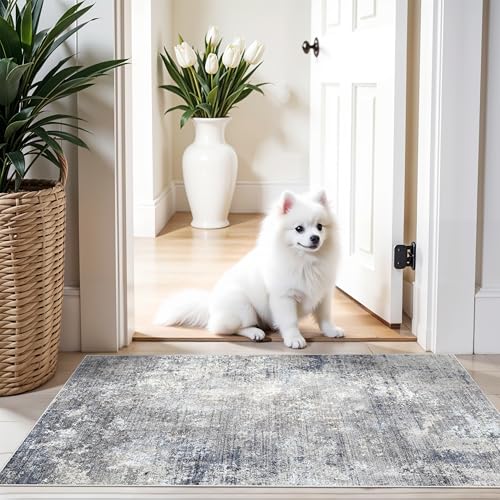
Washable 2×4 Runner Rug Non-Slip — Best Neutral Abstract
Some rooms need a rug that performs and then disappears, and this unbranded 2×4 runner is built for exactly that modesty. Its listing describes a washable, non-slip, low-pile thin rug in a modern abstract of blue and grey, for kitchens, bedrooms, entryways, bathrooms and bedsides. The palette is the point: blue-grey abstraction is the visual equivalent of a well-behaved guest, present in every room, insisting on nothing, and quietly absorbing the evidence of the day.
Thin and low-pile is a deliberate engineering choice at this size, and this rug commits to it fully. It clears doors, lies flat without a long breaking-in period, fits a washing machine without negotiation, and dries quickly enough to return to duty the same day. In a bathroom, that speed matters; in a kitchen, the low profile keeps it from becoming a trip edge under a cook carrying something hot; in an entryway, it vacuums in one pass.
Budget shoppers tend to land here first, and the reasoning is sound: at this size, the difference between a modest rug and a premium one buys less extra life than it does at area-rug scale, because the doorway, not the weaving, sets the retirement date. Spending the savings on a second rug for rotation is the genuinely clever version of the same purchase, and this runner’s quiet looks make it the easiest second rug in the list to live with.
The compromises are the mirror of the virtues. A thin rug offers the floor’s own cushioning and no more, so long standing belongs to the foam pick above. A quiet pattern will not rescue a dull room the way the AMADA’s blue can. What it offers instead is the highest probability in this list of fitting a space without a single regret: the safe pair of hands at 2×4, bought by people who have measured their doorway and their patience and chosen peace.
- Size: 2×4 feet, per the listing
- Pile: low and thin for maximum door clearance
- Pattern: modern abstract in blue grey
- Care: machine washable per the maker
- Rooms named: kitchen, bedroom, entryway, bathroom, bedside
Strengths
- The slimmest profile here clears doors the others must avoid.
- Blue-grey abstraction coordinates with cool and neutral schemes alike.
- Washes and dries quickly, suiting bathroom and kitchen rotation.
Trade-offs
- Thin construction means no meaningful cushion underfoot.
- The pattern is deliberately quiet and will not anchor a room.
- Unbranded consistency can vary more between production runs.
Best for: bathrooms, kitchens and tight entryways where clearance is measured in millimetres. Not suited for: anyone shopping for softness first and practicality second.
Comparison Table
| Pick | Pile | Grip approach | Best room |
|---|---|---|---|
| HILORUUG 2×4 Washable Entryway Rug | Low | Non-slip | Busy entry |
| AMADA 2×4 Modern Abstract Washable Rug | Low print | Non-slip | Hallway |
| Amearea Modern Washable Runner Rug 2×4 | Foam-cored | Non-slip | Bedside |
| SAFAVIEH Loft 300 Washable Accent Rug 2×4 | Medium, 1/2 in | Weight of pile | Bedroom |
| IOHOUZE Abstract Runner Rug 2×4 | Low print | Rubber backing | Foyer |
| Washable 2×4 Runner Rug Non-Slip | Low, thin | Non-slip | Bathroom |
How Low Does the Pile Need to Be for a Doorway Rug?
Measure the gap, not the guess, and write the measurement on your phone before you start shopping, because doorways are always narrower in memory than they are in the house you return to. Open the door that will swing over the rug and look at the clearance between its bottom edge and the floor at the tightest point of the arc, remembering that floors are rarely level and doors sag a little more each decade. A rug plus its backing must live comfortably inside that gap with room to spare for the grit it will collect, because a rug that clears on delivery day can start dragging by the first muddy week.
As a working rule, the flat washable rugs in this guide — the printed and low-pile picks — pass under most interior doors without drama. The half-inch Safavieh pile and the foam-cored Amearea are bedside and sink rugs by temperament, and asking them to live in a door’s arc is asking for curled edges and a daily shove with a foot. Site each rug where its build is an asset and the question of clearance mostly answers itself.
One more placement trick helps in tight entries: hinge-side positioning. If the rug sits mostly outside the swing’s tightest radius, with only its corner under the arc, even a slightly thicker rug can work. Lay the rug, swing the door slowly through its full travel, and watch where the edge passes before committing to the spot.
How Should You Wash a Small Rug Without Wrecking Its Backing?
Shake it outside first, longer than feels necessary. Most of what a doorway rug collects is loose grit, and grit left in the pile becomes abrasive paste in the wash, wearing the fibres and the machine alike. Then wash cool or warm rather than hot, on a gentle cycle, with the rug alone or with similar flat textiles so it can move freely and rinse clean.
Backing care decides how many washes the rug survives. Rubber and non-slip treatments both age under heat, so air drying flat — over a rail, a rack, or the back of a garden chair — preserves grip far better than a hot tumble. The thin rugs here dry in hours; even the foam runner dries by the next morning if it is stood somewhere air can reach both faces.
Wash on evidence rather than on a calendar. A 2×4 at a front door in a wet month may need the machine fortnightly; the same rug at a guest-room bedside may need it twice a year. Every wash costs a little backing and a little colour, so spend them where the dirt actually is, and spot-clean the small incidents in between with a damp cloth and patience.
Where Else Does a 2×4 Rug Earn Its Keep?
The size moonlights all over the house once you stop thinking of it as a doorway product. In a galley kitchen it runs the sink-to-stove corridor where cooks actually stand. In a laundry room it catches the drips between washer and basket. At the foot of a child’s bed it defines the territory where shoes are kicked off and stories are read on the floor. In front of a bathroom vanity it warms the tiles for the morning’s first barefoot minutes, which is why the washable requirement follows it from room to room.
Small spaces multiply its value. Studio flats and narrow hallways cannot host an area rug, but a 2×4 introduces pattern, colour and softness at a scale the architecture permits. Renters lean on the size for the same reason: eight square feet of personality that rolls up at the end of a tenancy and leaves the floor exactly as it was found.
Home workers have adopted the size too, as the boundary marker of a desk zone in a shared room: a 2×4 under a desk and chair defines a workplace on a bedroom floor, warms the feet during long calls, and rolls away when the room must become a bedroom again. The flat washable picks suit the role best, since chair casters and low pile tolerate each other, while foam and medium pile resist the wheels and lose.
Pet owners find their own uses: under food and water bowls, where a washable low rug contains the splash zone; inside the back door, where the first four feet of travel shake off the worst of a walk; and beside a favourite chair, where an ageing dog appreciates grip when standing up. A rug this size is less a furnishing decision than a household tool, and the houses that use them best tend to own several.
How Do Modern and Transitional Patterns Differ at This Scale?
At eight square feet, pattern scale is destiny. A modern abstract — the swirls and fields of the HILORUUG, the AMADA and the blue-grey runner — has no single motif to centre or crop, so the rug looks intentional from any angle and in any orientation. That forgiving quality is why abstracts dominate small washable rugs: the pattern cannot be installed wrong, and wear distributes across the design instead of concentrating on one pale medallion.
Transitional designs borrow the grammar of traditional rugs — borders, medallions, vine work — and redraw it in softened, contemporary colours. At 2×4 a transitional rug reads as a miniature of a grander object, which suits formal entries and period houses where a pure abstract would feel like an interruption. The cost of the charm is placement: a bordered design wants to be centred on its doorway or console, and it shows traffic lanes more honestly than an abstract does.
Solids, represented here by the ivory Safavieh, are the third answer and the bravest. A solid small rug is really a texture purchase — pile, light and shadow doing the decorative work — and it succeeds in quiet rooms where pattern already lives elsewhere: a busy wallpaper, a gallery wall, a tiled floor with its own geometry. Choose the family by asking what the room lacks: camouflage, character or calm, and the pattern decision makes itself.
How Should You Coordinate a 2×4 Rug With the Room Around It?
Start with the floor, because the rug’s first relationship is with the surface it interrupts. On pale wood or light tile, a darker rug like the HILORUUG or the AMADA grounds the space and gives the eye a threshold, a sense that one zone has ended and another begun. On dark flooring the same rugs nearly vanish, and a mid-tone like the IOHOUZE’s greige or the blue-grey runner does the defining work instead.
Then borrow one colour, exactly one, from something that already lives in the room: the door paint, a bench cushion, the kitchen’s cabinet hardware finish translated into a tone. A small rug that echoes a single existing colour looks collected; one that introduces three new colours looks like it wandered in from another house. The deep blue AMADA succeeds in so many schemes because blue already hides in denim, in ceramics, in half the artwork ever hung in a hallway.
Finally, mind the sightlines. A runner-format rug laid along the direction of travel lengthens a short hall visually, while the same rug laid across an entry widens it. Stand in the doorway where guests stand, look at the rug from there, and turn it ninety degrees if the room argues for it. Eight square feet is small enough that experimenting costs nothing but a minute.
What About Pets, Children and Floors You Do Not Own?
Pet households should read this guide from the washability column outward. The flat, low-pile, machine-washable picks are the pet picks, because accidents at a doorway are a scheduling certainty rather than a risk, and a rug that can be in the machine within the hour never becomes a grievance. Dark abstracts hide the between-wash evidence of shedding and muddy arrivals; the ivory Safavieh, for all its beauty, belongs in the pet-free bedroom of such a house, and the listings’ own stain-resistant claims should be treated as help, not armour.
Children change the brief toward cushion and grip. The Amearea’s foam core at a bedside or play corner, and the rubber-backed IOHOUZE where small feet arrive at speed, answer the two ends of childhood: falling down and running in. Low pile everywhere else keeps toy cars rolling and crumbs vacuumable, and every rug here can survive the washing rhythm that childhood imposes without being retired to the garage.
Renters and owners of delicate floors should note the backing question from the other side. Rubber and non-slip treatments grip by contact, and on some finishes — freshly sealed hardwood, certain vinyls — any backing should be checked periodically and the rug lifted and aired, because trapped moisture under a rug harms floors more faithfully than feet ever will. A thin washable rug lifted weekly for a shake is, in this respect, the kindest furnishing a rented floor can host.
How Long Should a Washable Entry Rug Last, and When Is It Done?
A small washable rug is a consumable with a long fuse, and honesty about that improves buying. The surface fibres of a hard-working doorway rug will flatten and fade in the traffic lane within a few years, however good the construction, because grit is an abrasive and shoes deliver it daily. The backing usually sets the true retirement date: when grip fades to the point that the rug travels on a dry, clean floor, the rug has become a hazard wearing out its welcome, and no amount of surface charm justifies keeping it at a threshold.
You can stretch the lifespan with unglamorous habits. Two rugs in rotation halve each rug’s washes and double its recovery time between them. A stiff brush or a beating outdoors weekly removes the grit that washing would otherwise grind through the pile. Keeping the floor beneath clean matters too, because a rug sliding on a layer of dust is a rug wearing its backing away from below.
Retirement need not mean the bin. A faded 2×4 with sound backing still serves in a garage doorway, under a potting bench, or as the workshop’s comfort strip in front of a bench. Demote it in stages, as households have always demoted textiles, and the purchase price divides itself across a decade of thresholds.
How Do You Choose Between Two Rugs That Both Seem Right?
Tie-break with the worst day, not the best one. Picture the doorway in the worst week of its year: the wettest boots, the muddiest dog, the darkest evening when nobody turns the hall light on. The rug that survives that week in your imagination — darker, flatter, grippier — is the rug to buy for an entry, whatever the showroom lighting argued. For a bedside, run the opposite film: the coldest morning, the sorest feet, the longest standing-still at the basin, and let softness win the tie it deserves to win there.
If the tie persists, let the washing machine vote. Check the drum you actually own: a rug that fits it comfortably will be washed promptly and often, and a rug that barely fits will be washed late and reluctantly, and the second rug will look older in a year than the first will in three. Practical care beats theoretical quality in a working doorway every single time.
And if the tie still persists, buy the one whose colour already exists somewhere in your home. Small rugs are accents, and accents succeed by relationship rather than by solo performance. The rug that rhymes with the door paint, the bench, the dog’s own muddy palette, will look right on the worst day and the best one alike.
How Do the Seasons Change What a 2×4 Rug Has to Survive?
Winter is the doorway rug’s examination season. Melted snow arrives as gritty water, road salt arrives as white crust that stiffens fibres and dulls colours, and the rug’s job expands from decoration to moisture management: it must give wet boots somewhere to stand that is not the bare floor, and it must do so several times a day without staying damp enough to smell. The flat washable picks shine here precisely because they can be rinsed, washed and dried in rotation, and because their low pile releases salt to the vacuum instead of hoarding it at the roots.
Summer reverses the assault. The enemy becomes dry dust, pollen and the fine sand that beach and garden households track in, all of which are vacuum problems rather than washing problems, and all of which a low-pile rug surrenders more easily than a deep one. Summer is also when a household notices a doorway rug’s colour most, since the light is better and the doors stand open; the abstract patterns here earn their keep by looking deliberate in sunshine rather than merely serviceable in gloom.
The households that handle both seasons best treat the doorway as a two-rug post. A darker, flatter rug takes the winter shift; a fresher one, perhaps the ivory Safavieh if the entry is sheltered, takes the summer. Each rests half the year, each is washed at its season’s end, and the doorway never wears the exhausted look that a single year-round rug develops by its second February.
How Should You Lay a Small Rug in a Kitchen Without Creating a Trip Edge?
Kitchens punish carelessness, because the person crossing the rug is often carrying something hot, sharp or full. The rules are simple and worth following exactly. The rug lies flat, fully flat, with no corner lifted and no fold stored underneath; if it will not lie flat after a day of settling, it does not belong in a kitchen at all. Its long edge should run parallel to the counter it serves, close enough that drips land on it and far enough that a step back from the stove does not land a heel on its edge.
Position it for the standing, not the walking. The sink run and the stove front are where cooks accumulate minutes; a 2×4 centred on the sink serves the washing-up, while a household that cooks more than it washes may prefer it at the range. Either way, keep it out of the triangle’s turning points, where feet pivot — a rug edge under a pivoting foot is the one configuration that can fold a corner upward over time.
And keep the washing rhythm honest, because a kitchen rug collects grease as well as crumbs, and grease changes a non-slip backing’s behaviour slowly and invisibly. A monthly wash in a busy kitchen is not fussiness; it is maintenance of the grip that makes the rug safe to be there in the first place.
What Mistakes Do Buyers Make With Small Rugs?
The first mistake is buying the pattern from a screen without checking the pile against the door. The second is placing a light-coloured rug at a working entrance and then blaming the rug for the season. The third is skipping the grip question on smooth floors, where a small rug’s low weight gives it no natural anchor; a rug that travels to the middle of a hallway is telling you its backing and your floor were never introduced.
A fourth mistake is washing hot and drying hotter, then wondering why the backing cracked within the year. A fifth is buying exactly one rug for a spot that needs a rotation: a spare 2×4, even a plainer one, means the doorway is never bare while its rug is in the wash, and the pair will outlast a single rug asked to work every day of the year.
Final Recommendation
For a front door that sees real life, the HILORUUG is the pick we would lay down first: its charcoal abstract was designed by the logic of mud itself, and its low pile will still be clearing the door in five winters’ time. If your hallway needs colour more than camouflage, the AMADA’s deep blue is the confident choice, and if the rug’s real job is to be kind to bare feet, the Amearea’s foam core is the one your mornings will thank.
Choose the Safavieh when the room is a bedroom and softness is the brief, the IOHOUZE when the floor is slick and the rug must not wander, and the quiet blue-grey runner when clearance is tight and peace is the priority. Measure the door, respect the wash, and a rug the size of a bath towel will quietly become the most competent furnishing you own.
Frequently Asked Questions
Will a 2×4 rug fit in a standard washing machine?
Generally yes, and that is one of the size’s chief virtues. The thin and printed rugs here fold or roll into an ordinary drum without force. The foam-cored Amearea and the half-inch Safavieh pile are bulkier; check your machine’s capacity honestly, wash them alone, and never force a rug into a drum it resists, because a rug that cannot move cannot rinse.
Do I need a separate rug pad under a non-slip 2×4?
Usually not on hard floors, where these rugs’ own backing or treatment does the work. A pad earns its place on very smooth tile if a particular rug still creeps, or where you want extra cushion at a sink run. Keep any pad slightly smaller than the rug so its edge never peeks out and becomes the trip hazard the rug was avoiding.
How do I stop the corners of a small rug from curling?
Curling is usually a memory problem: the rug remembers being rolled for shipping. Lay it pile-down overnight, weight the corners with books for a day, or roll it briefly in the opposite direction. Rubber-backed rugs respond well to a day in a warm room. Persistent curl at a doorway is a safety issue rather than a cosmetic one, so replace rather than tape down a rug that refuses to lie flat where feet land.
Is a printed rug a lesser rug than a woven one?
It is a different tool. Printing allows intricate modern patterns, a perfectly flat profile and easy washing at modest cost, at the price of surface depth. At 2×4, in motion, at floor level, most households gain more from the flatness and the washability than they lose in texture, which is why prints dominate this size category.
Can these rugs go on carpet?
They can, but grip behaves differently: non-slip backings are designed for hard floors, and a small rug on deep carpet may creep or bunch. On low carpet tiles or flatweave carpet they settle better. If the rug is destined for a carpeted hallway, expect to straighten it more often, whatever its listing promises about hard floors.
Should both sides of an entry have a rug?
Ideally, yes: an outdoor scraper mat outside and a washable 2×4 inside divide the work the way a lock and a latch divide security. The outside mat removes the coarse grit; the inside rug catches the moisture and the fine remainder. Households that can only manage one should put the washable one inside, where it protects the floor that costs money to refinish.
Related Guides
When the doorway grows, so should the rug: our guide to the Best 3×5 Rugs for Mudrooms covers the next size up for entrances that handle boots and dogs in volume. For tiny accents elsewhere in the house, the Best Accent Rugs gather the smallest formats room by room. Larger living spaces are served by the Best Affordable Rugs for Living Rooms, and if your colour questions start in the bathroom, the Best Bath Mats by Color sorts that room’s textiles by palette.


