What's inside
- Key Takeaways
- Quick Picks
- How Did We Choose These Natural Fiber Rugs?
- How Do All Six Natural Fiber Rugs Compare Side by Side?
- Why Does Fiber Choice Matter More Than Pattern at 9×12?
- How Do You Care for a Rug That Must Never Be Soaked?
- What Pad Belongs Under a Natural Fiber Rug This Large?
- Where Should Natural Fiber Never Be Placed, However Much You Love It?
- How Does a Natural Rug Change a Room Across the Seasons?
- How Do You Remove Odours and Dust From a Rug You Cannot Wash?
- What Should You Expect in the First Month With a Natural Rug?
- How Do Natural Rugs Pair With Wood, Leather and Linen?
- How Should You Plan Delivery and Placement of a Rug This Heavy?
- Can a Natural Fiber Rug Work in a House With Dogs?
- How Do You Layer a Smaller Rug Over a Natural 9×12?
- What Does the Room Gain Acoustically From a Hundred Square Feet of Fiber?
- How Should You Judge a Natural Rug in the First Five Minutes After Unrolling?
- How Long Should a Rug Like This Serve, and What Ages It?
- What Mistakes Ruin Natural Fiber Rugs Fastest?
- Final Recommendation
- Frequently Asked Questions
- Related Guides
As an Amazon Associate I earn from qualifying purchases. This post may contain affiliate links at no extra cost to you.
cottageverdict.com is reader-supported. When you buy through links on our site, we may earn an affiliate commission.
Where to buy: the six rugs below each lead to an Amazon listing, where you can check price on Amazon and confirm the fiber content, pile height and backing details for the 9×12 size before ordering. Natural fiber rugs vary visibly from piece to piece, so read the listing’s notes on colour variation as part of the product, not as a warning label.
A 9×12 natural fiber rug is less a purchase than a decision about what a room is made of. At a hundred and eight square feet, jute or sisal stops being an accent and becomes the floor’s personality: dry, matte, faintly golden, smelling very slightly of the field it grew in. The best 9×12 natural fiber rugs earn that dominance honestly, through weave and thickness rather than pattern, because these fibers take dye reluctantly and look best left close to their own colour.
That honesty cuts both ways, and this guide will not hide it. Natural fiber rugs do not go in a washing machine, ever. They dislike standing water, they shed a little especially when young, and their texture underfoot ranges from pleasantly nubby to frankly stern depending on the fiber and the knot. In exchange they offer something synthetic rugs imitate badly: a surface that ages by mellowing instead of wearing out, that hides dust in its own texture, and that makes wood, linen and leather look like members of the same family.
The six picks below divide along the real fault lines of the category. Three are jute in different tempers — knotted and thick, braided and rustic, hand-woven and comparatively low. One blends a seagrass-look herringbone into an easier-care brief. One is true sisal, the firmest and most tailored fiber of the group. Choosing between them is choosing how a room feels to bare feet at seven in the morning, which is a more useful question than which one photographs best.
Size deserves a sentence of respect. A 9×12 covers the whole of most living rooms and slides under a king bed with borders that feel generous rather than leftover. It is also heavy in a way synthetic rugs of the same size are not, because natural fibers carry real mass. Plan the delivery and the placement with two people, and decide the rug’s orientation before it lands, because adjusting a hundred square feet of jute by inches is a workout, not a tweak.
A final expectation to set before the picks: these rugs ask the household to change a few habits — shoes dried at the door, spills met with a cloth instead of a mop, a pad bought alongside — and in return they change the room’s character more completely than any synthetic alternative at this size. That exchange, habits for character, is the real product being reviewed below.
Key Takeaways
- Jute is the softest natural fiber here; sisal is the firmest and most tailored underfoot.
- None of these rugs is machine washable — vacuuming and prompt spot care are the regime.
- A separate non-slip pad is genuinely needed at this size and fiber type.
- Natural variation in tone is inherent to the material, not a defect to return.
- Thick knotted jute cushions a room; low hand-woven jute keeps chairs and doors easy.
- Keep natural fiber away from standing water, steam cleaning and damp basements.
- A 9×12 of real fiber is heavy: plan the delivery route, the orientation and a second pair of hands before it arrives.
Quick Picks
| Pick | Badge | Why it earns its place |
|---|---|---|
| SAFAVIEH Natural Fiber Jute Rug 9×12 NF447A | Thickest knotted jute | Three-quarter-inch knotted jute that gives a large room real cushion and grain. |
| The Knitted Co Hand Woven Jute Rug 9×12 | Braided and reversible | Hand-woven braided jute with a rustic farmhouse character, usable on both sides. |
| CAMILSON Easy Jute Rug 9×12 | Herringbone easy-care option | A herringbone seagrass-look weave pitched as the easy-cleaning member of the family. |
| HOMEMONDE Braided Jute Area Rug 9×12 | Boho braided all-rounder | Rectangle braided jute in natural brown, aimed at nearly every room in the house. |
| SAFAVIEH Natural Fiber Sisal Rug 9×12 NF143C | True sisal, tailored finish | Marble and beige sisal with a half-inch profile — the formal tailoring of the group. |
| SAFAVIEH Natural Fiber Jute Rug 9×12 NF459A | Low hand-woven jute | Hand-woven jute at three-eighths of an inch — the easiest-going jute at this size. |
How Did We Choose These Natural Fiber Rugs?
Fiber truth came first. Every pick had to be what its name claims — jute as jute, sisal as sisal — with the weave described plainly enough that a buyer could predict texture before unrolling a hundred square feet of it. Blends and lookalikes were admitted only where the listing is transparent about them, as with the herringbone seagrass-styled pick, and they are labelled as such in its review below.
Thickness was treated as a functional spec rather than a luxury one. The group spans roughly three-eighths of an inch to three-quarters, and that range changes everything downstream: door clearance, chair behaviour, how a room sounds, how the rug feels in January. We kept the spread deliberately wide so that a household can choose its own trade instead of inheriting ours.
Finally, each rug had to suit the scale. Fine, delicate weaves that charm at 5×7 can look lost and wear unevenly at 9×12, where traffic lanes cross open ground. The survivors are weaves with visual grain coarse enough to hold a large room — knots, braids and herringbones that read as texture from across the room and as craftsmanship up close.
Durability evidence was read the way owners experience it: not as laboratory abrasion counts but as the weave’s behaviour in the traffic lane, the doorway and under the dining chair. A construction that keeps its surface coherent when a chair leg twists on it daily earned its place over prettier weaves that fray at exactly that insult, because a 9×12 cannot be rotated away from its dining end the way a runner can.

SAFAVIEH Natural Fiber Jute Rug 9×12 NF447A — Thickest knotted jute
The NF447A is the heavyweight of this group in every sense: jute worked into a knotted construction with a pile around three-quarters of an inch, which at 9×12 produces a surface with genuine give. Walking across it feels like walking across a very firm mattress woven from rope, and that is meant as praise. Large hard-floored rooms — converted barns, open-plan lofts, tiled living spaces — need exactly this kind of mass to stop sounding like halls.
Knotted jute has a grain that flat weaves cannot imitate. Light rakes across the knots and the floor gains shadow and movement without a single dyed thread, so the rug partners patterned upholstery and busy curtains without competing. It is the pick for rooms that already own their colour and need texture to keep all that colour grounded.
Care follows the natural fiber rulebook strictly: vacuum with suction rather than a savage beater bar, blot spills immediately without soaking, and never steam clean. The thickness that makes it comfortable also makes it slow to dry if it does get wet, so it belongs in living rooms and bedrooms rather than anywhere near a leaking door or a dog’s water bowl station.
Under furniture it behaves like a foundation. Sofas settle into it with a satisfying finality, and the rug’s own weight keeps it planted, though a pad beneath remains wise on smooth floors to protect both rug and boards. Expect early shedding of loose fiber — the rug is settling, not failing — and expect the tone to vary gently across its surface, because that variation is the signature of the real material.
One placement this rug rewards is beneath a piano or a heavy bookcase run, where its mass reads as permanence and its texture keeps a formal room from feeling polished into coldness.
- Footprint: 9 x 12 ft
- Fiber: jute, knotted construction
- Pile: about 3/4 inch, the thickest here
- Use: indoor living room, office, entryway
- Care: vacuum and spot clean only
Strengths
- Deepest cushion and sound-softening of the six picks
- Knotted grain adds texture without any dyed pattern
- Weight and body make large rooms feel grounded
Trade-offs
- Slow to dry if soaked; keep away from water sources
- Early shedding while the fibers settle is normal
- Thickness can challenge low-clearance doors at the edge
Best for: large living rooms and lofts needing warmth, mass and quiet
Not suited for: dining rooms where chairs slide constantly, or damp-prone spaces

The Knitted Co Hand Woven Jute Rug 9×12 — Braided and reversible
Braiding is the oldest way to make jute behave, and this hand-woven rug wears that heritage openly. Strands are plaited and stitched into a broad, even field whose charm is its slight irregularity: no machine-perfect repetition, just the rhythm of hands. In farmhouse and rustic rooms that irregularity is the entire point, because it keeps a very large rug from looking manufactured.
Reversibility is a practical gift disguised as a styling one. When the traffic lane between door and sofa begins to show its years, flipping the rug presents the fresher face and doubles the interval before the rug looks tired anywhere. It also rescues the day a spill defeats spot cleaning on one side, though the honest response to a spill is still speed, blotting and restraint with water.
The listing allows indoor and outdoor use, and that claim deserves translation: a covered porch or sunroom, yes; an open deck in the rain, no. Jute outdoors in real weather will mildew and rot with enthusiasm. Treat the outdoor wording as permission for sheltered, dry outdoor rooms, and bring the rug in for winter if the space is not heated.
Underfoot, braided jute sits between the knotted SAFAVIEH’s depth and a flatweave’s firmness — textured, springy in a rope-like way, and kind to feet that dislike sisal’s sternness. It layers beautifully under a smaller patterned rug in the centre of a room, a stylist’s trick that also protects the highest-traffic ground.
Farmhouse tables with benches suit the braid especially well, because bench feet slide across it without the catching that thicker piles cause and the whole arrangement looks gathered rather than placed.
- Footprint: 9 x 12 ft
- Fiber: jute, hand woven braided design
- Profile: medium, textured braid
- Faces: reversible, both sides usable
- Care: vacuum, spot clean, keep dry
Strengths
- Reversible face doubles the rug’s presentable life
- Hand-braided texture suits farmhouse and rustic schemes
- Middle-ground comfort between deep knot and flat sisal
Trade-offs
- Outdoor claim means sheltered spaces only, not open weather
- Braid texture can trap grit that needs patient vacuuming
- Handmade irregularity will bother perfectionists
Best for: farmhouse living rooms and sunrooms wanting rustic texture
Not suited for: open porches, wet climates without cover, or fans of machine precision

CAMILSON Easy Jute Rug 9×12 — Herringbone easy-care option
The CAMILSON takes the natural fiber look in a more managed direction: a herringbone weave in a natural colour, styled after seagrass, with an easy-cleaning and washable-outside brief that the true jute and sisal picks cannot offer. That positioning makes it the bridge pick of this guide — the one for households that love the coastal, woven look but live a life that includes muddy boots and spilled smoothies.
Herringbone is doing serious visual work here. The zigzag grain gives a 9×12 field direction and refinement, reading almost tailored from across the room while staying unmistakably fibrous up close. It suits boho and coastal interiors that find plain jute too rustic and sisal too corporate, landing in a middle register that pairs with rattan, pale wood and white walls particularly well.
Because the listing pitches the rug for living room and patio alike, set expectations with the same care as the braided pick: easy-cleaning and hose-friendly language describes a rug that tolerates more moisture and rougher cleaning than hand-knotted jute, but any fiber rug lives longest where water visits briefly rather than taking up residence. A covered patio, yes; a puddle-prone deck corner, think twice.
Indoors, its flatter weave is the dining-friendly face of this roundup. Chairs slide more willingly than on the knotted or braided jutes, doors clear it easily, and the herringbone’s fine pattern hides crumbs between vacuums. Buyers choosing purely for barefoot luxury should look to the thicker picks; buyers choosing for a beautiful, manageable surface under real family traffic have found their candidate.
A hallway that opens into the living room benefits when the braid’s rhythm runs toward the seating, drawing the eye inward; run it across the traffic instead and the room feels wider and calmer.
- Footprint: 9 x 12 ft
- Design: herringbone weave, seagrass styling
- Colour: natural fiber tone
- Use: living room and covered patio
- Care: easy-cleaning brief, vacuum routinely
Strengths
- Herringbone grain looks tailored while staying rustic
- Easiest care brief in this natural-look group
- Flatter weave suits dining chairs and door swings
Trade-offs
- Seagrass styling is a look; read the listing’s fiber details closely
- Less barefoot cushion than the thick jute picks
- Outdoor use still means covered, not weather-exposed
Best for: coastal and boho dining or living rooms with heavy family traffic
Not suited for: purists who want certified single-fiber jute or sisal only
HOMEMONDE Braided Jute Area Rug 9×12 — Boho braided all-rounder
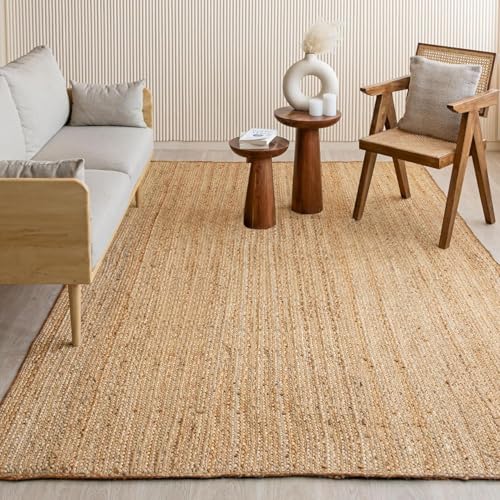
HOMEMONDE’s braided rectangle is the generalist of the group, listed for living room, kitchen, bedroom and entryway with the same easy-clean confidence. The braid here reads slightly finer and more uniform than the Knitted Co’s rustic plaiting, which moves it a step toward contemporary farmhouse: still handmade in character, tidier in execution, and easier to pair with modern furniture that would argue with a rougher weave.
The natural brown tone is the warmest in the roundup. Where most jute sits in the straw-to-wheat range, this rug leans toward the colour of strong tea, and that warmth flatters rooms with mid-tone wood floors that can make paler jute look washed out. It also hides the evidence of life — dust, crumbs, the faint grey of traffic — more gracefully than its paler cousins.
Braided construction brings the usual reversible, grit-trapping personality, and the same care covenant applies: suction vacuuming, prompt blotting, no soaking, no steam. In a kitchen placement, be honest about which kitchen: a dry galley where the rug warms a cook’s standing spot is one thing, the splash zone in front of a sink is another, and natural fiber should not live in the splash zone.
As a bedroom rug under a king bed it performs the classic natural-fiber trick, giving bare feet a dry, warm-textured landing that never feels clammy in summer or cold in winter. Jute regulates its surface temperature by simply being a dry plant fiber, and at 9×12 the effect covers the whole waking-up geography of the room.
Kitchens with a dry eating end can borrow this rug’s warmth there, provided the cooking splash zones keep their own washable mats and the jute is never asked to do a mat’s wet work.
- Footprint: 9 x 12 ft
- Fiber: jute, braided rectangle
- Tone: natural brown, warmest here
- Use: living room, bedroom, entryway
- Care: vacuum and spot clean, keep dry
Strengths
- Warm brown tone flatters mid-tone wood floors
- Tidier braid pairs with contemporary farmhouse furniture
- Hides dust and light soiling gracefully between cleans
Trade-offs
- Kitchen placement must avoid the sink splash zone
- Braid can hold grit deep; vacuum slowly and often
- Colour depth varies naturally across a handmade piece
Best for: warm-toned living rooms and king bedrooms wanting tidy rusticity
Not suited for: wet zones, or rooms with very pale floors needing contrast

SAFAVIEH Natural Fiber Sisal Rug 9×12 NF143C — True sisal, tailored finish
Sisal is the fiber that wears a suit. The NF143C works it into a tight, even weave in marble and beige tones with a profile around half an inch, and the result is the most tailored surface in this guide: flat, crisp, faintly lustrous, and utterly uninterested in being cosy. Rooms that want structure — a study, a formal living room, a dining room with architectural furniture — are where sisal has always belonged.
The barefoot truth must be stated plainly: sisal feels firm and dry, with a fine scratchiness that some people read as invigorating and others as unwelcoming. Nobody curls their toes into sisal. What it offers instead is superb behaviour under chairs and tables, a surface that brooms and vacuums clean with unusual ease, and a resistance to crushing that keeps it looking pressed while jute relaxes around it.
Sisal’s weakness is water in a different way from jute’s: it stains. A spilled glass of red wine on sisal is an emergency measured in seconds, and water itself can leave a tide mark as it dries. Households choosing sisal are choosing vigilance, rewarded by elegance. Place it where drinks are set down carefully, not where toddlers conduct experiments.
At 9×12 under a dining table, though, sisal makes a case no other pick matches. Chairs glide, the weave shrugs off crumbs, and the marble-beige colouring bridges warm and cool furniture tones with unusual diplomacy. Add a quality pad beneath — sisal rugs particularly benefit, since the pad supplies the cushion the fiber refuses to — and the room gains the most grown-up floor in this roundup.
In a study the sisal’s crispness keeps a desk chair’s castors honest and the room’s sound dry and focused, an environment writers and accountants have prized in this fiber for decades.
- Footprint: 9 x 12 ft
- Fiber: sisal, tight even weave
- Profile: about 1/2 inch
- Tones: marble and beige
- Care: vacuum, blot spills instantly, never soak
Strengths
- Most tailored, architectural finish of the six
- Superb under dining chairs; resists crushing
- Vacuums and sweeps clean with minimal effort
Trade-offs
- Firm, faintly scratchy under bare feet
- Water itself can leave tide marks; spills are emergencies
- Demands a pad to supply missing cushion
Best for: dining rooms, studies and formal living rooms wanting structure
Not suited for: barefoot lounging rooms, toddler zones, or relaxed spill households

SAFAVIEH Natural Fiber Jute Rug 9×12 NF459A — Low hand-woven jute
The NF459A answers the question the NF447A raises: what if a household wants real jute’s colour and honesty without three-quarters of an inch of it? Hand-woven in India to a low pile of about three-eighths of an inch, this rug keeps the fiber and drops the bulk, and in doing so becomes the most versatile jute here — as happy under a dining table as beside a bed.
Low jute behaves almost like a textile floor. Doors clear it, chairs tolerate it, and its woven surface has a cloth-like regularity that suits kitchens’ dry ends, hallways’ mouths and entryways that stop short of actual mud. It is also the easiest of the jutes to vacuum thoroughly, because grit sits on a flatter field and surrenders without the excavation the knotted pile requires.
The trade for that versatility is atmosphere. The thick knotted rug changes a room’s acoustics and temperature; this one changes mainly its colour and texture, which for many rooms is exactly the assignment. Layered under a vintage patterned rug in the centre of a seating arrangement, it plays the perfect supporting role — a natural border that makes the smaller rug look intentional and heirloom-rich.
Expect the honest jute behaviours in milder form: gentle early shedding, tonal variation across the weave, and a firm instruction to keep it dry. Its hand-woven origin means edges and dimensions carry a whisper of irregularity, which reads as character in situ and should be checked against perfectionist expectations before ordering a hundred and eight square feet of it.
Layering a narrow runner across this rug’s foot, where a bed’s occupants actually step down, concentrates softness where feet land and leaves the broad woven field to do its visual work undisturbed.
- Footprint: 9 x 12 ft
- Fiber: jute, hand-woven
- Pile: about 3/8 inch, lowest jute here
- Origin note: made in India
- Care: vacuum and spot clean only
Strengths
- Low profile suits doors, chairs and layered styling
- Easiest jute here to vacuum thoroughly
- Real fiber honesty without the heavyweight bulk
Trade-offs
- Less acoustic and cushioning effect than thick jute
- Hand-woven edges carry slight natural irregularity
- Still strictly a keep-dry, no-soak rug
Best for: dining rooms, layered living rooms and entryways wanting real jute
Not suited for: rooms needing plush comfort or serious sound softening
How Do All Six Natural Fiber Rugs Compare Side by Side?
| Pick | Fiber and weave | Thickness | Barefoot character |
|---|---|---|---|
| SAFAVIEH Natural Fiber Jute Rug 9×12 NF447A | Jute, knotted | About 3/4 inch | Firm-cushioned, grainy |
| The Knitted Co Hand Woven Jute Rug 9×12 | Jute, hand braided | Medium braid | Springy, rustic |
| CAMILSON Easy Jute Rug 9×12 | Herringbone woven | Low, even | Smooth, tailored-rustic |
| HOMEMONDE Braided Jute Area Rug 9×12 | Jute, braided | Medium braid | Warm, rope-springy |
| SAFAVIEH Natural Fiber Sisal Rug 9×12 NF143C | Sisal, tight weave | About 1/2 inch | Firm, crisp, dry |
| SAFAVIEH Natural Fiber Jute Rug 9×12 NF459A | Jute, hand-woven | About 3/8 inch | Flat, cloth-like |
Why Does Fiber Choice Matter More Than Pattern at 9×12?
Pattern is nearly absent from this category, and that absence is the lesson. Jute and sisal resist dye, hold colour unevenly and look best in their own narrow palette of straw, wheat, tea and stone, so a natural fiber rug competes on weave and fiber character instead of design. At 9×12 the weave becomes the pattern: knots cast tiny shadows, braids draw long rhythms across the room, and herringbone sets a direction the furniture can follow or deliberately cross.
Fiber decides the room’s daily physics. Jute’s softer, hollow fibers give a springier, quieter step and forgive a dropped glass more often; sisal’s harder fibers give a crisper sound, a firmer stand for furniture and a surface that shows a spilled drink no mercy. Neither is better in the abstract. A household that eats at a low table on the floor and a household that hosts seated dinners are buying for different bodies, and the fiber should follow the body.
Longevity also splits by fiber. Both outlast synthetic rugs in appearance when kept dry, because they mellow rather than pill, but sisal keeps its pressed look longer in chair traffic while jute keeps its comfort longer under bare feet. Choose the ageing you prefer, since at this size you will be watching it happen for years.
How Do You Care for a Rug That Must Never Be Soaked?
The regime is drier and simpler than most owners fear. Vacuum slowly with strong suction, ideally without an aggressive beater bar on the braided and knotted weaves, working in overlapping passes so grit lifts out of the texture rather than grinding deeper. Grit is the real enemy: left in the weave, it saws at fibers with every footstep, and most premature wear in natural rugs is grit damage wearing a disguise.
Spills demand speed and restraint in equal measure. Blot — never rub — with a clean dry cloth, working inward, then blot again with a cloth barely dampened if the spill is coloured, and dry the spot thoroughly with airflow. The instinct to flood a stain with water is precisely wrong for these fibers: jute weakens and can mildew, sisal marks where water has been. A small fan aimed at the spot is the most useful cleaning appliance in a natural-fiber household.
Seasonally, take the rug’s temperature as a room would. Lift a corner twice a year and check the floor beneath for moisture, especially on ground floors and over concrete. A pad with a breathable construction helps air move and protects both surfaces. Sunlight fades natural fibers gently and evenly if the rug is rotated; left unrotated, the window side tells the story alone.
What Pad Belongs Under a Natural Fiber Rug This Large?
Unlike the non-slip washable rugs elsewhere in this batch of guides, these six arrive without meaningful grip of their own, and a 9×12 of jute on polished boards will travel — slowly, but with the confidence of a glacier. A pad is therefore equipment, not an accessory. Felt-and-rubber pads suit the category best: the felt cushions the fibers and protects the floor, the rubber face holds position, and the combination adds the underfoot generosity that sisal in particular declines to provide.
Size the pad an inch or two smaller than the rug on every side so it hides completely and the rug’s edge lies flat against the floor. A pad that peeks out advertises itself and collects dust visibly; a pad cut too small lets the rug’s border curl and wander. Many suppliers cut to order, and at this scale the precision is worth requesting.
On heated floors or delicate finishes, check both the rug’s and the pad’s guidance before combining them, since some rubber compounds dislike sustained heat. Where a pad is impossible — over a floor that forbids it — rug tape at the corners is a distant second best, and heavy furniture placement becomes part of the anchoring strategy.
Where Should Natural Fiber Never Be Placed, However Much You Love It?
Bathrooms, however spa-like the styling photographs suggest, are the first forbidden zone: humidity alone, without a single splash, works into jute and sisal and invites mildew in the backing and pad. Kitchens divide by zone — the dry standing spot is fair game, the sink and dishwasher frontage is not. Basements over concrete that sweats in summer belong on the forbidden list unless a moisture barrier and pad are doing verified work beneath.
Entries that receive real weather need honesty about what ‘real’ means. A covered porch entry in a dry climate can host the braided picks happily; a farmhouse door that admits muddy boots daily will destroy a natural rug’s looks within a season and its structure soon after. The category’s beauty is a dry beauty, and placing it where water rules is not bravery but waste.
Children’s rooms split the vote. Jute’s texture forgives crumbs and craft debris and vacuums clean, but the same texture is unkind to crawling knees and makes a poor surface for floor play. Households with babies should save the natural fiber rug for the living room and let the nursery have something softer until the crawling era passes.
How Does a Natural Rug Change a Room Across the Seasons?
Summer is this category’s home season. Dry plant fibers feel cool and never clammy, they shrug off the dust that open windows invite, and their pale straw tones match the year’s light. A living room that felt heavy in February can be re-floored for June by unrolling jute and removing nothing else, which is why coastal and summer houses adopted these rugs generations ago.
Winter asks more of them. The thicker knotted pick rises to the season, adding real insulation over cold boards, while the low weaves contribute texture more than warmth and benefit from the layered smaller rug trick — a wool or vintage piece centred on the seating for the cold months, lifted again in spring. Layering also refreshes a room without a single new large purchase.
Light does seasonal work too. Low winter sun rakes across knotted and braided textures and makes the floor the most interesting surface in the room at four in the afternoon, while high summer light flattens the same rug into a calm field. A natural rug is never quite the same object twice a year, and owners who enjoy that slow change tend to keep these rugs longer than any synthetic they have owned.
How Do You Remove Odours and Dust From a Rug You Cannot Wash?
Air is the first remedy and usually the sufficient one. A natural rug that smells stale is holding dust and room air in its weave, and a breezy day with the rug draped over a broad railing — never a narrow line that could crease it — releases both. Sunlight helps in moderation: an hour or two freshens, while a full day of harsh sun fades unevenly and dries fibers toward brittleness.
Bicarbonate of soda is the traditional second remedy, sprinkled dry, left for some hours and vacuumed out thoroughly, and it suits jute and sisal precisely because it never wets them. Work in sections and vacuum slowly; powder left in a deep knot becomes tomorrow’s grit. Scented powders are best avoided, since the fibers hold fragrance as stubbornly as they hold odour and the room ends up smelling of both.
Persistent odour after airing points underneath, to the pad or the floor, and that investigation matters more than any surface treatment. Lift the rug, let the floor dry fully, and replace a pad that has absorbed a spill’s history. Natural rugs are honest surfaces; when one keeps a smell, it is usually reporting a problem below rather than causing it.
What Should You Expect in the First Month With a Natural Rug?
Expect the rug to finish settling into the room rather than arriving finished. Fibers relax, braided and knotted surfaces even out under traffic, and the tone appears to deepen slightly as dust of the harmless household kind settles into the weave’s shadow. Owners who vacuum patiently through this month are rewarded with a rug that looks better at week six than at day one, an unusual trajectory in floor coverings.
Edges deserve watching early. Hand-woven pieces may relax asymmetrically, and a corner that lifts in week one often lies flat by week four under a furniture foot or a small stack of books. Resist trimming anything: loose ends in a braid or weave are usually working ends that tuck back in with a blunt tool, and cutting them can start an unravel that sewing never quite persuades back.
Scent is part of the first month too. Real jute carries a faint hay-like smell that most households stop noticing within days and many come to associate with the room feeling clean. If the smell is chemical or sour instead, that is a listing problem worth raising promptly, because honest fiber should smell like a field, not a factory.
How Do Natural Rugs Pair With Wood, Leather and Linen?
These fibers are the diplomats of interior materials because they share a matte, dry honesty with the natural materials most homes already own. Against dark wood they supply the pale contrast that keeps a room from gloom; against pale wood they supply grain and shadow so the floor does not read as one continuous plank. Either way the partnership looks inherited rather than purchased.
Leather deepens beautifully on jute. The fiber’s straw tones pull the amber out of tan leather and give black leather a needed softness at its base, while the rug gains importance from the leather’s richness. Rooms furnished in leather and synthetic rugs often feel like showrooms; the natural rug is what turns them into libraries.
Linen and cotton upholstery complete the family. Their slubbed, imperfect weaves rhyme with braided and hand-woven surfaces, and the whole room settles into a register where nothing shines and everything breathes. Households chasing that register should let the rug be the largest textile in the room and keep the others quieter, so the floor’s texture leads.
How Should You Plan Delivery and Placement of a Rug This Heavy?
Measure the route, not just the room. A rolled 9×12 of jute is a long, stiff, heavy object that must turn corners in hallways and pass doorways at an angle, and stairwells have defeated more natural rug purchases than any defect in the rugs themselves. Walk the path from front door to final room with a tape and a honest eye before ordering, and arrange a second pair of hands for delivery day as part of the purchase plan.
Decide orientation on paper first. Braided and knotted weaves have a grain direction that catches light differently along its length, and the difference between a rug that glows toward the window and one that shadows toward it is visible from the doorway. Mark the chosen end with tape on the roll before unrolling, because rotating a placed 9×12 by half a turn is a two-person negotiation with every piece of furniture in the room.
Let the rug rest before furnishing it. A day lying flat, walked on and vacuumed, lets the weave relax from its rolled memory and reveals the true edges you will align furniture against. Patience on day one prevents the slow discovery, over months, that the whole seating group sits two degrees off the room’s axis.
Can a Natural Fiber Rug Work in a House With Dogs?
Yes, with the right member of this family and the right expectations. Jute forgives dry dirt, hair vacuums out of the lower weaves willingly, and the texture hides the faint traffic polish that dog routes create. The knotted and braided picks suit dog households best; sisal’s intolerance of liquid makes it the wrong choice anywhere a water bowl or an elderly dog is involved.
The non-negotiables are dryness and nails. A wet dog should be towelled before rug privileges resume, because repeated damp paws deliver moisture deep into fibers that dry slowly, and trimmed nails prevent the snagging that turns a braid’s working end into a pulled loop. Neither rule is onerous, and both are cheaper than replacing a rug.
Place a washable mat at the door the dog actually uses and the big rug’s workload collapses. Most of what a dog brings home can be intercepted in the first three feet; the natural rug then handles only the clean, dry dog, which it does beautifully and for years.
How Do You Layer a Smaller Rug Over a Natural 9×12?
Layering is where a big natural rug stops being a compromise and becomes a platform. The jute or sisal field supplies scale, texture and a neutral border; a smaller patterned or wool rug centred on the seating supplies colour, softness and the household’s personality. The border of natural fiber visible around the inner rug should be generous and even — a hand’s breadth at minimum, ideally more — so the arrangement reads as a framed composition rather than a rug that missed its size.
Choose the inner rug for the life that happens on it. In a family room it can be the washable, forgiving piece, while the natural base stays dry and dignified beneath; in a formal room a vintage wool piece over sisal achieves the collected, inherited look that designers charge to imitate. Keep the combined thickness in mind at door swings and under chair legs, since two rugs and a pad stack higher than any single piece.
Layering also solves the seasonal problem elegantly. The inner rug can be warm and deep for winter, light or absent for summer, while the natural 9×12 remains the room’s constant. Households that redecorate seasonally will find this the most economical stage they own: one permanent floor, endless small productions upon it.
What Does the Room Gain Acoustically From a Hundred Square Feet of Fiber?
Hard rooms ring. A large natural rug interrupts the floor’s share of that ringing, and the thicker weaves do it audibly: conversation loses its slight echo, footsteps stop announcing themselves two rooms away, and a television can play a notch quieter for the same clarity. The effect is softening rather than silencing, and it is most noticeable the first evening, before the ear recalibrates and simply calls the room comfortable.
Thickness and pad multiply the benefit. The knotted jute over a felt pad is the quietest combination in this guide, while sisal over the same pad contributes coverage more than absorption. Upstairs rooms and flats gain a neighbourly dimension too, since a covered floor delivers less impact noise downward, a kindness the people below will notice even if they never learn its source.
How Should You Judge a Natural Rug in the First Five Minutes After Unrolling?
Look first at the edges, because they report the making honestly: a hand-woven piece should run true within a small tolerance, with corners that sit close to square and a border that does not wander. Minor waviness in a braid is the material breathing; a pronounced taper from one end to the other is a making fault worth photographing and raising while the return window is wide open.
Then walk it barefoot in both directions of the grain and sit on it at floor level, the way the room will actually be used. Check the smell — faint hay is right, chemical sharpness is not — and run a palm hard across the surface to gauge early shedding, which should be loose surface fiber, not strands pulling free of the construction. A rug that passes those five minutes will almost always pass the year.
How Long Should a Rug Like This Serve, and What Ages It?
Kept dry, padded and vacuumed free of grit, a well-made jute or sisal rug commonly serves for many years, because the fibers do not pill or crush the way synthetic pile does; they polish. The calendar is rarely what ends one. Moisture episodes, grit left grinding in the weave and one enthusiastic steam clean do more ageing than a decade of ordinary footsteps.
Judge age by the underside and the edges rather than the face. A backing that powders, a border that frays faster than you can tuck it, or a weave thinning in the traffic lane to the point where the pad ghosts through — those are the honest retirement signals, and they arrive slowly enough that a household can plan a successor calmly instead of in emergency.
What Mistakes Ruin Natural Fiber Rugs Fastest?
Steam cleaning is the fastest ruin in the category. The machine feels like deep care and behaves like sabotage: heat and forced moisture swell the fibers, set stains, invite mildew in the depths and can distort a hand-woven rug’s shape permanently. Every pick in this guide is a vacuum-and-blot rug, and no rental machine upgrades that verdict.
Soaking a spill ‘to dilute it’ runs a close second. Water spreads the stain through absorbent jute, leaves tide lines on sisal and wets the pad and floor beneath, converting a surface incident into a structural one. Blot dry, blot barely damp, dry with air — the dull sequence is the correct one.
A third mistake is skipping the pad to save money at the exact size where the pad matters most. The rug slides, edges curl under the strain, floors scratch beneath gritty backing, and the household concludes the rug is poor quality when the missing layer was the problem. Budget for rug and pad as one purchase.
Finally, buyers order by photograph colour and return by daylight. Natural fibers vary by harvest and batch, and a screen shows one rug, not the distribution. Expect a family resemblance to the listing photographs rather than a paint-chip match, and the rug that arrives will look like the one you chose.
Buying natural fiber for a room with a known leak, a sweating floor or a pet water station is a quieter mistake than steam cleaning but just as fatal over a season. The rug records the moisture faithfully, in mildew scent and weakened fiber, long after the household has stopped noticing the source. Fix the water first; the rug will wait, and it will last a decade in the dry room it was promised.
Longevity expectations deserve a word here too, because owners sometimes retire a natural rug at the first traffic lane, mistaking mellowing for failure. A jute rug’s lane is a softening of tone where life happens, closer to the polish on a wooden stair than to damage, and households that rotate the rug seasonally distribute it until the whole surface shares the same gentle history. Retire the rug when the backing fails or the weave thins, not when it begins to look lived on — looking lived on is, for this material, the point.
Final Recommendation
If the decision stalls between jute’s comfort and sisal’s discipline, let the room’s footwear settle it: rooms lived in barefoot belong to jute, rooms crossed in shoes and chaired daily belong to sisal, and rooms that host both lives in sequence should take the low jute or the herringbone and stop apologising to either camp.
Choose by fiber temperament and the six sort themselves. Barefoot households that live on their floor should take the knotted NF447A for its depth, or the Knitted Co braid for a rustic middle ground. Dining rooms and studies that prize structure belong to the sisal NF143C, while the low hand-woven NF459A serves dining chairs and layered schemes with the least fuss. The CAMILSON herringbone is the peace treaty for families who want the woven look with an easier care life, and the HOMEMONDE braid warms the rooms the paler jutes leave cool.
Whichever arrives, give it the dry, unhurried care the material asks for and it will repay you in the currency natural fibers trade in: a room that feels more settled every year rather than more worn.
A floor covered in real fiber changes how a house sounds at night and how mornings feel underfoot, and once a household has lived a year on honest jute it rarely goes back to imitations.
Frequently Asked Questions
Can a jute or sisal rug be machine washed or steam cleaned?
No. Both fibers are damaged by soaking and steam: jute weakens and can mildew, sisal stains and marks where water has been. The care regime is suction vacuuming, immediate blotting of spills and thorough air drying. Any listing language about easy cleaning refers to how readily dry dirt and crumbs release, not to laundering.
Do natural fiber rugs need a pad underneath?
Yes, at 9×12 especially. These rugs carry no meaningful non-slip backing of their own, and a felt-and-rubber pad stops travel, protects the floor, and adds cushioning that sisal and low jute do not provide. Cut the pad slightly smaller than the rug so it stays hidden and the edges lie flat.
Which fiber is softest for bare feet?
Jute, in its thicker weaves, is the kindest here — the knotted NF447A first, then the braided picks. Low hand-woven jute feels flatter and firmer, and sisal is the firmest of all, with a dry crispness that suits shod feet and dining chairs better than lounging. Anyone prioritising barefoot comfort should not choose sisal.
Will a natural fiber rug shed forever?
Loose fibers shed most in the first weeks as the rug settles, then taper to very little with regular vacuuming. Persistent heavy shedding after the early period usually signals grit damage or an over-aggressive beater bar rather than normal behaviour. Treat the early fall as the rug finishing its manufacture in your home.
Can these rugs go under a dining table?
The lower, tighter picks can: the NF459A, the CAMILSON herringbone and above all the sisal NF143C let chairs move and crumbs sweep away. The thick knotted jute fights chair legs and traps debris, so it belongs in seating and bedroom zones. Whichever you choose, ensure pulled-out chairs remain on the rug.
Why does my rug’s colour differ slightly from the photos?
Because the material grew rather than being extruded. Harvest, batch and weave tension all shift the tone of jute and sisal gently, and listings photograph one example. The variation is the evidence of a genuine natural fiber, and across a whole room it reads as depth rather than discrepancy.
Related Guides
For more natural textures and calm rooms around the house, continue with our guides to Best 9×7 Rugs Best Affordable Outdoor Rugs Best Bolster Sleeping Pillows Best All-Natural Pillows



[…] planning the floors and soft surfaces around the house with our guides to Best 9×12 Natural Fiber Rugs Best Affordable Dining Room Rugs Best Blue Throw Pillows Best Acoustic […]