What's inside
- Key Takeaways
- Quick Picks
- How Did We Choose These Bolster Sleeping Pillows?
- What Jobs Does a Bolster Pillow Actually Do in Bed?
- Should You Choose Memory Foam or a Stuffed Bolster?
- How Do the Six Bolsters Compare at a Glance?
- How Do You Position a Bolster for Side Sleeping, Reading and Resting?
- How Should You Care for a Bolster So It Keeps Its Shape?
- What Mistakes Do Bolster Buyers Make?
- Which Bolster Belongs on Which Bed?
- How Does a Bolster Earn Its Place on a Sofa?
- How Thick Should a Bolster Be?
- What Should Couples Know Before a Bolster Moves In?
- How Does a Bolster Differ from a Body Pillow or a Lumbar Roll?
- Final Recommendation
- Frequently Asked Questions
- Related Guides
As an Amazon Associate I earn from qualifying purchases. This post may contain affiliate links at no extra cost to you.
cottageverdict.com is reader-supported. When you buy through links on our site, we may earn an affiliate commission.
Where to buy: linked names open each bolster’s Amazon page, where you can check price on Amazon and confirm the length and diameter against the bed or body it is meant to serve. Length is the whole game in this category, so measure twice before you fall in love — a bolster that stops ten inches short of its job is a cushion with good intentions.
The best bolster sleeping pillows solve a problem that square pillows cannot even describe. A side sleeper’s top knee drifts forward and down all night, the spine quietly twisting to follow; a long cylinder gives that knee somewhere honest to rest. A reader in bed needs a firm edge along the back that does not slump by chapter three. A bed that looks unfinished usually lacks exactly one long horizontal line. The bolster — part support, part furniture, part punctuation — answers all three needs with a single unglamorous tube of filling, and the six picks below were chosen to cover its whole working life, from the full-length body bolster to the little neck roll that travels.
This category splits first by length and then by filling, and the order matters. Length decides the job: forty-seven inches runs the width of a sleeper’s torso or the foot of a double bed, thirty inches serves a single leg or a child’s bed, twenty-four inches works as a lumbar roll or a paired accent, and sixteen inches is a neck roll, a different tool entirely. Filling decides the feel: traditional stuffed bolsters are soft, huggable and forgiving, while memory foam bolsters hold a firmer, more deliberate shape. The guide treats those two fillings as different instruments rather than better and worse, because the sleeper who wants to hug a bolster and the sleeper who wants to lean on one are not shopping for the same object, and no honest guide should pretend a single pick can be both at once.
A boundary worth stating plainly before the picks: a bolster is a comfort object. This guide describes how these pillows feel, where they sit and what they are shaped to do, and it makes no medical claims for any of them — no promises about pain, posture correction or conditions of any kind. People managing a health concern should take advice from their clinician, not from a pillow listing. What a well-chosen bolster genuinely offers is simpler and still worth having: a long, soft place for limbs and backs to rest, and a bed that looks like somebody finished making it, rather than abandoned it halfway through the morning.
Key Takeaways
- Length chooses the job — forty-seven inches for full-body and bed-width roles, sixteen for the neck alone.
- Ailuteie’s two picks are the stuffed, huggable school; the 1 MIDDLE ONE line represents firmer memory foam.
- The 1 MIDDLE ONE set of two at twenty-four inches is the flexible option, pairing as accents or serving one per leg.
- Utopia’s 6×16 pair are neck rolls and travel companions, not body bolsters — buy them for the smaller job.
- Removable velvet covers, offered by two 1 MIDDLE ONE picks, are the hygiene upgrade worth paying attention to.
- Diameter near eight inches suits most adults; much thinner reads as a roll, much thicker as furniture.
- A bolster earns its keep in more rooms than the bedroom — sofa ends, daybeds and window seats all borrow it.
Quick Picks
| Pick | Badge | Why it earns its place |
|---|---|---|
| Ailuteie Large Cylindrical Body Bolster Pillow | Best Full-Length Stuffed Bolster | A forty-seven-inch plump cylinder in steel grey, built for side sleepers who hug what they lean on. |
| Ailuteie Peallow Long Round Body Pillow | Best Mid-Length Bolster | Twenty-nine and a half inches of soft round support for one leg, a twin bed or a reading chair. |
| 1 MIDDLE ONE Bolster Pillow Velvet Cover | Best with Removable Cover | Full-length foam-core bolster in grey with a velvet cover that comes off for washing. |
| 1 MIDDLE ONE Memory Foam Body Pillow | Best Pair of Short Bolsters | Two twenty-four-inch memory foam bolsters that split duties between bed, sofa and legs. |
| 1 MIDDLE ONE Round Body Pillow Velvet Cover | Best Decorative Bolster | The full-length bolster in black velvet, for beds and sofas where the bolster is also the styling. |
| Utopia Bedding Bolster Inserts 6×16 Neck Roll 2 Pack | Best Neck Roll Pair | Small six-by-sixteen rolls for the neck, the knees or the suitcase, sold as a practical pair. |
How Did We Choose These Bolster Sleeping Pillows?
We mapped the category by length first, because a bolster guide that offers six near-identical forty-seven-inch tubes has failed before it begins. The list needed a full-length stuffed option, a full-length foam option with a washable cover, a mid-length for smaller beds and single-leg duty, a short pair for flexible use, a decorative colourway, and an honest neck roll for the travellers and neck-support shoppers who arrive at this category by a different door. Every length band a real shopper might need is represented, and each review states plainly which band its pick occupies and which jobs that band cannot do.
Filling was the second sort, and we kept the two schools separate rather than merging them into a false ranking. Ailuteie’s bolsters are the stuffed school: plump, squeezable, closer in spirit to a body pillow. The 1 MIDDLE ONE picks are the foam school, holding a cylinder’s shape with more determination and offering removable velvet covers on the full-length models. Neither school is the correct one. Side sleepers who embrace their bolster tend to prefer stuffing; readers and back-leaners tend to prefer foam’s refusal to slump. The reviews say which school each pick belongs to in the first paragraph, so nobody buys a hug expecting a beam or a beam expecting a hug.
Covers and care formed the third filter. A bolster lives against skin, bedding and hair products for years, and a fixed cover condemns it to surface cleaning for its whole life. The two full-length 1 MIDDLE ONE picks answer with removable velvet covers; the Ailuteie picks answer with size and simplicity. We also read each listing for the claims it does not make, and we have repeated none of the category’s medical language: where a maker’s page speaks of therapy, this guide speaks only of comfort, because comfort is what a cylinder of foam or stuffing can honestly sell.
Finally, we checked the small print on dimensions, because bolster listings are unusually creative with them. Lengths here are taken from the listings themselves, diameters likewise, and where a product is sold as a pair the review says pair every time it matters. A bolster is a simple object; the least a guide can do is describe its size truthfully and let the reader’s tape measure finish the conversation.
What Jobs Does a Bolster Pillow Actually Do in Bed?
Start with the job you can picture tonight, in your own bed, because a bolster bought for an imagined routine gathers dust while one bought for tonight’s actual position gets used before the week is out.
The side sleeper’s job is the famous one. Lying on one side, the upper leg wants to fall across and downward, and a long bolster placed lengthways gives it a resting place at a level height — the knees stack more calmly, the arms have something to hold, and the sleeper stops rearranging the bedding into a makeshift substitute at two in the morning. A full-length bolster does this best; a mid-length serves sleepers who only want the knee and lower leg supported. This is comfort geometry, described plainly: the pillow fills a space the body was otherwise filling with twist.
The second job is elevation and rest for the legs while lying on the back — a bolster under the knees takes the flat tension out of a long read or a long film in bed, and a bolster at the ankles serves people who simply like their feet raised. The third job is the backrest: a firm bolster along the headboard, behind ordinary pillows, builds the angled wall that bed-readers need, and here the foam school earns its keep because stuffing migrates away from the pressure. The fourth job is purely visual and should not be mocked — a bolster across the foot or the head of a bed is the horizontal line that makes the whole arrangement look finished, the reason hotel beds photograph as calm.
Outside the bedroom the bolster keeps working. On a daybed it is the back cushion by day; on a window seat it is the soft edge; in a child’s room a mid-length bolster is a bed rail of the gentlest kind, a soft border along the wall side. The neck roll’s jobs are smaller and more portable: behind the neck in a reading chair, under the knees on a long drive as a passenger, inside a suitcase as the pillow that guarantees the hotel’s offerings will not matter. A household that buys the right length discovers the bolster quietly becoming the most borrowed object in the home.
There is also the matter of the bolster as a boundary, a job nobody lists and everybody recognises. Along the wall side of a child’s bed it is the soft edge that keeps a small sleeper from meeting the wall at midnight. Down the middle of a wide bed shared during a family film, it is the armrest and the frontier both. In a studio flat, a bolster on the daybed draws the line between the room’s sleeping self and its daytime self more gracefully than any screen. Objects that draw kind boundaries tend to be kept, and a bolster’s quiet talent for drawing them explains much of its centuries-long survival in bedrooms that have discarded every other shaped pillow fashion.
Should You Choose Memory Foam or a Stuffed Bolster?
Memory foam holds a position. Press it and it yields slowly, then returns slowly, and along a whole night that temperament translates into support that stays where you put it: the bolster under the knees is the same height at dawn as at midnight. Foam bolsters feel firmer and more deliberate, they suit leaners and backrest-builders, and in the 1 MIDDLE ONE line they arrive with the removable covers that make long-term hygiene easy. Their temperament has a cost — foam is not huggable in the plush sense, and a foam cylinder embraced by a determined hugger feels like embracing gym equipment with good manners.
Stuffed bolsters — the Ailuteie school — are filled to be displaced. They mould around a leg, accept an arm’s full weight, and forgive every position a restless sleeper invents. That softness is the entire appeal for the hug-and-hold sleeper, and its price is shape: a stuffed bolster flattens where it is used most and needs a morning shake to remember it is a cylinder. Neither filling is a compromise version of the other. The honest question is whether your bolster works for you while you are awake — leaning, reading, propping — or while you are asleep and holding on. Awake points to foam; asleep points to stuffing; households with both kinds of user end up, sensibly, with one of each.
Temperature and weight finish the comparison. Foam bolsters are denser and heavier for their size, which keeps them planted on the bed but makes them less lovable to carry room to room. Stuffed bolsters travel around the house on one arm. Foam can feel warmer against the body in summer; stuffing breathes more freely. None of these differences is dramatic alone, but stacked together they explain why two sleepers in one house routinely defend opposite bolsters with genuine conviction — they are not disagreeing about quality, they are describing different nights.
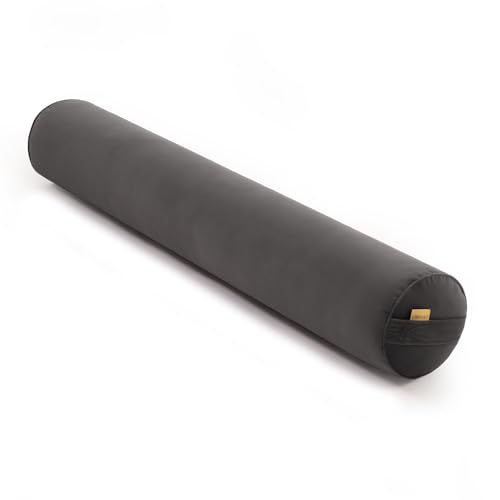
Ailuteie Large Cylindrical Body Bolster Pillow — Best Full-Length Stuffed Bolster
At just over forty-seven inches long and nearly eight inches thick, the big Ailuteie is the full-commitment bolster: a plump stuffed cylinder in steel grey that runs the length of a torso or the width of a double bed’s foot. Its school is stuffing, and it behaves like it — soft enough to hug properly, full enough to rest a leg along without the leg rolling off, and forgiving of the nightly rearrangements that firmer foam resists. For the side sleeper who has been making do with a folded spare pillow between the knees, this is the upgrade that ends the improvisation.
The steel grey colour is a quiet asset, sitting calmly with most bedding where a white bolster would glare and a black one would brood. As décor it works at the foot of the bed as the finishing roll, and on a daybed it becomes the long back cushion that makes the daybed honest. Its limits are the stuffed school’s limits: it will soften where it is used hardest, it asks for a morning plump to keep its figure, and a fixed cover means its cleaning life is lived at the surface. Buyers who want their bolster to double as a rigid reading backrest should look at the foam picks below; buyers who want to sleep holding something substantial have found their pick.
- Form: stuffed cylindrical body bolster
- Size: approximately 47.24 x 7.87 inches
- Colour: steel grey
- Role: side-sleeping companion, foot-of-bed roll, daybed back
- Buying note: check price on Amazon for current colour options
Strengths
- Full length serves the whole leg, not just the knee.
- Stuffed softness suits huggers and restless sleepers alike.
- Neutral steel grey disappears into most bedding schemes gracefully.
Trade-offs
- Softens at pressure points and needs regular plumping.
- Too yielding to serve as a firm reading backrest alone.
- Fixed cover limits deep cleaning to surface care.
Best for: side sleepers who hug their bolster and beds needing a full-width finishing roll. Not suited for: readers wanting a rigid back wall or anyone unwilling to plump a pillow.

Ailuteie Peallow Long Round Body Pillow — Best Mid-Length Bolster
The Peallow, Ailuteie’s twenty-nine-and-a-half-inch round body pillow in a fresh green-and-white colourway, is the bolster for smaller stages. A twin bed, a child’s bed, a reading chair, a single leg that wants support without a four-foot commitment — the mid-length fits all of them where the full-length would dominate. It keeps the stuffed school’s soft, holdable character in a size one arm can carry anywhere, which in practice means it will live in three rooms a week and be fought over gently.
Ailuteie describes the Peallow as soft and supportive for sleeping and for resting the back against, and that dual claim matches its geometry: long enough to run behind the shoulders on a chair or along the spine side of a single bed, round enough to roll under the knees. What it cannot do is the full side-sleeper’s job for a tall adult, because twenty-nine inches ends where a long leg is still going. Treat it as the household’s utility bolster — the one that fills the gap of the moment — and its size reads as versatility rather than compromise. The green-white colourway is the liveliest in this guide, a small brightness that suits children’s rooms and garden-facing spaces.
- Form: stuffed long round body pillow
- Size: approximately 29.5 inches long
- Colour: green and white colourway
- Role: single-leg support, twin beds, chair backs, children’s rooms
- Buying note: check price on Amazon; confirm length suits the intended sleeper
Strengths
- Portable mid-length moves between rooms and jobs easily.
- Soft stuffed feel in a size children can manage themselves.
- Bright colourway lifts plain bedding and playroom corners.
Trade-offs
- Too short for a tall adult’s full side-sleeping support.
- Stuffed fill flattens at the favourite spot without rotation.
- Light colourway shows marks sooner in heavy family use.
Best for: twin beds, children, chair readers and single-leg support. Not suited for: tall side sleepers needing end-to-end length.

1 MIDDLE ONE Bolster Pillow Velvet Cover — Best with Removable Cover
This is the foam school’s flagship in the guide: a full forty-seven-inch bolster, just under eight inches across, from 1 MIDDLE ONE, wearing a removable velvet cover in grey. The foam core holds the cylinder’s line with the determination stuffing never attempts — lean a back against it for a long read and it is the same shape at the end of the chapter as at the beginning — and the brand positions it as a long round roll for sleeping and for resting against, which matches how owners actually deploy a firm full-length bolster: under the knees, along the back, behind the pillows as the bed’s backrest layer.
The removable cover is the feature that will matter most in year three. Velvet comes off, washes, and returns, so the bolster that lives against skin and hair does not accumulate its service invisibly. Velvet also changes the bolster’s social role: in grey, with that soft sheen, this pick dresses a bed as convincingly as it serves one, sitting at the head or foot as the tailored roll in a made-bed photograph. The honest cautions are foam’s usual ones — firmer than a hug wants, heavier to move, warmer in summer — and velvet’s: it prefers a gentle wash and shows pressure marks that a plump and a brush mostly forgive.
- Form: foam-core bolster with removable velvet cover
- Size: approximately 47 x 7.87 inches
- Colour: grey velvet
- Role: knee support, reading backrest layer, dressed-bed roll
- Buying note: check price on Amazon; cover removes for washing
Strengths
- Firm foam shape holds through long reads and long nights.
- Removable velvet cover makes real washing possible.
- Tailored grey finish dresses a bed while it serves it.
Trade-offs
- Too firm to satisfy sleepers who hug their bolster.
- Heavier than stuffed rivals when carried between rooms.
- Velvet asks for gentler laundry than plain cotton covers.
Best for: bed readers, knee-support sleepers and anyone who values a washable cover. Not suited for: plush-seeking huggers or hot sleepers in summer rooms.

1 MIDDLE ONE Memory Foam Body Pillow — Best Pair of Short Bolsters
Two bolsters change the arithmetic of comfort, and this set — a pair of twenty-four-inch memory foam cylinders, just under eight inches across, in light grey — is the most flexible purchase in the guide. One under each knee. One on the bed and one on the sofa. One behind the back and one under the ankles. A pair also solves the couple problem, where a single bolster becomes contested territory by the second night. At twenty-four inches each, they occupy the lumbar-and-leg band: substantial rolls that support a body part completely without pretending to be full-length companions.
Memory foam at this size is at its best — firm, even, and indifferent to being leaned on — and the pair format suits the reading household particularly well, since two short bolsters build a better armchair-in-bed than one long one: one vertical behind the back’s small, one horizontal under the knees, and a reader is furnished. As décor, the pair flanks a bed or a bench symmetrically in the way single bolsters cannot. The compromises are the band’s own: neither piece will run a side sleeper’s full length, and foam’s warmth and weight follow the pair wherever they go. Bought for flexibility rather than for one fixed job, they are the pick most likely to be used every single day.
- Form: memory foam bolsters, set of 2
- Size: approximately 24 x 7.87 inches each
- Colour: light grey
- Role: knees, lumbar rest, paired bed and sofa accents
- Buying note: check price on Amazon; sold as a pair
Strengths
- Two bolsters cover two jobs, two rooms or two people.
- Memory foam holds an even, deliberate supporting shape.
- Symmetric pair dresses beds and benches with intention.
Trade-offs
- Neither piece is long enough for full side-sleeping duty.
- Foam warmth may not suit hot sleepers in summer.
- A pair needs twice the storage of a single short bolster.
Best for: couples, readers building a bed-armchair, and households splitting support between rooms. Not suited for: a tall side sleeper shopping for one long companion.
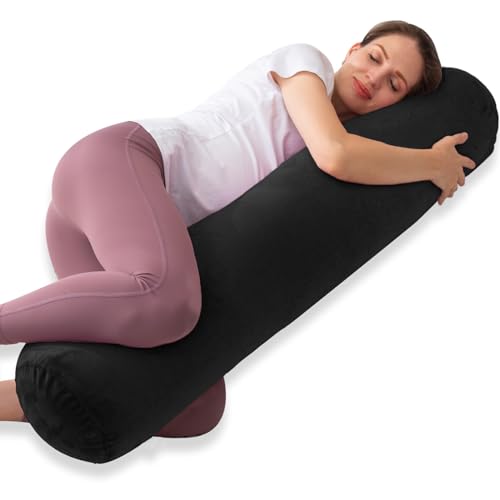
1 MIDDLE ONE Round Body Pillow Velvet Cover — Best Decorative Bolster
Same architecture as its grey sibling — a forty-seven-inch round bolster with a removable velvet cover — in black, and the colour changes the pick’s centre of gravity from service to style. A black velvet roll across a pale bed or along a light sofa is a graphic line, the single strongest horizontal statement soft furnishings can make, and this pick exists for the rooms that want that line drawn firmly. It still works for its living: the foam core supports knees and backs exactly as the grey version does. It simply dresses while it works, and dresses in a colour that forgives nothing and flatters almost everything pale.
Black velvet’s practical ledger deserves honesty. It shows pale lint, dust and pet hair with documentary enthusiasm, so this pick suits households whose bedding runs light and whose pets run dark — or households willing to keep a lint roller in the nightstand as the price of the look. The removable cover softens the commitment, since a wash restores the depth that dust dulls. On a sofa, the black roll reads as modern where grey reads as neutral; in a bedroom with white or cream bedding it is the contrast that makes the bed look designed rather than merely made. Buyers torn between this and the grey should ask which the room lacks — calm or punctuation — because the two picks are otherwise twins.
- Form: foam-core round bolster with removable velvet cover
- Size: approximately 47 x 7.87 inches
- Colour: black velvet
- Role: decorative bed and sofa roll with full supporting ability
- Buying note: check price on Amazon; cover removes for washing
Strengths
- Black velvet draws the strongest styling line in this guide.
- Full foam support hides inside a purely decorative silhouette.
- Removable cover lets the dramatic colour be maintained properly.
Trade-offs
- Black velvet displays lint, dust and pale pet hair immediately.
- Too bold a line for rooms built on soft, low-contrast calm.
- Firm foam feel, like its grey twin, is not a hugger’s pillow.
Best for: pale bedding and modern sofas wanting one decisive dark accent with real support inside. Not suited for: white-pet households or rooms that prefer their comfort invisible.
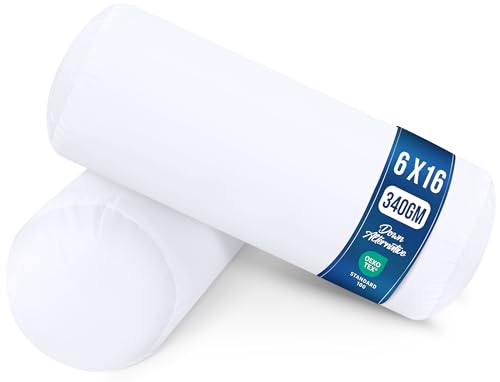
Utopia Bedding Bolster Inserts 6×16 Neck Roll 2 Pack — Best Neck Roll Pair
Every category has a pick that succeeds by refusing the category’s main job, and Utopia’s pair of six-by-sixteen-inch rolls is that pick. These are neck rolls — small cylinders for the curve of the neck in a chair or a bed’s top edge, for under the knees in a pinch, and above all for travel, where sixteen inches of guaranteed neck support in the suitcase ends the hotel-pillow lottery. They are sold as inserts, plain white and unpretentious, and a pair of them covers the realistic map of small-roll life: one at home in the reading chair, one living in the travel bag, both ready to be covered, cased or used as they are.
Judge them strictly at their scale and they are excellent value in a guide of giants: the diameter suits a neck rather than a leg, the length suits a suitcase rather than a bed, and the pair format means the second roll is never the one you forgot to pack. What they cannot do is any part of the full bolster’s work — a side sleeper resting a leg on a sixteen-inch roll is resting it on a rumour. Utopia’s own framing includes massage and recovery contexts; this guide makes no such claims and recommends them for the simpler, proven roles of neck comfort, chair support and travel insurance. Bought alongside a full-length pick, they complete a household’s bolster map; bought instead of one, they will disappoint exactly in proportion to the job they were asked to do.
- Form: small bolster inserts / neck rolls, 2 pack
- Size: approximately 6 x 16 inches each
- Colour: white
- Role: neck rest, reading chair, travel pillow, knee rest for short rests
- Buying note: check price on Amazon; these are inserts, covers are separate if wanted
Strengths
- True neck-roll scale that the larger picks cannot imitate.
- Pair format covers home and travel without repacking.
- Packs flat in a suitcase corner as hotel-pillow insurance.
Trade-offs
- No use at all for leg or full-body side-sleeping support.
- Plain white inserts look unfinished without a case or cover.
- Small diameter disappears under a large adult’s knees.
Best for: travellers, reading-chair necks and anyone completing a bolster collection at the small end. Not suited for: shoppers who need a body bolster and are tempted by a smaller price.
How Do the Six Bolsters Compare at a Glance?
| Pick | Length | Filling school | Primary job |
|---|---|---|---|
| Ailuteie Large Cylindrical Body Bolster Pillow | ~47 in | Stuffed | Side-sleeping hug and leg rest |
| Ailuteie Peallow Long Round Body Pillow | ~29.5 in | Stuffed | Single leg, twin bed, chair back |
| 1 MIDDLE ONE Bolster Pillow Velvet Cover | ~47 in | Foam, removable cover | Knees, backrest layer, dressed bed |
| 1 MIDDLE ONE Memory Foam Body Pillow | ~24 in × 2 | Memory foam | Paired knee and lumbar duty |
| 1 MIDDLE ONE Round Body Pillow Velvet Cover | ~47 in | Foam, removable cover | Decorative line with support inside |
| Utopia Bedding Bolster Inserts 6×16 Neck Roll 2 Pack | ~16 in × 2 | Insert fill | Neck rest and travel |
Two decisions organise the table: how long, and how firm. Length is dictated by the body and the bed, firmness by temperament. A household that answers both honestly will find its pick in a single row — and a household that cannot decide between the stuffed forty-seven and the foam forty-seven has really discovered that it contains two kinds of sleeper, which the pair of short foam bolsters or a two-bolster purchase solves more gracefully than a compromise neither side loves.
How Do You Position a Bolster for Side Sleeping, Reading and Resting?
For side sleeping, lay the long bolster parallel to the body, close enough that the top leg rests along it rather than reaching for it, with the top arm draped over its upper third. The common error is placing it too far away, which turns rest into reach; the second error is choosing a diameter so plump that the top leg sits higher than the hip finds natural. Give a new arrangement three nights before judging it — bodies negotiate with new furniture slowly, and the first night’s strangeness is information about novelty, not about fit.
For reading, build in layers: ordinary pillows against the headboard first, the bolster across them at the height of the lower back, and the book’s weight carried by the arms or a lap cushion rather than by the neck’s angle. Foam holds this architecture best. For resting the legs, the bolster goes under the knees with the legs’ full weight surrendered to it; a bolster used at half-commitment, with the calves hovering, tires the very muscles it was meant to rest. And for the neck roll, small adjustments rule — an inch higher or lower changes everything, and the roll should fill the neck’s curve without lifting the head, a distinction your shoulders will explain to you within one chapter if you get it wrong.
How Should You Care for a Bolster So It Keeps Its Shape?
Stuffed bolsters live by the morning shake: lift by the middle, shake the filling toward the ends, and rotate the bolster end-for-end weekly so the favourite spot migrates. Foam bolsters ask for less theatre and more patience — they recover their shape on their own schedule, and forcing them with heat or weight only argues with the material. Both schools benefit from a protector or cover between the bolster and the world; the two velvet-covered picks build that protection in, and owners of the fixed-cover picks can add a simple bolster case with the same effect.
Washing follows the cover, never the core, unless the maker explicitly says otherwise: velvet covers wash gently and dry away from direct heat, cases wash with the bedding, and foam cores should be aired rather than soaked. A bolster that smells of the season usually needs an afternoon near an open window more than it needs a machine. Store spare bolsters — the neck rolls between trips, the mid-length between grandchildren — lying flat and uncompressed, because a bolster stored folded teaches its filling a crease it may keep.
One habit ties the care of every pick in this guide together: give the bolster a place that is not the floor. A roll that lives on carpet gathers the room’s dust into its cover and gets stepped over, sat on and tripped across until its seams file a complaint. A bench, a basket, the bed itself — any assigned home keeps the bolster cleaner, rounder and more respected, and a respected bolster is simply a longer-lived one. The households whose bolsters survive a decade are rarely doing anything elaborate; they are doing small things — a shake, a case, a shelf — every week without fail.
What Mistakes Do Bolster Buyers Make?
Buying by photograph instead of by tape measure leads the list, because bolsters photograph without scale and a twenty-four-inch pair has disappointed many shoppers who pictured forty-seven. Second is expecting one bolster to serve two incompatible masters — the hug and the backrest — when the fillings for those jobs are opposites; the disappointment gets blamed on quality when it was really casting. Third is ignoring the cover question until the first spill or the first summer, by which time the fixed-cover bolster’s cleaning options have narrowed to hope and upholstery spray.
Fourth is the medical shortcut: buying a bolster as a treatment for a painful condition on the strength of a listing’s language. A bolster can make a comfortable position easier to keep; it cannot diagnose, correct or cure, and persistent pain deserves a professional’s attention rather than a pillow’s promises. Fifth is forgetting the bed’s other occupants — a forty-seven-inch bolster in a narrow double bed is a third party to every negotiation, and couples should discuss its tenancy before it arrives, ideally while looking at the twenty-four-inch pair with fresh and friendly eyes.
Which Bolster Belongs on Which Bed?
A twin bed is a narrow stage, and the mid-length Peallow was sized by that truth: twenty-nine inches supports a single sleeper’s leg or a child’s whole arrangement without annexing the mattress. Twin beds in guest rooms often take the short foam pair instead — one as the reading roll, one as the finishing accent — because guests use a bed as a chair as much as a bed. What a twin cannot host gracefully is the forty-seven-inch bolster across its width, which overhangs the edges and turns a neat bed into a raft with a mast.
Double and queen beds are the full-length bolster’s home ground. Across the foot, forty-seven inches sits inside the bed’s width with margin to spare, drawing the horizontal line that finishes the making. Along the body, the same length serves one side sleeper completely — and this is where couples should count honestly, because two side sleepers facing the same direction can share a long bolster’s length in sequence less often than optimism suggests. The twenty-four-inch pair is the diplomatic solution: a bolster each, no border disputes, and a bed that still dresses symmetrically in the morning.
King beds expose the opposite problem — forty-seven inches across a king’s foot looks like a bookmark in a novel, present but under-scaled. Kings take their bolsters along the body instead, one per sleeper, or wear the short pair as accents at the front of a deep pillow arrangement where scale matters less. Daybeds and sofa beds, finally, are the bolster’s second career: the full-length foam picks become the daybed’s back structure, the stuffed picks its lounging roll, and the neck rolls migrate to whichever chair in the room reads best. A bolster bought for a bed rarely stays only a bed’s, which is an argument for choosing a colour — steel grey, light grey, black — that the rest of the house can also live with.
How Does a Bolster Earn Its Place on a Sofa?
The sofa bolster is an old idea returning in modern dress. Along the back of a low sofa, a long roll softens the line where back meets seat and gives shorter sitters a cushion that meets them where they actually lean. At the end of a chaise or a sectional’s open side, a bolster is the armrest that the furniture forgot — a soft boundary that makes the corner seat the best seat. The foam picks hold these architectural roles with the most conviction, while the stuffed Ailuteie turns a sofa’s end into a lounging nest that teenagers will claim within the hour.
Colour discipline decides whether the sofa bolster reads as design or as bedding that escaped. The black velvet roll against a pale sofa is the boldest version, a deliberate graphic; the greys are the diplomats, present without argument. What fails is the bedroom-bright colourway on a formal sofa — the Peallow’s green-and-white charm belongs to the rooms it was described for. Households that move bolsters between bed and sofa, as most do, should buy the colour for the stricter room and let the relaxed room accept it, because a sofa can forgive a calm bolster anything, while a styled living room forgives a playful one much less.
How Thick Should a Bolster Be?
Diameter is the dimension shoppers feel first and research last. The picks in this guide cluster around eight inches for the body bolsters and six for the neck rolls, and that clustering reflects bodies rather than fashion. Around eight inches lifts a resting leg to roughly the height of the hip’s natural line for most adults and fills the space behind a leaning back without pushing it forward. Much slimmer — five inches and under — and a body bolster becomes a roll that the leg slides off in the night; much plumper and it stops being a support and becomes an obstacle the sleeper climbs.
Petite sleepers and children sit at the forgiving end of this: a smaller body meets an eight-inch bolster as a larger presence, which is another reason the mid-length Peallow suits children’s beds — its scale reads generous rather than excessive to a small sleeper. Larger adults, and anyone using the bolster chiefly under the knees while lying flat, can take the full eight inches gladly, since the knees’ bend wants the height. The practical test is domestic: rest the leg, close the eyes, and notice whether the far side of the body feels level or tilted. Level is the bolster doing its quiet geometry correctly; tilt means the diameter and the body are negotiating, and the body should win.
What Should Couples Know Before a Bolster Moves In?
A bed shared by two people is a small country with established borders, and a forty-seven-inch bolster is an immigration event. The sleeper who did not choose it will meet it nightly — as a welcome leg rest, as a neutral border, or as the thing that must be negotiated to the floor before sleep. The couples who thrive with a bolster are the ones who treated its purchase as a household decision: which side it lives on, whether it stays for the whole night or retires to the foot of the bed after the reading hour, and whose job the morning plumping is. These are thirty-second conversations that prevent a pillow from becoming a referendum.
The pair format exists precisely for the households where one bolster would start arguments — two twenty-four-inch foam rolls, one per citizen, each sovereign over its own knees. And there is an honourable third path: the bolster as evening-only furniture, present for reading and resting, banished to a bench or the daybed before sleep. Many bolsters live exactly that life and live it happily for a decade. What no household should do is buy the longest, firmest bolster in this guide as a surprise for a partner who has never mentioned wanting one; comfort objects are personal in a way that lamps are not, and the gift of a bolster lands best when the recipient has already been caught improvising one out of spare pillows.
How Does a Bolster Differ from a Body Pillow or a Lumbar Roll?
The three shapes share a family resemblance and different intentions. A body pillow is a long rectangle or a shaped slab, soft all through, designed to be embraced along the body’s front; it is a sleeping companion first and furniture never. A bolster is a true cylinder with structure — it rolls, it holds a line, it can bear a leaning back or a pair of knees without flattening into a pancake by midnight. A lumbar roll is the bolster’s smallest specialist cousin, sized for the small of the back in a chair, and in this guide the Utopia neck rolls sit between that world and the neck’s.
Shoppers arriving from body pillows should expect a bolster to feel firmer and more deliberate; shoppers arriving from lumbar rolls should expect it to feel grander and more versatile. The household that owns one of each is not being extravagant — it is equipped. The body pillow serves the front of the sleeper, the bolster serves the legs and the back, and the little roll serves the chair and the suitcase. Confusing the three is the category’s most common buying error, and it usually announces itself within one night, when the embraced cylinder feels like furniture and the leaned-on body pillow feels like a rumour. Name the job in plain words before ordering and the shapes will sort themselves.
Final Recommendation
Let length speak first and filling second. Tall side sleepers who hold their pillow should take the big stuffed Ailuteie and enjoy its unembarrassed softness; readers and knee-resters who lean should take the grey velvet-covered 1 MIDDLE ONE and enjoy a shape that stays where the evening puts it. The black twin is the same good decision wearing evening dress, the short foam pair is the flexible household answer, the Peallow is the small-bed and small-person specialist, and Utopia’s little rolls close the map at the neck and the suitcase. Measure the bed, name the job, respect the difference between a hug and a beam — a bolster chosen that way becomes the piece of the bed nobody remembers buying and everybody would replace tomorrow if it vanished. It asks for almost nothing: a shake, a wash of its cover, a place that is not the floor. In return it holds legs, backs, books and bed-making together, night after night, in the least glamorous and most useful shape a pillow can take.
Frequently Asked Questions
What length bolster do I need for side sleeping?
Most adults need the full-length band — around forty-seven inches — for the top leg and arm to rest along the bolster together. Shorter sleepers and those who only want knee support can drop to the twenty-nine-inch mid-length. The twenty-four-inch pair serves knees and lumbar rests rather than the full side-sleeping arrangement, and the sixteen-inch rolls are neck tools only.
Is memory foam or stuffing better in a bolster?
Neither — they are different instruments. Memory foam holds a deliberate shape for leaning, reading and resting the knees, and keeps that shape all night. Stuffing moulds around the body and suits sleepers who hug their bolster. Choose by the job you do most while the bolster is working: awake and leaning points to foam, asleep and holding points to stuffing.
Can a bolster replace my regular pillow?
For the head, generally no — a bolster’s diameter and firmness are designed for legs, backs and arms, and most sleepers find it too high or too unyielding under the head. The exception is the small neck roll, which is shaped for the neck’s curve in a chair or as a supplement on top of a flat pillow. Think of the bolster as the pillow’s colleague rather than its replacement.
How do I wash a bolster with a fixed cover?
Surface cleaning is the honest route: vacuum the cover, treat marks with a damp cloth and mild soap, and air the bolster thoroughly. Going forward, a removable bolster case over the fixed cover gives you a washable layer without replacing the pillow. The two full-length 1 MIDDLE ONE picks avoid the problem entirely with covers that come off — a genuine advantage for a product that lives against skin nightly.
Why does my stuffed bolster go flat in the middle?
Because that is where the work happens — filling migrates away from pressure toward the ends. A daily shake that pushes filling back to the centre, plus a weekly end-for-end rotation, keeps the shape honest for years. A bolster that has gone truly thin everywhere has reached the end of its filling’s life; at that point replacement, not technique, is the answer.
Do I need a separate case for a bolster?
For the fixed-cover picks, a case is the cheapest longevity you can buy: it takes the nightly contact, washes with the bedding, and lets the bolster underneath stay fresh for years. Match the case to the bolster’s length and diameter as closely as the sizes allow, and prefer a closure that stays shut under a sleeper’s weight. The two velvet-covered 1 MIDDLE ONE picks already include their removable layer, so a case there is optional decoration rather than protection. The plain white Utopia rolls benefit most visibly — a simple case turns an insert into a finished piece of the room.
How long does a bolster pillow last?
A foam bolster kept out of soaking water and crushing storage holds its shape for years of nightly service; a stuffed bolster’s life depends on the filling’s resilience and on the household’s shaking discipline, with a gradual softening that many owners experience as the pillow becoming more theirs rather than less useful. The honest end-of-life signs are a shape that no longer recovers by morning and a cover worn thin at the seams. When a bolster reaches that point it often retires gracefully to a child’s fort, a pet’s claimed territory or the daybed’s least-demanding end before it truly leaves the house.
Related Guides
The bolster belongs to a family of shaped pillows, and the rest of the shelf fills in around it. Best 3-Season Sleeping Quilts leaves the bedroom for the campsite, where long shapes serve warmth instead of posture. For the chair-and-bed reading life that bolsters support, Best Bed Reading Lounge Pillows covers the wedges and lounge pillows built for upright hours. On the floor beneath the bed, Best 3×5 Rugs for Mudrooms handles the hardworking small rugs of the house’s other threshold. And a made bed deserves its finishing layer, which Best Accent Rugs approaches from the floor up with small rugs that punctuate a room the way a bolster punctuates a bed.



[…] cover system begins with what goes inside it, and the rest of the pillow shelf branches from there. Best Bolster Sleeping Pillows covers the long cylindrical shapes that pair with square cushions on a dressed bed. The inserts […]