What's inside
- Quick Picks
- How We Chose These Picks
- Key Takeaways
- Detailed Reviews
- Comparison Table
- How to Choose Between Wool and Cotton for Your Home
- How Do You Care for Wool and Cotton Blankets Differently?
- Common Mistakes When Buying Natural Fibre Blankets
- How Does a Natural Fibre Blanket Age Compared with a Synthetic Throw?
- Which Blanket Belongs in Which Room?
- What Should You Check When a Natural Fibre Blanket Arrives?
- How Many Blankets Does a House Actually Need?
- What Does Breathability Actually Mean at Blanket Scale?
- Are Natural Fibre Blankets a Good Gift?
- Final Recommendation
- Frequently Asked Questions
- Related Guides
As an Amazon Associate I earn from qualifying purchases. This post may contain affiliate links at no extra cost to you.
As an Amazon Associate, cottageverdict.com earns from qualifying purchases made through links in this guide — at no extra cost to you.
Where to buy: all six blankets in this roundup are listed on Amazon, and each name is linked in the Quick Picks table, in its review heading and in the comparison table, so wherever you are in the page you can check price on Amazon and confirm the fibre, the dimensions and the colour on the listing before ordering. The best natural fiber blankets make a promise most modern throws quietly break: that the cloth on your sofa is what cloth used to be — wool and cotton, grown and shorn rather than synthesised — with the warmth, breathability and ageing behaviour those fibres have had for centuries. This guide holds that promise to a strict evidentiary standard. A pick is called wool only where its title says wool, organic only where its title says organic, and certified only where its title names the certification. Two of the six carry certifications in their titles — one OCS, one GOTS — and those two alone receive them here. The rest stand on their stated fibre, their stated dimensions and their weave, which is evidence enough when the fibre is honest.
The set divides into two wool throws and four cotton blankets, and the division is a genuine fork rather than a ranking. Wool insulates with a loft and a temperature intelligence that cotton does not attempt: it warms without sealing, breathes in both directions, and asks for gentler washing in exchange. Cotton is the washable, everyday fibre — softer against bare skin for many people, easier in the machine, cooler in summer, and available here in knits, a tapestry weave and a waffle weave that behave like three different blankets wearing one fibre’s name. Within cotton, the organic claims also divide honestly: two blankets title themselves 100% organic cotton without naming a certification in the title, and two carry named certifications, and this guide keeps those two tiers visibly separate because a claim and a certified claim are different kinds of evidence. Sizes run from a 50 by 60 inch lap throw to a 60 by 80 inch cotton knit and a full Queen bed blanket, so the first shopping question is not fibre at all. It is geography: where will this blanket live — on a body, on a sofa, or on a bed?
Quick Picks
| Blanket | Badge | The fibre fact first |
|---|---|---|
| Arcturus Bighorn Wool Blanket | Best Wool Throw | 100% virgin wool at 50×60 in ivory, titled heirloom-quality, warm, thick and durable. |
| Longhui Organic Cotton Cable Knit Throw | Best Big Cotton Knit | 100% organic cotton in a chunky cable knit at a generous 60×80, in beige. |
| EVERGRACE Organic Cotton Chunky Knit Throw | Best Certified Cotton Throw | OCS certified organic cotton in a seed stitch chunky knit, 50×60 in birch, midweight. |
| Temminc Wool Throw Blanket | Best Lightweight Wool | 100% wool at 55×83 and just 1.5 lbs per the title — the long, light, all-season wool. |
| Pure Country Weavers Herringbone Blanket | Best Tapestry Weave | A cotton tapestry throw in a herringbone natural weave, 69×48, made in the USA per the title. |
| Bedsure PureWoven Organic Cotton Waffle Blanket | Best Bed Blanket | A Queen waffle blanket in 100% organic cotton at 400 GSM, GOTS certified per the title, in grey. |
How We Chose These Picks
We began by reading fibre claims the way a textile buyer reads a spec sheet: the title is the contract, and anything not in it does not exist. Every pick had to state a natural fibre in its own title — wool or cotton, with percentages where the maker chose to print them — and five of the six print a full 100% figure, which is a stronger evidentiary position than most blanket listings offer. We then built the spread by job rather than by adjective. A thick wool throw for the cold end of the year. A light wool throw for the whole year. A big cotton knit for sofas and beds. A certified cotton throw at lap scale. A tapestry-woven cotton blanket with a maker’s provenance. A certified waffle bed blanket in a true bed size. Two fibres, three cotton constructions, two wool philosophies, two certifications — the set is a map of what natural fibre can honestly mean at blanket scale, and each review states its pick’s evidence before its praise.
Certifications were handled with particular care, because they are the easiest claim in this category to smudge. The EVERGRACE title names OCS certified organic cotton; the Bedsure title names GOTS certified organic cotton; those phrases appear in this guide attached to those two picks and no others. The Longhui titles 100% organic cotton without naming a certification in its title, and it is described here exactly that way: a titled organic claim, with no certification named in the title. Where a title is silent on a treatment, finish or care property, the spec boxes record the silence. A natural fibre claim, in this guide, is a chain that must reach back to a title link by link, or it is not printed.
Key Takeaways
- Two wool throws with opposite philosophies: the Arcturus is thick and heirloom-minded; the Temminc is 1.5 lbs and all-season.
- Four cotton blankets in three constructions: cable knit, chunky seed-stitch knit, tapestry weave and waffle weave.
- Certifications appear only where titled: OCS for the EVERGRACE, GOTS for the Bedsure. Longhui’s organic claim carries no named certification in its title.
- Sizes decide the job: 50×60 throws for laps and sofas, 60×80 and 55×83 for sharing and beds, Queen for a true bed blanket.
- Every fibre percentage in this guide is quoted from a title; where a title is silent on a property, the spec box says so.
Detailed Reviews
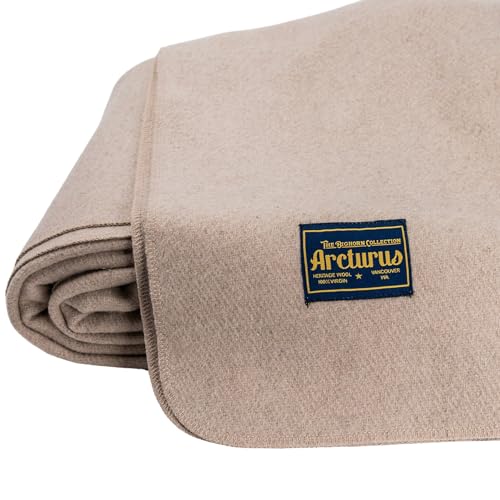
Arcturus Bighorn Wool Blanket
The Arcturus Bighorn is the cold-weather anchor of this guide: a throw in 100% virgin wool, 50 by 60 inches, in ivory, described by its title as heirloom-quality and as warm, thick and durable, aimed at home and cabin. Virgin wool is the substantive phrase — wool that has not been recycled from earlier cloth — and it matters here because the pick’s whole proposition is longevity: a blanket bought once, used hard, and handed on. At 50 by 60 this is a one-person throw with intent, sized for a lap, a reading chair, the foot of a single bed or a pair of shoulders by a fire, and the cabin in the title is honest positioning rather than decoration. Thick wool at this scale is outdoor-adjacent equipment: it shrugs off a chilly porch, it warms a tent’s edge, it lives in a car through winter without asking for anything. Ivory is the brave colour choice — beautiful against leather and wood, and committed to a life where it will meet cocoa, dog and woodsmoke; the buyer choosing ivory wool is choosing character over camouflage, and should do so knowingly.
Wool’s behaviour is the review’s real subject, because a first-time wool buyer is buying a fibre’s habits as much as a blanket. Wool insulates by loft and by the crimp of its fibres, and it keeps insulating with a grace synthetics envy: it breathes, so a wool throw warms without the sealed, clammy feeling of a fleece at the same weight, and it resists absorbing odours across a week of evenings in a way that suits a blanket which will not be washed weekly. That last point cuts to the care bargain. Thick wool asks for restraint in the wash — infrequent, gentle, and according to the maker’s instructions on the listing — and in exchange it asks for almost nothing else, season after season. The trade-offs are the fibre’s own and are stated without apology: wool is heavier in the hand than the cotton knits here, some skins find it present rather than soft against a bare neck, and a 50 by 60 throw will not cover two people or dress a large bed. Buy the Bighorn as the blanket equivalent of a good coat — one person’s, built for decades, happiest in cold air — and it is the most serious object in this guide.
Strengths
- 100% virgin wool with an heirloom, buy-it-once proposition
- Thick warmth that breathes instead of sealing
- Cabin-and-porch constitution suits indoor and outdoor duty
Trade-offs
- One-person scale at 50×60; no sharing or bed coverage
- Wool asks for infrequent, gentle washing
- Ivory shows a working life honestly
- Fibre: 100% virgin wool, per the title
- Dimensions: 50 x 60 inches, as titled
- Colour of this listing: Ivory
- Character in the title: heirloom-quality, warm, thick and durable
- Setting in the title: home and cabin
- Weight in pounds: not stated in the listing
Ideal for: one person’s cold-weather throw, bought for decades. Look elsewhere if: you need to cover two people, a large bed, or a machine-wash-every-week household.
Cold rooms and cabins calling? Review the price on Amazon for the ivory Bighorn before the season turns.
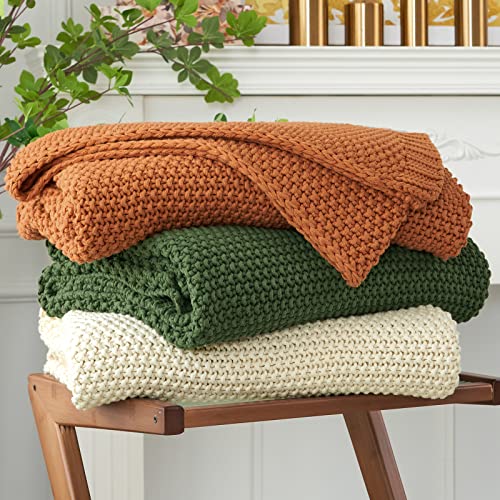
Longhui Organic Cotton Cable Knit Throw
The Longhui is the big soft centre of the cotton side: a chunky cable knit throw in 100% organic cotton, 60 by 80 inches, in beige, described as lightweight, and positioned for sofa, couch, bed and baby nursery, in a rustic shabby chic and modern farmhouse register. Begin with the dimensions, because 60 by 80 is not throw sizing, it is blanket sizing — long enough to cover a tall adult completely, wide enough for two people on a sofa to negotiate a fair border, and generous enough to fold at the foot of a double bed as a working layer rather than a gesture. The cable knit is the second fact: a knitted construction with the raised rope pattern of traditional knitwear, which gives the blanket its texture, its drape and its farmhouse look in a single structure. Cotton knit behaves like a garment, not a sheet — it stretches a little, settles over shapes, and softens across washes — and in a chunky gauge that behaviour reads as comfort engineered by loop size. The organic claim is stated exactly as the title states it: 100% organic cotton, with no certification named in the title, and this guide records it in precisely those terms.
The nursery in the title’s positioning deserves a calm sentence: the blanket is offered by its maker for nursery among other rooms, and this guide repeats that positioning as the maker’s, while noting the general household rule that loose blankets belong with supervised, awake time rather than in an infant’s sleep space. For the sofa and bed life that will be this blanket’s real career, the lightweight description matters: an 80-inch cotton knit that stayed heavy would be a winter-only object, and Longhui positions this one for year-round draping, the throw that lives on the sofa back in July as happily as in January. Beige is the farmhouse palette’s anchor — warm, forgiving, and designed to sit with wood, linen and every cushion colour a household accumulates. The cautions are knit’s own. Chunky knits snag on jewellery, pet claws and rough furniture edges, and a pulled loop is a visible event in a cable pattern. Cotton at this size is a real laundry load. And a knit this generous will stretch its drape over years, which owners read as softness and perfectionists read as growth. For the household that wants one big natural-fibre blanket to live at the centre of the sofa, this is the guide’s candidate.
Strengths
- True blanket scale at 60×80 for full coverage and sharing
- Chunky cable knit gives texture, drape and the farmhouse look
- 100% organic cotton per the title, lightweight for its size
Trade-offs
- Chunky knit loops can snag on claws and jewellery
- No certification named in the title for the organic claim
- Large cotton knit is a substantial wash load
- Fibre: 100% organic cotton, per the title
- Construction: chunky cable knit, as titled
- Dimensions: 60 x 80 inches
- Colour of this listing: Beige
- Positioning in the title: sofa, couch, bed, baby nursery; farmhouse styles
- Certification: none named in the listing title
Ideal for: the centre-of-the-sofa blanket in a farmhouse-leaning home. Look elsewhere if: your household includes enthusiastic pet claws, or you need a certification on record.
Want the big knit at the heart of the sofa? Confirm the price on Amazon and picture eighty inches of beige cable before ordering.

EVERGRACE Organic Cotton Chunky Knit Throw
The EVERGRACE throw is the certified cotton pick at lap scale: organic cotton in a chunky knit with a seed stitch, 50 by 60 inches, in a colour the title calls Birch, described as soft and breathable and as a cozy midweight, decorative throw for couch, bed and sofa, with OCS certified organic cotton stated in the title. The certification is the headline and this guide gives it its exact weight. OCS — the Organic Content Standard — is named in this title, which places the pick’s organic claim in the certified tier of evidence, a tier it occupies in this guide alongside only the GOTS-certified Bedsure. A shopper for whom organic is a purchasing principle rather than a preference should start here and at the Bedsure, because these are the two listings whose titles put a standard’s name behind the word. Seed stitch is the second distinction: a textured knit of small alternating bumps, less pictorial than the Longhui’s cables, more architectural, and well suited to a birch-toned throw that wants to read as texture rather than pattern across a sofa arm.
Midweight is the honest centre of the pick’s character. At 50 by 60 in a breathable cotton knit, this is the throw for the long middle of the year — spring evenings, air-conditioned summers, the first cool of autumn — and for the warm-blooded reader who finds wool throws and thick knits a room too far. It drapes a lap, dresses a sofa, folds at a bed’s foot as a visual layer with a little warmth in reserve. The cautions are scale and knit care, shared in part with its cotton neighbours. Fifty by sixty covers one person or decorates for two; it will not be the household’s shared blanket, and should not be bought as one. Chunky knits of any stitch ask to be kept from snags and washed with the gentleness knitted cotton deserves, following the maker’s instructions on the listing. And the certification, precisely because it is real evidence, should not be inflated by the reader into claims the title does not make about finishes or treatments — the title is silent on those, and the spec box records the silence. Within its lane — certified, textured, midweight, one person’s — the EVERGRACE is the most exactly-specified cotton throw in the guide.
Strengths
- OCS certified organic cotton named in the title
- Seed stitch texture reads as architecture, not pattern
- Breathable midweight suits the long middle of the year
Trade-offs
- 50×60 covers one person; not a sharing blanket
- Chunky knit needs snag awareness like all open knits
- Midweight will not serve as a deep-winter layer
- Fibre: organic cotton, per the title
- Certification in the title: OCS Certified Organic Cotton
- Construction: chunky knit, seed stitch, as titled
- Dimensions: 50 x 60 inches; colour: Birch
- Character in the title: soft and breathable, cozy midweight
- Treatments or finishes: not stated in the listing
Ideal for: principle-led buyers who want certification and a midweight throw. Look elsewhere if: you need a blanket for two, or for the coldest month.
Certification first, texture second? Compare the price on Amazon, where the OCS wording sits in the title itself.

Temminc Wool Throw Blanket
The Temminc is the wool pick for people who think wool means heavy, and its title refutes them with numbers: 100% wool, 55 by 83 inches, in a beige check plaid, at 1.5 pounds — a full-length throw at the weight of a hardback book. That combination reorganises what a wool blanket can be in a household. At 83 inches it covers a tall person completely or runs lengthwise down a single bed; at a pound and a half it travels, drapes over a sofa arm without dominating it, and serves as the all-season layer its title claims — the listing calls it breathable and non-itchy, cozy for bed, outdoor, travel and home decor, and an all-season throw, and those phrases are recorded here as the listing’s own description of a light wool’s intended life. The beige check plaid does quiet work in that life: it is a pattern that belongs in every season’s palette, unlike the tartans waiting in the next guide, and it lets the throw live visibly on furniture year-round rather than rotating into a cupboard when the holidays end.
Set the Temminc beside the Arcturus and the wool family’s range becomes the review’s real content. Same fibre claim — 100% wool — opposite philosophies. The Bighorn is thick, compact in footprint, built like equipment for cold; the Temminc is thin, long, built like clothing for weather that merely cools. A household could honestly own both and use them in different months, and a shopper choosing between them is really choosing which problem they have: cold that must be defeated, or coolness that must be softened. The light wool’s cautions are the reverse of the heavy one’s. It will not replace a winter blanket on a January bed, whatever the all-season phrase suggests to an optimistic reader in a cold climate; all-season, in a 1.5-pound throw, means it earns a place in every season’s rotation, not that it wins every season outright. The non-itchy phrase is the listing’s, and skin sensitivity to wool varies enough that a very sensitive reader should treat it as encouragement rather than guarantee. And a long, light throw at this size wants folding discipline, because 83 inches of cloth finds the floor if a household lets it. For travel, for sofas, for summer beds and long bodies, it is the wool pick that asks the least and covers the most.
Strengths
- Full 55×83 length at only 1.5 lbs per the title
- Year-round beige check suits every season’s room
- Travels and drapes where thick wool cannot
Trade-offs
- Light wool will not win a deep-winter night alone
- Non-itchy is the listing’s phrase; sensitive skin varies
- 83 inches of cloth needs folding discipline
- Fibre: 100% wool, per the title
- Dimensions: 55 x 83 inches, as titled
- Weight: 1.5 lbs, stated in the title
- Pattern and colour: beige check plaid
- Listing language: super soft, lightweight, breathable, non-itchy, all-season
- Certification: not given
Ideal for: tall readers, travellers and summer beds wanting real wool lightly. Look elsewhere if: your problem is serious cold rather than evening cool.
Long and light sound like your sofa? Check the price on Amazon and note the pound-and-a-half figure in the title.

Pure Country Weavers Herringbone Blanket
The Pure Country Weavers blanket is the guide’s woven — not knitted — cotton, and the construction difference deserves the first paragraph. Its title describes a herringbone natural weave blanket, a gift tapestry throw woven from cotton, made in the USA, at 69 by 48 inches. A tapestry weave is loom work: warp and weft interlaced into a firm, flat, structured cloth, the opposite temperament from the knits elsewhere in this guide. Where a knit drapes and stretches, a tapestry weave holds its shape, lies flat, and presents its pattern — here the zigzag discipline of herringbone — with a crispness that reads as furnishing rather than bedding. That makes this pick the decorator’s natural-fibre blanket: the throw for the back of a chair, the foot of a guest bed, the wall-adjacent sofa where a blanket is part of the room’s composition. The made in the USA line is stated in the title and recorded here as the pick’s provenance fact, for the many buyers for whom domestic weaving is itself a reason. The natural in the weave’s name is the maker’s wording for its undyed-looking register; the fibre claim that this guide stands behind is the one the title proves: woven from cotton.
At 69 by 48 the blanket is long and comparatively narrow — a lap-and-legs throw, a single person’s wrap, a layer across a bed’s foot where its length runs the width of the mattress and its width makes a band of pattern. It is not a cocoon for two, and its firmness is a character to choose rather than a flaw to forgive: tapestry cotton softens modestly with washing but will never drape like the cable knit, and a reader who wants to be swaddled should buy the Longhui instead. The gift framing in the title is believable for structural reasons — a woven blanket folds flat, presents beautifully, and carries its maker’s story in a way a knit does not — and the herringbone pattern is the safest of gifts, geometric and neutral. The cautions complete the picture: tapestry weaves can catch at the surface threads if dragged across rough edges, the size should be measured against its intended chair before ordering, and the title states no organic claim and no certification for this cotton, so none is made here. What it states — cotton, herringbone, tapestry weave, American making, honest dimensions — is a complete and respectable identity, and the blanket wears it well.
Strengths
- Loom-woven tapestry structure holds shape and pattern crisply
- Made in the USA, stated in the title
- Herringbone neutrality suits gifting and decorating alike
Trade-offs
- Firm drape; it furnishes more than it swaddles
- 48-inch width is a lap throw’s, not a sharing width
- No organic claim or certification in the title
- Fibre: cotton, per the title — woven from cotton
- Construction: tapestry weave, herringbone natural weave, as titled
- Dimensions: 69 x 48 inches
- Origin in the title: Made in the USA
- Positioning in the title: gift tapestry throw
- Organic certification: none stated in the listing
Ideal for: decorators and gift buyers who want woven structure and provenance. Look elsewhere if: you want a soft, stretchy knit to cocoon in.
After woven structure and a maker’s story? Check the price on Amazon for the herringbone tapestry in natural tones.
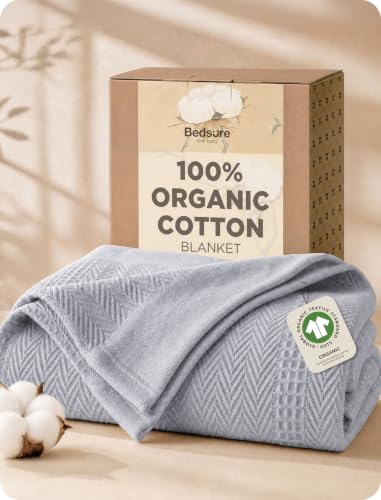
Bedsure PureWoven Organic Cotton Waffle Blanket
The Bedsure PureWoven closes the guide at bed scale, and it is the only true bed blanket here: 100% organic cotton in a waffle weave, Queen size, in grey, at a stated 400 GSM, with GOTS certified organic cotton in the title, a waffle and herringbone texture, and the listing’s descriptors of breathable, low shedding, all season, and home decor gift. Take the certification first, as this guide has taught. GOTS — the Global Organic Textile Standard — is named in this title, placing the pick in the certified tier alongside the EVERGRACE’s OCS, and those two are the only certifications anywhere in this guide. A Queen waffle blanket with a named global standard behind its organic claim is the strongest evidentiary object in the set, and the review says so plainly. Then the weave. Waffle cloth — a woven grid of recessed squares — traps thin pockets of air, which is how a cotton blanket at a stated 400 GSM can be warm in the cool months and still the blanket a summer sleeper reaches for: the texture does the insulating, and the fibre does the breathing. The herringbone element in the texture gives the grey surface its quiet pattern, so the bed looks dressed rather than merely covered.
Queen sizing reorganises the pick’s comparisons. It does not compete with the throws for a lap; it competes with the household’s existing bed layer, and it should be bought as a replacement or a rotation partner for that layer, with the all-season positioning read as the listing’s claim for the waffle structure’s range. Grey is the right colour for a working bed blanket — calm with every sheet colour a household owns, forgiving between washes — and the low shedding phrase, recorded as listing language, speaks to a real cotton annoyance the maker is at least addressing by name. The cautions: a Queen blanket is a Queen laundry load, and at 400 GSM it is the heaviest cotton wash in this guide. The waffle texture, while flatter than a knit, still prefers a gentle cycle’s respect over a rough one. And the certification’s scope should be read as the title states it — GOTS certified organic cotton — without the reader inflating it into claims about every other attribute, on which the title is separately informative or silent as the spec box records. As the bed-scale, certified, textured conclusion to the natural-fibre shelf, the Bedsure is the pick most likely to be used every single night of the year.
Strengths
- GOTS certified organic cotton named in the title
- True Queen bed scale with a stated 400 GSM
- Waffle texture insulates while cotton breathes
Trade-offs
- Queen size is the heaviest cotton laundry here
- A bed layer, not a sofa throw — different job entirely
- Grey is the only colour in this listing
- Fibre: 100% organic cotton, per the title
- Certification in the title: GOTS Certified Organic Cotton
- Construction: waffle weave with herringbone texture, as titled
- Size: Queen; density: 400 GSM, stated in the title
- Colour of this listing: Grey
- Listing language: all season, breathable, low shedding
Ideal for: a certified, breathable bed layer used nightly, all year. Look elsewhere if: you are shopping for a sofa throw, or your machine is small.
Replacing the bed layer itself? View the price on Amazon, where the GOTS wording leads the fibre claim.
Comparison Table
Fibre and certification are the honest columns here; both are quoted from titles, and blanks are silences, not secrets.
| Blanket | Fibre as titled | Certification on record | Footprint and form |
|---|---|---|---|
| Arcturus Bighorn Wool Blanket | 100% virgin wool | Not in listing | 50×60 throw, thick |
| Longhui Organic Cotton Cable Knit Throw | 100% organic cotton | None named in title | 60×80 chunky cable knit |
| EVERGRACE Organic Cotton Chunky Knit Throw | Organic cotton | OCS certified | 50×60 seed stitch knit |
| Temminc Wool Throw Blanket | 100% wool | Not in listing | 55×83 throw, 1.5 lbs |
| Pure Country Weavers Herringbone Blanket | Cotton, tapestry woven | Not in listing | 69×48 woven throw, USA-made |
| Bedsure PureWoven Organic Cotton Waffle Blanket | 100% organic cotton | GOTS certified | Queen waffle bed blanket, 400 GSM |
How to Choose Between Wool and Cotton for Your Home
Let the room decide first and the fibre second. A cold room, a porch, a cabin and a winter bed ask for wool’s insulation, and between the two wool philosophies here the choice is temperature: the Bighorn’s thick loft for cold that must be beaten, the Temminc’s long light layer for cool that must be softened. A warm room, a summer bed, a child’s supervised sofa time and a household that launders constantly ask for cotton, and within cotton the construction is the choice: knits for drape and cocooning, in cable or seed stitch according to the texture your room wants; tapestry weave for structure and furnishing; waffle for the bed, where its air-pocket grid earns its keep across seasons. Then apply the evidence filter this guide has used throughout. If organic matters to you as a verified principle, buy where a certification is named in the title — the OCS throw or the GOTS bed blanket — and let the uncertified organic claim compete on its other merits, which in the Longhui’s case are considerable: scale, softness and price’s usual arithmetic. If provenance matters, one pick states its making plainly. And if none of the principles move you, buy by size and season and washability, because a natural fibre blanket chosen for the room it will actually live in beats a principled blanket exiled to a cupboard.
How Do You Care for Wool and Cotton Blankets Differently?
The two fibres share a cupboard and nothing else. Wool is the low-maintenance fibre in everything except washing: it resists odour, sheds surface dirt with a shake and an airing, and asks to be washed rarely, gently and according to its maker’s instructions, then dried flat or with support so its wet weight does not pull it out of shape. Air a wool throw on a line on a dry day and you have done most of its annual care; store it clean, because moths read a season of skin and spill as an invitation, and a clean blanket in a closed bag or chest is a blanket that survives its summers. Cotton is the opposite bargain: it wants washing and tolerates it, softening across the cycles, and its care questions are mechanical rather than chemical. Knits should be washed with a gentleness that respects loops — a mesh bag for the chunky gauges, a cycle that does not wring them against a load of jeans — and dried without heroic heat, which tightens and tires cotton over years. The waffle and tapestry weaves are hardier and follow ordinary cotton care, with the tapestry’s surface threads grateful for a load without hooks and zips. One rule serves both fibres and closes the section: never store any blanket damp or unwashed at a season’s end, because storage is where small neglects become permanent, in either fibre, in any weave.
Common Mistakes When Buying Natural Fibre Blankets
The first mistake is reading the word organic on a title as a certification, when this guide’s own shelf shows the two tiers side by side: claims, and claims with a named standard behind them. The second is buying a 50 by 60 throw to do a Queen blanket’s job, or a Queen blanket to do a throw’s, because fibre romance drowned out the dimensions column. The third is expecting wool to behave like fleece — to be washed weekly, to feel like a synthetic cloud, to forgive a hot tumble — when wool’s whole value is that it is an older, hardier, more particular material. The fourth is the mirror error: expecting a cotton knit to insulate like wool in a cold room, then blaming the knit for a fibre mismatch the buyer chose. The fifth is snagging a chunky knit on the household’s real life — claws, rings, rough baskets — and calling the blanket fragile for meeting the environment it was placed in. The sixth is storing a wool blanket unwashed in spring. Every mistake here is a mismatch between a fibre’s stated facts and a buyer’s unstated assumptions, which is why this guide has quoted titles so relentlessly: the facts were available, in print, before the money moved.
How Does a Natural Fibre Blanket Age Compared with a Synthetic Throw?
The honest answer is that the two age in opposite directions, and the direction is most of the argument for natural fibre. A synthetic throw begins at its best: perfectly soft, perfectly even, colours at full strength, on the day it leaves the packet. From there it declines by small betrayals — the surface pills, the loft flattens where bodies sit, static builds in dry weather, and the cloth grows tired-looking while remaining technically intact, which is why so many synthetic throws are replaced while still functional. Wool and cotton run the other way. A good cotton knit is slightly earnest when new and softens into itself across the first year of washing, fitting the sofa better in year two than in week one. Wool deepens: the fibres settle, the surface grows more coherent, and a well-kept wool throw in year five looks like an object with a past rather than a product with a problem. Neither fibre is immortal — hems tire, knits stretch at their favourite fold, ivory wool records its adventures — but their decline is legible and often handsome, the way wood declines better than laminate. A buyer choosing natural fibre is partly choosing that trajectory: a blanket whose middle age is its best age, in exchange for care that a synthetic never demands. Households that replace soft furnishings with the seasons should ignore this entire argument and buy for the season. Households that keep things should weigh it heavily, because it is the difference between a blanket and an heirloom in the making.
Which Blanket Belongs in Which Room?
Walk the house and the guide’s six picks assign themselves. The reading chair by the cold window takes the Bighorn, because that chair is a one-person, cold-air station and the throw will live on its arm through every winter evening. The family sofa takes the Longhui, because that sofa is a negotiation between bodies, cushions and a dog, and it needs the 60 by 80 scale and a washable fibre to survive its own popularity. The guest room takes the tapestry weave, because a guest bed is judged dressed, and the herringbone’s structure photographs and presents like intention; it is also the room where a blanket is used least roughly and appreciated most visually. The master bed takes the Bedsure, because the bed layer is the one textile in the house used every night, and it should be the certified, breathable, correctly sized one. The EVERGRACE belongs wherever a single person reads, works or watches in the shoulder seasons — the desk chair, the porch swing in May, the lap in an air-conditioned room — because midweight certified cotton is a personal climate device more than a furnishing. And the Temminc is the house’s rover: the throw that goes to the garden, the car, the rented cottage and the summer bed, because a pound and a half of wool can be anywhere by suppertime. A household that buys by room in this way rarely ends up with the classic blanket failure — six throws, all on one sofa, none where they are needed — and rarely needs to buy twice.
What Should You Check When a Natural Fibre Blanket Arrives?
Natural materials announce their quality early, if the buyer inspects before the tags come off. Unfold the blanket fully and look along its edges: a knit should hold a consistent gauge without laddering or loose ladders of dropped stitches, a weave should run straight without bowing, and both should measure honestly against the titled dimensions, allowing the small relaxation that natural fibres show out of a packet. Lift it and judge the weight against its title’s story — the Temminc should feel startlingly light for its length, the Bighorn reassuringly otherwise — because a mismatch between the story and the hand is the earliest warning a buyer gets. Smell is a legitimate instrument here: natural fibre smells faintly of itself, lanolin-warm in wool’s case, cotton-neutral in the others, and a strong chemical perfume at unboxing is information worth weighing. Wash or air it as its maker’s instructions direct before first use, then run the blanket through one ordinary week of its intended duty before judging softness, because cotton knits in particular are reviewed unfairly in their first evening and fairly by their seventh. Finally, photograph nothing and keep the packaging until that week is done; natural fibre rewards patience, but the return window is the impatient buyer’s friend, and the two are compatible when the inspection is prompt.
How Many Blankets Does a House Actually Need?
Fewer than the cupboard usually holds, and better ones. Count by station rather than by sentiment: one throw per seat that is genuinely sat in during cold months, one bed layer per bed plus a rotation partner for the bed that is washed most, and one rover for the garden, car and guests. For most houses that arithmetic lands between four and seven blankets — which is, not coincidentally, the size of this guide. The stations matter more than the count. A house with a blanket on the reading chair, a blanket on the sofa, a layer on each bed and a light wool in the car boot is warm everywhere its people actually are, while a house with nine blankets in a linen press is warm in the press. Natural fibre strengthens the argument for the smaller, better stock: these are blankets that improve across their first years and hold their value as objects, so the cost of owning the right six is spread across a decade of evenings rather than a season of novelty. When a station’s blanket finally retires — thinned, stained, stretched past dignity — it demotes gracefully to pet, picnic and car duty, which is the natural fibre life cycle’s last kindness: even its retirement is useful, and nothing in this guide’s fibre story needs to end in a bin.
What Does Breathability Actually Mean at Blanket Scale?
Breathability is the word every blanket listing reaches for, so it is worth grounding in what a sleeper or sitter actually experiences. A breathable blanket lets water vapour from the skin pass outward instead of trapping it at the surface, so the microclimate under the cloth stays dry as well as warm; a sealing blanket can be equally warm on a thermometer and noticeably clammy by midnight. Natural fibres earn their reputation here by structure: wool’s crimped fibres hold air in a loft that vapour can travel through, cotton’s constructions — most openly the waffle’s grid and the knits’ loops — give vapour a path while the fibre itself absorbs a share of it. The practical test is not a specification but a night: a blanket under which you wake comfortable rather than faintly steamed is breathable for you, in your room, at your temperature, and the same blanket can fail the test in a warmer house. This is why the guide pairs its breathability language to rooms and seasons so insistently. The midweight EVERGRACE is breathable in the way a July evening needs; the Bighorn is breathable in the way a January cabin needs, which is to say it breathes while insulating hard. Neither claim is a laboratory figure, and none is printed as one here — they are descriptions of how these fibres and constructions behave, offered so a buyer can match the blanket to the night rather than to the adjective.
Are Natural Fibre Blankets a Good Gift?
They are among the safer textile gifts, and the reasons are structural. A blanket does not require the giver to know a size the way clothing does, nor a décor scheme the way cushions do; it requires only a judgement about the recipient’s climate and habits, which a thoughtful giver usually has. Within this guide, the picks divide by recipient with unusual neatness. The tapestry weave is the formal gift — woven, structured, made in the USA per its title, folding flat and presenting like an object with a story. The cable knit is the intimate gift, for the household whose sofa you have personally sat on. The certified throws are the principled gift, for the recipient whose values are known and whose standards the OCS and GOTS names in the titles will meet without a speech from the giver. The light wool is the traveller’s gift, and the thick wool the new homeowner’s, especially the one with a cold house and a long mortgage of winters ahead. Wrap any of them with a sentence about its care — wool’s rare and gentle washing, cotton knit’s kindness in the machine — because a natural fibre blanket’s only real gift risk is a first wash conducted in synthetic habits. The recipient who is told the one rule keeps the blanket for years; the one who is not may retire its virtues in a single hot cycle, and neither of you will ever know what was lost.
Final Recommendation
For cold rooms and long ownership, the Arcturus Bighorn Wool Blanket is the guide’s serious wool. For the sofa’s centre, the Longhui Organic Cotton Cable Knit Throw brings the scale and softness most households actually live with, and for the bed, the Bedsure PureWoven Organic Cotton Waffle Blanket pairs a named certification with a weave built for all seasons. Choose the fibre by the room, the certification by your principles and the size by the body it must cover — and the blanket you buy will still be earning its place when synthetic throws have come and gone.
Frequently Asked Questions
Is wool or cotton warmer?
Wool, weight for weight, in cold conditions — its crimped fibres hold loft and it keeps insulating gracefully, which is why the thick pick in this guide is wool. Cotton’s warmth depends on construction: a waffle weave traps air pockets and serves a bed across seasons, and a chunky knit warms a lap well, but a cotton blanket is rarely the answer to a genuinely cold room.
What is the difference between an organic claim and a certification?
A title can claim organic cotton on the maker’s word; a certification names a standard — OCS for the EVERGRACE throw and GOTS for the Bedsure blanket in this guide — that stands behind the claim. This guide attaches certification language only to the two picks whose titles name one, and describes the Longhui’s organic claim exactly as titled, without a named certification.
Can wool blankets be machine washed?
Follow the maker’s instructions on the listing for the specific blanket, because wool constructions differ. The general wool rule is restraint: wash rarely, gently, and dry with support, relying on airing and shaking for routine care. A household that needs to machine wash a blanket weekly should buy from the cotton side of this guide instead.
Which blanket suits a tall person?
Length decides it. The Temminc runs 55 by 83 inches in wool at only 1.5 lbs, and the Longhui knit runs 60 by 80 in cotton — both cover a tall adult completely. The 50 by 60 throws in this guide are lap scale and will leave a tall reader’s feet negotiating, whatever their fibre virtues.
Do natural fibre blankets shed or pill?
New cotton can shed loose fibre in early washes, declining as the cloth settles; the Bedsure’s title addresses shedding by name with its low shedding phrase, recorded here as listing language. Knits can pill at friction points over time. Wool is comparatively shed-resistant. In all cases the first wash, before use, is where the loose fraction should be met and dismissed.
What size blanket do I need for a Queen bed?
A true bed size, which in this guide is the Bedsure PureWoven in Queen — the only pick sold as a bed blanket. Throws at 50 to 60 inches wide dress a bed’s foot decoratively but do not cover sleepers; the 60 by 80 Longhui is the nearest crossover, working as a cover for one sleeper or a folded layer rather than a full bed blanket.
A final note on colour, since natural fibre palettes run quiet — ivory, beige, birch, grey, natural — and some buyers read quiet as limited. It is better read as honest. Undyed and earth-toned cloth shows its fibre rather than its dye, sits with every room a household already has, and ages without a fashion date stamped on it. The blanket that matches everything is rarely the one bought for a single season’s scheme, and in a category bought for decades, that restraint is a feature with a long memory.
Related Guides
The blanket shelf continues with plaid in all its seasons, then leaves textiles for tubs and slippers.


