What's inside
- Key Takeaways
- Quick Picks
- How We Chose These Picks
- How Do the Six Wool Blankets Compare at a Glance?
- Ranked by Weight: Where Does Each Blanket Really Sit?
- Merino, Lambswool, Alpaca or Utility Wool: Which Fibre Feels How?
- How Warm Is a Lightweight Wool Blanket, Really?
- How Should You Wash and Store Wool Blankets?
- Where Does a Wool Blanket Belong: Bed, Chair, Car or Camp?
- How Do You Read a Wool Blanket Listing Like a Buyer, Not a Fan?
- What Are the Honest Trade-Offs of Wool Against Fleece and Down?
- How Do You Choose a Wool Blanket for a Child, a Guest or a Gift?
- What Happens to Wool Blankets Over Ten Years of Use?
- How Should You Air, Refresh and De-Pill a Wool Blanket?
- What Mistakes Do Wool Blanket Buyers Make Most Often?
- Final Recommendation
- Frequently Asked Questions
- Related Guides
As an Amazon Associate I earn from qualifying purchases. This post may contain affiliate links at no extra cost to you.
cottageverdict.com is reader-supported. When you buy through links on our site, we may earn an affiliate commission.
Where to buy: the six blankets below are sold through Amazon, and each name in the Quick Picks table, the review headings and the comparison table links to its listing, where you can check price on Amazon and confirm the fibre percentages and dimensions before ordering. A guide to the best lightweight wool blankets owes you one thing above all: an honest weight order. ‘Lightweight’ is the most abused word in the blanket market, attached to everything from gossamer throws to military slabs, so this guide ranks its six picks from lightest to heaviest, states each one’s fibre percentage exactly as its listing gives it, and labels the heavyweight at the end as what it is — not lightweight, and proud of it.
The ranking, in brief: the alpaca-merino throw and the fine lambswool and merino-cashmere throws form the genuinely light end; the big PuTian merino sits in the middle as the full-coverage option; and the EverOne utility blanket and the thick Molithe stand at the heavy end as reference points and as the right answers for cars, cabins and cold that a throw cannot handle. Every pick is here for a reason, but the reasons differ, and the badges tell you which is which before you read a paragraph.
One more promise about method before the table: nothing in the reviews below depends on a claim the listing does not make. Where a maker publishes a percentage, a dimension or a care instruction, the review uses it and says so; where a maker is silent, the review works around the silence openly rather than filling it with the sort of confident detail that sounds expert and verifies nothing. In a category sold on heritage and adjectives, that restraint is the guide’s main qualification for your trust.
Wool’s case needs no exaggeration. It insulates while breathing, manages moisture better than any synthetic, resists flame naturally, and outlasts fashion by decades. Its variables are fibre fineness — merino and lambswool against skin, utility wool over a sheet — and weight, which this guide treats as a specification rather than a vibe. Choose your place on the weight scale first; the fibre and the colour will follow.
Key Takeaways
- Ranked honestly by weight: alpaca-merino lightest, then the fine lambswool and 95/5 merino throws, then the big PuTian merino, then the EverOne utility blanket, with the thick Molithe heaviest — and not lightweight.
- Fibre percentages as listed: EverOne 80% wool, Alashan 95% merino / 5% cashmere, Molithe 100% wool; the merino, alpaca and lambswool picks state fibre without a percentage split.
- For skin contact, fineness wins: merino, lambswool and alpaca throws can touch bare skin; the utility blankets want a sheet between.
- The PuTian is the coverage champion at 87×63 inches and, unusually for wool, machine washable per its listing.
- Buy the heavy end deliberately — car, cabin, emergency kit — and the light end for chairs, beds and travel; confusing the two is the category’s classic mistake.
Quick Picks
| Pick | Badge | Why it earns its place |
|---|---|---|
| PuTian Merino Wool Blanket Throw | Best Large Merino Throw | A merino wool throw at a generous 87×63 inches in Bohemia Orange, machine washable, with reinforced edges for couch, bed, travel and emergencies. |
| EverOne 80% Wool Blanket | Heavy Utility Blanket — Second Heaviest Here | An 80% wool blanket in olive drab, 66×90 inches, described as fire retardant — a full-size utility blanket at the heavy end of this guide. |
| Alpaca Merino Wool Throw Woven | Lightest True Throw | A woven alpaca and merino throw, 72×60 inches in charcoal grey, made in Peru — the lightest genuine throw in this guide, described as lightweight and breathable. |
| Moon Wool Plaid Throw Merino | Best Fine Lambswool Throw | A merino lambswool plaid throw in a beige-grey block windowpane check, made in the UK — the classic British throw of the guide. |
| Alashan 95% Merino Throw | Best Merino-Cashmere Blend Throw | A woven throw of 95% merino wool and 5% cashmere with a ripple finish, in navy — fine-fibre softness at throw weight. |
| Molithe 100% Wool Blanket | Thick and Heavy — Not Lightweight | A 100% wool blanket, 62×86 inches, described by its own listing as warm and thick in the military camping tradition — the heaviest pick here, included as the honest heavyweight. |
How We Chose These Picks
Selection for this guide began with the listings’ own words. Fibre content was taken exactly as stated — a percentage where a percentage is given, fibre names only where that is all the listing claims — and no blanket was promoted to a purity its listing did not assert. Size was required in the listing, not inferred, and each pick was then placed on a weight scale built from its dimensions, its weave description and its stated character, from the alpaca throw its maker calls lightweight to the Molithe its maker calls thick.
Colour and pattern were treated as tiebreakers rather than criteria — a blanket’s shade decides rooms, not warmth — except where a colour is the listing’s only offering, in which case the review says what that shade will and will not live with.
The result is a deliberately mixed six: three fine throws, one large mid-weight merino, and two heavy utility blankets included as labelled reference points. That mix reflects the real shape of searches for lightweight wool — many readers who type the words actually need the heavy blanket for a car or cabin and are better served by an honest label than by exclusion. What was excluded, without exception, were listings whose fibre claims could not be read plainly at all.

PuTian Merino Wool Blanket Throw — Best Large Merino Throw
Most throws economise on size; the PuTian spends it. At 87 by 63 inches this merino blanket is cut closer to a single-bed blanket than to a lap throw, which changes what it can do: wrap a tall person completely, serve as the only cover on a camp bed, or lie across a double bed as a real layer rather than a decorative stripe. In a guide about lightweight wool, that much coverage at throw weight is the opening argument.
Merino is the right fibre for the brief. Its fine fibres bend rather than prickle, so a merino blanket can go against skin in a way traditional utility wool cannot, and its natural crimp traps insulating air without demanding thickness. The listing adds the practicalities that separate a usable blanket from a precious one: machine washable, reinforced edges, and an explicit invitation to multi-scene use — couch, bed, travel, emergency kit. A wool blanket you may wash is a wool blanket you will actually use outdoors, which is where wool earns its mythology. The PuTian Merino Wool Blanket Throw deserves a careful read of its own listing before it joins your household.
The colour is Bohemia Orange, a rust-leaning statement shade, and it should be chosen with open eyes: this is the blanket as the room’s warm accent, not as a neutral. In a camper, a cabin or a grey living room it looks superb; in a pastel bedroom it will argue. Rank it in the middle of this guide’s weight order — more blanket than the fine throws, far less than the heavyweights at the list’s end — and it becomes the versatile centre of the six.
One more deployment the PuTian’s size and washability license: the guest bed in a house without a guest room. Folded at a sofa-bed’s foot it looks like a styled accent in a colour with intent; unfolded at midnight it is a genuine blanket that a guest can sleep under alone, and in the morning it goes in the wash with the sheets rather than into a cupboard of things too delicate to lend. Few objects in this guide cross between décor and duty as easily, and none at this size.
- Fibre: merino wool (no percentage stated in the listing)
- Size: 87 x 63 inches
- Colour: Bohemia Orange
- Edges: reinforced, per the listing
- Care: machine washable, per the listing
- Weight rank: middle of this guide — a full throw’s worth of wool
Strengths
- Largest coverage of the true throws here
- Merino softness suits skin contact
- Machine washable and reinforced for real use
Trade-offs
- Orange is a commitment, not a neutral
- Too large to pack as a personal travel wrap
- Mid-weight: not the lightest option for purists
Best for: campers, tall people and anyone wanting one big merino that does everything. Not suited for: hand-luggage travellers counting every gram.
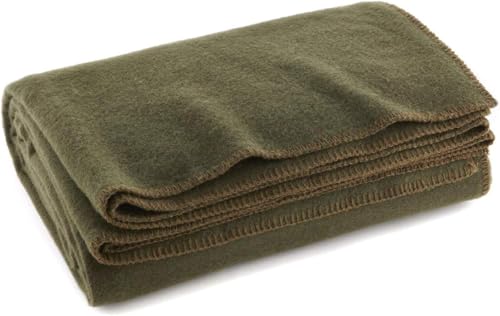
EverOne 80% Wool Blanket — Heavy Utility Blanket — Second Heaviest Here
Honesty about weight is this guide’s organising principle, so the EverOne’s position must be plain: at 66 by 90 inches of 80% wool, this is a full-size utility blanket, and it sits second-heaviest in the six. It belongs in a lightweight guide the way a reference point belongs on a map — it marks where ‘lightweight’ ends. Buyers who need a real blanket for a car boot, a cabin bunk or an emergency cupboard will find it exactly right; buyers chasing a featherlight throw should walk past it to the alpaca and lambswool picks above and below.
The specification is the classic utility pattern: 80% wool with the balance unstated in the title beyond the percentage itself, an olive drab colour that hides outdoor evidence, and a fire-retardant description that suits its intended worlds of campsites, vehicles and workshops. Wool’s natural reluctance to burn is part of why this format has been issued, in one army or another, for a century — it chars rather than melts, and it insulates even when damp, which no synthetic blanket in a car boot can promise. The EverOne 80% Wool Blanket deserves a careful read of its own listing before it joins your household.
Against skin, expect utility manners: this is a blanket to sleep under with a sheet between, or over a duvet, rather than against a bare neck. Its virtues are coverage, toughness and indifference to conditions. Judged as the heavy anchor of the guide it is admirable; judged as a lightweight throw it would be a miscarriage, and this review exists to make sure nobody buys it under that misapprehension.
A note on the fire-retardant description, since it can be misread as a promise: treat it as the listing’s characterisation of a utility wool blanket’s behaviour — wool chars and self-limits rather than melting — and not as a certification to drape over heaters or open flames. Used with the ordinary respect any textile near a campfire deserves, the EverOne’s format is the safest of the six around sparks, which is one more reason it, and not a fine throw, belongs at the fire’s edge.
- Fibre: 80% wool, per the listing
- Size: 66 x 90 inches
- Colour: olive drab
- Property: described as fire retardant in the listing
- Character: full-size utility blanket
- Weight rank: second heaviest of the six — not a lightweight throw
Strengths
- Full blanket coverage for bunks, cars and cabins
- Wool insulates even when damp
- Utility build shrugs off rough use
Trade-offs
- Heavy — fails the lightweight brief it anchors
- Utility hand feel wants a sheet between blanket and skin
- Olive drab suits outdoors, not most bedrooms
Best for: emergency kits, cabin bunks and car boots that see real weather. Not suited for: anyone whose search began with the word lightweight.

Alpaca Merino Wool Throw Woven — Lightest True Throw
If the word lightweight in this guide’s title is your whole reason for being here, this is your pick. The listing itself describes the throw as lightweight and breathable, and the fibre pairing explains why: alpaca fibre is hollow-cored, trapping warmth in the fibre’s own structure rather than in bulk, while merino contributes softness and elasticity. The result is a woven throw, 72 by 60 inches, that warms like a heavier blanket and packs like a lighter one — the combination travellers and small-space dwellers are actually shopping for.
It is made in Peru, the homeland of alpaca, and woven rather than knitted, which gives it the stable, blanket-like drape that knitted throws — prone to stretching into parallelograms — cannot hold. Charcoal grey is the thinking person’s neutral: darker and more forgiving than silver grey, softer than black, and equally at home on a sofa, across a bed’s foot, or over shoulders in a chilly home office. The listing’s ‘non itchy’ claim matches the fibre logic; alpaca has no lanolin and a smooth fibre surface, and the merino here is the fine kind. The Alpaca Merino Wool Throw Woven deserves a careful read of its own listing before it joins your household.
In the guide’s weight order it stands at the light extreme, and its trade-offs are the light extreme’s usual ones: less physical presence, less wind-stopping mass outdoors, and a price of admission for two premium fibres. For the reader who wants wool’s warmth with the least possible blanket, nothing else in the six is really competing with it.
The alpaca throw also answers a question the other picks cannot: what to pack when the blanket must earn its space in luggage. Folded, a woven 72 by 60 throw of hollow-fibre wool compresses to a fraction of a utility blanket’s bulk, yet it covers a sleeper on a train bunk, a cabin bed or a red-eye flight’s worth of airport chairs. Travellers who have carried a lesser blanket around the world tend to convert to alpaca permanently, and the conversion usually starts with a throw exactly like this one.
- Fibre: alpaca and merino wool (percentages not stated in the listing)
- Size: 72 x 60 inches
- Colour: charcoal grey
- Make: woven, made in Peru
- Character: described as lightweight and breathable in the listing
- Weight rank: lightest of the six
Strengths
- Genuine lightweight warmth from hollow alpaca fibre
- Woven stability — keeps its shape and drape
- Charcoal suits every room and travels anywhere
Trade-offs
- Light build offers less wind resistance outdoors
- Two premium fibres mean premium positioning
- Less cosy bulk for those who equate weight with warmth
Best for: travellers, small spaces and warm sleepers who still want real wool. Not suited for: anyone who wants a blanket to feel heavy on them.

Moon Wool Plaid Throw Merino — Best Fine Lambswool Throw
Some throws are products; this one is a tradition with a label. Moon is a British woollen mill of the old school, and its plaid throw in merino lambswool represents the form as it has been made for generations: a fine woven check — here a block windowpane in beige and grey — with the soft, matte surface that lambswool develops and synthetics imitate from a distance. Lambswool, taken from a sheep’s first shearing, is the softest grade of the fibre, and in a throw it shows as a fabric you reach for with the back of your hand.
The palette deserves its reputation. Beige and grey in a windowpane check is the most architectural pattern in this guide: it reads as texture across a room, as design across a sofa, and it coordinates with both the warm and cool halves of the neutral spectrum, which is why British throws in this register furnish everything from cottages to design hotels. It is also, in the honest weight order this guide maintains, a light throw — fine lambswool woven for drape rather than mass.
Buy it for the chair where you actually read, for the end of the bed in a guest room that aims to feel considered, or as the gift for the person whose taste runs to quiet quality. It will not serve a campsite and should not be asked to; within its intended world of interiors, it is the most finished object in this list, and the one most likely to be handed down rather than replaced.
Care for lambswool of this grade is mostly a matter of restraint: air it more often than you wash it, since wool refreshes in moving air and a plaid throw on a chair back is effectively airing itself between uses. When washing is due, cool and gentle is the whole recipe, and the plaid’s woven structure will hold its lines for decades if heat never enters the story. It is the lowest-maintenance luxury in the guide, provided the one rule is kept.
- Fibre: merino lambswool (no blend stated in the listing)
- Pattern: block windowpane plaid, beige grey
- Make: made in the UK, per the listing
- Format: woven throw
- Character: fine, soft, drape-led
- Weight rank: light end of the six, with the fine throws
Strengths
- Lambswool is the softest grade of wool
- British mill provenance and classic plaid design
- Neutral check coordinates with warm and cool rooms
Trade-offs
- An interiors piece — not for campsites or car boots
- Fine weave wants gentler handling than utility wool
- Plaid pattern is a traditional register, not a modern one
Best for: reading chairs, guest rooms and gifts of quiet quality. Not suited for: outdoor use or rough family duty.

Alashan 95% Merino Throw — Best Merino-Cashmere Blend Throw
Percentages are this guide’s love language, and the Alashan states the most interesting one here: 95% merino wool with 5% cashmere, woven into a throw with a rippled finish, in navy. That small cashmere fraction is not a marketing whisper — at the surface of a fabric, a minority of very fine fibres changes the hand feel disproportionately, softening merino’s springy character toward the suede-like touch that makes people describe a throw as ‘the good one’ without knowing why.
The ripple finish is the other considered detail: a woven texture that catches light in soft waves, giving a solid navy throw a sense of movement that flat weaves lack. Navy, as the cashmere guide in this batch also argues, is the anchor colour — it grounds pale rooms, deepens in lamplight, and hides the wear of a throw that will be used daily rather than admired. On a grey sofa it is the single deliberate note; on a bed it is the layer that makes white bedding look finished.
Weight-wise it belongs with the light, fine throws — a woven personal blanket for a person and a chair, not a bed system. Alashan’s trade is cashmere and fine-fibre goods, and this throw reads as a specialist’s product: the blend ratio chosen for feel, the finish chosen for light, the colour chosen for interiors. Readers who found the pure utility picks too rough and the pure luxury picks too delicate will find this is the guide’s middle path, paved with exactly five percent cashmere.
The ripple finish has a practical dividend beyond looks: textured weaves show creases and fold marks far less than flat ones, so the Alashan can live folded over a chair arm — the position of maximum visibility — without developing the tired tramlines that shame smoother throws. For a navy object in a bright room, that forgiveness matters daily. It is a small, unglamorous virtue, and it is the kind that decides which throw is still on the chair in five years.
- Fibre: 95% merino wool, 5% cashmere, per the listing
- Finish: ripple woven texture
- Colour: navy
- Format: woven throw
- Character: fine and soft-handed
- Weight rank: light end of the six
Strengths
- Cashmere fraction noticeably refines the hand feel
- Ripple texture gives solid navy real presence
- Specialist maker’s considered specification
Trade-offs
- Light throw weight — not a winter bed blanket
- Navy shows pale lint and pet hair
- The 5% cashmere still asks for gentle washing
Best for: the reader whose chair deserves the softest wool in the guide. Not suited for: family-room fort building or pet duty.

Molithe 100% Wool Blanket — Thick and Heavy — Not Lightweight
Let the badge do its work before anything else: the Molithe is not a lightweight blanket, and this guide will not call it one. Its own listing describes it as warm and thick, in the military blanket tradition, at 62 by 86 inches of 100% wool — which makes it, in this company, the heavyweight reference point, the blanket against which the word lightweight in everyone else’s description can be measured. Including it, clearly labelled, serves readers better than pretending the category has no heavy end.
What that weight buys is the full traditional wool proposition. A thick 100% wool blanket insulates in serious cold, keeps working when damp, resists sparks around a campfire in a way synthetics never will, and serves for years as car blanket, picnic ground-cover, sporting-event wrap and emergency layer in rotation. The military format is not a style affectation; it is a century of field testing distilled into dimensions and density, and households with outdoor lives will recognise the tool immediately.
Its costs are the mirror of its virtues: it is heavy to carry, bulky to store, and its hand is honest wool rather than fine-fibre softness — most people will want a layer between it and bare skin. In the weight ranking that structures this guide it stands last and heaviest, and that is a recommendation for the jobs at that end of the scale. Buy it for the cold, the car and the long term; buy anything above it in this list for lightness.
Storage is the Molithe’s one domestic demand: at 62 by 86 inches of thick wool it folds into a substantial parcel that wants a shelf, a boot or a bunk box of its own, not a drawer. Give it that space, keep it dry, and check it each autumn before the cold arrives — a ritual the military owners of its ancestors would recognise. In return it will be ready, every single winter, for the night the heating fails or the road turns white, which is the entire point of owning it.
- Fibre: 100% wool, per the listing
- Size: 62 x 86 inches
- Character: described as warm and thick in the listing
- Style: military camping blanket
- Weight rank: HEAVIEST of the six — explicitly not lightweight
- Role: car, camp, picnic, emergency layer
Strengths
- Maximum wool warmth and damp-weather performance
- 100% wool with no blend dilution
- Decades-grade utility across car, camp and home emergencies
Trade-offs
- Heavy and bulky — the opposite of this guide’s title promise
- Traditional wool hand wants a layer against skin
- Too much blanket for travel or small-space storage
Best for: serious cold, vehicles, campsites and emergency preparedness. Not suited for: lightweight seekers — see the alpaca and lambswool picks above.
How Do the Six Wool Blankets Compare at a Glance?
| Pick | Key specification | Defining detail |
|---|---|---|
| PuTian Merino Wool Blanket Throw | Fibre: merino wool (no percentage stated in the listing) | Weight rank: middle of this guide — a full throw’s worth of wool |
| EverOne 80% Wool Blanket | Fibre: 80% wool, per the listing | Weight rank: second heaviest of the six — not a lightweight throw |
| Alpaca Merino Wool Throw Woven | Fibre: alpaca and merino wool (percentages not stated in the listing) | Weight rank: lightest of the six |
| Moon Wool Plaid Throw Merino | Fibre: merino lambswool (no blend stated in the listing) | Weight rank: light end of the six, with the fine throws |
| Alashan 95% Merino Throw | Fibre: 95% merino wool, 5% cashmere, per the listing | Weight rank: light end of the six |
| Molithe 100% Wool Blanket | Fibre: 100% wool, per the listing | Role: car, camp, picnic, emergency layer |
Ranked by Weight: Where Does Each Blanket Really Sit?
Here is the order this guide has been promising, lightest to heaviest, with the reasoning exposed. Lightest is the alpaca and merino throw from Peru: a 72 by 60 inch woven throw whose maker describes it as lightweight, built from hollow-cored alpaca that warms without mass. Beside it at the light end sit the Moon Wool Plaid Throw Merino, fine lambswool woven for drape, and the Alashan 95% Merino Throw, a fine woven throw with a ripple finish — all three are personal blankets, sized and weighted for one person in one chair.
The middle belongs to the PuTian Merino Wool Blanket Throw alone. At 87 by 63 inches it carries noticeably more wool than the fine throws — that is what its coverage costs — while merino’s efficiency keeps it from utility-blanket territory. Think of it as the largest blanket that still belongs in a lightweight conversation, the ceiling of the category rather than its centre.
The heavy end is occupied, in ascending order, by the EverOne 80% Wool Blanket — 66 by 90 inches of utility wool is a lot of blanket however it is spun — and finally the Molithe 100% Wool Blanket, whose listing’s own words are ‘warm’ and ‘thick’. If your need is a car’s winter kit or a cabin bunk, shop at this end without apology; if your need is a throw for a reading chair, the top half of this ranking is your whole shortlist, and the bottom half is context.
Merino, Lambswool, Alpaca or Utility Wool: Which Fibre Feels How?
Wool is not one material but a family, and the differences are felt in the first touch. Merino comes from a breed selected for fine fleece; its fibres bend on contact with skin instead of pressing into it, which is why merino blankets and base layers can be worn bare. The PuTian and the Alashan in this guide trade on that fineness, and the Alashan’s 5% cashmere refines the hand further still.
Lambswool is a grade rather than a breed — the first shearing of a young sheep, shorter and softer than later clips — and the Moon throw shows its character: a matte, gentle surface with a traditional woven hand. Alpaca is a different animal entirely, its fibre hollow, lanolin-free and exceptionally warm for its weight; blended with merino in the Peruvian throw here, it produces the lightest warmth in the guide and a notably smooth, non-itchy contact.
Utility wool — the EverOne’s 80% and the Molithe’s 100% — is the family’s workhorse grade: longer, coarser fibres woven dense for durability and insulation. It is superb at its job and unapologetic about its hand. The rule for buyers is simple: the closer a blanket will live to bare skin, the finer the fibre you should insist on; the closer to a car boot or a campfire, the more the utility grades earn their roughness.
How Warm Is a Lightweight Wool Blanket, Really?
Warmth in wool comes from crimp — the natural waviness that holds fibres apart and traps still air — more than from thickness, which is the lightweight blanket’s whole opportunity. A fine merino or alpaca weave traps a surprising volume of air in very little mass, so the light throws in this guide warm a seated or sleeping person far beyond what their folded size suggests. What they cannot do is block wind or insulate against a cold surface beneath you; outdoors, they are layers in a system, not the system.
Indoors, the honest calibration is this: a light wool throw over the knees transforms a cool room; a mid-weight merino like the PuTian serves as a summer bed’s only blanket or a winter bed’s top layer; and serious cold — an unheated cabin, a car overnight — is the heavy end’s jurisdiction, where the Molithe’s thickness is not excess but equipment. Matching the blanket to the coldest realistic night, rather than the average one, is how wool earns its keep without disappointment.
Wool also manages the moisture side of warmth better than any rival fibre. It absorbs vapour from the skin and releases heat slightly as it does, buffering the clammy chill that synthetic blankets produce when a sleeper warms and cools through the night. For the light throws especially, that buffering is the difference between a blanket that feels warm and one that merely is warm on a specification sheet.
How Should You Wash and Store Wool Blankets?
Wool’s enemies are heat, agitation and alkaline detergent, in combination: that trio is what felts a blanket into a smaller, stiffer version of itself. The PuTian in this guide is listed as machine washable, which makes it the exception to handle by its own label; for the fine throws and utility blankets, the safe doctrine is a cool wool cycle or a gentle hand wash with a wool-specific detergent, minimal agitation, and a reshape while damp.
Dry flat or over a line’s full width, never hung by a corner, and never near a radiator’s direct blast. Wool dries more slowly than cotton or fleece — the Molithe, at its thickness, needs a full day of moving air — and storing a wool blanket before it is bone dry invites the mildew smell that no amount of airing quite removes. Patience at this stage is the whole secret; wool asks for little care, but it asks for unhurried care.
Storage brings the moth question, which wool shares with cashmere: store blankets clean, since soiling attracts larvae, in breathable bags with cedar if you keep them. Utility blankets in cars and cabins should be checked each season — a vehicle is a damp, temperature-cycling cupboard — and aired on a dry day. Treated this way, the blankets in this guide are decade purchases; the military format of the Molithe has been proving that lifespan since long before any of us were shopping.
Where Does a Wool Blanket Belong: Bed, Chair, Car or Camp?
The reading chair is the fine throw’s natural habitat — Moon’s plaid, the Alashan’s navy ripple, the alpaca’s charcoal — because a chair blanket is touched constantly, seen constantly, and used by one person whose preferences can be honoured exactly. Keep the throw folded on the chair’s arm and it becomes part of the room’s furniture; rotate two and the chair gains a seasonal wardrobe.
The bed takes wool in layers. The PuTian’s size makes it the only pick here that can headline a bed — as a summer cover or a winter topper over a duvet — while the fine throws serve at the foot, for the sleeper who wants one more stratum than their partner does. That asymmetric layering, one extra blanket on one side, quietly resolves the most common thermal disagreement in shared beds.
Car and camp belong to the heavy end, without sentimentality. The EverOne and the Molithe are the blankets to fold into a boot, a bunk or a tent: they tolerate damp, sparks, ground use and neglect, and they insulate when wet, which is the scenario that actually occurs outdoors. Sending a lambswool throw to do that work is not thrift but waste — match each blanket to its theatre and the whole cast lasts longer.
How Do You Read a Wool Blanket Listing Like a Buyer, Not a Fan?
Start with the fibre line and demand a percentage or an honest fibre name; this guide’s six all provide one or the other, and listings that hide behind the word ‘woollen’ or ‘wool blend’ without numbers should be priced in your head as mostly something else. Then find the dimensions in the text, not the photographs — a blanket photographed on a king bed may be a throw with ambition — and compare them with the job: 60 inches of width for a chair, 80-plus of length for a bed or a tall person.
Weight language deserves translation. ‘Lightweight’ in a listing, as with the alpaca throw here, is a claim to test against size and weave; ‘warm and thick’, as the Molithe states, is a claim to believe. A maker who publishes a fabric weight or an unambiguous character description is giving you evidence; a maker who publishes only adjectives is giving you weather. The ranking in this guide was built by preferring evidence wherever it existed.
Finally, read the care line as a truth serum. A listing that states machine washable, as the PuTian does, is making a checkable promise about construction; a listing silent on care is leaving you the default wool doctrine of caution. Neither is disqualifying — but the blanket you buy should be the one whose care you will actually perform, because wool’s longevity is decided less by its grade than by its owner’s habits.
What Are the Honest Trade-Offs of Wool Against Fleece and Down?
Fleece beats wool on price, washing indifference and drying speed, and for a blanket that will be dragged through childhood, that case is decisive. Wool beats fleece on breathability, moisture management, flame behaviour and lifespan, and it does not shed microfibres in the wash or build the static that makes fleece announce itself in winter rooms. The choice is between a blanket optimised for the laundry and one optimised for the sleeper.
Down beats everything on warmth per gram and loses to wool on almost every other practical axis: it cannot get wet without sulking, it migrates and clumps, it is difficult to wash, and as a throw it is the wrong shape entirely. Wool blankets occupy the durable middle — nearly as warm in practice, indifferent to damp, washable with respect, and shaped for beds, chairs and emergencies alike.
Cost per year is where wool’s case closes. A well-bought wool blanket in this guide’s class is a ten-to-twenty-year object; amortised honestly, the fine throws compete with fleece that is replaced every few seasons, and the utility blankets undercut everything by simply refusing to wear out. Buy wool once, at the weight your life actually needs, and the category leaves your shopping list for a decade.
How Do You Choose a Wool Blanket for a Child, a Guest or a Gift?
Children change the fibre calculation in wool’s favour in one specific way: wool’s natural flame reluctance and temperature regulation suit small sleepers who kick covers off and overheat in synthetics, while its care demands argue for the tougher end of this guide rather than the fine throws. A PuTian, washable and reinforced, is the child-proof end of respectable wool; the lambswool and alpaca belong in the rooms adults retreat to, and there is no shame in a household that runs both policies at once.
Guests deserve the middle of the range: a blanket warm enough for a stranger’s unknown preferences, soft enough against skin they did not choose, and presentable enough to fold at a bed’s foot. The PuTian again, or the Moon plaid where the room leans traditional, covers that brief; leave the second layer folded visibly, because guests use what they can see and freeze politely under what they cannot find.
As a gift, wool’s longevity is the message — this is an object that will still be in service when trendier presents are landfill. Match the weight to the life: a fine throw for the reader, the alpaca for the traveller, a utility blanket for the new driver or the cabin owner, whose gratitude will arrive with the first breakdown or frost. Include the care doctrine in the card in one sentence, and the gift is complete: an heirloom with instructions.
What Happens to Wool Blankets Over Ten Years of Use?
A good wool blanket ages by softening and settling rather than by failing. The weave relaxes into its owner’s habits — the chair throw takes the chair’s shape, the bed blanket’s folds learn their places — and the surface develops the matte, lived-in finish that new wool imitates with difficulty. Colours mellow slightly in honest light; edges, if reinforced as the PuTian’s are, hold their lines; and the blanket’s warmth, being a property of crimp rather than coating, does not wash out or wear off.
The failure modes are all in the owner’s hands: felting from hot washes, moth damage from dirty storage, mildew from a damp cupboard, and the slow thinning of a blanket used as a groundsheet beyond its grade. Notice that none of these is the wool’s fault, and none is mysterious — the care section of this guide is short because wool’s contract genuinely is short. Keep it, and a decade passes with the blanket improving; break it, and the blanket will testify to exactly which clause was broken.
That longevity reframes the purchase entirely. The fine throws here are not indulgences to be justified against cheaper blankets; they are the cheaper blankets, divided by the years they serve. The Molithe may outlast the car it is bought for. Buy wool at the weight your life needs, keep its three rules, and this category of shopping simply ends — which is, in the end, the most lightweight outcome of all.
How Should You Air, Refresh and De-Pill a Wool Blanket?
Wool’s most underused care tool is fresh air. A blanket hung over a line or a chair back on a dry, breezy day sheds odours, releases the moisture it buffered overnight, and relaxes creases — a full refresh with no water, no detergent and no risk. Households that air their wool weekly wash it rarely, and washing rarely is the single strongest predictor of a blanket reaching its second decade. Sunlight in moderation helps; a full summer afternoon of it will fade colour, so choose bright shade and moving air over direct blaze.
Pilling, when it comes, arrives on the high-friction zones — the middle of a chair throw, the foot of a bed blanket — as loose surface fibres balling together. It is cosmetic, not structural, and a fabric comb or a careful pass with a battery shaver restores the surface in minutes. Utility blankets pill least, fine merino most visibly in its first season; in both cases the pills diminish as the loose fibre clears, and the blanket underneath is unchanged.
What Mistakes Do Wool Blanket Buyers Make Most Often?
- Trusting the word ‘lightweight’ in a title — this guide ranks its picks by real weight and labels the thick Molithe as not lightweight; do the same arithmetic wherever you shop.
- Buying a utility blanket like the EverOne or Molithe for skin-contact comfort, or a fine lambswool throw for a car boot — the two ends of the weight scale have opposite jobs.
- Ignoring fibre percentages: 80% wool, 95/5 merino-cashmere and 100% wool are different products, and the listings here state them plainly for a reason.
- Washing fine wool hot and hard, felting a throw into a rug in one cycle; follow the label, and default to cool and gentle.
- Storing wool damp or dirty, which invites mildew and moths respectively — clean, dry and breathable is the whole doctrine.
- Judging warmth by folded thickness alone; crimp and fibre type mean the lightest throw here can out-warm a thicker synthetic.
Final Recommendation
Choose your end of the scale first. For the lightest genuine wool warmth, the alpaca-merino throw is the guide’s answer — hollow-fibre warmth, woven in Peru, in a charcoal that goes anywhere. For interiors and gifts, the Moon lambswool plaid is the classic object, and the Alashan’s 95/5 merino-cashmere is the softest hand of the six. Between them, the PuTian merino is the big-hearted all-rounder: the most coverage, the easiest care, and enough wool for a bed of one’s own.
Then respect the heavy end for what it is. The EverOne is a full utility blanket for bunks and boots, and the Molithe — thick, heavy, 100% wool and explicitly not lightweight — is the blanket for serious cold and serious emergencies. A household that owns one fine throw and one of these heavy anchors is equipped for every night the year contains, which is a better outcome than any single compromise blanket could offer.
Wool rewards the buyer who reads percentages, believes dimensions and ranks weight honestly. Do those three things — as this guide has done in the open, pick by pick — and the blanket folded over your chair or stowed in your car will still be on duty, unchanged in character, long after lighter promises have worn thin.
Frequently Asked Questions
Which of these blankets is actually the lightest?
The alpaca-merino throw, by construction and by its maker’s own description: alpaca’s hollow fibres deliver warmth at the lowest mass, and at 72 by 60 inches it is a true personal throw. The Moon lambswool and the Alashan merino-cashmere throws sit in the same light class. The Molithe, at the other extreme, is the heaviest — its listing calls it warm and thick, and this guide never calls it lightweight.
Is 80% wool as good as 100% wool?
Different, not simply worse. The EverOne’s 80% wool is a utility specification — the remaining fibre content typically serves durability and cost in a blanket built for cars and cabins, and its performance in damp and cold remains unmistakably wool’s. For skin softness and purity of claim, the 100% Molithe and the fine-fibre throws lead; for a working blanket, 80% is an honest, proven formula — provided, as here, the percentage is stated rather than hidden.
Can I machine wash these wool blankets?
The PuTian is listed as machine washable, and should be washed by its label’s instructions. For the others, treat machine washing as a cool, gentle wool cycle at most, with wool detergent — or hand wash — because heat and agitation felt wool permanently. When a listing is silent on washing, the cautious doctrine is the correct one, and the fine throws in particular deserve it.
Why is a not-lightweight blanket in a lightweight guide?
Because readers searching this category split into two camps, and the second camp — cars, cabins, emergency kits, serious cold — is better served by a clearly labelled heavyweight than by silence. The Molithe’s badge, spec box and review all state that it is thick, heavy and not lightweight. If you came for lightness, the top half of the ranking is yours; the Molithe exists so nobody buys a heavy blanket by accident, or misses one on purpose.
Does wool itch?
Coarse wool can; the fine fibres in most of this guide generally do not. Merino, lambswool and alpaca are selected or graded for softness, and the alpaca throw’s listing describes it as non-itchy, which matches alpaca’s smooth, lanolin-free fibre. The utility blankets — EverOne and Molithe — are the honest exceptions: use them over a sheet or clothing, as their military format always intended, and itch never enters the arrangement.
How long will a wool blanket last?
Measured in years, wool is the longest-lived blanket fibre in ordinary use: a decade is unremarkable, and utility blankets in the Molithe’s tradition routinely serve far longer. The lifespan is decided by washing gentleness, dry storage and protection from moths rather than by wear in service. Buy the right weight once, keep it clean and dry, and replacement becomes a decision about décor rather than necessity.
Related Guides
Rounding out the rooms these blankets live in? The bathroom shelf is covered by Best Hair Drying Towels, the floors beneath the reading chair by Best Cordless Vacuums for Hardwood and Carpet, and the washable layer underfoot by Best Cotton Area Rugs for Living Rooms.


