What's inside
- Key Takeaways
- Quick Picks
- How Did We Choose These Lightweight Receiving Blankets?
- Comparison Table
- What Should You Look for When Buying Lightweight Receiving Blankets?
- How Do You Use Receiving Blankets Safely Through the Day?
- What Mistakes Do Families Make With Receiving Blankets?
- What Happens During the First Month With a Receiving Blanket Stack?
- Where Else in the House Do Receiving Blankets Quietly Earn Their Keep?
- How Should You Store, Fold and Hand Down a Working Blanket Stack?
- What Role Do Receiving Blankets Play at Appointments and Weigh-Ins?
- Do Receiving Blankets Behave Differently Across the Seasons?
- Final Recommendation
- Frequently Asked Questions
- Related Guides
As an Amazon Associate I earn from qualifying purchases. This post may contain affiliate links at no extra cost to you.
cottageverdict.com is reader-supported. When you buy through links on our site, we may earn an affiliate commission.
Where to buy: every linked pack below leads to its Amazon listing, where you can check price on Amazon and confirm the pack count, the fabric content and the exact square dimensions before you order. One entry near the end has no link at all: it covers a generic sort of pack that dozens of sellers offer, so we assess the sort itself instead of any single seller.
The best lightweight receiving blankets are not the prettiest things in a nursery, and that is precisely their charm. A receiving blanket is a flat, thin square of flannel that gets folded under a newborn during a feed, spread across a changing mat in a draughty hallway, tucked around small legs in a car seat while an adult watches, and then thrown into a wash basket still damp. Parents who buy one beautiful blanket learn this within a week. Parents who buy a proper stack of plain flannel squares learn it comfortably, because there is always a clean one folded in the drawer when the laundry cycle lags behind the baby.
This guide treats receiving blankets as work equipment rather than decoration. The questions that matter are unglamorous ones. How many squares actually arrive in the pack, and are they all the same size? Does the flannel stay soft after repeated hot washes, or does it pill into sandpaper by the second month? Are the edges finished in a way that survives tugging, folding and the occasional use as an emergency burp cloth over a shoulder? A print you love matters, of course, especially in photographs, but a print on a blanket that shrinks unevenly will annoy you long after the novelty of the pattern fades.
One safety point belongs at the front, because receiving blankets are so often photographed inside cribs. A loose blanket of any weight does not belong in a sleep space while a baby sleeps without an adult watching. These flannel squares are for held time, for supervised tummy time on the floor, for a layer across your own lap while you feed, and for warmth in a stroller while you are right there pushing it. When sleep comes, the blanket comes away and the baby sleeps on a clear, flat surface. That single habit matters more than any fabric choice in this entire guide, and every recommendation below assumes you will follow it.
Key Takeaways
- Pack count is the real value measure here, because receiving blankets rotate through the wash daily.
- Flannel squares earn their keep during feeds, changes and supervised floor time, never as loose crib bedding.
- Gerber appears three times in this list, yet each of its packs differs in count, print family and feel.
- The seven-packs from Luvable Friends and Simple Joys suit households building a laundry buffer from scratch.
- Square dimensions vary more than listings suggest, so measure one blanket against your changing mat.
- A generic unbranded multipack can work as a backup stack if you inspect stitching on arrival.
Quick Picks
| Pick | Badge | Why it earns its place |
|---|---|---|
| Gerber Flannel Receiving Blankets Butterfly | Best Everyday Stack | Five cheerful flannel squares that handle the daily rotation without fuss. |
| Luvable Friends Flannel Receiving Blankets 7-Pack | Best Laundry Buffer | Seven blankets mean a clean square survives even a missed wash day. |
| Simple Joys Flannel Receiving Blankets 7 Pack | Best Muted Colours | Grey, white and mint tones that photograph calmly and hide minor marks. |
| Gerber Flannel Receiving Blankets Retro Floral 4 Pack | Best Gift-Leaning Pack | A vintage floral look for families who want utility that still feels pretty. |
| Gerber Flannel Receiving Blankets Clouds Grey 5 Pack | Best Neutral Set | Soft grey cloud prints that suit any nursery palette and any sibling. |
| Plain Cotton Flannel Receiving Blanket Multipack | Best Backup Option | A budget-tier generic stack for spares in the car, the pram and grandparents’ houses. |
How Did We Choose These Lightweight Receiving Blankets?
We started from the way these blankets are actually used during the first six months, which is relentlessly. A receiving blanket might line a Moses basket while an awake baby is carried from room to room, catch milk during three separate feeds, serve as a clean surface on a café changing table, and still be expected to look presentable when a grandparent arrives. Any pack that could not survive that rhythm, at least on paper and in its construction, did not belong here regardless of how sweet its print looked in a thumbnail.
Fabric came first in our thinking. Every linked pick in this guide is cotton flannel, a brushed woven cloth that feels warm against skin without the stretch of jersey or the open weave of muslin. Flannel matters for this particular job because it lies flat, folds into a compact square, absorbs small spills instead of letting them run, and tolerates the hot, frequent washing that newborn laundry demands. We favoured packs whose listings stated full cotton content plainly, and we treated vague fabric descriptions as a warning sign rather than a mystery to be solved optimistically.
Count and size came next, and they interact in ways listings rarely explain. A seven-pack of slightly smaller squares may serve a family better than a four-pack of generous ones, or the reverse, depending on whether the blankets mostly line a changing mat or mostly wrap around a held baby. We looked for packs that gave parents a genuine rotation, because a receiving blanket that is always in the wash is a receiving blanket you effectively do not own. Where a listing gave dimensions, we weighed them; where it did not, we said so in the review instead of guessing.
Finally, we considered who else buys these packs. Receiving blankets are a classic contribution from relatives who want to give something useful without guessing at sizes of clothing a baby will outgrow in weeks. A good gift pack needs to arrive looking tidy, wash without drama, and avoid prints so specific that they clash with everything a family already owns. That is why this list mixes playful patterns with calm neutrals, and why the prose-only generic entry is framed honestly as a spare stack rather than a present.

Gerber Flannel Receiving Blankets Butterfly — Best Everyday Stack
Gerber is the name most hospital bags in North America seem to contain somewhere, and this butterfly pack shows why the brand keeps that position. Five cotton flannel squares arrive in white grounds scattered with butterflies, a print cheerful enough for photographs yet pale enough that milk marks and wash fading do not announce themselves. The flannel itself is the familiar Gerber weight: light, flat, and quick to dry on a rack, which matters when the same five blankets cycle through a small household’s laundry several times a week.
In daily use, these squares behave like good kitchen cloths do in a busy kitchen. They fold without fighting, they stay where you lay them on a changing mat because flannel grips slightly instead of sliding, and they layer neatly two at a time when a car seat ride on a cool morning calls for a little extra across a watched baby’s legs. The edges are finished simply rather than luxuriously, and after many washes you may notice the squares relax into a slightly softer, slightly less crisp version of themselves. Most parents count that as improvement rather than wear.
Where this pack asks for compromise is generosity. Five blankets is a workable rotation for a household that washes every other day, but it is not a deep bench. Families expecting twins, or anyone whose laundry happens in weekly batches at a shared facility, will feel the bottom of this stack by Thursday. The butterfly print also commits you to a distinctly sweet look; if your taste runs to plain nursery textiles, the clouds pack further down this list covers the same ground in grey.
- Fabric: cotton flannel, brushed woven finish
- Pack count: five blankets
- Print family: butterfly pattern on white
- Care: machine washable, tumble friendly
- Role: everyday rotation for feeds and changes
Strengths
- Dries quickly, which keeps a small rotation turning over fast
- Flannel surface grips changing mats instead of skating across them
- Pale print hides the ordinary fading of frequent washing gracefully
Trade-offs
- Five pieces is a shallow stack for twins or weekly laundry
- Edge finishing is functional rather than decorative
- Print leans sweet, which will not suit every nursery’s style
Best for: first-time parents building a starter rotation that washes and dries without ceremony.
Not suited for: households that launder once a week and need a deeper bench of spares.

Luvable Friends Flannel Receiving Blankets 7-Pack — Best Laundry Buffer
The Luvable Friends seven-pack answers the most common receiving blanket complaint, which is simply running out. Seven cotton flannel squares in a basic elephant print give a household enough depth to keep two in the changing area, two in the wash, one in the pram, one in the car and one still folded in reserve. That arithmetic sounds trivial until you live with a newborn through a week of rain, a broken dryer or a stomach bug, at which point blanket depth stops being arithmetic and becomes morale.
The elephant print sits in the friendly middle of nursery taste: clearly a baby pattern, not so sugary that adults tire of looking at it by week three. The flannel is comparable in hand to the Gerber squares, light and flat with that slight brushed warmth, and the blankets fold to a tidy, uniform stack that fits a shallow drawer. Because all seven share one print family, folding laundry stays simple; nobody is matching sets at midnight, and any square can go anywhere in the house without looking borrowed from a different kit.
The compromise here is sameness. Seven identical-print blankets offer no variety for photographs, and parents who enjoy dressing a nursery scene will find the repetition plain. The squares also sit at the standard rather than generous end of receiving blanket sizing, so taller babies outgrow full wrapping sooner, though the blankets continue working as changing layers and lap cloths long after wrapping ends. Treat this pack as infrastructure, the plain pipes of the nursery, and its value becomes obvious.
- Fabric: cotton flannel across the whole pack
- Pack count: seven blankets
- Print family: basic elephant motif
- Care: machine washable for frequent cycles
- Role: deep rotation and multi-room spares
Strengths
- Seven pieces create a genuine buffer against laundry delays
- Single print family keeps folding and restocking effortless
- Enough squares to station spares in car, pram and changing area
Trade-offs
- No print variety for families who like rotating looks
- Standard sizing wraps bigger babies for a shorter window
- Presentation is plain, so it reads as practical rather than gift-like
Best for: parents who know their laundry rhythm is irregular and want depth over decoration.
Not suited for: gift buyers hoping the present itself will draw a delighted gasp.
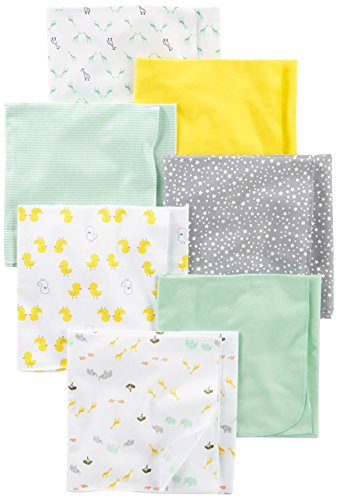
Simple Joys Flannel Receiving Blankets 7 Pack — Best Muted Colours
Simple Joys, the Carter’s line made for Amazon, takes the same seven-blanket logic as the Luvable Friends pack and dresses it in grey, white and mint. The effect is calmer than almost anything else in this category. These are the receiving blankets you can spread on a sofa during a video call with relatives, drape over your shoulder in a café, or lay across a pram without the textile shouting its babyishness across the room. For parents whose home style runs neutral, that restraint is worth real money.
The flannel is soft from the first wash and stays even through the constant cycling these packs endure. Grey in particular earns its place in a working stack: it disguises the faint shadows that pale fabrics develop after months of washing, so the blankets keep looking respectable in photographs long after a white set has gone tired. Mint adds just enough colour to distinguish one square from another in the drawer without committing the family to a theme.
There are limits. A muted palette photographs beautifully in a styled nursery but can look a little flat as a standalone gift, since the pleasure here is cumulative and quiet rather than immediate. The seven squares share the standard receiving dimensions of the category, so the same wrapping window applies as with other flannel packs. And because the colours are light overall, a determined stain from a first taste of puréed carrot months later will still show; these are working blankets, not heirlooms, and they are priced and built accordingly.
- Fabric: cotton flannel, soft brushed surface
- Pack count: seven blankets
- Colour family: grey, white and mint assortment
- Care: machine washable, frequent washing tolerated
- Role: neutral rotation for style-conscious homes
Strengths
- Muted tones blend into adult living spaces without visual noise
- Grey squares disguise long-term wash wear better than white
- Seven pieces give the same laundry depth as louder rivals
Trade-offs
- Quiet palette makes a less exciting standalone present
- Light colours still reveal strong food stains eventually
- Standard dimensions, so wrapping use ends as baby grows
Best for: families furnishing a calm, neutral nursery who still need workhorse quantities.
Not suited for: anyone shopping for a single cheerful statement piece.

Gerber Flannel Receiving Blankets Retro Floral 4 Pack — Best Gift-Leaning Pack
The retro floral Gerber pack is the one entry here that leads with looks, and it earns that position honestly. The print reaches back to the kind of flowered flannel that lined prams decades ago, which gives it an immediate warmth with grandparents and anyone assembling a nursery with vintage touches. Four squares at a stated thirty inches square make this the most precisely sized pack in the guide, and that dimension is a useful middle: large enough to wrap a small newborn for held cuddles, compact enough to fold into a changing bag without bulk.
Because the count is four rather than five or seven, this pack works best as one layer of a family’s system rather than the whole system. Pair it with a plainer stack and the florals become the blankets that appear in photographs, at family lunches and on the good changing mat, while the plainer squares absorb the messiest shifts. The flannel itself matches Gerber’s usual light, quick-drying character, so the pretty print does not come with fussy care demands attached.
The trade is obvious and worth naming plainly. Four blankets cannot carry a household alone through a heavy laundry week, and buyers who mistake this for a complete kit will be washing at midnight within days. The retro print, while charming, is a strong stylistic commitment; it will sit oddly in an ultra-modern monochrome nursery. Buy it as the charming component of a larger plan, or as a present paired with something plain, and it delights. Buy it as the entire plan and it will feel thin.
- Fabric: cotton flannel with vintage-style floral print
- Pack count: four blankets
- Stated size: thirty inches square per listing
- Care: machine washable, quick to dry
- Role: photogenic layer within a larger rotation
Strengths
- Retro floral print carries genuine nostalgic charm
- Stated square dimensions remove sizing guesswork
- Same unfussy Gerber flannel care as plainer packs
Trade-offs
- Four pieces cannot sustain a household rotation alone
- Strong vintage look clashes with monochrome nurseries
- Works best bought alongside a plainer, larger stack
Best for: gift buyers pairing charm with a practical second pack.
Not suited for: anyone expecting one purchase to cover every blanket duty.

Gerber Flannel Receiving Blankets Clouds Grey 5 Pack — Best Neutral Set
Clouds printed on soft grey give this five-pack the gentlest personality in the Gerber trio here. Where the butterfly set reads sweet and the retro floral reads nostalgic, the clouds set reads peaceful, and that quality suits the places receiving blankets spend their working lives: draped over a feeding chair arm, folded beside a changing mat, tucked into a hospital bag where calm colours are quietly welcome. Five squares match the everyday rotation of the butterfly pack, with the same light flannel and the same quick turnaround through wash and drawer.
Grey flannel has a practical virtue that only appears after months of ownership. White blankets slowly take on the history of every spill, while grey absorbs that history into its tone and keeps presenting a tidy face to the world. The cloud motif also ages gracefully with the child; a square that begins life under a newborn still looks appropriate spread beneath a sitting baby during floor play half a year later, because the print never insists on newborn scale the way tiny character patterns can.
The compromises mirror its butterfly sibling. Five pieces suit a wash-every-other-day household and strain a weekly one. The palette, while versatile, offers little contrast variety across the pack, so the drawer holds a family of near-identical squares; some parents love that uniformity and others find it dull by the second month. Neither reaction is wrong. What this set promises is calm, consistent utility, and on that promise it delivers without surprises in either direction.
- Fabric: cotton flannel in soft grey tones
- Pack count: five blankets
- Print family: clouds across grey grounds
- Care: machine washable, dries quickly on a rack
- Role: neutral everyday rotation with long visual life
Strengths
- Grey ground keeps blankets looking tidy across months of washing
- Cloud print suits newborns and older babies equally well
- Matches almost any nursery palette or sibling hand-me-down set
Trade-offs
- Little variety within the pack for print-loving families
- Five pieces still limit weekly-laundry households
- Calm styling may feel plain as a centrepiece gift
Best for: parents who want one versatile set that outlasts the newborn phase visually.
Not suited for: buyers who enjoy bold, changing prints in daily rotation.
Plain Cotton Flannel Receiving Blanket Multipack — Best Backup Option
Every category has an unbranded tier, and receiving blankets are no exception. Generic cotton flannel multipacks circulate under rotating labels at the budget end of the market, sold as plain squares for households that need quantity in several locations at once. Because no single listing represents this tier fairly, the entry that follows sketches the type in general terms: expect simple flannel, basic edge stitching, mixed or single plain colours, and pack counts that look generous for the money. Positioned honestly, this is a budget-tier purchase, and it should be judged by budget-tier standards.
Used wisely, a generic stack solves real problems. Grandparents’ houses need a changing layer and a lap cloth. The car needs a square that can catch a spill and live in the boot without anyone mourning it. A childcare bag benefits from spares nobody tracks anxiously. In those roles, plain flannel performs the same flat, absorbent, washable service as branded flannel, and losing one square to a motorway service station is an annoyance rather than a small grief.
The cautions are about consistency. Unbranded packs vary between production runs, so squares within one pack may differ slightly in size or finish, and stitching deserves a tug test on arrival. Wash the whole stack before first use, check for loose threads, and retire any square whose edges fray early. If the pack passes those simple checks, it becomes exactly what it should be: invisible infrastructure. If it fails them, it was cheap enough to replace without a second thought, which is the entire logic of the tier.
- Fabric: cotton flannel, basic brushed finish
- Pack count: varies by seller, usually generous
- Colour family: plain or mixed basics
- Care: machine washable; pre-wash before first use
- Role: spares for car, travel and second homes
Strengths
- Low cost makes multi-location spares painless
- Plain flannel performs the core jobs without frills
- Losing one square carries no financial sting
Trade-offs
- Sizing and stitching consistency varies between packs
- Needs an arrival inspection branded packs rarely require
- No brand accountability if a batch disappoints
Best for: stocking grandparents’ houses, cars and childcare bags with expendable spares.
Not suited for: a family’s one and only blanket purchase.
Comparison Table
| Pick | Pack count | Fabric | Character |
|---|---|---|---|
| Gerber Flannel Receiving Blankets Butterfly | 5 | Cotton flannel | Sweet everyday rotation |
| Luvable Friends Flannel Receiving Blankets 7-Pack | 7 | Cotton flannel | Deepest laundry buffer |
| Simple Joys Flannel Receiving Blankets 7 Pack | 7 | Cotton flannel | Muted grey and mint calm |
| Gerber Flannel Receiving Blankets Retro Floral 4 Pack | 4 | Cotton flannel | Vintage floral charm |
| Gerber Flannel Receiving Blankets Clouds Grey 5 Pack | 5 | Cotton flannel | Peaceful neutral staying power |
| Plain Cotton Flannel Receiving Blanket Multipack | Varies | Cotton flannel | Budget spares everywhere |
What Should You Look for When Buying Lightweight Receiving Blankets?
Start with the honest arithmetic of your laundry. Count the days between washes in a normal week, then assume a newborn will soil two or three blankets on an ordinary day and more on a difficult one. That multiplication, unglamorous as it is, tells you whether a four-pack is a charming supplement or a trap. Most households land somewhere between ten and fourteen working squares once changing, feeding, pram and car duties each claim their share, which is why this guide favours packs that combine well rather than a single heroic purchase.
Next, handle the idea of the fabric, even if you are buying online and can only read about it. Flannel should feel brushed and slightly warm in description, woven rather than knitted, and light enough to fold into a changing bag without turning it into luggage. Cotton flannel breathes adequately for held and supervised use, absorbs small spills instead of beading them, and asks nothing special of your washing machine. If a listing hides its fabric content behind soft adjectives, treat that silence as information and move toward a pack that states its materials plainly.
Size deserves a moment with a tape measure. Spread your changing mat, look at the surface of the seat where your baby will be held, and picture a square of roughly thirty inches across those spaces. A square that covers the changing mat fully protects the mat’s own cover and reduces laundry elsewhere. A square much smaller still works as a lap cloth and shoulder protector but will frustrate you as a changing layer. Neither size is wrong; each simply belongs to a different job, and a mixed stack quietly covers both.
Edges and finishing tell you how a blanket will age. Look for hems that lie flat in product photographs, stitching that runs evenly around all four sides, and corners that do not curl in the images. Flannel squares live a hard life of folding, tugging and hot water, and the hem is where that life shows first. A blanket whose edges survive looks tidy for months; one whose stitching unravels becomes a rag with good memories, useful still, but no longer something you spread under a baby in company.
Finally, think about colour as a long-term employee rather than a first impression. Pale prints photograph sweetly in the first week and grey grounds look wiser by the sixth month, so a stack mixing both serves the whole season. If relatives will contribute blankets, steer them toward the plain or neutral packs and keep the charming prints for your own smaller purchases, because duplicates of a loud print feel like clutter while duplicates of a neutral read as a well-planned system.
One last buying habit separates satisfied households from frustrated ones: order the second pack earlier than feels necessary. Parents wait until the stack is visibly failing, then discover that delivery days and laundry days rarely cooperate. Buying the supplement pack while the first is still performing turns a potential crisis into a non-event, and the new squares can be washed and folded into the rotation at leisure. In a category this inexpensive, foresight costs very little and rescues entire evenings.
How Do You Use Receiving Blankets Safely Through the Day?
The daily choreography of a receiving blanket is simple once its boundaries are clear. Reach for one when a baby is awake and attended: spread beneath them during a change, folded under their head on your lap during a feed, laid across a clean floor for supervised tummy time, or draped over your shoulder before you lift a recently fed baby upright. In each case an adult is present, the blanket is a surface or a layer within arm’s reach, and it leaves with the adult when the activity ends.
Sleep is where the boundary hardens into a rule. When a baby goes down to sleep, receiving blankets do not go with them as loose bedding. The crib or bassinet stays clear and flat, the baby sleeps on their back, and warmth comes from the room and from appropriate sleep clothing rather than from a square of flannel however light. This is not a fussy distinction invented for guides; it is the consistent safe-sleep position, and it costs nothing to follow because these blankets have a dozen daytime jobs waiting for them.
Washing is part of safe use too. Receiving blankets contact milk, saliva and everything a changing mat witnesses, so they should cycle through hot washes frequently and dry fully before returning to the drawer, since a damp folded square develops odours quickly in a closed space. Keep a small lidded bin near the changing area for used squares so the clean stack and the waiting stack never mingle. That tiny separation, maintained without thought after the first week, is what makes a rotation feel effortless instead of chaotic.
As the months pass, the jobs change shape. The squares that once wrapped a held newborn become the clean surface under a sitting baby at a picnic, the layer between a toddler’s snack and a grandparent’s sofa, the emergency towel in a swimming bag. A good receiving stack never really retires; it just drifts from the nursery into the general linen life of the house, which is another argument for buying plain, sturdy flannel in quantities that match your laundry rather than your decorating ambitions.
What Mistakes Do Families Make With Receiving Blankets?
The commonest mistake is buying beauty in single units. One exquisite blanket, however lovely, spends half its life in the wash and the other half being searched for, while a plain stack of ten simply works. Families discover this within a fortnight and then buy the stack anyway, at which point the exquisite blanket becomes a photograph prop and the lesson has cost double. Start with the stack. Add beauty later, with open eyes, as the retro floral pack in this guide is meant to be added.
A second mistake is leaving blankets in the sleep space because the room felt cool or the photograph looked cosy. Loose bedding and unattended sleep do not belong together, whatever the fabric weight, and a lightweight square is still loose bedding. If a baby seems cold at night, the answers are room warmth and suitable sleep clothing, discussed with your own health professionals if you are unsure, not an extra layer tucked into the crib.
Third comes the sizing surprise: ordering a pack without checking dimensions, then discovering the squares are smaller than the changing mat they were bought to cover. Product photographs flatter scale relentlessly. Read the stated size, compare it with your mat and your pram, and let that thirty-second check decide between packs that otherwise look identical on a screen.
Fourth, families often wash receiving blankets too gently for too long, treating them like delicate clothing until odours and residue build into the flannel. These are work textiles. Hot, regular washing is their natural environment, and the packs in this guide are built for exactly that treatment. A blanket that emerges clean and flat after fifty washes has done its job; one protected from the machine has merely postponed its laundry to a worse moment.
What Happens During the First Month With a Receiving Blanket Stack?
The first week teaches the rotation faster than any guide can. Blankets vanish into the hospital bag, the car seat journey home, the first feeds at odd hours, and the changing mat that seems to need a fresh surface every single time you approach it. Families who counted their stack smugly before the birth recount it humbly around day four, usually while a wash is running. This is normal, and it is why the arithmetic earlier in this guide assumed several squares a day rather than one pristine blanket admired from a shelf.
By the second week a geography emerges. Two squares live permanently beside the changing mat because that is where they are reached for without thinking. One rides in the pram basket for park benches and café floors. One stays folded over the feeding chair, and another waits in the car for the spill nobody predicted. The rest circulate between drawer and laundry, and the household stops discussing blankets entirely, which is the true sign that the quantity is finally right.
Week three usually brings the first outing that lasts longer than an hour, and with it a new appreciation for a square folded small in a changing bag. A receiving blanket becomes the clean island on a public changing table, the shade held by an adult over a pram on a bright pavement, the layer between a sleeping-in-arms baby and a warm adult chest on a train. None of these uses appears on packaging, yet together they explain why experienced parents pack two squares for any journey and feel vaguely uneasy with one.
Toward the end of the first month the stack starts showing its character. Favourite squares emerge, usually the softest ones, and migrate toward feeding duty. Squares with a corner that curls get demoted to floor duty. A stain that survived three washes stops mattering. The blankets have become household objects rather than baby equipment, and that quiet demotion is a compliment to the flannel, because only genuinely useful textiles survive the transition from nursery purchase to everyday linen.
Visitors change the equation briefly. Grandparents arrive with opinions and often with additional blankets, some wonderful and some destined for the back of the drawer. Accept them all graciously, wash them, and let the rotation judge them. A square that keeps being chosen will earn its place whatever its origin, and one that never leaves the drawer can become the emergency car spare without any family diplomacy being spent on the decision.
Where Else in the House Do Receiving Blankets Quietly Earn Their Keep?
The bathroom adopts them first. A folded flannel square on the edge of a baby bath gives wet hands something grippy that is not a good towel, and another square waits on the floor for the small person who objects to being cold for even a second after the water. Because flannel dries fast and washes hot, nobody minds dedicating two squares to bath duty permanently, and the household towels return to their original owners with relief.
The kitchen finds uses nobody planned. A square becomes the clean surface under a bottle drying rack, the cloth that catches the first experiments with a spoon months later, the layer between a highchair tray and a grandparent’s polished table at a family lunch. Food stains that would ruin a decorative blanket merely graduate a flannel square into messier service, and there is a strange satisfaction in watching one textile work its way honestly down the ranks of the house.
Travel multiplies their value out of proportion to their weight. In a suitcase, receiving blankets pad a bottle warmer, wrap a spare outfit so it can be found in the dark, line a hotel changing surface of unknown cleanliness, and stand in for the home feeding chair layer in a rented cottage. They weigh almost nothing, they fold to nothing, and they forgive being forgotten in a holiday property in a way that a cherished heirloom blanket never could.
Childcare settings appreciate them for a different reason: they are unmistakably yours. A named flannel square in a childcare bag gives staff a clean, familiar-smelling surface for your baby’s changes and floor time, and it comes home in the evening wash without ceremony. Nurseries that handle dozens of children prefer exactly this kind of plain, labelled, endlessly washable textile over anything precious, because their laundry systems are even less sentimental than yours.
Eventually the last squares drift into the general rag-adjacent population of the house, softening paintwork protection, lining a pet carrier for a kitten’s first vet trip, or cushioning seedlings on a windowsill. A receiving blanket that began under a newborn and ends under a tray of tomato plants has lived a full and honourable life. Buying sturdy flannel in sensible quantities is what makes that whole arc possible, and it is the real reason this humble category deserves a guide of its own.
How Should You Store, Fold and Hand Down a Working Blanket Stack?
Storage sounds trivial until a drawer of badly folded flannel starts costing you minutes you do not have. The method that survives contact with real life is a simple quarter fold, repeated identically for every square, producing a uniform brick that stacks in two columns inside a shallow drawer. Uniformity matters more than neatness for its own sake: a hand reaching into that drawer at three in the morning should close on a usable blanket without unfolding three wrong ones first, and identical bricks are what make that blind grab reliable.
Keep the clean stack where the work happens rather than where the furniture looks best. If changes happen on a mat in the bedroom, the drawer belongs within arm’s reach of that mat, even if a prettier arrangement would put blankets in a hallway cupboard. Every metre between the mat and the stack is a metre walked while holding a baby who has just demonstrated why a fresh square is needed, and households quickly reorganise themselves around that truth regardless of how the nursery was originally styled for photographs.
Folding also reveals condition, which is a hidden benefit. A square whose hem is starting to travel will show it as you fold; a square thinning at the centre announces itself against the light of a window. Catching wear at the folding stage lets you demote a blanket to floor or car duty before it fails somewhere embarrassing, and it keeps the top of the rotation genuinely soft against newborn skin. Two minutes of attention during a laundry fold is the only maintenance programme these textiles will ever ask of you.
Handing down deserves a word, because flannel receiving blankets are among the most handed-down objects in family life. Wash the whole stack, fold it, and pass it on without ceremony or apology for its softness; a pre-softened square is a gift, not a compromise. If you are the receiving household, run your own hot wash, inspect hems with fresh eyes, and integrate the inherited squares into your rotation gradually, keeping your most trusted blankets for feeding duty until the newcomers have proven themselves through a few cycles.
Gifting etiquette cuts the other way. When you buy receiving blankets for someone else’s baby, resist the single gorgeous square and choose a honest pack in a calm print, ideally paired with a note saying these are meant to be used hard. New parents receive many beautiful objects and very few workhorses, and the friend whose plain flannel stack is still in daily service at month four is remembered with a gratitude that decorative presents rarely earn. Practical generosity is underrated precisely because it does not photograph well at the shower.
There is also a quiet environmental argument for the stack approach. A dozen cotton squares washed efficiently for years, then demoted through a household’s textile ranks, displace a surprising quantity of disposable changing mats, paper layers and single-use wipes across a childhood. Nobody needs to buy receiving blankets as an ecological statement, and this guide does not ask you to. It is simply worth noticing that the cheapest, plainest option in the nursery often turns out to be the least wasteful one as well.
Finally, know when a square is done. Flannel that has thinned to translucency, hems that have surrendered on two sides, or a persistent odour that survives honest hot washing are all signs of a completed career. Retire those squares to the rag bag without guilt. They have been washed hundreds of times, caught everything a baby could offer, and asked for nothing but hot water in return, which is more than can be said for most objects a household buys.
What Role Do Receiving Blankets Play at Appointments and Weigh-Ins?
Clinic visits introduce a use that rarely appears in product descriptions. Babies are weighed and examined on surfaces that have hosted many babies before them, and a familiar flannel square from home gives your child a clean, recognisable layer on the examination table while giving you one less thing to wonder about. Staff are entirely accustomed to parents producing their own square, and the blanket’s home smell can settle a baby who finds bright rooms and cold scales objectionable, which makes the whole appointment shorter for everyone involved.
Vaccination days give the square another job. A baby held against a parent’s chest, with a familiar blanket across the parent’s shoulder, recovers from the brief shock of an injection faster in a setting that smells and feels like home. The blanket then absorbs the tears, the dribble and occasionally the parent’s own relieved laughter, and goes into the wash that evening carrying the whole story of the day. Small textiles accumulate these memories out of all proportion to their cost.
There is a organisational trick worth stealing from experienced parents: dedicate one distinctive print to appointments. The retro floral pack in this guide, for example, could become the clinic set, living in the changing bag rather than the drawer, always washed and replaced immediately after each visit. Dedicating a print removes the morning scramble before an appointment and guarantees the bag’s contents are complete, because a missing floral square is obvious in a way a missing plain one never is.
Appointments also expose babies to waiting rooms, where a receiving blanket becomes a light layer across a held baby when the air conditioning runs cold, a clean surface on a parent’s lap, and a discreet screen during a feed for parents who prefer one. None of this requires the blanket to be beautiful. It requires the blanket to be present, clean and soft, which circles back to the founding argument of this entire guide: quantity and reliability first, decoration as a welcome second.
Do Receiving Blankets Behave Differently Across the Seasons?
Winter flatters flannel. A square warmed briefly on a radiator before a change takes the shock out of a cold mat, and layers of flannel across a held baby in a draughty hallway add warmth without bulk. The same stack that felt merely useful in September feels essential in January, especially in older houses where one room is always colder than the baby’s parents would choose. Keep two squares near the front door for arrivals and departures, when temperature changes are sharpest and a small person appreciates a familiar layer most.
Summer tests the stack differently. Flannel is not the coolest cloth in the nursery, and on the hottest afternoons a receiving square’s job shrinks to surfaces and shoulders rather than wrapping. That is honest work still: a clean layer on a park bench, a sweat-absorbing cloth over a feeding shoulder, a pad beneath a baby on a picnic rug. Households in warm climates often run a mixed drawer, muslin for wrapping and flannel for surfaces, and find the partnership covers the whole year without either textile pretending to be the other.
Shoulder seasons are where a full rotation quietly proves itself, because laundry dries slower in damp spring weather and a shallow stack can stall entirely. The seven-pack households in this guide will feel smug in October, and they will have earned it. Depth, once again, is the whole secret: enough squares that the weather, the dryer and the baby can all have an off day simultaneously without the system noticing.
Final Recommendation
For most households, begin with depth: a seven-pack from Luvable Friends or Simple Joys as the foundation, chosen by whether an elephant print or a grey-and-mint palette suits your rooms. Add one Gerber five-pack, butterfly or clouds, to widen the rotation, and let the retro floral four-pack be the charming extra if a vintage touch makes you happy. Keep the generic multipack idea in reserve for cars and grandparents. When the drawer always holds one clean square more than the day demands, you will know the system is right, and these plain flannel workhorses will have earned their shelf.
Frequently Asked Questions
How many receiving blankets does a newborn actually need?
Most families settle between ten and fourteen working squares once feeding, changing, pram and car duties are counted. A single pack rarely covers that alone, which is why this guide treats packs as components of one stack. Twins, weekly laundry or a baby prone to reflux all push the number upward, while daily washing lets a smaller total survive.
Can a receiving blanket be used for swaddling?
A flannel square can wrap a held baby briefly while an adult is right there, but it is not a dedicated swaddle product and it should never be part of unattended sleep. Purpose-made swaddles are cut and sized for that job. Treat receiving blankets as daytime layers for attended moments, and let sleep happen on a clear surface without loose cloth.
Why choose flannel over muslin for receiving blankets?
Flannel lies flatter, grips surfaces slightly, and absorbs small spills instead of letting them run, which suits changing and feeding duties. Muslin breathes more openly and drapes larger, which suits swaddling and warm-weather shading. Many households own both and reach for each by job; this guide covers the flannel side of that partnership.
How should receiving blankets be washed?
Wash them hot and often, as the work textiles they are, and dry them fully before folding them away. Separate used squares in a small lidded bin so clean and waiting laundry never mix. Cotton flannel tolerates this rhythm well and usually softens pleasantly across the first months of cycles.
When do babies outgrow receiving blankets?
They outgrow being wrapped in them within a few months, but the squares themselves keep working as changing layers, lap cloths, picnic surfaces and emergency towels for years. That second career is why plain, sturdy packs repay their cost so reliably, and why prints you still like at month six matter more than prints that thrill you at the baby shower.
Related Guides
Blanket questions rarely stop at one category, especially in a house preparing for a baby. If your nursery planning is widening, you may also enjoy Best Muslin Swaddle Blankets for the larger, airier side of the same drawer, and Best Backpacking Blankets when family life eventually trades the pram for a trail. Shoppers comparing warm layers for grown-up journeys can browse Best Acrylic Blankets with Satin Binding, while anyone setting up a bathing routine alongside the blanket drawer should read Best Baby Bathtubs for Infants.


