What's inside
- Where to buy the six moving blankets
- Quick Picks
- How these picks were chosen
- The fleet at a glance
- How much blanket does your move actually need?
- Wrapping technique: where blankets succeed or fail
- After the move: the blanket’s second and third careers
- Protecting floors, stairs and the house itself
- Storage furniture, seasonal duty and the long game
- How professionals load a truck, in blanket terms
- Special loads: pianos, glass, instruments and art
- Teaching helpers, borrowing trucks and other human factors
- A note on colour, of all things
- Common mistakes when buying moving blankets
- Final recommendation
- Frequently asked questions
As an Amazon Associate I earn from qualifying purchases. This post may contain affiliate links at no extra cost to you.
As an Amazon Associate, cottageverdict.com earns from qualifying purchases.
Let us clear the room before ranking anything: the best blankets for moving are not blankets for sleeping, and nobody in this guide will be curling up under one. A moving blanket is a thick, quilted pad built to wrap furniture, line a truck bed, cushion appliances and absorb the thousand small collisions of a relocation. It is measured in pounds per dozen rather than thread counts, sized to swallow dressers rather than people, and judged by what survives the move — the furniture, the floors, and the blanket itself. Shop for it the way movers do, by weight, size and pack count, and the six pads below sort themselves into a clear order.
Weight is the category’s honest shorthand. Makers quote pounds per dozen blankets, and that single number predicts padding thickness better than any adjective. This shortlist spans the real range: a light recycled-cotton dozen at twenty-one pounds, an economy quilted dozen at thirty-five, and a professional heavy dozen at ninety — a spread so wide that choosing by weight alone nearly chooses the blanket for you. Light pads fold, drape and store easily; heavy pads shrug off the corner of a cast-iron stove. Most households need something chosen deliberately between those poles, for the furniture they actually own.
Pack count is the second axis, because a move consumes blankets the way a party consumes ice. A studio apartment might travel on four pads; a three-bedroom house can swallow twelve and ask for more. The six listings below run from four packs to twelve packs, in sizes from seventy-two by forty inches up to the full eighty by seventy-two. Read the reviews with your own inventory in mind — count the big pieces, the glass fronts, the appliances — and the right combination of weight and quantity will announce itself before the final recommendation does.
Where to buy the six moving blankets
Value in bulk opens the list: the Sure-Max twelve pack, quilted pads in navy and black at eighty by seventy-two inches, weighted thirty-five pounds per dozen and labelled Pro Economy by its own maker.
Small moves and top-up duty suit the WEN four pack, heavy duty padded blankets at seventy-two by eighty inches from a tool brand that sells them as workshop-grade protection.
Sustainability enters with the VEVOR twelve pack, professional pads in recycled cotton at seventy-two by fifty-four inches and a featherweight twenty-one pounds per dozen, pitched at furniture, floors and appliances.
Reinforcement is the Amazon Basics pitch: six tear-resistant blankets at seventy-two by eighty inches in black, built for households that drag pads across driveways and expect them to survive it.
Maximum armour closes the heavy end with the JourneyO six pack, eighty by seventy-two inches at a serious ninety pounds per dozen, the heavy duty pro option in blue.
Narrow coverage has its own specialist in the Simpli-Magic twelve pack, heavy duty padded blankets at seventy-two by forty inches, a slimmer cut for tall, thin pieces and layered wrapping.
Quick Picks
| Pick | Best for | Defining figure from the listing |
|---|---|---|
| Sure-Max Pro Economy Moving Blankets 12 Pack 80×72 | Whole-house value | 35 lb/dz, quilted, 12 pack, 80 x 72 in |
| WEN Padded Moving Blankets 4 Pack 72×80 | Small moves, top-ups | Heavy duty padded, 4 pack, 72 x 80 in |
| VEVOR Recycled Cotton Moving Blankets 12 Pack 72×54 | Light, flexible padding | 21 lbs/dz, recycled cotton, 12 pack, 72 x 54 in |
| Amazon Basics Tear-Resistant Moving Blankets 6 Pack 72×80 | Rough handling | Reinforced tear-resistant, 6 pack, 72 x 80 in |
| JourneyO Padded Moving Blankets 6 Pack 80×72 | Heaviest protection | 90 lb/dz, heavy duty pro, 6 pack, 80 x 72 in |
| Simpli-Magic Padded Moving Blankets 12 Pack 72×40 | Narrow pieces, layering | Heavy duty padded, 12 pack, 72 x 40 in |
How these picks were chosen
The first filter was authenticity: every pick had to be a genuine moving or packing blanket, quilted or padded, sold for protecting goods in transit. Furniture covers, storage bags and bed blankets were excluded no matter how their listings flirted with the keyword. What remained was then sorted by the numbers movers actually trade in — weight per dozen, dimensions, pack count — because those three figures predict performance in a truck far better than adjectives like premium or deluxe.
Weight per dozen anchored the comparison. Where a listing states it, the figure is quoted exactly: twenty-one, thirty-five and ninety pounds per dozen mark the light, middle and heavy stations of this guide. Where a listing instead leans on phrases like heavy duty padded or reinforced tear-resistant without publishing a dozen weight, the review says so and judges the pad by its stated construction and dimensions. No blanket here was assigned a weight its maker did not publish; inventing one would defeat the entire logic of the category.
Dimensions and pack counts were weighed together, as movers weigh them. A dozen smaller pads can outperform six large ones for a load of chairs and lamps, while a single grand piano or armoire wants the biggest single sheets available. The shortlist therefore spans both philosophies — bulk dozens in two sizes, mid-count six packs, one four pack — so a reader can match the load they actually face rather than the load a marketing department imagined.
Sure-Max Pro Economy Moving Blankets 12 Pack 80×72
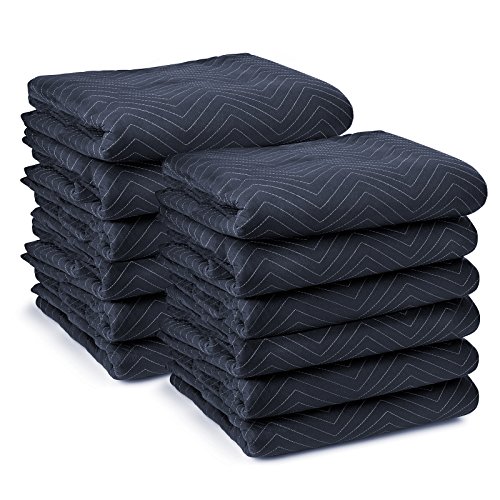
Sure-Max names its own tier without blushing: Pro Economy. Twelve quilted pads, eighty by seventy-two inches each, thirty-five pounds per dozen, in navy blue and black. That is the profile of the blanket a household buys when the move is big, the furniture is ordinary-to-good, and the budget must cover tape, boxes, a truck and pizza as well as padding. Thirty-five pounds per dozen works out to a pad with real loft — enough to wrap a dresser, line a floor run, or fold double over a glass-fronted cabinet — without the arm-aching heft of the professional tier.
- Weight: 35 lb/dz, per the listing
- Size: 80 x 72 inches
- Pack: twelve blankets
- Construction: quilted shipping furniture pads
- Colours: navy blue and black
Strengths
- Twelve full-size pads cover a multi-room move in one purchase
- Quilting keeps padding distributed instead of lumped at corners
- Mid-range weight balances protection against handling effort
Trade-offs
- Economy tier will not match ninety-pound pads against sharp, heavy edges
- Twelve pads are a storage commitment after the move ends
- Two-tone pack means colours alternate rather than matching
The arithmetic of a house move favours this pack relentlessly. Count a typical load: sofa, two beds, dressers, a dining set, appliances, a desk, bookcases. Each large piece wants one pad minimum, the fragile ones want two, and the truck floor wants a layer beneath everything. Twelve pads vanish into that arithmetic before the truck is half loaded, which is why movers buy dozens and amateurs buy four-packs and regret it at the kerb. Starting with twelve mid-weight pads is the single easiest way to make a self-managed move feel professional.
After the move, these pads begin their second career, which economy blankets do better than any other tier: garage duty. They line shelves, wrap stored furniture, cushion the car boot for tip runs, and pad the floor under DIY projects. A household that moves once and stores smartly will use a dozen economy pads for a decade. That long tail of usefulness is the honest argument for the twelve pack over a rental — the rental goes back on Monday; the Sure-Max stays, working quietly, for years.
One more scenario belongs to this pack: the phased move, where a household relocates across several weekends rather than in one hired-truck day. Twelve pads let each carload travel protected without a nightly unpacking of the same four blankets, and the mid weight means a single person can wrap and carry a padded dresser drawer stack without heroics. Phased moves are how most families with two cars and no deadline actually relocate, and a dozen affordable pads is the equipment that makes the method feel calm instead of improvised.
Best for: whole-house self-moves and anyone furnishing a garage with working pads. Not suited for: protecting genuinely heavy, sharp-edged antiques in a single layer. Volume with honest weight is a rare listing combination, so Check price on Amazon if a dozen mid-weight pads matches your inventory.

WEN Padded Moving Blankets 4 Pack 72×80
WEN approaches the category from the workshop. Its four pack of heavy duty padded blankets measures seventy-two by eighty inches — the generous orientation, longer than wide — and the maker is a tool company, which shows in the framing: these are protective pads that happen to serve moves, sold in a count sized for a project rather than a household relocation. Four big pads suit the studio move, the single-room shuffle, the appliance swap, or the top-up role beside a larger fleet of blankets already owned.
- Size: 72 x 80 inches
- Pack: four blankets
- Construction: heavy duty padded, per the listing
- Weight per dozen: not given in the listing title
- Model reference in listing: 272804
Strengths
- Large single-pad coverage for sofas, mattresses and appliances
- Four pack suits small moves without surplus storage
- Tool-brand framing implies workshop second life
Trade-offs
- Four pads run out fast on a multi-room load
- No dozen weight published in the title to compare directly
- Buying several packs to scale up erases the simplicity
Think of this pack as the answer to a specific Saturday: the washing machine is being replaced, the new one arrives at noon, and the floors between the door and the laundry room are worth more than the machine. Four large pads lay a protected path, wrap the outgoing appliance, and cushion the incoming one. The same four pads cover a student’s move across town or a single inherited sideboard travelling to a sibling’s house. Small, defined jobs are where a four pack shines, and most households face those jobs far more often than full relocations.
The missing dozen weight deserves a plain word. WEN’s listing title leans on heavy duty padded rather than a number, so this guide cannot rank its loft precisely against the Sure-Max thirty-five or the JourneyO ninety. Buyers for whom that figure is decisive should read the full listing page for specifications before choosing. Buyers choosing by role — a handful of large, sturdy pads for defined jobs — will find the pack coherent as offered, and the seventy-two by eighty footprint is genuinely among the most useful single sizes in the category.
Workshop owners will read this pack differently again. A padded blanket under a project car, over a finished tabletop awaiting collection, or lining the bench during assembly is furniture protection in its daily form, and four pads rotate through those duties without ever being missed elsewhere. WEN’s tool-catalogue context quietly promises that life: the blanket as shop equipment that occasionally moves house, rather than moving equipment that occasionally enters a shop. Buyers whose garage is a workplace may find that framing decisive.
Best for: small moves, appliance days and topping up an existing blanket stock. Not suited for: a full family relocation bought as the only protection. If four large pads are the shape of your Saturday, Check price on Amazon and picture them against your largest piece before ordering.

VEVOR Recycled Cotton Moving Blankets 12 Pack 72×54
VEVOR’s dozen is the lightweight of the guide and wears two distinctions proudly: recycled cotton construction and a stated weight of twenty-one pounds per dozen. At seventy-two by fifty-four inches, each pad is a touch smaller than the full-size sheets elsewhere here, and the listing aims them at protecting furniture, floors and appliances alike. Light pads are not failed heavy pads; they are a different tool. They drape over curved pieces, tuck around chair legs, fold into box liners and layer two-deep where a single heavy pad would be overkill and under-flexible.
- Weight: 21 lbs/dz, per the listing
- Size: 72 x 54 inches
- Pack: twelve blankets
- Material: recycled cotton, per the listing
- Stated targets: furniture, floors, appliances
Strengths
- Recycled cotton gives textile waste a working second life
- Light weight makes layering and draping genuinely easy
- Twelve pads spread across many small and medium pieces
Trade-offs
- Thin padding is wrong for heavy, sharp-cornered loads alone
- Smaller sheet size leaves the biggest pieces short of coverage
- Light pads shift more in transit unless strapped or taped
The recycled cotton story deserves respect rather than a passing nod. Moving blankets live rough lives and are often treated as disposable; a pad spun from recycled textile starts its life having already diverted material from landfill, and a dozen of them multiplies that small virtue. For renters moving between flats with mid-weight furniture — flat-pack pieces, soft seating, electronics — twenty-one pounds per dozen honestly suffices, especially doubled over corners and screens. Matching the pad to the load is greener than overbuying armour, too.
Layering is this pack’s technique, and it is worth learning. One VEVOR pad over a television, a second folded across its corners; one under a stack of picture frames, another between them. Twelve pads invite that generosity in a way six heavy pads cannot, because there are simply more units to distribute. The mover’s question is never only how thick, but how many — and on the how-many axis, this dozen ties for the lead in this guide while asking the least of the arms carrying it.
Renters in particular should note how forgiving light pads are of small storage. A dozen twenty-one-pound blankets compress into a fraction of the cupboard that a dozen heavy pads demand, which in a flat is not a detail but the whole decision. They also travel well between the short leases that define renting life: one person can carry the whole dozen in a single trip to the car. The category’s lightest serious option exists because that life exists, and it serves it without apology.
Best for: flat moves, layered wrapping and buyers who value recycled material. Not suited for: single-layer protection of very heavy furniture. A dozen light pads is a system, not a compromise, and Check price on Amazon confirms the recycled cotton construction on the listing.

Amazon Basics Tear-Resistant Moving Blankets 6 Pack 72×80
Durability of the blanket itself is this pick’s headline: reinforced, tear-resistant moving blankets from Amazon’s own Basics line, six of them, black, at seventy-two by eighty inches. Movers destroy blankets in predictable ways — dragging loaded pads across concrete, snagging on truck door latches, catching under dolly wheels — and a reinforced construction speaks directly to that abuse. Six large pads sit in the middle of this guide’s count range, aimed at the one or two bedroom move where a dozen would linger in storage afterward.
- Size: 72 x 80 inches
- Pack: six blankets
- Construction: reinforced tear-resistant, per the listing
- Colour: black
- Weight per dozen: none stated in the listing title
Strengths
- Reinforcement targets the tearing that kills ordinary pads
- Six large pads fit the one-to-two-bedroom move neatly
- Black hides the grime that moving blankets inevitably collect
Trade-offs
- No published dozen weight in the title for loft comparison
- Six pads still leave a big house move short
- Black pads absorb heat on sunny loading days
The tear question is worth dwelling on, because it separates blankets that survive one move from blankets that survive five. Padding rarely fails by compressing; it fails by ripping at a stress point, after which the pad sheds its filling and becomes a rag. Reinforcement — stronger binding, tougher facing — is the maker’s answer, and Amazon Basics stakes its listing on it. For households that lend blankets to friends, haul them to storage units and press them into renovation duty, that toughness compounds into real value across years.
Six pads at this size also make a tidy starter fleet for the perennially useful neighbour: the person whose garage holds the blankets everyone borrows for collecting furniture, moving students home and protecting floors during painting. Black is the right colour for that life, concealing the evidence of every job. Pair this six pack with a light dozen from elsewhere in the guide and the combined fleet covers nearly any domestic scenario — heavy reinforced sheets for the big pieces, light pads for everything else.
There is a social dimension to owning the reinforced six pack: your blankets become the street’s blankets. They will be borrowed for collecting wardrobes, moving offspring, and protecting floors during a neighbour’s renovation, and reinforcement is what lets a pad survive other people’s urgency. Households comfortable with that role — most streets have one, and value it — should buy for the borrowers as much as for themselves. The black colour, again, is the right choice for a fleet whose biography will be written by many hands.
Best for: repeat movers, lenders and one-to-two-bedroom relocations. Not suited for: buyers who rank purely by published dozen weight. Toughness is a legitimate spec in its own right, and Check price on Amazon shows the reinforced construction in the listing details.

JourneyO Padded Moving Blankets 6 Pack 80×72
Ninety pounds per dozen. Sit with that number a moment, because it is nearly triple the Sure-Max figure and more than quadruple the VEVOR, and it defines this JourneyO six pack completely: six blue pads at eighty by seventy-two inches, built to heavy duty pro specification. Each pad carries roughly the weight of a small bag of cement, and wrapping one around a piano, a gun safe, a marble-topped table or a cast-iron range feels less like draping cloth and more like installing armour. This is the blanket tier professionals reach for when the cargo is irreplaceable.
- Weight: 90 lb/dz, per the listing
- Size: 80 x 72 inches
- Pack: six blankets
- Tier as listed: heavy duty pro
- Colour: blue
Strengths
- Densest padding in this guide by a wide margin
- Full eighty-by-seventy-two coverage for the largest pieces
- Pro weight class suits heirloom and commercial-grade loads
Trade-offs
- Heavy pads tire the people carrying the wrapped furniture
- Six pads at this weight are a serious storage stack
- Overkill, honestly, for flat-pack furniture and soft goods
Weight cuts both ways, and this review will not pretend otherwise. A ninety-pound dozen protects superbly and handles terribly; every wrapped piece gains noticeable kilos, stairs become negotiations, and a lone mover will curse the armour by the third trip. Crews of two or more, dollies, and short carries are this tier’s natural habitat. The buyer should also count honestly: how many pieces in the house genuinely warrant pro padding? For most homes the answer is two or three — which is precisely why a six pack, rather than a dozen, is the sensible count at this weight.
Where the JourneyO earns its keep beyond argument is the single catastrophic save. One gouge across a refinished tabletop, one cracked marble edge, costs more in repair and regret than the entire price difference between blanket tiers. Insurance rarely covers the sentimental layer of that loss. Households moving antiques, instruments or inherited pieces are not buying padding when they choose this pack; they are buying down the probability of a story they would tell with bitterness for decades. Priced against that, heavy is cheap.
Professional movers reading this guide would add one refinement: at this weight, how a pad is folded matters as much as how it is wrapped. Thick pads folded carelessly develop permanent creases that telegraph through to polished surfaces; folded in thirds and stored flat, they stay true. The six pack’s owners are, almost by definition, people protecting valuable things, and that small storage discipline protects the protector. It takes one shelf and no money, and it is the difference between a pro pad at year five and a lumpy relic.
Best for: antiques, pianos, stone tops and any load whose damage would be permanent. Not suited for: solo movers, long stair carries or lightweight furniture. When the cargo justifies armour, Check price on Amazon and confirm the ninety-pound dozen weight on the listing before committing.
Simpli-Magic Padded Moving Blankets 12 Pack 72×40
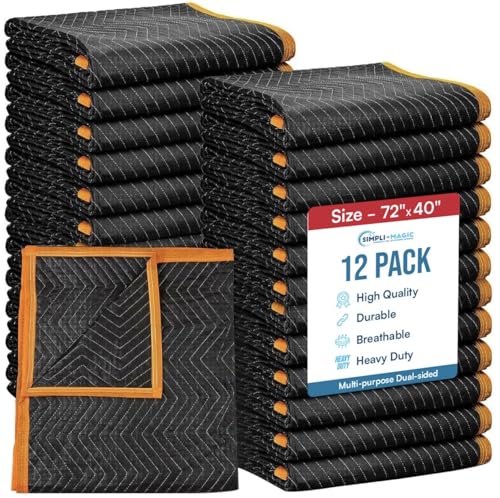
Geometry is this pick’s idea. Simpli-Magic cuts its heavy duty padded blankets at seventy-two by forty inches — full length, narrow width — and sells them twelve at a time as packing blankets and furniture covers. A forty-inch width sounds like a compromise until the load is mostly tall, slim things: floor lamps, rolled rugs’ companions, chair stacks, framed art, a bicycle, the long sides of a bookcase. On such pieces a full-width pad bunches and wastes half its area in folds, while the narrow cut wraps cleanly, tapes neatly and layers without bulk.
- Size: 72 x 40 inches
- Pack: twelve blankets
- Construction: heavy duty padded, per the listing
- Stated roles: packing blankets, furniture covers
- Weight per dozen: not given in the listing title
Strengths
- Narrow cut wraps tall, slim pieces without wasteful bunching
- Twelve units invite generous layering and distribution
- Excellent as interleaving between stacked items in the truck
Trade-offs
- Forty inches cannot wrap a sofa or mattress alone
- No dozen weight in the title for direct loft ranking
- Works best as part of a fleet rather than the whole fleet
Every experienced mover keeps a sub-fleet of smaller pads, because real loads are mostly not sofas. They are the twenty awkward objects between the sofas: the mirror, the lamp with the fragile stem, the guitar case, the stack of dining chairs that wants a pad between each pair. A dozen seventy-two by forty pads is that sub-fleet bought in one gesture. They also serve as truck carpentry — lining walls, filling voids so loads cannot shift, padding the wheel arches — jobs where a big pad would have to be folded into submission first.
The honest limitation is the mirror image of the strength. A household whose move is dominated by three huge pieces gains little here; the narrow pads would need pairing and taping to cover a wardrobe, at which point a full-size sheet was the right tool all along. Read this pick as a specialist that makes the other five picks better, or as the whole answer only for the genuinely slim-profile move: a room of art, instruments and lamps travelling across town.
Artists and collectors, a word in your direction. Works travel to exhibitions, photographers’ studios and buyers’ homes in a rhythm nothing like a house move, and the narrow dozen is shaped for exactly that circulation: one pad per piece, wrapped and taped, with spares for the return journey. Galleries improvise this with whatever cloth is at hand; owning the right cut of pad turns improvisation into procedure. For a studio that ships or shows work even twice a year, the pack justifies itself in avoided frame corners alone.
Best for: art, lamps, chair stacks and as the supporting fleet beside full-size pads. Not suited for: wrapping the largest furniture single-handed. Specialists earn their place by fit, and Check price on Amazon shows the narrow format clearly in the listing.
The fleet at a glance
| Blankets | Weight per dozen | Size | Pack |
|---|---|---|---|
| Sure-Max Pro Economy | 35 lb | 80 x 72 in | 12 |
| WEN Padded | See listing page | 72 x 80 in | 4 |
| VEVOR Recycled Cotton | 21 lbs | 72 x 54 in | 12 |
| Amazon Basics Tear-Resistant | See listing page | 72 x 80 in | 6 |
| JourneyO Heavy Duty Pro | 90 lb | 80 x 72 in | 6 |
| Simpli-Magic Padded | See listing page | 72 x 40 in | 12 |
How much blanket does your move actually need?
Walk the house and count like a mover
Take a notebook, not a guess. Room by room, list every item too big for a box, and assign each one pad: one for ordinary pieces, two for glass, gloss finishes and anything inherited. Add two for the truck floor and walls, and two wildcards for the objects you have forgotten exist — there are always objects you have forgotten exist. Most two-bedroom homes land between ten and fourteen pads; most studios land between four and six. That count, against the pack sizes above, is your order.
Assign weight by consequence, not by size
The heaviest pads belong on the pieces whose damage would be permanent or expensive, which is not always the largest furniture. A flat-pack wardrobe is big and nearly indestructible; a small marble side table is neither. Walk the inventory asking what a gouge would cost — in money, in repair possibility, in family feeling — and spend the JourneyO-tier protection exactly where the answers are frightening. Light pads everywhere else is not cheapness; it is correct allocation.
Plan the second life before the first use
Moving blankets outlive moves by decades, so buy with the afterlife in view. A household with a garage, workshop or storage habit will use a dozen pads forever; a flat-dweller moving abroad in a year should buy the four or six pack and pass them on. Storage space is the silent constraint: twelve heavy pads occupy a shelf the way a winter’s worth of bedding does. The right purchase is the one whose tenth year looks as sensible as its first weekend.
Renting versus buying, settled plainly
Rental blankets make sense for the one-move household with no storage and no future projects, and they make no sense at all for anyone who moves every few years, lends to family, or runs a workshop. Ownership also removes the return deadline, which is when rushed unloading damages furniture. If the calendar after your move contains even one more relocation, one renovation or one child leaving for university, the packs in this guide will pay their way.
Wrapping technique: where blankets succeed or fail
A blanket protects only where it stays, and staying is technique. Wrap the pad fully around the piece, overlap the edges, and secure with tape applied to the blanket — never to the furniture’s finish — or with stretch wrap over the top. Corners deserve folded reinforcement, because corners are what meet door frames. Glass and mirrors want a pad against the surface and a rigid layer outside it where possible; a blanket alone is cushioning, not armour plate, and pretending otherwise cracks glass.
Inside the truck, blankets work a second shift as engineering. Line the walls where furniture will ride, wedge folded pads into voids so nothing can gather momentum, and lay a floor layer beneath the heaviest pieces. A load that cannot move cannot be damaged by movement; that sentence is the whole science of packing a truck. The narrow Simpli-Magic pads and the light VEVOR dozen excel at this void-filling work, which is another reason fleets beat single products.
Unloading deserves the same patience as loading, though it rarely gets it. Pads come off indoors, not on the driveway; pieces are unwrapped where they will live; blankets are shaken, folded and counted before the truck leaves. The count matters — a pad left in a returned rental truck is a deposit conversation nobody enjoys — and the fold matters, because a blanket stored folded flat is a blanket ready for its next decade of small emergencies.
After the move: the blanket’s second and third careers
Households that keep their moving blankets discover a slow parade of uses. They pad the car boot for collecting furniture and Christmas trees. They line the garage floor under engine work and the garden path under kneeling. They wrap the good furniture in the storage unit, cover the motorcycle, cushion the sound of a drum kit, and become, in more than one family, the dog’s approved outdoor bed. Readers furnishing lighter domestic adventures will find the leisure cousin of these pads compared in Best Selling Picnic Blankets, while the heated relatives live in Best Low Voltage Electric Blankets — same word, three entirely different species of cloth. Even the floor gets its own version of the argument in Best Washable Runner Rugs, where washability rather than padding is the prized trait. Knowing which species a task needs is most of household wisdom.
Protecting floors, stairs and the house itself
Moving blankets guard the building as faithfully as the furniture, a duty buyers often forget until the first gouge appears in a hallway floor. A runner of pads from door to room — the light VEVOR dozen is ideal — turns a parade of boots, dollies and dragging corners into a procession the floor never feels. Staircases deserve a pad folded over the banister rail and one on the turn landing, where every large piece pivots within an inch of the wall. Door frames, those perennial casualties, can be wrapped with a narrow Simpli-Magic pad and a strip of tape in ninety seconds, and unwrapped without a mark.
Landlords and sellers should read that paragraph twice. A move conducted over unprotected floors can cost a deposit or a buyer’s goodwill; a move conducted over pads leaves the house exactly as photographed. The blankets that enable that outcome cost less than one hour of a decorator’s time. When the last piece is in the truck, walk the pad runners once: any scuff on a pad is a scuff the floor did not take, and the small pile of evidence tends to convert even the sceptical into blanket believers.
Appliances make the building-protection case on their own. A fridge or washer crossing a kitchen floor on a dolly concentrates hundreds of pounds onto small wheels; a pad beneath spreads the load and catches the drips that appliances reliably produce when tilted. Movers who skip the floor pad to save three minutes spend thirty repairing impressions in vinyl. The lesson generalises: blankets are cheapest at the moment they look unnecessary.
Storage furniture, seasonal duty and the long game
Between moves, the smartest households keep a few pads in permanent service. Stored furniture wears a blanket the way good clothes wear a garment bag: the pad keeps dust, light and casual knocks off the finish for years. Seasonal items — the garden furniture stack, the spare bed, the good dining chairs in the garage — all live better wrapped. A fleet bought for one move thus becomes the house’s standing protection service, and the purchase price amortises across a decade of small rescues nobody counts.
Sound is an unlisted benefit worth mentioning. Pads draped over a drum kit, laid under a washing machine that walks across the laundry floor, or hung in a workshop corner measurably soften a room’s noise. Musicians and home recordists have used moving blankets as improvised acoustic treatment for generations, precisely because dense quilted cloth is what the physics asks for. The JourneyO tier, densest here, performs that trick best — another entry in the ledger of second careers that make ownership beat rental.
Finally, think of the blanket fleet as family infrastructure that travels between generations of households. The pads that move a child into a first flat this year will move a grandchild in twenty years, unchanged in function, faintly heroic in biography. Few purchases in the home category offer that span. Buying a sensible fleet once — mid-weight backbone, specialists where the inventory demands — is therefore less a moving expense than a small, permanent investment in every relocation your family will ever improvise.
How professionals load a truck, in blanket terms
Watch a professional crew and the blankets reveal their hierarchy. The first pads down form the floor layer, and they are rarely the best ones — mid-weight workhorses like the Sure-Max dozen take the grit and the dolly wheels. Walls get lined where the tall pieces will stand. Then the furniture itself arrives, each piece wrapped before it leaves its room, because wrapping in place is calmer and cleaner than wrapping at the truck. The heaviest pads appear only around the designated treasures, and everyone on the crew knows which pieces those are before the first lift.
Loading order follows the same logic. Heavy, blanket-wrapped pieces form the base and the walls of the load; lighter wrapped goods fill the middle; pads stuff every void so the whole mass rides as one body. A well-blanketed truck is quiet at speed — no rattles, no shifts — and drivers say they can hear a badly packed load within the first mile. Amateurs can copy the entire method with the fleets in this guide; the knowledge costs nothing and the blankets do the rest.
The unload reverses the choreography, with one addition: inspection. Each pad shaken out at the destination tells the story of what it absorbed — the scratch that stopped in the quilting, the corner that pressed but never cut through. Crews read those marks the way sailors read weather. A household that performs the same small inspection learns, move by move, exactly where its protection is being spent, and buys its next pack with evidence rather than intuition.
Special loads: pianos, glass, instruments and art
Certain objects rewrite the rules, and a good fleet bends around them. Upright pianos concentrate enormous weight on small casters and present polished surfaces on every side; they want the heaviest pads beneath and around, a dolly under the whole assembly, and a crew that has agreed the route before the first tilt. The JourneyO tier exists for this paragraph. Glass-fronted cabinets and mirrors want a pad against the glass, a rigid board outside the pad if one is available, and transport in a vertical orientation, braced so the piece cannot flex. A blanket cushions; it does not stiffen, and glass forgives cushioning but not flexing.
Instruments split by temperament. Guitars and violins travel in their cases, with pads serving as the cushioning around the cases inside the vehicle. Drum kits, oddly, are blanket natives: shells nest inside one another separated by pads, hardware rides wrapped, and the kit arrives without a single new scratch. Artwork wants the narrow dozen and clean pads specifically — a pad that has lined a garage floor should never touch a canvas or a gilt frame, which is why fleets benefit from an informal two-class system: house pads and clean pads, stored apart, never confused on the day.
Antiques gather all these lessons into one object: old joints, irreplaceable finishes, materials that react badly to pressure in the wrong place. Wrap generously, lift by structure rather than by ornament, and let the heaviest pads form a cradle rather than a tourniquet. The goal is a piece that experiences the move as a gentle, padded stillness. Achieve that, and the blanket fleet has done the finest work it will ever do.
Teaching helpers, borrowing trucks and other human factors
Most self-managed moves run on borrowed labour — friends, siblings, the neighbour with the strong back — and blankets quietly manage that labour too. A wrapped piece is a piece a helper can grip without fear of being blamed for a scratch, which makes volunteers braver and steadier. Unwrapped antiques produce the opposite effect: hesitant carries, awkward grips, and risk concentrated exactly where nobody wants it. Padding the furniture is also, in a real sense, padding the friendships, because nothing sours a favour like damage done while helping.
Brief the crew in blanket terms before the first lift. Which pieces get two pads, which get the heavy ones, which wall of the truck is lined — a two-minute conversation that prevents twenty improvised decisions. Assign one person to pads specifically on a big move: folding, carrying, counting. That role sounds minor until the moment a pad is needed at the far end of the house and nobody knows where the stack went. Professional crews run this way for a reason, and the reason scales down to a family Saturday perfectly well.
Feed people, rest people, and let the blankets do the worrying about surfaces. A move is remembered socially long after it is forgotten logistically, and households that protect both the furniture and the helpers tend to be invited to help again — which, given the mathematics of friendship and relocation, may be the most valuable outcome a blanket fleet can buy.
A note on colour, of all things
Blanket colour looks like pure taste until a move is underway. Two-tone fleets, like the navy and black Sure-Max dozen, let a crew sort pads at a glance — dark for floors, light-side-out for finished surfaces — if the household bothers to set the convention. Single-colour fleets look tidier in storage and photograph better in the listing, which is worth exactly nothing at the kerb. What does matter is visibility against the truck’s interior: a blue pad shows clearly in a dim cargo space, while a black pad can vanish into shadow and be left behind. Crews count pads at the end of the day; colour that helps the count is a feature, and colour that hides a stowaway pad is a small, real cost.
Colour also writes the fleet’s future. Pads destined for lending, workshops and garden duty should be dark and forgiving; pads reserved for clean work — art, instruments, finished furniture — benefit from being visibly distinct, so nobody grabs the wrong class in a hurry. Households building a two-class system from this guide might run black Amazon Basics for the rough work and keep the blue JourneyO set apart for treasures. The system costs nothing beyond a shelf decision, and it prevents the one contamination accident every mover has a story about.
Common mistakes when buying moving blankets
Buying four pads for a fourteen-pad house. Underbuying is the classic error, discovered at the kerb with the truck meter running. Count the inventory honestly, add wildcards, and let the pack size follow the count rather than the hope.
Choosing by adjective instead of dozen weight. Heavy duty appears on light pads and heavy ones alike; the pounds-per-dozen figure is the maker’s measurable promise. Where a listing publishes it, compare it. Where it does not, know that you are buying construction claims instead of numbers.
Wrapping everything in the heaviest tier. Ninety-pound pads on flat-pack furniture waste money, storage and the movers’ backs. Consequence, not size, should assign the armour — save the pro weight for the pieces whose loss would actually hurt.
Taping blankets directly to furniture finishes. Tape belongs on the blanket, on stretch wrap, on anything except varnish, veneer and paint. One lifted finish line costs more than the entire blanket fleet, and it happens in the last tired hour of packing.
Returning, selling or binning the pads immediately. A moving blanket’s first job is its least interesting one. Households that keep them find uses for a decade; households that dispose of them re-buy protection at the next appliance delivery, renovation or house move, at full price and in a hurry.
Final recommendation
Match the fleet to the inventory. A typical house move is best served by the Sure-Max dozen as the backbone — honest mid-weight pads in real quantity — with the JourneyO six pack reserved for the pieces whose damage would be permanent, if your inventory contains such pieces. Lighter lives travel well on the VEVOR dozen, especially layered; smaller or rougher lives suit the WEN four pack and the reinforced Amazon Basics six. Add the Simpli-Magic narrow dozen whenever the load includes art, lamps and chairs in number. Buy once, count honestly, and the blankets will still be working for your household long after the move is a story.
One closing piece of arithmetic for the undecided: price the alternative. A single professional furniture repair — a refinished top, a re-veneered edge, a reglued and touched-up antique — typically exceeds the cost of an entire blanket fleet, and some damage, particularly to inherited pieces, cannot be repaired at any price because the original finish was the value. Against that arithmetic, the question is never really whether a household can afford proper moving blankets. It is whether it can afford the move without them, asked in the calm weeks before the truck arrives rather than in the loud hour after something cracks.
Keep one pad out of the fleet permanently, marked with a strip of tape if necessary, as the household’s designated utility cloth, and the fleet stays complete, counted and ready, for moving day. The utility pad absorbs the paint spills, the car-boot emergencies and the garden kneeling, sacrificing itself so the counted sets remain counted. It is a small organisational trick, borrowed from hotels and their linen hierarchies, and it ends the slow erosion by which a dozen quietly becomes nine without anyone noticing until the truck is already booked, the helpers are already fed, and the dressers are standing unwrapped in the hall at the exact moment when nobody has time left to solve the shortage gracefully, calmly, or without a second, entirely avoidable trip to a shop that has already closed for the evening.
Frequently asked questions
What does pounds per dozen actually tell me?
It tells you the combined weight of twelve blankets, which tracks the amount of padding material in each one. Twenty-one pounds per dozen means a light, drapable pad; thirty-five means a mid-weight workhorse; ninety means a dense professional pad. It is the closest thing the category has to a universal comparison number, which is why this guide quotes it wherever a listing publishes it.
How many moving blankets does a two-bedroom home need?
Usually ten to fourteen, counting one per large piece, two for fragile or glossy pieces, and a few for the truck itself. The dozen packs in this guide exist because that arithmetic is so consistent. Studios and single rooms manage with four to six, which is the WEN and Amazon Basics territory.
Can moving blankets be washed?
They can be cleaned, with expectations set correctly: these are working pads, and most households hose, brush or spot-clean them and dry them thoroughly rather than machine-washing bulky quilted pads. Shake them out after every job, store them dry, and they will stay serviceable for years. A pad stored damp is a pad retired early.
Are light blankets a false economy?
Only when they are asked to do a heavy blanket’s job alone. Layered, or matched to light furniture, the twenty-one-pound VEVOR dozen is correctly engineered and easier to live with. The false economy is the mismatch — light pads under a piano, pro pads around a bookcase — not the weight class itself.
Should I rent instead of buying?
Rent if this is certainly your only move, storage is impossible, and no projects loom. Buy if any of those conditions wavers. Ownership removes the return deadline, survives into a decade of secondary uses, and costs less than two rentals in most households’ real timelines.
Do moving blankets protect against rain during loading?
They blunt a shower; they do not waterproof a load. Quilted pads absorb water rather than shedding it, so a rainy loading day calls for speed, a canopy if one can be improvised, and plastic sheeting over the blanket layer for the walk between door and truck. The blankets’ job resumes inside the vehicle, where the load is dry and the padding works as designed.
Can I use moving blankets as furniture covers in storage?
Yes — that is one of their best second careers, and several listings in this guide name furniture covering among their roles. Drape rather than seal, so air can circulate, and lift the pads occasionally in long storage to check the finish beneath. A stored piece under a clean pad ages far more gracefully than one under plastic alone.
Count the furniture, weigh the consequences, and your move will be remembered for the new home rather than for anything that broke on the way to it.


