What's inside
- Key Takeaways
- Quick Picks
- How We Chose These Picks
- Which of the Best Cotton Area Rugs for Living Rooms Fits Your Floor?
- How Do the Six Rugs Compare at a Glance?
- Why Choose Cotton for a Living Room at All?
- Braided, Woven or Tufted: What Changes Underfoot?
- How Do You Wash a Cotton Rug Without Wrecking It?
- How Should Jute-Blend Rugs Be Cleaned Instead?
- What Size Cotton Rug Does a Living Room Need?
- How Does Cotton Handle Sunlight, Pets and Children?
- Why Does a Cotton Rug Need a Pad or a Backing?
- How Do You Layer Cotton Rugs in a Cottage Living Room?
- What Should You Check When a Hand-Woven Rug Arrives?
- How Long Will a Cotton Rug Live?
- Cotton Versus Wool Versus Synthetics, Honestly
- How Do You Keep a Braided Rug’s Edges Handsome?
- What Colours Does Cotton Wear Best?
- How Should You Vacuum Cotton and Jute Rugs?
- When Is an Accent Rug the Whole Answer?
- How Do You Store Cotton Rugs Between Seasons?
- How Do You Choose a Cotton Rug for a Room With a Fireplace?
- What Does Hand-Woven Actually Buy You?
- How Should You Arrange Furniture on a Cotton Rug?
- Why Do Cotton Rugs Suit Summer Houses and Porches Indoors?
- How Do You Refresh a Cotton Rug Between Washes?
- What Should a First-Time Rug Buyer Learn From Cotton?
- How Do You Match a Cotton Rug to Curtains and Upholstery?
- What Is the Environmental Case for Cotton and Recycled Rugs?
- How Do You Handle a Cotton Rug in a House With Underfloor Heating?
- What Mistakes Do Buyers of Cotton Rugs Make Most Often?
- Final Recommendation
- Frequently Asked Questions
- Related Guides
As an Amazon Associate I earn from qualifying purchases. This post may contain affiliate links at no extra cost to you.
cottageverdict.com is reader-supported. When you buy through links on our site, we may earn an affiliate commission.
Where to buy: the six rugs below link to their Amazon listings from the Quick Picks table, their review headings and the comparison table, where you can check price on Amazon and confirm the fibre content and dimensions for yourself, a habit this guide recommends with unusual warmth. The best cotton area rugs for living rooms promise a natural, breathable, washable floor, and the honest version of that promise includes jute partners, one wool-dominant exception and sizes from accent mats to a 9×12, each labelled for exactly what it is.
Cotton’s case is tactile before it is visual. It is the fibre of the household’s most trusted cloth, soft without static, cool in summer, kind to bare feet and unbothered by water in a way wool never is. A living room floored in cotton feels informal in the best sense, a room that expects to be lived in. The six picks below explore that character across braided, woven, hand-loomed and recycled constructions, with their fibre percentages stated rather than smoothed over.
Key Takeaways
- Fibre percentages are stated per pick; one pick is 80 percent wool and is labelled an exception.
- Braided cotton has body and texture that flatweave cotton cannot offer.
- Jute partners bring rustic texture and rule out soaking washes.
- The washable picks earn their claim the cotton way, through water-tolerant fibre and backing.
- Two picks are accents, not anchors; their reviews say so in the first paragraph.
- Cotton drinks water and dries slowly, so washing a big cotton rug is a planned event.
Quick Picks
| Pick | Badge | Why it earns its place |
|---|---|---|
| KOZYFLY Washable Rug 6×9 Braided | Best Braided Cotton for Living Rooms | A 6×9 braided cotton rug with rubber backing, washable, in warm orange beige, tan and brown. |
| KOZYFLY Washable Rug 4×6 Braided | Best Small Braided Cotton | The 4×6 braided sibling in black and dark grey, rubber backed and washable, for smaller rooms and entries. |
| Scandilivin Jute Cotton Rug 9×12 | Best Large Hand-Woven Natural | A 9×12 hand-woven jute and cotton rug in natural beige, farmhouse in spirit, the largest rug in this guide. |
| ANSSO Wool Rug 8×10 Merino Cotton | Wool-Dominant Exception — 80% Merino, 20% Cotton | An 8×10 tufted rug that is 80% merino wool and 20% cotton, labelled here as the guide’s wool exception. |
| COTTON CRAFT Woven Area Rug – 2 Pack Entrywa | Best Reversible Cotton Pair | A 2-pack of woven cotton throw rugs with fringe in tan natural, reversible and washable, sized as accent mats. |
| COTTON CRAFT Jute Chindi Braid Rag Rug – 4 F | Best Round Recycled Cotton Accent | A 4-foot round handwoven braid of jute and recycled cotton chindi, reversible, in boho multi-colour. |
How We Chose These Picks
Fibre honesty governed everything. We read each listing’s material statement and carried it into the review unedited in spirit: the KOZYFLY pair as braided cotton, the Scandilivin as a jute and cotton hand-weave, the COTTON CRAFT round as jute with recycled cotton, and the ANSSO as what it is, a merino-dominant rug with a cotton minority, included as a labelled exception because its comfort answers a question cotton shoppers genuinely ask.
Construction came second. Braiding, flat weaving, hand looming and tufting produce four different floors from related fibres, and the guide spreads its picks across them so the reader chooses a texture, not merely a pattern. Backing and care were read together, since a washable claim means little without a construction that survives the wash, and a jute rug’s dry-care terms are a specification, not a failure.
Finally, scale was labelled rather than hidden. This guide contains a 9×12 foundation, two mid-size living-room rugs, an 8×10 exception and two accents, and each review opens by placing its rug in that geography. A reader who finishes the guide knowing which rug does which job has been served better than one sold six interchangeable rectangles.
Which of the Best Cotton Area Rugs for Living Rooms Fits Your Floor?

KOZYFLY Washable Rug 6×9 Braided — Best Braided Cotton for Living Rooms
KOZYFLY’s 6×9 is the most complete answer to this guide’s question, because it is genuinely what the title promises: a braided cotton area rug, sized for a living room, with the practical additions the fibre needs. The rubber backing keeps a light woven rug honest on hard floors, and the washable claim suits cotton’s nature, since cotton is the fibre households already trust to go through water and come back itself.
Braiding changes a cotton rug’s character entirely. Where flatweave cotton can feel like a cloth on the floor, braided construction gives the rug body, texture and a hand-made irregularity that reads as craft rather than manufacturing. The warm palette here, orange beige with tan and brown, is a sunset register that flatters leather, mid-tone wood and the kind of living room that collects its colours rather than coordinating them.
At 6×9 it is a true living-room size for modest rooms, anchoring a sofa and coffee table without demanding the floor plan of a hall. Wash it as the listing directs and dry it thoroughly and flat where you can, because cotton drinks water generously and a braided rug is heavy with it; the effort is the honest price of a natural-fibre rug that can be cleaned at home at all.
- Size: 6×9 ft
- Construction: braided woven cotton
- Backing: rubber, non-slip
- Care: washable, per listing
- Palette: orange beige, tan, brown
- Rooms named by maker: living room, bedroom, dining room, office
Strengths
- Braided body gives cotton real texture and weight
- Rubber backing suits hard living-room floors
- Washable in the way cotton households expect
Trade-offs
- Wet braided cotton is heavy to handle
- Warm palette will not sit quietly in cool rooms
- Braided edges ask for care when vacuuming
Braided rugs reward a vacuum without a beater bar, worked along the braid rather than across it. The construction’s charm is its raised, hand-worked surface, and treating it gently in the weekly clean is how that surface stays charming for years instead of fuzzing into apology.
Best for: modest living rooms wanting natural cotton texture with grip and washability
Not suited for: cool-toned rooms or anyone wanting a rug that lies board-flat

KOZYFLY Washable Rug 4×6 Braided — Best Small Braided Cotton
The second KOZYFLY is the same braided idea at 4×6, and the size changes the job rather than merely shrinking it. A 4×6 braided cotton rug is a reading-chair rug, a small-apartment living-room rug, a rug for the floor space in front of a sofa in a room where an 6×9 would swallow the boards whole. Its listing also names entryway and kitchen duty, and the rubber backing makes those nominations credible.
Black and dark grey is the working palette of this guide. Where its larger sibling glows warm, this one absorbs evidence: the dark braid forgives the traffic of a household entrance and the crumbs of a kitchen’s edge, and washes back without the fading anxiety that haunts pale cotton. Dark braided cotton also grounds pale floors beautifully, giving a light room one deliberate anchor.
Buyers choosing between the two KOZYFLY rugs should choose by room arithmetic, not by preference for colour alone. The braid, backing and washability are shared; what differs is the territory covered and the mood carried. In a genuinely small living room the 4×6 is not the lesser rug, it is the correctly sized one, and correct sizing is the most underrated specification in all of floor covering.
- Size: 4×6 ft
- Construction: braided woven cotton
- Backing: rubber, non-slip
- Care: washable, per listing
- Palette: black, dark grey
- Rooms named by maker: living room, kitchen, entryway, dining room, bedroom
Strengths
- Right-sized braided cotton for small rooms
- Dark palette forgives entrance and kitchen evidence
- Shares the washable, rubber-backed build of its sibling
Trade-offs
- Too small to anchor a full-size living-room suite
- Dark braid shows pale lint and pet hair
- Braided texture needs the same gentle vacuuming
In an entryway, let this rug be the household’s grit border: shoes pause on it, bags land on it, and the rest of the home’s floors stay cleaner for its service. A washable dark braid at the door is less a decoration than a border policy, and a very effective one.
Best for: small living rooms, entries and kitchens wanting dark, washable braided cotton
Not suited for: full-size living rooms needing a rug under every seat’s front legs

Scandilivin Jute Cotton Rug 9×12 — Best Large Hand-Woven Natural
Scandilivin brings scale and a second fibre. At 9×12 this is a hand-woven rug for rooms that think big, and its material is a jute and cotton partnership rather than pure cotton, a fact this guide states as plainly as the listing does. Jute brings the straw-toned body and rustic texture; cotton softens the hand and the palette. The natural beige result is the farmhouse ideal, a floor that looks grown rather than manufactured.
Hand-woven construction carries variations a machine rug irons out: slight irregularities in tension, edges that are honest rather than laser-true, a surface with weather in it. In a rustic or bohemian living room those are the rug’s credentials. In a minimalist room demanding geometric perfection they will read as flaws, and buyers should choose with their room’s temperament, not with the photograph’s lighting.
Care is where the jute partnership asks respect. Jute dislikes soaking, so this rug’s cleaning life is vacuuming, shaking and spot care rather than the machine washing the KOZYFLY pair invites. At 9×12 it would defeat domestic machines regardless. Buy it as a natural, textured foundation maintained by dry methods, and its scale and material honesty will repay the arrangement for years.
- Size: 9×12 ft, the largest here
- Construction: hand woven
- Fibre: jute and cotton blend, per listing
- Palette: natural beige
- Style: farmhouse, rustic, bohemian
- Care: dry methods and spot care suit the jute content
Strengths
- Genuine hand-woven character at a grand scale
- Jute body gives texture cotton alone cannot
- Natural beige grounds rustic rooms effortlessly
Trade-offs
- Not a machine-washable rug; jute dislikes soaking
- Hand-woven irregularities will bother perfectionists
- 9×12 is a heavy, committed piece of floor
A rug this size should be placed once and placed well, with furniture arranged on it rather than around it. Let the sofa’s front legs and the chairs all stand on the field, and the 9×12 stops being a large object in the room and becomes the room’s ground itself.
Best for: large farmhouse and rustic living rooms wanting hand-woven natural texture
Not suited for: anyone needing machine washing or crisp, machine-perfect edges

ANSSO Wool Rug 8×10 Merino Cotton — Wool-Dominant Exception — 80% Merino, 20% Cotton
This review begins with the label, because the label is the review. The ANSSO is 80 percent merino wool and 20 percent cotton, per its own listing. It is, by fibre, a wool rug with a cotton minority and a cotton non-slip backing, and it appears in a cotton guide as a clearly marked exception for readers whose living rooms want what only wool gives. Any guide that filed it as a cotton rug without that sentence would be misleading you, so here the sentence stands first.
What wool gives is the tufted softness and resilience that woven cotton cannot imitate. The ANSSO is a soft tufted area rug in beige cream at 8×10, a plush-leaning presence underfoot with the spring that makes wool the historic luxury fibre of floors. The cotton share and the cotton backing ground the construction, but the walking experience, the warmth and the recovery from furniture dents are wool’s work, and they should be credited to wool.
Judge it, then, against wool’s terms rather than cotton’s. It will not join the washable cotton conversation; wool tufted rugs ask for professional-grade care and gentle vacuuming. It asks a higher commitment and returns a higher comfort. Readers who came for cotton’s easy nature should pass it by with respect; readers who came for a natural-fibre living-room rug and find cotton too flat have just been shown their exception.
- Size: 8×10 ft
- Fibre: 80% merino wool, 20% cotton, per listing
- Construction: soft tufted
- Backing: cotton non-slip
- Palette: beige cream
- Status in guide: wool-dominant exception, not a cotton rug
Strengths
- Wool’s tufted softness and resilience at full 8×10 scale
- Cotton backing adds grip beneath the wool field
- Beige cream suits calm, layered living rooms
Trade-offs
- It is not a cotton rug, whatever shelf it was found on
- Wool care replaces cotton’s wash-and-forget ease
- Tufted pile asks for gentler vacuuming than flatweaves
Place the ANSSO where its softness will be used barefoot, the floor between sofa and window rather than under the dining end of the room. Wool’s luxury is wasted under chair legs and earned under feet, and the rug’s placement should follow that arithmetic honestly.
Best for: readers who wanted natural fibre and discover they actually want wool’s comfort
Not suited for: anyone shopping strictly for cotton, or for machine-washable care

COTTON CRAFT Woven Area Rug – 2 Pack Entrywa — Best Reversible Cotton Pair
COTTON CRAFT’s woven pair changes the scale of the conversation, and the listing is honest about it: these are throw rugs and accent mats sold as a 2-pack, not full living-room anchors. In a guide about living rooms their role is the supporting one, layered beside a sofa, under a coffee table’s edge, at the hearth or in the reading corner, where a washable cotton accent does work a giant rug cannot be bothered with.
Reversibility is the pair’s quiet brilliance. A woven cotton mat with two presentable faces doubles its service between washes, distributes its wear across both sides and lets a household flip a coffee-marked surface on a guest day without a laundry emergency. The fringe and the tan natural colouring give them the boho farmhouse character their listing claims, casual and handmade in mood.
Washability at this scale is effortless in a way the big rugs cannot match: these go in a domestic machine without a capacity calculation, dry quickly and return the same day. Households building a cotton-floored living room in layers, one large foundation plus washable accents where life actually spills, will find this pair the most-used cotton they own.
- Format: 2-pack of woven cotton throw rugs
- Faces: reversible
- Trim: fringe
- Palette: tan natural
- Care: washable, per listing
- Role: accent mats for layering, not room anchors
Strengths
- Two reversible rugs multiply placement options
- Machine washing is genuinely effortless at this scale
- Fringed boho character suits layered cottage rooms
Trade-offs
- Not sized to anchor a living-room suite alone
- Fringe needs straightening after washes
- Accent scale may disappoint buyers skimming sizes
Use the pair as the living room’s moving parts: one at the sofa’s foot where drinks are set down, one rotated to the sunniest chair. When one is in the wash the other holds the room’s pattern, and the household discovers that small washable cotton is a system, not a compromise.
Best for: layered living rooms wanting washable cotton accents in rotation
Not suited for: anyone needing a single rug to furnish a whole seating area
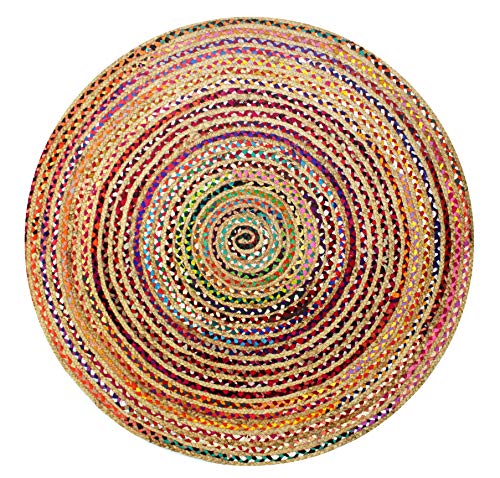
COTTON CRAFT Jute Chindi Braid Rag Rug – 4 F — Best Round Recycled Cotton Accent
The chindi rug closes the list with the oldest idea in rug-making: nothing wasted. Chindi weaving braids together recycled cotton cloth, here partnered with jute, into a 4-foot round rug of many colours, handwoven and reversible. Each one is effectively unrepeatable, since the recycled cloth that feeds it varies, and that uniqueness is either its charm or its risk depending on the buyer’s temperament.
Round is the shape’s argument. Living rooms are rectangles of rectangles, and a round rug under a reading chair, a plant grouping or a small table breaks the grid with intent. The multi-colour braid carries the boho and farmhouse rooms its listing names, gathering a room’s stray colours into one forgiving field where no single spill or scuff can find a plain background to disgrace itself on.
As with the Scandilivin, the jute content sets the care terms: dry cleaning methods, shaking and spot care rather than soaking washes, and a pad beneath if it wanders on smooth floors. Buy it as a hand-made accent with a material conscience, sized for a corner’s story rather than a room’s foundation, and it will be loved accurately, which is the best any rug can ask.
- Size: 4 ft round
- Construction: handwoven braid rag rug
- Fibre: jute and natural recycled cotton, per listing
- Faces: reversible
- Palette: multi-colour, varies by nature of recycled cloth
- Care: dry methods suit the jute content
Strengths
- Recycled cotton gives it a material story worth telling
- Round shape breaks a room’s rectangle grid
- Multi-colour braid forgives everyday marks completely
Trade-offs
- Accent size, not a room foundation
- Colours vary; the delivered rug is its own edition
- Jute content rules out machine washing
Give a round rug a round job: under a swivel chair it turns with its user, under a plant stand it becomes a garden bed indoors, and under a small breakfast table it makes a corner into a destination. Asking it to anchor a sofa suite is the one assignment its shape honestly refuses.
Best for: reading corners and boho living rooms wanting a hand-made round accent
Not suited for: buyers needing a large, uniform, machine-washable foundation rug
How Do the Six Rugs Compare at a Glance?
| Pick | Badge | Size or format |
|---|---|---|
| KOZYFLY Washable Rug 6×9 Braided | Best Braided Cotton for Living Rooms | Size: 6×9 ft |
| KOZYFLY Washable Rug 4×6 Braided | Best Small Braided Cotton | Size: 4×6 ft |
| Scandilivin Jute Cotton Rug 9×12 | Best Large Hand-Woven Natural | Size: 9×12 ft, the largest here |
| ANSSO Wool Rug 8×10 Merino Cotton | Wool-Dominant Exception — 80% Merino, 20% Cotton | Size: 8×10 ft |
| COTTON CRAFT Woven Area Rug – 2 Pack Entrywa | Best Reversible Cotton Pair | Format: 2-pack of woven cotton throw rugs |
| COTTON CRAFT Jute Chindi Braid Rag Rug – 4 F | Best Round Recycled Cotton Accent | Size: 4 ft round |
Read size as the first sort and fibre as the second. The foundations, accents and the wool exception each do a different job, and most disappointment in this category comes from asking one rug to do another rug’s work.
Why Choose Cotton for a Living Room at All?
Because cotton behaves like the rest of a lived-in home. It is soft without the static crackle synthetics generate in dry winters, it stays cool underfoot through summer, and it accepts washing with the indifference of a fibre that has been laundered for millennia. A cotton rug also ages gracefully in colour, softening rather than shining, which suits rooms that gather their character slowly.
Its limits are equally honest. Cotton has no spring, so it lies flat and stays flat, offering texture rather than cushion. It absorbs spills deeply and dries slowly, which makes it a fibre for households that blot promptly and wash deliberately. Choose cotton for its hand, its calm and its washability, and do not ask it to impersonate wool’s resilience, a job this guide reserves for its one labelled exception.
Braided, Woven or Tufted: What Changes Underfoot?
Braiding builds a rug from ropes of fibre, giving a raised, directional texture with real body, as the KOZYFLY pair shows. It is the construction most forgiving of wear, since the surface is structure all the way down, and the most characterful underfoot, a gentle terrain rather than a plane. Braided edges and a slight spring make rooms feel hand-made.
Flat weaving lies calm and thin, ideal under doors and dining chairs, while tufting, the ANSSO’s method in wool, stands fibres upright for softness at the price of delicacy. The construction decides the rug’s personality more than its pattern does, and matching construction to room, braid for the family room’s traffic, flatweave for the dining end, is the experienced buyer’s first move.
How Do You Wash a Cotton Rug Without Wrecking It?
Follow the listing for the rug in hand, because backing decides what fibre alone would forgive. The rubber-backed KOZYFLY rugs and the small COTTON CRAFT mats are listed as washable, and for them a gentle cycle, mild detergent and a thorough, flat dry is the routine. Cotton emerges from water heavy, so lift with your legs, support the rug’s whole weight, and never hang a wet braided rug by one edge where its own water weight can stretch the weave.
Drying is the step that decides success. Cotton releases water slowly, and a rug relaid damp will smell of its own patience within days. Dry flat with air on both sides where possible, turn it once, and give a big rug a full day. The jute-containing rugs in this guide skip the machine entirely, and their care section below explains the dry alternative.
How Should Jute-Blend Rugs Be Cleaned Instead?
By patience and dryness. Vacuum with suction only, since beater bars worry hand-woven jute, and take the rug outside for a thorough shake or a gentle beat, which removes more grit from a natural weave than any machine pass. Spills should be blotted immediately and dried fast, because jute stains and weakens when left wet, and a fan aimed at a blotted patch is a jute owner’s best appliance.
The reward for this discipline is texture no washable rug can offer. Jute’s straw body and the chindi braid’s recycled colour are dry-care objects, closer to baskets and linen than to laundry, and households that accept the terms get years of rustic service. Households that know they will not accept them should buy the washable cotton pair and be at peace.
What Size Cotton Rug Does a Living Room Need?
The same arithmetic as any rug, with one cotton-specific caution. Anchor the seating: front legs of sofa and chairs on the rug, a border of floor beyond. The 6×9 KOZYFLY achieves this in modest rooms, the 9×12 Scandilivin in grand ones, and the 4×6 and the accents serve corners and small flats where the seating group is a chair and a lamp rather than a suite.
The caution is weight in the wash. A cotton rug’s dry size understates its wet reality, so the buyer of a large washable cotton rug should picture carrying it, soaked, from machine to drying space, and size their ambition to their arms as well as their floor. The biggest washable rug is not automatically the best one; the best one is the largest you will actually wash.
How Does Cotton Handle Sunlight, Pets and Children?
Sunlight softens cotton’s colours over seasons, most visibly in the warm palettes, so rotation matters in bright rooms. The fibre itself is unbothered by sun in a way that makes cotton a safer choice than delicate wools for a glass-walled room, and the distressed and natural tones in this guide wear their fading as patina rather than damage.
Pets and children are where cotton’s washability earns its keep, with the honest footnote that claws can catch braided and looped textures. Choose the flatter weaves where a determined cat sharpens its opinions, keep nails trimmed as any household should, and let the washable claim do the rest. A fibre that can be cleaned is the correct answer to a household that makes messes professionally.
Why Does a Cotton Rug Need a Pad or a Backing?
Because woven cotton is light and smooth, and on hard floors an unbacked woven rug is a travelling object. The KOZYFLY pair solves it with rubber backing; the hand-woven and accent rugs may need a separate non-slip pad, which also adds a whisper of cushion cotton cannot supply itself and protects the weave from grinding against grit trapped beneath it.
A pad extends a natural rug’s life in a second way, by evening the wear. Foot traffic compresses a rug against the floor’s hard truth; a pad interposes forgiveness. Budget for one with any unbacked pick here, cut it slightly smaller than the rug so it stays invisible, and the combination will feel like a single, more expensive object.
How Do You Layer Cotton Rugs in a Cottage Living Room?
Start with the calmest foundation the room can hold, a natural flatweave or the Scandilivin’s beige field, then let smaller cotton pieces carry pattern and colour where life happens. The COTTON CRAFT pair exists for exactly this second layer: at the sofa’s foot, under the coffee table’s spill zone, in the reading corner, washing easily and often while the foundation rests undisturbed.
Layering is also a washing strategy. The pieces that soil fastest are the smallest and most washable, and the big rug’s deep cleans become rare events. A household that layers cotton is running a system, foundation plus sacrificial accents, and systems are how natural fibres stay beautiful in busy rooms without heroic effort.
What Should You Check When a Hand-Woven Rug Arrives?
Its honesty. Lay it flat and look along the edges: hand-woven rugs carry small irregularities as their signature, and the question is whether yours reads as character or as carelessness. Check the dimensions with a tape, since hand-made sizes are approximations wearing numbers, and walk it in socks to feel for any ridge the furniture will find before you do.
Give it days to relax. Natural fibres arrive remembering the roll or the fold, and corners settle under books and time rather than force. Judge the rug at the end of its first week, in your light, under your furniture, because that is the object you actually bought, and it is usually kinder than the first hour suggested.
How Long Will a Cotton Rug Live?
Years of daily service, with its character changing rather than failing. Colours mellow, braids settle, the weave relaxes into the room’s traffic pattern, and a cotton rug at year five often looks more at home than it did at month one. The ends of its life are written at the edges and the traffic lanes, where fibres thin first, and rotation postpones both by seasons.
Washing discipline decides the total. Each wash is a small withdrawal from the rug’s account, so wash on evidence rather than on schedule alone, vacuum faithfully between, and blot spills before they become wash-worthy. Treated so, cotton repays with the longest, calmest service of any fibre in its price of effort, which is why households return to it generation after generation.
Cotton Versus Wool Versus Synthetics, Honestly
Cotton is the washable natural: soft, cool, static-free and content in water, but flat, absorbent and slow to dry. Wool is the resilient natural: springy, soil-hiding and warm, but allergic to casual washing and priced accordingly, as this guide’s one wool exception demonstrates by contrast. Synthetics are the engineers: stain-shedding and tough, but prone to static and a hand-feel many households tolerate rather than enjoy.
The living room that hosts children, dogs, muddy seasons and bare feet in summer is cotton’s natural constituency, provided its people accept the blotting-and-washing rhythm. The room that wants a decade of untouched luxury should buy wool and a professional’s number. Knowing which household you are is the entire science; the fibres are merely honest about their terms.
How Do You Keep a Braided Rug’s Edges Handsome?
Edges are where braided rugs confess their age, since feet catch them, chair legs worry them and vacuum bars, if allowed, fray them first. Lift the vacuum’s beater bar or switch to suction at the perimeter, and never drag furniture across a braid’s edge when a lift would do. A braid that lifts at one spot can often be coaxed flat with weight and time before it becomes a trip and a tear.
Rotation serves edges as it serves colour, moving the door-side braid to the sofa’s shelter twice a year. The braided picks here are built to be lived on for years, and edge kindness is the small tax their construction asks in return for all that texture.
What Colours Does Cotton Wear Best?
Earth’s palette, which is no limitation in rooms that want calm. The warm sunset of the large KOZYFLY, the working blacks of its sibling, natural beige, tan and the chindi braid’s gathered multi-colours all sit inside cotton’s native register, where dye takes softly and light moves gently across a matte surface. Cotton does not do jewel-box saturation gracefully, and its rugs are wiser for not attempting it.
Choose the palette by the floor’s temperature. Warm braids rescue cool grey boards; natural beige disappears restfully into pale oak; the dark 4×6 anchors a light room that floats. A cotton rug’s colour should feel inevitable once placed, the floor’s own idea, and these six were spread across the register so one of them can feel that way in most rooms.
How Should You Vacuum Cotton and Jute Rugs?
Suction is the safe universal, with the beater bar raised or retired for braided, hand-woven and fringed pieces. Work slowly, in the direction of the weave where there is one, and empty the machine’s bin before it is full, since natural fibres shed their dust generously and a choked vacuum merely rearranges it. Fringe should be combed straight with fingers rather than vacuumed into a tangle.
Monthly, take the rug’s underside as seriously as its face. Grit migrates through natural weaves and grinds from beneath, the one direction no surface clean reaches. A shake outside, a vacuum of the floor beneath and a brief pass over the backing will do more for a cotton rug’s lifespan than any product sold for the purpose.
When Is an Accent Rug the Whole Answer?
When the room’s floor is beautiful and its problem is local. A reading corner that needs softness, a hearth that needs a washable guard, a sofa’s foot that catches every drink: these are accent-sized problems, and furnishing them with accent-sized cotton, washable and reversible, is proportionate buying. The COTTON CRAFT pair’s whole philosophy is that not every floor problem deserves nine feet of rug.
Accents also serve the undecided. A household unsure whether it is a rug household at all can learn the answer from two washable mats in a month, at the cost of a takeaway, before committing to a foundation. Small cotton is how cautious people gather evidence, and evidence is how good rooms get made.
How Do You Store Cotton Rugs Between Seasons?
Clean, bone dry and rolled rather than folded, with the pile or braid outward and a sheet of plain cotton cloth as its companion if it will sleep long. Natural fibres stored damp keep the damp’s smell as a permanent resident, and a braided rug folded wetly will hold its creases like opinions. A cool, aired cupboard is the whole requirement.
Label the roll with its room and its pad, if it has one, because January’s household archaeology wastes more weekends than any other domestic science. A rug that returns to its floor in one trip, with its pad found and its care remembered, is a system working; the storage habits are part of the purchase, as they are for every natural thing a house keeps.
How Do You Choose a Cotton Rug for a Room With a Fireplace?
Natural fibres and hearths have lived together for centuries, and cotton’s part is to be the washable, replaceable layer in the spark’s neighbourhood rather than the heirloom. The COTTON CRAFT accents earn their keep here, guarding the floor where ash and embers land, shaking out easily and washing without a household summit. Keep any rug at the distance common sense and the hearth’s maker prescribe, and let the accent take the soot that the foundation should never meet.
Colour helps too: the gathered multi-colours of the chindi braid and the warm KOZYFLY tones treat ash dust as a rumour rather than a headline. A pale foundation rug in front of a working fire is a cleaning rota disguised as a decoration, and experienced hearth households stopped buying them generations ago.
What Does Hand-Woven Actually Buy You?
Variation with a human signature. A hand-woven rug’s slight unevenness scatters light the way a machine surface cannot, so the floor reads as textile rather than print, and in natural fibres that difference is visible from the doorway. Hand work also tends to repairable work: a loose end can be tucked, a small damage localised, where a machine rug’s failure is often total.
The price is tolerance. Dimensions approximate, edges breathe, and the perfectionist will find a week’s worth of complaints in any hand-woven piece. This guide’s position is that a living room, of all rooms, can afford character, and that the Scandilivin and chindi picks repay tolerance with a quality no specification sheet lists: they look made, because they were.
How Should You Arrange Furniture on a Cotton Rug?
Front legs on, back legs off is the classic settlement, and cotton’s flatness makes it a clean one, since a woven rug adds no height for chair legs to climb. On the braided picks, expect a whisper of terrain under a leg and level any determined rocker with its own glides rather than by moving the rug, because the braid’s texture is the point of the purchase.
Leave the rug a margin of floor on every side so the room reads as floored, not carpeted, and align the rug to the room’s architecture, the fireplace, the window wall, rather than to one wandering sofa. Cotton’s calm patterns forgive small misalignments, but the eye reads a crooked foundation forever, and straightening a 9×12 after the furniture lands is nobody’s favourite afternoon.
Why Do Cotton Rugs Suit Summer Houses and Porches Indoors?
Because cotton is the fibre of warm weather. It stays cool, it tolerates the damp towel and the sandy foot better than any rival, and it washes back after a household of guests without a specialist’s invoice. A summer house floored in washable cotton starts each season with a laundry day rather than a restoration project, which is exactly the temperament a holiday home needs.
The braided KOZYFLY pair suits the brief best, with the small dark one as the threshold’s border guard. Keep even cotton out of standing damp, air the house’s rugs before closing it up, and the fibre will greet the next season as an old retainer rather than a problem stored over winter.
How Do You Refresh a Cotton Rug Between Washes?
Air and agitation, the two oldest laundry arts. A cotton rug hung or draped outside on a dry, breezy day loses its room-smell and much of its dust to the wind, and a thorough shake or gentle beat returns grit that vacuuming skimmed. Sunlight for an hour freshens the surface, with the rotation rule applied so one face does not take all the light’s softening.
Spot-treat the week’s marks as they happen, with blotting and the mildest solution the listing allows, and the deep wash recedes to its proper seasonal place. A cotton rug refreshed weekly and washed rarely will outlast and out-look a rug washed monthly and ignored between, because fibre, like everything else in a house, prefers regular small kindnesses to occasional rescues.
What Should a First-Time Rug Buyer Learn From Cotton?
That a rug is a system, not an object. Cotton teaches it fastest because its needs are legible: a pad or a backing, a vacuum without violence, a wash on evidence, a rotation twice a year. A household that learns those habits on forgiving cotton will keep every later rug, wool, silk or synthetic, better than a household that began with an unforgiving fibre and learned by damage.
Start with the size you can maintain, in the construction your room’s life actually requires, and let the first rug be the teacher it wants to be. The six in this guide were arranged as a curriculum as much as a catalogue, from the washable braids to the great hand-woven, and graduating through them is a pleasant education.
How Do You Match a Cotton Rug to Curtains and Upholstery?
By texture before colour. Cotton’s matte, fibrous surface sits happiest beside linen, canvas and other honest weaves, and its patterns are quiet enough to let a printed curtain lead the room. Where upholstery is smooth leather or polished velvet, a braided cotton rug supplies the missing grain, and the room feels dressed rather than decorated.
Colour should be borrowed, not matched. Pull one tone from the rug into a cushion or a throw and leave the rest unmatched, because cotton’s softened palette punishes exact coordination, making near-misses look like errors. A room that borrows lightly from its rug looks collected; a room that matches exactly looks like a showroom photograph of itself.
What Is the Environmental Case for Cotton and Recycled Rugs?
Natural fibres return to the earth at the end of their service in a way synthetics do not, and cotton’s long, repairable life spreads its growing cost across many years. The chindi braid makes the strongest case in this guide, giving recycled cotton cloth a second career underfoot, with jute, itself a fast-growing plant fibre, as its partner.
Honesty requires the other half: cotton growing can be thirsty work, and a rug washed wastefully spends water throughout its life. The environmental purchase is therefore the durable one, washed on evidence and kept for a decade, and this guide’s emphasis on maintenance is not separate from its material story but the completion of it.
How Do You Handle a Cotton Rug in a House With Underfloor Heating?
Check the backing before the fibre. Cotton itself tolerates gentle warmth contentedly, but rubber backings and adhesives have their own temperature opinions, and the maker’s guidance governs where the two disagree. The unbacked woven and hand-made picks here sit naturally on heated floors with a suitable pad, their natural fibres breathing as the floor warms.
Heated floors also dry spills and damp patches faster, which cotton households can count as a blessing with one caution: a rug dried too fiercely in one spot can stiffen there. Rotate as usual, blot as usual, and let the heating be the room’s servant rather than the rug’s laundry, and cotton and underfloor warmth will coexist for years.
One more comfort belongs to this pairing: a cotton rug over a heated floor takes the edge off the morning’s first steps without the stuffiness a deep pile traps, and in bedrooms and bathrooms-adjacent living spaces that gentle, even temper underfoot is a daily pleasure disproportionate to its cost. It is the kind of quiet compatibility that never appears in a listing and decides more renewals than any pattern. Households rarely mention it when they praise a room, yet they plan their mornings around the floors that treat their bare feet kindly.
What Mistakes Do Buyers of Cotton Rugs Make Most Often?
The first is believing the word cotton on a guide or a shelf without reading the percentage. Blends are legitimate and often excellent, as the jute partnerships here show, but a rug that is four-fifths wool is a wool rug, and it will demand wool’s care and deliver wool’s comfort. Read the fibre line before the pattern, every time.
The second is soaking what should be shaken. Jute-containing rugs are ruined by kindness more often than by neglect, drowned in a well-meant wash their fibre never agreed to. Match the cleaning to the material statement, not to the household’s habits, and natural rugs stop dying young.
The third is buying an accent at anchor prices of attention, or an anchor with an accent’s expectations. Size and role are printed plainly in every review above; a household that reads them buys once, while a household that shops by photograph buys twice.
Final Recommendation
For a true cotton living room, the KOZYFLY Washable Rug 6×9 Braided is this guide’s centre of gravity, braided, backed and washable at a real living-room size. The Scandilivin Jute Cotton Rug 9×12 owns the grand, rustic end of the category, and the COTTON CRAFT Woven Area Rug – 2 Pack Entrywa will quietly become the most-washed cotton in any layered home. The wool exception stays labelled as one, for the reader who discovered mid-guide that wool was the actual errand. Cotton rewards the household that reads fibre lines and washes on evidence, and a living room floored in honest cotton feels like a place where life is expected, which is the highest compliment a floor can earn.
Frequently Asked Questions
Are all the rugs in this guide really cotton?
No, and the guide labels the exceptions rather than hiding them. The KOZYFLY pair and the COTTON CRAFT woven mats are the cotton-centred picks; the Scandilivin and the chindi braid partner cotton with jute; and the ANSSO is 80 percent merino wool with 20 percent cotton, included as a clearly marked wool-dominant exception. Each review states its fibre content in its opening paragraphs and its specification list.
Can I machine wash a cotton area rug?
Only where the listing says so. The rubber-backed KOZYFLY rugs and the small COTTON CRAFT mats are listed as washable, and they should be washed gently and dried flat and fully. The jute-containing rugs should never be soaked, since jute weakens and stains in water; they are maintained by vacuuming, shaking and prompt blotting instead.
Why does my cotton rug feel flat compared with my old wool one?
Because cotton has no natural spring. Its fibres lie where they are woven, giving texture and softness of hand without the upright resilience wool provides. A non-slip pad beneath adds a little cushion and a lot of stability, and braided construction adds body, but a cotton rug will never bounce like wool, which is precisely why this guide includes one wool exception for readers who discover they miss it.
How do I stop a lightweight cotton rug from sliding?
Choose a backed model where you can, as the KOZYFLY pair demonstrates, and fit a non-slip pad under unbacked weaves, cut slightly smaller than the rug. Clean, dry floors grip better than dusty ones, and furniture standing on the rug’s edges anchors it further. A cotton rug that still travels after pad and placement is telling you its corner of the room has more traffic than its weight can govern.
Will the colours of a cotton rug fade?
Gradually, in strong light, as most natural fibres do. Cotton’s fading is a softening rather than a bleaching, and the warm, natural and distressed palettes in this guide wear it as patina. Rotating the rug twice a year evens the light’s work across the whole field, and curtains or blinds at the fiercest hour do more for any rug’s colour than any treatment sold afterwards.
Related Guides
A cotton floor invites the rest of the room to relax, and the companion guides are ready: Best Neutral Rugs for Bedrooms carries the same fibre honesty into the bedroom, Best Vessel Sinks for Bathrooms handles the smallest room’s biggest fixture, and Best Turkish Hand Towels finishes the house’s cotton story in the bathroom.


