What's inside
- Key Takeaways
- Quick Picks
- How Did We Judge Suction Claims We Could Not Verify?
- How Do the Six Vacuums Compare on Runtime, Weight and Floor Head?
- Why Are Kilopascal Claims So Hard to Compare?
- Hardwood First: What Does a Floor Head Owe a Wooden Floor?
- Then Carpet: Why the Same Head Must Change Its Character
- How Should a Mixed-Floor Home Actually Clean?
- What Maintenance Keeps a Cordless Stick Honest?
- Handheld Mode: The Second Vacuum Hiding in Every Stick
- How Do You Test a New Vacuum in Its First Fortnight?
- What Does Boost Mode Really Cost?
- How Should You Store and Charge a Stick Vacuum?
- When Is a Cordless Stick the Wrong Tool Entirely?
- How Do Allergies and Dust Sensitivity Change the Choice?
- What Should You Check About Spares Before Choosing a Challenger?
- How Does a Stick Vacuum Age Across Three Years?
- How Do You Clean a Whole House on One Charge, Whatever the Machine?
- What Role Do Rugs Play in a Hardwood Home’s Cleaning?
- How Should Two-Person and Pet-Heavy Households Divide the Work?
- How Do You Choose Between a Shark and a Challenger, Finally?
- What Does a Vacuum Owe the Person Who Cleans at Night?
- What Mistakes Do Cordless Vacuum Buyers Make Most Often?
- Final Recommendation
- Frequently Asked Questions
- Related Guides
As an Amazon Associate I earn from qualifying purchases. This post may contain affiliate links at no extra cost to you.
cottageverdict.com is reader-supported. When you buy through links on our site, we may earn an affiliate commission.
Where to buy: every vacuum below is sold through Amazon, and the names in the Quick Picks table, the detailed sections and the comparison table link to the listings, so you can check price on Amazon and confirm runtime, weight and included tools before ordering. The best cordless vacuums for hardwood and carpet live a double life, gliding over boards that punish the wrong brushroll and then climbing onto carpet that swallows weak suction — and this guide judges them on both halves of that life.
One honesty rule governs everything that follows. Three of these vacuums carry enormous suction figures in their listings — 50, 60 and 65 kilopascals — and those numbers are maker-claimed: stated by the sellers, measured by methods no independent standard governs, and not comparable against each other or against the Shark models, whose listings make no such claim at all. This guide reports those figures only as claims, clearly labelled, and judges every vacuum instead on the evidence a buyer can actually weigh: runtime as listed, weight in the hand, the design of the floor head, and the tools in the box.
The field therefore divides into the three Sharks — a known quantity, with 40-minute runtimes stated across the trio and brushrolls designed for pet hair and mixed floors — and three high-specification challengers whose paper numbers tower and whose real virtues are their long claimed runtimes, self-standing designs and screens. Read the Sharks for certainty and the challengers for ambition, and let your floors arbitrate.
A final framing before the picks: a cordless vacuum is bought against a household’s patience as much as against its dirt. The machine that is light enough, charged enough and reachable enough to be used daily will keep a home cleaner than a stronger machine used weekly, which is why this guide keeps returning to handling, storage and runtime honesty. Specifications start the conversation; habits finish it, in vacuums as in most of the house.
Key Takeaways
- Suction figures in kilopascals on the three unbranded sticks are maker-claimed and unverified; this guide judges by runtime, weight and floor head instead.
- All three Shark models state a 40-minute runtime in their listings, the most conservative and comparable figure in this guide.
- The challengers claim 65 to 70 minutes of runtime, which — if it holds in your home — changes how a whole house gets cleaned.
- Hardwood wants a gentle, non-scratching head; carpet wants agitation and airflow; every pick here is sold for both surfaces.
- Each model converts to a handheld, which is where stairs, sofas and car interiors actually get cleaned.
- Keep the filter clean and every figure in this guide stays closer to true.
- A vacuum kept charged beside the hall will quietly outperform a stronger one stored in pieces.
Quick Picks
| Pick | Badge | Why it earns its place |
|---|---|---|
| Shark Cordless Pet Stick IY143H | Best All-Round Mixed-Floor Pick | A lightweight Shark with a self-cleaning brushroll, 40-minute runtime and an XL dust cup. |
| Shark Pet Cordless IX141 | Best Proven Shark | The established IX141 with 40-minute runtime, LED headlights and crevice and pet tools included. |
| Shark PowerPro Reveal Plus IZ376H | Best Lightweight Shark | A lightweight PowerPro in charcoal with upholstery and crevice tools and a 40-minute runtime. |
| Zulyxio Cordless Vacuum 580W | Best Long-Runtime Challenger | A self-standing stick claiming 65 minutes of runtime and an anti-tangle head, with maker-claimed 50Kpa suction. |
| Cordless Vacuum 650W 60KPA | Best Touch-Screen Challenger | A self-standing stick claiming 70 minutes, a touch screen and anti-tangle head, with maker-claimed 60KPA suction. |
| Cordless Vacuum 680W Self-Standing | Best Big-Cup Challenger | A self-standing stick with an OLED screen and a large 1.8L cup, claiming 70 minutes and maker-claimed 65KPA. |
How Did We Judge Suction Claims We Could Not Verify?
The listings were read with a sceptic’s pencil. Where a maker states a runtime, it is quoted as stated: 40 minutes for each Shark, 65 minutes for the Zulyxio, 70 minutes for the other two challengers — with the standing caveat that runtimes are measured by makers on their gentlest settings, and that maximum-power minutes are always fewer. Where a listing claims suction in kilopascals, the figure is recorded as maker-claimed and then set aside, because no buyer can verify it and no honest guide should rank by it. Wattage figures in the challengers’ names were treated the same way: noted, not scored.
What was scored is what hands and floors report. Floor-head design came first: self-cleaning and anti-tangle brushrolls, as the Sharks and the challengers variously describe, decide how much hair a household must cut out of the machine with scissors. Weight and balance came next, because a stick vacuum is carried by its middle and used one-handed overhead. Dust-cup size, handheld conversion, and the included crevice and pet tools completed the picture, since mixed-floor homes are really several cleaning jobs wearing one coat.
A last note on method, because this category invites exaggeration: no vacuum in this guide was credited with a runtime longer than its listing states, a weight lighter than its listing gives, or a filtration property its maker does not claim. Where the evidence ran out — and with maker-claimed suction figures it runs out quickly — the guide says so in plain words and moves the judgement to ground a buyer can stand on.

Shark Cordless Pet Stick IY143H — Best All-Round Mixed-Floor Pick
The IY143H is the Shark formula in its most current form: a lightweight stick whose self-cleaning brushroll is the headline, because the brushroll is where pet-owning households wage their monthly war. A self-cleaning design combs hair off the roll and into the airstream as it works, which does not abolish maintenance but changes it from a scissor session on the kitchen floor to an occasional glance. In a house with a shedding dog, that difference is the difference between a vacuum that gets used and one that gets apologised for.
Forty minutes of runtime as listed is the honest middle of the cordless world: enough for a flat or a small house in one pass, enough for the downstairs of a larger home with the upstairs held for the next charge. The XL dust cup suits that rhythm, swallowing a full session’s worth of hair and grit before it asks for the bin, and the removable handheld conversion covers the sofa, the stairs and the car’s footwells without a second machine.
Moonlight blue is the finish, a 2026 release by the listing, and the whole package reads as the safe pair of hands in this guide. It makes no kilopascal claims and needs none; its argument is a brushroll that stays clean, a runtime that is stated plainly, and a maker’s service network behind it. For mixed floors with pets, that is the argument most households actually live on.
- Runtime: 40 minutes, per the listing
- Brushroll: self-cleaning design for pet hair
- Dust cup: XL capacity as listed
- Format: stick converting to removable handheld, Moonlight Blue
Strengths
- Self-cleaning brushroll cuts the scissor sessions
- Stated runtime is realistic for flats and small houses
- XL cup means fewer trips to the bin mid-clean
Trade-offs
- Forty minutes will not do a large house in one pass
- No suction figure is claimed, so paper comparisons flatter rivals
- Handheld mode still carries the motor’s weight
Best for: pet-owning flats and small houses with mixed floors.
Not suited for: very large homes wanting a single-charge whole-house clean.
Map your home’s floor area against a 40-minute session honestly, and check the listing’s weight if the cleaner will be carried upstairs: Check price on Amazon

Shark Pet Cordless IX141 — Best Proven Shark
The IX141 is the veteran of this guide, a model whose design has been in homes long enough for its habits to be common knowledge. Its listing leads with powerful suction — described in words rather than kilopascals, which this guide counts as a virtue — alongside the same 40-minute runtime and XL dust cup as its newer sibling. LED headlights in the floor head sound like a garnish until the first pass beneath a sofa, where the dust geography of a room is suddenly lit like a stage.
The tool set is the IX141’s quiet advantage: a crevice tool for the skirting-board frontier and a pet tool for upholstery are named in the listing, and they are the two attachments that turn a floor vacuum into a household one. Grey, lightweight, convertible to a handheld — the specification reads like a checklist written by someone who has cleaned a house with pets in it, because it was.
Against the newer IY143H, the choice is brushroll philosophy and finish. The IX141’s headlights and included pet tool make it the detail-cleaner’s pick; the newer model’s self-cleaning brushroll makes it the low-maintenance pick. Either way the buyer is inside the same honest ecosystem: stated runtimes, no invented suction figures, and parts and filters that a known maker continues to supply.
- Stated runtime: 40 minutes
- Floor head: LED headlights as listed
- Dust cup: XL capacity as listed
- Tools: crevice tool and pet tool named in the listing
Strengths
- Headlights reveal dust under furniture
- Pet and crevice tools included for whole-house work
- Proven design with a known maker behind it
Trade-offs
- Brushroll is not the self-cleaning design of the newer model
- Forty minutes caps the largest homes
- Grey finish is functional rather than decorative
Best for: detail-minded pet owners who clean under and above floors too.
Not suited for: anyone whose first priority is a self-cleaning brushroll.
If stairs and upholstery feature in your week, the included tools matter, so confirm the listing’s tool list matches your jobs: Check price on Amazon

Shark PowerPro Reveal Plus IZ376H — Best Lightweight Shark
The PowerPro Reveal Plus sells lightness as a system rather than a statistic. A stick vacuum is lifted, carried, angled under furniture and held overhead for cobwebs, and every one of those movements taxes the wrist that a heavy machine punishes. Shark’s listing calls this model lightweight for hardwood and carpet alike, and pairs that with the handheld stick design that lets the same machine shrink for stairs and shelves without a second appliance coming out of the cupboard.
Upholstery and crevice tools are included by the listing, which matters for the Reveal part of its name: the crevice tool patrols the border where floors meet skirting and crumbs retire, while the upholstery tool lifts the sofa from crumb repository to presentable. Forty minutes of runtime, stated as with its siblings, frames it for flats and modest houses, or for the daily top-up cleans of a larger home between deeper sessions.
Charcoal is the finish, and the positioning is clear: this is the Shark for the cleaner who values handling over headline features. It does not claim the self-cleaning brushroll of the IY143H or the headlights of the IX141 in its listing, so buyers should choose with eyes open — what it offers instead is the lightest route into the same honest runtime and the same mixed-floor brief, from the maker whose claims this guide can quote without a caveat.
- Runtime figure: 40 minutes, as listed
- Design: lightweight stick for hardwood and carpet
- Tools: upholstery and crevice tools as listed
- Format: handheld conversion, charcoal finish
Strengths
- Light handling suits daily, whole-room cleaning
- Upholstery and crevice tools cover above-floor jobs
- Stated runtime from a maker with a service network
Trade-offs
- No self-cleaning brushroll is claimed in the listing
- Forty minutes limits single-session coverage
- Fewer headline features than its Shark siblings
Best for: daily cleaners who prize light handling above features.
Not suited for: pet-heavy homes needing the self-cleaning brushroll most.
Weight is this model’s argument, so check the listing’s figure against the vacuum you currently find tiring: Check price on Amazon

Zulyxio Cordless Vacuum 580W — Best Long-Runtime Challenger
The Zulyxio arrives with the challenger manifesto printed in its name: 580W, a maker-claimed 50Kpa of suction, and 65 minutes of runtime. Take the claims in the order this guide trusts them. The runtime, if it holds anywhere near its figure in real use, is the meaningful one — an hour-plus session swallows a whole house, stairs and all, without the mid-clean charge that reorganises a Saturday. The kilopascal figure is reported here as maker-claimed and unverified, and no part of this pick’s case rests on it.
The design details argue more persuasively than the numbers. Self-standing is a small mercy multiplied by every pause in a clean — the vacuum parks itself instead of sliding down a wall or lying across a doorway. Anti-tangle, claimed for its head, addresses the hair problem that defines pet households. Lightweight is claimed too, and a long-runtime machine that is also light in the hand is aiming at exactly the whole-house session its battery promises.
What the challenger cannot offer is the known-maker safety net: the service network, the decade of filter supply, the model’s reputation written by thousands of owners. That is the genuine trade at this end of the guide, and it should be made knowingly. Buyers whose homes defeat 40-minute machines have a rational reason to accept it; buyers in small flats are paying for runtime they will never spend.
- Runtime: 65 minutes claimed in the listing
- Suction: 50Kpa maker-claimed, unverified — see guide note
- Design: self-standing, anti-tangle head as listed
- Motor figure: 580W as stated by the maker
Strengths
- Claimed runtime covers a whole house in one session
- Self-standing design parks neatly between rooms
- Anti-tangle head suits pet-hair households
Trade-offs
- Suction figure is maker-claimed and unverifiable
- Runtime is measured on the maker’s gentlest terms
- Lesser-known maker means a thinner service network
Best for: larger homes that outrun a 40-minute battery.
Not suited for: small flats, or buyers who value a known maker above runtime.
Read the listing’s runtime conditions carefully — the setting it was measured on decides how much of the 65 minutes is yours: Check price on Amazon
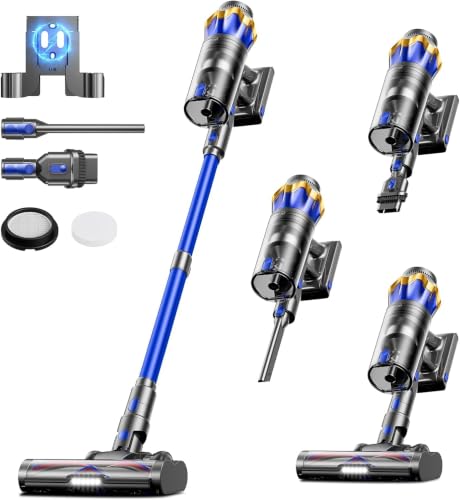
Cordless Vacuum 650W 60KPA — Best Touch-Screen Challenger
This unbranded challenger raises the paper stakes again: 650W, a maker-claimed 60KPA, and 70 minutes of claimed runtime, presented through a touch screen on the handle. The screen is the detail worth pausing on, because a vacuum that shows its mode and battery state at a glance changes the clean’s rhythm — no guessing whether the battery will finish the room, no discovering the boost mode by accident. Whether the screen survives years of cupboard knocks is a question only time answers, but as an interface it is genuinely thoughtful.
Self-standing and anti-tangle repeat the challenger pattern, and by now the pattern itself is the story: these machines compete on the conveniences that daily use actually notices. Seventy claimed minutes, again, will have been measured gently, and the honest buyer discounts it — but even a discounted hour is a different cleaning life from forty minutes, letting a whole house, its stairs and its car be one session rather than a campaign.
The kilopascal figure is the largest claim in this guide and receives the guide’s standard treatment: maker-claimed, unverified, and excluded from the ranking. What remains is still substantial — runtime, interface, standing design — provided the buyer accepts the unbranded trade: support and spares are a listing’s promise rather than a network’s habit. For a tech-comfortable household that keeps receipts and reads listings closely, that trade can be rational.
- Runtime: 70 minutes claimed in the listing
- Suction: 60KPA maker-claimed, unverified — see guide note
- Interface: touch screen as listed
- Design: self-standing, anti-tangle head as listed
Strengths
- Claimed 70 minutes for whole-house sessions
- Touch screen shows mode and battery at a glance
- Self-standing body parks without a wall
Trade-offs
- Largest suction claim is also the least verifiable
- Unbranded support and spares are a listing promise
- Screen is one more component to protect from knocks
Best for: tech-comfortable households cleaning large floor areas.
Not suited for: buyers who want a maker with a long track record.
Check the listing for spare filter and battery availability before ordering, because a long-runtime machine deserves a supported future: Check price on Amazon

Cordless Vacuum 680W Self-Standing — Best Big-Cup Challenger
The third challenger completes the set with the largest dust cup in this guide: 1.8 litres as listed, which is canister territory wearing a stick vacuum’s clothes. Cup size is an unglamorous specification that pet households understand in their bones, because a cup that fills in one room turns every clean into a relay of bin trips, while a cup this size swallows a whole session’s hair and grit and asks for the bin at the end, once. An OLED screen presents the machine’s state with the clarity its rivals’ touch screen promises.
Seventy minutes claimed runtime, a self-standing body and an anti-tangle head repeat the challenger formula, and the formula’s consistency across three makers suggests the market has learned what households ask for. The 65KPA suction figure is, by this guide’s standing rule, maker-claimed and unverified — the largest such number here and the one this guide leans on least. The 680W motor figure is likewise the maker’s own arithmetic.
Where does that leave the thoughtful buyer? With a machine whose verifiable virtues — cup, screen, standing design, claimed runtime — suit a large, hairy household, and whose unverifiable numbers should be treated as decoration. If the Sharks are this guide’s certainty, this is its capacity pick: the most volume, on paper the longest legs, and a support question each buyer must settle with the listing before the box arrives.
- Dust cup: 1.8L as stated in the listing
- Runtime: 70 minutes claimed in the listing
- Suction: 65KPA maker-claimed, unverified — see guide note
- Interface and design: OLED screen, self-standing, anti-tangle
Strengths
- 1.8L cup swallows a whole pet-household session
- OLED screen keeps mode and battery legible
- Self-standing with anti-tangle head for daily ease
Trade-offs
- Suction claim is maker-stated and not independently verified
- Big cup adds bulk when full of debris
- Unbranded maker, so check spares and support first
Best for: large pet households tired of emptying mid-clean.
Not suited for: anyone who ranks purchases by verified figures only.
A 1.8L cup is this machine’s signature, so confirm the listing’s weight when full if stairs are part of the clean: Check price on Amazon
How Do the Six Vacuums Compare on Runtime, Weight and Floor Head?
| Pick | Badge | Key detail | Best for |
|---|---|---|---|
| Shark Cordless Pet Stick IY143H | Best All-Round Mixed-Floor Pick | Runtime: 40 minutes, per the listing | pet-owning flats and small houses with mixed floors. |
| Shark Pet Cordless IX141 | Best Proven Shark | Stated runtime: 40 minutes | detail-minded pet owners who clean under and above floors too. |
| Shark PowerPro Reveal Plus IZ376H | Best Lightweight Shark | Runtime figure: 40 minutes, as listed | daily cleaners who prize light handling above features. |
| Zulyxio Cordless Vacuum 580W | Best Long-Runtime Challenger | Runtime: 65 minutes claimed in the listing | larger homes that outrun a 40-minute battery. |
| Cordless Vacuum 650W 60KPA | Best Touch-Screen Challenger | Runtime: 70 minutes claimed in the listing | tech-comfortable households cleaning large floor areas. |
| Cordless Vacuum 680W Self-Standing | Best Big-Cup Challenger | Dust cup: 1.8L as stated in the listing | large pet households tired of emptying mid-clean. |
Why Are Kilopascal Claims So Hard to Compare?
A pascal figure sounds like laboratory certainty, which is exactly why it decorates so many listings. In practice, suction can be measured at the motor, at the head, sealed or flowing, on a new filter or a seasoned one, and each choice moves the number dramatically. Without a shared standard governing which measurement a listing must quote, one maker’s 50Kpa and another’s 65KPA are not two points on one scale; they are two advertisements in the same units. That is why this guide labels them maker-claimed and ranks by other evidence.
The evidence that survives scrutiny is behavioural. Does the head seal to the floor or skate over it? Does the brushroll agitate carpet pile or merely sweep its surface? How long does the battery sustain the mode you actually use? A vacuum that answers those questions well will clean superbly whatever its box claims, and a vacuum that answers them badly will disappoint at any number of kilopascals. Judge the machine, not the unit.
Hardwood First: What Does a Floor Head Owe a Wooden Floor?
Hardwood asks for gentleness with grip. The head must glide without scratching — no grit trapped under a hard wheel, no aggressive plate edge — while sealing closely enough to pull dust from the boards’ seams, where it loves to settle. Soft rollers are the famous answer, but a well-designed brushroll with fine bristles, kept clean, serves boards honourably too, and every pick here is sold for hardwood as part of its brief. The real scratch risk is neglect: a brushroll wound with gritty hair becomes sandpaper with a motor.
Boards also reveal a vacuum’s manners. A head that scatters debris forward on hard floors — the classic stick-vacuum snowplough — doubles the work, while a head that gathers on both passes halves it. Watch for that behaviour in the first week with any machine here, on the floor you own, because it is a property of head design and floor finish together, and no listing can promise it for your particular varnish.
Then Carpet: Why the Same Head Must Change Its Character
Carpet cleaning is agitation plus airflow. The pile hides grit at its base, and only a brushroll that beats and lifts the fibres while the suction carries the loosened dirt away will reach it. This is the half of the brief where weak machines are exposed: a stick that glides beautifully over boards may merely groom a carpet’s surface, leaving the deep grit that wears pile from beneath. The pet-focused designs here — self-cleaning and anti-tangle brushrolls — exist because carpet plus hair is the hardest work a cordless stick is asked to do.
Boost modes earn their battery cost on carpet, and the honest runtime conversation happens here too: a machine’s gentle-mode minutes are for boards, while carpet on boost spends the battery at several times the rate. Households with wall-to-wall carpet should read every runtime in this guide as a ceiling, plan their cleans in zones, and value the challengers’ longer claimed runtimes accordingly — while remembering whose claims they are.
How Should a Mixed-Floor Home Actually Clean?
In sequence, and by zone. Start where the dirt is tracked in — hall and kitchen hard floors — while the battery is full and the cup is empty, then move to the carpeted rooms where boost mode will spend the charge faster. Empty the cup before the carpet if the hard floors filled it, because airflow through a full cup fades exactly when carpet needs it most. Finish with the handheld jobs — stairs, sofa, the car’s weekly penance — on whatever charge remains.
Frequency beats duration in cordless life. A stick that lives on its charger, grabbed for ten minutes daily, keeps a mixed-floor home at a standard that a weekly marathon never quite reaches, because crumbs and hair are removed before they are walked in and wound in. Every machine here supports that rhythm; the self-standing challengers support it best of all, parked in a corner rather than exiled to a cupboard. Choose the vacuum your habits will actually pick up.
What Maintenance Keeps a Cordless Stick Honest?
Three small rituals. The filter, washed or tapped clean on the maker’s rhythm, because a choked filter is the silent thief of suction in every cordless machine ever sold — more cleans are restored by a filter rinse than by any other act. The brushroll, inspected weekly and freed of its hair winding before the winding becomes a mat; self-cleaning and anti-tangle designs stretch the interval but do not abolish it. And the cup, emptied before it is full rather than after, since airflow dies politely as the cup crowds.
Batteries ask for ordinary kindness: not stored flat for months, not cooked on a sunny windowsill, and used regularly, because cordless tools age best in service. None of this is specialised knowledge, and all of it together is the difference between a vacuum that feels strong in year three and one that feels tired by Christmas. The makers’ claims begin the conversation; the owner’s habits finish it.
Handheld Mode: The Second Vacuum Hiding in Every Stick
Every pick here converts to a handheld, and for many households the handheld quietly does half the work: stairs trodden into portability, upholstery refreshed, the car rescued, the highchair’s blast radius contained. Judge the conversion as a product in itself — how fast the machine shrinks, how the weight sits in one hand, and whether the crevice tool is in the box, as the Sharks’ listings promise, or an aspiration to be bought later.
Stairs deserve their sentence. A full stick on a staircase is an accident rehearsing; a handheld with a crevice tool is the correct instrument, light enough to carry in one hand while the other keeps the banister. Households with stairs should weigh the handheld ergonomics of these six as heavily as their floor heads, and readers with serious stair carpet may also want the dedicated canister guide linked below, because some jobs deserve a specialist.
How Do You Test a New Vacuum in Its First Fortnight?
Give it the house’s worst week, not its best. Run it over the hall after a muddy weekend, the carpet after the dog has claimed it, and the kitchen after a baking session, and watch three things: whether the head scatters on the hard floor, whether the carpet comes up visibly revived or merely tidied, and how much of the claimed runtime a real mixed clean consumes. Those three observations, in your own rooms, outweigh any figure in any listing, including the ones quoted in this guide.
Test the small systems too. Empty the cup over the bin and note whether the dust leaves or explodes; convert to handheld on the stairs and feel the wrist cost; wash the filter once so the knack is learned early. A vacuum is a decade of these small interactions, and the fortnight when returning it is painless is the time to discover whether its habits fit yours.
What Does Boost Mode Really Cost?
Boost is a loan taken against the battery. The motor spins harder, airflow climbs, carpet gives up its deep grit — and the runtime figure on the box, measured at the gentlest setting, becomes irrelevant arithmetic. A machine claiming 70 minutes may give a large fraction of that on boards and a small fraction on carpet boost, and both numbers can be honest while describing different machines. The skilled cordless cleaner therefore spends boost like money: on the rug that needs it, off it the moment the floor turns to boards.
This is also where the screen-equipped challengers make a quiet case for themselves. A battery readout you can see while cleaning turns boost from a gamble into a budget, letting the cleaner decide at the hallway whether the bedroom carpet gets its deep pass today. The Sharks ask for the same judgement without the display, which experienced owners develop by rhythm and habit. Either way, the clean improves the moment boost becomes a decision instead of a default.
How Should You Store and Charge a Stick Vacuum?
Where it will be grabbed. The entire cordless advantage evaporates if the machine lives dismantled in a cupboard behind the ironing board, because the ten-minute clean — the kind that keeps a home ahead of its dirt — only happens when the vacuum is easier to reach than the dirt is to ignore. A charger by the hall cupboard, a corner where a self-standing model can park, a hook where a handheld conversion hangs: these are not accessories but the appliance’s operating conditions.
Charging habits should be as dull as the storage. Keep the battery topped between cleans rather than run flat and abandoned, keep the charger somewhere ventilated and unremarkable, and resist the sunny windowsill and the freezing garage alike. Batteries are the one component whose lifespan the owner’s routine genuinely writes, and a machine whose battery fades in year two becomes a corded vacuum with none of a corded vacuum’s honesty. Treat it kindly and the runtime you bought is the runtime you keep.
When Is a Cordless Stick the Wrong Tool Entirely?
When the job is a building site, a flood of plaster dust, or a deep-pile carpet the size of a ballroom being cleaned weekly to a professional standard. Stick vacuums are sprinters with small cups; renovation debris chokes their filters, and acres of deep carpet spend their batteries before their brushes have done justice to the pile. Households facing those jobs honestly will keep a corded or canister machine for the heavy campaign and let the stick do what it does peerlessly: the daily, the quick, the everywhere-in-between.
Recognising the boundary makes the stick better at its own work. Freed from the renovation and the spring-clean marathon, a cordless stick lives as a maintenance instrument, and maintenance — little and often — is what actually keeps mixed floors beautiful. The six machines here are all maintenance instruments of quality; the buyer’s task is simply not to ask them to be siege engines as well.
How Do Allergies and Dust Sensitivity Change the Choice?
A vacuum’s job is to move dust from the floor into a bin without touring it through the room’s air on the way, and dust-sensitive households should judge the exhaust and the emptying as carefully as the suction. A cup that empties with a drop and a lid beats a cup that must be shaken and scraped; a filter that is washed on schedule keeps the exhaust honest; and a machine used little and often stirs less settled dust per session than one weekly marathon that re-aerosols the week’s accumulation.
This guide makes no medical claims for any model, and listings’ filtration language should be read as product description rather than therapy. What can be said plainly is mechanical: clean filters, a cup emptied outdoors or into a bag, and a brushroll kept free of its winding all reduce the dust a clean redistributes. Households with sensitivities should build those habits around whichever pick they choose, because the habits, more than the badge, decide the air.
What Should You Check About Spares Before Choosing a Challenger?
Filters, brushrolls and batteries are the three consumables of cordless life, and a machine is only as durable as their supply. Before choosing one of the unbranded challengers, read its listing for spare filters and a replacement battery path, and note whether the brushroll can be removed and replaced or is married to the head. A vacuum whose wear parts are obtainable is a purchase; one whose wear parts are a mystery is a rental with a flattering term.
The Sharks invert the question: their makers’ ecosystems make filters and parts a routine search rather than an expedition, which is a real part of what their names are worth. Neither answer is automatically right — a challenger with listed spares and a responsive seller may serve splendidly — but the question must be asked before the first filter clogs, not after. Put it on the pre-purchase checklist beside runtime and weight, where it belongs.
How Does a Stick Vacuum Age Across Three Years?
Gracefully, if its owner keeps the small faiths. The battery softens first and most noticeably, holding a little less of its original charge each year; the brushroll’s bristles shorten and soften; the cup’s seals gather a film of fine dust that a wash restores. None of these is a failure — they are the patina of a working tool — and a machine whose filters were kept clean will still be recognisably itself in year three, while a neglected twin feels asthmatic by its first birthday.
Plan for the battery conversation in advance. A model whose battery can be replaced gets a second life at that moment; a sealed model becomes a shorter-horizon purchase, and its buyer should price that horizon honestly at the start. This is another of the unglamorous listing details — battery replaceability — that separates a considered purchase from a hopeful one, and it is worth two minutes of any buyer’s attention before the box is opened.
How Do You Clean a Whole House on One Charge, Whatever the Machine?
By refusing to waste the charge on theatre. Begin with the rooms that decide the house’s dignity — hall, kitchen, the carpet everyone sees — and work towards the rooms that forgive. Keep the machine moving at a walking pace that lets the head gather rather than skate, overlap passes on carpet where the pile hides its grit, and single-pass the boards where one clean sweep does the work. Empty the cup at the halfway mark even if it looks half innocent, because airflow is the currency the second half of the house is paid in.
End with the battery’s last minutes spent where they show: the handheld pass over the stairs and the sofa, which are the surfaces guests actually touch. A clean sequenced this way makes 40 honest minutes feel like a whole-house service, and makes the challengers’ longer claims feel luxurious rather than necessary. The machine provides the minutes; the method provides the house.
What Role Do Rugs Play in a Hardwood Home’s Cleaning?
Rugs are where hardwood homes keep their carpet problem. A runner in the hall and a rug under the table collect the grit that boards would otherwise spread, and they ask the vacuum to change character mid-room — glide, then agitate, then glide again — several times in a single clean. This is the mixed-floor brief in miniature, and it is why a head that transitions without drama, neither scattering on the boards nor skimming the rug, is worth more than any single-surface brilliance.
Treat rugs as the boost mode’s natural home. Their pile hides the sharp grit that damages both the rug and, once tracked out, the boards around it, so the battery spent lifting that grit is the best-spent charge of the clean. Shakeable small rugs should still be shaken outside occasionally — no vacuum of any kind fully substitutes for gravity and fresh air — but the daily pass is what keeps a rug from becoming a grit reservoir with a pattern.
How Should Two-Person and Pet-Heavy Households Divide the Work?
By frequency rather than by territory. In a house with shedding animals, the winning system is a rota of short cleans — ten minutes after the morning walk, ten after the evening one — because pet hair removed daily never reaches the tumbleweed stage that fills cups and winds brushrolls into submission. The vacuum that lives charged and reachable, rather than stored and assembled, is the one this rota actually uses, which loops the decision back to storage and self-standing designs.
The deep clean then becomes a weekly pleasure instead of a penance: carpets boosted in zones, upholstery tooled, the car forgiven. Households that divide the rota between two people should choose a machine both find light, because the best vacuum in a shared house is the one neither person avoids. Weight, in the end, is a household specification, not a personal one.
How Do You Choose Between a Shark and a Challenger, Finally?
Ask what would make you regret the purchase in month six. If the answer is a battery that died with no replacement path, a filter nobody sells, or a head that broke without a service network, you are a Shark buyer and should enjoy the certainty. If the answer is standing in an uncleaned bedroom with a flat battery for the fourth Saturday running, you are a runtime buyer, and the challengers’ claimed hours — discounted honestly, still longer — answer your actual problem. Regret, predicted accurately, is the most reliable buying instrument in this entire guide.
There is no shame in either answer, and there is a real sense in which the two groups are not rivals but neighbours: the Sharks optimise trust, the challengers optimise stamina, and a household’s floors are the only electorate that counts. Read your own rooms, count your own carpet, remember your own habits with filters and chargers, and the choice between them usually makes itself before the comparison table is even reached.
What Does a Vacuum Owe the Person Who Cleans at Night?
Quiet manners and honest light. Households with sleeping children, shift-working partners or thin walls clean at hours when a machine’s voice matters, and while no stick vacuum here is silent, the gentler modes that stretch runtime also soften noise — another reason the long-runtime machines earn their keep in real homes. The IX141’s headlights, bought for dust, turn out to be a night feature too, letting a cleaner work a room by the head’s own light rather than waking the house with the ceiling’s.
Night cleaning also rewards the self-standing designs, which can be parked silently mid-room instead of leaned and slid, and the handheld conversions that let a staircase be finished without waking the landing. None of these virtues appears in a suction figure. All of them decide whether a vacuum is loved by the household that actually lives with it, which is the only verdict that outlasts a listing.
What Mistakes Do Cordless Vacuum Buyers Make Most Often?
Ranking by the kilopascal figure is the defining mistake in this category. Those numbers are maker-claimed, measured by no shared standard, and unfit to compare — yet they are printed largest on the box. Buyers who rank by runtime they can test, weight they can feel and a head design they can inspect end up with the better vacuum and the calmer conscience.
A second mistake is reading runtime as a promise rather than a ceiling. Every figure here was measured by its maker on gentle settings; boost mode on carpet spends a battery several times faster. Plan your cleans around the discounted figure and the machine will feel generous; plan around the headline and it will feel like a liar by the second room.
Finally, buyers forget the filter. A cordless vacuum with a clogged filter loses its strength so gradually that owners blame the battery, the motor and the brand before performing the two-minute rinse that restores it. Put the filter on the calendar the day the box arrives.
A fourth mistake is storing the machine where it cannot be grabbed. A cordless vacuum’s entire value is the clean that happens because it was easy; exiled to a deep cupboard, it becomes a corded vacuum’s inconvenience without a cord’s stamina. Choose its parking place before it arrives, and let that place be somewhere the dirt also lives.
Final Recommendation
For most mixed-floor homes, the Shark Cordless Pet Stick IY143H is the recommendation: a self-cleaning brushroll, an XL cup and an honestly stated 40 minutes from a maker that stands behind them. The Shark Pet Cordless IX141 suits detail cleaners with its headlights and pet tool, and the Shark PowerPro Reveal Plus IZ376H is the light-handling choice for daily cleans in flats and modest houses.
The challengers ask for a knowing trade. The Zulyxio’s claimed 65 minutes and self-standing ease, the touch-screen model’s claimed 70 minutes, and the big-cup model’s 1.8 litres all serve large homes that outrun the Sharks’ batteries — provided the buyer accepts that the towering suction figures are maker-claimed decoration and that support runs through a listing rather than a network. Judged on runtime, design and cup, they earn their places here; judged on kilopascals, nothing should be bought at all.
Walk your own floors before you order, count the carpet against the boards, and choose the machine whose honest specifications match the larger half — because a vacuum bought for the home you have, rather than the numbers you were shown, will still be picked up gladly a year from now.
Frequently Asked Questions
Can I trust the 50–65KPA suction figures on some of these vacuums?
Treat them as maker-claimed marketing figures, not measurements you can compare. There is no shared standard for how such numbers must be obtained, so a higher figure does not establish a stronger vacuum. This guide ranks the models on runtime as listed, floor-head design, weight and tools — evidence a buyer can actually weigh.
Is 40 minutes of runtime enough?
For a flat or a small house, comfortably; for a larger home, it covers a floor or a zoned clean rather than the whole house at once. Remember that makers measure runtime on gentle settings, so carpet work on boost will use the battery faster. The challengers’ claimed 65–70 minutes exist for households that find 40 minutes a genuine constraint.
Which pick is best for pet hair?
The IY143H’s self-cleaning brushroll is the strongest pet feature in the guide, with the IX141’s included pet tool close behind for upholstery. The challengers’ anti-tangle heads make the same promise in their listings. In every case, weekly brushroll checks and a clean filter decide how well the promise holds.
Will a stick vacuum scratch hardwood floors?
A well-kept head should not: the risk comes from grit and hair wound into the brushroll or trapped under wheels, which turns the head into an abrasive. Keep the roll clean, empty the cup before debris backs up to the head, and test any new machine on an inconspicuous board first if your finish is delicate.
Stick or canister for a house with many stairs?
A stick’s handheld mode handles stairs well for routine cleans, and every model here converts. For deep, frequent stair carpet work, a lightweight canister you can set on the steps may serve better — the companion guide linked below is devoted to exactly that job.
How often should the filter be washed?
Follow the rhythm the maker’s listing and manual describe for your model, and err on the frequent side in pet households. The signal to act early is a machine that sounds willing but picks up weakly — that is a filter asking for its rinse far more often than it is a motor failing. Let a washed filter dry completely before refitting it.
Which of these vacuums is easiest to live with daily?
The one that fits your storage and your strength. The lightweight PowerPro Reveal Plus asks least of the wrist, the self-standing challengers ask least of the room, and the IY143H asks least of your maintenance time with its self-cleaning brushroll. Daily ease is a property of the household as much as the machine, which is why this guide describes all three routes honestly.
Related Guides
Floors do not end at the stick vacuum’s reach, and the guides below cover the stairs, the rugs and the rest of the house around them. Best Canister Vacuums for Stairs Best Neutral Rugs for Bedrooms Best Vessel Sinks for Bathrooms


