What's inside
- Key Takeaways
- Quick Picks
- How We Chose These Picks
- Which of the Best Commercial Vacuums for Hardwood Floors Fits Your Building?
- How Do the Six Machines Compare at a Glance?
- What Does Commercial Actually Mean in a Vacuum Cleaner?
- Why Can a Brush Roll Be a Problem on Hardwood?
- Bagged or Bagless in a Workplace?
- How Much Does Cord Length Change a Cleaning Route?
- What Maintenance Keeps a Commercial Vacuum Honest?
- How Should You Vacuum Hardwood in an Occupied Building?
- When Is a Home Vacuum Enough for a Business?
- How Do You Compare Filtration Claims Without a Laboratory?
- What Should a Multi-Site Buyer Standardise On?
- How Long Should a Commercial Vacuum Last?
- Why Do Wheels and Soleplates Matter More on Hardwood?
- How Should You Store Machines Between Shifts?
- What Does Noise Do to a Cleaning Schedule?
- How Do You Train a New Operator in Ten Minutes?
- Why Keep a Second, Smaller Machine at All?
- How Should You Budget the True Cost of a Commercial Vacuum?
- How Do You Clean Entrance Matting and the Grit It Traps?
- What Changes When the Floor Is a Gym or Hall?
- How Should You Handle Wet-Day Cleaning on Hardwood?
- Why Do Commercial Cords Fail First, and How Do You Prevent It?
- How Do You Audit a Cleaning Cupboard in Fifteen Minutes?
- What Should a Buyer Ask a Supplier Before Ordering?
- How Does Season Change a Hardwood Cleaning Rota?
- How Do You Keep Upholstery and Stair Treads on the Same Rota?
- What Records Should a Facilities Manager Keep?
- How Do You Choose Between Two Uprights That Look Identical?
- How Should a Small Business Without a Cleaner Choose?
- What Is the Kindest Way to Retire a Commercial Vacuum?
- What Mistakes Do Buyers of Commercial Vacuums Make Most Often?
- Final Recommendation
- Frequently Asked Questions
- Related Guides
As an Amazon Associate I earn from qualifying purchases. This post may contain affiliate links at no extra cost to you.
cottageverdict.com is reader-supported. When you buy through links on our site, we may earn an affiliate commission.
Where to buy: the six machines below link to their Amazon listings from the Quick Picks table, their review headings and the comparison table, where you can check price on Amazon and confirm cord length, bag type and included tools for the exact configuration on offer. The best commercial vacuums for hardwood floors are not simply stronger home vacuums; they are machines built around durability, repairability and the economics of cleaning the same floors hundreds of times.
That distinction shapes every judgement in this guide. A domestic machine is optimised for a weekly hour and a quiet life in a cupboard. A commercial machine is optimised for a daily shift, an operator who did not choose it, collisions with furniture, and a manager who expects belts and bags to be replaceable rather than fatal. On hardwood specifically, it also has to respect the floor: no scattering grit, no marking wheels, no drama at the edges.
Key Takeaways
- Commercial means durable and repairable first; suction is only one line of the specification.
- Carpet-bred uprights clean hardwood competently when paced, and scatter grit when rushed.
- Bagged systems suit shared workplaces because disposal is sealed and simple.
- A backpack at about nine pounds out-covers every upright on large open floors.
- One pick here is a home machine, labelled as such, for genuinely light duty only.
- Long cords and stocked spares prevent more missed cleans than any motor figure.
Quick Picks
| Pick | Badge | Why it earns its place |
|---|---|---|
| Oreck Commercial XL Upright | Best Lightweight Upright | A bagged, lightweight upright with automatic height adjustment and a high-speed brush roll, built for commercial routes. |
| Bissell Commercial BGU1937T | Best Bagless Upright With Tools | A bagless Pro Cup upright with on-board tools, for sites that want dirt-cup economics and detail reach. |
| Hoover Commercial Shoulder Vac Pro | Best Backpack for Large Areas | A bagged backpack with HEPA media filtration and a chiropractic-design harness, worn at about nine pounds. |
| Sanitaire SC679K Tradition | Best Old-School Bagged Durability | A red bagged upright from the Tradition line, the long-cord, fix-it-forever pattern of commercial cleaning. |
| Eureka Vacuum Cleaners for Home,Airspeed Ult | Lightest Pick — Home Machine, Light Duty Only | A 7.7 lb home upright with washable filter and tools, listed as senior-friendly; included honestly as a light-duty option. |
| Hoover Commercial PortaPower Lightweight Can | Best Carry-Along Canister | A bagged canister that carries by hand or shoulder strap, works as a vacuum and a blower, with full attachments. |
How We Chose These Picks
We weighted the commercial evidence in each listing: construction intent, dirt system, filtration claims, tools and the service economy behind the brand. Machines designed for professional routes, with consumables sold everywhere and parts treated as routine, ranked ahead of machines with impressive domestic specifications. The Eureka is the deliberate exception that proves the filter, admitted only with its light-duty status stated wherever it appears.
Hardwood performance was judged by mechanism rather than by slogan. Brush-driven uprights were assessed for the scatter problem and for how technique mitigates it. The backpack and canister were assessed on glide, reach and carried weight. Filtration claims were taken from the listings themselves, with HEPA media credited where the maker states it and nowhere else.
Finally we spread the six across the shapes commercial cleaning actually takes: two classic uprights, one bagless upright, one backpack, one canister and one featherweight. A buyer running a hall, a shop or a small office should be able to find their building somewhere in that spread, and to rule out the rest quickly.
Which of the Best Commercial Vacuums for Hardwood Floors Fits Your Building?

Oreck Commercial XL Upright — Best Lightweight Upright
Start with the confession this category demands: Oreck built its reputation on carpet. Hotels and offices bought these uprights by the corridor because they are light, simple and quick on pile, and the Commercial XL carries that DNA openly, with a high-speed brush roll and automatic height adjustment doing the work. On the best commercial vacuums for hardwood floors question, the Oreck therefore has to be judged as a carpet specialist visiting bare boards, not as a native.
Here is what that means in practice. A fast brush roll on hard flooring can flick grit ahead of the suction path if you charge at debris, the classic upright-on-hardwood fault. Worked at a walking pace, with passes that let the brush sweep toward the intake, the Oreck picks up respectably and its light body is a genuine blessing across a long shift. But a buyer whose floors are ninety percent bare wood should know the brush is a compromise they manage, not a feature that helps them.
The commercial virtues are real and they are the reason it leads this list anyway. It is bagged, so dust leaves the building in a sealed paper bag rather than a shaken cup. It is famously serviceable, with belts, bags and brush rolls treated as consumables any supply closet can stock. And its weight lets one cleaner cover floors that would exhaust the same person pushing a heavy machine, which across a working week is a performance figure no suction number captures.
- Format: bagged upright
- Height: automatic adjustment, per listing
- Brush: high-speed brush roll
- Heritage: carpet-first design, hard floor capable
- Use class: commercial
- Carry: lightweight body for long routes
Strengths
- Featherweight body reduces operator fatigue
- Bagged dirt disposal suits shared workplaces
- Parts and consumables are a service economy of their own
Trade-offs
- Brush roll can scatter grit on bare floors if rushed
- Carpet-first design is not the last word on hardwood
- Bags are a running cost to budget for
Technique rescues this machine on wood. Approach a pile of debris slowly and let the brush feed it, vacuum the room’s centre in long lanes, and save the edges for a final slow pass. Rushed, it scatters; paced, it behaves like the professional tool it is.
Best for: mixed commercial floors where carpet still dominates and one light upright must cover everything
Not suited for: bare-hardwood purists who want a suction-only, brush-free clean

Bissell Commercial BGU1937T — Best Bagless Upright With Tools
The BGU1937T is the bagless answer in a category that mostly prefers bags, and it earns its place by solving the two problems that follow bagless machines into commercial buildings. Its Pro Cup dirt container is sized for real debris rather than demonstration dust, and the on-board tools mean the cleaner who finds a corner full of grit is already carrying the crevice tool to deal with it.
On hardwood, a bagless upright lives or dies by how honestly its brush and suction share the work, and by whether emptying it re-dusts the room it just cleaned. The cup system here empties from the base in the usual modern fashion, which keeps the plume down if you empty into a bag held around the cup, a habit worth teaching every operator. Filters become the recurring chore instead: a neglected filter strangles suction long before the motor complains.
Choose this Bissell where the purchasing logic is consumables. A small business that resents buying bags forever, and has one reliable person who will wash or replace filters on schedule, gets a sturdy upright with detail tools and no supply shelf. A site with rotating casual staff should think twice, because bagless machines punish neglected maintenance more visibly than bagged ones do.
- Format: bagless upright
- Dirt system: Pro Cup container
- Tools: on-board set, per listing
- Use class: commercial
- Maintenance centre: filters and cup, no bags
- Floor brief: upright duty across mixed surfaces
Strengths
- No bag purchases, ever
- On-board tools handle edges and corners mid-route
- Generous cup suits debris-heavy entrances
Trade-offs
- Filter discipline decides its suction over time
- Cup emptying needs care to avoid dust plume
- Heavier in hand than the lightest rivals here
Write the filter date on a strip of tape on the machine’s body. Bagless commercial vacuums rarely die; they fade, one clogged filter at a time, and a visible date turns an invisible chore into a rota anyone can follow.
Best for: small businesses wanting bagless economics with tools always on board
Not suited for: sites with rotating staff and no maintenance rota

Hoover Commercial Shoulder Vac Pro — Best Backpack for Large Areas
The Shoulder Vac Pro changes the question from pushing to wearing. The machine rides on the operator’s back on a harness Hoover describes as chiropractic in design, the wand does the walking, and large open hardwood areas, halls, gyms, places of worship, retail floors, get covered at a pace no upright matches. Stairs stop being an obstacle course, because the vacuum climbs with you instead of being hauled behind you.
Weight is the specification that decides whether a backpack is a liberation or a punishment, so here it is plainly: the unit sits in the roughly nine-pound class before its cord and tools, light for its category, and the harness spreads that load across the hips and shoulders. Nine pounds worn well beats fifteen pounds pushed badly, but it is still a load, and a full shift in one is a fitness commitment a facilities manager should discuss honestly with staff rather than spring on them.
Filtration is the other headline. The listing states HEPA media filtration in a bagged system, which is the combination dust-sensitive buildings ask for: the bag does the bulk capture and seals for disposal, the media handles the fine fraction. On hardwood the wand head glides rather than scrubs, which suits bare floors well; there is no heavy brush housing to mark boards and no machine body bumping skirting as you turn.
- Format: bagged backpack
- Carried weight: about nine pounds for the unit
- Filtration: HEPA media, per listing
- Harness: chiropractic design, per maker
- Power: corded
- Best terrain: large open floors and stairs
Strengths
- Covers big hardwood areas faster than any upright
- Stairs and bleachers become ordinary work
- Bagged HEPA media system suits dust-sensitive buildings
Trade-offs
- Worn weight is still a load across a full shift
- Cord management needs training and patience
- Overkill for small suites and single rooms
Fit the harness before judging the machine. A backpack adjusted so the load rides on the hips feels half its catalogue weight, while the same unit hanging from the shoulders feels double, and most backpack complaints are fitting complaints in disguise.
Best for: halls, gyms, churches and large open hardwood floors cleaned on a schedule
Not suited for: small offices where an upright parks in a cupboard between quick cleans
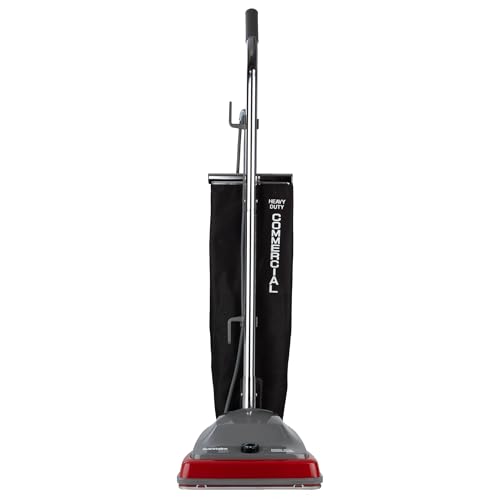
Sanitaire SC679K Tradition — Best Old-School Bagged Durability
Sanitaire’s Tradition line is what commercial durability looked like before vacuums became appliances with screens. The SC679K is a bagged upright in the classic mould: a simple, robust body, a long working cord, and a design philosophy that treats every wearing part as replaceable by the owner with ordinary tools. Janitors have kept machines of this pattern alive for years beyond the lifespan of prettier rivals.
On hardwood it behaves like the Oreck’s generation-mate, because it is one. A brush-driven upright of this school cleans bare floors competently at a sensible pace and brilliantly the moment carpet appears, and it asks the same technique in return: do not charge debris piles, let the machine feed. What it returns for that courtesy is indifference to hard knocks. Door frames, table legs and the daily collisions of commercial work glance off a Tradition.
Repairability is the real specification here, and it compounds. A vacuum that can be kept in service with belts, bags and brushes bought anywhere is a vacuum whose cost spreads across years of shifts. For a school, a hall or a rental operation equipping several cupboards, that arithmetic usually beats chasing the newest specification, and the SC679K is the list’s clearest expression of it.
- Format: bagged upright
- Line: Tradition, commercial pattern
- Build brief: simple, owner-serviceable
- Cord: long working cord for commercial routes
- Floor brief: mixed, carpet-strong
- Colour: red, high-visibility in a cupboard
Strengths
- Built to be repaired rather than replaced
- Long cord cuts socket-hopping on big routes
- shrugs off the collisions of daily commercial work
Trade-offs
- Brush-first cleaning needs pacing on bare boards
- Fewer refinements than newer designs offer
- Bagged running costs continue for its whole life
Equip the cupboard, not just the machine. A Tradition with spare bags, a belt and a brush strip stored beside it is a system that never misses a shift; the same vacuum without spares is one snapped belt away from a week of borrowed equipment.
Best for: schools, halls and multi-cupboard operations valuing service life over novelty
Not suited for: buyers wanting the quietest or most refined bare-floor clean

Eureka Vacuum Cleaners for Home,Airspeed Ult — Lightest Pick — Home Machine, Light Duty Only
Honesty section: this Eureka is not a commercial vacuum, and its own listing does not pretend otherwise, describing a home Airspeed upright of 7.7 pounds that is senior-friendly, with a washable filter and tools for carpet and hard floor. It sits in this guide because real buyers ask a fair question, whether a very light home machine can handle a very small commercial job, a studio, a tiny salon, a single-room office, and the answer is a qualified yes.
The qualification is duty cycle. A home upright is engineered for a household’s weekly hours, not a cleaner’s daily ones, and its plastics, cord and motor expect rest between sessions. Used for twenty minutes a day in one small space, it will serve cheerfully and its feather weight is a kindness to whoever carries it up stairs. Asked to clean a restaurant nightly, it will age in dog years and fail without the parts network the true commercial picks enjoy.
On hardwood its light body and simple build are adequate for dust and crumbs, and the washable filter keeps running costs near zero. Read it as the list’s honest footnote: the right purchase for the smallest premises and the wrong one for anything larger, included so the boundary of the word commercial is drawn where it belongs, at workload rather than at marketing.
- Format: home upright, light duty
- Weight: 7.7 lb, per listing
- Filter: washable
- Tools: brush and crevice tool included
- Floor brief: carpet and hard floor, domestic scale
- Position in guide: light-duty option, not commercial grade
Strengths
- Lightest machine in this guide by a wide margin
- Washable filter keeps consumable costs minimal
- Simple enough for any staff member to use
Trade-offs
- Not built or warranted for commercial duty cycles
- Parts and service network is a domestic one
- Small capacity fills quickly in debris-heavy spaces
If this is the machine your premises genuinely need, buy it with clear eyes and a calendar note to inspect its cord and brush monthly. Light-duty machines survive light duty well; what kills them is silent promotion into heavy duty nobody admitted to.
Best for: studios, tiny salons and single-room offices with minutes-per-day cleaning
Not suited for: any premises cleaned daily at scale, where true commercial builds belong

Hoover Commercial PortaPower Lightweight Can — Best Carry-Along Canister
The PortaPower is the commercial vacuum as a carried tool rather than a wheeled one. It is a bagged canister light enough to lift by its handle or hang from a shoulder strap, trailed by its cord, and it goes where uprights cannot: under pews, across staircases, along the tops of partitions, into the corners of a stage. Buildings are full of hardwood that is not open floor, and this is the machine for that majority.
The attachment set is the product. With the right nozzle the PortaPower details edges, treads and upholstery in the same pass as the floor, and its listing adds a second trade entirely: reversed, it works as a blower, clearing leaves from an entrance or dust from a workshop corner. Few machines in this guide hold two jobs; fewer still hold them in one hand.
On open hardwood it will not outpace an upright, and it does not try to. Suction through a floor nozzle cleans bare boards well, the canister body never barges into furniture, and the bagged system keeps disposal tidy. Buy it as the partner machine in a two-vacuum building, or as the only machine in a small, obstacle-rich one, and it will earn its cupboard space weekly.
- Format: bagged canister, carried
- Carry: handle or shoulder strap
- Second mode: blower, per listing
- Kit: attachments included
- Use class: commercial
- Best terrain: stairs, pews, edges and cluttered rooms
Strengths
- Reaches the floors uprights cannot work
- Blower mode earns a second job in entrances
- Bagged disposal keeps detail work tidy
Trade-offs
- Slower than an upright across open floor
- Carried format tires an arm over very long sessions
- Cord trails and must be managed around obstacles
Hang it from the shoulder on stairs and work downward, so the cord falls behind you and the machine’s weight stays over your hips. Carried in the downhill hand it swings; worn properly it disappears, which is the difference between a tool and a burden.
Best for: obstacle-rich buildings, stairs, pews and detail routes in any premises
Not suited for: wide open floors where upright pace is the whole requirement
How Do the Six Machines Compare at a Glance?
| Pick | Badge | Format |
|---|---|---|
| Oreck Commercial XL Upright | Best Lightweight Upright | Format: bagged upright |
| Bissell Commercial BGU1937T | Best Bagless Upright With Tools | Format: bagless upright |
| Hoover Commercial Shoulder Vac Pro | Best Backpack for Large Areas | Format: bagged backpack |
| Sanitaire SC679K Tradition | Best Old-School Bagged Durability | Format: bagged upright |
| Eureka Vacuum Cleaners for Home,Airspeed Ult | Lightest Pick — Home Machine, Light Duty Only | Format: home upright, light duty |
| Hoover Commercial PortaPower Lightweight Can | Best Carry-Along Canister | Format: bagged canister, carried |
Format is destiny in this category. Choose the shape that matches your floor plan and staffing first, then argue about brands, because a perfectly specified upright in a building full of stairs will lose every week to a merely good backpack.
What Does Commercial Actually Mean in a Vacuum Cleaner?
It describes a duty cycle and a support system, not a colour scheme. Commercial machines assume daily use by operators of varying care, so their housings tolerate knocks, their cords are long and replaceable, and their wearing parts, belts, bags, brush rolls, filters, are stocked as consumables. When something wears out, the expected event is a repair measured in minutes, not a replacement measured in budget meetings.
It also implies honest simplicity. A cleaner at the end of a shift needs a machine that empties, unclogs and stores without a manual. Every pick in this guide can be understood by a new starter in one demonstration, and that is not a limitation of the category; it is the category working as designed.
Why Can a Brush Roll Be a Problem on Hardwood?
A spinning brush is a broom moving at motor speed. On carpet that broom digs debris out of pile and feeds it to the suction, which is why carpet-bred uprights clean pile so well. On a bare board the same broom meets loose grit with nothing to slow it, and a fast approach can flick particles forward faster than the intake gathers them, scattering the very pile you aimed at.
The remedies are technique and honesty. Technique: slow lanes, deliberate passes over debris, edges finished last. Honesty: a building that is almost entirely hardwood, cleaned to a shine standard, may be better served by the backpack or canister here, whose floor tools glide and suck without a broom’s enthusiasm. The uprights remain excellent mixed-floor machines; they are simply not brush-free bare-floor specialists.
Bagged or Bagless in a Workplace?
Bagged systems win most shared workplaces on disposal alone. A full bag lifts out sealed, carries the dust of a week to the bin without a plume, and gives every operator the same simple routine. The costs are literal: bags are a consumable line forever, and running out of bags idles the machine as surely as a breakdown.
Bagless answers with the cup, as the Bissell here does, removing the consumable and adding a maintenance duty in its place. Filters must be cleaned or changed on a rota, and cups must be emptied with a little ceremony to keep the dust down. Sites with one conscientious owner-operator often prefer bagless; sites with rotating hands usually sleep better with bags.
How Much Does Cord Length Change a Cleaning Route?
More than motor specifications do. Every socket change costs a stop, a walk, a replug and a restart of rhythm, and across a large floor those stops accumulate into real minutes per clean. Commercial uprights and the backpack here carry the long cords the work expects, letting a cleaner run whole rooms, sometimes whole floors, from a single outlet.
Long cords bring their own discipline. They trail across wet-mopped zones, invite trips when left loose in doorways and wear at the plug first. Coil from the machine end, inspect the last metre monthly, and treat a damaged cord as a stop-work fault rather than an annoyance, because in a public building a frayed cord is a liability with a plug on it.
What Maintenance Keeps a Commercial Vacuum Honest?
Three consumables decide most of a machine’s life: bags or filters, belts where fitted, and the brush roll’s bristles. A simple log on the cupboard door, dates and initials, outperforms any memory. Suction complaints should trigger the same checklist in order, full bag or clogged filter, blocked hose, worn belt, before anyone concludes the motor is dying.
Hardwood adds one inspection domestic users skip: the underside. Grit embeds in wheels and floor tools, and a wheel carrying a stone becomes a scratching tool dragged across every board. A ten-second wipe of wheels and soleplate at the start of a shift is the cheapest floor protection in this entire guide.
How Should You Vacuum Hardwood in an Occupied Building?
Sequence matters more than speed. Work from the far corner toward the door so nobody walks the finished floor, keep the cord behind your line of travel, and time the noisiest passes for the building’s emptiest minutes where the rota allows. In offices and clinics, a vacuum that arrives unannounced at a doorway reads as carelessness even when the cleaning is excellent.
Edges deserve their own pass with the machine slowed, because skirting lines collect the grit that foot traffic pushes outward. The uprights here handle edges adequately in stride; the PortaPower exists for buildings whose edges include pews, plinths and stair treads that an upright’s head cannot address at all.
When Is a Home Vacuum Enough for a Business?
When the business is one small room, cleaned briefly and not daily, by the person who bought the machine. The Eureka in this guide serves that premises honestly: light, simple, cheap to run, adequate on a studio’s boards. The boundary is workload and consequence. If the vacuum’s failure would close a treatment room or leave a restaurant floor dirty for service, the machine is commercial-critical and should be commercial-built.
There is also a warranty plain truth: domestic machines used commercially commonly step outside the use their makers warrant. A buyer who knowingly runs a home machine at work should price in early replacement, and at that arithmetic the true commercial picks often cost less across three years than two successive domestic ones.
How Do You Compare Filtration Claims Without a Laboratory?
Read for the system, not the acronym. A sealed bagged path with HEPA media, as the Hoover backpack lists, captures at the bag first and polishes with the media, and disposal keeps the captured dust captured. A bagless machine’s filtration lives in its filters’ condition, which is why its real-world performance swings with maintenance discipline.
Be suspicious of any claim that floats free of the dirt path. What matters is whether the route from floor to bag or cup is sealed, whether the exhaust passes the stated media, and whether emptying undoes the capture. This guide credits only what each listing states, and treats filtration as a housekeeping and dust-management quality, not a promise about anyone’s health.
What Should a Multi-Site Buyer Standardise On?
One upright pattern across sites, plus one detail machine, is the fleet logic that keeps consumables simple. Standardising means one bag type on every shelf, one belt in every drawer and operators who can walk into any site and already know the machine. The Sanitaire and Oreck patterns have supported that logic for years because their parts are everywhere.
Resist standardising on the newest machine for its own sake. A fleet’s value is in its boring reliability and shared spares, and a mixed fleet of excellent machines still loses to a uniform fleet of good ones every time a belt snaps at the far site on a Friday.
How Long Should a Commercial Vacuum Last?
With consumables replaced and collisions forgiven by design, the classic uprights here should give years of daily service, and their makers’ parts networks exist precisely because owners expect that horizon. Backpacks and canisters of commercial build share the expectation. The honest variable is not the machine but the maintenance culture around it.
Plan replacement by condition, not birthday. A vacuum whose housing is cracked at the handle, whose cord has been repaired twice and whose brush housing is worn oval has finished its service however young it is. A tight, clean, fully consuming-parts machine of twice the age is the better tool, and audits should judge the object, not the invoice date.
Why Do Wheels and Soleplates Matter More on Hardwood?
Carpet forgives a vacuum’s underside; hardwood records it. Hard wheels carrying embedded grit, a soleplate with a burred edge, a brush housing ridden low enough to scuff, each writes its signature on boards that cost more than any machine in this guide. Commercial floors are often sealed and durable, but sealed is not invulnerable, and the damage pattern of a neglected vacuum is unmistakable.
The routine is trivially cheap: glance at wheels and underside weekly, pick out embedded grit, and retire a machine whose underside is damaged to carpet-only duty. Operators should know that reporting a scratching sound is maintenance gold, not an admission of fault, or they will stop reporting it and the floor will keep the secret instead.
How Should You Store Machines Between Shifts?
A commercial vacuum lives where it is stored, and a bad cupboard shortens its life as surely as bad floors. Coil the cord loosely rather than wrenching it around hooks, stand the machine where its handle is not the doorstop, and keep bags and spares in the same cupboard so a full bag never becomes a reason to shake and reuse one.
Backpacks should hang or sit with the harness untangled, and canisters with their hoses in a relaxed loop rather than a kink. Five unhurried minutes at the end of a shift is the entire cost, and it buys a machine that starts tomorrow’s clean already working, which is the only definition of ready a facilities rota respects.
What Does Noise Do to a Cleaning Schedule?
Commercial machines are built for power and durability before quiet, and in occupied buildings the schedule must absorb that fact. Clinics, offices and places of worship all have hours when a vacuum’s voice is a genuine intrusion, and no specification in this guide should be read as a promise of hush.
The practical answer is zoning by time: open floors and entrances during the building’s loud, busy hours, quiet rooms and offices at the day’s edges. A backpack’s motor rides behind the operator and away from desks, which some sites find easier to schedule around, but the honest tool here is the rota, not the machine.
How Do You Train a New Operator in Ten Minutes?
Teach the route, the consumable and the fault, in that order. The route: far corner to door, slow lanes, edges last. The consumable: how a full bag or a due filter presents, and where the spares live. The fault: what a blockage sounds like, what a slipping belt smells like, and when to stop and report rather than force the machine onward.
Then watch one full room. Most vacuum damage in commercial settings is not malice but an untaught habit, the charged debris pile, the cord yanked by its plug, the full bag shaken and refitted. Ten minutes of witnessed practice prevents the three, and it is the cheapest insurance a cleaning budget can buy.
Why Keep a Second, Smaller Machine at All?
Because buildings are two jobs wearing one address. Open floors reward pace and capacity; stairs, edges, upholstery and the forest of chair legs reward reach and lightness. A single upright asked to do both does the first well and the second resentfully, and the second is where visitors actually notice dirt, on the tread, at the skirting, under the pew.
The PortaPower pattern exists to be that second machine, and pairing it with any upright here gives a building complete coverage without a flagship budget. Buyers who can afford only one machine should choose by their building’s dominant job and accept the other job will be slower, rather than buying a compromise that flatters neither.
How Should You Budget the True Cost of a Commercial Vacuum?
Add the machine, three years of its consumables, one belt-and-brush service, and the labour minutes its cord length and weight save or cost per clean. Run that arithmetic and the ranking of this guide often inverts: a dearer machine with cheap parts and a long cord can undercut a bargain that eats filters and socket changes.
Include failure in the budget honestly. A premises that cannot function with a dirty floor is buying uptime, and uptime is stocked spares, a repairable pattern and, for the most critical sites, a second machine. The cheapest vacuum is the one that has never once left a floor uncleaned for want of a two-minute part.
How Do You Clean Entrance Matting and the Grit It Traps?
Entrances are where hardwood goes to be scratched, because every shoe delivers its grit there first. The commercial answer is frequency over force: short, regular passes at the door, before grit migrates inward on soles, protect more board than any weekly deep clean. Matting itself needs the brush uprights, worked slowly in both directions, since its whole purpose is holding debris the floor must never meet.
Shake or beat removable mats outside on a rota, and vacuum beneath them, because a mat sitting on trapped grit becomes sandpaper with a frame. The PortaPower earns its keep here too, detailing the mat’s border where uprights ride up and quit. Entrances are a small area with an outsized vote on the whole building’s floor condition.
What Changes When the Floor Is a Gym or Hall?
Scale and emptiness. A hall’s hardwood is one vast field with nowhere for dirt to hide, so pace becomes the specification that matters and the backpack’s walking-speed coverage earns its premium. Uprights still serve, but their lanes multiply until the clean becomes an endurance event, and tired operators cut corners in patterns visible from the doorway.
Halls also concentrate the edge problem at scale: skirting, stage fronts and stacked-chair zones collect the day’s dust in long lines. Plan the clean as two passes with two tools, field first, edges second, and the hall stops being the building’s longest job and becomes its most predictable one.
How Should You Handle Wet-Day Cleaning on Hardwood?
Wet days import water, grit and urgency together. The vacuum’s job narrows to grit, since water belongs to mops and mats, and vacuuming a wet floor with a dry commercial machine is a fault, not a shortcut. Increase entrance frequency, keep the machine on dry zones, and let it pick up the abrasive load before mopping spreads it into a grinding slurry.
After the rush, inspect the underside before the next dry clean. Wet grit cakes onto wheels and soleplates and dries into exactly the scratching compound the weekly check exists to catch. Two minutes with a cloth at the door saves a refinishing conversation in spring.
Why Do Commercial Cords Fail First, and How Do You Prevent It?
Cords die at their ends and at the operator’s habits: plugs yanked from sockets by the cable, cables run over by the machine’s own wheels, coils wrenched tight around storage hooks until the conductors fatigue. A cord is a consumable with a long fuse, and every abuse shortens it invisibly until the failure arrives mid-clean in a public space.
Prevention is a taught technique. Unplug by the plug, coil in loose loops from the machine outward, route the cord behind the line of travel and never across a doorway’s swing. Sites that teach cord craft in the first ten minutes of training replace cords on a schedule; sites that do not replace them on an emergency.
How Do You Audit a Cleaning Cupboard in Fifteen Minutes?
Read the cupboard as a system. Machine first: bag or filter state, cord condition, underside clean, brush free of wound hair and string. Spares second: correct bags present, a belt, a filter, each where a stranger could find them. Log third: dates current, initials legible, gaps explained. A cupboard that passes those three reads will pass a month of shifts.
Finish with the question nobody asks: what happens the morning this machine does not start? If the answer involves a closed room or a dirty restaurant, the audit’s real finding is the missing second machine or repair path, and it belongs in the report in those words.
What Should a Buyer Ask a Supplier Before Ordering?
Ask about the parts shelf, not the launch brochure. Which consumables does the supplier stock today, what does a brush roll cost in time to reach you, and who services the machine in your area? A commercial vacuum is a relationship with a supply chain wearing a handle, and the answers predict year three better than any first-week impression.
Ask also what the machine is not for. Honest suppliers name the duty cycle plainly, as this guide does for the Eureka, and a buyer who hears the limits stated aloud can trust the capabilities stated next. Silence about limits is itself an answer, and rarely the reassuring kind.
How Does Season Change a Hardwood Cleaning Rota?
Winter imports grit and salt, autumn imports leaves that crumble into the pile at the door, and summer imports dust through open windows onto boards that show every footprint. A rota written in January and never revised will be wrong by July, and the floors will file the correction in scratches and dull patches.
Revise frequency before revising force. Seasonal dirt is a scheduling problem: more entrance passes in grit season, more edge work when windows stay open, deeper cleans after events. The machines in this guide cover the range a building actually meets, provided the rota admits the year has seasons.
How Do You Keep Upholstery and Stair Treads on the Same Rota?
Stairs and upholstered seating collect the building’s most visible dirt in the places hands and eyes actually land, yet they are the first items dropped when a rota runs late. The tools decide whether they survive scheduling: an upright’s hose tools handle a tread or two, while the PortaPower was designed for exactly this terrain and finishes a staircase without theatre.
Schedule them as their own short round rather than the tail of a floor clean, because work appended to a finished job is work designed to be skipped. Ten dedicated minutes with the carried machine keeps treads and pew cushions at the standard the floors already meet, and visitors read the whole building by its worst surface.
What Records Should a Facilities Manager Keep?
Four lines per machine are enough: purchase date, consumable changes, repairs, and the operator notes that precede most failures. The record’s purpose is pattern-spotting. A machine eating belts quarterly is telling you about its floors or its operator, and a model whose parts take weeks is telling you about next year’s purchase.
Keep the records where the machines live, on the cupboard door or a card in the spares box, because records filed in an office are archaeology while records at the point of work are instructions. When a machine is replaced, its card is the most honest buying advice the building owns.
How Do You Choose Between Two Uprights That Look Identical?
Put them to work on your own floor for one full clean each, and time the route, count the socket changes and empty what each collected. Specification sheets converge in this category because the underlying job is old and understood; the differences live in weight over an hour, cord behaviour and how the machine treats your building’s particular edges.
Then price the consumables for three years and ask the parts question of each maker. The upright that wins on the floor and loses on the shelf is a loan, not a purchase. Buildings that buy on the combined evidence rarely shop again for years, which is the outcome this category exists to deliver.
How Should a Small Business Without a Cleaner Choose?
When the operator is also the owner, weight and simplicity outrank fleet logic. The machine will be lifted by whoever closes up, used in short bursts between customers and maintained from memory rather than a rota. That profile points to the lightest honest tool for the space: the Oreck for a shop floor with carpet in it, the PortaPower for a cluttered little premises, the Eureka only where the area is truly tiny.
Write the two maintenance dates, bag or filter and underside check, on the calendar the business already lives by. A small business has no facilities department, so the calendar is the department, and a machine maintained by diary beats a finer machine maintained by intention.
What Is the Kindest Way to Retire a Commercial Vacuum?
Retire it whole, to a lighter duty or a grateful smaller premises, rather than running it until it fails mid-shift in front of customers. A machine demoted from the restaurant to the stockroom often gives years more service, and its replacement arrives as a planned purchase instead of an emergency at weekend prices.
Keep its card with it. The next owner inherits the consumable sizes, the repair history and the quirks, which is the difference between a gift and a riddle. Commercial machines earn long lives; a documented handover is how those lives actually happen.
And when a machine truly reaches the end, strip it before it goes. The spare bags that fit nothing else you own, the good belt, the attachments that wander between models, all belong in the cupboard rather than the skip. A retiring vacuum’s last useful act is stocking the shelves for its successor, and tidy premises have always known that thrift and readiness are the same habit viewed from opposite ends of a shift.
What Mistakes Do Buyers of Commercial Vacuums Make Most Often?
The first is buying a domestic machine for a commercial rota because the suction figures looked similar. Duty cycle is the specification that matters, and it is the one home listings never state. The result is a machine ageing years in months, outside the use its warranty imagined.
The second is ignoring the underside on hardwood. A brush-scattered clean can be fixed with technique, but grit embedded in a wheel scratches every pass until somebody looks. Weekly underside checks belong in the rota from the first week, not after the first visible line appears on the boards.
The third is stocking no spares. A commercial vacuum without bags, a belt and a filter beside it is a promise with a single point of failure. The machines in this guide were chosen partly because their consumables are ordinary; failing to shelve them wastes the very advantage they were bought for.
Final Recommendation
For a mixed-floor building that wants one dependable upright, the Oreck Commercial XL Upright remains the pace-and-weight benchmark, provided its brush is given the paced technique hardwood asks for. Large open floors belong to the Hoover Commercial Shoulder Vac Pro, and the most serviceable long-life bet is the Sanitaire SC679K Tradition. Match the machine to the building’s real rota and the floor will stay clean without heroics. Commercial cleaning rewards the buyer who chooses boring reliability on purpose, because the best vacuum in a working building is the one nobody ever has to think about.
Frequently Asked Questions
Can a commercial upright damage hardwood floors?
A neglected one can. Grit embedded in wheels, a damaged soleplate or a brush housing ridden too low will mark boards over time, which is why weekly underside inspections matter. A maintained machine, worked at a sensible pace, cleans hardwood safely, and the scatter of loose grit by a brush roll is a technique issue, solved by slowing the pass over debris.
Are bagged vacuums really better for workplaces?
For most shared workplaces, yes, on disposal and simplicity. A sealed bag removes dust without a plume, every operator follows the same routine, and the only discipline required is stocking spares. Bagless machines suit owner-operated sites that will keep filters on a rota, as the Bissell in this guide rewards, but they punish neglected maintenance faster.
How heavy is the Hoover backpack to wear all shift?
The unit sits in the roughly nine-pound class before cord and tools, which is light for a backpack vacuum, and its harness is designed to spread that load across hips and shoulders. Fitted well, it is sustainable across long routes; fitted badly, hanging from the shoulders alone, it will feel far heavier, so harness adjustment is part of the machine, not an accessory.
Is the Eureka in this guide a commercial vacuum?
No, and the guide labels it accordingly wherever it appears. It is a 7.7 lb home upright included because the smallest premises, a studio or single-room office cleaned briefly, can honestly be served by one. Used on a daily commercial rota it would wear quickly and sit outside its intended use, which is why the other five picks exist.
What spares should be stocked beside a commercial vacuum?
At minimum: a pack of the correct bags or a spare filter set, one drive belt where the design uses one, and a brush roll or brush strip. Add the cupboard-door log with dates for each change. Those few items convert most breakdowns into two-minute repairs and keep a building’s cleaning rota intact through the small failures every machine eventually has.
Related Guides
Once the floors are covered, the rest of the building’s comfort list is shorter than it looks: Best Air Purifiers With Humidifiers handles the rooms where air itself is the complaint, Best Immersion Blenders equips a staff kitchen that feeds the people doing the cleaning, and Best Cotton Blankets covers the soft furnishings of any rest space on the premises.



[…] the rug is settled and the rest of the room is calling, our guide to Best Commercial Vacuums for Hardwood Floors covers the machines that keep hard floors under rugs in good order, Best Gas Cooktops With Grills […]