What's inside
- Key Takeaways
- Quick Picks
- How Did We Choose These Immersion Blenders?
- How Do the Six Compare Side by Side?
- What Makes Emulsifying the Hardest Test of a Stick Blender?
- How Should You Read Wattage Claims on Corded Blenders?
- Which Attachments Change What You Cook, and Which Gather Dust?
- How Do You Make Mayonnaise With a Stick Blender, Step by Step?
- Why Does Blending Potatoes With a Blade Turn Them to Glue?
- How Do You Blend a Soup Silky Without a Sieve?
- What Should You Check About Cords, Storage and Washing?
- How Does a Portable Bottle Attachment Change Mornings?
- When Should You Choose a Kit Over a Single Refined Stick?
- How Do You Keep a Corded Blender Working for Years?
- What Is the Difference Between Turbo and a Top Speed Step?
- How Should Left-Handed and Smaller-Handed Cooks Choose?
- How Do You Blend Baby Food and Family Soup From the Same Pot?
- What Does a Stainless Blade Do That a Plastic One Cannot?
- How Should You Blend Nuts, Crumbs and Other Dry Jobs?
- Why Do Professional Kitchens Keep a Stick Blender Beside the Hob?
- How Do You Rescue a Sauce That Has Split?
- What Should You Cook First With a New Immersion Blender?
- How Do You Choose Between Twelve and Sixteen Speed Steps?
- What Role Does the Beaker Play Beyond Blending?
- How Do You Blend Frozen Fruit Without Abusing the Motor?
- How Does a Stick Blender Change Weeknight Cooking, Really?
- What Should You Spend Attention on Instead of Money?
- How Do You Keep Soup From Climbing the Arm and Into the Motor?
- What Mistakes Do Buyers Make Most Often?
- Final Recommendation
- Frequently Asked Questions
- Related Guides
As an Amazon Associate I earn from qualifying purchases. This post may contain affiliate links at no extra cost to you.
cottageverdict.com is reader-supported. When you buy through links on our site, we may earn an affiliate commission.
Where to buy: all six blenders below are sold through Amazon, and their names in the Quick Picks table, the detailed sections and the comparison table link to their listings so you can check price on Amazon and confirm attachment lists before ordering. The best immersion blenders — listed here under their emulsifier brief, because emulsifying is the hardest thing these tools do — share one defining trait: a cord. That cord is unfashionable and entirely deliberate, because it buys unlimited stamina and sustained power that no battery in the companion cordless category can match.
Read this guide as the plugged-in counterpart to the cordless question. Where a battery blender wins on freedom, these win on endurance: preserving days, double batches, fibrous soups and long emulsifying sessions that never pause for a charger. Every wattage quoted is the maker’s stated figure from the listing, presented as such, because brands measure differently and honesty about that beats false precision.
The six divide by philosophy. Two Ganiza kits maximise functions and speed steps; two KOIOS models split between anti-scratch focus and a copper-motor value kit; KitchenAid offers the purist’s single refined stick; and Mueller fields the proven classic. Attachment counts range from none beyond a jar to eight functions in one box, and the right answer depends entirely on what your kitchen already owns.
Emulsifying runs through the guide as the test that separates toys from tools. Any stick can stir soup; holding a mayonnaise together, silkening a soup without a sieve and mashing a potato without glueing it require control at low speeds, stamina at high ones and blades designed for the work. Judge each pick against the job you actually cook most, and the shortlist will sort itself.
Key Takeaways
- Every pick is corded, so stamina is unlimited — the trade is a tether, accepted in exchange for sustained power.
- Wattages are maker-stated figures: 1000W claims on the KOIOS and Ganiza models, 500W on the Mueller, all read comparatively.
- The Ganiza 8-in-1 is the only pick with a potato masher, solving the gluey-mash failure mode properly.
- KitchenAid’s KHBV53 is the purist option: variable speed, an eight-inch arm and a lidded jar, no attachment sprawl.
- Emulsions reward the gentle end of the speed range; sixteen-step and twelve-step models earn their steps there.
- Anti-scratch design on the newer KOIOS matters if your saucepans are coated and expensive.
Quick Picks
| Pick | Badge | Why it earns its place |
|---|---|---|
| KOIOS 1000W Immersion Blender 3-in-1 | Best anti-scratch design | A maker-stated 1000W corded blender with 12 speeds, turbo, and an anti-scratch arm that treats coated pans kindly. |
| Ganiza Immersion Blender 5 in 1 | Best full kit under one cord | Max 1000W per the maker, sixteen speeds, and a five-piece kit with an 800ml beaker and 600ml chopper. |
| Ganiza Immersion Blender 8 in 1 | Most functions of any pick here | Eight functions around the same corded platform, adding a potato masher and a portable bottle to the 5-in-1 formula. |
| KOIOS 5-in-1 Hand Immersion Blender | Best copper-motor value kit | A 1000W maker-stated blender with a copper motor, twelve speeds, a 600ml beaker and a 500ml food processor, in red. |
| KitchenAid Corded Hand Blender KHBV53 | Best minimalist corded pick | A variable-speed corded blender with a removable eight-inch arm and blending jar — deliberately, elegantly simple. |
| Mueller Ultra-Stick Immersion Blender | Best straightforward budget-minded stick | A maker-stated 500W heavy duty motor, eight speeds with turbo, whisk, frother and beaker — the sensible classic. |
How Did We Choose These Immersion Blenders?
The emulsifier brief set the first filter: a pick had to offer graded low-speed control, because oil-into-yolk work exposes one-speed tools immediately. Models whose listings described only maximum power without speed architecture were set aside, however loud their numbers.
Stated wattage was recorded exactly as each maker presents it and treated as a comparative signal, never an absolute measurement, since test conditions differ by brand. Attachment lists were verified against the listings item by item — beaker volumes, chopper capacities and the presence or absence of whisks, frothers and mashers all appear in the sections as the listings state them.
The final balance spans the real market: maximal kits, focused tools, a heritage purist and a proven classic, at speed ranges from eight steps to sixteen. Each pick leads on at least one honest dimension, and each section names the dimension on which it trails, so the guide reads as six distinct recommendations rather than one recommendation wearing six badges.

KOIOS 1000W Immersion Blender 3-in-1 — Best anti-scratch design
Emulsifying is this blender’s home turf — the word sits in the keyword for a reason — and the KOIOS 3-in-1 is built around the two things emulsion work demands: fine speed control and an arm that will not vandalise the pan. Twelve speeds plus a turbo burst cover the range from a cautious mayonnaise start to a full-throttle soup finish, while the anti-scratch design addresses the quiet fear every owner of a coated saucepan carries when a steel bell starts circling inside it.
The wattage is the maker’s stated figure, as with every corded model in this guide, and the honest way to read it is comparatively rather than absolutely: this class of plugged-in motor sustains its effort indefinitely, with no battery deciding when the session ends. A double batch of hummus, a preserving day’s worth of passata, a freezer-filling soup marathon — corded stamina is the entire argument, and this model makes it while keeping the attachment list tight at a whisk and a milk frother beside the arm.
Tight is the operative word in both directions. There is no chopper in this box, so cooks who mince daily should look at the Ganiza models below; what you get instead is a focused emulsifying tool with a stainless blade and non-BPA materials where food makes contact. For the sauce-and-soup cook whose pans are coated and whose standards for hollandaise are not negotiable, that focus is a feature wearing the disguise of an omission.
- Maker-stated 1000W corded motor with turbo mode
- Twelve speeds for graded emulsifying control
- Anti-scratch arm design for coated cookware
- Stainless steel blade, whisk and milk frother included
- Non-BPA food-contact materials per the listing
Strengths
- Speed range suits delicate emulsions and soups alike
- Anti-scratch design protects expensive coated pans
- Corded stamina never calls time on a batch
Trade-offs
- No chopper attachment for mincing work
- Cord dictates where you stand while blending
- Turbo is tempting but splashes shallow liquids
Best for: sauce and soup cooks with coated pans who emulsify weekly.
Not suited for: prep cooks who need a chopper in the same box.
Ganiza Immersion Blender 5 in 1 — Best full kit under one cord
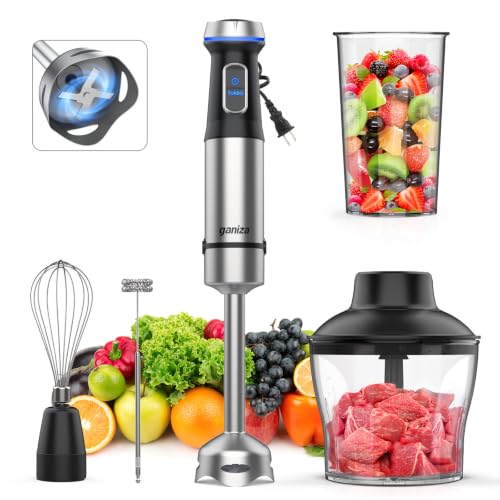
Ganiza’s 5-in-1 is the kit-builder’s answer in this guide: a corded hand blender whose listing states a maximum of 1000W from its heavy duty motor, sixteen speed settings, and a box that includes an 800ml mixing beaker, a 600ml chopper, a whisk and a milk frother around the stainless-bladed arm. Where the KOIOS above specialises, this one generalises — and for a kitchen equipping itself in one purchase, generalising well is the whole job.
Sixteen speeds sounds like numerology until you emulsify with them. The bottom of the range is genuinely gentle, letting oil enter a yolk mixture at the pace emulsions demand, while the steps upward give a smoothie or a soup distinguishable gears rather than a leap from idle to violent. The chopper’s 600ml capacity sits in the useful middle: a full onion-and-herb base, a salsa, a batch of breadcrumbs, without the refilling dance of the smallest bowls.
Corded power with this breadth asks one thing in return — drawer space and washing-up tolerance. Five functions mean five sets of parts after a full cooking day, and the cord, while it guarantees stamina, will remind you it exists every time you circle a large pot. Households that cook widely and often will call that a bargain; minimalist soup-only cooks should take the hint from the KOIOS section and buy narrower.
- Maker-stated max 1000W heavy duty corded motor
- Sixteen speed modes for fine emulsifying control
- 800ml mixing beaker and 600ml chopper included
- Whisk and milk frother attachments in the box
- Stainless steel blade on the blending arm
Strengths
- Broadest speed range in this roundup
- Chopper capacity suits real prep quantities
- One purchase covers blending, mincing and whisking
Trade-offs
- Many parts after a full cooking session
- Cord management returns with corded stamina
- Kit needs a dedicated drawer or storage box
Best for: households equipping a kitchen in one broad, capable purchase.
Not suited for: minimalists who blend only soup and resent washing attachments.
Ganiza Immersion Blender 8 in 1 — Most functions of any pick here
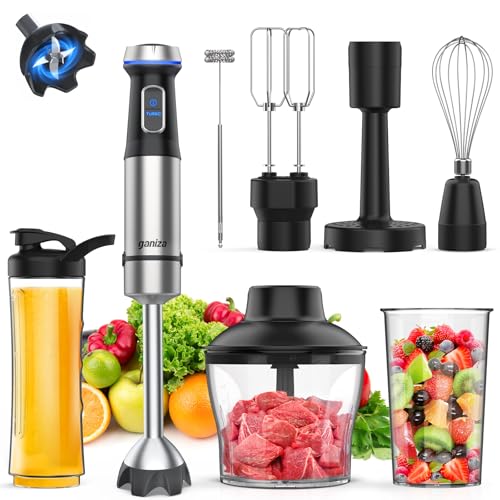
Eight-in-one is a claim that deserves unpacking rather than applause, so here is the unpacking: blending arm, beaker, chopper, whisk, frother, potato masher and a portable bottle join the corded handle, on the same max-1000W, sixteen-speed platform as the 5-in-1 above. The additions are not random. A masher attachment produces a rustic, textured mash without the glue risk of blending potatoes at speed, and the portable bottle blends a smoothie in the vessel it travels in, deleting one washing-up step from busy mornings.
The masher deserves its paragraph because potato is where immersion blenders go to disgrace themselves. A blade at full speed ruptures starch into wallpaper paste; a masher’s slower, pressing action keeps the texture honest. Sunday roasts, cottage pies and bubble-and-squeak all benefit, and households that mash weekly may find this single attachment justifies choosing the 8-in-1 over its sibling more than the other six functions combined.
Everything said about the 5-in-1’s breadth applies here with interest — more parts, more storage, more washing — plus one new consideration: overlap. If your kitchen already owns a beloved masher and a countertop blender for bottles, this kit duplicates them. If it owns neither, the 8-in-1 is the single-box answer to the widest brief in this guide, and its corded stamina means the whole repertoire is available for as long as the cooking lasts.
- Maker-stated max 1000W corded motor, sixteen speeds
- Eight functions including potato masher and portable bottle
- Beaker, chopper, whisk and frother included
- Stick emulsifier format for soups and purees
- Attachments aimed at smoothies, purees and mash
Strengths
- Potato masher solves the gluey-mash problem properly
- Portable bottle deletes a transfer and a wash
- Widest repertoire of any pick in this guide
Trade-offs
- Largest parts count to store and clean
- Duplicates tools some kitchens already own
- Corded tether applies to every function
Best for: mash-loving households wanting the widest single-box repertoire.
Not suited for: small kitchens where eight functions of storage is impossible.

KOIOS 5-in-1 Hand Immersion Blender — Best copper-motor value kit
This KOIOS is the elder sibling of the guide’s opening pick, and the comparison is instructive. The stated power matches at 1000W with twelve speeds, but the emphasis shifts: a copper motor — copper windings conduct efficiently and shed heat well, which is why makers name the material — and a fuller kit, adding a 600ml mixing beaker and a 500ml food processor to the whisk and frother, all in a red finish that refuses to disappear into a drawer of grey appliances.
The processor bowl is the meaningful upgrade. At 500ml it handles the daily mince — garlic and ginger for a curry base, nuts for a crumble, herbs for a sauce — in the seconds-between-stirring rhythm that real cooking demands. Between this and the Ganiza 5-in-1, the decision narrows to speed steps against motor story and beaker size against bowl size; both are defensible, and the sections are written so you can feel which kitchen each belongs to.
Age counts in this model’s favour in one specific way: a design that has sold for years accumulates a public record of quirks and virtues that a launch-month listing cannot offer. Read that record, note the non-BPA materials and the corded stamina it shares with the whole guide, and you have the value-kit argument complete — proven breadth, honest numbers, and a colour that cheers up the washing up.
- Maker-stated 1000W with copper motor
- Twelve speeds for soups, sauces and drinks
- 600ml mixing beaker and 500ml food processor included
- Whisk and milk frother attachments in the box
- Non-BPA materials, red finish
Strengths
- Copper motor story appeals to longevity hunters
- Processor bowl covers daily mincing jobs
- Long-selling design with a public track record
Trade-offs
- No anti-scratch billing like its newer sibling
- Chopper bowl smaller than the Ganiza equivalent
- Red finish will not suit every kitchen scheme
Best for: value seekers wanting a proven, full-featured corded kit.
Not suited for: cooks prioritising the newest anti-scratch arm design.

KitchenAid Corded Hand Blender KHBV53 — Best minimalist corded pick
After four kits competing on attachment counts, the KitchenAid KHBV53 arrives like a deep breath: a variable-speed corded hand blender, a removable eight-inch blending arm, a blending jar with a lid, and nothing else asking for drawer space. This is the emulsifier for cooks who already own a food processor they like, whisk by hand without resentment, and want the stick itself — the tool that enters the soup — to be the refined part of the purchase.
Variable speed here is a dial-led, graded affair tuned for control at the gentle end, where mayonnaise and hollandaise are won. The eight-inch arm reaches properly into stockpots, the jar with its lid turns the blender into a dressing-and-storage system for the fridge door, and the matte black finish shrugs off the tomato stains that tattoo lighter plastics. BPA-free materials are stated, as they are across this guide’s better listings.
Simplicity is this pick’s argument and its limit in a single breath. There is no whisk for cream, no chopper for onions, no frother for the morning latte — KitchenAid sells a broader ecosystem elsewhere, but this box is a purist’s. Buy it if your kitchen’s other tools are already loved; pass it by if this purchase must equip a kitchen from near zero, because the Ganiza kits above were designed for exactly that reader.
- Variable-speed corded motor, dial control
- Removable eight-inch blending arm for deep pots
- Blending jar with lid included for storage
- Matte black finish, BPA-free materials
- Purpose-built for smoothies, shakes and soups
Strengths
- Refined control at the gentle speeds emulsions need
- Jar with lid doubles as fridge storage
- Minimal parts, minimal washing up
Trade-offs
- No whisk, chopper or frother in the box
- Corded tether, as with every pick here
- Purist brief disappoints one-box shoppers
Best for: equipped kitchens wanting a refined, simple emulsifying stick.
Not suited for: first kitchens needing attachments to cover many jobs.

Mueller Ultra-Stick Immersion Blender — Best straightforward budget-minded stick
Mueller’s Ultra-Stick is the pick that has quietly furnished more kitchens than any other in this guide, and its specification explains the popularity: a maker-stated 500W heavy duty motor, eight speeds plus a turbo setting, and a box containing the blending shaft, a whisk, a milk frother and a measuring beaker. Nothing is exotic; everything is present. For the cook who wants a corded emulsifier that simply works, this has been the default answer for years.
The 500W figure invites an honest paragraph, because this guide contains models stating twice that number. Wattage as printed is a maker’s figure measured under each brand’s own conditions, and in the hand, technique and blade design mediate most of what a cook actually feels. The Mueller handles the category’s core work — soups, sauces, smoothies, whipped cream — with the stamina its cord guarantees; the number matters less than the long public record of it doing so, which is this pick’s real specification.
Treat it as the sensible classic rather than the exciting one. The speed range is narrower than the Ganiza pair, there is no chopper, and the design language is functional rather than beautiful. What you receive in exchange is a proven tool at the uncomplicated end of the market, with the whisk and frother covering the two attachments most households genuinely use after the arm itself.
- Maker-stated 500W heavy duty corded motor
- Eight speeds plus a turbo setting
- Blending shaft, whisk and milk frother included
- Measuring beaker supplied for emulsions and drinks
- Long-selling design with a wide public record
Strengths
- Proven, uncomplicated and easy to live with
- Whisk and frother cover the most-used extras
- Corded stamina for everyday batch sizes
Trade-offs
- No chopper for mincing and prep
- Narrower speed range than the Ganiza models
- Functional looks rather than design statement
Best for: everyday cooks wanting a proven corded stick without fuss.
Not suited for: buyers wanting the widest attachment kit or finest speed steps.
How Do the Six Compare Side by Side?
Trait against caveat, one line each. Notice how the trade-offs cluster: breadth costs washing up, purity costs versatility, and heritage costs novelty. The sections exist so you can pick the cost your household minds least, which is the only honest way to choose inside a category this mature.
| Pick | Standout trait | Watch out for |
|---|---|---|
| KOIOS 1000W Immersion Blender 3-in-1 | Anti-scratch arm and twelve speeds for emulsions | No chopper in the box |
| Ganiza Immersion Blender 5 in 1 | Sixteen speeds and a full five-piece kit | Parts count after big cooking days |
| Ganiza Immersion Blender 8 in 1 | Eight functions with masher and portable bottle | Duplicates tools some kitchens own |
| KOIOS 5-in-1 Hand Immersion Blender | Copper motor and a proven five-piece kit | No anti-scratch billing |
| KitchenAid Corded Hand Blender KHBV53 | Purist variable-speed stick with lidded jar | No attachments beyond the jar |
| Mueller Ultra-Stick Immersion Blender | Proven classic with whisk, frother and beaker | No chopper; narrower speed range |
What Makes Emulsifying the Hardest Test of a Stick Blender?
An emulsion is a truce between ingredients that want to separate, and the blender’s job is to negotiate it drop by drop. Oil must enter a yolk or a mustard base slowly enough to disperse into droplets too small to regroup, which demands a motor that stays smooth and willing at its lowest speeds. A tool that surges or stalls at the gentle end breaks the truce before it forms, and no amount of top-end power redeems it afterwards.
Soups test the opposite virtue — sustained effort through volume and heat — and sauces test both in sequence. This is why the guide weighs speed architecture alongside stated wattage: the sixteen-step Ganiza and twelve-step KOIOS models earn their complexity at the bottom of their ranges, while the Mueller’s eight speeds cover the same ground more coarsely but adequately for most kitchens.
How Should You Read Wattage Claims on Corded Blenders?
Every figure in this guide is the maker’s own, printed in the listing, and brands do not measure under one shared standard. A stated 1000W and a stated 500W therefore tell you something real about positioning within a brand’s range and something murkier across brands. Treat the numbers as a rough league table, then let blade design, speed control and the public record of the model refine the picture.
What corded power guarantees regardless of the printed figure is duration. A plugged-in motor does not fade across a long session, does not ask for a charging ritual, and delivers its Monday performance on the preserving Saturday of the year as well. For households whose blending is batched and heavy, that consistency outweighs any single number on any box in this guide.
Which Attachments Change What You Cook, and Which Gather Dust?
The whisk changes breakfasts and baking days: cream, egg whites and batter at speeds a hand whisk resents. The chopper changes weeknight prep, mincing the onion-garlic-ginger foundation of half the world’s dinners in seconds. The frother changes mornings only for milk-coffee households, where it is used daily, and is otherwise the attachment most likely to be found, pristine, at the back of the drawer during a clear-out.
The masher — one pick here — changes Sunday lunch, because potatoes mashed by pressing rather than blade stay fluffy instead of gluey. Rank any kit against your own cooking diary before paying for its count. A five-piece kit matched to your habits beats an eight-piece kit matched to somebody else’s, and every section above tells you plainly which household each box was built for.
How Do You Make Mayonnaise With a Stick Blender, Step by Step?
Use the tall, narrow beaker several picks include, because geometry is half the recipe. Yolk, mustard, lemon and seasoning go in first, oil rests on top, and the blender’s bell settles to the base before switching on at a low speed. Hold it still while the emulsion catches and thickens at the bottom — you will see the colour pale — then tilt and raise the arm slowly to draw the remaining oil down into the truce.
If the mixture splits, do not chase it at high speed. Start a fresh yolk in a clean beaker, then add the broken mixture in a thread as if it were oil, and the emulsion will usually re-form with its dignity intact. The graded low speeds praised throughout this guide exist precisely for these ninety seconds, and a cook who masters them owns every aioli, Caesar dressing and hollandaise thereafter.
Why Does Blending Potatoes With a Blade Turn Them to Glue?
Potato starch is stored in granules that a fast blade ruptures wholesale, releasing a paste that sets the mash like wallpaper adhesive. The faster and longer the blade works, the worse the texture, which is why experienced cooks mash by pressure — a ricer, a hand masher, or the masher attachment on the Ganiza 8-in-1 — and reserve blades for almost everything else in the kitchen.
If a blade is all you have, damage limitation is possible: work the potatoes hot, add butter and warm milk first, and use the briefest pulses at the lowest speed, stopping while the texture still looks rustic. It will be acceptable rather than admirable. Households that mash weekly should treat the masher attachment as this guide’s most quietly important feature and choose accordingly.
How Do You Blend a Soup Silky Without a Sieve?
Start with vegetables cooked truly soft — no blender fully redeems an undercooked carrot — and blend in the pot with the arm submerged, working in slow passes that let the vortex draw chunks down. Sweetcorn skins, fibrous celery and herb stems resist longest; give those soups an extra minute and a tilt of the pot so the mixture pools deeper at the arm’s bell.
Fat is the finisher’s friend. A knob of butter, a swirl of cream or good oil blended in at the end rounds the texture in a way extra minutes cannot, because the emulsion it forms coats the palate like silk. Taste before salting heavily, since blending concentrates perception, and remember that a soup blended to absolute smoothness can turn monotonous — some cooks stop a pulse early for character.
What Should You Check About Cords, Storage and Washing?
Cord length decides where you can work more than any other practical detail, so favour a route from socket to hob that does not cross a walkway or drape over a burner. Hang the tool or drawer it near that socket, and store attachments in one box or basket so the kit stays a kit. Loose choppers migrate; boxed choppers get used.
Washing follows one rule across the guide: powered handles are wiped, never immersed, while arms, beakers and bowls follow their listings’ dishwasher guidance. A ten-second blend of warm soapy water in a jug cleans most arms better than a brush, and drying blades before storage keeps edges and tempers intact. These unglamorous habits decide whether a blender is loved in year three.
How Does a Portable Bottle Attachment Change Mornings?
Blending a smoothie in the bottle it travels in deletes the transfer, the jug wash and the inevitable drip down the counter’s edge. For commuters and gym-goers, that deleted minute is the difference between a habit that survives February and one that does not. The Ganiza 8-in-1 is the only pick here offering it, which is why its section treats the bottle as a headline rather than a footnote.
The compromise is capacity and power distribution: a bottle blends for one, and frozen ingredients need the liquid-first, pulse-patient technique described elsewhere in this guide. Households blending for a family will still reach for a beaker or a countertop machine. Judge the bottle by your mornings, not by its novelty, and it will either justify the 8-in-1 single-handedly or not at all.
When Should You Choose a Kit Over a Single Refined Stick?
Inventory your kitchen honestly. A food processor you like, a hand mixer that works and a masher that fits your hand together argue for the purist stick — the KitchenAid here — because every attachment in a new kit would duplicate a resident. A bare kitchen argues the opposite: one Ganiza box equips blending, mincing, whisking and frothing in a single delivery, at a combined cost and footprint no set of separates can match.
The middle answer exists too. The KOIOS 5-in-1 and Mueller cover the common attachments without the full eight-function sprawl, suiting kitchens that need a chopper or a whisk but already own the rest. There is no virtue in maximalism or minimalism as such; there is only the match between the box and the drawers it must live with.
How Do You Keep a Corded Blender Working for Years?
Treat the cord kindly — coil it loosely, never wrap it tight around the handle, and keep it off hot hobs, since a nicked cord retires an otherwise perfect tool. Rest the motor during marathon sessions: a minute’s pause between large batches costs nothing and heat is the quiet enemy of every small motor in this guide, copper-wound or not.
Keep blades dry, chopper lids unstressed by heavy stacking, and the beaker out of the oven’s warming drawer where plastics age early. None of this is expertise; it is the ordinary respect a daily tool earns. The models in this guide are mechanically simple, and simple machines reward simple care with decade-long service.
What Is the Difference Between Turbo and a Top Speed Step?
A numbered top step is a sustained setting; turbo is a held burst that overrides the dial for as long as your thumb stays down. Turbo earns its place at the end of a soup, when the last chunks need violence, and at the start of a smoothie, when ice must be persuaded. Used carelessly in a shallow beaker it is also a splash generator, which is why the gentle start matters more with a turbo button in reach.
Cooks who emulsify often should test turbo discipline early: finish emulsions on the graded steps, and reserve the burst for breaking down solids. The distinction sounds pedantic until the first mayonnaise, at which point it becomes the entire recipe. Every pick here with a turbo labels it clearly; use it as a spice, not a staple.
How Should Left-Handed and Smaller-Handed Cooks Choose?
Button placement and grip diameter decide comfort more than weight in this category, because a stick blender is held under load, often one-handed, sometimes above a steaming pot. Trigger and dial layouts differ across these six; cooks with smaller hands should favour models whose speed control can be adjusted without regripping mid-blend, and anyone cooking daily should read the sections’ control descriptions with their own hands in mind.
Ambidextrous design is rarer than listings imply. Where a control sits asymmetrically, a left-handed cook adapts within a week in most cases, but the adaptation is real and worth knowing about before the return window closes. Test the grip in the first days on real food, not on air, and let your hands vote while voting is still free.
How Do You Blend Baby Food and Family Soup From the Same Pot?
Cooks feeding a baby from the family meal learn one reliable sequence: blend the whole pot to the texture the adults want, remove the baby’s portion, then blend that portion again in the beaker until it reaches the smoothness the stage requires. The beaker’s narrow geometry does the fine work a wide pot cannot, and seasoning added after the portion is removed keeps the baby’s food plain without condemning everyone else to bland soup.
Cool portions quickly, refrigerate what serves tomorrow and freeze the rest in small trays, because the stick blender’s real gift to parents is batch economics: one cooking session becomes a week of meals. Any pick in this guide handles cooked vegetables kindly, and the corded models do it without a battery anxiety in the background of an already busy evening.
What Does a Stainless Blade Do That a Plastic One Cannot?
Stainless blades tolerate hot liquids indefinitely, shrug off turmeric and tomato staining that tattoo lighter materials, and keep an edge through years of contact with ice, nuts and frozen fruit edges. Every pick in this guide uses a stainless blade on its arm, which is one reason the category as a whole ages gracefully compared with cheaper plastic-bladed toys.
The blade’s guard shape matters as much as its metal. A bell that flows liquid downward reduces suction against the pan base — the grab that startles new users — and an anti-scratch profile, like the newer KOIOS offers, goes further by keeping metal from kissing coated surfaces. Read the arm’s design as carefully as the motor’s numbers; it is the part that touches your food and your pans.
How Should You Blend Nuts, Crumbs and Other Dry Jobs?
Dry work belongs in the chopper bowls, not under the arm, because a stick blender in dry crumbs mostly rearranges them. Short pulses rule: three seconds on, a shake of the bowl, three more, until the texture evens out. Nuts release oil as they go, so the line between crumbs and butter is a matter of ten extra seconds — decide which side of it dinner needs before you start.
Breadcrumbs from stale bread, biscuit bases for cheesecakes and spice rubs all follow the same pulse-and-shake discipline. Overfilled bowls defeat it, because the top layer never visits the blade; work in two modest loads instead of one heroic one. The chopper-equipped picks here — both Ganiza models and the KOIOS 5-in-1 — were chosen partly because their bowls are sized for exactly these jobs.
Why Do Professional Kitchens Keep a Stick Blender Beside the Hob?
Speed of correction. A sauce that needs silking thirty seconds before plating cannot travel to a countertop blender and back; the stick enters the pan, fixes the texture, and is rinsed before the plates move. Professionals also value the portion control: a single serving of soup can be re-blended to order without disturbing the batch, which is the same trick home cooks use for the baby’s portion described above.
The lesson for home kitchens is placement. A stick blender stored beside the hob gets used as a cooking tool; one stored in a distant cupboard gets used as an appliance, which is to say rarely and reluctantly. Every pick in this guide is compact enough for a utensil drawer or a wall hook near the stove, and choosing its home is part of choosing the model.
How Do You Rescue a Sauce That Has Split?
Most split sauces are emulsion failures, and the stick blender is the rescue tool as well as the usual suspect. For a broken hollandaise or butter sauce, place a spoon of hot water or a fresh yolk in a clean beaker, then add the split sauce in a slow thread with the blender running gently, exactly as if it were oil in a new mayonnaise. The emulsion usually re-forms within half a minute.
Grainy cheese sauces respond to a different kindness: off the heat, a brief blend at low speed, and a splash of the cooking liquid to loosen the proteins’ grip. What no rescue survives is continued boiling, which sets the damage. Learn these two moves and a whole category of dinner-party panic quietly leaves your life, which may be the strongest single argument in this entire guide.
What Should You Cook First With a New Immersion Blender?
Begin with a soup you know by heart, so the tool’s character shows against a familiar baseline. Follow it with a dressing in the beaker to learn the splash threshold, then a mayonnaise when the kitchen is calm and nobody is hungry, because first emulsions deserve an unhurried teacher. By the third job your hands will know the speed dial’s geography without looking.
Save the heroic jobs — the double hummus, the preserving marathon — for week two, when technique is settled. Tools judged on a fair apprenticeship tend to be kept and loved; tools ambushed by the hardest job in the repertoire on day one tend to be blamed. The order of first cooks is a small decision with a long shadow, and it costs nothing to get right.
How Do You Choose Between Twelve and Sixteen Speed Steps?
The honest difference is granularity at the bottom. Sixteen steps divide the gentle zone more finely, which emulsion specialists feel when an extra half-step is the difference between coaxing and breaking a sauce. Twelve steps cover the same territory slightly more coarsely, and eight — the Mueller’s range — covers it adequately for cooks whose repertoire is soups and smoothies rather than hollandaise.
Nobody needs sixteen distinguishable speeds for soup, and pretending otherwise is how specification sheets win arguments kitchens lose. Choose the granularity your most delicate regular job demands, and let the rest of the dial be headroom rather than homework. The sections above score each model on exactly that basis, which is why no pick here is shamed for its count.
What Role Does the Beaker Play Beyond Blending?
A tall beaker with volume marks becomes the kitchen’s small-measures hub: dressings shaken and stored in it, batter rested in it, a single smoothie portion judged by eye against its graduations. The lidded KitchenAid jar leans furthest into storage; the Ganiza’s 800ml beaker leans into capacity. Both outlive their blending role on any given day.
That second life matters when you count storage honestly. A beaker that also measures, stores and serves earns its cupboard centimetres three ways, while a single-purpose jug earns them once. When two kits compete closely, compare their beakers as kitchenware in their own right — it is frequently the detail that separates the kit you keep from the kit you tolerate.
How Do You Blend Frozen Fruit Without Abusing the Motor?
Give the blade a fighting chance: liquid first, fruit second, and a five-minute counter rest for the hardest pieces while you measure the rest. Pulse to break the mass into gravel, rest the motor a breath, then blend steadily, adding liquid in splashes until the vortex takes over. Corded stamina helps here — there is no battery draining — but heat still builds in any small motor asked to chew ice continuously.
Work in that rhythm and every pick in this guide produces a respectable smoothie; demand a solid, dry, freezer-burned block be powdered in one press and even the strongest will complain audibly. Technique is not an excuse for weak tools — it is the difference between using a good tool well and using it briefly.
How Does a Stick Blender Change Weeknight Cooking, Really?
It removes the transfer. Soup stays in its pot, sauce stays in its pan, and the washing up shrinks by one large jug and one ladle’s worth of drips every single time. Multiplied across a winter of weeknights, that deleted transfer is the difference between blended soups appearing twice a week and appearing on special occasions. Tools win their place by removing friction, and no kitchen tool removes a step as completely as this one.
The second change is confidence with sauces. Cooks who know a split emulsion can be rescued, and a lumpy gravy can be silked in place, attempt more of both. Menus quietly widen: veloutés, pan sauces, fresh dressings instead of bottled. That widening — not any specification in this guide — is what owners actually report a year later, and it is why the category’s devotees sound evangelical.
What Should You Spend Attention on Instead of Money?
Technique, placement and one good beaker. Technique because the gentle start and the patient raise decide emulsions more than any motor. Placement because a blender stored by the hob becomes a cooking tool while one stored across the room becomes an errand. A good beaker because its geometry governs everything from splash control to portion judgement.
None of those cost anything after the purchase itself, which is the encouraging secret of this whole category: the distance between an adequate immersion blender experience and an excellent one is mostly knowledge. This guide has tried to hand over that knowledge alongside the shortlist, so whichever of the six you buy, it arrives to a kitchen already prepared to use it well.
How Do You Keep Soup From Climbing the Arm and Into the Motor?
Every arm has a maximum immersion line, usually where the shaft meets the handle, and hot soup that climbs past it is heading for seals that were never meant to bathe. Deep pots tempt the mistake: the liquid looks far away until the vortex rises. Keep the bell submerged but the junction dry, tilting the pot toward the arm when the level runs low instead of plunging the handle after the last cupful.
If liquid does reach the junction, stop, wipe the handle down and let it dry before storage. The tools in this guide are built for steamy, splashy work at the bell end and dry, grippy work at the handle end, and respecting that border is the simplest longevity habit a corded blender asks of its owner.
Keep one final proportion in mind as you choose: the arm does the work, the attachments do the variety, and your technique does the finishing. A household that understands that triangle will be happy with any of the six, because it will ask each tool for what the tool is genuinely built to give — and that, more than any badge or number printed on a box, is what satisfying ownership of an immersion blender has always consisted of.
And if the choice still feels close after all six sections, flip a mental coin between your two finalists and notice which result disappoints you. That small flinch is your actual preference announcing itself — usually for the kitchen you really keep, rather than the one in the photographs — and it has settled more appliance decisions honestly than any comparison table ever printed, including, we cheerfully admit, the one in this guide.
Trust that flinch, place the order, and put the kettle on — the first soup is closer than the deliberation made it feel, and it will teach your hands more in ten minutes than another evening of comparison ever could.
What Mistakes Do Buyers Make Most Often?
- Judging corded blenders on wattage alone, when speed control at the gentle end decides every emulsion you will ever make.
- Blending potatoes at full speed and blaming the recipe for glue, when the blade’s starch damage is the entire story.
- Adding oil quickly to a mayonnaise and then increasing the speed, which guarantees a split that patience would have prevented.
- Immersing the motor handle during washing up — the arm detaches precisely so the electrics never meet the sink.
- Buying the eight-function kit for a kitchen that already owns half its contents, then storing the duplicates resentfully.
- Letting the cord drape across a lit burner on the way to the socket, the classic corded-tool accident.
Final Recommendation
Choose by the work you cook most. Emulsion devotees and coated-pan owners should start with the KOIOS 1000W Immersion Blender 3-in-1, whose anti-scratch arm and twelve speeds were specified for exactly that life, while kit-builders get the most complete single purchase from the Ganiza Immersion Blender 5 in 1 and its sixteen speeds and honest chopper.
Mashers and maximalists are served by the 8-in-1 Ganiza, proven value by the copper-motor KOIOS kit, and purists by the KitchenAid Corded Hand Blender KHBV53, with the Mueller waiting patiently as the classic that simply works. No pick here is the wrong tool; each is the right tool for a kitchen the guide has described in its section.
Plug in, start slow, and let the first mayonnaise be your graduation piece rather than your gamble. A corded emulsifier chosen for its gentle speeds and kept within reach will still be silking soups and holding sauces together long after flashier appliances have been replaced — and the evening a hollandaise holds perfectly at the first attempt, you will understand why this category’s devotees never go back.
Frequently Asked Questions
Are the wattages in this guide measured the same way?
No — each figure is the maker’s stated number from its own listing, and brands test differently. Use them as a rough league table within the guide, and weigh speed control, blade design and the model’s track record alongside the printed figure.
Can an immersion blender really make mayonnaise?
Yes, and it is arguably the best tool for it. A narrow beaker, a low starting speed and a slow raise of the arm once the emulsion catches will produce a firm mayonnaise in under a minute, as the step-by-step section describes.
Which pick should I choose for mashed potatoes?
The Ganiza 8-in-1, because it is the only pick with a dedicated masher attachment. Blades rupture potato starch into glue; a masher presses instead, keeping the texture fluffy, which is why the distinction matters so much.
Is a chopper attachment as good as a food processor?
For daily quantities — an onion base, herbs, nuts, breadcrumbs — yes, and it is faster to wash. For large batches, pastry or slicing work, a full food processor remains the better tool, and the guide’s purist pick assumes you may already own one.
Why choose corded when cordless models exist?
Stamina and sustained power. A corded blender never fades mid-batch and never needs charging, which suits preserving days, double batches and long emulsifying sessions. The companion cordless guide covers the opposite trade, freedom from the socket.
How do I stop soup splashing when I blend?
Submerge the bell fully before switching on, start at a low speed, tilt the pot so liquid pools deeper, and work in slow pumps. Most splashing is a blade starting half in the air, which is a technique fault rather than a tool fault.
Related Guides
If the blending station is sorted and the rest of the kitchen is calling, these guides continue the renovation: Best Panel-Ready Dishwashers Best Lightweight Wool Blankets Best High-End Wall Mount Range Hoods



[…] settled and you are furnishing the rest of the room, these guides pick up where the hob leaves off: Best Immersion Blenders Best Cotton Blankets Best Indoor Electric […]