What's inside
- Key Takeaways
- Quick Picks
- How We Chose These Picks
- How Do the Six Blenders Compare Side by Side?
- Why Choose Glass When Plastic Is Lighter and Cheaper?
- How Do You Handle a Heavy Glass Jar Safely Every Day?
- What Does Thermal Shock Mean for a Blender Jar?
- How Should You Blend Hot Soups in a Glass Jar?
- How Does Jar Shape Change What Ends Up in Your Glass?
- What Can a Glass Jar Do That Owners Rarely Ask Of It?
- How Should You Choose a Capacity When Every Jar Looks Big Enough?
- What Do Programs and Presets Actually Do Inside the Jar?
- How Do You Keep a Glass Jar Sparkling Without Babying It?
- What Should Entertainers Know Before a Frozen-Drink Night?
- How Does a Glass Blender Serve a Household That Cooks From Scratch?
- How Should You Judge a Second-Hand or Inherited Oster?
- What Is the Right Way to Blend Nut-Heavy and Seed-Heavy Recipes?
- How Do You Blend Quietly Enough for Early Risers and Babies?
- What Should You Verify on Delivery Day?
- How Does Altitude and Ice Type Change the Crushing Brief?
- When Should You Replace a Jar, a Blade or the Whole Machine?
- How Do You Pour and Serve From a Big Glass Jar Gracefully?
- What Does a Glass Jar Mean for Baby Food and Special Diets?
- How Should a Small Kitchen Store a Blender It Uses Daily?
- What Is the Honest Lifespan Maths of Glass Versus Plastic?
- How Do You Decide Between the Two Oster Flagships?
- What Should a Buyer With Arthritic Hands or Limited Grip Choose?
- How Does a Blender Jar Earn a Place in a Zero-Waste Kitchen?
- What Mistakes Do New Glass Blender Owners Make Most Often?
- How Should You Run a New Glass Blender’s First Three Blends?
- How Should You Gift a Glass Blender Without Gifting a Burden?
- What Is the Simplest Sign a Glass Jar Was the Right Call?
- Final Recommendation
- Frequently Asked Questions
- Related Guides
As an Amazon Associate I earn from qualifying purchases. This post may contain affiliate links at no extra cost to you.
cottageverdict.com is reader-supported. When you buy through links on our site, we may earn an affiliate commission.
Where to buy: the six blenders in this guide are sold through Amazon, and every model name in the Quick Picks table, the detailed reviews and the comparison table links to its listing, where you can check price on Amazon and confirm the jar material, capacity and included cups for the exact version on sale.
People shop for the best glass blenders for smoothies for reasons that have little to do with blending power. Glass does not hold the smell of last month’s garlic sauce. It does not cloud after a hundred dishwasher cycles or stain turmeric yellow in a single curry. It feels like kitchen equipment rather than camping gear, and it sits heavily and reassuringly on its base while ice is being destroyed inside it. For cooks who blend hot soups, spicy pastes and daily smoothies in the same jar, that material honesty is the whole argument.
Six machines carry the argument here, four of them Oster and Hamilton Beach designs built explicitly around glass jars, plus two modern program-driven blenders whose listings headline capacity and cycles, where we flag the jar question openly rather than assuming it. Capacities run from a household-friendly 40 ounces to a party-scale 76, power from a modest 700 watts to a headline 1700 peak, and prices of attention from simple two-speed dials to digital displays with timers. The right pick depends on whether your smoothies share the jar with soups, sauces and a decade of daily use.
Key Takeaways
- Glass jars resist stains, odours and scratching, which is why they suit kitchens that blend savoury and sweet in the same vessel.
- Glass is heavier and breakable, so the trade is durability of surface against fragility of structure; handle and storage habits decide if it suits you.
- Oster’s long-running jar and blade ecosystem makes replacement glass and parts unusually easy to find years later.
- Two picks here headline programs and peak power rather than jar material, so verify the jar specification on the listing if glass is non-negotiable.
- Wave-action and reversible-blade designs matter because glass jars are often wider, and a wide jar needs help keeping the load circulating.
Quick Picks
| Pick | Badge | Why it earns its place |
|---|---|---|
| Oster Pro 1200 Blender Glass Jar | Best All-Round Glass Jar Blender | Smart Settings, seven speeds and a dual-direction blade in a glass jar, plus a 24-ounce smoothie cup. |
| Hamilton Beach Power Elite Blender Glass Jar | Best Budget Glass Jar Pick | A 40-ounce glass jar with the Wave Action system and twelve functions at the gentlest position in the range. |
| Oster Classic Heritage Blender Glass Jar | Best Heritage Durability Pick | The classic six-cup glass design with a stainless blade and a ten-year warranty named on the listing. |
| Oster Vortex Plus Glass Blender 1200W | Best Big-Capacity Glass Pick | A 76-ounce jar, reversible steel blades and four iBlend auto programs for households blending in volume. |
| KitchenAid Pure Power Blender | Best Power and Personal Jars | 1700 watts of peak power, a 68-ounce jar and two personal jars with a precision speed knob. |
| Gourmia Countertop Blender 8 Programs | Best Program Variety | Eight blend programs, a digital timer display and a tamper for cooks who like guided cycles. |
How We Chose These Picks
Jar material led the judging, obviously, but with a discipline: we only describe a jar as glass where the maker’s own listing title says so. That is why the four Oster and Hamilton Beach machines carry glass in their names and spec boxes plainly, while the KitchenAid Pure Power and the Gourmia are presented on their genuine strengths, power and programs, with an explicit note to confirm jar material on their listings before buying if glass is your reason for shopping. Honesty about two listings is worth more than a tidier table.
Beyond the jar, we weighed circulation. Glass jars tend to be broad and heavy, and a broad jar can strand ingredients at its corners unless the blade system fights back. Hamilton Beach answers with its Wave Action system that pulls mixtures downward. Oster answers twice, with a dual-direction blade on the Pro 1200 and reversible steel blades on the Vortex Plus. Programs mattered next: Smart Settings, iBlend auto programs and Gourmia’s eight cycles all aim to make texture repeatable for people who blend before coffee.
Finally, we considered the decade view. A glass jar blender is a keep-it appliance, so parts ecosystems counted heavily; Oster’s jars, blades and gaskets have been standardised for so long that replacements are a search away rather than an archaeology project. Warranty language counted too, and the Heritage model’s ten-year warranty, stated on its listing, is the strongest such signal in this guide.
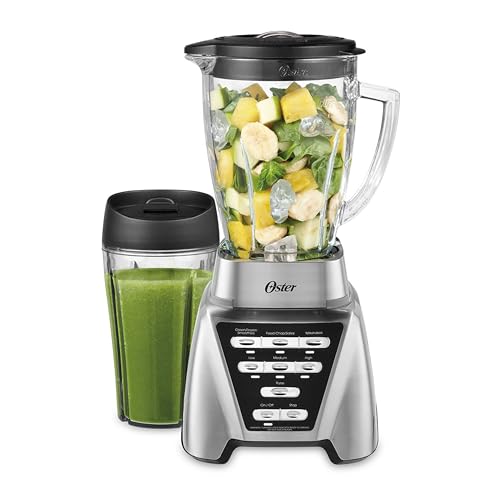
Oster Pro 1200 Blender Glass Jar — Best All-Round Glass Jar Blender
The Pro 1200 is the glass blender we would hand to most households, because it pairs the material they came for with the blade idea glass jars need most. Its dual-direction blade technology runs the cutting assembly both ways, which breaks up the dead zones where frozen fruit likes to hide in a wide jar, and Smart Settings technology wraps the common jobs into guided programs across seven speeds. The brushed nickel finish keeps the machine looking like the serious countertop equipment it is, and the included 24-ounce smoothie cup covers the single-serving mornings the big jar overshoots.
Daily life with the Pro 1200 is defined by that flexibility. The glass jar takes the family smoothie, the soup and the salsa without flavour memory between them, then the cup takes a solo shake to the car. Seven speeds give manual control when a recipe deserves it, and the programs take over when it does not. If your household blends across the whole menu and wants glass at the centre of it, this is the balanced answer in the guide.
- Jar: glass jar with brushed nickel base
- Speeds: 7 speeds with Smart Settings technology
- Blade: dual direction blade technology
- Extra vessel: 24 oz smoothie cup included
- Model line: Oster Pro 1200
- Best loads: smoothies, soups, frozen drinks
Strengths
- Reversing blade keeps wide-jar loads circulating
- Programs and manual speeds cover both moods
- Smoothie cup adds a personal format free
Trade-offs
- Glass jar is heavy to wash one-handed
- Programs take a week to learn by heart
- Nickel finish shows water spots in hard-water homes
Best for: households blending sweet and savoury in one jar. Not suited for: anyone who drops kitchenware often.

Hamilton Beach Power Elite Blender Glass Jar — Best Budget Glass Jar Pick
The Power Elite proves that the glass-jar brief does not require a flagship budget. Its 40-ounce glass jar is the right size for one to three smoothies, and the Wave Action system is the design’s quiet intelligence: the jar’s shape continuously pulls the mixture down into the blades, compensating for the modest 700 watts by refusing to let ingredients hide. Twelve functions, including puree and crush ice settings, give a simple control panel more range than its price position suggests.
Expectations should be set by physics rather than hope. This machine makes good smoothies from fresh and frozen fruit in sensible pieces, and it will work harder and longer on a jar packed with whole frozen strawberries and large cubes than the Oster Pro will. For a first glass blender, a small household, or a second machine at a holiday home, that is a fair exchange for the gentlest ticket in this guide. Model 58148AG has been a staple recommendation in this class for years precisely because the formula is honest.
- Jar: 40 oz glass jar
- Power: 700 watts
- System: Wave Action pulls mixture into blades
- Functions: 12 including puree and crush ice
- Colour of this listing: Black
- Model reference: 58148AG
Strengths
- Glass jar quality at the friendliest level here
- Wave Action helps a modest motor perform
- Compact jar suits one to three servings
Trade-offs
- Heavy frozen loads take longer and louder work
- Forty ounces limits family batch size
- Fewer premium touches than the Oster pair
Best for: first-time glass blender buyers and small homes. Not suited for: big families or ice-heavy entertainers.

Oster Classic Heritage Blender Glass Jar — Best Heritage Durability Pick
The Heritage is the blender your grandparents would recognise, kept in production because its simplicity refuses to date. A six-cup glass jar, a stainless steel blade, two speeds and a motor the listing rates at 1000 peak watts: that is the entire proposition, and it has been enough for generations of milkshakes, smoothies and sauces. The listing’s ten-year warranty is the loudest durability claim in this guide, and it is backed by the deepest replacement-parts ecosystem in home blending, because Oster has made jars and blades to this pattern for decades.
Two speeds sound like a limitation until you notice how most blending actually goes: low to start and gather, high to finish. The Heritage simply declines to subdivide those decisions. What it will not give you is program finesse, pulse choreography or a personal cup, and its classic jar demands the two-handed respect glass deserves. Buy it if your instinct says appliances should be repaired rather than replaced; it is the closest thing in this guide to a lifetime purchase.
- Jar: 6-cup glass jar, classic Oster pattern
- Power: 1000 peak watts
- Blade: stainless steel blade assembly
- Speeds: 2 speed settings
- Warranty: 10 year warranty named on the listing
- Design line: Classic Series Heritage
Strengths
- Decades-deep parts and jar availability
- Ten-year warranty stated by the maker
- Foolproof two-speed operation for any user
Trade-offs
- No programs, pulse routines or personal cup
- Two speeds limit texture fine-tuning
- Classic styling divides modern kitchens
Best for: buy-it-for-life shoppers and traditional kitchens. Not suited for: program lovers or smoothie-cup commuters.

Oster Vortex Plus Glass Blender 1200W — Best Big-Capacity Glass Pick
Scale is the Vortex Plus’s opening argument: a 76-ounce dishwasher-safe jar that swallows a party batch of frozen drinks in one cycle, driven by a 1200-watt motor through reversible steel blades. Reversibility is more than a novelty in a jar this wide; rocking the load back and forth through the blades is how big volumes reach uniform texture without a tamper dance. Four iBlend auto programs cover frozen drinks, milkshakes, salsa and smoothies, so the machine’s size does not demand the operator’s full attention.
A Blend-N-Go cup rides along for the solo mornings, giving this flagship the same dual-format trick as the Pro 1200. The costs of scale are the expected ones: the full jar is a serious lift to the sink, the footprint is the largest in the guide, and a two-person smoothie in a 76-ounce jar blends like a puddle in a lake, thin loads under the blades’ best reach. Households that entertain, batch-cook soups or feed a smoothie-loving crowd will forgive all of that by the second weekend.
- Jar: 76 oz jar, dishwasher safe
- Power: 1200 watt motor
- Blades: reversible steel blades
- Programs: 4 iBlend auto programs
- Extra vessel: Blend-N-Go cup included
- Colour of this listing: Black
Strengths
- Largest capacity in this guide by a margin
- Auto programs tame the big jar’s workflow
- Reversible blades even out large loads
Trade-offs
- Full jar is heavy to lift and wash
- Small loads blend below its comfort zone
- Largest counter and cupboard footprint here
Best for: entertainers and large smoothie households. Not suited for: couples blending one small drink daily.
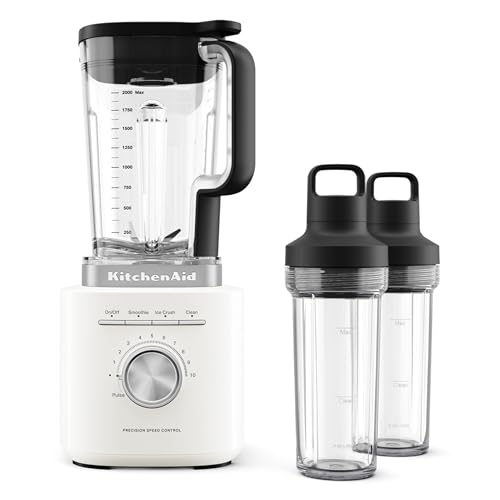
KitchenAid Pure Power Blender — Best Power and Personal Jars
KitchenAid enters this guide on horsepower and flexibility rather than on the word glass, and we will be plain about that: the listing for the Pure Power headlines a 68-ounce blending jar and two 16-ounce personal blending jars, with 1700 watts of peak power and a precision speed control knob, but it does not trumpet jar material in its title the way the Oster listings do. If a glass jar is your non-negotiable, confirm the jar specification on the listing before ordering. If power and format lead your list, read on, because this is a formidable machine.
The smoothie cycle gives the big jar a programmed route to its best texture, while the knob keeps manual control satisfyingly analogue for a modern machine. The personal jars convert the same base into a commuter blender, which makes the Pure Power the only pick here besides the BL660-style hybrids that genuinely lives both lives. Model KSB2078PL carries KitchenAid’s service network behind it, and for households whose blending is heavy, hot and daily, that network plus this power is a serious proposition in any jar material.
- Main vessel: 68 oz blending jar
- Power: 1700 watt peak power
- Personal jars: two 16 oz jars included
- Control: precision speed control knob
- Program: dedicated smoothie cycle
- Model reference: KSB2078PL
Strengths
- Strongest headline power in this guide
- Big jar plus personal jars on one base
- Analogue knob suits hands-on blenders
Trade-offs
- Listing title does not specify jar material
- Peak wattage is a surge figure, not sustained
- Flagship scale suits committed users best
Best for: power-led buyers wanting jar and cup formats. Not suited for: shoppers for whom verified glass is the point.

Gourmia Countertop Blender 8 Programs — Best Program Variety
Gourmia’s pitch is guidance. Eight blend programs, four speeds plus pulse and a manual mode, a digital display with an integrated timer, and a round-plated tamper included for pushing thick loads down into the blades of its 56-ounce pitcher. The tamper is the tell that this machine expects to work on dense mixtures, smoothie bowls and frozen desserts that lesser pitchers leave stratified. Like the KitchenAid above, its listing headlines capacity and programs rather than jar material, so glass purists should verify the pitcher specification on the listing itself.
For cooks who blend by recipe and like a machine that counts seconds honestly, the timer display is a small luxury that becomes a habit. Dishwasher-safe parts keep the program-rich machine from becoming a cleaning-rich one. Gourmia’s support footprint is smaller than Oster’s or KitchenAid’s, which is the standing trade for feature density at this level. If your blending life is varied and program-friendly, the Gourmia covers more named jobs out of the box than anything else in this guide.
- Pitcher: 56 oz capacity
- Programs: 8 blend programs
- Speeds: 4 speeds plus pulse and manual mode
- Display: digital with integrated timer
- Tool: round-plated tamper included
- Cleanup: dishwasher-safe parts per the listing
Strengths
- Widest program menu in this guide
- Tamper handles thick, dense blends
- Timer display makes recipes repeatable
Trade-offs
- Listing title does not specify pitcher material
- Smaller brand network than Oster or KitchenAid
- Many programs mean a learning curve
Best for: recipe-driven blenders who like guided cycles. Not suited for: two-button traditionalists or glass absolutists.
How Do the Six Blenders Compare Side by Side?
| Pick | Capacity | Control style | Standout detail |
|---|---|---|---|
| Oster Pro 1200 Blender Glass Jar | Glass jar | 7 speeds + Smart Settings | Dual-direction blade |
| Hamilton Beach Power Elite Blender Glass Jar | 40 oz glass | 12 functions | Wave Action system |
| Oster Classic Heritage Blender Glass Jar | 6-cup glass | 2 speeds | 10 year warranty listed |
| Oster Vortex Plus Glass Blender 1200W | 76 oz | 4 auto programs | Reversible steel blades |
| KitchenAid Pure Power Blender | 68 oz + 2 jars | Precision knob | 1700W peak power |
| Gourmia Countertop Blender 8 Programs | 56 oz | 8 programs + timer | Tamper included |
Why Choose Glass When Plastic Is Lighter and Cheaper?
The case rests on three properties. Glass is chemically sleepy: it does not absorb the flavours or pigments of what it holds, so Monday’s curry paste does not haunt Friday’s banana smoothie. Its surface stays smooth for years, where plastic micro-scratches into a haze that traps residue and dulls the jar’s looks. And it tolerates heat gracefully, which matters when the same jar blends steaming soups in winter and frozen drinks in summer.
The counter-case is equally real. Glass breaks, and it breaks at the worst moment, usually full. It adds weight to every lift, pour and wash. Households with stone floors, small children doing the washing-up, or a blender that travels to picnics may rationally choose otherwise. This guide exists for the households on the other side of that judgement, who keep a jar for a decade and want it to look and taste neutral for all ten years.
How Do You Handle a Heavy Glass Jar Safely Every Day?
Two hands, dry grip, short journeys. Lift the jar by its handle and base together when it is full, because a full 76-ounce jar is a kettlebell wearing a smoothie costume. Wash it in a sink with a towel laid in the bottom if your sink is ceramic or stone, so a slip becomes a clunk instead of a crack. Dry the jar before it goes back on the base, since a wet jar on a powered base is a pairing nobody needs.
Storage deserves one decision: the jar lives either on the base or in a low cupboard it can reach without stretching over other glassware. Most chips and cracks in long-lived jars happen during storage gymnastics, not blending. Treat the jar like the decade-long equipment it is, and the material will repay the respect by looking new when plastic rivals have long gone cloudy.
What Does Thermal Shock Mean for a Blender Jar?
Glass dislikes sudden temperature swings more than it dislikes heat itself. A jar taken straight from blending frozen drinks and plunged into steaming wash water is being asked to expand unevenly, and even good borosilicate-style kitchen glass appreciates a gentler transition. Let a frosty jar stand a minute, rinse lukewarm first, then wash hot. The same courtesy applies in reverse when a jar of hot soup meets a cold stone counter; set it on a cloth or a wooden board.
These habits sound fussy until you price a replacement jar and discover your model is the one size out of stock. Oster’s ecosystem softens even that risk, with jars widely available, but prevention remains cheaper than any spare part. A glass blender asks for a cook’s ordinary attentiveness, nothing more theatrical, and returns years of neutral, unstained service for it.
How Should You Blend Hot Soups in a Glass Jar?
Hot blending is where glass earns its premium, and also where technique matters most. Fill the jar no more than halfway, because soup expands its ambitions when agitated and steam needs headroom. Start at the lowest speed with the lid’s vent open or the lid slightly ajar under a folded towel, letting pressure escape while the vortex forms, then climb gradually. The Oster Pro’s range of speeds and the Gourmia’s manual mode both suit this ramp; a two-speed machine like the Heritage asks you to pulse patiently at the start.
Blend in batches and keep a ladle’s discipline: hot soup on skin is a kitchen injury that ruins the evening it was meant to crown. Pour from the jar with both hands and a dry cloth on the handle. Once the rhythm is familiar, the glass jar becomes a soup instrument plastic owners quietly envy, because it emerges from a tomato bisque as clear as it entered it.
How Does Jar Shape Change What Ends Up in Your Glass?
Two jars of equal capacity can blend like different species. A jar that narrows toward the base concentrates the load over the blades and suits smaller batches, while a broad, squared jar creates corners where a well-designed blade system can fold ingredients back into the vortex. Glass jars in this guide lean broad, which is exactly why their makers pair them with circulation tricks: Wave Action’s downward pull, reversible blades that rock the load, and dual-direction cutting that refuses to let a corner become a pantry.
Your recipes vote on shape too. Thick mixtures like hummus and nut-heavy smoothie bowls prefer a jar whose base keeps the load in blade contact, with a tamper, like Gourmia’s, as the equaliser. Thin, liquid blends forgive almost any geometry. If your blending skews thick, weight the circulation features and the tamper heavily; if it skews juicy, any jar here will serve and you can choose on capacity and controls instead.
What Can a Glass Jar Do That Owners Rarely Ask Of It?
Because glass tolerates heat and shrugs off stains, it moonlights beyond smoothies with unusual grace. Blend warm pancake batter and pour straight from the jar’s spout. Mill a spice rub, then a milkshake an hour later, with no ghost of cumin in the cream. Make a marinade at noon, a frozen cocktail at six and a baby-food puree the next morning, each tasting only of itself. That neutrality across a whole day of cooking is the lived experience behind the material’s reputation.
Glass also ages visibly well, which changes how a kitchen feels. A five-year-old glass jar on an Oster base still looks like equipment, where a scarred plastic jar makes the whole machine look tired and invites premature replacement. Owners who care about a kitchen’s appearance across years, not just its performance across weeks, consistently underrate this until they have owned both materials.
How Should You Choose a Capacity When Every Jar Looks Big Enough?
Work backwards from your largest honest load, then add headroom for the vortex. A couple blending two smoothies needs the 40-ounce Hamilton Beach class and no more. A family of five needs the Pro 1200’s jar or better. Entertainers and soup batchers belong in Vortex Plus territory at 76 ounces, where a double soup recipe blends in one pass instead of two. Remember that fill lines mark blending capacity, not brim capacity, and a jar run at its line already works hard.
Small-load behaviour cuts the other way. A single smoothie in a huge jar spreads thin and blends reluctantly, which is why two picks here include personal cups and why the hybrid format keeps winning households. If your week contains both a Sunday crowd and a Tuesday solo shake, buy the dual-format machine and stop asking one vessel to be two tools.
What Do Programs and Presets Actually Do Inside the Jar?
A preset is a choreography of speeds and pauses written by someone who blended the target food many times. A smoothie cycle ramps to break the load, sustains to polish texture, and pulses to drop stragglers from the jar walls. An ice-crush pattern attacks in bursts so cubes shatter instead of skating. Smart Settings on the Oster Pro, iBlend on the Vortex Plus and Gourmia’s eight programs are all dialects of this same idea, differing in how many foods they claim to know.
Manual control remains the native language for cooks who adjust by ear. The KitchenAid’s precision knob and the Heritage’s two honest speeds serve that temperament. Neither philosophy wins in the abstract; programs reward routine, knobs reward attention. Most households contain one of each temperament, which is why machines offering both, like the Pro 1200 and the Gourmia, tend to end arguments at the shelf.
How Do You Keep a Glass Jar Sparkling Without Babying It?
Cloudiness on glass is usually mineral film from hard water, not damage, and it yields to a vinegar soak that plastic owners can only envy for its simplicity. Blend warm water with a drop of washing-up liquid after each use for the daily clean, and give the jar a vinegar bath monthly if your water is hard. The blade assembly wants the same respect as any blender’s: rinse promptly, dry fully, and check the gasket’s mood during deep cleans.
Dishwasher convenience varies by component rather than by jar. The Vortex Plus jar is listed dishwasher safe, and glass generally tolerates the machine well, but powdered detergents and crowded racks are how rims get chipped in practice. If you do machine-wash the jar, give it room, keep it off the heating element’s neighbourhood, and let the smaller plastic parts ride in the top rack where the violence is gentler.
What Should Entertainers Know Before a Frozen-Drink Night?
Volume changes everything about blending. Ice for twelve margaritas is a workout that separates the Vortex Plus and Pure Power class from the household middleweights, not because the smaller machines cannot crush ice, but because batch rhythm matters when guests are waiting. Blend in waves, rest the motor between the largest loads, and keep a second tray of ice staged so the machine, not the freezer commute, sets the pace.
Glass brings a presentational dividend at parties: a jar that pours cleanly and looks like bar equipment earns its counter space in front of an audience. Chill the jar beforehand for frozen drinks if you remember, since a room-temperature jar spends its first minute melting your texture. And assign the blending to one person; a jar passed between enthusiastic amateurs is how lids get cross-threaded and loads get doubled by mistake.
How Does a Glass Blender Serve a Household That Cooks From Scratch?
Scratch cooking generates the odd, unglamorous loads that justify a serious jar: breadcrumbs from the heel of a loaf, a romesco that must be silk, a curry paste that stains everything it touches except glass, pancake batter for a crowd, a vinaigrette emulsified for the week. Each of these is a two-minute job in a blender and a ten-minute job by hand, and the week’s arithmetic quietly builds the case for the machine’s footprint.
The Heritage Oster, with its two speeds and immortal parts supply, is the scratch cook’s traditional ally, while the program-rich machines suit cooks who want those jobs timed and repeatable. Either way, the jar’s neutrality is the feature doing the heavy lifting, because a scratch kitchen’s blender touches more flavours in a day than a smoothie-only machine meets in a month.
How Should You Judge a Second-Hand or Inherited Oster?
Classic Oster blenders circulate through families and second-hand shops like cast-iron pans, and the glass-jar ecosystem is why they remain useful. Check three things on any veteran machine: the blade assembly’s bearings, which should spin freely without grinding; the jar’s rim and base threads, which should be free of chips; and the gasket, which is a cheap replacement that refreshes the whole seal. A Heritage-era base with a new gasket and blade can out-blend a neglected new machine.
Parts commonality is the quiet superpower here. Because Oster standardised its jar pattern across decades and models like the Heritage in this guide, a jar bought today fits bases older than some of their owners. That is the practical meaning of a mature platform, and it is worth weighing against any newer machine whose jars exist only as long as its production run does.
What Is the Right Way to Blend Nut-Heavy and Seed-Heavy Recipes?
Nuts and seeds ask for patience and staging. Blend them with the liquid portion first, at high speed, longer than instinct suggests, because their oils release gradually and the texture turns a corner suddenly from gritty to glossy. A tamper, as included with the Gourmia, keeps dense mixtures in contact with the blades without opening the lid mid-blend. Small batches behave better than heroic ones, and a warm jar from a previous soup blend will melt nut butters into cooperation faster.
Seeds that resist, like flax, benefit from a soak or a pre-grind in a spice grinder if your blender leaves them whole after an honest minute. Judge the result by the drink’s finish rather than the clock; the goal is a smoothie that does not require chewing. Machines with strong circulation, the Pro 1200’s dual-direction system among them, shorten this work noticeably compared with a simple two-speed jar.
How Do You Blend Quietly Enough for Early Risers and Babies?
No blender is silent, but glass and good habits shave the worst off the event. Blend on a towel to decouple vibration from the counter, keep the jar’s load liquid enough that the motor is not straining against a dry mass, and finish the blend in one decisive run instead of five apologetic bursts that each restart the loudest phase. Programs help because they end the blend at the earliest correct moment rather than when a cautious human finally decides to stop.
Timing is the other half of courtesy. A smoothie blended at night and refrigerated in its cup loses a little brightness and buys a household its sleep, a trade many new parents rate as the best in this entire guide. If mornings must be fresh, the personal-cup formats concentrate the noise into the shortest possible window, which sleeping partners consistently prefer to a pitcher’s longer roar.
What Should You Verify on Delivery Day?
Inspect the jar before anything else, turning it slowly against the light to catch chips at the rim and hairline cracks near the base, because glass damage is a return-now conversation, not a live-with-it one. Seat the jar on the base and run water through a short blend to test the seal while the packaging is still open. Count the cups, lids and tools against the listing, since a missing Blend-N-Go cup or tamper is easiest to remedy in week one.
Register the warranty, photograph the model plate, and keep the manual with the kitchen’s other appliance papers. Then make the blend you bought the machine for, at your real recipe size, and judge it without mercy. A glass blender should feel like a decade-long decision from its first smoothie; if the jar, the noise or the controls already annoy you on day one, the return window is the cheapest exit you will ever be offered.
How Does Altitude and Ice Type Change the Crushing Brief?
Not all ice is the same opponent. Dense, clear cubes from a home freezer are the hardest test, while the softer, cloudy ice from a fridge dispenser shatters kindly in almost anything here. Large cubes deserve a head start: crack them in a bag with a rolling pin, or let the jar’s first pulses do the cracking at low commitment before the full-speed finish. Wet ice, straight from a drink bucket, blends faster than freezer-burned cubes that have fused into masonry.
Households that entertain with bagged ice will find even the Hamilton Beach coping gracefully, while households freezing their own trays of solid cubes should weight the stronger Oster and KitchenAid systems. The ingredient nobody lists on the box is your own ice supply, and matching the machine to it prevents the common disappointment of a good blender judged by an unfair exam.
When Should You Replace a Jar, a Blade or the Whole Machine?
Replace the jar when chips reach the rim or threads, because a chipped rim cuts and a damaged thread leaks, and neither improves with optimism. Replace the blade assembly when blends that once took forty seconds now take ninety with the same recipe, or when the bearing’s spin feels gritty in your fingers. Gaskets are consumables; a weeping seal is a gasket asking politely for retirement, not a machine failing.
Replace the machine when the motor’s note changes permanently, when speeds drop out, or when the cost of parts approaches the cost of a successor with a fresh warranty. The Heritage’s ten-year warranty and Oster’s parts depth push that day unusually far away, which is the economic form of the durability argument running through this guide. Buy once, maintain lightly, and let the jar outlast trends.
How Do You Pour and Serve From a Big Glass Jar Gracefully?
A full glass jar pours like a jug of consequence, and the technique is commitment: one hand on the handle, one steadying the base, a decisive tilt and a glass positioned before the pour begins. Hesitation halfway is what sends smoothie down the jar’s outside. The spouts on these jars are shaped for the job, but they reward a confident angle and punish a timid one, so fill glasses over the sink or a tray until the machine’s manners are familiar.
For children’s servings and car cups, decant into a measuring jug first if the big jar’s pour feels like defusing something. There is no prize for serving directly from the flagship vessel, and the cook who moves a smoothie through one extra jug keeps both the counter and the morning calmer. Thick blends benefit from a spatula’s escort; let gravity do the slow work rather than shaking a heavy jar over a small glass.
What Does a Glass Jar Mean for Baby Food and Special Diets?
Households pureeing baby food care about two things a glass jar provides beautifully: total neutrality between batches and easy, visible cleanliness. A jar that shows every residue line against the light gets washed properly, and a material that keeps no flavour memory lets a pear puree follow a lentil soup without negotiation. Blend in small, liquid-supported batches, cool quickly, and portion into the fridge or freezer the same day.
Special diets benefit similarly. Allergen-conscious kitchens can dedicate one jar to safe ingredients with confidence that yesterday’s nut blend is not lingering in scratched plastic, because glass scrubs back to a verifiably clean state. That verifiability, more than any feature list, is why many careful households insist on glass for the blender above every other appliance.
How Should a Small Kitchen Store a Blender It Uses Daily?
The daily-use blender earns the counter’s best real estate: a spot with elbow room, an outlet of its own and no overhead cabinet conflict when the jar lifts off. If the counter truly cannot hold it, a low cupboard directly beneath the prep area is the acceptable compromise, with jar and base stored together so assembly never becomes a treasure hunt. Storing the jar separately from its base across the kitchen is how blenders retire early in spirit.
Cord discipline keeps the arrangement safe. A loose cord across a wet counter is an invitation, so use the shortest sensible route to the outlet and keep the excess coiled behind the machine. Small kitchens reward this tidiness doubly, because the blender’s corner doubles as prep space the moment the machine slides back, and a clean, cord-free surface is the difference between a workstation and a shrine.
What Is the Honest Lifespan Maths of Glass Versus Plastic?
A plastic jar typically asks for replacement every few years as it clouds, stains and absorbs its history, while a glass jar’s replacement is usually an accident rather than a schedule. Spread across a decade, the glass jar’s higher starting weight buys fewer replacement purchases and a machine that still looks presentable in year eight. The motor usually decides the true lifespan in both cases, which is why the warranty and parts arguments around the Oster models matter as much as the jar itself.
None of this makes plastic wrong; it makes the materials suited to different owners. Plastic forgives drops, travels lightly and suits blenders that live in caravans, dorms and picnic baskets. Glass rewards a settled kitchen that blends in one place for years. Choose the material that matches the life the blender will actually lead, and the arithmetic will follow the lifestyle every time.
How Do You Decide Between the Two Oster Flagships?
The Pro 1200 and the Vortex Plus are cousins with different centres of gravity. The Pro centres on versatility at family scale: a glass jar of everyday size, seven speeds, Smart Settings and a smoothie cup for the solo run. The Vortex centres on volume: 76 ounces, auto programs tuned to frozen drinks and entertaining, and a Blend-N-Go cup that keeps it honest on weekday mornings. Households whose biggest regular load is a family smoothie should take the Pro and enjoy the lighter jar every day.
Households whose calendar includes parties, soup seasons and visiting grandchildren will extract the Vortex’s value often enough to forgive its heft. The deciding image is your largest monthly blend: picture it in each jar, then picture washing that jar at the end of the day. The machine that wins both pictures is the right flagship, and the other remains an excellent answer to a question your household is not asking.
What Should a Buyer With Arthritic Hands or Limited Grip Choose?
Grip changes the glass calculation honestly. A full glass jar is the heaviest vessel in this guide, and a cook with limited hand strength should weight the smaller Hamilton Beach jar, blend in two lighter batches, and pour with the jar rested on a cloth rather than held aloft. The personal cups on the Pro 1200 and Vortex Plus also serve this cook well, moving the daily smoothie into a vessel designed for one-handed life.
Controls matter as much as weight. Big, positive buttons and a chunky knob, like the KitchenAid’s precision control, are kinder than small touch panels to hands that cannot press delicately, and the Heritage’s two-speed simplicity has an accessibility argument hidden inside its nostalgia. Ask whose hands will run the machine on its worst morning, and let those hands vote before the jar’s beauty does.
How Does a Blender Jar Earn a Place in a Zero-Waste Kitchen?
A durable jar is a small act of refusal: it declines the cycle of cloudy plastic replacements and keeps a machine in service across the years when trends suggest upgrading. Glass also recycles cleanly at the end of its life, unlike the mixed materials of many appliance parts. Owners pursuing a lower-waste kitchen find the glass blender an easy ally, especially in the Oster ecosystem where a single broken part rarely retires the whole machine.
The habit side matters equally. A blender that handles vegetable trimmings into soups, stale bread into crumbs and soft fruit into smoothies is a food-waste tool wearing an appliance’s clothes. Buy the jar that will still be blending those rescues in ten years, maintain its blades and gaskets, and the machine becomes part of the household’s conscience as well as its breakfast.
What Mistakes Do New Glass Blender Owners Make Most Often?
Thermal shock tops the list, as the section above explains, with the freezer-to-boiling-wash swing as its classic form. Second is the one-handed full-jar lift, which ends with a smoothie on the floor and a jar in two pieces roughly once per neighbourhood per year. Third, owners blend dry, hard loads with no liquid and wonder at the noise, when a splash of liquid would have let the blades do their work in half the time and a quarter of the drama.
Fourth comes lid complacency with hot liquids, sealing steam into a pressure vessel and redecorating the ceiling. Fifth, people store the jar nested inside other glassware, chipping rims that then cut lips and ruin seals. And sixth, buyers choose capacity by ambition rather than routine, purchasing the 76-ounce entertainer for a two-smoothie household and resenting its weight daily. Every mistake here is a habit, and habits are cheaper to fix than jars.
How Should You Run a New Glass Blender’s First Three Blends?
Begin with water and ice alone, the purest test of crushing and sealing, and watch for leaks at the base while the jar is still returnable. Follow with your standard smoothie at its normal size, judging texture against the machine it replaces. Finish with something savoury and pale, a hummus or a white sauce, then a glass of water blended after washing: if the water tastes of nothing, the jar’s neutrality promise is already keeping itself. Three blends, one evening, and you know the machine you actually bought.
How Should You Gift a Glass Blender Without Gifting a Burden?
A glass blender is a decade-scale present, so aim it at a settled kitchen rather than a temporary one. The Heritage suits the cook who values permanence, the Pro 1200 suits the household that blends everything, and either lands better with a card that names why you chose it than with a bigger box chosen blindly. Keep the receipt somewhere findable; even the perfect jar deserves an exchange path if the recipient’s counter disagrees with your measuring.
What Is the Simplest Sign a Glass Jar Was the Right Call?
Blend something staining, wash the jar, blend something pale, and taste nothing but the second recipe. That small, repeatable miracle is the whole case for the material, renewed weekly.
Final Recommendation
For most glass-seeking households, the Oster Pro 1200 Blender Glass Jar is the complete answer: glass, a reversing blade, programs and a personal cup in one brushed-nickel package. Traditionalists should take the Oster Classic Heritage Blender Glass Jar and its listed ten-year warranty, while entertainers will use every ounce of the Oster Vortex Plus Glass Blender 1200W. Choose the jar you will still enjoy lifting in five years, keep it out of thermal trouble, and your smoothies will taste of fruit alone, exactly as the orchard intended.
Frequently Asked Questions
Are glass blender jars dishwasher safe?
Glass itself shrugs off dishwashers, and the Vortex Plus jar is listed as dishwasher safe. Lids, gaskets and blade assemblies vary by maker, so follow each model’s guidance; hand-washing the blade unit remains the kinder habit for its edge and seal.
Can a glass jar handle ice as well as plastic?
Yes. The crushing happens at the blades, and the glass jars here pair with systems designed for frozen loads, from Oster’s reversible blades to Hamilton Beach’s Wave Action. Use sensible cube sizes and liquid in the jar, as with any blender.
What if I cannot tell whether a jar is glass from the listing?
Check the specification section of the listing for jar material before ordering, as we flag for the KitchenAid and Gourmia picks in this guide. If the material matters to you and the listing will not confirm it, choose one of the models that names glass in its title.
Is a heavier jar actually more stable on the counter?
Weight helps a blender sit planted during violent ice work, and glass contributes real ballast. Stability also comes from feet and base design, so treat heft as a supporting virtue rather than the whole story.
How long should a glass jar last?
Absent drops and thermal abuse, effectively the life of the motor, which is the material’s great advantage. Oster’s standardised jars also mean a replacement is easy to source if an accident does happen.
Do glass jars blend more quietly than plastic?
Glass can take the sharp edge off some blending resonance, but the motor and the ice remain the loud parts of the event. Expect a modest difference in tone, not a quiet appliance.
Related Guides
A well-equipped kitchen rarely stops at one upgrade. If crispy lunches are next on the list, Best Air Fryers with Stainless Steel Basket scores every basket material honestly before you buy. Underfoot comfort for the cook standing at that counter is covered in Best Area Rugs 9 x 12, which includes kitchen-friendly washable options at room scale. And when the renovation reaches the sink itself, Best Farmhouse and Apron Kitchen Sinks covers the deep-basin designs that make washing a big glass jar a pleasure instead of a juggling act.


