What's inside
- Key Takeaways
- Quick Picks
- How We Chose These Picks
- Which Animal Print Living Room Rugs Should You Look at First?
- How Do These Animal Print Living Room Rugs Compare Side by Side?
- How Do You Style an Animal Print Rug Without Overwhelming the Room?
- How Do You Care for Faux Fur and Printed Animal Print Rugs?
- Cheetah or Leopard: How Do the Two Prints Actually Differ?
- How Does Animal Print Pair With Different Sofa Colours?
- Can Animal Print Work in Open-Plan and Multi-Use Rooms?
- What Mistakes Do Buyers Make With Animal Print Rugs?
- How Does Lighting Change the Way Animal Print Reads?
- What Should You Check Before Ordering a Hide-Shaped Rug?
- Final Recommendation
- Hide Shape or Rectangle: How Do You Choose the Silhouette?
- Why Choose Faux Over a Real Hide?
- Frequently Asked Questions
- Related Guides
As an Amazon Associate I earn from qualifying purchases. This post may contain affiliate links at no extra cost to you.
cottageverdict.com is reader-supported. When you buy through links on our site, we may earn an affiliate commission.
Where to buy: linked names open their Amazon listings, where you can check price on Amazon and confirm the exact dimensions and backing before ordering. The best animal print living room rugs all make the same wager: that a living room is improved by one confident, wild note played at floor level. Every pick in this guide is faux — printed or faux-fur interpretations of cheetah and leopard patterning, most of them cut into the irregular hide shape that makes the category instantly recognisable. No animal was involved in any of these rugs, and that fact is not a footnote; it is the reason the modern versions can be washable, affordable and guilt-free in ways their inspirations never were.
Understand the shape before the pattern, because the shape governs placement. The classic hide silhouette — roughly five feet across at its widest, with organic, asymmetric edges — is not a small area rug but a large accent, designed to float at an angle in front of a sofa, under a coffee table’s centre, or beside a reading chair, the way a real hide would be laid. Four of the six picks follow that silhouette at around 5.2 feet. One pick goes deliberately smaller, a three-foot accent for tight spots. And one pick breaks ranks entirely: the DweIke, a rectangular 6×9 machine-washable rug that wears leopard print in a conventional area-rug format for households that want the pattern’s energy with a rectangle’s manners.
Surface is the second axis. Most of these rugs are faux fur — a short, soft, printed pile that mimics the look of a pelt with a fraction of the weight and none of the care anxiety. The DweIke instead uses a low printed pile with a rubber backing, trading plushness for the ability to survive a washing machine and a dining room. Between the plush hide-shapes and the practical rectangle lies the whole decision this guide exists to illuminate: is your animal print a piece of theatre, or a working rug that happens to be dressed as one?
A living room can hold exactly one statement of this volume comfortably, which makes choosing it a genuinely enjoyable problem. Get the scale right, get the surface right, and an animal print rug does something no safe neutral can: it makes the room look decided. Guests may not remember your sofa in five years. They will remember the cheetah on the floor.
It helps to know that this category forgives experimentation more than most. Hide shapes are light, movable and comparatively modest in cost next to the furniture they transform, so a household can try the wild note, live with it through a season of evenings, and refine — a different angle, a different room, a plush surface exchanged for a washable one — without the commitment weight of a wall-to-wall decision. The six picks below are arranged as a ladder of that experimentation, from the three-foot accent that asks almost nothing to the 6×9 rectangle that asks, gloriously, for everything.
Key Takeaways
- Every pick is faux — printed or faux-fur cheetah and leopard patterning with no animal hide involved at any stage.
- Most picks use the classic hide silhouette around 5.2 feet, an accent shape meant to float at an angle across the floor, not anchor a room wall to wall.
- Faux-fur surfaces deliver the soft, theatrical pelt look; the DweIke’s low pile instead adds machine washing and a gripping rubber backing.
- One small three-foot pick serves tight accents — beside reading chairs, in dressing areas, or layered over larger plain rugs as a patterned centrepiece.
- Animal print is a one-statement pattern: pair it with plain upholstery, solid cushions and quiet curtains, and let the floor hold the room’s wild note entirely alone.
- Hide shapes show their edges, so placement angle and the surrounding border of floor space are part of the design decision itself.
Quick Picks
| Pick | Badge | Why it earns its place |
|---|---|---|
| WARM HAVEN Cheetah Print Rug 5.2×7 | Best Statement Cheetah | A generous 5.2×7 faux cheetah with rustic multicolour depth that commands a living room floor with confidence. |
| yingda1992 Leopard Area Rug Faux Fur | Best Faux Fur Feel | The classic hide mat in soft faux fur at 5.2 by 6.5 feet, the category’s traditional silhouette done plush. |
| Leopard Print Rug Cheetah 5.2×6.8 Faux Cowhide | Best Washable Hide Shape | A no-slip, washable faux cowhide in cheetah print that keeps the hide drama and drops the care anxiety. |
| Cheetah Print Rug Small Faux Cowhide | Best Accent Size | A compact 3.3 by 3.1 foot hide shape for layering, chair-side accents and small-room statements. |
| Leopard Rug Fluffy Animal Print 5.2×7 | Best Plush Comfort | The fluffiest faux-fur leopard here, a soft hide-shaped field for bedrooms and bare-foot living rooms. |
| DweIke Leopard Print Rug Washable 6×9 | Best Practical Large | A rectangular 6×9 leopard in low pile with rubber backing — machine washable, dining-room capable, unmistakably wild. |
How We Chose These Picks
We began with pattern honesty, the quality that separates a designed rug from a novelty item. Animal print rugs divide into those that render the pattern with some fidelity — varied spot scale, tonal depth, an organic irregularity — and those that stamp a repeating cartoon across a rectangle. The six below were chosen from the first camp, with cheetah and leopard interpretations that read as textile art rather than novelty merchandise. Every pick is faux, and we treated any ambiguity about that as disqualifying rather than charming.
Shape and surface came next. The guide needed the category’s centre — hide silhouettes around five feet in faux fur — represented at several temperaments: the WARM HAVEN’s rustic statement, the yingda1992’s classic plush, the washable faux cowhide’s practicality, the fluffy leopard’s comfort. It also needed the two honest exceptions: a small accent for households whose rooms cannot host five feet of cheetah, and the DweIke’s rectangle for households whose lives cannot host a delicate one. A guide with only hide shapes would be a fantasy; a guide without them would not be about animal print at all.
Finally, we weighed living-room reality: backings that keep an angled accent from migrating across polished boards, surfaces that vacuum without shedding their print into baldness, edges that survive being walked over at an angle ten thousand times, and sizes stated in the odd, honest dimensions of hide shapes — 5.2 feet is not a typo in this category but the signature of a silhouette measured at its widest points. A pick that failed on any of those domestic counts was set aside, however handsome its spots.
Which Animal Print Living Room Rugs Should You Look at First?
One more preliminary, because this category attracts impulse like few others: decide whether you are buying the print for the room you have or for the room in the photograph. The photograph’s room has no dog, no toy migration, no radiator in the wrong place and light that behaves like a studio. Your room has all of those, and the right pick is the one whose surface, backing and size survive your room’s actual biography. The guide’s temperaments — washable, plush, smooth, miniature, rectangular — exist to map prints onto biographies, and five honest minutes spent on that mapping will do more for your satisfaction than any amount of spot-admiring.
Decide what job the print is doing. If the room is calm, furnished and faintly boring — the classic beige living room that functions perfectly and excites nobody — start with the WARM HAVEN or the yingda1992 and let a hide shape do its theatre. If the room is busy with family life and the rug must earn its place practically, start with the DweIke and never look back. If your room is small or your courage is real but your floor is limited, start with the three-foot accent and layer it. The fluffy leopard is where barefoot households and bedroom-adjacent living rooms should begin.

WARM HAVEN Cheetah Print Rug 5.2×7 — Best Statement Cheetah
The WARM HAVEN is the guide’s maximalist: a faux cheetah at 5.2 by 7 feet — the largest of the hide-style picks — described in rustic, multicolour terms that distinguish it from flatter, two-tone prints. Cheetah patterning lives or dies by its spots, and the rustic depth here gives the field variation, so the rug reads as an organic surface rather than a wallpaper repeat. At this size it stops being an accent and becomes a territory: the soft country in front of the sofa where the room’s life happens, patterned like something wild decided to lie down there.
That scale suits the rooms animal print serves best — large, plain, under-patterned living rooms where the floor is the only place a statement can be made without renovating. Leather sofas, plain linen, dark wood and brass all have long, happy histories with cheetah, and the multicolour rusticity widens the rug’s diplomacy to include warm woods and earthy palettes that a stark black-and-tan print would fight. Lay it at a slight angle, let its edges show against bare floor, and resist the urge to centre it like a rectangle; hides are placed, not aligned.
Its demands match its presence. A 5.2×7 statement leaves little pattern budget for the rest of the room, so busy cushions and rival rugs must retire. Faux-fur surfaces want regular vacuuming with care around the edges, and a rug this size is a two-hand carry to shake out. Households that accept those terms gain the single most transformative object in this guide — the one that turns a furnished room into a styled one in the time it takes to unroll it.
- Size: 5.2 x 7 feet, hide style
- Pattern: cheetah, rustic multicolour
- Surface: faux animal print fur
- Suits: living rooms, bedrooms
- Role: statement centrepiece
Strengths
- Largest hide-style footprint here, with pattern depth that reads organic rather than printed-flat.
- Rustic multicolour tones cooperate with leather, warm wood and earthy palettes.
- Instantly styles plain rooms, doing the work of a full redecoration at rug scale.
Trade-offs
- Consumes the room’s entire pattern budget, retiring busy cushions and rival textiles.
- Large faux-fur surface needs regular, careful vacuuming and two hands to move.
- Statement scale overwhelms small rooms rather than enlivening them.
Best for: large, plain living rooms ready for one confident, wild centrepiece.
Not suited for: small rooms or interiors already rich in competing patterns.

yingda1992 Leopard Area Rug Faux Fur — Best Faux Fur Feel
If the category has a classic form, this is it: a leopard hide mat in faux fur at 5.2 by 6.5 feet, the traditional silhouette with its organic outline, printed with the rosettes that distinguish leopard from cheetah’s simpler spots. The yingda1992’s appeal is tactile as much as visual — faux fur with a soft hand that invites bare feet and floor-sitting, the pelt experience translated into a washable-adjacent, animal-free textile. In living rooms it layers beautifully over larger plain rugs or bare boards; in bedrooms it is the classic beside-the-bed indulgence.
Leopard is the most historically decorated of the animal prints, with a design lineage running through a century of interiors, and that lineage makes it the easiest print to style seriously. It behaves almost as a neutral in warm palettes — designers have treated leopard as a spice rather than a main course for decades — which means this rug can join rooms that a cheetah statement might overwhelm. The hide outline keeps it playful; the rosettes keep it classic.
Care is the faux-fur routine: vacuum gently, shake outdoors, spot-clean promptly, and keep the rug’s edges from being trapped under heavy furniture legs where the outline can crease. The hide shape also means coverage is impressionistic — it will not protect a rectangular territory or sit squarely under a dining set. As the category’s traditional article, though, executed in plush faux fur at the classic size, it is the pick against which the others define their variations.
- Size: 5.2 x 6.5 feet, hide shape
- Pattern: leopard rosettes
- Surface: faux fur
- Suits: living rooms, bedrooms, home offices
- Role: classic hide accent
Strengths
- Classic hide silhouette and rosette pattern carry a century of styling precedent.
- Soft faux-fur hand invites bare feet, floor-sitting and bedroom placement.
- Leopard’s warm neutrality layers over plain rugs and boards with ease.
Trade-offs
- Irregular outline gives impressionistic coverage, not rectangular protection.
- Faux fur wants gentle vacuuming and prompt spot care to stay plush.
- Edges can crease if trapped beneath heavy furniture legs.
Best for: classic living rooms and bedrooms wanting the traditional hide in plush faux fur.
Not suited for: under-table duty or households needing washable, hard-wearing coverage.

Leopard Print Rug Cheetah 5.2×6.8 Faux Cowhide — Best Washable Hide Shape
This pick resolves the hide shape’s oldest tension: the silhouette says handle with care, but the household says otherwise. Built as a faux cowhide in cheetah print at 5.2 by 6.8 feet, it is listed as no-slip and washable — a hide-shaped rug that can be cleaned properly rather than merely maintained. For living rooms with dogs, children or a healthy traffic of snacks, that single specification moves the animal print from the fragile column to the practical one without surrendering the shape that makes the category fun.
The faux cowhide construction gives the surface a smoother, more pelt-like finish than the fluffier faux furs elsewhere in the guide, which suits the cheetah print’s sleek character. Cheetah spots on a smooth field read crisp and graphic; the rug photographs like a designer piece and behaves like a family one. Its size sits comfortably in the category’s standard band, large enough to anchor a coffee-table arrangement, light enough in spirit to angle across a corner.
Washable still deserves its asterisk: a 5.2×6.8 rug needs a machine with real capacity and a drying plan, and the no-slip surface should be checked after washes to confirm its grip has renewed rather than faded. But compared with dry-clean anxieties and spot-clean-only pelts, this is the hide shape grown up — the one a household can actually live on, spill on, and restore with a wash cycle and an afternoon of drying.
- Size: 5.2 x 6.8 feet, hide shape
- Pattern: cheetah print on faux cowhide
- Surface: soft faux fur finish, no-slip
- Care: washable per listing
- Suits: living rooms, bedrooms, dining rooms
Strengths
- Washable construction brings hide-shape drama into family-room practicality.
- Smooth faux cowhide surface renders cheetah spots crisp and graphic.
- No-slip backing keeps an angled accent planted on hard floors.
Trade-offs
- Washing at this size still requires a large-capacity machine and drying space.
- Smoother finish offers less plush depth than the guide’s fluffy faux furs.
- Hide outline remains an accent shape, not full rectangular coverage.
Best for: busy living rooms wanting the hide silhouette with washable, no-slip practicality.
Not suited for: households seeking deep plush pile or formal rectangular anchoring.

Cheetah Print Rug Small Faux Cowhide — Best Accent Size
Not every room can host five feet of cheetah, and not every admirer of the print wants to commit a whole floor to it. This small faux cowhide — 3.3 by 3.1 feet, a hide silhouette in miniature — is the category’s tasting portion: a complete animal-print statement at accent scale. Its natural posts are the ones large hides cannot serve: beside a reading chair, in front of a dressing table, at the foot of a favourite armchair, or layered over a large plain rug as the patterned jewel at its centre.
Layering is where the small hide becomes a stylist’s instrument rather than a compromise. A big, quiet rug — sisal, plain wool, a neutral flatweave — gains a whole personality from a cheetah hide floated over its middle, and the arrangement can be rearranged, rotated or retired in minutes when tastes shift. In kitchens and small living rooms, the listing’s own suggested territory, the mini hide gives a wild note at a scale the room can absorb without the pattern becoming the room’s only idea.
The limits are scale’s limits, stated cheerfully: it anchors nothing, protects little floor, and under a coffee table it would look like a coaster. It is also, being small, the easiest pick here to move, wash-day-manage and store, which makes it the natural first purchase for the animal-print curious. Many statement rooms begin with exactly this rug and a household discovering, to its own surprise, that it wants more.
- Size: 3.3 x 3.1 feet, small hide shape
- Pattern: cheetah and leopard print
- Surface: faux cowhide fur
- Suits: living rooms, kitchens, dressing areas
- Role: accent and layering piece
Strengths
- Accent scale delivers the full animal-print effect in rooms too small for standard hides.
- Superb layering piece over large plain rugs, rearrangeable in minutes.
- Light and manageable to move, clean and store between styling moods.
Trade-offs
- Anchors no furniture and protects very little floor.
- Can look lost if asked to serve as a room’s only rug at larger scales.
- Miniature hide shape reads playful, which formal rooms may not want.
Best for: small rooms, layering over plain rugs, and first-time animal-print buyers.
Not suited for: serving as a living room’s sole, furniture-anchoring rug.

Leopard Rug Fluffy Animal Print 5.2×7 — Best Plush Comfort
Where the washable cowhide is the category’s realist, this leopard is its romantic: a fluffy faux-fur hide at 5.2 by 7 feet, built for the rooms where the rug is not just seen but inhabited. The deeper, softer pile turns the hide shape into a destination — the spot children claim for reading, the warm island in front of a bedroom’s seating, the living-room corner where everyone ends up on the floor despite a house full of chairs. Its leopard patterning rides on that plushness with a soft-focus effect, the spots slightly diffused by the pile, which makes this the gentlest, least graphic animal print in the guide.
That softness suits a particular styling register: bedrooms, nurseries-adjacent family rooms, and living rooms that lean cosy rather than tailored. In a tailored room, a fluffy hide can look like a pet that wandered in; in a cosy room, it looks like the point. The 5.2×7 footprint matches the WARM HAVEN’s territory, so the choice between them is purely about surface philosophy — rustic and defined, or plush and diffused.
Plush faux fur asks the most care in the guide: regular gentle vacuuming to keep the pile standing, prompt attention to anything spilled into its depths, and an acceptance that high-traffic lanes will flatten faster than on smoother surfaces. It is not the rug for a dining room or a mud-season entry. It is the rug for the household whose highest floor value is comfort, and who wants that comfort wearing leopard.
- Size: 5.2 x 7 feet, hide shape
- Pattern: leopard and cheetah print
- Surface: fluffy faux fur
- Suits: living rooms, bedrooms, nurseries, home offices
- Role: plush comfort accent
Strengths
- Deepest, softest faux-fur comfort in the guide for floor-level living.
- Plush pile softens the print, suiting cosy rooms that find graphic prints harsh.
- Generous hide footprint creates a true destination zone in front of seating.
Trade-offs
- Plush pile flattens in traffic lanes and hides spills until they are found by hand.
- Most care-hungry surface here, wanting frequent gentle vacuuming.
- Cosy character can look untidy in tailored, formal living rooms.
Best for: cosy living rooms and bedrooms where barefoot comfort outranks crisp pattern.
Not suited for: dining rooms, entries, or low-maintenance households.
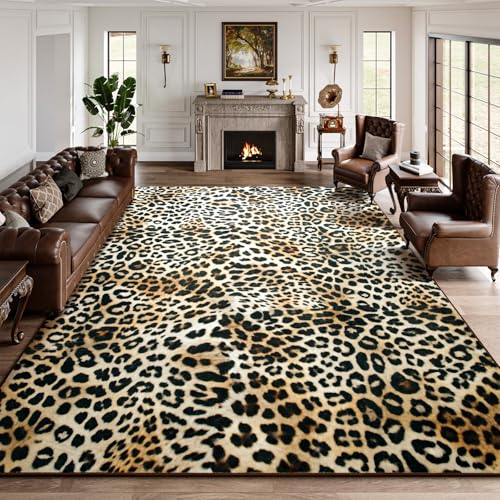
DweIke Leopard Print Rug Washable 6×9 — Best Practical Large
The DweIke is the guide’s argument that animal print can hold a real job. It abandons the hide silhouette for a conventional rectangle at a full 6×9, prints its leopard across a low pile, backs it with rubber, and makes the whole construction machine washable. This is animal print for the dining room, the family living room, the household with a dog and a schedule — the pattern’s full visual energy, engineered like a modern washable area rug, non-slip and ready to anchor furniture in the ordinary rectangular way.
That rectangle changes the styling conversation. A 6×9 leopard under a dining table is a genuinely bold interior decision, the pattern visible in the border around the table and chairs, turning every dinner into an occasion with a backdrop. In a living room it anchors a full grouping — sofa and chairs with legs aboard — which no hide shape can honestly do. The white-brown colourway keeps the print lighter and more contemporary than the classic golden leopard, suiting rooms with pale furniture that deeper prints would darken.
The trade is tactile: low pile is not a pelt, and anyone whose heart is set on faux-fur softness should choose among the hide shapes instead. Machine washing a 6×9 also remains a large-machine, full-drying-plan undertaking, however willing the rug itself is. But as the only pick that unites the pattern, the size, the grip and the laundry, the DweIke is the guide’s recommendation for households that refuse to choose between wild and practical.
- Size: 6 x 9 feet, rectangular
- Pattern: leopard and cheetah, white brown
- Construction: low pile, rubber backing, non-slip
- Care: machine washable per listing
- Suits: living rooms, dining rooms, bedrooms, kitchens
Strengths
- True 6×9 rectangle anchors full furniture groupings as no hide shape can.
- Machine-washable low pile with rubber backing suits dining and family duty.
- Lighter white-brown print keeps bold pattern compatible with pale rooms.
Trade-offs
- Low pile cannot offer the faux-fur pelt experience of the hide-shaped picks.
- Washing a 6×9 requires a large machine and a serious drying plan.
- Full-room leopard is a major commitment that will direct all other pattern choices.
Best for: dining rooms and family living rooms wanting bold print with washable practicality.
Not suited for: shoppers seeking the hide silhouette or plush faux-fur softness.
How Do These Animal Print Living Room Rugs Compare Side by Side?
| Pick | Size and shape | Surface | Defining strength |
|---|---|---|---|
| WARM HAVEN Cheetah Print Rug 5.2×7 | 5.2 x 7 ft, hide style | Faux fur | Rustic statement scale |
| yingda1992 Leopard Area Rug Faux Fur | 5.2 x 6.5 ft, hide | Faux fur | Classic plush hide |
| Leopard Print Rug Cheetah 5.2×6.8 Faux Cowhide | 5.2 x 6.8 ft, hide | Faux cowhide, washable | Hide drama, laundry ease |
| Cheetah Print Rug Small Faux Cowhide | 3.3 x 3.1 ft, hide | Faux cowhide fur | Accent and layering |
| Leopard Rug Fluffy Animal Print 5.2×7 | 5.2 x 7 ft, hide | Fluffy faux fur | Plush comfort |
| DweIke Leopard Print Rug Washable 6×9 | 6 x 9 ft, rectangle | Low pile, rubber backing | Practical full-room print |
Read the table by shape first: five hides and one rectangle is the category’s true shape, and your room’s need — accent or anchor — decides which column of history you join. Among the hides, surface separates the temperaments: rustic definition, classic plush, washable smoothness, miniature versatility, deep fluff. The DweIke stands apart as the working rug in costume, and for many households it will be the wisest wild decision they make. If the table leaves you torn between two hides, choose by touch rather than by photograph: the surface your household will enjoy walking on daily is the one whose pattern you will still be admiring in a year, long after the novelty of the spots has settled into affection.
How Do You Style an Animal Print Rug Without Overwhelming the Room?
The governing rule is arithmetic, and it is worth engraving above the sofa: one wild thing per room, given the floor and the silence of everything else. An animal print rug is a complete pattern statement, and it styles best against restraint — plain upholstery in linen, leather or solid wool; cushions in solid colours pulled from the print’s own palette; curtains that keep their opinions to themselves. Leopard and cheetah both contain multitudes of tone — tans, browns, blacks, creams — which is why they cooperate with so many plain palettes: almost any warm neutral you own already exists somewhere in the spots.
Placement is the second styling lever, and hide shapes reward a particular confidence. Angle the hide. A hide laid parallel to the sofa looks like a rectangle that failed; a hide laid at a relaxed diagonal looks like a beautiful object that landed. Let the whole silhouette show against bare floor or a larger plain rug, with the coffee table centred on it or deliberately off it, and keep the surrounding floor border generous — a hide crowded by furniture legs loses the outline that is half its charm.
Metal and wood choices finish the composition. Brass, blackened metal, dark walnut and worn leather all have long alliances with animal print and deepen its glamour; pale pine and white-painted furniture push it toward the playful and contemporary, which suits the small hide and the DweIke’s lighter colourway. What animal print cannot abide is a rival: a floral sofa, a striped curtain and a cheetah floor in one sightline is not eclecticism but an argument. Choose the floor as the speaker, and let everything else in the room be a good listener.
How Do You Care for Faux Fur and Printed Animal Print Rugs?
Faux fur’s routine is gentle and regular, closer to caring for a favourite coat than for a floor: vacuum with suction and a soft brush approach rather than aggressive beating, working with the pile’s direction, and shake the rug outdoors when its size permits to release what vacuuming loosens and to let the pile lift again in the fresh air. Spills should be blotted into the pile’s depths promptly — faux fur hides liquid as readily as it hides crumbs, and a spill discovered late is a stain with a head start. The washable picks, the faux cowhide and the DweIke, convert deep cleaning into a laundry event; follow their listings’ guidance, use a machine with genuine capacity for their size, and dry them flat and fully before returning them to the floor.
Edges and outlines deserve specific attention on hide shapes. The irregular perimeter is the rug’s beauty and its vulnerability: edges trapped under furniture can crease, and edges in traffic lanes can curl. Reposition the rug’s angle occasionally, keep heavy legs off the outline, and let a curled edge rest under a stack of books overnight rather than fighting it daily. Printed low pile, the DweIke’s surface, is the forgiving exception — vacuum it like any hardworking rug and wash it when family life requires.
Storage and rotation are simple and worth the small effort: roll rather than fold where possible, keep faux fur dry, clean and aired, and rotate hide shapes to a fresh angle with the seasons so light and traffic distribute their effects across the whole silhouette instead of engraving one corner. An animal print rug’s pattern is its value, and pattern kept clean, uncreased and unfaded keeps the room’s statement at full volume for years.
Cheetah or Leopard: How Do the Two Prints Actually Differ?
The words are used interchangeably in listings — several picks here answer to both — but the patterns have distinct characters worth knowing before you commit a floor to one. Cheetah spots are simple: solid dark marks, evenly scattered, graphic and clean. The effect is modern, almost polka-like in its regularity, and it suits contemporary rooms that want the wild note delivered with a designer’s restraint. The WARM HAVEN and the washable faux cowhide wear cheetah in this spirit, their spots reading crisply even from across a room.
Leopard markings are rosettes: clustered, broken rings with tonal centres, denser and more ornate than cheetah’s dots. The effect is richer, warmer, more historical — leopard is the print of vintage glamour and traditional eclectic rooms, and its complexity makes it the better camouflage for the daily evidence of a lived-in floor. The yingda1992 and the fluffy leopard carry this character, their rosettes softened further by faux-fur pile into something almost painterly.
In practice, the choice is about register. Cheetah reads younger, cleaner, more graphic; leopard reads warmer, deeper, more classic. Rooms with modern furniture and plain palettes usually take cheetah as their native accent, while rooms with wood, books, brass and inherited pieces find leopard speaks their language already. And since the prints share a palette, a household can move between them across rooms — cheetah in the living room, leopard in the bedroom — without the house feeling undecided.
How Does Animal Print Pair With Different Sofa Colours?
The sofa is the rug’s largest neighbour, and the pairing decides whether the room reads as styled or as accidental. Begin with the easiest alliances: tan, camel and cognac leather sofas are animal print’s oldest friends, the combination so established it functions as a classic in its own right. Cream and ivory linen sofas take the print as their drama, the rug supplying all the pattern the arrangement needs. Grey sofas — the modern default — pair surprisingly well with the warmer prints, the contrast between cool upholstery and warm spots giving a room its tension, provided cushions echo one of the rug’s browns to mediate.
Dark sofas demand a lighter print or a lighter ground. A black or charcoal sofa over the DweIke’s white-brown leopard is a composed, graphic arrangement; the same sofa over a deep golden hide can sink the room’s centre into darkness unless lamps and pale cushions lift it. Velvet sofas in jewel tones — emerald, rust, ochre — are the connoisseur’s pairing, each colour finding a relative inside the print’s palette, but the arrangement works only when every other pattern in the room resigns.
Patterned sofas are the honest difficulty. A floral, striped or checked sofa plus an animal print floor is a combination that a handful of professional stylists can land and most rooms cannot. If your sofa already speaks in pattern, give the floor the small hide layered over plain carpet, at accent volume — or accept that the animal print’s moment in your home may belong to a bedroom chair-side rather than the main room. Knowing when not to deploy the print is part of deploying it well.
Can Animal Print Work in Open-Plan and Multi-Use Rooms?
Open-plan spaces are where animal print earns a strategist’s respect, because a print this strong can define a zone more decisively than furniture alone. A hide shape angled in the seating zone of an open room announces that territory as the relaxed, social heart of the plan, while the dining and working zones keep their plainer floors and their separate characters. The eye reads the pattern change as a room change, which is precisely the illusion open plans need.
The DweIke plays the opposite role in the same architecture: at 6×9 it can hold the dining zone of an open plan, its print contained by the table and chairs above it, giving that zone a celebratory identity while the seating area stays calm. Choosing which zone gets the wild note is a genuine design decision — print where people gather to relax reads as glamour, print where people gather to eat reads as occasion — and households should make it by asking where they want the room’s energy to concentrate.
Multi-use rooms — the living room that is also a playroom, office and cinema — ask for the washable temperaments. The faux cowhide hide and the DweIke survive the room’s rotating cast of activities, while the fluffy faux furs serve best where the room’s uses are fewer and calmer. In every configuration, keep the print to one zone and let the others breathe; an open plan with animal print in two zones has not doubled the style but halved it, twice.
What Mistakes Do Buyers Make With Animal Print Rugs?
The first mistake is scale confusion in both directions: expecting a 5.2-foot hide to anchor a living room like an 8×10 rectangle, then feeling the room looks unfinished and faintly apologetic — or ordering the 6×9 DweIke for a small room and discovering that leopard, at that coverage, is less an accent than an occupation. Tape the footprint, respect the shape’s role, and the mistake evaporates. The second is pattern pile-up: adding the print to a room already fluent in florals, stripes and checks, producing a space where every surface is shouting a different wild idea.
Third comes alignment anxiety — squaring a hide shape to the room’s walls, nudging it parallel degree by degree until its organic charm is ironed into a failed rectangle that satisfies nobody. Hides are placed at angles, asymmetrically, like the natural objects they evoke. Fourth is surface mismatch: putting fluffy faux fur where dining chairs scrape and children snack, or expecting the DweIke’s low pile to feel like a pelt. The guide separates these temperaments precisely so the right surface reaches the right room.
Fifth, buyers sometimes apologise for the print after buying it — surrounding it with so much beige camouflage that the statement dies of politeness. An animal print rug is a decision. Style the room to support it, plainly and confidently, and it will repay the conviction every time someone walks in and smiles at the floor.
How Does Lighting Change the Way Animal Print Reads?
Animal print is a pattern of contrasts, and light is contrast’s editor. In bright, even daylight, the prints in this guide read at their crispest — cheetah spots separate cleanly, leopard rosettes show their tonal centres, and the DweIke’s white-brown field looks fresh and contemporary. South-facing living rooms flatter every pick here, but they also expose every crumb on a fluffy pile, which is a lighting argument for the smoother surfaces in sun-flooded rooms.
Evening light tells a warmer story. Under lamps, the golden and brown tones in leopard deepen, faux fur’s pile catches small highlights along its direction, and a hide shape in front of a sofa acquires the fireside glamour that made the category famous. North-facing rooms, short on direct sun, can flatten the prints toward a general tan impression — pleasant, but a reason to choose the higher-contrast patterns, the WARM HAVEN’s rustic depth or the DweIke’s defined spots, over the softest diffused leopard.
The practical ritual is the same one this site recommends for bold textiles everywhere: live with a cushion or throw of similar tones in the intended spot for a few days, morning and evening, before ordering the rug. Pattern this confident deserves a rehearsal in your own light, and the rehearsal almost always confirms the choice — or saves a return by redirecting it to the print whose contrast your room’s light was built to show.
What Should You Check Before Ordering a Hide-Shaped Rug?
Measure the silhouette, not the fantasy. Hide dimensions are measured at the widest and longest points of an irregular outline, so a 5.2×7 hide covers meaningfully less floor than a 5×7 rectangle, with its tapered ends contributing shape rather than territory. Mark the outline’s rough footprint on your floor with tape — an elongated, organic blob, not a rectangle — and check it against sofa fronts, door swings and the coffee table’s legs. Most disappointment in this category is born in the gap between the rectangle a buyer imagined and the hide that arrived.
Check the backing against your floor: an angled accent on polished boards needs the grip several picks here provide, or a shaped pad beneath. Check the surface against your household’s traffic, using the guide’s temperament notes rather than the listing’s happiest photograph. And check your own pattern budget one final time — walk the room, count its existing patterns honestly, and confirm that the floor’s wild note will be the only loud voice. Pass those four checks and the rug that arrives will be the rug you meant to buy.
Final Recommendation
Choose by the role the wild note will play, and by the surface your household’s daily life will honestly sustain. Pure statement in a large calm room: the WARM HAVEN. The classic hide, plush and traditional: the yingda1992. Hide drama with a washing machine’s forgiveness: the washable faux cowhide. A first, small or layered experiment: the three-foot accent. Comfort above all: the fluffy leopard. And a working rug for a dining or family room that refuses to be tame: the DweIke, rectangle and all.
Whichever you unroll, remember that the print is doing the room a favour no neutral can — it is giving the floor a memory, a story, a little controlled wilderness under the furniture of ordinary life. Style around it with restraint, care for it with the gentleness its surface asks, angle it like you mean it, and let the wild thing lie there being wonderful for years.
Hide Shape or Rectangle: How Do You Choose the Silhouette?
The silhouette decision is really a decision about what kind of object you want on the floor. A hide shape is a placed object, closer in spirit to a sculpture or a throw than to a carpet: it has a front and a back in the viewer’s mind, it wants an angle, and it contributes outline as well as pattern to the room. A rectangle is architecture: it defines a territory, organises furniture, and disappears into the room’s geometry even when its pattern is loud. Both can carry identical spots; they will never feel like the same purchase.
Rooms with strong geometry of their own — rectangular layouts, aligned furniture, a formal axis — often take the hide shape as their one organic interruption, and the contrast is the charm. Rooms that are already irregular, angled or open-plan often need the rectangle’s discipline more than another freeform gesture. Traffic argues too: rectangles protect the floor’s working territory evenly, while hides protect a picturesque island and leave the traffic lanes to fend for themselves.
There is also the question of commitment’s half-life. A hide can be lifted, moved to another room, layered or stored in minutes, making it the lower-regret way to live with a bold pattern while your confidence calibrates. A 6×9 rectangle is a furnishing decision with a longer shadow. Households new to animal print do well to start with the hide — or even the small hide — and graduate to the DweIke’s full-room declaration only when the pattern has proven itself a pleasure rather than a novelty.
Why Choose Faux Over a Real Hide?
Beyond the obvious ethical relief, faux wins this category on practical grounds that real hides cannot contest. A real hide is a natural material with a natural material’s agenda: it can dry, curl, shed and react to humidity, it wants specialist cleaning, and its price reflects its origin. The faux rugs in this guide can be vacuumed without ceremony, in two cases washed outright, angled and re-angled without a thought for grain or nap damage, and replaced without a financial event if a household’s taste or a toddler’s art project intervenes.
Faux also wins on consistency. A printed pattern is as bold at the rug’s edge as at its centre, the silhouette is cut to a reliable size, and a second rug ordered later will match the first in a way no two natural hides ever will — a genuine consideration for the layering and multi-room strategies this guide recommends. What faux surrenders is the connoisseur’s texture: the particular hand of real hair and hide, which some buyers prize above every practical argument. For a living room floor that must serve a family’s daily life, this guide’s judgement is that the surrender is well traded, and the animals, presumably, agree.
Frequently Asked Questions
Are these rugs made from real animal hide?
No. Every pick in this guide is faux — printed or faux-fur interpretations of cheetah and leopard patterning, including the picks shaped like hides. The silhouette and the spots are homages; the materials are synthetic textiles, which is what makes them washable, lightweight, consistent in pattern and entirely animal-free.
How do I place a hide-shaped rug in a living room?
Lay it at a relaxed angle in front of or partly under the sofa, with the whole outline visible against floor or a larger plain rug. Centre a coffee table on it or leave it clear as a soft territory for feet and floor cushions. Avoid squaring it to the walls at all costs — the organic asymmetry is the design, and the design is the point.
Can an animal print rug work in a small living room?
Yes, at the right scale and with discipline elsewhere. The three-foot accent hide was made for this, especially layered over a plain rug, and even a standard hide can work if the rest of the room stays plain and pale. What small rooms cannot host is the 6×9 rectangle of full-coverage print plus other busy patterns competing at equal volume.
Is leopard print a neutral?
Designers often treat it as one in warm palettes, because its tans, browns, creams and blacks coexist with most warm neutrals and woods. It is a statement neutral — quieter than its reputation, louder than a plain rug — and it pairs best with solid colours drawn from its own tones, repeated in cushions or a throw to tie the arrangement together.
How do I stop a hide-shaped rug from sliding or curling?
Start with the backing: several picks here include no-slip surfaces designed for hard floors, and placing the rug on a clean, dry, dust-free floor lets them work as intended. For polished boards, a thin pad cut inside the hide’s outline adds grip without showing. Curling edges respond to a night under a stack of heavy books and to being kept out from under furniture legs, which are the usual cause of a creased outline.
Can I layer an animal print rug over carpet?
Yes — layering a hide shape over a low, plain carpet or a large flat natural rug is one of the category’s classic moves, and the small hide in this guide exists largely for exactly that purpose. Keep the base layer low and firm so the hide sits flat, and expect to re-angle the arrangement occasionally, since layered textiles migrate gently with traffic.
Which pick is best with dogs and children?
The DweIke, for its washable low pile and rubber backing, and the washable faux cowhide hide for families committed to the silhouette. Fluffy faux fur is the least forgiving of snacks, muddy paws and juice archaeology, and serves best in calmer, adult-centred rooms where its softness can be enjoyed without a daily incident report.
Related Guides
For the hide shape in its other great pattern family, our guide to the Best Animal Skin Rugs covers faux cowhide in western and farmhouse tones. The print’s smaller companions are gathered in the Best Animal Pillows, useful for echoing the rug’s palette on the sofa. Readers balancing bold floors with calm air should also see the Best Area Rugs for Allergies for low-pile, washable thinking, and the Best Area Rugs for Dark Hardwood Floors for contrast strategies under statement rugs.


