What's inside
- Key Takeaways
- Quick Picks
- How Did We Decide What Counts as Basic?
- How Do the Six Compare on Simplicity and Scope?
- What Stitches Does a Basic Machine Actually Need?
- Why Do Dials Suit Beginners Better Than Menus?
- How Do You Thread a Basic Machine Without the Usual Tears?
- What Fabrics Belong on a Basic Machine, and What Should Wait?
- How Should a Beginner Practise Seams, Corners and Curves?
- What Does a Free Arm Actually Do for Everyday Sewing?
- How Do You Keep a Simple Machine Running Well for Years?
- Which First Projects Teach the Most While Forgiving Mistakes?
- How Do You Choose Between Two Very Similar Basic Models?
- What Should You Verify on the Listing Before Ordering?
- Why Do Experienced Sewers Keep a Basic Machine Beside a Fancy One?
- How Does Sewing Weather Change What a Basic Machine Gets Asked to Do?
- What Needles and Threads Should a Beginner Stock First?
- How Should You Arrange a Small Sewing Corner for a Basic Machine?
- When Does Basic Stop Being Enough?
- How Do You Sew a Straight Seam Every Single Time?
- What Is Seam Allowance, and Why Does It Decide Whether Clothes Fit?
- How Should You Press and Finish Seams Like Someone Who Means It?
- How Do You Mend the Five Things Every Household Breaks?
- What Safety Habits Should Every New Sewer Build Early?
- How Can Two People Share One Basic Machine Peacefully?
- Why Does the Humble Test Seam Deserve Its Own Ritual?
- What Mistakes Do Beginners Make With Basic Machines?
- Final Recommendation
- Frequently Asked Questions
- Related Guides
As an Amazon Associate I earn from qualifying purchases. This post may contain affiliate links at no extra cost to you.
cottageverdict.com is reader-supported. When you buy through links on our site, we may earn an affiliate commission.
Where to buy: the six machines below are sold through Amazon, and their names in the Quick Picks table, the detailed reviews and the comparison table link to their listings so you can check price on Amazon and confirm the included feet before ordering. The best basic sewing machines share a philosophy that has nothing to do with deprivation: a short list of stitches you understand completely, controls you can read at a glance, and nothing between you and the fabric that needs a password, an update or a submenu.
Basic, done well, is a design discipline. A dial that clicks into a stitch is honest feedback. A chart printed on the machine’s body never needs charging. A stitch set edited down to seams, zigzags, stretch stitches and a buttonhole covers the overwhelming majority of what households sew, and it can be learned in a weekend rather than a season. The reward for that restraint is confidence: every control on the machine has been touched, understood and used.
The six picks interpret simplicity in six different ways. Two are mechanical Brothers with charts printed where you can see them. One adds a quilting table and eight feet while keeping dials. One is a computerized exception, included because its screen arguably makes basic sewing simpler still. One is a heavy-duty bundle for buyers whose basics include denim. One is a compact portable with just twelve stitches and nothing to fear.
What none of them does is embroidery, automatic everything, or decorative excess. If your sewing plans are hems, seams, curtains, cushions, simple garments and repairs — the plain work that fills real mending baskets — a basic machine is not a compromise at all. It is the correct tool, and the sections after the picks explain how to choose among these six honest versions of it.
Key Takeaways
- Basic means a short, fully understood stitch list: straight, zigzag, stretch and a buttonhole carry nearly all household sewing.
- Printed stitch charts and honest dials beat menus for learners, because the machine explains itself every time you sit down.
- The XR3774 stretches the definition usefully, adding a wide table and eight feet while keeping mechanical simplicity.
- A screen can serve simplicity too: the CS5055 shows settings plainly instead of hiding them in dial positions.
- Heavy basics exist: the SINGER 4452 bundle treats denim and canvas as everyday work rather than a special occasion.
Quick Picks
| Pick | Badge | Why it earns its place |
|---|---|---|
| Brother XR3774 Sewing and Quilting Machine | Best Basic With Room to Grow | Thirty-seven stitches, a wide table and eight feet keep the dials simple while leaving headroom for quilting ambitions. |
| Brother GX37 Sewing Machine | Best Printed-Chart Basic | Its 37 stitches are printed on the machine itself, so the reference you need is always exactly where your eyes already are. |
| Brother CS5055 Computerized Sewing Machine | Best Basic With a Screen | The LCD display states your stitch and settings in plain view, which for many beginners is simpler than remembering dial positions. |
| SINGER 4452 Heavy Duty Sewing Machine Bundle | Best Basic for Thick Fabrics | The bundle pairs 32 stitches and strong power for thick fabrics with an extension table and extra feet, keeping heavy work uncomplicated. |
| Portable Sewing Machine for Beginners 12 Stitches | Best Truly Simple Portable | Twelve stitches, reverse sewing and an LED light strip the machine down to the essentials, then a thread kit and table complete the kit. |
| Brother XM2701 Sewing Machine 27 Stitches | Best First-Ever Machine | An automatic needle threader, free arm and six feet remove the three fiddliest parts of learning while keeping 27 stitches dial-simple. |
How Did We Decide What Counts as Basic?
We applied a kitchen-table test: could a new owner, manual closed, thread the machine, choose a stitch, sew a seam, finish its edge and make a buttonhole within their first two evenings? Models passed when controls were labelled on the machine itself, when stitch selection was a single action, and when the included feet covered the core tasks without a shopping list. Decorative depth counted for nothing; clarity counted for almost everything.
We also required the basics to be complete rather than merely few. Twelve stitches with reverse sewing and a sensible zigzag outrank thirty stitches missing a stretch option. A basic machine should handle cotton, linen, light jersey and ordinary repairs without apology, and its maker should state plainly what arrives in the box. Where a pick bends the definition — a screen here, a bundle there — the review says why the bend serves a beginner instead of distracting one.

Brother XR3774 Sewing and Quilting Machine — Best Basic With Room to Grow
Calling a machine with 37 built-in stitches basic requires an argument, and the XR3774 makes it through its controls rather than its count. Selection stays mechanical and visible, the wide table arrives in the box, and eight included sewing feet is the most generous bundle in this guide. The result is a machine a beginner can operate on day one that still has somewhere to go in year two, when a first quilt or a larger garment asks for table support and a different foot.
The wide table deserves its reputation among simple machines. Fabric that rests level feeds straighter, and straight feeding is the whole secret of neat beginner seams. Quilting is the obvious beneficiary, but curtain panels, tablecloths and dress lengths all behave better with support. If your idea of basic sewing includes projects measured in metres rather than centimetres, this is the pick that respects both the simplicity and the scale.
There is a patience to this machine’s design that suits learners well. Nothing about it hurries you: the stitch range is wide enough that a new technique rarely requires new equipment, yet the path to each stitch remains a physical dial rather than a scrolling list. Owners who grow from mending into making will appreciate that the growth happens inside the same calm interface. It is the basic machine least likely to be outgrown by the person who bought it for the simplest of reasons.
- Stitch library: 37 built-in stitches, mechanically selected
- Table: wide table included for quilts and large pieces
- Feet in the box: 8 included sewing feet, the most here
- Format: sewing and quilting machine with a free arm layout
- Simplicity angle: dials and printed guidance, no screen to learn
Strengths
- Wide table steadies big beginner projects beautifully
- Eight feet cover techniques other basics charge extra for
- Mechanical controls stay familiar as skills grow
Trade-offs
- Thirty-seven stitches exceed a purist’s definition of basic
- Larger footprint than the compact picks in this guide
- Quilting ambitions may eventually want a bigger harp
Best for: beginners whose simple sewing already includes quilts, curtains and table linen.
Not suited for: minimalists who want the shortest possible stitch list.
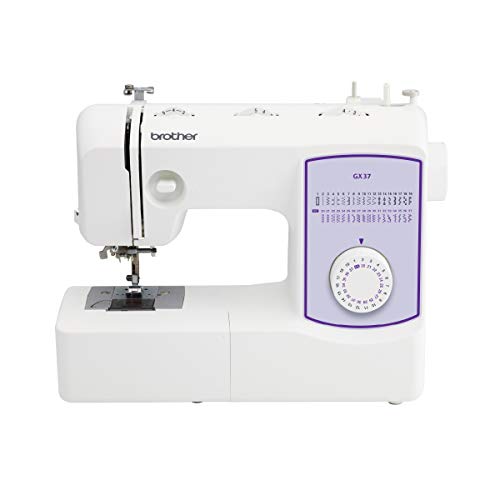
Brother GX37 Sewing Machine — Best Printed-Chart Basic
In a guide about simplicity, the GX37’s finest feature is not a stitch at all; it is the chart printed on the machine’s body, listing its 37 built-in stitches where the sewer sits. That single decision removes the manual from the sewing table, and with it the most common beginner interruption: stopping mid-project to look something up. The machine teaches by being read, a little more each session, until its whole vocabulary is memorised without effort.
Six included sewing feet keep the practical side equally plain. The feet handle the ordinary repertoire — general seams, zips, buttonholes, overcasting — and the decorative stitches among the 37 let a basic machine dress up plain work without pretending to be a craft computer. For households that want one straightforward machine whose instructions live on its own skin, the GX37 is the most self-explanatory seat in this guide.
Printed guidance also ages gracefully. Screens dim, apps change and booklets wander into recycling, but a chart moulded into the machine’s front panel will be legible in fifteen years. That permanence suits the basic philosophy: buy a tool, learn it completely, and let its familiarity become the feature. Sewers returning after months away will find the GX37 especially forgiving, because relearning it takes one glance rather than one chapter.
- Stitch library: 37 built-in stitches including decorative options
- Reference: full stitch chart printed on the machine itself
- Feet in the box: 6 included sewing feet
- Selection: mechanical dial, one action per stitch
- Format: full-size machine for garments and crafts
Strengths
- Chart on the body ends manual dependence completely
- Decorative range livens plain projects without complexity
- Six feet cover the core household repertoire
Trade-offs
- No display to confirm length and width settings
- Decorative stitches reward practice before they look crisp
- Buyers wanting a quilting table should look at the XR3774
Best for: self-reliant beginners who want the machine to explain itself at a glance.
Not suited for: sewers who prefer a screen to confirm every setting.

Brother CS5055 Computerized Sewing Machine — Best Basic With a Screen
The CS5055 is this guide’s deliberate heresy: a computerized machine in a basic roundup. Its defence is that simplicity lives in the user’s experience, not in the parts list. The LCD display shows which stitch is selected and how it is set, in plain figures, every time. A beginner never wonders whether the dial stopped one click early, never sews a seam with last project’s settings still engaged, and never has to memorise what an unlabelled position means.
For households where several people share one machine, that visible state is a genuine simplifier: whoever sits down can see exactly how the machine is configured before touching fabric. The sewing underneath remains the familiar household repertoire, neither inflated nor exotic. If your version of basic is “nothing to guess,” rather than “nothing electronic,” this Brother makes the most coherent case in the guide.
There is a learning dividend, too. Because settings are displayed numerically, beginners start connecting numbers to outcomes — this length for basting, that width for overcasting — and build a transferable understanding of how sewing works. Dial machines teach the same lessons by feel over a longer apprenticeship. Neither route is wrong, but the screen shortens the guessing phase considerably, and for impatient learners that shorter phase is often the difference between a hobby that sticks and one that stalls.
- Control style: computerized selection with LCD display
- Display role: stitch and settings visible before you sew
- Format: full-size machine for everyday garments and crafts
- Simplicity angle: no dial positions to memorise or misread
- Shared use: current setup is obvious to the next sewer
Strengths
- Visible settings prevent the commonest beginner errors
- Easy to resume a project after days away
- Shared households always know the current configuration
Trade-offs
- Electronics are a long-term repair consideration
- Purists may find buttons less satisfying than dials
- No heavy-duty claim for routine thick fabric
Best for: beginners who think in numbers and households sharing one machine.
Not suited for: sewers who want purely mechanical controls on principle.
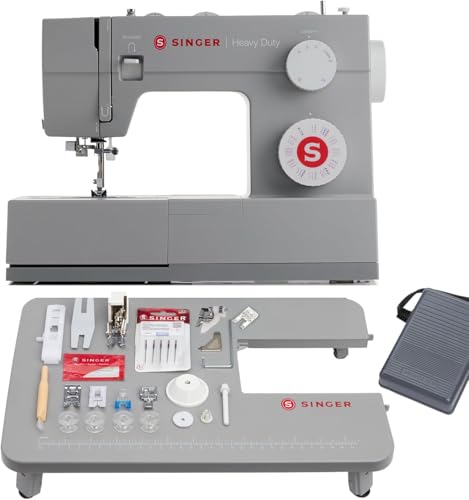
SINGER 4452 Heavy Duty Sewing Machine Bundle — Best Basic for Thick Fabrics
For some households, basic sewing means jeans hems, canvas tote repairs and curtain weights, and a delicate machine is the complicated option because it keeps failing at the ordinary. The 4452 bundle answers with 32 built-in stitches delivering 110 applications, fifty percent more power for thick fabrics, and an extension table plus two extra presser feet folded into a holiday bundle. The simplicity here is operational: one strong machine, set up once, that does not ask you to nurse it through a folded seam.
The extension table matters more on heavy work than light, because thick fabric drags, and drag is what pulls seams crooked and exhausts beginners. Level support lets the motor’s strength translate into straight stitching. Read the stitch applications figure as SINGER’s way of counting honestly: each stitch adjusts, and the adjustments are where everyday versatility actually lives. If your mending pile is denim-heavy, this is the basic machine that treats your normal as normal.
Bundle thinking suits beginners in another way: decisions are pre-made. The table is there, the extra feet are there, and the first heavy project can start without a research detour into accessories. New sewers underestimate how often a project stalls not on skill but on a missing foot discovered at nine in the evening. A bundle that anticipates the common needs keeps early momentum intact, and momentum, in the first months of any craft, is the resource that decides whether the machine becomes furniture or a habit.
- Stitch library: 32 built-in stitches delivering 110 applications
- Power claim: 50% more power aimed at thick fabrics
- Bundle: extension table and 2 presser feet included
- Format: heavy-duty machine for denim, canvas and home décor
- Simplicity angle: strength removes nursing and workarounds
Strengths
- Thick fabrics are its home territory, not its limit
- Extension table steadies heavy, dragging material
- Bundle removes accessory decisions for new owners
Trade-offs
- Heavier and larger than the light-duty picks
- Power is surplus for sewers of fine fabrics only
- Bundle contents should be verified against the listing
Best for: households whose basic sewing includes denim, canvas and upholstery repairs.
Not suited for: sewers working mainly with light dress fabrics and crafts.

Portable Sewing Machine for Beginners 12 Stitches — Best Truly Simple Portable
Twelve stitches is the shortest list in this guide, and the portable wears that as a badge of honour. With a dozen options, a beginner can genuinely learn every one: what it looks like, when it is used, how it behaves on cotton and jersey. Reverse sewing is present for locking seams, an LED light watches the needle, and the included extension table plus 32-colour thread kit mean the small machine arrives as a complete little station rather than a bare appliance.
Portability is the other half of its simplicity. A compact machine that lives in a cupboard and emerges onto the kitchen table lowers the activation energy of every repair; the hem gets done because setting up took ninety seconds. For students, renters and anyone sewing in shared space, that convenience is not a compromise feature. It is the feature that determines whether sewing happens at all in a busy week.
Its limits should be stated as plainly as its virtues. Bulky layers, large quilts and heavy curtains will outgrow its bed and its motor, and decorative ambitions have nowhere to go. But judged as an instrument for learning the craft’s grammar and handling a flat’s worth of mending, it is admirably focused. Many owners keep a machine like this even after buying bigger equipment, because for a ten-minute repair, the little portable is still the fastest route from torn to fixed.
- Stitch library: 12 built-in stitches, the shortest list here
- Essential feature: reverse sewing for secure seam ends
- Lighting: LED light over the sewing area
- Bundle: extension table and 32-colour thread kit included
- Format: compact electric model for crafts and repairs
Strengths
- Every stitch can be learned and remembered completely
- Sets up in moments on any household table
- Thread kit makes practice colourful and immediate
Trade-offs
- Small bed limits quilts and bulky projects
- Not built for sustained heavy fabric work
- Decorative sewers will feel the short list quickly
Best for: students, renters and new sewers in small or shared spaces.
Not suited for: quilters and makers of large or heavy projects.

Brother XM2701 Sewing Machine 27 Stitches — Best First-Ever Machine
The XM2701 earns its place in a basic guide by deleting friction rather than features. The automatic needle threader removes the single most repeated annoyance in sewing. The free arm removes the struggle of feeding a sleeve or trouser leg around a flat bed. Twenty-seven stitches, chosen by dial, cover the household repertoire with a little decoration in reserve, and six included feet mean the core techniques are available from the first week rather than after an accessory order.
Notice what the design assumes: that a beginner’s scarcest resource is patience at the setup stage. Every removed fiddle — threading, wrestling cuffs, hunting for the right foot in a separate purchase — returns minutes and morale to actual sewing. That is why this model is recommended to first-time buyers so persistently across the sewing world. It is not the simplest machine here by stitch count, but it may be the simplest to live with while everything is new.
Its mechanical nature keeps the learning honest in a useful way. The sewer chooses each stitch deliberately, watches its length and width as physical settings, and builds the cause-and-effect understanding that transfers to any machine they meet later, from a classroom model to a borrowed vintage workhorse. Graduates of the XM2701 rarely feel lost in front of other equipment. For a first machine, that transferable confidence is worth as much as any single feature on its specification list.
- Stitch library: 27 built-in stitches for utility and decoration
- Threading help: automatic needle threader as standard
- Bed shape: free arm for sleeves, cuffs and pant legs
- Feet in the box: 6 sewing feet included
- Format: portable full-size mechanical machine
Strengths
- Needle threader removes the biggest beginner annoyance
- Free arm makes garment repairs straightforward early on
- Skills learned transfer to almost any other machine
Trade-offs
- Dial settings require a glance at the chart while learning
- No table included for very large projects
- Decorative range is present but deliberately modest
Best for: first-time buyers who want everyday sewing made as frictionless as possible.
Not suited for: sewers planning large quilts from the first month.
How Do the Six Compare on Simplicity and Scope?
| Pick | Badge | Distinguishing detail |
|---|---|---|
| Brother XR3774 Sewing and Quilting Machine | Best Basic With Room to Grow | 37 stitches, wide table and 8 feet under mechanical control |
| Brother GX37 Sewing Machine | Best Printed-Chart Basic | 37 stitches with the chart printed on the machine body |
| Brother CS5055 Computerized Sewing Machine | Best Basic With a Screen | LCD display that makes settings visible at a glance |
| SINGER 4452 Heavy Duty Sewing Machine Bundle | Best Basic for Thick Fabrics | 32 stitches, extension table and power for thick fabrics |
| Portable Sewing Machine for Beginners 12 Stitches | Best Truly Simple Portable | 12 stitches with reverse, LED light and a full starter bundle |
| Brother XM2701 Sewing Machine 27 Stitches | Best First-Ever Machine | 27 stitches with auto needle threader and free arm |
What Stitches Does a Basic Machine Actually Need?
Strip sewing to its skeleton and four functions remain. A straight stitch builds seams. A zigzag finishes edges, applies appliqué and flexes with stretch fabric. A dedicated stretch stitch keeps knit seams from popping when a garment moves. A buttonhole finishes shirts, dresses and duvet covers. Every pick in this guide covers those four, which is precisely what qualifies them as basic rather than merely cheap.
Beyond the skeleton, judge extras by your own project list. A blind hem stitch earns its place if you shorten trousers often. Decorative stitches earn theirs on children’s clothes and household linen. Three-step zigzag helps elastic and heavy knits. The right basic machine is not the one with the fewest stitches, but the one whose short list maps completely onto your sewing — with nothing missing that you need weekly, and little included that you will never touch.
Why Do Dials Suit Beginners Better Than Menus?
A dial is a map you can see all at once. The stitches are arranged in a fixed order, the current choice points at you, and changing it is one deliberate movement. Nothing is hidden behind a screen hierarchy, and nothing changes because a touch registered twice. For a learner building mental models, that physical stability matters: the machine’s state is always visible, even across the room, even mid-conversation.
Dials also age kindly. They work with dusty fingers, in bright sunlight that washes out screens, and after years away from sewing, because the labels are printed rather than rendered. The CS5055 in this guide answers with a clear display, which is the one electronic approach that preserves the same virtue — total visibility of state. Whichever camp you choose, insist on that virtue. A machine whose settings you cannot read at a glance will eventually sew a surprise into your best fabric.
How Do You Thread a Basic Machine Without the Usual Tears?
Raise the presser foot before threading; that single habit prevents most tangles, because it opens the tension discs so the thread can settle between them. Follow the numbered or printed path slowly, hold the thread with slight tension, and make sure the take-up lever is at its highest point when its turn comes. Draw the bobbin thread up through the needle plate before placing fabric, and hold both thread tails behind the foot for the first few stitches.
When a jam or bird’s nest happens anyway — and it will — resist adjusting everything. Rethread completely, from spool to needle, with the foot raised. That ritual cures the majority of faults on basic machines, because most faults are a thread that missed one guide in a path of eight. Sewers who learn this in week one save themselves years of superstitious dial-twiddling.
What Fabrics Belong on a Basic Machine, and What Should Wait?
Begin with stable woven cottons: old sheets, shirts and quilting fabric teach feeding, steering and seam allowances without fighting back. Move next to linen and light chambray, then to jersey with a ballpoint needle and a stretch stitch, accepting that knits demand a slower hand and no pulling. Fleece and sweatshirting follow comfortably on most of these machines, especially with a slightly longer stitch.
Save the divas for later confidence. Silk and chiffon slide and fray as a hobby. Multiple layers of denim belong to the 4452 in this guide, or to careful work with a fresh heavy-duty needle on the stronger Brothers. Vinyl and leather need specialist feet and needles entirely. A basic machine is not a weak machine, but respecting its fabric comfort zone is what keeps early projects encouraging rather than elegiac.
How Should a Beginner Practise Seams, Corners and Curves?
Draw your practice on fabric instead of buying exercises. With a ruler and chalk, mark straight lines, a grid of squares, circles and a spiral on scrap cotton. Sew along each line without thread first, needle punching the path, to learn steering and speed. Then thread up and repeat, comparing the stitched lines to the drawn ones. Corners teach the pivot: needle down, foot up, turn, foot down, continue. Curves teach easing off the pedal and letting the feed dogs set the pace.
Keep every sampler. Label them with the stitch, length and fabric, and they become a personal manual more useful than any printed one, because they show your machine in your hands. Within a fortnight of such evenings, the core movements of sewing — starting, guiding, pivoting, reversing, stopping — become automatic, and projects stop being examinations and start being making.
What Does a Free Arm Actually Do for Everyday Sewing?
The free arm is the narrow bed that remains when the accessory tray slides off a machine, and it exists for tubes: sleeves, cuffs, trouser legs, children’s clothes, socks and bag openings. Fabric slips around the arm so the needle sews a circle of material without the rest of the garment bunching under the foot. On a flat bed, the same job becomes a wrestling match that twists seams and tempers alike.
Two picks here, the XM2701 and XR3774 among them, build their everyday appeal partly on this feature. If your sewing list leans toward garments and repairs — and most household lists do — treat a free arm as close to essential. If you sew mainly flat goods like quilts, curtains and cushion covers, it matters far less, and table size becomes the bed feature to prioritise instead.
How Do You Keep a Simple Machine Running Well for Years?
Simplicity extends a machine’s life because there is less to drift, corrode or confuse. The routine is short enough to memorise: brush lint from the bobbin race after a few sessions, change the needle at the start of each significant project, and keep the machine covered when it sits idle on a table. Dust is the slow enemy of every mechanism, and a cover is the cheapest service contract in sewing.
Store the pedal lead loosely, keep feet and bobbins in their tray, and sew the machine at least occasionally — mechanisms prefer gentle regular use to years of stillness. Follow the manual on oiling, since some modern machines are sealed against it. Treated this way, a basic mechanical machine commonly outlasts several changes of hobby fashion, which is rather the point of buying simply in the first place.
Which First Projects Teach the Most While Forgiving Mistakes?
Choose projects whose errors hide. A drawstring bag forgives crooked seams inside a casing. An envelope cushion cover forgives them inside a fold. A simple apron forgives almost everything and teaches ties, hems and pockets in one garment. Pyjama trousers from an old sheet introduce pattern cutting, elastic channels and the free arm, at a cost of nearly nothing if they fail.
Sequence matters more than ambition. Each project should add exactly one new skill to the last, so confidence compounds instead of colliding. The sewers who thrive on basic machines are rarely the ones who began with a lined jacket; they are the ones whose first five projects all finished, however humbly, and taught them that finishing is a skill in itself.
How Do You Choose Between Two Very Similar Basic Models?
Make a list of your next six projects and interrogate each machine against it. Which includes the foot the zip cushion needs? Which has the table the curtain panels want? Which one’s chart will you still understand in a year? Then weigh the lived details: where the machine will sit, whether it must be carried, how its light falls, whether its dials suit your eyesight and your hands.
Between the GX37 and XM2701, for instance, the decision is decorative range and a printed chart against a needle threader and a famous first-machine reputation. Between the XR3774 and everything else, it is table and feet against compactness. There is no abstract winner, only a match. Basic machines reward this honesty because their differences, though small, are exactly the differences you will feel every session.
What Should You Verify on the Listing Before Ordering?
Check the buttonhole type, because a one-step buttonhole removes measuring from a fiddly job while a four-step asks you to mark and turn. Confirm whether the stitch chart lives on the machine, in the manual, or nowhere you will find it at midnight. List the included feet by name and compare them with your first projects; a missing zipper foot is a delayed cushion, every time.
Confirm the free arm if garments are planned, the extension table if large flat work is planned, and the bobbin class so spares are easy to source. Note the machine’s weight if it will travel to classes or be lifted onto a table weekly. Basic machines are bought to be used without fuss, and every one of these checks is a small defence of that fuss-free future.
Why Do Experienced Sewers Keep a Basic Machine Beside a Fancy One?
Ask in any long-standing sewing room and you will find a plain machine that never gets sold. It is the one threaded for mending while the flagship is mid-quilt, the one lent to grandchildren, the one carried to classes so the expensive machine stays home. Basic machines earn this permanence by being instantly ready: no boot-up, no project settings to disturb, no anxiety about a borrowed needle breaking something precious.
There is also a creative argument. Constraints concentrate the mind; a short stitch list pushes skill into fabric choice, fit and finish, where quality actually shows. Many beautiful garments predate decorative stitches entirely. Owning a basic machine is therefore not a stage everyone must graduate from. For plenty of sewers it is the destination, arrived at early and defended happily for decades.
How Does Sewing Weather Change What a Basic Machine Gets Asked to Do?
Autumn fills the mending basket with school uniforms, coat buttons and trouser hems let down for growing legs. Winter asks for fleece, flannel and curtain weight — the season when a stronger pick or a fresh needle proves its worth, and when early darkness makes a good sewing light more than a luxury. Spring brings alterations to lighter clothes and the first garden-season repairs to aprons, tool rolls and cushion covers that live outdoors.
Summer is project season: dresses, shorts, beach bags and costumes, sewn in longer evenings. A basic machine that handles this annual cycle without complaint has passed the only examination that matters. When choosing among the six, picture your own year’s basket rather than a single project, because the machine must serve all four seasons of a household’s small emergencies and ambitions.
What Needles and Threads Should a Beginner Stock First?
Needles are not interchangeable trivia; they are half the stitch. Stock universal needles in two sizes for woven fabrics, ballpoint needles for jersey and other knits, and a heavier denim needle if jeans feature in your repairs. Change them far more often than feels reasonable — at every new project is a good beginner’s rule — because a dull needle causes skipped stitches, pulled threads and mysterious misery that gets blamed on the machine.
For thread, begin with good-quality all-purpose spools in white, black, grey and one beige; those five mend most of a wardrobe invisibly. Add colours as projects demand them rather than buying a rainbow that gathers dust. The portable pick’s included 32-colour kit is the cheerful exception, ideal for crafts and practice. Wind bobbins carefully, keep them with their spools where you can, and your basic setup will feel organised rather than improvised.
How Should You Arrange a Small Sewing Corner for a Basic Machine?
Height decides comfort more than equipment does. The machine’s bed should sit roughly level with your elbows when seated, so shoulders stay down and hands rest lightly on the fabric. A chair that adjusts is worth more than any accessory at this stage. Place light to fall on the needle from the front or the left, so the presser foot’s shadow never hides the seam line you are following.
Support the fabric’s journey: a table deep enough that work rests instead of dangling, or an extension table where the machine offers one. Keep scissors, pins and the seam ripper within one reach, and the lint brush in the same drawer. A corner arranged this way turns a basic machine into a workstation that invites use, and invitation — the ease of beginning — is what turns a purchase into a practice.
When Does Basic Stop Being Enough?
The honest limits arrive in a predictable order. Embroidery ambitions end the basic era immediately, because none of these machines can stitch a design file. Serious quilting may eventually ask for a wider harp and a walking foot setup beyond a starter’s patience. Production sewing — dozens of identical garments — rewards speed and automation that basic machines deliberately omit. Decorative heirloom work can outgrow a short stitch list over years.
Notice that none of those limits involves ordinary clothing, household textiles or repairs, which is why so many sewers never meet them. Buy basic for the sewing you actually have, keep the machine maintained, and let any future upgrade be pulled by a real project rather than pushed by a feature list. That discipline is the whole philosophy of this guide, applied to the day you eventually outgrow it.
How Do You Sew a Straight Seam Every Single Time?
Straightness is a guidance problem, not a talent. Ignore the needle, which only distracts, and watch the fabric’s edge against a seam guide instead: the engraved lines on the needle plate, a strip of masking tape placed at your seam allowance, or the edge of the presser foot itself. Choose one reference and keep your eyes on it for the whole seam, feeding the fabric with fingertips placed well ahead of the foot.
Speed is the second secret. Beginners sew straighter slowly, because corrections happen before errors grow. Let the machine run at a pace where you could stop within an inch, and lengthen your stride only as seams prove themselves. Within a few evenings the eye, the guide and the pedal settle into a partnership, and straight seams stop feeling like an achievement and start feeling like the default state of your work.
What Is Seam Allowance, and Why Does It Decide Whether Clothes Fit?
Seam allowance is the distance between your stitching line and the fabric’s cut edge, and consistency in it is the invisible mathematics of garment making. Sew a pattern’s seams at a wandering allowance and the finished piece quietly changes size at every join; sew them evenly and the pieces meet as the designer intended. Beginners should choose one standard allowance, mark it on the machine with tape if needed, and defend it on every seam.
Household sewing has its own allowances: hems turned twice to hide raw edges, curtain seams wide enough to weight the drape, repair patches overlapped generously. The principle never changes — decide the distance before sewing, guide by it faithfully, and press the result. A basic machine with a clear needle plate and a steady sewer will outperform, on this measure, any machine guided carelessly.
How Should You Press and Finish Seams Like Someone Who Means It?
Pressing is sewing’s silent half. A seam pressed flat and open behaves in a garment; an unpressed seam advertises its homemade origins forever. Press every seam as it is sewn, before crossing it with another, using the iron’s tip along the stitching line and then opening the allowances where the pattern intends. The difference costs two minutes and returns a garment that looks made rather than assembled.
Finishing protects that work. Zigzag the raw edges, overcast them with the appropriate foot, or turn and stitch where fabric is fine. Unfinished edges fray in the wash until seams weaken, which is why the humblest zigzag on a basic machine is genuinely a durability feature. Sewers who press and finish as habits, not afterthoughts, produce the clothes that get worn for years.
How Do You Mend the Five Things Every Household Breaks?
Trouser hems come loose: re-crease the fold, pin at intervals, and blind-hem or straight-stitch from the inside where stitches hide. Seams split at stress points: restitch slightly inside the original line with a shorter stitch and reinforce the ends. Buttons vanish, which is hand sewing, but their buttonholes can be refreshed by machine. Torn pocket linings yield to a patch and two rows of stitching. Jersey develops small holes that a stretch stitch and stabilising scrap close invisibly enough for another season of wear.
None of these repairs needs more than a basic machine, a matching thread and ten unhurried minutes. Together they form the economic heart of home sewing: garments returned to service weekly, wardrobes lasting longer, and a machine that earns its shelf space in rescues rather than masterpieces. Keep a mending basket beside the machine and the habit sustains itself.
What Safety Habits Should Every New Sewer Build Early?
Fingers guide fabric from a respectful distance; the needle’s neighbourhood is for fabric only. Keep the machine’s speed modest while learning, stop fully before adjusting anything near the foot, and switch off before changing a needle. Pins should be removed as the foot approaches them rather than sewn over, because a struck pin can snap a needle and startle even experienced hands.
Good light is a safety feature as much as a comfort, and so is a tidy table where scissors close and rotary tools — if they ever arrive — stay capped. Children sew seated, supervised and on machines whose speed can be tamed, with guards where fitted. These habits sound solemn listed together, yet in practice they become as automatic as looking before crossing a road, and they keep the craft’s pleasures free of its rare sharp edges.
How Can Two People Share One Basic Machine Peacefully?
Shared machines fail socially before they fail mechanically, usually over settings changed without notice. Agree a house rule: whoever finishes returns the machine to straight stitch, medium length, standard foot and a neutral needle, so the next sewer always starts from a known place. Keep a small notebook in the accessory tray recording who is mid-project and what settings their work needs, and shared sewing becomes cooperation instead of archaeology.
The CS5055’s display helps here, since its state is legible at a glance, but the rule matters more than the hardware. Households that adopt it find a basic machine serves several sewers gracefully — a parent mending at dawn, a teenager costuming by afternoon — because predictability, like simplicity, is a feature the whole family uses.
Why Does the Humble Test Seam Deserve Its Own Ritual?
Every project, every fabric change and every needle swap should begin with thirty seconds on a scrap of the same material, folded to the same number of layers as the real seam. That scrap answers the questions that ruin work when asked too late: is the tension balanced, does the stitch length suit the cloth, does the needle pierce cleanly or punch and drag? Adjust on the scrap, where mistakes are free, and the garment receives only proven settings.
Keep the habit sacred even as confidence grows, because experienced sewers are simply beginners who test without thinking. Label good scraps with their settings and they accumulate into a reference set for your regular fabrics — the cotton you always buy, the jersey the children wear, the denim you mend monthly. A basic machine plus a disciplined test seam is a combination that produces professional calm out of household equipment.
What Mistakes Do Beginners Make With Basic Machines?
The commonest mistake is blaming the machine for threading errors: loops underneath, tangles at the start and snapped thread are almost always a missed guide or a presser foot that stayed down during threading. The second is sewing for weeks on the needle that arrived fitted, long after it has dulled. The third is pulling fabric from behind the foot to hurry it along, which bends needles and ruins the feed dogs’ careful work.
Beginners also skip the test seam, committing good fabric to untested settings, and store machines uncovered in dusty rooms between enthusiasms. Each error is small, free to avoid and expensive in aggregate. A basic machine is forgiving equipment, but it rewards the few rituals — rethread fully, fresh needle, test scrap, cover when idle — with a reliability that fancier machines cannot meaningfully beat.
Final Recommendation
Match the machine to the plainest description of your sewing and you will not go far wrong. New garment-makers who mend as much as they make should start with the Brother XM2701 and its friction-free setup. Bigger flat projects point to the Brother XR3774 and its wide table, while denim-heavy households belong with the SINGER 4452 bundle and its unembarrassed strength.
Whichever you choose, learn it completely — every stitch, every foot, every small sound it makes when happy. A basic machine known deeply will out-sew a sophisticated one known shallowly, and the plain work of hems, seams and repairs will quietly hold a household together for years.
Frequently Asked Questions
Are basic sewing machines good enough for making clothes?
Yes — clothes are what they were built for. Seams, hems, buttonholes, zips and simple construction all sit inside a basic stitch list, and most garments use fewer distinct stitches than a beginner expects. What basic machines omit is embroidery and decorative excess, not garment capability. Choose a free-arm model for sleeves and cuffs, keep needles fresh, and the limitation you will feel is your own developing skill, not the machine.
What is the difference between a basic machine and a beginner machine?
The labels overlap heavily, but beginner usually describes the buyer and basic describes the philosophy. A beginner machine may include hand-holding extras like a needle threader or a screen. A basic machine is defined by a short stitch list and direct controls, whoever uses it. The XM2701 is both; the CS5055 is beginner-friendly without being mechanically basic. Either label is fine if the controls suit you.
Can a basic machine sew jeans?
A single layer of denim, or a hem folded carefully, is within reach of the stronger picks here using a denim needle and a slow pace, and the SINGER 4452 is built for exactly that work. Multiple thick layers at a jeans inseam are the hardest test in home sewing and defeat many machines of every price. Flatten bulky seams, sew slowly, and let the needle — not your hands — do the pushing.
How many stitches will I actually use in a month of sewing?
Most home sewers use three or four: straight stitch for seams, zigzag for edges and stretch, a stretch stitch for knits, and the buttonhole when a project demands it. A fifth — blind hem — joins the rotation in households that alter trousers often. That is why a well-edited list of twelve to thirty-seven stitches serves real life completely, and why hundreds of patterns mostly decorate a specification sheet.
Do I need a walking foot or other extra feet right away?
Not for the core repertoire, because the picks here bundle the feet that matter first: general purpose, zipper and buttonhole feet among them. Add a walking foot when quilting layers or slippery fabrics become regular, and a rolled-hem foot when fine hemming becomes a habit. Buying feet in response to real projects keeps spending honest and skills growing in step with equipment.
Why does my new machine skip stitches or tangle underneath?
Almost always, the cause is setup rather than defect. Rethread completely with the presser foot raised, confirm the bobbin unwinds in the direction its diagram shows, and fit a fresh needle suited to the fabric — ballpoint for knits, sharper points for wovens. Test on two layers of scrap cotton. This short ritual resolves the overwhelming majority of early faults on simple machines.
Related Guides
Simple sewing pairs naturally with finished edges, good coffee and the laundry that feeds the mending basket: Best Beginner Serger Sewing Machines Best Automated Coffee Machines Best 4 Cubic Foot Washing Machines


