What's inside
- Key Takeaways
- Quick Picks
- How Did We Judge Washers Around the Four-Cubic-Foot Mark?
- How Do the Six Compare on Capacity and Format?
- What Does Four Cubic Feet Actually Hold?
- Front Load or Top Load at This Size?
- How Should You Measure for a Washer This Size?
- Do Fifteen or Sixteen Cycles Matter, or Is It Marketing?
- What Will a Bigger Drum Do to Water and Energy Use?
- How Do You Load a Four-Cubic-Foot Drum Properly?
- How Do You Wash Bedding in Each Size Class?
- What Installation Details Differ Between These Machines?
- How Should a Growing Household Choose in This Class?
- How Loud Is a Four-Cubic-Foot Washer, and Where Should It Live?
- What Does the First Month With a Family-Size Washer Teach You?
- How Do Spin Speed and Water Extraction Affect Your Drying?
- What Should a Family Check in the First Week of Ownership?
- Which of These Machines Suits a Rental With a Laundry Room?
- Which Sizing Mistakes Do Buyers of This Class Regret Most?
- Final Recommendation
- Frequently Asked Questions
- Related Guides
As an Amazon Associate I earn from qualifying purchases. This post may contain affiliate links at no extra cost to you.
cottageverdict.com is reader-supported. When you buy through links on our site, we may earn an affiliate commission.
Where to buy: all six washers below are sold on Amazon, and the linked names in the Quick Picks table and the detailed sections lead to the matching listing, where you can check price on Amazon and confirm exact dimensions, cycle lists, and inlet requirements before ordering. Shoppers searching for the best 4 cubic foot washing machines usually want one specific thing: a washer big enough for a family’s weekly laundry, including bedding, that still fits a standard laundry space. This guide is honest about the arithmetic from the start, because only part of this line-up truly sits at or above four cubic feet, and the rest earn their place as deliberate step-downs for smaller households and tighter rooms.
Capacity numbers deserve translation. Four cubic feet of drum will swallow a king duvet, a week of towels, or the mixed load of a four-person household without the machine walking across the floor in protest. Drop to two and a half cubic feet and you have a couples’ machine that handles daily wear happily and bedding one piece at a time. Neither is better in the abstract; they are answers to different houses, and this guide treats the smaller picks as considered alternatives rather than failures to reach the headline number.
The six picks divide into three front loaders clustered around the target size, one full-size top loader with an agitator for households that prefer loading from above, and two compact front loaders for apartments and laundry cupboards. Read the capacity sections before the pick sections if you are still deciding what four cubic feet buys, because the worst washer purchase is a correctly built machine in the wrong size for the loads you actually run.
Key Takeaways
- Only three picks here truly meet or pass four cubic feet; the two compacts are included deliberately for smaller homes, not as near-misses.
- A 4.0 to 4.5 cubic foot drum handles king bedding and a family’s weekly wash; 2.5 cubic feet suits couples who wash more often.
- Front loaders use less water and stack with a dryer; the top loader trades stacking for an agitator and easier loading.
- Measure the whole delivery path, not just the laundry alcove: doorways and turns reject more washers than alcoves do.
- Cycle count matters less than the right few cycles; fifteen programs you never touch wash nothing.
Quick Picks
| Pick | Badge | Why it earns its place |
|---|---|---|
| TABU 4.0 Front Loader (Black) | Closest to True 4.0 | TABU’s black front loader states exactly 4.0 cubic feet with fifteen cycles, an LED display, and a stackable, space-saving shape. |
| BLACK+DECKER BFLW45M 4.5 | Best Full-Size Step Up | BLACK+DECKER’s 4.5 cubic foot front loader adds capacity headroom, twelve cycles, ENERGY STAR certification, and hot and cold inlets. |
| BLACK+DECKER BTLW41MW Top Loader | Best Top-Load at the Size | A 4.1 cubic foot top loader with a central agitator, stainless steel tub, glass lid, and ten cycles for households that load from above. |
| West Bend Compact Front Loader | Best Compact Footprint | West Bend’s 2.2 cubic foot front loader packs fifteen cycles, a see-through door, and a stackable shape for small spaces. |
| TABU 2.5 Front Loader (Black) | Best Smaller Sibling | TABU’s 2.5 cubic foot black front loader mirrors the 4.0 model’s fifteen cycles and stackable design for tighter rooms. |
| BLACK+DECKER 2.7 Front Loader | Best Mid-Compact | BLACK+DECKER’s 2.7 cubic foot front loader offers sixteen cycles and an LED display, the largest cycle list here at compact size. |
How Did We Judge Washers Around the Four-Cubic-Foot Mark?
We treated four cubic feet as a working threshold rather than a marketing label, checking each listing’s stated drum size and sorting the line-up into machines that meet it, machines that pass it, and machines included openly as smaller alternatives. Around that sorting we weighed the things that decide ownership satisfaction: load format, since front and top loading suit different bodies and rooms; cycle range, with a preference for useful variety over raw count; and footprint, because a washer that fits the alcove but cannot pass the hallway door is a return waiting to happen.
We also looked for signs a machine was designed for its size class rather than merely shrunk or stretched into it. The full-size picks offer the cycle counts and displays of household machines, the compacts offer stackable shapes and apartment intent in their listings, and the top loader commits to its agitator format honestly. A washer is a ten-year roommate; the ones below were chosen because each appears to know what it is.
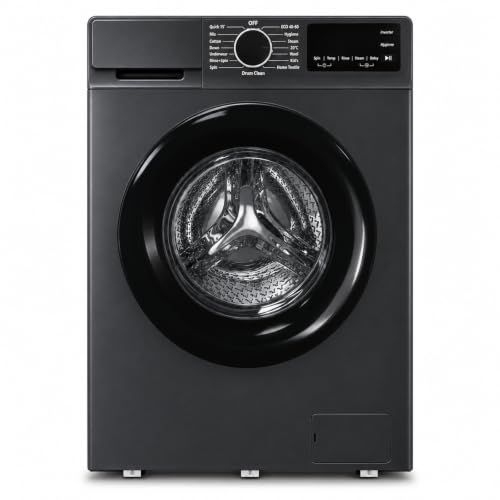
TABU 4.0 cu ft Front Load Washer Black — Closest to True 4.0
The TABU is the pick that answers the search term literally: a front load washer stated at exactly 4.0 cubic feet, finished in black, with fifteen washing cycles and an LED display. For a household that measured its alcove, counted its bedding, and concluded that four cubic feet is the requirement, this machine does not ask for a compromise in either direction. The black finish is a genuine differentiator too, in a category where white is the default and darker laundry rooms are increasingly common.
Fifteen cycles is a generous spread for the size, covering the territory from delicates to heavy bedding without forcing everything through a normal program and hope. The listing emphasises a compact, space-saving, stackable design, which means the full capacity does not demand a full-size footprint in the way older four-foot machines did; paired with a matching dryer above, it gives a small laundry room a family’s worth of washing in a single column of space.
As a lesser-known brand in this company, TABU asks buyers to value the specification sheet, and the sheet is strong. What you cannot assess from a listing is long-term parts availability, so the sensible buyer registers the warranty, keeps the documentation, and treats the first months as the proving period they are with any newer name. On capacity, cycles, and footprint, though, this is the headline pick of the guide on its merits.
- Capacity: 4.0 cu ft, the exact size this guide is named for
- Cycles: 15 washing cycles across fabric types
- Display: LED control display
- Form: front load, stackable and space-saving
- Finish: black, an alternative to the category’s default white
Strengths
- Hits the four-cubic-foot brief precisely
- Stackable shape protects floor space
- Cycle range covers bedding through delicates
Trade-offs
- Newer brand name than the established makers here
- Black finish shows lint and detergent dust readily
- Front load format needs door-swing clearance in the room
Best for: households that calculated four cubic feet as their requirement and want a machine that states it exactly.
Not suited for: buyers who strongly prefer a long-established brand badge on a major appliance.

BLACK+DECKER 4.5 cu ft Front Load Washer BFLW45M — Best Full-Size Step Up
If four cubic feet is your minimum rather than your target, the BLACK+DECKER BFLW45M is the step up that makes the minimum feel generous. Its 4.5 cubic foot drum takes the king duvet and the towel mountain in the same load, and that headroom changes laundry behaviour: fewer split loads, fewer half-empty cycles, and a weekly wash that fits into one morning instead of colonising the whole day. The machine is a full-size front loader in the conventional mould, with an LED display and twelve cycles.
Two specification details lift it above a simple size claim. ENERGY STAR certification signals that the larger drum does not drink water and power in proportion to its size, which matters when a machine this big runs daily. And proper hot and cold inlet hoses mean the washer controls its own temperatures rather than relying on whatever arrives, which shows up in whites and in heavily soiled loads where warm water earns its keep.
The costs of size are the usual ones, payable in space rather than money. A 4.5 cubic foot front loader needs its alcove, its door clearance, and a delivery path that accepts it, and it will look oversized in a small flat where a compact belongs. Households should also be honest about whether they generate 4.5 cubic feet of laundry or merely fear running out of room. If the loads are real, this is the guide’s most complete full-size package.
- Capacity: 4.5 cu ft, the largest drum in this guide
- Cycles: 12 wash cycles with an LED display
- Efficiency: ENERGY STAR certified
- Inlets: hot and cold inlet hoses included
- Form: full-size front load, 120V household supply
Strengths
- Headroom ends split loads for big households
- Certified efficiency softens the running costs of size
- Dual inlets give the machine real temperature control
Trade-offs
- Needs a full-size alcove and a generous delivery path
- Oversized for couples, who will run it half empty
- Front load door swing must be planned in tight rooms
Best for: large households whose weekly laundry genuinely fills four-plus cubic feet.
Not suited for: apartment dwellers or couples, for whom the drum is mostly air.

BLACK+DECKER 4.1 cu ft Top Load Washer BTLW41MW — Best Top-Load at the Size
Not every household wants to kneel at a front loader, and the BTLW41MW is the size class’s answer for them: 4.1 cubic feet in a top load format, with a central agitator, a stainless steel tub, and a glass lid so you can watch the wash without opening it. Loading from above suits taller users, anyone who dislikes crouching, and the pleasant habit of dropping in the forgotten sock mid-fill without breaking a door seal or a cycle’s logic.
The agitator is the substantive choice here and it should be chosen knowingly. A central post agitator moves clothes vigorously and handles heavily soiled loads, workwear, and sports kit with an enthusiasm that impeller and front load machines moderate. The trade is gentleness: delicate fabrics live a harder life around an agitator, and the post consumes a little of the drum’s centre, which bulky duvets must wrap around rather than tumble through.
Ten cycles and an LED display keep the machine modern without excess, and the stainless tub will not chip or rust the way coated tubs eventually can. What the format cannot do is stack, so the space above it belongs to shelves rather than a dryer. For a household with a real laundry room, a preference for top loading, and laundry that comes home genuinely dirty, this is not the compromise pick; it is the correct one.
- Capacity: 4.1 cu ft in a top load format
- Wash action: central agitator for vigorous cleaning
- Tub: stainless steel with a glass viewing lid
- Cycles: 10 wash cycles with an LED display
- Supply: 120V standard household connection
Strengths
- Top loading spares knees and backs
- Agitator excels on heavily soiled loads
- Stainless tub resists chips and rust
Trade-offs
- Cannot stack a dryer above it
- Agitator is harder on delicates
- Bulky bedding must arrange around the central post
Best for: households with a laundry room that prefer top loading and wash genuinely dirty loads.
Not suited for: stacking laundry cupboards or wardrobes heavy on delicate fabrics.

West Bend Compact Front Load Washer — Best Compact Footprint
The West Bend is the guide’s small-space specialist, and it makes no attempt to disguise its 2.2 cubic feet as anything else. What it offers instead is a full feature set at compact scale: fifteen wash cycles, an LED display, a see-through door, and a stackable, space-saving body aimed squarely at apartments, RVs, and the small spaces its listing names. For a single person or a couple in a flat with a laundry cupboard, this is not a reduced machine; it is a correctly sized one.
Fifteen cycles at this size is a statement of intent. Compact washers often cut the cycle list to a token few, forcing delicates, synthetics, and cottons through variations of the same program. Here the range survives the shrinking, so a small household’s varied wardrobe gets the same consideration as a family’s. The see-through door, a small thing, turns out to matter in rental life, where checking that a red sock has not joined the whites is a weekly event.
The limits are arithmetic and permanent. Bedding goes through one piece at a time, a week’s laundry for two takes more loads than a big drum would, and guests with suitcases of washing will queue. If your loads are modest and your space is not, though, the West Bend’s argument is that capacity you cannot house is capacity you do not have, and 2.2 cubic feet installed beats 4.5 cubic feet returned to the depot.
- Capacity: 2.2 cu ft compact drum
- Cycles: 15 wash cycles, a full range at small scale
- Door: see-through front load door
- Form: stackable and space-saving for apartments and RVs
- Display: LED control display
Strengths
- Full cycle range in a genuinely compact body
- Stackable shape suits laundry cupboards
- Purpose-built for apartments rather than merely shrunk
Trade-offs
- Bedding washes one piece at a time
- More loads per week for a couple
- No path to larger capacity as households grow
Best for: singles and couples in apartments, RVs, and small homes with modest loads.
Not suited for: families, whose laundry volume will overwhelm it daily.
TABU 2.5 cu ft Front Load Washer Black — Best Smaller Sibling
TABU’s 2.5 cubic foot model is the smaller sibling of this guide’s headline pick, sharing its black finish, fifteen cycles, LED display, and stackable intent at a size aimed at apartments and laundry rooms where the 4.0 cannot go. That family resemblance is practically useful: a household that likes the larger machine’s approach but measures a smaller alcove does not have to start its research again with a different brand’s logic and controls.
At 2.5 cubic feet, the drum suits one or two people’s regular laundry completely and their bedding sequentially. A duvet cover alone, sheets alone, towels in a sensible batch: the rhythm is more loads, each properly filled, which front loaders reward with better cleaning and lower water use than a big drum run half empty out of habit. For a couple that washes twice a week, the cadence feels normal within a fortnight.
The shared caveat with its sibling is the newer brand name, and the shared strength is the specification per unit of space. Black, stackable, fifteen cycles, and a footprint that respects the room: if the 4.0 TABU is the answer to a family’s brief, this is the answer to the same brief written by a smaller household in a smaller home, and it deserves to be read that way rather than as a consolation.
- Capacity: 2.5 cu ft for singles and couples
- Cycles: 15 washing cycles matching its larger sibling
- Display: LED control display
- Form: front load, stackable, space-saving
- Finish: black to match the 4.0 model’s styling
Strengths
- Same cycle range and design as the 4.0 pick
- Proper size for a couple’s twice-weekly rhythm
- Stacks to give small rooms a full laundry column
Trade-offs
- Bedding must be split into single pieces
- Newer brand, like its larger sibling
- Will be outgrown if the household expands
Best for: couples and small flats that want the headline machine’s approach at apartment scale.
Not suited for: growing families, who should buy the capacity they will need next year.

BLACK+DECKER 2.7 cu ft Front Load Washer — Best Mid-Compact
The BLACK+DECKER 2.7 cubic foot front loader sits at the top of the compact class, and its specification reads like a machine refusing to accept that compact means basic: sixteen cycles, the longest list in this guide, behind an LED display in a 2.7 cubic foot drum. For a household whose laundry is varied but not voluminous, that combination is arguably the sweet spot of the entire line-up: real capacity for a couple’s week, real choice in how each load is treated.
Sixteen cycles earn their keep when a wardrobe spans gym kit, work shirts, delicates, and the occasional load of towels that needs genuine heat. Rather than approximating everything with a normal program and a prayer, the machine gives each category its own water, motion, and spin logic. The brand name also carries the practical benefit of a wide service and parts network, which compact-appliance buyers feel most keenly in year four rather than week one.
The same honesty applies as with every compact: 2.7 cubic feet is a couple’s machine, and bedding is a sequential activity. It is also a front loader in the compact class, so it competes with the West Bend and the smaller TABU on footprint, where room measurements, not features, should arbitrate. If the alcove accepts it and the household numbers two, this is the compact we would buy with our own money.
- Capacity: 2.7 cu ft, the top of the compact class
- Cycles: 16 cycles, the longest list in this guide
- Display: LED control display
- Form: compact front load for smaller laundry spaces
- Brand support: established maker with a wide parts network
Strengths
- Largest cycle range here in a compact body
- Capacity genuinely covers a couple’s week
- Established brand backing for parts and service
Trade-offs
- Still a sequential machine for bedding
- Front load format needs door clearance
- Couples who wash rarely may fill it slowly
Best for: couples with varied wardrobes who want full-size cycle choice at compact scale.
Not suited for: families of four or more, whose volume needs the true four-foot class.
How Do the Six Compare on Capacity and Format?
| Pick | Format | Headline trait | Watch out for |
|---|---|---|---|
| TABU 4.0 Front Loader (Black) | Front load, 4.0 cu ft | Exactly the headline size, 15 cycles, black | Newer brand name |
| BLACK+DECKER BFLW45M 4.5 | Front load, 4.5 cu ft | Largest drum, ENERGY STAR, dual inlets | Needs the most room |
| BLACK+DECKER BTLW41MW Top Loader | Top load, 4.1 cu ft | Agitator, stainless tub, glass lid | Cannot stack; harder on delicates |
| West Bend Compact Front Loader | Front load, 2.2 cu ft | 15 cycles in the smallest footprint | Bedding one piece at a time |
| TABU 2.5 Front Loader (Black) | Front load, 2.5 cu ft | Sibling of the 4.0 with the same cycle range | Sequential bedding for couples |
| BLACK+DECKER 2.7 Front Loader | Front load, 2.7 cu ft | 16 cycles, established brand, compact | Still a couple-scale drum |
What Does Four Cubic Feet Actually Hold?
Drum capacity is quoted in cubic feet and experienced in laundry baskets, so a translation helps. A machine around four cubic feet comfortably takes a king-size duvet, or a full week of one person’s clothing, or the towel output of a family bathroom, in a single load. It is the size at which laundry stops being a daily negotiation and becomes a weekly event, which is precisely why the size class is searched for by name.
Below that line, the experience changes in kind rather than just degree. A two-and-a-half cubic foot drum handles daily clothing for two without complaint, but bedding becomes a rotation: duvet cover on Tuesday, sheets on Thursday, towels whenever. Households that wash frequently barely notice; households that batch everything into Sunday feel the ceiling every week. The correct question is not which size is better but which rhythm your household actually lives by.
It is also worth knowing that front load drums use their volume more completely than the number suggests, because clothes tumble through water rather than needing to be submerged in it. A 2.7 cubic foot front loader does more work per load than older top loaders of similar rating. Compare like with like where you can, and treat the stated figure as a guide to class rather than a laboratory measurement.
Front Load or Top Load at This Size?
The format decision at four cubic feet is really three decisions wearing one coat. Front loaders wash with less water, treat fabrics more gently, extract more water in the spin so drying is cheaper, and stack with a dryer to halve the laundry footprint. Top loaders ask for no kneeling, tolerate mid-cycle additions gracefully, and, in agitator form, clean heavily soiled loads with unmatched enthusiasm. Both formats at this size are mature and capable; the choice is about your room and your laundry’s character.
Rooms first. A laundry cupboard or a stacked column mandates a front loader, full stop. A spacious laundry room with shelving above the machines frees you to choose on laundry alone. Bodies second: anyone with bad knees or a bad back will feel the front loader’s low door every single day, and a top loader’s rim height is its own ergonomic argument. Laundry third: delicates and wool point front, workwear and sports kit point toward the agitator.
The line-up here reflects that spread deliberately. Three full or near-full-size front loaders, one agitator top loader, and compacts that are front loading because stacking is their purpose. If you arrived undecided, decide by room, then body, then laundry, in that order, and the format question usually answers itself.
How Should You Measure for a Washer This Size?
Measure the alcove, then measure everything between the street and the alcove, because washers fail deliveries at doorways, hallway turns, and stairwell corners far more often than at their final position. Record width, height, and depth of the space; then the narrowest door on the route, remembering that doors come off hinges and add an inch when they must. A 4.5 cubic foot machine that cannot turn the corner is a 4.5 cubic foot machine going back on the truck.
Depth is the dimension buyers underestimate. A front loader needs its own depth plus room behind for hoses and ventilation, plus the door’s swing in front, plus a person. In a cupboard, check that the door of the cupboard and the door of the washer can both open fully without a negotiation. For a stacked pair, confirm the ceiling height against the combined column and leave the working space the dryer will need above.
Finally, measure your largest regular load rather than your largest imaginable one. If the king duvet is washed twice a year, a laundrette trip twice a year is cheaper than a drum bought for it and run half empty for the other fifty weeks. Size for the rhythm of your real laundry and the machine will feel right every week instead of merely adequate twice a year.
Do Fifteen or Sixteen Cycles Matter, or Is It Marketing?
Cycle counts inflate like megapixels once did, and a buyer is right to be suspicious. Strip away the marketing and a washer needs perhaps eight honest programs: normal, heavy, delicates, a quick wash, a bedding or bulky program, a rinse and spin, something for whites or high heat, and something gentle for wool or synthetics. Every pick here meets that bar. The extra cycles in a fifteen or sixteen program machine are refinements: soil-level variations, temperature combinations, and fabric-specific motions that save you manually combining settings.
Where a long cycle list genuinely helps is a varied household. The family whose drum sees football kit, office shirts, a baby’s worth of cotton, and a grandmother’s cardigans in the same week uses more of the list than a single person in uniform clothing. Judge the list against your wardrobe rather than against rival lists, and remember that the cycles you use daily, normal and quick, are present and competent on every machine here.
The display and controls deserve as much attention as the count. An LED display that shows time remaining changes laundry behaviour, because loads get moved to the dryer on time instead of sitting damp. Across a decade of ownership, that small information feature may matter more than three extra programs nobody in the house can define.
What Will a Bigger Drum Do to Water and Energy Use?
Counter-intuitively, a larger drum run full usually beats a smaller drum run constantly. Front loaders meter water to the load, so a 4.5 cubic foot machine washing a genuinely full load uses its resources efficiently, and the BLACK+DECKER’s ENERGY STAR certification confirms its efficiency has been measured rather than asserted. The waste appears when a big drum is habitually run at a third of its capacity for a handful of shirts: the machine still heats, fills, and spins for a load that a compact would have handled frugally.
This is the environmental version of the guide’s recurring argument. The greenest washer is the one sized to your rhythm, run full, on the coolest cycle the load allows. Cold washing suits most modern detergents and most ordinary laundry, reserving hot cycles for towels, bedding, and illness weeks, and the spin speed you choose quietly decides your drying bill, since water extracted mechanically is water the dryer never has to evaporate.
Compacts make the same point from the other side. A 2.2 cubic foot machine washing small loads daily can use less across a week than a big machine’s two giant loads, if the household’s pattern is genuinely little and often. There is no virtuous size, only a matched one, and matching is a decision you make once and benefit from for years.
How Do You Load a Four-Cubic-Foot Drum Properly?
Fill the drum loosely to about three quarters and the wash will clean; pack it to the door and the same machine will disappoint you. Clothes need room to tumble and fall, because the falling is the cleaning action in a front loader. A load compressed at loading stays compressed, water threads through it unevenly, and the centre items emerge with their dirt largely undisturbed and their owners unfairly blaming the machine.
Sort by weight as much as by colour. A drum of similar-weight items balances and spins cleanly, while one bath towel among t-shirts will hoard water, unbalance the spin, and leave everything wetter than it should be. Bedding benefits from being loaded as a single item with the opening tucked, so it cannot swallow smaller garments into a wet, unwashed parcel, a trick every large-drum owner learns exactly once the hard way.
Use the big drum’s size for what it is for: fewer, fuller, better-planned loads. Keep a basket system that separates the week’s laundry into drum-sized portions, and the four cubic feet you paid for will do the work of a laundry service. Treat it as a bin to be stuffed and it will perform like one, at any size, from any brand.
How Do You Wash Bedding in Each Size Class?
Bedding is the load that sells capacity, so it deserves a size-by-size account. In the 4.5 and 4.1 cubic foot machines, a king duvet goes in alone and comes out genuinely washed, because the drum gives it room to unfold, submerge, and tumble rather than rotating as a single wet parcel. Sheets and pillowcases can accompany smaller items in the same class without crowding. This is the class to buy if bedding day is a weekly event and laundrette trips are a hated chore, because the machine converts the worst load in the house into an ordinary one.
At 4.0 cubic feet the story is nearly the same with a little more arrangement: the duvet still fits, the drum still works it properly, and only the largest combinations of duvet plus sheets ask to be split. Couples and smaller families will rarely feel the difference from the class above, which is exactly why the exact-four machine anchors this guide. The difference appears at the extremes, and most households do not live at the extremes.
In the compact class, bedding becomes a rotation and should be planned as one rather than resented as a failure. Duvet cover one day, sheets another, pillowcases with the towels: each load properly filled, each properly washed, and the full duvet itself reserved for a laundrette’s big drum a few times a year. Households that wash little and often barely notice the ceiling. Households that batch a fortnight into one day will hit it weekly, and they are the readers who should buy the full-size class and be done with the question.
What Installation Details Differ Between These Machines?
Full-size front loaders and the top loader all expect the conventional arrangement: hot and cold supplies, a drain, and a level floor that can take a heavy machine’s spin without complaint. The BLACK+DECKER front loader includes its inlet hoses, a small completeness worth noting because installations stall over smaller things. The top loader needs no door-swing clearance in front but claims the space above itself forever, since nothing stacks on a machine whose lid must open upward, and shelving plans should be drawn with that in mind.
Compacts install with the same plumbing but a lighter footprint, and their stackable designs introduce one extra decision: whether the dryer goes above now, later, or never. Fit the stacking arrangement at installation if it is planned at all, because retrofitting a column in a finished cupboard is a miserable afternoon. Check also that a compact’s door and the cupboard’s door agree with each other through their full swings, a geometry problem that has embarrassed many careful measurers.
Every machine in the guide benefits from the same unglamorous installation virtues: new hoses rather than inherited ones, a level check after the first week when the machine has settled, and a photographed record of the connections before the machine is pushed home. Installations fail at their beginnings or not at all, and an hour of care on delivery day is the cheapest reliability any of these washers will ever be given.
How Should a Growing Household Choose in This Class?
The honest dilemma in this size class is between the household you are and the household you expect to become. A couple planning children will outgrow a 2.5 cubic foot compact on a timescale measured in months after the baby’s arrival, because infant laundry is small in item size and enormous in frequency. For them the exact-four or the 4.5 machine is not indulgence but foresight, bought once instead of twice, and the years of slightly-underfilled drums before the family grows are a modest premium for that foresight.
The reverse case deserves equal honesty. A household whose children have left, whose laundry has halved, and whose knees have opinions should not keep buying family capacity out of habit. The compacts here, particularly the 2.7 with its sixteen cycles, serve a two-person household’s varied wardrobe completely, and a smaller machine run properly full will outwash and outlast a giant run at a third of its design load. Shrinking the drum to the life is not downsizing the laundry; it is fitting it.
Renters sit outside the dilemma and should buy for the current flat alone. A washer’s working life spans several homes, but its size must fit the smallest likely one, and a compact that moves with you beats a full-size machine that fits this year’s laundry room and next year’s not at all. Portability across a decade of addresses is its own form of capacity.
How Loud Is a Four-Cubic-Foot Washer, and Where Should It Live?
Full-size machines carry their drums on real suspension with real mass around them, which is why a level, well-installed four cubic foot washer is generally a calmer appliance than the portables renters wrestle with. Its spin is a rising hum rather than a negotiation, provided the floor beneath it is firm and the load inside it is sane. The location still matters: a laundry room with a closing door is the ideal, a cupboard on a wooden upper floor is the compromise, and the compromise is managed with the levelling and mat discipline described in this site’s anti-vibration guidance.
Top and front loaders behave differently in the room. The top loader’s energy stays mostly within its cabinet and its lid never needs swing space, which suits a room where people pass in front of the machines. The front loader asks for its door’s arc and rewards it with the stacking option that can halve the laundry’s footprint. In a house, rather than a flat, these are questions of convenience rather than neighbourliness, but they decide whether the laundry room feels designed or merely occupied.
One placement rule applies to every pick: leave the machine room to be serviced. A washer wedged immovably into its alcove turns a ten-minute pump filter clean into an extraction operation, and the households that maintain their machines are the ones whose machines can be reached. An inch of mercy on each side is a decade of easier ownership, at any size, from any maker.
What Does the First Month With a Family-Size Washer Teach You?
It teaches the household its own laundry, usually for the first time. Loads that were guesses in the old machine become visible quantities in a big transparent-lidded or front load drum, and families discover that their true unit is not the week but the category: towels behave as one economy, bedding as another, and the children’s kit as a third with its own smell-based urgency. The cycle list stops being a specification and becomes a vocabulary the household actually speaks, and most families settle on three or four programs that carry ninety percent of their washing.
It also teaches the loading discipline a large drum demands. The temptation of capacity is the mixed mega-load, everything in together at one temperature, and the first month usually includes one pink-tinged or shrunken lesson in why sorting survives every advance in machine size. A drum this big rewards the basket system by the door, lights and darks and delicates pre-sorted by the people who undress, so that loading the machine is a single motion rather than an archaeological dig.
By the end of the month the machine should have disappeared, which is the highest state a household appliance can reach. It is simply where laundry goes and whence it returns, its size unremarked because it matches the loads, its cycles unexamined because they are the household’s own habits wearing buttons. If your first month ends in that invisibility, you chose the right size, and this guide’s whole argument is that the size, more than the badge, is what you were choosing.
How Do Spin Speed and Water Extraction Affect Your Drying?
A front loader’s less celebrated virtue is how dry its loads emerge. High spin speeds press water out of fabrics mechanically, and water removed by spinning is water your dryer never has to evaporate or your rack never has to drip. Across a family’s weekly laundry that difference is a real utility saving and a real time saving, and it is one of the structural reasons front loaders dominate this size class despite the top loader’s ergonomic charms. When you compare machines, the spin is not a footnote to the wash; it is half the laundry process, priced in your drying bills.
The top loader’s agitator format typically extracts less, which its owners repay in drying time, a fair trade for those who chose it for wash action and loading comfort, but one that should be made knowingly. Households line-drying indoors in winter should weigh extraction heavily, because a load that leaves the drum merely damp dries overnight, while a load that leaves it wet writes the flat’s humidity for a day. The compacts sit between the two, spinning respectably for their size and pairing naturally with the rack-drying life of small homes.
Fabric care sets the ceiling on all of this. The highest spin is for towels, bedding, and cottons that can take it; delicates and wool ask for gentleness and repay it by lasting. The cycle lists in these machines encode exactly those judgements, which is another reason to choose the right program rather than the fastest one. A four cubic foot drum gives you the room to wash properly; the spin, chosen well, finishes the job the wash began.
What Should a Family Check in the First Week of Ownership?
Live with the machine deliberately for seven days before judging it. Run the biggest bedding load the household owns, because that is the load the capacity was bought for, and watch whether the drum works it or merely rotates it. Run the smallest quick load too, since a family machine spends half its life on school uniforms and forgotten kit, and a drum that handles both extremes without complaint has justified its size in the only court that matters. Note the cycle times the display promises against the times the machine keeps, because planning laundry around a lying clock is a small daily tax nobody should pay for a decade.
Check the unglamorous things while the remedies are easy. Level after the first days, when the machine has settled into its floor. Inspect the hoses after the first week rather than the first year. Register the warranty in the first month, while the receipt is still where you left it. A family-size washer is infrastructure, and infrastructure rewards the household that commissions it properly instead of merely unboxing it.
Which of These Machines Suits a Rental With a Laundry Room?
Renters with a genuine laundry room occupy the happy middle of this guide: they have the hookups and the floor for a full-size machine, but not the certainty of staying that makes a flagship purchase easy. For them the exact-four TABU or the established BLACK+DECKER front loader are the sensible centre of the market, big enough for real family laundry, standard enough to leave behind or take along without drama, and priced in the class where a machine can be a five-year answer rather than a lifetime commitment. Measure the room’s door as carefully as a homeowner would, because rental laundry rooms are famously reached through the narrowest door in the building.
Which Sizing Mistakes Do Buyers of This Class Regret Most?
- Measuring the alcove but not the hallway. The commonest failed delivery in this size class happens at a doorway turn, not at the machine’s final home; measure the whole route.
- Buying 4.5 cubic feet for a couple’s laundry. A big drum run at a third capacity wastes water, heats air, and washes worse than a compact run properly full.
- Choosing an agitator for a delicate wardrobe. The top loader here is superb on soiled loads and hard on fragile fabrics; match the wash action to the clothes you own.
- Ignoring door swing in a cupboard install. A front loader whose door cannot open fully is a machine you load through a gap, daily, for years.
- Judging by cycle count alone. Fifteen cycles you cannot set confidently lose to ten you understand; the display and controls are part of the specification.
Final Recommendation
If your household’s laundry is genuinely family-sized, start with the machine that states the brief exactly: the TABU 4.0 Front Loader (Black) puts four cubic feet, fifteen cycles, and a stackable black cabinet into the space a lesser machine would occupy. Families who want headroom above the brief and certified efficiency should step up to the BLACK+DECKER BFLW45M 4.5, whose extra half cubic foot ends split loads for good. And if the room, rather than the laundry, is the constraint, the BLACK+DECKER 2.7 Front Loader proves that a compact can keep a full cycle list and a clear conscience at 2.7 cubic feet.
Measure the route, count your real loads, and buy the drum that matches the rhythm of your house rather than the biggest number in the search results. A washer sized honestly is a washer you stop thinking about, and that silence, week after week, is the true product this size class sells.
Frequently Asked Questions
Is 4 cubic feet big enough for a family of four?
For most families, yes: it handles a week of mixed clothing in two or three loads and takes king bedding in one. Families with several children in sports kit may prefer the 4.5 cubic foot step up, while families who wash little and often can manage happily with less. Rhythm matters as much as headcount. One more practical note: the drum figure is the machine’s total volume, and the usable load is the one that still tumbles freely, so a family that fills to three quarters and washes twice will outclean a family that stuffs once. Judge the first month by whether the weekly rhythm feels unhurried, because that feeling, more than any number on the listing, is what the right capacity actually buys a household over the years ahead.
Why are smaller washers in a guide about 4 cubic foot machines?
Because many shoppers searching this size discover, on measuring, that their room or their loads call for less. The compacts here are labelled honestly at 2.2 to 2.7 cubic feet and included as deliberate alternatives, so the comparison happens in one place rather than after a return.
Does an agitator clean better than a front loader?
It cleans heavily soiled items more aggressively, which is why workwear households favour it. Front loaders clean ordinary laundry at least as well while using less water and treating fabrics more gently. Better depends on whether your loads are dirty or delicate.
Can these front loaders really stack?
The TABU models and the West Bend are described as stackable and space-saving in their listings, which means a compatible dryer can mount above with the correct stacking kit. Always confirm the pairing and kit for the specific dryer, and check the combined height against your ceiling before ordering.
How much space should I leave behind the washer?
Allow room for the inlet and drain hoses to curve without kinking, typically a few inches, plus ventilation space. Front loaders also need their full door swing in front. The listing dimensions are the machine alone; the installed footprint is always larger, and planning for it prevents the classic shove-and-pray installation.
Will a bigger drum raise my utility bills?
Only if it runs under-filled. A large front loader washing full loads meters water to the load and, in the ENERGY STAR certified case here, has verified efficiency. Run any drum at a third of its capacity as a habit and the bills will reflect the habit, not the machine.
Related Guides
Capacity settled, the neighbouring questions are reliability, the wider appliance shelf, and the other machines in the house: Best and Most Reliable Washing Machines Best Ambient Noise Machines for a Room Best Brother Quilting Machines


