What's inside
- Key Takeaways
- Quick Picks
- How Did We Choose Washers for Calm Spinning Without Any Published Ratings?
- How Do the Six Compare on Calm-Spinning Traits?
- Where Does Washer Vibration Actually Come From?
- Why Do Twin Tubs Shake More Than Automatics?
- How Do Levelling and Feet Decide Whether a Machine Walks?
- Which Loads Spin Calmly and Which Loads Fight?
- What Can You Do About Floors, Neighbours, and Noise?
- How Should You Set Up a Portable Washer for Its Quietest Life?
- What Does a Spin Cycle Sound Like When It Is Going Wrong?
- How Do Different Floors Change the Same Machine’s Behaviour?
- When Is Vibration a Fault Rather Than a Behaviour?
- How Do Spin Speeds and Programs Change the Shake?
- What Should You Do the Day a New Portable Washer Arrives?
- How Should You Test a Machine’s Manners in Its First Week?
- What Is a Reasonable Expectation to Bring to This Category?
- How Do You Talk to Neighbours About a Machine Before It Is a Problem?
- Which Habits Make Even a Good Washer Shake?
- Final Recommendation
- Frequently Asked Questions
- Related Guides
As an Amazon Associate I earn from qualifying purchases. This post may contain affiliate links at no extra cost to you.
cottageverdict.com is reader-supported. When you buy through links on our site, we may earn an affiliate commission.
Where to buy: all six washers below are sold on Amazon, and the linked names in the Quick Picks table and the detailed sections lead to the matching listing, where you can check price on Amazon and confirm capacity, feet, and installation requirements before ordering. A necessary honesty opens this guide to the best anti vibration washing machines: no listing here publishes a vibration measurement, and we will not invent decibel figures or millimetre amplitudes for machines we are describing from their specifications. What can be discussed truthfully is mechanism: where washer vibration comes from, which designs and installation habits genuinely reduce it, and why some formats in this very line-up shake more than others by their nature.
Vibration is born in the spin. A drum rotating at speed with a load that is not perfectly distributed becomes an eccentric weight, and the machine must either absorb that energy, through suspension, mass, and feet, or transmit it to the floor. Small portable machines, which dominate this guide because they are what apartment and dorm shoppers buy, have less mass and simpler suspension than full-size machines, so their anti-vibration story is mostly about loading, levelling, and the floor beneath them. Two picks are twin tubs, whose separate spinner design we discuss frankly: they can shake harder than single-drum automatics, and the guide explains why rather than hiding it.
Read the mechanism sections as seriously as the picks, because in this category the owner’s behaviour is half the product. The same machine that walks across a tiled floor on Tuesday will sit quietly on Thursday after being levelled, loaded evenly, and given a mat. The picks below were chosen for the traits that help, compact footprints that are easy to level, automatic programs that manage spin distribution, and, in the twin tubs, an honest account of what their format gives and takes.
Key Takeaways
- No honest decibel or vibration figure exists in these listings, so this guide judges mechanisms and habits, not invented numbers.
- Unbalanced loads cause most real-world shaking; drum size matched to load and even loading are the first anti-vibration features.
- Levelling and feet matter more than any badge: a portable machine levelled on a firm floor sits still, and a tilted one walks.
- Twin tubs shake more by design, because their small high-speed spinner tubs are exquisitely sensitive to uneven packing.
- Single-drum automatic portables manage spin distribution themselves, which makes them the calmer choice for thin floors.
Quick Picks
| Pick | Badge | Why it earns its place |
|---|---|---|
| COMFEE’ 2.4 Portable | Best Automatic Portable | COMFEE’s 2.4 cubic foot full-automatic portable runs eight programs that manage the spin cycle for you, in a magnetic gray compact body. |
| ROVSUN 25LBS Automatic Portable | Best Large Automatic Portable | ROVSUN’s 25-pound full-automatic portable pairs a stainless steel drum with a drain pump, at the top of the portable size range. |
| Winado 15.6LBS Automatic Portable | Best Mid-Size Automatic | Winado’s 15.6-pound full-automatic portable offers ten wash programs and a stainless drum with a drain pump for apartments and dorms. |
| Auertech Twin Tub 28 lbs | Best Twin Tub, With Eyes Open | Auertech’s 28-pound twin tub pairs an 18-pound washer with a 10-pound spinner and a drain pump, and asks you to pack the spinner carefully. |
| COSTWAY Twin Tub 20 lbs | Best Compact Twin Tub | COSTWAY’s twin tub washes 12 pounds and spins 8, with timer control in a durable compact body for RVs and dorms. |
| BLACK+DECKER BPWM20W 2.0 Portable | Best Brand-Backed Portable | BLACK+DECKER’s 2.0 cubic foot portable gives 15.4 lb capacity, six cycles, a transparent lid, and a quick-connect sink adapter. |
How Did We Choose Washers for Calm Spinning Without Any Published Ratings?
With no measurements to rank, we ranked causes. Machines were favoured when their design addresses a known source of shake: automatic programs that redistribute a load before committing to full spin speed, drums large enough that a normal load sits evenly instead of clumping, and compact bodies with four feet that an owner can actually level in a small space. We included the twin tubs deliberately and labelled their behaviour honestly, because they are widely bought for exactly the small homes where vibration matters, and a guide that omitted them would leave those buyers uninformed.
We also weighted what the owner controls. Every pick here can be levelled by hand, fits a standard anti-vibration mat, and suits the small-load rhythm that keeps portable drums balanced. A machine that demands perfect behaviour to stay still scored lower than one that forgives. The result is less a ranking of quietness than a field guide to calm laundry, with each pick’s mechanism explained so you can predict its behaviour on your floor, which is the only prediction honestly available.
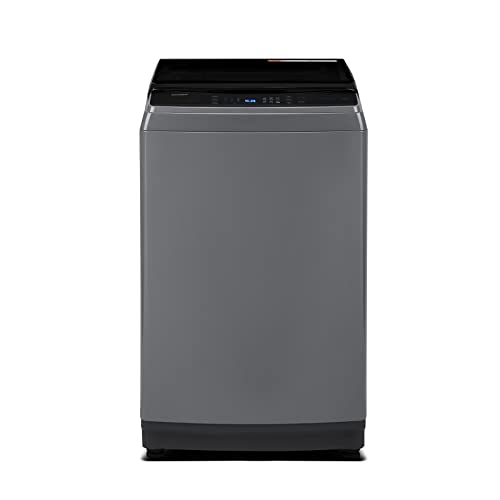
COMFEE’ 2.4 cu ft Portable Washing Machine — Best Automatic Portable
The COMFEE’ 2.4 is the calmest proposition in this line-up for a simple reason: it is a single-drum full-automatic, and automatics earn their name during the spin. A modern automatic program does not simply accelerate and hope; it tumbles the load, senses distribution through the drum’s behaviour, and only commits to full speed when the load is spread tolerably evenly. That management, invisible when it works, is the difference between a machine that hums in the corner and one that tours the bathroom.
At 2.4 cubic feet the drum is large for a portable, and size itself is an anti-vibration trait in small machines. Tiny drums force clothes into a single clump that dries into a lump; a larger drum lets a load distribute around the wall of the tub, which is where a balanced spin begins. Eight programs cover the household’s categories, a child lock suits the shared spaces it will live in, and the magnetic gray body is compact enough to level carefully in the small footprint it occupies.
No portable is a full-size machine with a concrete counterweight, and this one will still announce an unbalanced load of one heavy towel by pausing, redistributing, or spinning gently rather than fast. Treat that behaviour as the design working, level its feet on the firmest floor available, and it will do apartment laundry with a composure its twin-tub rivals cannot match.
- Capacity: 2.4 cu ft, large for a portable drum
- Programs: 8 automatic wash programs
- Spin management: full-automatic cycle control
- Safety: child lock for shared spaces
- Form: compact body sized for RV, dorm, and apartment floors
Strengths
- Automatic spin management redistributes loads for you
- Larger drum helps loads spread evenly
- Single-drum design avoids the twin-tub shake problem
Trade-offs
- Still a light machine that needs careful levelling
- One heavy item can force a slower, gentler spin
- No published vibration rating, like every pick here
Best for: apartment dwellers who want the machine itself to manage spin behaviour.
Not suited for: buyers wanting the manual control and low cost of a twin tub.

ROVSUN 25LBS Portable Washing Machine — Best Large Automatic Portable
The ROVSUN 25LBS scales the automatic argument up. A stainless steel drum at the largest portable capacity in this guide gives loads the most room to distribute themselves, and distribution, repeated like a refrain through this guide, is where quiet spinning is decided. The machine is a full-automatic washer and spin dryer combo with a drain pump, so the entire cycle, including the spin’s management, happens inside one drum under the program’s control rather than in a separate tub packed by hand.
Stainless steel contributes beyond durability here: a smooth, rigid drum wall lets clothes slide into an even layer against it as speed builds, rather than catching on seams or texture. The drain pump matters to placement, because a machine that can drain upward into a sink can be positioned on the firmest, most level patch of floor in the room rather than wherever gravity happens to allow, and placement on firm flooring is an anti-vibration decision.
It remains a portable, with a portable’s modest mass, and a determinedly unbalanced load will still slow its spin or shake its cabinet. Level it, load it in loose layers rather than a single dropped bundle, and resist washing one bath mat alone. Do those ordinary things and this is the portable most likely to be forgotten mid-cycle, which is the highest praise a washing machine can earn.
- Capacity: 25 lbs, the largest portable rating here
- Drum: stainless steel inner drum
- Format: full-automatic washer and spin dryer combo
- Drainage: built-in drain pump for flexible placement
- Use: home and apartment laundry at near-full scale
Strengths
- Big drum gives loads room to balance themselves
- Automatic single-drum spin control
- Pump drainage lets you choose the firmest floor spot
Trade-offs
- Light cabinet still needs levelling and even loading
- Single heavy items will trigger gentler spins
- No measured vibration figure is published
Best for: larger households in apartments who want automatic calm at portable scale.
Not suited for: buyers who prefer the hands-on twin-tub format and its lower complexity.

Winado 15.6LBS Full Automatic Portable Washer — Best Mid-Size Automatic
The Winado occupies the middle of the automatic portable range, at 15.6 pounds of capacity with ten wash programs, a stainless steel drum, and a drain pump. Ten programs at this size is a thoughtful count, because program choice is spin behaviour in disguise: a delicates program spins gently by design, a bedding program distributes longer before accelerating, and having the right program available stops owners from forcing every load through the most violent option on the dial.
Its size is itself a vibration strategy for small homes. A mid-size drum matches the loads a single person or couple actually generates, which means the drum is usually properly filled, and a properly filled drum is the most balanced drum. Owners of oversized machines washing three shirts are fighting physics; owners of this machine, washing a right-sized load, are assisted by it. The stainless drum keeps the load sliding into place as the spin builds.
As with its automatic siblings, the caveats are about mass and honesty. It is a light appliance that must be levelled, its ten programs cannot repeal an eccentric load of wet denim, and no rating exists to promise you a number. What it offers is the automatic format’s managed spin in the size most small households will load correctly most often, and in this category, most often is what quiet means.
- Capacity: 15.6 lbs full-automatic portable
- Programs: 10 wash programs including gentle options
- Drum: stainless steel inner drum
- Drainage: drain pump included
- Form: compact washer and spin dryer for apartment and dorm
Strengths
- Program range lets you choose gentler spins
- Right-sized drum encourages balanced full loads
- Stainless drum aids even load distribution
Trade-offs
- Mid-size capacity will not suit large families
- Light body requires a level, firm placement
- Unbalanced denim loads will still slow the spin
Best for: singles and couples whose loads match its drum, which is most small households.
Not suited for: families, whose volume pushes them to the larger automatics here.
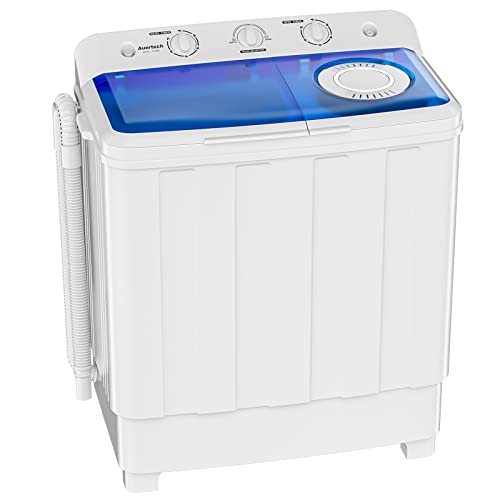
Auertech Portable Twin Tub Washing Machine — Best Twin Tub, With Eyes Open
The Auertech twin tub is here because twin tubs are what many small-home buyers choose, for their low cost, their speed, and their total manual control, and its vibration story must be told plainly. The washer tub agitates gently and is not the problem. The spinner is a small tub that rotates at high speed to fling water from clothes, and a small tub is merciless about packing: a load pressed unevenly, heavy on one side, becomes an eccentric weight at full speed within seconds, and the machine will shake, knock, and travel if it is allowed to spin that way.
None of that makes the machine bad; it makes the operator part of the mechanism. Packed evenly, in flat layers with heavy items distributed around the wall, the spinner runs true and dries clothes astonishingly well for its size. The drain pump on this model eases emptying the wash tub, the combined 28-pound rating across its tubs is generous, and the whole appliance asks for no plumbing permanence at all. Generations of dorm and apartment laundry have been done exactly this way.
Choose it if you value control, price, and spin-drying power, and accept the discipline it charges: level it, pack the spinner like you mean it, and stay within earshot during the spin. Choose an automatic instead if you want to press a button and leave the room. This guide’s respect for the twin tub is genuine, and so is its warning label, and both are printed in the same size type.
- Capacity: 28 lbs total, 18 lbs washer and 10 lbs spinner
- Format: twin tub, semi-automatic operation
- Drainage: drain pump fitted
- Spin: separate high-speed spinner tub
- Use: dorms, apartments, and RVs without fixed plumbing
Strengths
- Powerful spin drying when packed evenly
- Total manual control over wash and spin time
- No permanent installation required
Trade-offs
- Spinner shakes hard if packed unevenly
- Semi-automatic means moving loads between tubs by hand
- You are the spin-management system
Best for: hands-on buyers who want twin-tub economy and will pack the spinner carefully.
Not suited for: anyone who wants to start a load and leave the building.
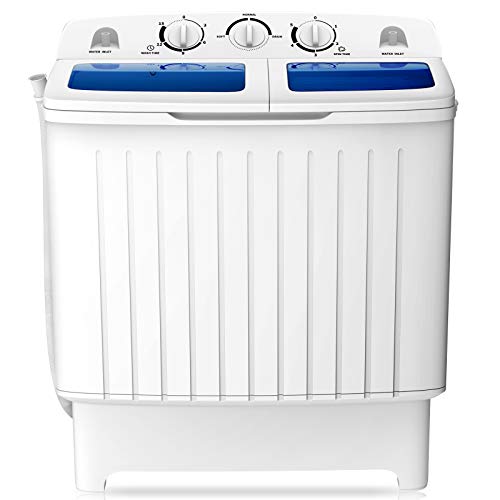
COSTWAY Portable Twin Tub Washing Machine — Best Compact Twin Tub
The COSTWAY twin tub is the smaller, simpler expression of the same format: twelve pounds of washing and eight pounds of spinning, twenty pounds combined, under timer control in a compact blue-and-white body. Everything said about its Auertech sibling applies at this scale, with the physics slightly sharpened. A smaller spinner tub is even more sensitive to an uneven pack, because there is less circumference across which to spread a mistake, and the machine’s light body has less mass with which to forgive one.
Within that honesty, the machine has real virtues for its intended life. Timer control keeps the wash tub’s rhythm in your hands, the format is famously quick, a wash and spin can turn around a small load while an automatic is still filling, and the whole appliance stores in the footprint of a laundry basket. For RVs, dorms, and the smallest apartments, where the alternative is a laundrette trip, its compromises are the price of having laundry at home at all.
Run it on the firmest floor you have, ideally not a sprung wooden floor above a neighbour’s ceiling, level it with unusual care, and pack the spinner in flat, alternating layers. Owners who adopt those habits report the format’s secret: a twin tub treated as an instrument rather than an appliance behaves far better than its reputation, and this is the most accessible way to learn that discipline.
- Capacity: 20 lbs total, 12 lbs washer and 8 lbs spinner
- Format: twin tub with timer control
- Design: durable compact body in blue and white
- Use: RV, apartment, and dorm laundry
- Spin: separate spinner tub, pack evenly for calm running
Strengths
- Smallest footprint of any full laundry solution here
- Fast turnaround on small loads
- Simple mechanics and simple controls
Trade-offs
- Small spinner is the most packing-sensitive here
- Light body transmits shake to weak floors
- Manual transfer between tubs on every load
Best for: RVs, dorms, and tiny flats where any home laundry is a victory.
Not suited for: upper-floor flats with thin floors and neighbours below, unless run with great care.

BLACK+DECKER 2.0 cu ft Portable Washer BPWM20W — Best Brand-Backed Portable
The BLACK+DECKER BPWM20W closes the guide as the automatic portable with the most familiar name, at 2.0 cubic feet and 15.4 pounds of capacity with six cycles. Its anti-vibration relevance is the automatic format’s usual one, a single drum whose spin is program-managed, delivered at a size that suits the small loads apartment life produces, with a transparent lid that lets you watch a load settle into balance, or visibly fail to, before the spin commits to speed.
Six cycles is a short list used well: the everyday categories are present, and fewer programs means owners actually learn which spin each program uses, which is its own quiet education in calm laundry. The quick-connect sink adapter defines its installation, and that has a placement benefit worth repeating: a machine that connects at a sink can be stationed on the firmest floor in the room and levelled there, rather than being banished to a flexible corner by fixed plumbing.
It will not match a full-size machine’s planted stillness, because mass is mass and this is a portable. But among light machines it combines the three things that matter, automatic spin management, a right-sized drum, and a maker whose documentation and parts will exist when you need them. On an upper floor, on a mat, levelled with intent, it is as considerate a neighbour as portable laundry gets.
- Capacity: 2.0 cu ft, 15.4 lb rated load
- Cycles: 6 wash cycles for everyday loads
- Connection: quick-connect sink adapter and drain hose included
- Lid: transparent, for watching loads balance
- Format: full-automatic single drum portable
Strengths
- Automatic spin management in a brand-backed machine
- Sink connection frees placement to the firmest floor
- Transparent lid teaches balanced loading by sight
Trade-offs
- Portable mass cannot equal a full-size machine’s stillness
- Six cycles is a working minimum, not a luxury list
- Sink connection occupies the tap while washing
Best for: renters wanting automatic calm with an established maker behind it.
Not suited for: buyers set on twin-tub control or full-size capacity.
How Do the Six Compare on Calm-Spinning Traits?
| Pick | Format | Headline trait | Watch out for |
|---|---|---|---|
| COMFEE’ 2.4 Portable | Full-automatic portable, 2.4 cu ft | Program-managed spin, larger drum | Light body needs levelling |
| ROVSUN 25LBS Automatic Portable | Full-automatic portable, 25 lbs | Stainless drum, pump placement freedom | Still portable mass on big loads |
| Winado 15.6LBS Automatic Portable | Full-automatic portable, 15.6 lbs | 10 programs including gentle spins | Mid-size capacity ceiling |
| Auertech Twin Tub 28 lbs | Twin tub, 28 lbs total | Strong spin drying, drain pump | Spinner shakes if packed unevenly |
| COSTWAY Twin Tub 20 lbs | Twin tub, 20 lbs total | Tiniest footprint, timer control | Most packing-sensitive spinner here |
| BLACK+DECKER BPWM20W 2.0 Portable | Full-automatic portable, 2.0 cu ft | Managed spin, transparent lid, brand support | Six cycles only |
Where Does Washer Vibration Actually Come From?
Every spin cycle is a controlled argument with physics. Wet laundry is heavy, it never distributes perfectly, and a drum turning at hundreds of revolutions per minute turns any unevenness into a rotating eccentric load. The machine’s suspension, springs and dampers in a full-size washer, simpler mounts in a portable, absorbs some of that energy. Its mass resists some. Its feet pass the remainder into the floor, and the floor, particularly a sprung wooden one, may amplify what it receives into the thump the whole flat can feel.
This is why no single feature abolishes vibration and why this guide refuses to rank machines by numbers nobody published. The variables multiply: load composition, load size, spin speed, levelling, floor construction, and the machine’s own mass and suspension. A buyer controls most of those variables more completely than any manufacturer does, which is genuinely good news, because it means a calm laundry is mostly a practice rather than a purchase.
The picks divide by how much of that practice they automate. Single-drum automatics manage distribution and spin speed themselves. Twin tubs hand the entire responsibility to the person packing the spinner. Neither approach is dishonest; they are different contracts, and the sections below price each contract fairly.
Why Do Twin Tubs Shake More Than Automatics?
A twin tub separates washing from spinning, and the spinner is where the format’s character concentrates. It is a small tub, it spins fast, and it is loaded by hand, three facts that multiply each other. In a small circumference, one heavy trainer on one side is a large fraction of the total load, and at high speed that fraction becomes a hammer. An automatic’s larger drum, machine-managed redistribution, and gradual acceleration exist precisely to prevent that configuration from ever reaching full speed.
The twin tub’s defence is that its operator can prevent it too, with knowledge the automatic keeps to itself. Pack the spinner in flat layers. Alternate heavy and light items around the wall. Press the load down evenly and use the spinner’s press cover if one is supplied. Packed that way, a twin tub spins true and extracts water with an efficiency that embarrasses many automatics, which is why the format survives. Packed carelessly, it will demonstrate every claim in this section within ten seconds.
There is also a placement corollary. A twin tub on a firm ground floor is a lively appliance; the same machine on a flexible upper floor is a neighbour dispute with a timer. If your home is the second kind and your heart is set on a twin tub, a dense anti-vibration mat and strict packing discipline are not accessories but conditions of purchase.
How Do Levelling and Feet Decide Whether a Machine Walks?
A washer out of level is a washer pre-loaded with a direction to travel. The spin’s forces find the tilt, the machine rocks onto two feet, and each rock is a small step. Walking machines are almost never broken machines; they are tilted ones, and the cure costs a spirit level, a spanner, and ten patient minutes. Adjustable feet exist on these portables precisely so a small machine can be made true on an imperfect floor, and the adjustment is the single highest-value act in this entire guide.
Work methodically. Rock the machine by hand to find the loose corner, extend that foot until the rock disappears, then check level front to back and side to side across the top. Run a spin with a normal load and watch the first minute; a machine that sits still then will sit still for the cycle. Recheck after a month, because feet settle into flooring and new machines bed in, and a quarter turn in June prevents the October migration across the bathroom.
Feet meet floor through whatever you put under them, which is where mats enter. A dense rubber anti-vibration mat spreads load, grips both surfaces, and absorbs the high-frequency component that floors transmit as sound. On tile or concrete it is a refinement; on wood above a neighbour it approaches a duty. What a mat cannot do is substitute for levelling, and stacking a mat under a tilted machine merely gives the tilt a softer launch pad.
Which Loads Spin Calmly and Which Loads Fight?
The calmest load is a full drum of similar items: a set of towels, a week of t-shirts, bedding of one kind. Similar weights distribute into an even ring, absorb water at similar rates, and stay where the spin puts them. The fighting load is a mixture of one heavy, waterlogged item and a crowd of light ones. The heavy item claims a side, the light items cannot counterweight it, and the machine either shakes or, if it is an automatic with sense, refuses full speed and leaves the load wetter than expected.
Single heavy items are the extreme case and deserve their own rule: do not spin a lone bath mat, a single pair of jeans, or one soaked hoodie at full speed in a portable machine. Add towels or similar ballast to give the drum something to balance with, or accept the gentler spin the machine chooses. This is not fussiness; it is the arithmetic of rotating masses, and every calm laundry room in the world obeys it.
Loading technique helps at the margins that matter. Drop items in loose and one at a time rather than as a single carried bundle, which preserves the random distribution the machine needs. Untangle sheets before loading rather than after, because a sheet ball is an eccentric load wearing a disguise. Small disciplines, repeated weekly, are what separate a quiet machine from an identical loud one.
What Can You Do About Floors, Neighbours, and Noise?
Floors transmit washer energy in two forms: the shake you feel and the hum you hear, and they travel differently. Shake follows structure, so a machine on joists above a neighbour’s bedroom will announce itself through the ceiling regardless of its manners at source. Hum is airborne and easier to muffle with a closed door. Knowing which problem you have decides the remedy: mats and placement for structure-borne energy, timing and doors for the airborne kind.
Placement is an underused remedy. A machine against a load-bearing wall, over a joist rather than mid-span, or in a ground-floor utility corner transmits a fraction of what the same machine sends from the middle of a suspended floor. Portables, including every pick here, can be moved to the best spot in the room because their connections are temporary; use that freedom deliberately rather than defaulting to wherever the machine first landed.
Timing is the social remedy and it works. Most neighbour friction about laundry is about hour, not volume: a spin cycle at seven in the evening is an appliance, and the same cycle at midnight is a grievance. Run the loud loads when the building is awake, keep the machine maintained so it does not develop the rattles of age, and a portable washer in a flat is a solved problem rather than a simmering one.
How Should You Set Up a Portable Washer for Its Quietest Life?
Begin before the first wash. Choose the firmest, most level patch of floor, ideally tile or concrete over a solid base, and level the machine there with the care described above. Fit the mat if the floor is wooden or a neighbour lives below. Route the drain so the hose cannot kink or pull the machine off its footing mid-cycle, and connect water fittings snugly by hand, because a machine that shifts to find a leak will not stay level either.
Then build the loading habit from the first week, while the machine is a novelty you are still watching. Similar items together, loose loading, ballast for single heavy pieces, and a pause to redistribute any load the machine audibly dislikes. With an automatic, let its redistribution cycles finish rather than cancelling impatiently; that tumbling pause is the machine solving the problem you would otherwise hear.
Finally, maintain the calm. Recheck level seasonally, keep feet clean of the grit that turns them into skates, and tighten any fitting that weeps. Vibration management is not a feature you buy once but a state you keep, and the keeping is measured in minutes per month. Every machine in this guide can live quietly under that regime, including, with discipline, the twin tubs.
What Does a Spin Cycle Sound Like When It Is Going Wrong?
Owners usually hear a vibration problem before they see one, and the sounds have meanings worth learning. A rhythmic thump that builds with speed is the classic unbalanced load, the drum’s eccentric weight striking once per revolution, and it calls for a pause and a redistribution rather than a braver spin. A high whine that was not there last month can be a bearing beginning its long farewell. A rattle that changes when you press the cabinet is often a foot, a loose panel, or a coin that escaped a pocket and now lives between drum and tub, announcing itself at exactly the speed you use most.
The correct response to a new sound is curiosity at low cost. Stop the cycle, redistribute or remove the load, check the feet for rock, and run the machine empty on a spin. An empty drum should spin almost silently; if the noise persists with nothing in the machine, the problem is mechanical and early attention is cheap attention. If the noise vanishes, the problem was the load, and the lesson is about packing rather than parts.
Keeping a rough memory of your machine’s ordinary voice is the enabling habit here. A portable washer’s normal spin has a character, a rising hum and a settling steadiness, and owners who know it notice departures in the first cycle rather than the fiftieth. In a category without published measurements, the owner’s ear, calibrated by familiarity, is the most sensitive instrument available, and it is free.
How Do Different Floors Change the Same Machine’s Behaviour?
A concrete ground floor is the kindest audience a washer can have: it absorbs the spin’s energy into mass and returns almost nothing. The same machine on a tiled bathroom floor over a solid base behaves nearly as well, with the tile adding a little brightness to the sound. Move that machine to a suspended wooden floor and the floor becomes a sounding board, flexing under each revolution and broadcasting the energy downward into the room below and outward into the flat’s own joists, which is why identical machines earn opposite reputations in different buildings.
Position within the wooden floor matters as much as the floor itself. Boards are stiffest near their supports, so a machine placed against a load-bearing wall, over or near a joist, sits on the calmest ground available, while the middle of a span is the most flexible and the worst seat in the house. Portables can be moved to the good ground because their connections are temporary, and that mobility, used deliberately, is worth more than any accessory.
Where the floor cannot be helped, the mat and the schedule carry the load. A dense mat decouples the machine from the boards and swallows the higher frequencies, and running heavy spins while the building is awake converts a grievance into a background event. The goal is not silence, which portable laundry will never honestly promise, but a level of presence that neighbours register as a household appliance rather than a building problem.
When Is Vibration a Fault Rather Than a Behaviour?
Most shaking is behaviour: levelling, loading, and floor, in that order, explain the overwhelming majority of cases, and the checks cost nothing. Vibration graduates to a fault when it survives those checks. A machine that is level, loaded evenly or empty, and still knocks, grinds, or travels is reporting worn suspension, a failing bearing, a loose counterweight or drum component, or, in a new machine, transit packaging that was never removed. Each of those deserves a technician rather than another hopeful adjustment.
New machines deserve one specific check before any other: the transit bolts. Front load drums are locked for shipping, and a machine run with its bolts in place will shake violently from its first cycle and damage itself in the process. If a new washer’s behaviour is extreme rather than mild, the bolts are the first suspect, ahead of the floor, the load, and the machine’s character, and the manual’s installation pages are the authority.
Age reframes the question too. A machine that has crept louder across a year is wearing, and the economics of repair depend on which component is speaking. Feet, hoses, and filters are trivial; bearings and suspension are the deep work whose cost should be weighed against the machine’s remaining life. The honest owner distinguishes the two early, while the cheap fixes are still the true ones.
How Do Spin Speeds and Programs Change the Shake?
Spin speed is the volume knob on vibration, and the programs on these machines are, among other things, a set of pre-chosen volumes. A delicates program spins slowly because silk cannot take more, and the side effect is the calmest cycle the machine owns. A cotton program spins at full commitment and asks the floor to accept it. Owners who understand this stop treating program choice as a fabric question only and start using it as a household one: the heavy spin for the morning load, the gentler program for the evening one, when the building is settling and the neighbours are home.
Load composition lets you cheat the arithmetic further. A load of similar items reaches its balance quickly and can take a faster spin in peace, while the mixed load of a towel, a hoodie, and three socks will shake at speeds the towels alone would have forgiven. Sorting by weight, already good laundry practice for washing’s sake, is doubly good practice for the spin’s sake, and in a flat it is the difference between a machine that is heard and a machine that is merely known to exist.
The automatic picks manage this relationship themselves, limiting speed when distribution is poor, which owners sometimes misread as the machine failing to spin properly. It is the opposite: the machine is choosing your floor over your schedule. Help it choose better by loading evenly, and the full speeds return. Force it, by cancelling and restarting impatiently, and you have merely volunteered to hear the problem at full volume instead.
What Should You Do the Day a New Portable Washer Arrives?
Treat arrival day as an installation, not an unboxing. Choose the machine’s home by the floor first and the plumbing second, because a portable can reach a sink with a longer hose more easily than it can calm a flexible floor. Level it where it will live, with the patience the levelling section describes, and run the first cycle empty or with a sacrificial load of old towels while you stay in the room and learn its voice, its pauses, and the exact moment its spin commits to speed.
Use that first week to calibrate your loading against its behaviour. Note which of your ordinary loads it accepts at full spin and which it argues with, and adjust the composition of the arguing loads rather than their size: swap a heavy item between loads, add ballast to the single-item wash, untangle the sheet that balls. By the second week the household and the machine have negotiated their treaty, and the terms are simply the habits that keep it quiet.
Fit the mat now, while the intention is fresh, if your floor is wooden or a neighbour is below. Check the level again after a fortnight, because new feet settle and floors compress, and write the machine’s ordinary sound into your memory by the simple act of having listened to it once on purpose. Arrival day done this way is the cheapest anti-vibration technology in this entire guide, and it is available for every pick in it.
How Should You Test a Machine’s Manners in Its First Week?
Run a deliberate programme of ordinary loads and observe like an owner rather than a critic. The towel load is the examination: heavy, thirsty, and prone to clumping, it will find any levelling error and any loading habit that needs correcting. Follow it with the mixed daily load and then with a deliberately gentle program, and by the end of the week you will know your machine’s range the way you know a car’s, by feel rather than by figures. That feel is the real specification sheet of a portable washer, and no listing can issue it to you in advance.
Change one variable at a time when something displeases you. If the towel load shook, redistribute it before you touch the feet; if it shakes again identically, level before you blame the load. Owners who change three things at once learn nothing except that something worked, and the lesson deserts them the next time the symptom returns in a different costume. The scientific method sounds grand for laundry, but in a flat with a neighbour below, it is simply good manners with a notebook.
By the second week, write down the settings and habits that work: the program for towels, the packing pattern for the spinner, the load that needs ballast. Tape the note inside a cupboard door if the household shares the machine, because a portable washer’s calm is a household practice, and practices that live in one person’s head leave when that person goes on holiday. The machine will keep its side of the treaty exactly as long as the household keeps theirs.
What Is a Reasonable Expectation to Bring to This Category?
Bring the expectation of management rather than silence. A portable washer, levelled, matted, and loaded with intelligence, becomes a background appliance whose spin is noticed the way a fridge’s hum is noticed, which is to say only when it stops. The same machine, bought with the expectation that a badge would abolish physics, disappoints its owner within a week and earns a review its engineering never deserved. The honest promise of this category is not that the machine will be quiet; it is that quiet is achievable, by the means this guide has described, with every format in it.
That is also why this guide has refused, from its first paragraph, to decorate any pick with an invented number. A figure would have been easy to print and impossible to defend on your floor, in your building, under your load of towels. Mechanisms travel; measurements do not. Learn the mechanisms, level the feet, pack the spinner, sort by weight, and the machine you already own will very likely become the machine this category promised you.
How Do You Talk to Neighbours About a Machine Before It Is a Problem?
The cheapest anti-vibration device ever made is a conversation held before the first complaint. Tell the flat below when the machine arrives, ask which hours would genuinely disturb them, and agree the laundry window the way neighbours agree everything that works. A household that has been consulted experiences the same spin as a household appliance; a household that discovers it unannounced experiences it as an intrusion, and the difference is not in the decibels, which this guide has carefully never quoted, but in the consent.
Then keep the agreement visibly. Wash the heavy loads inside the agreed hours, mention the mat you fitted because you meant to be considerate, and check in once after the first fortnight. Portable laundry in dense housing is a social technology as much as a mechanical one, and the owners who treat it that way keep both their machines and their neighbours for years.
Which Habits Make Even a Good Washer Shake?
- Skipping the levelling because the machine is small. Light machines walk furthest; a portable out of level will tour the room on its first enthusiastic spin.
- Packing a twin-tub spinner in a heap. The spinner has no redistribution system except you, and a heaped load becomes an eccentric hammer at speed.
- Spinning one heavy item alone. A lone soaked bath mat cannot balance itself in any drum; add ballast or accept a gentle spin.
- Placing the machine mid-span on a wooden floor. The most flexible point of the floor amplifies everything; position over support, against a load-bearing wall.
- Cancelling an automatic’s redistribution pause. That slow tumbling is the machine solving the imbalance; interrupting it sends the problem into the spin at full strength.
Final Recommendation
Calm laundry is achievable with every format here, provided you choose the contract that suits you. Buyers who want the machine to manage the problem should take the COMFEE’ 2.4 Portable, whose automatic programs and generous portable drum do the redistribution work unaided. Those who want the same automatic behaviour at the largest portable scale should choose the ROVSUN 25LBS Automatic Portable, with its stainless drum and the placement freedom its drain pump allows. And buyers set on a twin tub’s economy and control can still live quietly with the Auertech Twin Tub 28 lbs, if they accept its one condition, that the spinner is packed in flat, even layers every single time.
Level the feet before the first wash, load for balance rather than for capacity, and put the machine on the firmest floor you have. Do those unglamorous things and the question of vibration largely answers itself, whatever the badge on the front of the machine.
Frequently Asked Questions
Can I trust any washing machine’s quietness claims?
Only the mechanism behind them. These listings publish no vibration or noise measurements, and this guide invents none. Judge instead by format, drum size, spin management, and your floor, and treat any precise decibel figure attached to a portable washer with polite suspicion.
Why does my washer walk across the floor?
Almost always levelling, occasionally an unbalanced load, rarely a fault. Find the rocking corner, extend that foot, and test with a normal load. A machine that still travels when level and evenly loaded deserves a service opinion; a machine that settles was never broken.
Are anti-vibration mats worth it?
On hard floors they are a refinement, and on wooden floors above neighbours they approach a necessity. A dense mat grips, spreads the load, and absorbs the high-frequency hum floors transmit. It cannot fix a tilted machine, so level first and mat second.
Is a twin tub a bad choice for an upper-floor flat?
It is the most demanding choice, not an impossible one. Its spinner needs careful packing and the machine needs the firmest placement and ideally a mat. If you cannot commit to that discipline, a single-drum automatic from this guide will be a kinder neighbour.
Why does my automatic sometimes spin slowly or for longer?
That is its balance management working. The program redistributes the load and limits speed when distribution is poor, protecting itself and your floor at the cost of time and a slightly wetter load. Helping it with even loading makes the slow cycles rare.
Does a bigger portable shake less?
Generally, yes, for two reasons: a larger drum distributes loads more evenly, and the machine’s extra mass resists the forces that remain. The 25-pound automatic here is the calmest portable proposition for that combination, though levelling still decides the final result. The qualification worth adding is that size helps only when the load uses it: a big drum carrying one small bundle will still clump that bundle into a single eccentric parcel. Fill the larger drum properly, or add ballast to the small load, and the size advantage becomes real rather than theoretical, which is the same lesson this guide has taught at every scale.
Related Guides
Quieter laundry pairs naturally with the apartment guide that follows it, and with the other hard-working machines gathered here: Best Apartment Washing Machines Best Philips Automatic Pasta Makers Best Affordable Embroidery Machines


