What's inside
- First, the Ground Rules for Black
- The Black Six, Briefly
- How the Black Field Was Screened
- The Black Contenders on Stated Figures Alone
- Black Stainless, Gloss Black, Matte Black: Reading a Door Properly
- When a Wrap, a Magnet, or a Spare Panel Is Actually the Right Answer
- Keeping Black Looking Expensive: The Ten-Second Habit and Its Enemies
- Light, Shadow, and the Rooms Black Belongs In
- Fitting the Narrow Machine: What an 18-Inch Opening Demands
- Mistakes Specific to Buying Black
- Black and the Rest of the Suite: Ranges, Fridges, and Small Appliances
- Hygiene Cycles and What a Sanitize Rinse Is Really For
- Deciding in the Right Order: Opening, Noise, Virtue, Finish Family
- Energy and Water Across the Black Range
- The Long View: Black’s Resale and Rental Logic
- Final Recommendation
- The First Month With a Black Machine: Settling the Household Into It
- Black-Panel Questions, Answered Plainly
- Related Guides
As an Amazon Associate I earn from qualifying purchases. This post may contain affiliate links at no extra cost to you.
cottageverdict.com is reader-supported. When you buy through links on our site, we may earn an affiliate commission.
How to shop this shortlist: every machine below is a complete dishwasher manufactured with a black door, sold through its Amazon listing — use the listing to check price on Amazon and to study the door’s photographs at full size, because black finishes differ in gloss and depth more than photographs first suggest. If a listing shows a panel, a skin, or a magnet rather than a machine, you have wandered into the accessory results this guide deliberately excludes.
Search for the best dishwashers with black panels and the internet hands you a strange basket: vinyl decals, magnetic covers, replacement door skins, and spare panels, all wearing the vocabulary of the appliance itself. Let this guide be plain at the outset — none of those is a dishwasher, and none appears below as a pick. A wrap can refresh a tired door for the cost of a takeaway, and the prose further down discusses when that is the honest answer, but a wrap cannot wash a plate. The six machines reviewed here are complete, plumbed, black-doored dishwashers whose manufacturers built the finish in at the factory: four Kenmores spanning the brand’s black range, an 18-inch COMFEE’ for narrow kitchens, and a Gordon Ramsay by THOR model whose title says almost nothing beyond its colour and size.
Why choose black at all? Because in the right kitchen it is the finish that organises the room. Against pale cabinets it draws a confident horizontal line; against dark cabinetry it disappears into shadow and lets handles and worktops speak; in an industrial or modern scheme it partners with matte black taps and rails as if the room were planned around it — because it was. Black also hides the scuffs and shoe-kicks that accumulate at a dishwasher’s base better than any pale finish, though it shows dust and dried drips more honestly, a trade this guide examines rather than hides.
The field, on stated numbers, is strong. The flagship Kenmore Elite claims 42 dBA — the quietest figure in this entire dishwasher programme — with a TotalFlex third rack and the full UltraWash Plus suite. Two more Kenmores cover the family middle at 49 dBA with different rack and safety emphases, a fourth closes the range at 51 dBA and 14 places, and the COMFEE’ proves that black is not reserved for full-size kitchens. Readers planning the wall beside the dishwasher run may enjoy Best Wall Ovens for Roasting Vegetables, where the same question — which finish, which format — is asked of ovens with equally strong opinions.
First, the Ground Rules for Black
- Every pick is a complete dishwasher with a factory black door — no decals, magnets, wraps, or spare panels appear as picks.
- The quietest stated figure in this programme lives here: 42 dBA on the Kenmore Elite.
- One pick is an 18-inch machine (the COMFEE’, 8 place settings) — the only narrow model in the dishwasher groups this batch.
- Leak detection is named in two titles, third racks in two others; no single model here claims both.
- The Gordon Ramsay by THOR title states size and colour only — its entire specification lives in documentation, and this guide treats it accordingly.
The Black Six, Briefly
| Machine | Distinction | The short case |
|---|---|---|
| Kenmore Elite Black Stainless 42 dBA | Flagship of the finish | The quietest stated rating anywhere in this programme, with a TotalFlex third rack. |
| COMFEE 18-Inch Black | Narrow-kitchen answer | Eight places, a steel tub, and heated dry in an 18-inch black cabinet. |
| Gordon Ramsay by THOR Black | Name-led contender | A 24-inch black machine from a chef-branded range — specification to be verified in full. |
| Kenmore Black TurboDry 49 dBA | Floor-protecting family pick | Leak detection with TurboDry across 15 places. |
| Kenmore Black Third Rack 49 dBA | Fullest cycle suite | Third rack, Accela Wash, Sani Rinse, and TurboDry in one black specification. |
| Kenmore Black 51 dBA | Range-closing value | Fourteen places with Sani Rinse, SmartDry, and leak detection at the range’s foot. |
How the Black Field Was Screened
The screen for this guide had to solve the problem the introduction describes: separating machines from merchandise. A candidate survived only if its listing title described a complete built-in dishwasher — a tub, a wash system, a capacity — wearing black as its manufactured finish. That single rule swept away the decals, the magnetic skins, the vinyl wraps, and the replacement panels that crowd the search results, along with a handful of panel-ready machines whose blackness would have depended on a cabinet panel the buyer supplies. What remained was a compact, honest field: six machines, five of them full-size, from three badges.
Ranking within the field followed the household consequences of each title. Noise came first, because black kitchens skew modern and open-plan, and an open-plan machine must be quiet to be tolerable; the Elite’s 42 dBA therefore leads the guide. Drying and rack architecture shared second place — TurboDry appears in three titles, third racks in two — and safety third, with leak detection named twice. As throughout this programme, every silence in a title is recorded in the spec boxes in plain language, and the THOR entry demonstrates why: when a title offers nothing but size and colour, the honest review says so and sends the reader to the documentation with a checklist, rather than borrowing specifications from the brand’s other models.
A note on the phrase “black stainless,” which attaches to the Elite in its pool name while its title says simply black. Finishes marketed as black stainless are typically a dark coating over stainless steel, with a brushed depth that plain black enamel lacks; plain black doors are usually painted or coated steel with a smoother, glossier face. The two age differently and clean differently, and the care section below treats them separately. Where this guide cannot confirm from a title which construction a door uses, it says so — another small honesty that prevents a large disappointment.

Kenmore Elite Black Stainless 42 dBA — Flagship of the finish
Elite is Kenmore’s word for its top shelf, and this black flagship justifies the badge on its title alone: 42 DBA — quieter than any other figure stated in this batch’s dishwasher guides — a TotalFlex third rack, UltraWash Plus, TurboDry, QuietWash, and SmartWash, wrapped around 15 place settings with ENERGY STAR certification. Read that list slowly. It is the complete modern specification: the sensor wash for ordinary days, the fast and sanitize options implied by the suite around it, fan-assisted drying for plastics, a third rack for the cutlery and the long utensils, and a noise figure that belongs in a library, all behind a black door. If a household wants black and wants everything, the search ends here and the remaining question is only whether the budget agrees.
The TotalFlex name promises a third rack with more arrangement freedom than a fixed tray, and in a flagship that flexibility is the difference between a rack that hosts the household’s actual utensils and one that hosts an idealised set. QuietWash as a named mode reinforces the 42 dBA headline: this is a machine designed to run during dinner parties in the open-plan rooms black kitchens usually anchor. The title does not name the tub material — at Elite level the documentation will settle it quickly — and it does not need to name much else. This is the reference black dishwasher of the programme, the one the other five are measured against.
- Format: 24-inch built-in, black finish
- Stated sound level: 42 DBA, with a named QuietWash mode
- Racks: TotalFlex 3rd rack
- Systems named: UltraWash Plus, TurboDry, SmartWash
- Capacity: 15 place settings
- Tub material: the listing title leaves it unstated — the manufacturer’s documentation carries the specification
- Certification: ENERGY STAR certified, per the title
- Locating the Kenmore Elite Black Stainless 42 dBA: its Amazon listing is the source — check price on Amazon there and study the door finish photographs closely
Strengths
- A 42 dBA rating makes it the open-plan black machine without rival here.
- The fullest wash and dry suite in the group sits behind the same door.
- TotalFlex third-rack flexibility suits households with serious utensil collections.
Trade-offs
- Flagship positioning means flagship expectations on budget — it will not be the cheapest black door here.
- The tub material requires a documentation check the price point should not demand.
- Its quietness is wasted in a doored kitchen, where a sibling’s features may serve better.
Best for: open-plan homes that want black, capacity, and near-silence in a single purchase. Not suited for: doored kitchens on a discipline budget, where the 49 dBA Kenmores deliver the same loads audibly but adequately.

COMFEE 18-Inch Black — Narrow-kitchen answer
Every other machine in this guide assumes a 24-inch opening. The COMFEE’ assumes 18, and for the kitchens that need it — the apartment galley, the studio, the narrow Victorian terrace where the dishwasher slot was carved from a cupboard — that assumption is the entire product. Its title is admirably complete for its size: a stainless steel tub, 8 place settings, 6 washing cycles, heated dry, an adjustable top rack, a stated 52dB, and Energy Star plus NSF standing, in black. A steel tub and heated drying at this width are not givens; plenty of narrow machines economise on both, and this one declines to.
Eight place settings sounds modest until it is translated into a real household of one or two: a day’s plates, glasses, pans, and cutlery, washed nightly, which is exactly the rhythm small kitchens impose because there is nowhere to stack waiting dishes. The adjustable top rack earns its keep daily at this scale, where two centimetres of clearance decide whether the tall glasses fit at all. At 52dB it is not a quiet machine, but small kitchens are rarely open-plan theatres, and a door — most galleys have one — closes the subject. For its intended rooms, this is the most precisely aimed pick in the guide.
- Format: 18-inch built-in, black — the group’s only narrow machine
- Tub: stainless steel, per the listing title
- Capacity: 8 place settings
- Programs: 6 washing cycles, with heated dry
- Rack: adjustable top rack
- Stated sound level: 52dB
- Certification: Energy Star and NSF, per the title
- Locating the COMFEE 18-Inch Black: available through Amazon — check price on Amazon via the listing, and measure your opening twice before ordering
Strengths
- It brings a steel tub and heated dry to a width where both are often sacrificed.
- The adjustable rack converts its small capacity into usable, tall-item capacity.
- Black at 18 inches is genuinely scarce, and this machine serves that niche completely.
Trade-offs
- Eight places is a firm ceiling — entertaining means running it twice or washing up.
- At 52dB it is the loudest machine in this guide.
- Sheet pans and the largest roasting tins may simply not fit its geometry.
Best for: singles, couples, and small kitchens with an 18-inch opening and a black scheme. Not suited for: families, whose daily load would overflow it before breakfast ended.
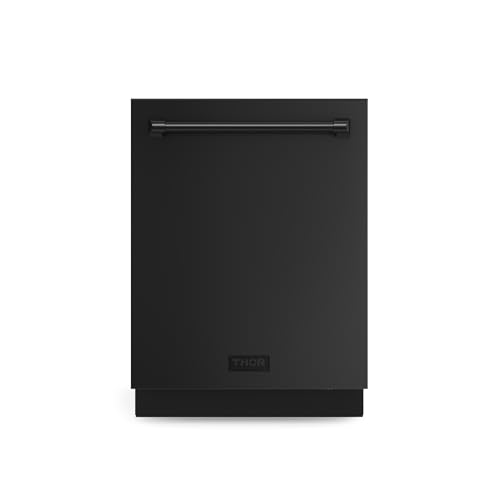
Gordon Ramsay by THOR Black — Name-led contender
Here is the whole of this machine’s title: Gordon Ramsay by THOR Kitchen, 24 inch, dishwasher, black. No decibels, no capacity, no tub, no cycles, no drying, no certification. This guide includes it because the product is real, the badge pairing is interesting — a chef-branded line from an appliance maker with a professional-range heritage — and black-panel shoppers will meet it in their search results and deserve a framework for judging it. But let the framework be honest: everything that matters about this dishwasher must be established from THOR’s documentation and the listing body, and a buyer who cannot find a stated sound rating, tub material, and place-setting count there should walk away, however handsome the door.
What can be said without invention? The format is a full-size 24-inch built-in in black, which places it in the guide’s main arena. The branding suggests a range designed to sit alongside THOR’s cooking appliances, so households building a matched black suite from that maker have a coherence reason to investigate it that no specification can supply. Chef branding, though, is a licence, not a wash system; it tells you about the marketing department’s ambitions, nothing about spray pressure. Treat this entry as a research assignment with a famous name attached: potentially a fine machine, presently an undocumented one, and priced judgement must wait on the paperwork.
- Format: 24-inch built-in, black, per the listing title
- Brand line: Gordon Ramsay by THOR Kitchen
- Capacity, sound, tub, cycles, drying: none of these figures appears in the listing title — each must be taken from the manufacturer’s documentation before purchase
- Locating the Gordon Ramsay by THOR Black: listed on Amazon — check price on Amazon there only after the documentation has supplied the missing specification
Strengths
- It completes a matched THOR black suite for households building one.
- Full-size format keeps it in contention for family kitchens.
- A professional-heritage maker stands behind the badge, which counts for parts and support.
Trade-offs
- The title’s total silence on specification makes it the highest-homework pick here.
- Chef branding carries no information about washing performance.
- Every rival in this guide states more in its title than this one does.
Best for: THOR suite builders willing to verify the full specification in documentation first. Not suited for: anyone who wants the evidence before the enquiry — the Kenmores state theirs openly.

Kenmore Black TurboDry 49 dBA — Floor-protecting family pick
This is the black counterpart of a familiar family formula, and its title leads with the pairing that matters to houses rather than to spec sheets: TurboDry and leak detection, with SmartWash sensing, 15 place settings, a stated 49 DBA, and ENERGY STAR certification. The leak detection deserves the same emphasis it received in the white guide — a dishwasher’s worst failure is hydraulic, not electronic, and a machine that watches its own plumbing protects floors that cost more than any appliance. In black, on a pale timber floor, that protection pairs with a door that hides the scuffs of family traffic: a quietly defensive specification, in the best sense.
Against the Elite above it, the trade is clear-eyed: seven decibels and the third rack are surrendered, and in return the household gets the leak sentinel and a simpler two-rack interior that some families honestly prefer — a basket for cutlery, deep racks for everything else, no shallow tray to negotiate. TurboDry keeps the drying modern. The title leaves the tub material unstated, as its white sibling did, so the documentation check applies with the usual force. For a family kitchen with a door, a wooden floor, and no interest in flagship pricing, this is the black machine calibrated to reality.
- Format: 24-inch built-in, black
- Safety feature named: leak detection, per the listing title
- Wash and dry named: SmartWash and TurboDry
- Sound and size: 49 DBA stated, across 15 place settings
- Tub material: not given in the listing title — the manufacturer’s documentation is where it is confirmed
- Certification: ENERGY STAR certified, per the title
- Locating the Kenmore Black TurboDry 49 dBA: sold on Amazon — check price on Amazon at its listing when you are ready to order
Strengths
- Leak detection guards the floor, the asset most at risk from any dishwasher.
- TurboDry gives family plastics a fighting chance without heated-dry energy.
- Fifteen places and a sensor cycle cover the standard family load completely.
Trade-offs
- No third rack, so cutlery competes for lower-rack space again.
- At 49 DBA it is a doored-kitchen machine, not an open-plan one.
- The unstated tub material needs verifying, as with several Kenmores here.
Best for: families on timber floors who value the leak sentinel over the third rack. Not suited for: open-plan households, who should climb to the Elite’s 42 dBA.

Kenmore Black Third Rack 49 dBA — Fullest cycle suite
If the TurboDry model is the defensive Kenmore, this one is the complete one. Its title carries the longest feature list of the 49 dBA pair: a third rack, UltraWash Plus, SmartWash, Accela Wash, a Sani Rinse, and TurboDry, across 15 place settings. That is every named system in the brand’s mid vocabulary assembled in a single black machine — the fast cycle for midweek, the sanitize rinse for the raw-chicken board, the sensor wash for everything else, fan drying to finish, and the shallow rack on top for the cutlery and the carving knife. Households that actually use their dishwasher’s range, rather than its default, will find nothing missing here except silence.
The absence it shares with its sibling is leak detection, and the absence it shares with the Elite is quiet — 49 dBA is respectable, family-kitchen loud, and no more. Choosing between the two 49 dBA Kenmores is therefore a clean values question: the third rack and the full cycle suite, or the leak sentinel and the simpler interior. This guide’s instinct is that cooks choose this one and floor-owners choose its sibling, and both instincts are defensible. The tub material, once again, awaits the documentation; the rest of the specification is stated with unusual completeness. Households equipping a serious baking kitchen alongside might cross-read Best Hamilton Beach Bread Machines — another corner where one brand’s overlapping models need untangling.
- Format: 24-inch built-in, black
- Racks: 3rd rack fitted, per the listing title
- Systems named: UltraWash Plus, SmartWash, Accela Wash, Sani Rinse, TurboDry
- Capacity and sound: 15 place settings, 49 DBA stated
- Tub material: the listing title does not specify it — verify through the manufacturer’s documentation
- Certification: ENERGY STAR certified, per the title
- Locating the Kenmore Black Third Rack 49 dBA: offered through Amazon — check price on Amazon on the product page
Strengths
- The broadest named system suite of any 49 dBA machine in this guide.
- A third rack plus a sanitize rinse serves both the everyday and the hygienic load.
- Accela Wash answers the midweek turnaround that defeats lesser menus.
Trade-offs
- No leak detection, the sibling’s headline, is included here.
- Its 49 DBA figure confines it to kitchens with doors or tolerant ears.
- Feature richness is wasted on households that only ever press one button.
Best for: keen cooks who use the full cycle range and want the third rack’s order. Not suited for: timber-floor households for whom leak protection outranks every cycle.

Kenmore Black 51 dBA — Range-closing value
The fourth Kenmore closes the black range, and its title shows what the range’s foot still includes: UltraWash, SmartWash, a Sani Rinse, SmartDry, and leak detection, across 14 place settings at a stated 51 DBA, with ENERGY STAR certification. Pause on that: the value model of this black family carries both a sanitize rinse and leak detection — two features that headline dearer machines elsewhere in this programme. What it concedes is a place setting, a few decibels, the third rack, and the TurboDry name, with SmartDry standing in as its drying answer. As a specification for a household that wants black, safe, and sanitary without climbing the range, it is remarkably complete.
SmartDry versus TurboDry is the one comparison to make carefully, because the names are cousins rather than synonyms and the title does not define either. The documentation will describe the mechanism; what can be said here is that this model names a drying system at all, which puts it ahead of several machines in neighbouring guides that name none. At 51 DBA it belongs behind a door. Within a door’s protection, though, a family gets the two features with the longest consequences — hygiene and leak vigilance — at the range’s gentlest position, and that is a rational place for a black range to end.
- Format: 24-inch built-in, black
- Systems named: UltraWash, SmartWash, Sani Rinse, SmartDry
- Safety feature named: leak detection, per the listing title
- Capacity and sound: 14 place settings, 51 DBA stated
- Tub material: not stated in the listing title — look to the manufacturer’s documentation for it
- Certification: ENERGY STAR certified, per the title
- Locating the Kenmore Black 51 dBA: available on Amazon — check price on Amazon through its listing before committing
Strengths
- Sani Rinse and leak detection at the range’s foot is an unusually generous pairing.
- Fourteen places still covers most family loads without a second run.
- A named drying system spares buyers the unstated-drying gamble.
Trade-offs
- At 51 DBA it is the loudest full-size machine in this guide.
- No third rack, and one fewer place setting than its siblings.
- SmartDry’s mechanism needs the documentation to be understood, not assumed.
Best for: value-led families who refuse to surrender hygiene or leak protection to save money. Not suited for: noise-sensitive or third-rack-committed households.
The Black Contenders on Stated Figures Alone
| Machine | Size | Sound stated | Headline system |
|---|---|---|---|
| Kenmore Elite Black | 24-inch | 42 DBA | TotalFlex 3rd rack, TurboDry |
| COMFEE’ Black | 18-inch | 52dB | Heated dry, steel tub |
| Gordon Ramsay by THOR Black | 24-inch | Not in title | None stated |
| Kenmore Black TurboDry | 24-inch | 49 DBA | Leak detection, TurboDry |
| Kenmore Black Third Rack | 24-inch | 49 DBA | 3rd rack, Accela Wash, Sani Rinse |
| Kenmore Black 51 dBA | 24-inch | 51 DBA | Sani Rinse, leak detection, SmartDry |
The table’s lesson is that black buyers are choosing among virtues, not between good and bad: silence at the top, safety in the middle, completeness beside it, hygiene at the foot, and a narrow machine for the rooms the others cannot enter.
Black Stainless, Gloss Black, Matte Black: Reading a Door Properly
Black is three finishes wearing one word. Black stainless — the Elite’s family — is a dark coating over brushed stainless, with depth and a slight texture that breaks light softly; it resists fingerprints better than plain stainless and reads as charcoal in bright rooms rather than true black. Gloss black, the traditional enamel look, is a mirror-adjacent surface that throws reflections, shows every dried drip as a pale comet, and anchors a high-contrast kitchen like a piano anchors a room. Matte black absorbs light, hides drips best of all, and can look dusty sooner because its surface gives dust nothing to slide off. A listing’s photographs, studied at full size against the listing’s own finish wording, are the buyer’s only reliable guide to which black is actually being sold — and where a title says merely “black,” as most here do, the documentation and the photographs must agree before you order.
Matching across a suite follows from the same distinctions. A black-stainless dishwasher beside a gloss-black range is a mismatch that photographs hide and daylight exposes; two blacks of different families quarrel quietly forever. If the room already holds black appliances, identify their family first — brushed depth or smooth gloss — and buy the dishwasher in the same one. If the dishwasher is the room’s first black appliance, its family sets the precedent the rest will follow, which is a genuine argument for the Elite’s black stainless: it is the most forgiving black to match later, because its charcoal depth sits comfortably beside both gloss and matte companions.
When a Wrap, a Magnet, or a Spare Panel Is Actually the Right Answer
This guide excluded accessories from its picks, but honesty requires the prose to admit their place. If your existing dishwasher washes beautifully and only its door offends you — a stainless front in a kitchen that has gone black around it — then a quality magnetic cover or vinyl wrap is the rational purchase: it costs a fraction of a machine, installs in an afternoon, and can be removed when taste changes again. The same logic covers renters, who cannot replace appliances at all, and sellers preparing a house, for whom a tired door is a cosmetic problem with a cosmetic cure. What these products cannot do is improve a wash, quiet a pump, or dry a plastic tub; the moment the machine itself is the problem, only a machine is the answer.
Spare panels occupy a third category: legitimate parts for panel-ready machines whose owners are changing cabinet fronts. If that is your situation, the panel must come from the machine’s own maker to fit its door geometry, and it is a component, not an upgrade. The confusion this guide set out to prevent is only the search-result kind, where accessories borrow appliance language and a hurried buyer orders a magnet expecting a motor. Read the noun in any listing — machine, cover, skin, panel — and the category error becomes impossible.
Keeping Black Looking Expensive: The Ten-Second Habit and Its Enemies
Black’s reputation for showing everything is half true, and the true half has a cheap cure. What black shows is contrast: pale dust, dried droplets, flour, the faint salt of evaporated splash water. All of it sits on the surface rather than in it, which means all of it leaves with a damp microfibre cloth in about ten seconds. The households that love black are the ones that build that wipe into the closing of the kitchen each night — a single pass while the kettle boils — and the households that resent black are the ones that let a month of droplets mineralise into a constellation that then needs vinegar and patience. The finish is not high-maintenance; it is maintenance-visible, and it rewards rhythm over effort.
Its enemies are specific. Scouring pads and powdered abrasives scratch gloss black into a haze that catches light unevenly forever after, and they strip black stainless’s coating at the scratch’s edge. Spray cleaners aimed at a neighbouring hob drift onto the door and, if left, dry into pale blooms that look like finish failure but are only chemistry sitting where it was not invited — wipe overspray immediately and the problem never exists. Hard-water drips from a tap above the machine print the same pale fan they print on any finish, only sooner to the eye on black; the vinegar cloth, used weekly, keeps the fan a rumour. And sunlight deserves a mention: a black door in a south-facing kitchen absorbs heat and shows its dust in raking light more honestly than any other surface in the room, which is an argument for the blind’s angle, not against the door.
Handles and edges age first on any finish, and black is no exception — the top edge of the door, where hands pull, and the corners at kick height collect the micro-history of a household. A soft cloth with a drop of mild detergent, monthly, on exactly those zones, keeps the wear pattern even and the door reading as one surface. None of this exceeds the care stainless demands; it merely differs in what it displays when neglected, and a buyer who knows that in advance will never be surprised by it.
Light, Shadow, and the Rooms Black Belongs In
Black appliances are lighting instruments. In a north-facing kitchen with cool, flat light, a gloss black door can read as a hole in the run — handsome if the room has the confidence for it, gloomy if the cabinetry around it is also dark and the worktops darker still. In a sunlit room, the same door throws a soft reflection and becomes the run’s anchor, the object the eye rests on between windows. Matte and black-stainless finishes soften both extremes, which is why they have become the default blacks of modern ranges: they hold their tone in more lights than gloss can. Before ordering any machine in this guide, hold something black and glossy — a baking tray will do — in the dishwasher’s position at three times of day, and watch what the room does to it. The tray test costs nothing and predicts the decade.
Artificial light deserves its own sentence, because kitchens are evening rooms. Under warm downlights, black stainless warms toward charcoal-brown at its edges, a quality designers exploit when pairing it with timber; gloss black under the same lights turns theatrical, mirroring the pendants. If the room’s evening character matters more than its noon character — for most households it should — judge the finish after dark, from the doorway, with the under-cabinet lights on. That is the view you will actually live with, and it is the view estate photographs never show.
Fitting the Narrow Machine: What an 18-Inch Opening Demands
The COMFEE’ earns a practical section of its own because narrow installs fail differently. An 18-inch opening is often an adapted cupboard rather than a designed appliance slot, which means the plumbing may arrive from the side, the floor inside the opening may sit at a different height from the kitchen floor, and the surrounding cabinetry may not be square. Measure the opening’s width at its narrowest point, check for a water supply and a waste connection within hose reach, and confirm the door’s swing clears whatever stands opposite — in galley kitchens, an 18-inch machine’s door can meet the oven door in a way the room’s designer never intended because the room never had a designer.
Levelling matters doubly in a narrow cabinet, where a machine leaning a degree has nowhere to lean to. Set the feet so the door closes with even gaps, run the first cycle empty while watching the side connections — access is tighter after the machine is home — and keep the manual’s clearance figures in front of you rather than in memory. A narrow machine installed carefully behaves exactly like its full-size cousins; a narrow machine forced into an unmeasured cupboard becomes the source of every “small dishwashers are useless” story ever told, none of which was the machine’s fault.
Mistakes Specific to Buying Black
The first is the category error just described: ordering an accessory in the belief it is an appliance, a mistake the search results actively encourage. The second is assuming all blacks match, and discovering the charcoal-versus-gloss quarrel only when the new door stands beside the old range in morning light. The third is forgetting dust: black shows pale dust and dried water spots more faithfully than any other finish, so a household that hates wiping should choose black with its eyes open and a microfibre cloth stationed nearby — the finish rewards a ten-second habit and punishes its absence. The fourth is paying for the Elite’s silence in a kitchen with a door and a hallway, where its quieter siblings would have served identically; black’s flagship premium should be spent only by rooms that can hear it.
Fifth, do not let a famous name substitute for a specification — the THOR entry in this guide exists to make that point gently. And sixth, remember the toddler variable in reverse: black doors show small handprints in grease-pencil clarity, which some parents of young children count as the finish’s one true cost. None of these mistakes is fatal, and all are avoidable with the same instrument used throughout this guide — the title, the documentation, and a photograph studied at full size. Readers of our applique coverage will recognise the pattern: Best Sewing Machines for Applique likewise warns against buying a category label instead of the underlying capability.
Black and the Rest of the Suite: Ranges, Fridges, and Small Appliances
Few households buy a kitchen at once; they accumulate it, and the dishwasher is often the piece that forces the finish question for everything that follows. The strategic view treats this purchase as the suite’s anchor decision. Black is the easiest anchor to build on in one respect — every major maker offers black or black stainless across ranges and refrigeration, and small appliances from kettles to stand mixers treat matte black as a permanent colourway rather than a seasonal one. It is the hardest anchor in another: blacks differ by family, as this guide has stressed, and a suite accumulated across brands will mix gloss, matte, and coated steel unless each purchase is checked against the anchor’s family in daylight.
The practical method is to keep a reference. Photograph the installed door in daylight with a sheet of white paper beside it for white balance, and carry that photograph when shopping for the next appliance; better still, keep the maker’s finish name from the documentation with the house papers. When the range is replaced in six years, that small archive will do more for the room’s coherence than any amount of squinting at showroom lighting. Suites cohere by record-keeping, not by luck.
Hygiene Cycles and What a Sanitize Rinse Is Really For
Two machines in this guide name a Sani Rinse and several more imply hot hygiene options in their suites, so the feature deserves a plain explanation. A sanitize rinse raises the final rinse water to a temperature intended to reduce bacteria on the load’s surfaces — the cycle to choose after the board that held raw poultry, the jars destined for preserves, the baby’s feeding equipment, the sickroom’s glasses and bowls. It is not a steriliser and does not claim to be; it is a meaningful step beyond a standard hot wash, bought with energy and time, and it should be spent on the loads that earn it rather than run as a household default. Used that way, a few times a month, it is among the most genuinely useful features a modern dishwasher owns, and its presence at the foot of this black range — in the 51 dBA model — is a small scandal of generosity.
The everyday hygiene story is less dramatic and more important: a machine run daily on full loads, with its filter rinsed monthly and its door gasket’s fold wiped weekly, keeps its interior at a standard no cycle name can substitute for. Sensor washes such as SmartWash help by matching effort to soil instead of running a fixed lukewarm programme, and heated or fan drying completes the picture by denying mould the damp interior it wants. Black interiors show none of this, which is the one sense in which a dark machine is less honest than a pale one — its tub will not display neglect, so the calendar, not the eye, must govern the filter ritual.
Deciding in the Right Order: Opening, Noise, Virtue, Finish Family
Black-panel shopping fails when it is done in the wrong order — finish first, everything else as an afterthought. The order that works is the reverse of the search term. Begin with the opening: 18 inches or 24, measured at its narrowest, with the floor’s height checked against the machine’s. That single measurement eliminates either the COMFEE’ or the other five, and no amount of finish enthusiasm should be allowed to reopen the question. Continue with the room’s acoustics: open-plan living promotes the Elite regardless of its price, because its 42 dBA is a property of the room’s comfort, not of the machine’s vanity; a doored kitchen demotes noise to a tiebreaker and lets the other virtues lead.
Third, choose the household virtue — the third rack and full suite, the leak sentinel, the hygiene pairing at the range’s foot, or the THOR’s suite coherence after its documentation has been read. Only fourth, with the machine effectively chosen, should the finish family be settled: black stainless, gloss, or matte, judged in the room’s own light against whatever black already lives there. Buyers who follow that order end with a machine that fits, behaves, serves, and matches, in that sequence of importance. Buyers who reverse it end with a beautiful door in front of the wrong dishwasher, which is the one outcome this entire guide exists to prevent.
Energy and Water Across the Black Range
Four of the six titles here claim ENERGY STAR certification and the other two are silent on the subject in their titles, which — by this guide’s standing rule — sends their buyers to the documentation rather than to a conclusion. Certification sets a regulated ceiling on water and energy per test cycle; real households then move the actual figure with load discipline, cycle choice, and drying habits. The black range illustrates the spread nicely: the COMFEE’ washes small loads efficiently by definition, the flagship’s sensor suite trims effort to soil, and the value Kenmore’s SmartDry asks the documentation to explain its appetite. None of these differences will dominate a household bill next to the simple habit of running full loads, but over a decade of daily cycles, certification plus discipline is real money and real water, and it is available behind a black door at every level of this range.
The Long View: Black’s Resale and Rental Logic
Black photographs dramatically, which cuts both ways in a sale. In listings it reads as designed — a kitchen with intention — and intention sells rooms. To a buyer whose taste runs pale, though, a black suite can read as a commitment they must budget to undo, and some will discount accordingly. The balanced truth is that black sits in the same neutral class as stainless for resale purposes: a mainstream finish, competently installed, in good condition, which is all a survey ever asks. Condition dominates colour in every valuation, and a black door kept with the ten-second habit presents better at a viewing than a neglected stainless one with water marks down its face.
For landlords, black’s case is operational. It hides the scuffs and kick marks of tenancy turnover better than pale finishes, shows a departing tenant’s cleaning standard honestly at inspection — grease and dust are both visible, which cuts both ways fairly — and matches the matte black taps and rails that rental refurbishments now standardise on. The 51 dBA Kenmore, with its leak detection and sanitize rinse, is the landlord specification in this guide almost by design: hygienic between tenancies, vigilant over the floor throughout them.
Final Recommendation
Buy the Elite if your kitchen is open to your living space: its 42 dBA is the programme’s quietest stated figure, its TotalFlex rack and full system suite leave nothing on the table, and black stainless is the most matchable black a suite can start from. Buy the Third Rack Kenmore if you cook seriously behind a door, the TurboDry Kenmore if your floor matters more than your cutlery tray, and the 51 dBA model if hygiene and leak vigilance at the range’s foot match your household’s real priorities. The COMFEE’ owns its narrow niche completely, and the THOR awaits a documented verdict from anyone whose suite demands it. Black done properly is not a compromise finish — and with the Elite humming at the end of a dark run of cabinets, it is the finish that makes the whole kitchen look decided.
The First Month With a Black Machine: Settling the Household Into It
The first weeks with any of these machines are a negotiation between the household’s habits and the interior’s design, and black ownership adds one small clause: learning where the door’s wipe fits in the evening. Most households settle it within a fortnight — the cloth lives in the sink’s caddy, the pass takes ten seconds, and the door rewards them by looking showroom-clean at breakfast. The loading negotiation takes about as long. Third-rack households discover which utensils they actually own too many of; basket households rediscover the discipline of handles-down, points-protected loading that a generation of dishwasher owners learned by heart. Neither settlement is a burden; both are simply the machine becoming furniture rather than news.
Use the month to run every named system once, deliberately: the sanitize rinse on a board-and-jars load, the fast cycle on a fresh midweek load, the sensor cycle on the Sunday aftermath. A defect in any system is a warranty conversation in week three and an argument in year three, and the household that has exercised the whole machine owns the evidence either way. Photograph the serial plate, file the receipt, and note the installer’s name if a firm fitted it. Then forget the appliance entirely, which is the highest state a dishwasher can achieve — present in the room’s design every hour, present in the mind almost never.
Black-Panel Questions, Answered Plainly
Is a magnetic dishwasher cover the same as a black-panel dishwasher?
No. A cover is an accessory that dresses an existing door; a black-panel dishwasher is a complete machine manufactured with a black door. Covers are legitimate for cosmetic refreshes and rentals, but they change nothing about washing, drying, or noise. Every pick in this guide is a complete machine.
Does black stainless scratch more easily than regular stainless?
Black stainless is a coating over steel, so a deep scratch can reveal the brighter metal beneath in a way a plain black enamel door — coloured through a thicker layer — disguises better. Treat either finish with soft cloths only, keep scouring products away from the door, and expect black stainless to reward gentleness with the best fingerprint resistance of the three black families.
Which black machine suits a small apartment?
The COMFEE’, if your opening is 18 inches — it is the only narrow pick here, with a steel tub and heated dry. If the opening is a full 24 inches but the flat is open-plan, the Elite’s 42 dBA is the apartment answer despite its size, because in a studio the dishwasher shares air with the sofa and the bed.
Why do two Kenmores here both claim 49 DBA but different features?
Because decibels measure the pump and insulation, not the interior. One 49 dBA Kenmore spends its budget on leak detection, the other on a third rack and a fuller cycle suite. Same noise, different virtues — which is why this guide insists on reading whole titles rather than ranking by a single number.
Do black doors get hot in a sunny kitchen?
A black surface absorbs more radiant heat than a pale one, so a door in direct afternoon sun will feel warmer to the touch than its white neighbour would. The effect is cosmetic rather than functional — the machine’s insulation and clearances are designed without reference to finish — but it is one more reason the tray test in real light, at the room’s sunniest hour, belongs in the buying ritual for this finish.
Is black a safe choice if I may switch the rest of the suite later?
Safer than most fashion finishes, because black never leaves the catalogues: every maker keeps a black or black-stainless line, and small appliances treat matte black as permanent. The risk is not availability but family — gloss beside matte beside coated steel. Buy the anchor door in black stainless if future matching matters most, since its charcoal depth tolerates the widest range of companions.
Can I change a black door’s finish later if I tire of it?
Not gracefully. A factory black door can be covered — the wraps and magnets discussed above exist for exactly that impulse — but it cannot be re-finished to a durable stainless or white by any household process. Treat the finish as a decade-long commitment, which is why this guide spends so many words on light tests and suite matching before the purchase rather than remedies after it.
Will a black door make my small kitchen feel smaller?
A single black appliance in a pale run reads as an accent, not a cave-in; it is a full wall of black cabinetry that darkens a room. In narrow kitchens the COMFEE’ in black can actually sharpen the space by giving the eye one confident object. Judge the door as furniture, in the room’s real light, before installation — the same daylight rule as any finish.
Related Guides
Control placement is the natural next question once the finish is settled, and Best Top-Control Dishwashers ranks machines by that hidden-control format across finishes — useful for black buyers who want the door’s face left completely uninterrupted.


