What's inside
- Key Takeaways
- Quick Picks
- How We Chose These Picks
- How Do the Six Countertop Machines Compare?
- Where Can a Countertop Dishwasher Actually Live?
- How Do You Fill, Drain and Vent One Without Drama?
- What Fits Inside, Honestly?
- Which Program Should You Run for Which Mess?
- How Do You Keep a Mini Machine Clean?
- What Mistakes Do Countertop Buyers Repeat?
- How Does a Countertop Model Compare With an Eighteen-Inch Portable?
- What About Noise in a Studio or Shared House?
- How Can Renters and Dorm Residents Stay Within the Rules?
- Can a Countertop Dishwasher Help an Elderly Parent Living Alone?
- What About an Office Kitchenette or a Small Business?
- How Well Do These Machines Suit Holiday Lets and Second Homes?
- What Should You Know About Steam, Cabinets and Counter Materials?
- Is Buying a Used Countertop Dishwasher Sensible?
- How Does Jug Filling Become Effortless Ergonomics?
- What Power and Water Do RV and Boat Owners Need to Plan?
- How Should a One-Person Household Load Differently?
- What Is the Sensible Way to Descale?
- How Do You Childproof and Pet-Proof a Countertop Machine?
- What Does a Week of Real Use Teach You?
- How Should You Choose Between Two Finalists?
- What Changes When Two Machines Compete for One Counter?
- Why Does the Second Month Feel Different From the First?
- What Is the Kindest Way to Retire an Old Machine?
- Final Recommendation
- Frequently Asked Questions
- Related Guides
As an Amazon Associate I earn from qualifying purchases. This post may contain affiliate links at no extra cost to you.
cottageverdict.com is reader-supported. When you buy through links on our site, we may earn an affiliate commission.
Where to buy: the best portable countertop dishwashers gathered here are all sold on Amazon, and their names link to the matching listing in the Quick Picks table, the detailed reviews and the comparison table, where you can check price on Amazon and verify the counter footprint, tank size and hose fittings against your own kitchen before ordering. A countertop dishwasher is the smallest honest answer to dish pile-up: a box roughly the size of a large microwave that perches beside the sink, washes a modest load properly, and asks for no plumber, no cabinet surgery and no landlord negotiation beyond a courteous mention.
The format suits a particular household shape. One or two people, cooking real food in a small kitchen, generate enough plates, pans and glasses to resent the sink but not enough to justify a floor-standing machine. Dorm rooms, studio flats, RVs, office kitchenettes and granny annexes all share that arithmetic. The countertop machine also travels: it can move house in a car boot, serve a holiday let for a season, then retire to a utility shelf when life changes.
Two filling philosophies divide the field. Tank models carry a built-in reservoir — five litres is the common size — that you fill with a jug, freeing the machine from any faucet connection and letting it perch anywhere near a drain or a bucket. Hookup models draw from the tap through a hose and suit counters right beside the sink. Several picks here do both. Capacity hovers around four to six place settings of smaller items, which means dinner plates are the size limit to check: measure your largest plate’s diameter against the interior height before anything else, because that single measurement predicts daily happiness more reliably than any program list.
Key Takeaways
- Tank-fed models need no faucet connection at all, which makes them the only choice for RVs, dorms and counters far from a tap.
- Plate diameter is the hidden capacity limit: check your biggest dinner plate against the machine’s interior height first.
- Six place settings in countertop language means a day of dishes for one or two people, not a family roast with guests.
- Baby-care and high-temperature cycles matter to households sterilising bottles, and are wasted money for everyone else.
- A water softener, where fitted, transforms results in hard-water districts more than any extra wash program.
- These machines drain into the sink or a container, so the drain hose’s resting place is part of the installation.
Quick Picks
| Pick | Badge | Why it earns its place |
|---|---|---|
| COMFEE’ Countertop Dishwasher with Water Tank | Best All-Rounder | A 1.32-gallon tank, six programs and dual spray in a black box built for apartments and RV life. |
| NOVETE Portable Countertop Dishwasher | Best for Baby Gear | Five-litre tank, five programs including baby care, plus an air-dry function and interior LED light. |
| EUHOMY Countertop Dishwasher Portable | Quietest Claim | Six programs, dual spray arms and a stated 40 dB operating level aimed at studio living. |
| Hamilton Beach Counter Top Portable Dishwasher HBDW3208 | Best Established Name | Six place settings in white from a household brand, the straightforward hookup countertop option. |
| Midea Countertop Dishwasher Portable 6 Place | Best for Quiet Apartments | Six settings, Energy Star, extra cycles and a stated 52 dB in a silver apartment-friendly box. |
| HAVA Countertop Dishwasher with Water Softener | Best for Hard Water | Eight wash programs, a built-in water softener, child lock and delayed start around a five-litre tank. |
How We Chose These Picks
Filling method led the selection, because it decides where a machine can live. Tank models dominate this list — the COMFEE’, NOVETE and HAVA all carry reservoirs — since the freedom to park a dishwasher anywhere near a power outlet and a drain is the format’s modern advantage. The Hamilton Beach represents the older hookup school for counters that sit directly beside a faucet, where a hose is no hardship at all.
Program menus were judged against real small-household loads. Baby-care cycles appear on the NOVETE and EUHOMY because young parents in small flats are a genuine countertop constituency, not a marketing invention. Fruit-wash and ventilation modes were treated as bonuses rather than reasons to buy. Noise claims were noted exactly as listings state them, because a studio dweller sleeps metres from the machine and even a modest difference shapes nightly life.
Finally, water treatment separated the HAVA from the crowd. Hard water defeats more small dishwashers than weak pumps ever will, leaving glasses filmed and heating elements furred. A built-in softener addresses the root cause, so the HAVA holds a place that no amount of extra programs could earn for a rival. Energy Star recognition on the Midea likewise signals disciplined water and power use for a machine that may run twice daily.
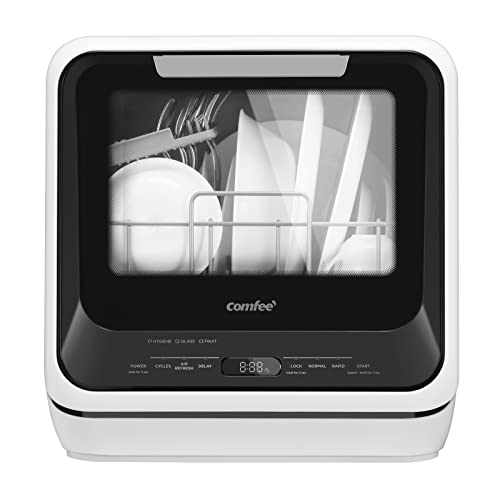
COMFEE’ Countertop Dishwasher with Water Tank — Best All-Rounder
COMFEE’ has quietly become the default name in tank-fed countertop washing, and this black model shows why. The 1.32-gallon reservoir — five litres in metric language — fills from a jug in a couple of trips, after which the machine wants nothing from your faucet. Park it on a counter, a sturdy cart or an RV worktop, aim the drain hose at a sink or container, and dinner’s aftermath is handled. For renters forbidden from touching plumbing, that independence is the whole ballgame.
Six programs cover the household spread, including a high-temperature option that suits households wanting extra hygiene confidence on boards and bottles, and the listing describes a 360-degree dual spray arrangement intended to reach the corners that single-arm mini machines miss. The COMFEE’ tank model presents itself as compact and energy efficient, pitched at apartments, dorms and RVs — precisely the homes where a countertop earns its surface.
Daily reality is a rhythm of fill, run, drain. Filling by jug sounds like a chore until you time it: under a minute, and it replaces the twenty minutes of hand washing the load would have taken. Keep the tank’s inlet accessible — park the machine so a jug pours without acrobatics — and descale occasionally in hard-water areas. Owners who build the fill into the post-dinner tidy, kettle in one hand and jug in the other, stop noticing the step entirely within a week.
- Fill: 1.32 gal built-in water tank, or inlet hose
- Programs: 6
- Spray: 360° dual spray per listing
- Extras: High-temp and air-dry functions per listing
- Finish: Black
Strengths
- Tank freedom lets it live almost anywhere with power and drainage.
- Six programs include high-temperature washing for hygiene-focused loads.
- Dual spray aims at the corner coverage small machines often lack.
Trade-offs
- Jug filling is a small daily ritual hookup models never ask for.
- Large dinner plates remain the format’s universal tight squeeze.
- Black finish shows pale water spots in hard-water homes.
Best for: renters, RVers and dorm dwellers who cannot touch the faucet. Not suited for: families washing full-size plates for five every night.

NOVETE Portable Countertop Dishwasher — Best for Baby Gear
The NOVETE aims at the smallest apartments and the newest parents simultaneously. Its five-litre built-in tank frees it from the faucet, an inlet hose is included for those who prefer a plumbed fill, and the five washing programs include a baby-care cycle — the feature that explains this machine’s following. Bottles, pump parts, teats and weaning bowls accumulate in a sink faster than any other category of washing-up, and a dedicated hot cycle that handles them in a batch is a genuine quality-of-life purchase at 3 a.m.
An air-dry function and an interior LED light round out a specification written by someone who has unloaded a mini dishwasher in a dark kitchenette while a baby slept nearby. The NOVETE keeps its footprint compact for the counters of small apartments, and the tank approach means it can live on a nursery-side surface or a utility cart rather than competing for the prized space beside the sink.
Households without babies should still read the specification generously: baby care is simply the hottest, most hygiene-minded program, useful for chopping boards after raw chicken and for the sick-room crockery of winter bugs. The trade is capacity — this is a small machine for small loads, and a couple who cooks elaborate dinners will run it twice. For its intended homes, that is a fair exchange for a machine that fits at all.
- Fill: 5L built-in tank, inlet hose included
- Programs: 5, including baby care
- Extras: Air-dry function, LED interior light
- Audience: Small apartments, young parents
- Drainage: Hose to sink or container
Strengths
- Baby-care cycle answers a real, exhausting daily need.
- Tank or hose filling gives two installation styles in one box.
- Air-dry and interior light show thoughtful small-space design.
Trade-offs
- Compact capacity means keen cooks will run two loads.
- Baby features are wasted on households long past that stage.
- Jug filling from the tank routine adds a step each cycle.
Best for: new parents in small flats drowning in bottles. Not suited for: households whose nightly load includes big pans and platters.

EUHOMY Countertop Dishwasher Portable — Quietest Claim
EUHOMY leads its listing with a number rarely foregrounded in this category: 40 dB, a stated operating level in library-whisper territory. Treat manufacturer noise figures as claims to compare rather than laboratory truth, but the intent is clear — this machine is pitched at people who live, work and sleep within earshot of their kitchen counter. Studio flats, bedsits and open-plan micro-apartments are its natural habitat.
Six programs include the expected normal, eco and quick settings plus baby care in a strong variant, a fruit mode and a dry cycle, with dual spray arms claiming 360-degree coverage for loads of thirty-plus items according to the listing. The EUHOMY also advertises a long ventilation mode — up to 73 hours per the listing — intended to keep a closed, loaded machine from smelling stale between runs, a thoughtful touch for people who load gradually across a day and wash at night.
No-hookup filling suits the same audience: no faucet adapter battles in a shared house, no hose across a landlord’s worktop. Judge this pick by your sensitivity to sound and smell rather than by raw capacity. If a humming box on the counter would irritate you into hand washing again, the quietest claim in the guide is worth more than an extra place setting.
- Fill: No-hookup tank filling
- Programs: 6, including baby care/strong and fruit
- Noise: 40 dB per listing
- Spray: Dual spray arms, 360° coverage per listing
- Extras: Dry cycle, extended ventilation per listing
Strengths
- Stated 40 dB level targets studio and bedsit living directly.
- Ventilation mode fights the stale smell of gradually loaded machines.
- Broad program menu includes fruit washing and a dry cycle.
Trade-offs
- Noise figure is a maker claim; placement on hollow counters amplifies any machine.
- Feature richness may exceed what a two-program household uses.
- Capacity still obeys the countertop format’s plate-size limits.
Best for: studio dwellers who sleep within metres of the kitchen. Not suited for: buyers who want the simplest possible control panel.

Hamilton Beach Counter Top Portable Dishwasher HBDW3208 — Best Established Name
Longevity is this pick’s argument. The HBDW3208 has served as the establishment countertop option for years: six place settings, a white cabinet, and a faucet-hookup design from a brand whose small appliances fill half the kitchens in North America. In a category crowded with young labels, there is comfort in a name with a service department older than its competitors.
The hookup design defines its home. Counters immediately beside a sink suit it perfectly; the hose run is short, drainage is direct, and there is no tank to fill or descale. That simplicity removes the jug ritual entirely, at the cost of the placement freedom tank models boast. For a permanent perch next to the tap — the way most countertop machines actually live — the trade is often invisible.
Six place settings in this older design swallow the daily ware of a couple who cook moderately: plates, bowls, mugs, glasses and a saucepan or two arranged with intent. White shows splashes, so wipe it when you wipe the counter. Choose the Hamilton Beach when you value a known badge and a proven layout over tank tricks, and when your counter’s geography already puts the machine beside its water supply.
- Capacity: 6 place settings
- Fill: Faucet hookup
- Finish: White
- Model: HBDW3208
- Brand: Hamilton Beach
Strengths
- Established brand with a long-running, understood design.
- Hookup filling removes tank filling and descaling chores.
- Six settings cover a moderate-cooking couple comfortably.
Trade-offs
- Must live beside the sink; no tank-fed placement freedom.
- White cabinet shows cooking splashes quickly.
- Feature list is plainer than the newest tank rivals.
Best for: permanent counter spots right beside the faucet. Not suited for: RVs or rooms where the sink is across the space.

Midea Countertop Dishwasher Portable 6 Place — Best for Quiet Apartments
Midea is one of the world’s largest appliance makers, and its countertop entry reads like a checklist written by a big manufacturer’s engineers: six place settings, Energy Star recognition, a cycle menu described as six-plus-two, and a stated 52 dB operating level in a silver cabinet aimed at apartments, dorms and RVs. Nothing here is exotic; everything is considered.
The extra cycles beyond the standard six give households with varied loads some tailoring — lighter work for a breakfast-only run, stronger treatment after a cooking session — without turning the panel into an aircraft cockpit. Energy Star status matters in this format because small machines often run twice a day; efficiency per cycle compounds into real money and real water across a year of double runs.
Silver is a shrewd finish for a countertop box: it sits comfortably beside stainless kettles and toasters, and it hides water spotting better than gloss black while looking less clinical than white. Pair the Midea with a habit of loading through the day and running the eco cycle overnight — subject to your building’s noise courtesies — and it becomes the invisible staff member of a small apartment.
- Capacity: 6 place settings
- Cycles: 6+2 per listing
- Noise: 52 dB per listing
- Certification: Energy Star
- Finish: Silver
Strengths
- Big-maker engineering with Energy Star efficiency for twice-daily use.
- Expanded cycle menu tailors washing to load size and soil.
- Silver finish blends with stainless small appliances.
Trade-offs
- Stated noise is higher than the EUHOMY’s headline claim.
- Silver shows fingerprints on the door between wipes.
- Still bound by countertop plate-diameter limits.
Best for: apartment couples running the machine once or twice daily. Not suited for: anyone needing tank filling far from a sink — confirm fill method on the listing.

HAVA Countertop Dishwasher with Water Softener — Best for Hard Water
Hard water is the countertop dishwasher’s silent enemy, and the HAVA is the only pick here that fights it at the source. A built-in water softener treats incoming water before it reaches your glasses, attacking the film, spotting and scale that make owners in limestone districts conclude their machine is broken when it is merely thirsty for softened water. If your kettle furs up monthly, this feature is not a luxury; it is the difference between a machine that delights and one that disappoints.
Around that softener, HAVA loads the specification generously: eight wash programs — the broadest menu in this guide — a five-litre built-in tank for hookup-free placement, a child lock for households with curious toddlers, and a delayed start so the cycle can run when electricity is cheaper or the household is out. Enhanced energy efficiency is claimed in the listing’s own words.
The softener needs salt, topped up occasionally, which is the honest price of the technology and familiar to any European dishwasher owner. Keep a bag beside the detergent and the chore becomes monthly and trivial. For soft-water households the HAVA’s advantage narrows to its program count and delay start; for hard-water homes it stands alone in this line-up, and those readers can stop shopping here.
- Fill: 5L built-in tank, no installation needed
- Programs: 8 wash programs
- Treatment: Built-in water softener
- Extras: Child lock, delayed start
- Efficiency: Enhanced energy efficiency per listing
Strengths
- Water softener directly answers hard-water filming and scale.
- Eight programs give the widest tailoring in this guide.
- Child lock and delayed start suit family flats and off-peak tariffs.
Trade-offs
- Softener salt is an ongoing consumable to remember.
- Feature depth is wasted in naturally soft-water districts.
- Rich menus mean a longer read of the manual on day one.
Best for: hard-water households tired of cloudy glasses. Not suited for: minimalists who want two buttons and no consumables.
How Do the Six Countertop Machines Compare?
| Pick | Fill method | Programs | Signature point |
|---|---|---|---|
| COMFEE’ with Water Tank | 1.32 gal tank | 6 | Dual spray, RV-ready |
| NOVETE Portable | 5L tank + hose | 5 | Baby care, air-dry |
| EUHOMY Portable | Tank, no hookup | 6 | 40 dB claim, ventilation |
| Hamilton Beach HBDW3208 | Faucet hookup | Standard set | 6 settings, established name |
| Midea 6 Place | See listing | 6+2 | Energy Star, 52 dB claim |
| HAVA with Softener | 5L tank | 8 | Water softener, child lock |
Let your water and your floor plan arbitrate. Tank machines free the counter’s geography; the hookup Hamilton Beach rewards a sink-side perch with zero filling chores. Hard water crowns the HAVA. A sleeping baby in the next room elevates the EUHOMY’s quiet claim and the NOVETE’s baby cycle for entirely different reasons. Capacity barely separates them, which is precisely why these secondary traits deserve the deciding vote.
Where Can a Countertop Dishwasher Actually Live?
Beside the sink is the postcard answer, but tank models widen the map considerably. A sturdy rolling cart turns the machine into a movable station that parks in a corner and docks for duty. A utility-room counter near a laundry sink works beautifully. In an RV, the machine often claims the end of the galley counter and drains into the sink it serves. The requirements never change — a level surface that can bear a full machine’s weight, a power outlet, and a drain path — but the rooms that satisfy them multiply once the faucet stops being compulsory.
Clearance above matters as much as footprint. These boxes open upward or forward depending on design, and the space under wall cabinets in older kitchens can be surprisingly low. Measure from counter to cabinet underside, compare with the machine’s height plus loading room for tall glasses, and check that the door’s swing does not collide with a kettle’s permanent home. A machine that fits on paper but cannot open fully in place will irritate daily.
Weight deserves respect too. A filled countertop dishwasher is a heavy object, and thin laminate shelves or folding tables are not its friends. Purpose-built appliance carts with locking casters exist for exactly this pairing, and owners who adopt one gain both mobility and a storage shelf beneath for detergent and the filling jug.
How Do You Fill, Drain and Vent One Without Drama?
Tank filling is a jug-and-patience exercise: most tanks take about five litres, added through a top inlet, often with a fill indicator or an audible beep at capacity. Keep the jug with the machine so the ritual stays in one place. Overfilling invites a puddle; underfilling invites a mid-cycle pause, so learn your tank’s signal during the first week and the step becomes automatic.
Drainage is simpler than newcomers fear. The drain hose rests in the sink, clipped or weighted so the pump’s pulses cannot walk it out onto the counter. Where no sink is near, a bucket on the floor accepts the outflow, provided you empty it promptly and never let the hose end sit submerged in dirty water. Venting needs nothing special: steam escapes around the door area at cycle end, so avoid parking heat-sensitive items directly in front of a running machine, and open the door a crack after the beep to let the load flash-dry.
Hookup models trade the jug for a faucet adapter ritual familiar from floor portables. Either way, the first three runs deserve supervision. Watch the hose connections, listen for the pump’s normal voice, and check the counter beneath afterwards. Confidence in a small appliance is earned in week one and spent for years.
What Fits Inside, Honestly?
Bring a tape measure to your plate cupboard. Dinner plates around ten inches usually stand comfortably; oversized eleven- and twelve-inch chargers may lean at angles that block spray or refuse entry altogether. Cereal bowls, pasta bowls, mugs and tumblers are the format’s daily bread. A medium saucepan fits if the day’s plates are few; a stockpot evicts everything else and should stay a sink item. Cutting boards ride vertically at the rack’s edge in many models, a small mercy for cooks.
Think in two-load strategy for cooking-heavy days: prep tools and boards first while dinner finishes, tableware after the meal. The machine’s speed on a quick cycle makes this rotation painless, and the kitchen never reaches the everything-at-once crisis that overwhelms a single load. Households that master the rotation stop wishing for a bigger machine surprisingly quickly.
Cutlery baskets in mini machines fill fast; a household of two generates a day’s forks and knives easily, but serving spoons and utensils crowd the basket’s cells. Many owners lay long utensils flat on the upper level where the design allows. Baby households should picture bottles disassembled — bottles, rings, teats and pump flanges consume rack geometry faster than plates do, which is why the NOVETE’s dedicated cycle pairs with a rack routine you will want to practise twice before trusting it at midnight.
Which Program Should You Run for Which Mess?
Normal handles the mixed daily load and will be your default within a week. Eco stretches time to save energy and water, ideal for overnight runs. Quick rescues the lunch things before dinner cooking begins. Baby care and high-temperature modes are hygiene tools: bottles, boards after raw meat, sick-room dishes. Fruit modes, where offered, rinse produce gently — a novelty for most, a delight for market-day households who wash berries and grapes in quantity.
Detergent dosing shrinks with the tub. A full-size pod can overdose a mini machine, foaming excessively and leaving film; many makers suggest powder or gel for dosing control, or pods formulated for small loads. Rinse aid earns its place because these machines dry largely by residual heat and door-open evaporation, and plastics — lunch boxes, bottle parts — hold water droplets stubbornly. A filled rinse-aid reservoir and a door cracked open at cycle end transform morning unloading.
How Do You Keep a Mini Machine Clean?
The filter at the tub floor is the whole secret. Rinse it weekly; a clogged filter recirculates yesterday’s lunch onto today’s glasses and is the first suspect in every disappointing load. Wipe the door seal, descale monthly in hard-water districts — or feed the HAVA’s softener its salt and let it prevent the scale instead — and run an empty hot cycle with a cleaner tablet when odours develop. Tank models add one more ritual: empty and dry the reservoir if the machine will sit unused, because standing water in a warm kitchen turns stale.
Exterior care is counter care: drips from jug filling and hose handling land on the worktop, so a mat under the machine protects wooden counters and catches the evidence before it spreads. Silicone appliance mats made for this footprint cost little and also damp the pump’s hum through hollow counters.
What Mistakes Do Countertop Buyers Repeat?
Measuring the counter’s width but not its height under cabinets is the classic opening error. Assuming the biggest plates fit is the second. The third is forgetting drainage: a tank machine still needs somewhere for dirty water to go, and discovering that mid-purchase is nobody’s plan. Buying for a household of five because the listing said six place settings also ends in tears — place settings count tableware, not the pans a family dinner generates.
A quieter mistake is parking the machine where filling it requires moving three other appliances. Convenience compounds: a dishwasher that is easy to reach gets run twice daily without thought, while one buried behind the air fryer becomes an expensive shelf. Choose the perch for the routine, not for the photograph, and the machine will pay its rent.
How Does a Countertop Model Compare With an Eighteen-Inch Portable?
Floor portables hold eight settings including full-size pans, roll to the sink and occupy floor rather than counter. Countertop models hold less, live on the work surface and can work from a tank. The choice is really about which surface your kitchen can spare. Counters crowded with cooking equipment argue for the rolling machine; floors pinched by a tiny footprint argue for surrendering counter length instead. Many households own both across a lifetime, graduating as homes change.
Cost of ownership is similar: detergent, rinse aid, descaler and time. The countertop’s advantage is commitment-free trial — it can serve a rental, then move to a holiday home, then help an elderly parent. That portability across life stages is why the format keeps growing even as built-in machines dominate new kitchens.
What About Noise in a Studio or Shared House?
Countertop machines sit at ear height on resonant surfaces, so placement shapes perceived noise more than specification sheets do. A mat underneath, a solid counter, and a load arranged so nothing rattles against the tub walls all lower the volume meaningfully. The EUHOMY’s stated 40 dB and the Midea’s stated 52 dB bracket the claims in this guide; in practice, either machine on a hollow counter above a cupboard drum will sound louder than its number, and either on stone will sound gentler.
Scheduling solves the rest. Run the machine before bed rather than after lights-out, or during the household’s noisy hours of cooking and television. In shared houses, a countertop dishwasher at supper time is background; the same machine at 2 a.m. is a neighbour dispute. Courtesy is a feature no manufacturer can install.
How Can Renters and Dorm Residents Stay Within the Rules?
Tank models are the diplomats of the appliance world: they alter nothing, connect to nothing permanent and leave in a box. Most dorm rules that ban cooking appliances target heat and fire risk; a dishwasher is a water appliance, but rules vary, so read the housing handbook before ordering rather than after confiscation. In rentals, the courtesy conversation is short — no plumbing changes, machine sits on a protective mat, tenant present during runs — and most landlords accept those terms easily.
Water discipline helps the case. Never run any dishwasher while out overnight, keep the drain hose secured, and place a leak alarm under the counter edge if the floor below is someone else’s ceiling. Demonstrating that level of care once tends to end the negotiation permanently.
Can a Countertop Dishwasher Help an Elderly Parent Living Alone?
This format quietly excels in that role. Standing at a sink through three washing-up sessions a day is tiring and, for unsteady hands, a breakage risk; a countertop machine turns the chore into loading at waist height and pressing a button. Tank models suit bungalows where the sink tap is a designer style no adapter fits. Choose simple controls, a door that opens without force, and a filter that lifts out in one piece, then set the machine up during a visit and run it together twice so the routine is familiar before you leave.
Safety details are easy to arrange. A mat beneath catches drips before they reach the floor, a leak alarm adds reassurance, and a machine placed at the counter’s end keeps the walking route to the kettle clear. Adult children often report the unexpected benefit: a parent who hosts grandchildren again because the clean-up no longer looms over the visit. Few appliances buy back sociability, but this one demonstrably can.
What About an Office Kitchenette or a Small Business?
Shared mugs are the hygiene weak point of every small workplace, and a countertop dishwasher is the cheapest credible fix. One lunchtime run handles the morning’s cups and the team’s lunch plates, ending the era of the communal sponge. Tank models avoid facilities paperwork because nothing is plumbed; the office manager fills a jug and the machine does the rest. Nominate a rota for loading and filter rinsing, because shared machines fail socially before they fail mechanically.
Client-facing spaces gain too. A salon, a small clinic waiting room or a showroom kitchenette can serve drinks in real crockery instead of disposables, washing between appointments on a quick cycle. The machine’s domestic scale is the point: commercial dishwashers are faster but demand installation, drainage and service contracts that a six-person office will never justify.
How Well Do These Machines Suit Holiday Lets and Second Homes?
Hosts love them for a selfish reason: guests wash dishes properly when a machine does the work, and checkout inspections stop finding greasy pans abandoned in ovens. A countertop unit needs no installation in a property where permanent changes complicate insurance, and it can be stored away in low season. Leave laminated-free, simple instructions — most guests need one line about filling the tank and one about which button starts the normal cycle.
For second homes visited monthly, the tank routine has a wrinkle: drain and dry the reservoir before leaving, run a short rinse cycle on arrival, and the machine stays fresh despite idle weeks. A machine in a holiday property also protects the good crockery a host actually cares about, because guests who would chip plates at a sink will happily load a rack instead.
What Should You Know About Steam, Cabinets and Counter Materials?
A dishwasher exhales warm, damp air, and the wall cabinet directly above a countertop machine lives in that weather. Painted wood tolerates it for years; raw or poorly sealed timber can swell at the edges, and delicate items stored in the cabinet’s front row — flour, spices, matches — prefer a drier home. Leave a hand’s breadth between machine and cabinet underside where you can, and open the door promptly at cycle end so the steam burst escapes into the room rather than condensing on the door’s own seal.
Counter materials shrug off the format with one exception: unsealed wooden worktops dislike standing drips from jug filling. A tray or mat solves it permanently. Stone, laminate and stainless counters need no thought at all beyond the weekly wipe they already receive. Heat is a non-issue; the cabinet of a countertop machine stays touchable throughout a cycle, which is why the format is allowed its perch among other appliances.
Is Buying a Used Countertop Dishwasher Sensible?
Sometimes — the format’s portability creates a healthy second-hand market of machines outgrown by growing families. Inspect three things in person: the filter and tub floor for the grey film of a neglected machine, the tank and hoses for scale and cracks, and the door seal for splits. Run a short cycle at the seller’s home if possible; a pump that sounds like gravel is negotiating its retirement. Factor in a new set of hoses and a deep descale as immediate costs.
Walk away from any machine with a musty smell that survives an open door, because odour baked into plastic and seals across years of closed storage rarely leaves. The better used buys are the boring ones: a clean tank, a present manual, a seller who can explain the baby cycle they used weekly. In this category, evidence of routine care is worth more than a recent purchase date.
How Does Jug Filling Become Effortless Ergonomics?
The fill is the format’s only daily manual task, so design it like a barista designs a station. Keep a dedicated jug that lives beside the machine, sized to fill the tank in two pours rather than four. Fill at the sink with the jug resting in the basin, not held under the tap at arm’s length, and carry it the short distance with two hands when full — five litres weighs five kilograms. Households that park the machine within two steps of the sink stop perceiving filling as a task at all.
Arthritic hands change the calculus toward lighter, more frequent pours or toward the hookup Hamilton Beach, which removes lifting entirely. Electric kettle owners sometimes fill from the kettle’s spout for precision. None of this is complicated, but it rewards thirty seconds of thought on day one, because the fill happens seven hundred times a year and tiny frictions multiply.
What Power and Water Do RV and Boat Owners Need to Plan?
Off-grid, the countertop dishwasher is a luxury with a budget. Each cycle draws heated water and pump power, so schedule runs when solar input is strong or the generator is already working for other loads. The tank’s five litres come from the same fresh supply you drink from, which argues for the eco program as the RV default. Drainage into the grey tank is standard practice; know its capacity before a wash-heavy day.
Motion matters underway: these machines belong to parked life. Run them at the dock or the campsite, never while travelling, and secure the unit against sliding with the same seriousness given to a microwave. Owners who respect those limits report the format transforms small-space travel cooking, because a proper meal no longer carries a proper washing-up penalty.
How Should a One-Person Household Load Differently?
Solo dwellers generate dishes in a slow trickle, and the temptation is to let the machine fill across two days. That works if you rinse nothing, close the door between additions, and choose a model whose ventilation or dry functions keep the waiting load from turning stale — one reason the EUHOMY’s long ventilation claim exists. Scrape each plate as it goes in, stand glasses so they cannot pool water, and the eventual cycle emerges clean despite the wait. Alternatively, embrace the small-load life: run a quick cycle nightly with the day’s handful of items and enjoy a permanently empty sink. Water use per quick cycle is modest enough that either rhythm is defensible; pick the one matching your patience.
Cooking for one also produces the format’s favourite loads — a single saucepan, a roasting tray for two portions, the bowl collection of a soup maker. These fit a countertop rack with room to spare, which is why solo cooks often report higher satisfaction than families who borrowed the format. The machine was designed around your exact arithmetic.
What Is the Sensible Way to Descale?
Scale builds where water heats, so the routine targets the heater and the spray paths. In hard-water areas without a softener, run a monthly empty cycle with a citric-acid descaler or the maker’s recommended product, and wipe the tank’s interior walls where a chalky tide line forms. Vinegar cycles are the folk alternative; use them sparingly and rinse afterwards, because seals prefer neutral chemistry. The visible test is the glass test: when a clean glass dries cloudy despite rinse aid, scale or softener salt — depending on your model — needs attention before the next load, not after a month of cloudy results.
Prevention beats the cure calendar. Households in the hardest districts should shortlist the HAVA first for exactly this reason; everyone else can treat descaling as a seasonal chore paired with changing the clocks, which makes it memorable without making it frequent.
How Do You Childproof and Pet-Proof a Countertop Machine?
A countertop box sits at toddler eye level, with buttons designed to be pressed. The HAVA’s child lock exists because small fingers find cancel buttons mid-cycle with unerring instinct. On models without a lock, position the machine so its panel faces away from the room’s traffic, and treat a mid-cycle cancellation as a restart rather than a disaster. Pets present a different audit: cats will sit on the warm cabinet, which is harmless, and dogs will investigate the drain hose, which is not — route hoses where chewing cannot reach them and never let a hose rest on the floor in a puddle’s reach.
Detergent storage is the serious item. Pods resemble sweets to small children, so keep them in a latched box on a high shelf, never in the pretty jar beside the machine that photographs favour. The machine itself, used with its door closed and its chemicals stored properly, is among the safer appliances in a family kitchen.
What Does a Week of Real Use Teach You?
Day one teaches placement: you will move the machine once, probably six inches, and that six inches will matter every day afterwards. Day two teaches loading order — glasses first to claim the safe spaces, plates next, the awkward bowl last into whatever geometry remains. By day four the filling jug has a home and the drain hose a habitual resting curve. By the weekend, the machine has a nickname or at least a definite article: the dishwasher, no longer the new dishwasher.
The second week teaches trust. You stop opening the door mid-cycle to check, stop pre-rinsing out of anxiety, and start believing the filter routine is enough. Loads come out right because you have learned your own dishes’ behaviour — which mug traps water, which pan needs the heavy program, which plastic lid warps if it migrates to the lower rack. That personal knowledge, not the specification sheet, is what ownership actually consists of, and it is why returns cluster in the first fortnight while five-year owners sound like evangelists.
How Should You Choose Between Two Finalists?
When the shortlist narrows to two, stop comparing features and start comparing Tuesdays. Picture the ordinary weeknight: who cooks, who loads, where the machine sits in the lamplight, what sound it makes under the television. The model that fits that picture with fewer apologies wins, even if its program count is lower. Then run the veto checks — tallest plate, cabinet clearance, tank or tap — because a veto ignored becomes a return arranged.
Finally, consider the household’s next two years. A baby arriving argues for the NOVETE’s cycle; a move to a hard-water town argues for the HAVA; a looming studio flat argues for the EUHOMY’s quiet claim. Appliances outlast circumstances less often than we pretend, so buy for the life that is visibly coming rather than the one in the brochure.
What Changes When Two Machines Compete for One Counter?
Small kitchens collect appliances like harbour walls collect boats, and the countertop dishwasher must negotiate territory with the kettle, the toaster and the coffee maker. The honest audit is frequency: the machine used twice daily outranks the gadget used twice weekly, and the loser of that contest should find a cupboard rather than forcing the dishwasher into an awkward corner where filling it becomes a juggling act. Some households rotate seasonally — the dishwasher reigns during term time, yields to preserving equipment in autumn — and a machine light enough to move makes that rotation painless.
Power outlets arbitrate too. A countertop dishwasher wants its own socket while it heats water; sharing a strip with a kettle invites tripped breakers at breakfast. Plan the electrical geography with the same care as the water geography and the morning routine stays peaceful.
Why Does the Second Month Feel Different From the First?
Novelty fades and infrastructure remains. By the second month nobody in the house comments on the machine, which is the highest compliment a utility can earn. The sink stays emptier, the counter routine has a shape, and guests stop offering to wash up because there is visibly nothing to wash. If a household reaches that point, the purchase has succeeded in the only currency that matters — unremarkable, daily relief — and the specification debates of purchase week will seem, in retrospect, charmingly over-serious.
What Is the Kindest Way to Retire an Old Machine?
When a countertop dishwasher finally retires, its portability gives it options a built-in never gets: a student relative, a community kitchen, a workshop tea station. Clean the filter, descale the tank, coil the hoses and pass it on with its manual and your one piece of hard-won advice. Appliances that gave years of evenings back deserve better than a kerb, and in this format the second life is usually out there waiting.
Final Recommendation
Match the machine to your water, your noise tolerance and your life stage. The COMFEE’ tank model is the balanced default for renters and RV owners; the NOVETE serves new parents best; the EUHOMY chases quiet for studio living; the Hamilton Beach rewards a sink-side perch with hookup simplicity; the Midea brings big-maker efficiency to daily apartment runs; and the HAVA stands alone where hard water films every glass. Any of them returns the twenty daily minutes the sink currently steals.
One last encouragement: the first week will involve one spilled jug, one badly stacked rack and one load rerun, and then the machine will simply belong to the household. Measure your tallest plate and your under-cabinet height before you choose, and let those two numbers veto ruthlessly — a countertop dishwasher that fits your plates and your counter will be loved daily, while a cleverer one that fits neither becomes the most efficient dust collector you ever bought.
Frequently Asked Questions
Do countertop dishwashers need plumbing?
Tank models do not: fill the reservoir with a jug and drain into a sink or bucket. Hookup models connect to a faucet with an adapter while they run. Several machines offer both routes, so check the listing for the model you choose.
Will my dinner plates fit?
Plates up to roughly ten inches usually stand well; larger chargers may not. Measure your biggest plate and compare it with the interior dimensions on the listing before ordering, because plate size is the most common reason these machines get returned.
How much water does a tank model hold?
Five litres, or about 1.32 gallons, is the common size among the tank picks here. That reservoir covers a full cycle, and refilling with a jug takes under a minute once the routine settles.
Can a countertop dishwasher handle baby bottles?
Yes, and models with a baby-care program — the NOVETE and the EUHOMY in this guide — run hotter cycles suited to bottles and pump parts. Disassemble everything so water reaches all surfaces, and keep bottle brushes for the narrowest pieces.
Where does the dirty water go?
Out of a drain hose into your sink, or into a bucket if the machine lives away from plumbing. Secure the hose so pump pulses cannot flick it out, and never leave its end submerged in the drained water.
Related Guides
All this cooking deserves proper ventilation, so look next at Best Ducted Range Hoods Under Cabinet, then move to the serene end of home upgrades in Best Luxury Freestanding Bathtubs, and finish with cold storage planning in Best Chest Freezers 5 Cu Feet.


