What's inside
- Key Takeaways
- Quick Picks
- How We Chose These Picks
- How Do the Six Compare at a Glance?
- How Should You Verify a Dishwasher’s Origin Before You Buy?
- What Does American Production Mean for Parts and Service?
- How Do You Read a Model Number and a Specification Sheet Like a Technician?
- What Does a Decade of Ownership Actually Cost Beyond the Purchase?
- How Should a Kitchen Renovation Sequence Around a Dishwasher Choice?
- Why Do Two Buyers Read the Same Origin Claim So Differently?
- What Should Landlords and Second-Home Owners Take From This Guide?
- How Does This Guide’s Grading Apply to Your Next Appliance Too?
- Which Mistakes Do Shoppers Make When Chasing Domestic Origin?
- How Do Room Surfaces Change the Sound Figures You Are Comparing?
- What Happens If Production Moves After You Buy?
- Final Recommendation
- Frequently Asked Questions
- Related Guides
As an Amazon Associate I earn from qualifying purchases. This post may contain affiliate links at no extra cost to you.
cottageverdict.com is reader-supported. When you buy through links on our site, we may earn an affiliate commission.
Where to buy: each model below links to its Amazon listing, where the country of origin statement for that specific configuration can be checked alongside delivery and installation details — and checking it matters more in this guide than in any other we publish. Shoppers hunting the best american made dishwashers deserve a straight account of what “American made” can and cannot promise, so this page separates the manufacturers whose United States production we can state plainly from the brands where the honest answer depends on the individual model in front of you.
Here is that account, without varnish. Bosch builds its dishwashers for the North American market in New Bern, North Carolina, and we say so confidently for both Bosch picks below. GE Appliances manufactures in Louisville, Kentucky, at the Appliance Park complex, and we say so confidently for both GE picks below. Kenmore is an American brand with a long domestic retail history, but its appliances are produced through manufacturing partners and assembly arrangements that vary by model and production run, so for the two Kenmore picks we advise verifying the country of origin on the specific listing before treating origin as settled. That three-tier honesty is the spine of this guide; a page that blurred it would be marketing, not guidance.
Origin, though, is only the first filter. A dishwasher still has to wash, dry, fit, and stay quiet enough for your rooms, and the six machines here spread across 39 to 55 dBA, stainless and hybrid tubs, hidden and visible controls. Read the provenance for each pick carefully, then judge the appliance on the same practical grounds you would apply to any purchase — because a factory address is a reason to shortlist a machine, never a substitute for the machine suiting your kitchen.
Key Takeaways
- Bosch dishwashers for this market are built in New Bern, North Carolina — stated confidently for both Bosch picks in this guide.
- GE Appliances dishwashers come from Louisville, Kentucky, where the company runs its long-established Appliance Park production.
- Kenmore is an American brand whose assembly varies by model, so confirm the origin printed on the specific listing you order.
- Sound runs from 39 dBA for the Bosch Benchmark to 55 dBA for the GE front-control model, a gap your room layout should arbitrate.
- The two Kenmore picks are the same hybrid tub design in stainless and black finishes, letting colour rather than specification drive that choice.
- Stainless tubs appear on the Bosch pair and the GE top-control pick; hybrid tubs serve the Kenmore pair and should be judged on drying habits.
Quick Picks
| Pick | Badge | Why it earns its place |
|---|---|---|
| Bosch Benchmark Series 24 Inch Dishwasher | North Carolina Flagship | New Bern production paired with a 39 dBA stainless tub for the quietest American-built option here. |
| Bosch 800 Series 24 Inch Dishwasher | North Carolina All-Rounder | The same New Bern line in a pocket-handle model running at 42 dBA for everyday family service. |
| GE Top-Control Dishwasher Stainless Steel Tub | Louisville Stainless Pick | Kentucky production with a stainless tub and hidden controls for a calm, modern front. |
| GE 24 Inch Built-in Tall Tub Front Control Dishwasher | Louisville Practical Pick | Front controls, Sanitize, and Dry Boost from Louisville in a black tall tub format at 55 dBA. |
| Kenmore 24 Inch Hybrid Tub Dishwasher Stainless | Adjustable Rack Choice | An American brand’s flexible MoreSpace rack in fingerprint resistant stainless; verify origin per listing. |
| Kenmore 24 Inch Hybrid Tub Dishwasher Black | Black Finish Choice | The Kenmore hybrid design in black with UltraWash and high-temperature options; verify origin per listing. |
How We Chose These Picks
Provenance came first in this selection, and it was graded rather than assumed. Brands earned a confident origin statement only where the manufacturing story is established and specific: a named plant, a named city, a production line associated with the product family. Where the picture was a brand-level story with model-level variation, we kept the pick — Kenmore’s machines are legitimately part of an American appliance conversation — but attached the verification advice directly to the pick rather than burying it in a footnote. Readers should never have to guess which kind of claim they are reading.
After provenance, ordinary dishwasher virtues decided the order. We weighed published sound levels, tub construction, rack flexibility, drying and sanitising features named by the manufacturer, and control layout, exactly as we would for any buyer. The result deliberately mixes flagships and workhorses, because the audience for American manufacturing includes both the design-led remodeler and the landlord replacing a unit in a duplex. Neither should have to choose between their origin preference and a machine that fits the job.
A word on what we did not do: we did not treat a brand’s headquarters, history, or marketing language as proof of where a specific dishwasher was assembled, and we did not import origin claims from one model to its siblings. Assembly can shift between plants and years. The confident statements in this guide are narrow on purpose, attached to the brands and product families where the ground is firm, and the hedged statements are equally deliberate. That discipline is the difference between a buying guide and a flag with a price tag.

Bosch Benchmark Series 24 Inch Dishwasher — North Carolina Flagship
The provenance first, stated plainly: Bosch produces its dishwashers for North America in New Bern, North Carolina, a plant that has anchored the brand’s presence in this market for decades. Buyers who care about domestic manufacturing can treat that as settled ground. What arrives from New Bern in Benchmark form is the top of the range — a stainless steel tall tub, top controls hidden along the door edge, and a 39 dBA operating level that remains the quietest figure anywhere in this guide. The combination matters: this is not a token domestic pick included for its postcode, but a genuinely flagship appliance that happens to be built in North Carolina.
Living with 39 dBA changes how a kitchen gets used. The cycle can run through a dinner party without becoming part of the entertainment, through a baby’s afternoon nap in the next room, through a film night in an open-plan layout. The stainless tub supports the drying side of the bargain, condensing moisture against its walls so glasses and ceramics emerge ready for the cupboard. Racks follow Bosch’s tall tub logic, swallowing dinner plates below and giving bowls and glasses an orderly upper tier, with the door front left as an unbroken stainless sheet that suits contemporary cabinetry.
The flagship tier asks flagship commitment, and the honest question is whether your household will collect the value. A closed kitchen with a timer running loads at 2 a.m. uses little of that silence. An open-plan home uses it every single evening. We place the Benchmark first because its combination of verified North Carolina production and class-leading quiet is unique on this page, but the 800 Series directly below exists precisely for buyers who want the same factory story at a gentler tier.
Service thinking also favours the established plant. A long-running production site implies a mature parts pipeline and technicians who know the product family deeply, which is the unglamorous side of buying domestic: support tends to live near where manufacturing knowledge lives. For a machine expected to serve a decade of family dinners, that ecosystem is part of what the premium purchases.
- Origin: built in New Bern, North Carolina
- Tub: full stainless steel, tall tub layout
- Sound level: 39 dBA
- Controls: top control, hidden panel
Strengths
- Confident domestic provenance from an established North Carolina plant.
- Quietest operation in this guide for shared living spaces.
- Stainless tub aids drying and resists long-term odours.
Trade-offs
- Highest tier here, priced by flagship logic.
- Hidden controls require opening the door to check progress.
- Silence premium is wasted on kitchens sealed away from living areas.
Best for: origin-conscious buyers in open-plan homes who run cycles while rooms are occupied. Not suited for: budget-led replacements in closed kitchens.

Bosch 800 Series 24 Inch Dishwasher — North Carolina All-Rounder
Same city, same confidence: the 800 Series comes off the New Bern, North Carolina production story as surely as the Benchmark above it. What changes is the tier and the detailing. A pocket handle replaces the flagship’s presentation, the rating settles at 42 dBA, and the stainless tall tub remains — which is to say, the attributes most owners touch daily survive the step down intact. For the majority of American-made shoppers, this is the model where the reasoning ends: domestic production, stainless interior, near-flagship quiet, and a front that sits flush with flat-panel cabinetry.
That pocket handle is more than a styling note. In galley kitchens and tight working triangles, a recessed grip removes the bar that catches aprons and hips, and it lets the dishwasher read as a calm stainless rectangle within a run of modern cabinets. Top controls complete the disappearing act. Inside, the machine handles the standard family rotation with the composure Bosch buyers pay for — breakfast bowls, the Sunday casserole, water bottles multiplying in the cupboard — without exotic systems to learn or maintain.
Comparing the two Bosch picks is really comparing how much silence your floor plan can use. Three decibels separate them on paper; in a kitchen with a door, that difference evaporates, while in a studio-style great room it remains audible across an evening. Buy the Benchmark for the room that hears everything. Buy this one for every other room, and put the difference toward the installation done properly, the rinse aid stocked, and the filter cleaned on schedule — the unglamorous investments that decide how any dishwasher ages.
There is also a fleet logic to the 800 Series: it is the Bosch tier most likely to be matched by neighbours, colleagues, and reviewers with years of ownership to report. A buyer who values a deep pool of lived experience around their exact model, alongside the New Bern origin, will find this the most documented path into American-built dishwashing on the page.
- Origin: built in New Bern, North Carolina
- Tub: full stainless steel, tall tub layout
- Sound level: 42 dBA
- Handle: recessed pocket handle, top controls
Strengths
- Verified North Carolina production at a more approachable tier than the flagship.
- Flush pocket handle suits narrow kitchens and modern cabinetry runs.
- Stainless tub and low sound cover the daily virtues without weakness.
Trade-offs
- Marginally more audible than the Benchmark in open-plan rooms.
- No third rack for cutlery-heavy households.
- Still premium territory beside hybrid tub alternatives.
Best for: most buyers wanting American-built Bosch quality for daily family use. Not suited for: shoppers needing a third rack or visible front controls.

GE Top-Control Dishwasher Stainless Steel Tub — Louisville Stainless Pick
GE Appliances manufactures in Louisville, Kentucky, where Appliance Park has produced household machines for generations, and this top-control dishwasher carries that origin confidently. For buyers whose domestic preference runs toward the Louisville story — one of the great American appliance manufacturing sites — this is the GE pick that pairs provenance with a stainless steel tub and a hidden control panel. The combination gives GE loyalists a modern, calm-fronted machine without leaving the brand’s Kentucky heartland.
The stainless tub is the specification to underline. It brings the condensation drying and odour resistance that hybrid interiors work harder to match, and it signals the tier GE intends here: not the rental-grade workhorse, but the owner-occupier machine. Top controls keep the door face clean, matching the contemporary kitchen language of the Bosch pair while speaking it with a Louisville accent. Rack space follows the tall tub pattern, ready for the family dinner service and the pans behind it.
Because the listing for this model is comparatively restrained in its headline claims, we are equally restrained in ours: no decibel figure is headlined in the API title, so we will not invent one, and buyers for whom a precise sound number is decisive should confirm it on the listing itself. What can be said from the specification is that the format, tub, and origin align into a coherent proposition — Kentucky-built, stainless inside, discreet outside — aimed at households replacing a mid-tier machine with something they intend to keep.
GE’s service footprint is the supporting argument. Appliance Park’s scale sustains a national network of parts and technicians familiar with these platforms, and for many buyers — particularly outside major metros — that familiarity is the practical face of buying American. A machine that local engineers know, with parts that local suppliers stock, shortens every future repair by days.
- Origin: manufactured in Louisville, Kentucky
- Tub: stainless steel
- Controls: top control, hidden panel
- Format: 24 inch built-in
Strengths
- Confident Louisville production from a landmark American appliance site.
- Stainless tub supports drying performance and long service.
- Deep national service and parts familiarity behind the platform.
Trade-offs
- No headline decibel figure in the listing title to compare directly.
- Hidden controls will not suit buyers wanting at-a-glance status.
- Specification is restrained beside feature-led rivals in this guide.
Best for: GE loyalists wanting Kentucky production with a stainless interior. Not suited for: buyers who need a published sound figure before deciding.

GE 24 Inch Built-in Tall Tub Front Control Dishwasher — Louisville Practical Pick
The second Louisville entry takes the practical road: front controls you can read from across the room, a tall tub in a black finish, and two named features — Sanitize and Dry Boost — that describe exactly what they do. The model code in the listing is GDF450PGRBB, and its rating is 55 dBA, the most audible figure in this guide. We will not dress that up. This is a machine for kitchens with doors, households that run the wash while out, and buyers who rank clarity and cleaning options above hush.
Sanitize earns its keep in specific, real situations: baby bottles and cutting boards during a household stomach bug, canning jars in preserving season, the water bottles that live in gym bags. A high-temperature final stage gives those loads a treatment the normal cycle does not claim. Dry Boost attacks the familiar plastic problem from the heated side, extending drying effort so containers come out readier for the cupboard. Together they describe a machine specified for families with grubby, practical loads rather than dinner-party stemware.
Front controls in black make this the easiest model here to hand to a guest, a tenant, or a teenager: the settings are visible, the interface is honest, and nothing hides behind a door edge. The tall tub swallows the family service plus pans, and GE’s Louisville production and service network stand behind it with the same confidence as the stainless pick above. Choose it when your priorities are legibility, sanitising power, and an origin you can state in one sentence — Louisville, Kentucky — and when its voice in the room is a price your floor plan can pay.
Black as a finish deserves its honest sentence too. It hides the smudges that stainless advertises, pairs with the many kitchens still running black appliance suites, and avoids the premium attached to steel fronts. In a kitchen being refreshed gradually rather than remodelled at once, that continuity can be the difference between a machine that blends in today and one that waits for a renovation that may take years.
- Origin: manufactured in Louisville, Kentucky
- Model: GDF450PGRBB, tall tub, black finish
- Sound level: 55 dBA
- Features: Sanitize cycle and Dry Boost, front controls
Strengths
- Kentucky production with a service network to match.
- Sanitize stage serves families, preserving season, and illness weeks.
- Visible controls make operation obvious for every household member.
Trade-offs
- 55 dBA will be heard clearly in adjoining living space.
- Black finish will not match stainless appliance suites.
- Dry Boost spends extra energy to solve the plastics problem.
Best for: practical families wanting Louisville origin, visible controls, and a sanitize option. Not suited for: open-plan homes sensitive to appliance noise.

Kenmore 24 Inch Hybrid Tub Dishwasher Stainless — Adjustable Rack Choice
Now the careful paragraph, because Kenmore requires one. Kenmore is an American brand, sold in American homes for generations, and its dishwashers are produced through manufacturing arrangements that vary by model — which means we will not state a plant or a city for this machine, and you should check the country of origin printed on this specific listing before counting origin as a settled reason to buy. That is not a dismissal of the pick. It is the same standard applied across this page: confident where the ground is firm, explicit where it is not.
On appliance merits, the case rests on the MoreSpace adjustable rack. Rack geometry decides whether tall stemware, stockpots, and serving platters load without a wrestling match, and an adjustable upper rack answers the holiday-meal problem that fixed racks lose. The hybrid tub and 54 dBA rating frame the compromises plainly: drying leans on habit — crack the door, unload in order — and the machine will be audible in the room while it works. The fingerprint resistant stainless front, meanwhile, is a genuine daily mercy in a house with children.
Who should choose it? The buyer who likes Kenmore, values the rack, has a kitchen with a door, and is content to verify origin on the listing rather than needing a factory story told to them. That buyer gets a flexible, familiar machine from a brand American service technicians have known for decades. The buyer who needs guaranteed domestic assembly as the headline reason should stay with the Bosch or GE picks above, where this guide can make the promise without a caveat.
There is a broader honesty worth stating once: model-level variation is normal across the whole appliance industry, not a Kenmore peculiarity. Plants change, production shifts, and listings update. The habit this pick teaches — read the origin line on the exact unit you are ordering — protects you on every future appliance purchase, whichever badge it wears.
- Brand: Kenmore, an American brand; assembly varies by model
- Origin advice: verify country of origin on this specific listing
- Tub: hybrid construction, adjustable MoreSpace rack
- Sound level: 54 dBA, fingerprint resistant stainless
Strengths
- Adjustable rack handles tall and awkward loads rivals refuse.
- Fingerprint resistant finish suits busy family kitchens.
- Familiar brand with generations of service recognition.
Trade-offs
- Origin cannot be stated as confidently as the Bosch or GE picks.
- 54 dBA is plainly audible during a cycle.
- Hybrid tub asks more of your drying routine than stainless.
Best for: Kenmore households prioritising rack flexibility and willing to verify origin per listing. Not suited for: buyers needing a guaranteed plant and city before purchase.
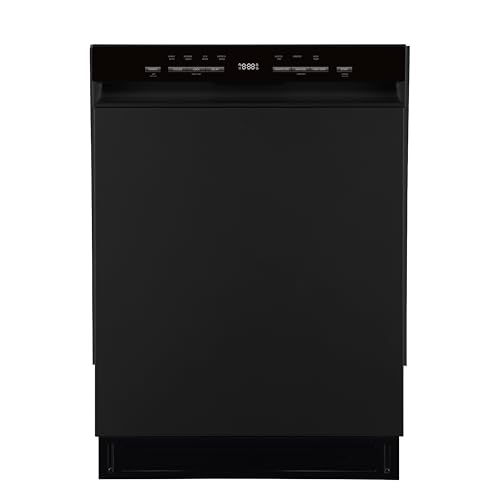
Kenmore 24 Inch Hybrid Tub Dishwasher Black — Black Finish Choice
Let us be direct about what this pick is: the same Kenmore hybrid tub dishwasher as the stainless model above, finished in black. Same 54 dBA rating, same MoreSpace adjustable rack concept, same class of wash options — the wider listing family names UltraWash filtration plus high-temperature and SmartWash-style sensing among its tools. Saying so plainly respects your intelligence and your time; colour is a legitimate reason to choose between them, and it is the only reason, so the decision can be made on your kitchen’s palette rather than on imaginary specification differences.
The origin guidance repeats without alteration, because it must: Kenmore is an American brand whose assembly arrangements vary by model, so check the country of origin on this listing’s own statement before treating provenance as decided. If the listing confirms what you hoped, the black finish brings practical virtues — it shrugs off the fingerprints and smears that stainless displays, and it completes black appliance suites that are still common in American kitchens, particularly in rentals and gradual refreshes where one steel appliance would strand the room between eras.
Functionally, everything said about loading flexibility applies here unchanged. The adjustable rack remains the reason this design earns two slots in an origin-focused guide at all: it solves the geometric problem — tall glasses above, platters below, the roasting pan at an angle — that no cycle programme can fix. The hybrid tub’s drying manners and the 54 dBA voice are equally unchanged, so the same floor-plan test applies. Door between kitchen and sofa? Proceed happily. Open-plan great room? The Bosch and GE sections above are your territory.
Choosing between the two Kenmore finishes, then, is refreshingly simple. Match the suite you have or the suite you are building toward, confirm the origin line on the listing, and order with a clear conscience about what you bought and why. In a guide built on saying exactly what can be claimed, a pick whose whole story can be told honestly in a paragraph is a fitting place to end the detailed reviews.
- Brand: Kenmore, an American brand; assembly varies by model
- Origin advice: verify country of origin on this specific listing
- Finish: black, hybrid tub, adjustable rack
- Sound level: 54 dBA, UltraWash filtration family
Strengths
- Black finish hides smudges and completes existing black suites.
- Adjustable rack flexibility matches the stainless version.
- Straightforward specification with no learning curve.
Trade-offs
- Origin requires the same per-listing verification as its twin.
- Audible 54 dBA operation in shared spaces.
- Black narrows future matching if you later switch to steel.
Best for: black-suite kitchens wanting Kenmore flexibility with origin checked at listing level. Not suited for: buyers wanting guaranteed assembly origin or a quiet cycle.
How Do the Six Compare at a Glance?
| Model | Origin position | Sound | Standout |
|---|---|---|---|
| Bosch Benchmark Series 24 Inch Dishwasher | New Bern, NC | 39 dBA | Flagship quiet, stainless tub |
| Bosch 800 Series 24 Inch Dishwasher | New Bern, NC | 42 dBA | Pocket handle all-rounder |
| GE Top-Control Dishwasher Stainless Steel Tub | Louisville, KY | See listing | Stainless tub, hidden controls |
| GE 24 Inch Built-in Tall Tub Front Control Dishwasher | Louisville, KY | 55 dBA | Sanitize and Dry Boost |
| Kenmore 24 Inch Hybrid Tub Dishwasher Stainless | Verify per listing | 54 dBA | Adjustable rack, steel finish |
| Kenmore 24 Inch Hybrid Tub Dishwasher Black | Verify per listing | 54 dBA | Adjustable rack, black finish |
How Should You Verify a Dishwasher’s Origin Before You Buy?
Begin on the listing itself, looking for the country of origin field in the product information or specifications area rather than in marketing copy. That field describes the specific model and configuration being sold, which is exactly the granularity that matters. If the field is absent or ambiguous, the manufacturer’s own product page for the full model number is the next stop, followed by the specification sheet, which commonly carries origin and compliance data in its fine print. Photograph or save what you find at purchase time; if a question ever arises later, the record you kept beats a listing that may have been edited since.
Understand the vocabulary while you search. “Made in USA” carries a strict regulatory meaning about domestic content and transformation, while “assembled in USA” and “built in” language describe final assembly and may coexist with globally sourced components — compressors, electronics, and pumps travel the world in nearly every brand’s supply chain, including the confident picks in this guide. Neither phrase is a trick, but they are not synonyms, and a buyer who knows the difference reads listings with clearer eyes. What this guide claims for Bosch and GE is production at named American plants for these dishwasher families; what it advises for Kenmore is checking which claim the specific listing makes.
Finally, keep origin in proportion. It is a legitimate preference — supporting domestic plants, shortening supply lines, aligning with service networks — and it deserves accurate information. It does not predict whether a rack fits your platters or whether 55 dBA will annoy your household. Verify the origin, then run the ordinary appliance tests: dimensions, sound against your floor plan, tub against your drying habits, racks against your dishes. A purchase that survives both examinations is one you will still be pleased with in year six.
What Does American Production Mean for Parts and Service?
The practical dividend of a domestic plant is rarely the flag; it is the ecosystem. Models produced in volume at New Bern or Louisville sit at the centre of a deep bench of trained technicians, stocked parts distributors, and accumulated repair knowledge. When a drain pump fails in year seven, the question is never whether the part exists in the world but how many days stand between the failure and the fix — and for high-volume domestically produced platforms, the answer is usually short. Rural buyers feel this most, because the travelling technician who serves their county knows the common platforms by heart.
Warranty handling follows similar logic. Established domestic lines tend to have mature documentation, clear model and serial records, and service procedures every authorised agent has performed before. None of this guarantees a flawless decade — pumps and boards fail on every badge — but it tilts the ownership experience toward repair rather than replacement, which is both the economical and the sustainable outcome. When you register your machine, record the model and serial numbers somewhere retrievable, and keep the origin documentation you verified at purchase with them; future you, mid-repair, will be grateful for the folder.
How Do You Read a Model Number and a Specification Sheet Like a Technician?
The model number is the machine’s true name, and learning to use it separates confident buyers from hopeful ones. Marketing names stay constant while configurations drift, but the model code — GDF450PGRBB on the GE front-control pick, for instance — pins the exact variant: its finish, its feature set, its production family. When you verify origin, order a part, or register a warranty, the model number is the key that makes every database answer about your machine rather than about its cousins. Photograph the rating plate inside the door edge on delivery day and keep the image with your household records.
Specification sheets reward the same literal reading. Dimensions there are stated to fractions that matter at installation: overall height with feet at their lowest, depth with and without the handle, the cut-out the cabinet must provide. Sound figures, where published, come from standardised testing, which makes them comparable across brands even though your kitchen’s surfaces will shift the lived result a little. Place setting counts follow an agreed test load, useful for ranking machines against each other and useless as a prediction of your casserole’s fate. Read the sheet for what it is — a comparison instrument — and the listing’s prose for what it is not.
One more document deserves a download before purchase: the installation manual. It states the electrical and plumbing expectations in the manufacturer’s own words, including drain routing, water pressure range, and clearance demands that sales pages summarise or skip. Twenty minutes with that manual, tape measure in hand, has saved more buyers from delivery-day failure than any review ever written, and it costs nothing but attention.
What Does a Decade of Ownership Actually Cost Beyond the Purchase?
The purchase is the loudest number in a dishwasher’s life and rarely the largest influence on satisfaction. Water and energy per cycle are modest for modern machines, yet multiplied across a decade of family service they form a real sum, which is why cycle discipline — full loads, normal programmes as the default, heavy reserved for genuine need — is an economic habit as much as an environmental one. Detergent and rinse aid are the consumables owners actually feel, and both reward correct dosing: pods used on half loads and powder poured by optimism both tax the household quietly every week.
Repairs form the decade’s second ledger. A pump, a latch, a control board — each is a few hundred in parts and labour terms on any badge, and the domestic platforms in this guide tilt those events toward shorter, simpler fixes because parts and knowledge are close at hand. The owner’s contribution is maintenance that prevents the preventable: filter rinses, seal wipes, an occasional hot empty cycle, prompt attention to a new noise while it is still a spoon in the wrong place rather than a bearing announcing itself. Machines rarely die of age alone; they die of accumulated neglect meeting one unlucky component.
Set against that ledger, the tier decision clarifies. Paying more for a stainless tub and a quieter drive buys daily comfort and a tub that will not be the reason for replacement, which spreads its cost across thousands of pleasant cycles. Paying less for a hybrid workhorse and maintaining it faithfully can produce a decade just as satisfactory in a kitchen that does not hear the machine. Both are rational. The irrational purchase is the one made on a single headline — origin included — while ignoring the arithmetic of the years that follow.
How Should a Kitchen Renovation Sequence Around a Dishwasher Choice?
Renovators often meet the dishwasher last, when cabinets are ordered and the budget is tired, yet the machine repays earlier attention. Decide the control style before the cabinet design is fixed, because a slab-front top-control model and a visible front-control panel ask different things of the surrounding cabinetry’s rhythm. Confirm the water and waste positions while walls are open, since moving a supply line costs little during a renovation and a great deal after the cabinets land. If panel-ready ambitions exist, raise them before ordering anything in this guide, as these are finished-front machines whose looks are part of their proposition.
Flooring is the hidden variable. A dishwasher installed before a floor is raised can find itself trapped behind the new surface, unable to slide out for service without lifting boards — a misery owners discover at the first pump failure. Coordinate heights with your flooring contractor so the machine can be levelled today and removed in year seven. Likewise, leave the shutoff valve accessible and the electrical junction reachable; the installer and the future technician are both you, in a sense, at different dates.
Sequence the purchase itself near the renovation’s end if storage is tight, but make the decision early, because delivery windows and installation bookings bunch up in renovation season. When the machine finally slides in, run the commissioning habits this guide recommends — every programme once, results inspected in daylight, filter and rinse aid baselined — and the renovated kitchen begins its life calibrated rather than merely new.
Why Do Two Buyers Read the Same Origin Claim So Differently?
Origin means different things to different households, and naming your own meaning sharpens the decision. For some buyers it is employment — a preference for supporting the machinists, assemblers, and engineers of New Bern or Louisville, towns where appliance plants are anchor employers and the work is skilled. For others it is logistics: shorter supply lines feel sturdier in a world that has watched shipping seize up, and a part that travels from a domestic warehouse arrives on a different clock than one crossing an ocean. For a third group it is service confidence, the belief — broadly supported by the depth of these platforms — that a domestically centred product family will be understood by the technician who eventually knocks on the door.
None of those meanings is the only correct one, and none obliges a particular pick. The employment-minded buyer and the service-minded buyer may both land on the Bosch 800 Series for entirely different reasons, while a logistics-minded buyer in a black-suite kitchen may verify the Kenmore listing, find its statement satisfactory, and order the black model with a clear head. What this guide insists on is only that the claim under your reason be real: checked at the right granularity, for the right model, in the manufacturer’s or listing’s own words. Preference built on verified fact ages well; preference built on a vague flag on a box does not.
If your household argues the question — one partner origin-first, the other fit-first — the resolution usually sits in the middle of this page. The all-rounder picks exist precisely where the two values overlap, offering confident provenance inside machines that also happen to suit ordinary kitchens on ordinary evidence. Start the argument there and it tends to end quickly, which is its own domestic harmony worth manufacturing.
What Should Landlords and Second-Home Owners Take From This Guide?
Rental and second-home kitchens rewrite the priorities without changing the facts. Durability and legibility outrank quiet and finish, because tenants will not read manuals and a holiday kitchen’s machine may sit idle for weeks between uses. The GE front-control pick speaks this language fluently: visible settings any guest can operate, a sanitize cycle for turnover cleans, Louisville service depth when something fails mid-season. The Kenmore pair, with origin verified per listing, offer rack flexibility for the unpredictable dish collections rentals accumulate.
Idle periods carry their own maintenance note. A machine left unused benefits from the door left ajar so seals dry, and from a short cycle run on arrival before the first real load, flushing the system and confirming all is well before guests depend on it. Landlords should leave the model and serial numbers, the filter-cleaning rhythm, and the local service contact in the property’s house book; a tenant who can clean a filter is a work order that never gets filed. Origin, for this audience, is mostly a service story — and on that measure the domestically centred platforms in this guide make their case without a single slogan.
How Does This Guide’s Grading Apply to Your Next Appliance Too?
The three-tier habit used here — confident claim, hedged claim, verify-it-yourself claim — travels well beyond dishwashers, and adopting it may be the most durable thing this page gives you. Laundry pairs, ranges, and refrigerators all carry the same marketing weather: famous domestic plants attached to some families, partner production attached to others, and listings that update as arrangements shift. The shopper who asks, of every model, “which tier is this claim?” will read the entire appliance market more accurately than the shopper who memorises brand nationalities, because brands are portfolios and models are facts.
Keep the evidence hierarchy in the same order used here. A named plant with a named product family outranks a brand history page; a listing’s origin field outranks a headline; a specification sheet outranks a slogan. When sources conflict, believe the most specific one and note the date you checked it, because production is a living arrangement and last year’s answer can expire quietly. That is not cynicism — it is the same respect for accuracy that makes the confident claims on this page worth trusting. New Bern and Louisville earn their certainty by being checkable, and the Kenmore advice earns its place by refusing to borrow that certainty.
Bring the habit to the store or the listing with a short script: model number first, origin field second, dimensions and sound third, rack or capacity fit fourth. Four questions, in that order, will carry you through almost any appliance purchase with your preferences intact and your facts straight — which is, in the end, the only kind of patriotic shopping that actually supports the plants it celebrates, since factories are sustained by buyers who choose them on purpose rather than by accident.
Which Mistakes Do Shoppers Make When Chasing Domestic Origin?
The first mistake is treating a brand’s nationality as a model’s birthplace. Headquarters, heritage, and even a famous American plant do not transfer automatically to every product wearing the badge, which is why this guide grades its claims instead of inheriting them. The second mistake is the mirror image: dismissing a good machine because its origin story is hedged. The Kenmore picks here are honest appliances with a genuinely useful rack; a buyer who verifies the listing and likes what it says has made a sound purchase, not a compromised one.
Third, shoppers let origin crowd out fit. A Louisville-built machine at 55 dBA placed in a studio apartment is a daily irritation wearing a virtuous label, while the quiet New Bern flagship in the same room would have been the wiser patriotism. Fourth comes neglecting the unglamorous installation and maintenance that decide lifespan regardless of birthplace: level feet, a correct drain loop, a cleaned filter. Fifth, buyers forget that listings change — a model verified today deserves a fresh glance if you reorder next year, because production arrangements are living things. Keep the verification habit and the fit habit together, and origin shopping becomes what it should be: informed, calm, and final.
How Do Room Surfaces Change the Sound Figures You Are Comparing?
Published decibel figures are measured under standard conditions, and your kitchen is not standard. Hard surfaces — tile, stone counters, glass cabinet fronts — reflect sound and can make a mid-forties machine feel present in a way the number alone would not predict, while rugs, curtains, and timber soften the same machine into the background. This is why two owners of identical dishwashers report different experiences, and why the safest reading of this guide’s spread — 39 at the hushed end, 54 and 55 at the forthright end — is as a ranking rather than a promise. The Benchmark will be the quietest in your room too; how quiet in absolute terms depends on the room it lands in.
Practical mitigations exist for the louder end. Running the cycle when the household is out or asleep behind closed doors is the oldest solution and still the best. Ensuring the machine is level and firmly secured removes the rattle component that owners often mistake for wash noise. Keeping the filter clean prevents the strained pump note that develops when water struggles. Apply those three habits and even the practical GE and Kenmore picks settle into the role they were specified for — heard in the kitchen, forgotten elsewhere — while the Bosch pair approach genuine inaudibility in the next room.
What Happens If Production Moves After You Buy?
Occasionally a reader worries that a model’s production might shift plants in a later year, somehow invalidating a purchase already made. It does not. Your machine’s origin is fixed at its manufacture, recorded on its rating plate, and its parts ecosystem follows the platform rather than the headlines. If anything, high-volume platforms that enjoy long production runs — wherever they run — accumulate the deepest support. Buy the unit in front of you, verify the unit in front of you, and let future production arrangements be future buyers’ homework, exactly as yours was today.
The same calm applies to resale and to the second owner. A well-kept dishwasher with its model documentation, its service history, and a clean filter tells the next household everything that matters, and a rating plate settles the origin question for them just as the listing settled it for you. Appliances outlive their marketing cycles; records are how their stories survive the journey.
Final Recommendation
For the buyer who wants the strongest combination of confident origin and appliance excellence, the Bosch Benchmark Series 24 Inch Dishwasher stands first: New Bern production, a stainless tub, and quiet that lets a shared room stay shared. One step down in tier but not in provenance, the Bosch 800 Series 24 Inch Dishwasher is the version most households should actually buy, while Louisville loyalists should take the GE Top-Control Dishwasher Stainless Steel Tub for its Kentucky production and stainless interior.
One closing test before any order: read your chosen pick’s review once more and underline the sentence that describes your household. If the sentence exists, the machine fits the life it will actually lead, and the origin claim attached to it has already been graded honestly in these pages. If no sentence sounds like your home, the right pick is a different row of the table, and finding that out now — rather than at the first dinner party or the first laundry day — is the entire value of a guide written this carefully.
The GE front-control model serves practical families who value sanitize and visible controls over hush, and the two Kenmore finishes serve rack-led buyers willing to confirm origin at listing level. Each of those is a respectable decision made with open eyes, which is all this guide asks. Buy the factory story you can verify, in the machine your kitchen can love, and the question of where your dishwasher was born will have been answered the way it deserves — precisely, and only once.
Frequently Asked Questions
Where are the Bosch dishwashers in this guide made?
In New Bern, North Carolina. Bosch produces its dishwashers for the North American market there, and we state that confidently for both the Benchmark and the 800 Series picks in this guide.
Where are the GE dishwashers in this guide made?
GE Appliances manufactures in Louisville, Kentucky, at Appliance Park. Both GE picks here carry that Louisville origin, one with a stainless tub and hidden controls, the other a front-control tall tub in black.
Why does the guide hedge on Kenmore’s origin?
Because Kenmore appliances are produced through arrangements that vary by model and run, so a single plant claim would overstate what is known. Kenmore is an American brand; check the country of origin on the specific listing to settle the question for the unit you order.
Does American production mean every component is American?
No. Modern appliances of every origin use globally sourced components such as electronics and pumps. Domestic production describes where the machine is manufactured or assembled, and the exact claim on a listing — made, assembled, or built — is worth reading literally.
Is a domestically made dishwasher easier to repair?
Often, in practice. High-volume domestic platforms support deep parts availability and wide technician familiarity, which tends to shorten repairs. Keep your model and serial numbers recorded and register the warranty promptly to benefit fully.
What paperwork should I keep from the purchase?
Keep the order confirmation showing the full model number, a saved copy of the listing’s origin statement as it stood on the day you bought, the delivery paperwork, and the warranty registration record. Together they settle nearly every question that can arise later — service eligibility, parts identity, and the provenance you verified — without depending on a listing that may be edited in a future season.
Should origin outweigh sound level when I choose?
Only if your floor plan makes sound irrelevant. A machine you hear resenting itself through every cycle will not feel like a good purchase in year three, whatever its birthplace, so weigh the room first and the provenance proudly but second.
Related Guides
Carry the same origin standards into the laundry room with Best American Made Dryers, where the confident and hedged claims are graded by the same rules used here. Plan the driveway phase of a home refresh with Best Car Pressure Washers for Home Use, and finish the evening in the room you have just quietened with Best At Home Karaoke Machines.


