What's inside
- Key Takeaways
- Quick Picks
- How Did We Choose These Dark-Finish Dishwashers?
- How Do the Six Dark Finishes and Specifications Compare?
- What Is the Real Difference Between Black Stainless, Black and Matte Black?
- How Should You Match a Black Dishwasher Into an Existing Suite?
- How Do You Keep a Dark Finish Looking Designed Rather Than Dirty?
- Which Kitchens Should Not Choose a Black Dishwasher?
- How Long Will a Black Finish Stay in Fashion, and Does It Matter?
- How Should a Dark Dishwasher Be Lit and Placed in the Run?
- What Mistakes Do Buyers of Black Dishwashers Make?
- Final Recommendation
- Frequently Asked Questions
- Related Guides
As an Amazon Associate I earn from qualifying purchases. This post may contain affiliate links at no extra cost to you.
cottageverdict.com is reader-supported. When you buy through links on our site, we may earn an affiliate commission.
Where to buy: the six machines below are listed on Amazon, and each name links to its listing, where the finish description, the tub material and the exact shade language used by the maker can be read before you match anything to your cabinets.
The best black stainless steel dishwashers begin with a vocabulary problem, and this guide starts by solving it. The market sells two different things under one moody name. True black stainless is stainless steel given a dark, usually fingerprint-resistant coating, with the metal’s depth and a slight sheen that shifts in the light. Plain black and matte black machines are a separate family: painted or finished in a flat dark tone, handsome in their own right, but a different material with different behaviour around scratches, fingerprints and neighbouring appliances. Buyers who learn to tell them apart shop this category well; buyers who do not end up matching a suite by accident and missing by a shade.
The six picks below are therefore described with their finishes kept honest. Where a listing presents a machine as black, this guide calls it black. Where the finish is matte black, that is the phrase used. None of the six is dressed up in language its own listing does not support, because the entire risk in this category is a mismatch discovered on delivery day, when the dishwasher meets the fridge it was bought to match and the two blacks turn out to be strangers.
Beyond the finish, these are working family machines: twenty-four-inch built-ins with twelve to fifteen settings, stainless or hybrid tubs, and published figures where the listings give them. The sections after the picks cover matching a suite, living with dark finishes, and the lighting that decides whether a black kitchen looks designed or merely dim.
There is also a pleasure in this category that purely practical guides understate. A dark dishwasher changes a kitchen’s mood the way a dark wall does, anchoring pale cabinetry, deepening wood, and giving stainless-weary eyes a rest. The picks below were chosen to deliver that pleasure without smuggling in weak machines beneath it, because a beautiful door on a poor dishwasher is a disappointment that repeats at every load.
Key Takeaways
- True black stainless and plain or matte black are different finishes; this guide names each pick’s finish as its listing does.
- Black stainless typically resists fingerprints better, while matte black hides them but shows pale water spots.
- A scratch behaves differently on coated metal than on a painted black front; ask which you are buying.
- Match a suite by standing the finishes together in your own light, not by photographs.
- Dark fronts make controls and handles part of the design; front-control and hidden-control models suit different kitchens.
- Capacity and tub material still decide daily satisfaction long after the shade is chosen.
Quick Picks
| Pick | Badge | Why it earns a place |
|---|---|---|
| BLACK+DECKER BDW200MB Black | Best Black With Delay Start | The six-program black model, with a delay of up to a day for households that run the wash offstage. |
| BLACK+DECKER BDW100MB Black | Best Black With Smart Wash Simplicity | Five programs and a Smart Wash cycle in the same black livery, for buyers who prefer the machine to decide. |
| Cosmo Tall Tub, Matte Black | Best Matte Black With Three Racks | A matte black tall tub at 45 dBa whose third rack and auto-open dry suit design-led family kitchens. |
| Kenmore 15-Setting Black | Best Black for Big Family Loads | Fifteen settings, TurboDry and leak detection in black, the capacity pick of the dark finishes. |
| Seasons Front Control Black | Best Black With Visible Controls | A front-control black built-in for buyers who want the cycle state readable across the room. |
| Kenmore Hybrid Tub Black | Best Black Hybrid-Tub Value | A hybrid tub and a 54 DBA figure at twelve settings, the pragmatic dark option for closed kitchens. |
How Did We Choose These Dark-Finish Dishwashers?
Finish honesty was the first filter. Listings were read for exactly what they claim: black, matte black, or a dark finish on a named construction, and the picks below carry those descriptions forward without inflation. That discipline matters because the category’s disappointment stories almost never concern washing; they concern a machine whose black was warmer, cooler, glossier or flatter than the black it was bought to sit beside.
Working credentials came second. Every pick is a full-size twenty-four-inch built-in, because the black-suite kitchen is usually a designed kitchen with a standard bay. Tub construction was noted carefully, stainless where the listing says so and hybrid where it says that, because a dark exterior over a lesser interior is a poor trade that photographs well for exactly one season. Published sound figures were carried through where listings state them, the Cosmo at 45 dBa and the Kenmores at 49 and 54 DBA, so that a design-led purchase does not accidentally become the loudest voice in an open-plan room.
Finally, we spread the list across the finish spectrum deliberately: two BLACK+DECKER blacks at different program counts, a matte black Cosmo with three racks, two Kenmore blacks at different capacities and tub builds, and a plainly presented Seasons front-control model. Together they let a buyer shop the shade first and the specification second, which is the order this category demands.
A note on evidence belongs here too. Finish names in listings are marketing language as much as material science, and where a listing says only black, this guide reports black and leaves the metallurgy unclaimed. Readers comparing a model described elsewhere as black stainless should check whether that phrase comes from the maker’s own specification or from a retailer’s headline, because the two sources do not always agree, and the maker’s version is the one that will arrive in the box.

BLACK+DECKER 24 Inch Built-In Dishwasher BDW200MB Black — Best Black With Delay Start
The BDW200MB is the fuller-featured of this guide’s two BLACK+DECKER machines, and its listing describes a black twenty-four-inch built-in with a stainless steel tub, twelve place settings, six wash programs and a delay start of up to twenty-four hours. Read the finish plainly: this is a black machine, presented as black, and it should be matched against other true black appliances rather than against the smokier tones of coated black stainless. Within a black suite it sits confidently, with a depth that flat photography tends to undersell.
The delay start is the feature that shapes its household. A machine that can be loaded after dinner and set to run in the small hours, or to finish as the household returns from work, turns dishwashing into a background service. In an open-plan home with a dark, design-led kitchen, that scheduling is partly aesthetic: the beautiful room is not asked to host a working appliance’s noise during the evening it was designed for. Six programs give the scheduling something worthwhile to schedule, covering the week’s range from glassware to roasting pans.
The stainless tub under the black front is the specification to underline for value hunters. Dark finishes are often sold over cost-cut interiors, and this listing does the opposite, pairing the showroom face with the interior that resists staining and helps drying for a decade. A buyer choosing between this and a glossier rival with a lesser tub should choose the tub; finishes are admired across a room, but tubs are lived with at arm’s length, daily.
Energy Star standing appears in the listing, completing a specification that asks very little compromise for its position in the range. The honest limits are the class limits: twelve settings is a family load, not a banquet, and a black front in a sunlit kitchen will show dust and pale drips with the enthusiasm all dark finishes share. Neither limit is a surprise, and both are priced into the recommendation.
As a suite member, audition it beside the fridge before the old machine leaves. Blacks differ by undertone, warm against cool, and the BDW200MB’s black should be confirmed as the same family as the appliances it will flank. Five minutes with the door sample or the delivered machine in daylight saves the one disappointment this category specialises in.
The delay feature has a design consequence worth planning: a machine that runs at night should be loaded with the morning in mind, since whoever unloads it may not be whoever loaded it. Households that adopt the delayed routine usually develop a shared loading map within a month, and the map, taped inside a cupboard, becomes part of the kitchen’s quiet infrastructure.
Verdict on value: the most complete black package here, bought for its tub and its timing as much as its shade.
Owners running the delay overnight should leave the detergent dispenser as the last loading act, so the tablet waits dry until the cycle begins rather than softening in a steamy closed tub for hours.
In a two-cook kitchen the six programs also divide labour gracefully: one partner’s roasting days and the other’s glass-heavy dinner parties each have a named cycle, and the machine stops being reset by whoever arrives second.
- Format: full-size built-in finished in black
- Capacity: 12 place settings
- Tub: stainless steel per the listing
- Programs: 6 wash programs
- Extras on listing: delay start up to 24 hours; Energy Star
Strengths
- Stainless tub beneath the dark finish
- Delay start keeps the wash out of the evening
- Six programs cover a full family week
Trade-offs
- Black finish shows dust and pale drips in bright light
- Twelve settings will not absorb a banquet
- Shade must be checked against existing black appliances
Best for: black-suite kitchens wanting scheduling flexibility
Not suited for: buyers matching a true coated black stainless suite

BLACK+DECKER 24 Inch Built-In Dishwasher BDW100MB Black — Best Black With Smart Wash Simplicity
The BDW100MB is the BDW200MB’s close sibling, and this guide treats the pair as a study in what a small specification step means. The listing describes the same black twenty-four-inch format, the same stainless tub and twelve settings, with five wash programs including a Smart Wash cycle that reads the load and sets itself. Where its sibling sells control, this model sells delegation: load, press, and let the machine judge the soil it finds.
Smart Wash suits a particular kind of household, the one where several people load the machine with several different theories about programs. A sensing cycle abolishes the argument and the occasional scorched-on eco wash that results from optimism. In a family kitchen finished in black, where the dishwasher is one appliance among a working set rather than a hobby, that quiet competence is the feature most likely to be used ten thousand times.
The finish discussion mirrors its sibling’s exactly, because the livery is shared: a true black, to be matched with black appliances, and not assumed to be the coated, smoky black stainless of premium suites. The advantage of a shared livery across a brand’s range is real for suite builders, since a household can step between program counts without re-auditioning the shade, and a replacement years later has a fair chance of matching the neighbours it rejoins.
Choose between the siblings on temperament. The six-program machine rewards the cook who wants a named cycle for every occasion and a delay timer for the night. This five-program machine rewards the household that wants the decision made for it, well, every time. Both stand on the same stainless tub and the same honest black, which is why this guide is comfortable recommending either without ranking the pair by anything except the buyer’s own habits.
One ownership note applies to both: black fronts reward a ten-second wipe habit. A microfibre cloth kept in the drawer above the machine, used when the door is opened after a cycle, keeps the finish at showroom depth indefinitely, and in a dark kitchen that depth is most of the point of having chosen black at all.
There is a resale and replacement comfort in choosing the high-volume black of a mainstream badge. Kitchens outlive appliances, and when a machine in a matched suite eventually fails, a widely sold black model gives the household the best chance of replacing like with like without reopening the entire suite’s shade negotiation.
Verdict on value: the delegation model, for households that want flagship manners without flagship deliberation.
If the Smart Wash ever seems to underperform, the cause is almost always a load arranged so the sensors read a cleaner machine than the corners contain; spread the soil honestly and the judgement improves.
A black machine beside a black range benefits from one shared habit: wipe both fronts in the same pass, because two dark planes kept at the same depth of black read as a suite even when their shades differ slightly.
- Format: full-size built-in finished in black
- Capacity: 12 place settings
- Tub: stainless steel per the listing
- Programs: 5 wash programs including Smart Wash
- Credential on listing: Energy Star
Strengths
- Smart Wash ends program arguments in shared kitchens
- Same stainless tub and livery as its six-program sibling
- Five programs keep the panel calm and legible
Trade-offs
- No headline delay feature like its sibling
- Black finish needs a regular wipe to stay deep
- Smart cycles still need sensible loading to judge well
Best for: busy families who want the machine to choose the cycle
Not suited for: cooks who want a named program for every occasion

Cosmo 24 Inch Tall Tub Dishwasher 3 Racks 45 dBa — Best Matte Black With Three Racks
The Cosmo is this guide’s matte black representative, and the distinction is its identity. Its listing describes a tall-tub machine in matte black with three racks, hidden top controls behind a touch panel, a published 45 dBa figure, sanitize technology and an auto-open dry. Matte black does not pretend to be metal; it is a flat, light-absorbing finish that reads as a deliberate design material, closer to slate than to an appliance, and in the right kitchen that is precisely its power.
Matte finishes behave differently from gloss and coated metal in daily life. Fingerprints, the plague of stainless, largely vanish on matte, because there is no sheen for skin oil to interrupt. In exchange, pale deposits, hard-water spots, detergent drips and dust, announce themselves in light contrast against the dark flat ground. Households in hard-water districts should buy this finish with a wiping habit already agreed, because matte black kept clean is stunning and matte black neglected looks chalky in a way gloss never does.
The working specification is the strongest in this guide on several axes at once: the only third rack, the joint benefit of flat cutlery loading, a tall tub for sheet pans and tall glasses, and a 45 dBa figure that suits open-plan rooms where a black kitchen usually lives. Auto-open drying, which cracks the door at the cycle’s end to release steam, pairs naturally with the design brief: no fanfare, no beeping ceremony, just dishes drying in the room’s own air while the kitchen keeps its composure.
Hidden controls complete the design argument. A matte slab with no visible panel is the closest a dishwasher comes to being a cabinet, and in kitchens built around handleless runs and integrated everything, that invisibility is the feature. The cost is the usual one: cycle status lives at the door’s edge, checked by opening or by the machine’s own signals rather than at a glance from the sofa.
Match this finish against cabinetry, not against other appliances. Matte black was born for pale oak, warm grey and deep green kitchens where the dishwasher is a shadow line in the run. Beside a glossy black fridge it will look like a different material, because it is one, and the kitchen will read as designed only if that contrast was intended from the start.
The sanitize option belongs in this finish’s story because dark kitchens are often family kitchens designed by adults who cook seriously. A hot, certifying cycle for boards, bottles and preserving jars gives the beautiful room a working conscience, and it will be used more than the showroom suggested by anyone who pickles, brews or feeds a baby.
Verdict on value: the designer’s pick of the six, and the easiest machine here to build a room around.
Matte owners should keep one cloth for the door alone, because a cloth that has polished a worktop will carry compounds that leave a sheen on matte, and the door will show the difference in raking light.
Guests notice this machine, which is rare for a dishwasher, and owners should expect the matte finish to start conversations that a stainless front never would; it is the extrovert of the list despite its silence.
- Format: 24-inch tall tub built-in, matte black
- Published figure on listing: 45 dBa
- Racks: 3 rack design per the listing
- Controls: hidden top control touch panel
- Extras on listing: sanitize technology and auto open dry
Strengths
- Matte finish shrugs off fingerprints entirely
- Third rack and tall tub lead the guide on flexibility
- 45 dBa suits the open-plan rooms black kitchens favour
Trade-offs
- Pale water spots show clearly on matte black
- Hidden controls hide cycle status too
- Finish matches cabinetry better than glossy appliances
Best for: design-led kitchens wanting a shadow-dark, quiet machine
Not suited for: buyers matching a glossy black or black stainless suite

Kenmore 24 Inch Built-In Dishwasher Black 49 DBA — Best Black for Big Family Loads
The Kenmore at 49 DBA is the capacity argument in black. Its listing describes fifteen place settings, the largest count in this guide, with TurboDry, SmartWash and leak detection, and Energy Star certification. A household that cooks for five or six daily does not experience dishwashers as design objects first; it experiences them as logistics, and a machine that swallows the whole day in one load changes the kitchen’s evening more than any finish can. That this one also wears the family’s chosen black is the point of its place here.
Fifteen settings should be read as a rhythm, not a number. It means the machine runs once, late, full, rather than twice at half load, which is better for water, for energy and for the household’s patience. TurboDry addresses the big-load weakness, plastics and tubs emerging wet from a crowded wash, while SmartWash removes the program debate in a kitchen where several cooks load with several standards. Leak detection, quietly listed, is the feature that lets a big machine run while the house is at work or asleep, which is when a once-a-day machine most wants to run.
The 49 DBA figure is the honest trade. It is calmer than any budget machine and present in an open-plan room in a way the Cosmo’s 45 is not. In a closed family kitchen, which is where fifteen-setting households usually live, it is a fair exchange: a door’s worth of insulation in the architecture, traded for a whole extra place-setting row in the machine. Buyers should make that trade consciously rather than discovering it at the first dinner party.
The black finish on a machine of this size is a large dark plane in the kitchen, and it will anchor the room. Against pale cabinets it reads as a deliberate focal appliance; among black companions it completes the wall. Either way, its scale means the shade audition matters even more than usual, because there is simply more of it to be wrong about.
Verdict on value: the family logistical choice, where capacity is the luxury and black is the uniform it wears.
Fifteen settings also changes who loads. In big households the machine becomes a rota rather than a person’s job, and a front of plain black with a legible presence suits that communal status: it looks like infrastructure, which in a family of six is exactly what it is.
With fifteen settings aboard, agree a household rule for the machine’s cutlery and sharp knives, because a big communal load is where good knives go to be dulled by cheerful helpers.
Energy certification on a machine this size matters more than on a small one, because a fifteen-setting wash moves family quantities of water and heat, and its efficiency is multiplied by every day of the year.
- Format: full-size built-in finished in black
- Published figure on listing: 49 DBA
- Capacity: 15 place settings
- Features on listing: TurboDry, SmartWash and leak detection
- Credential on listing: ENERGY STAR Certified
Strengths
- Fifteen settings mean one full run per day
- Leak detection suits unattended and overnight cycles
- TurboDry tackles the big-load plastics problem
Trade-offs
- 49 DBA will be heard in open-plan rooms
- A large black front dominates its wall
- Big capacity tempts loads to wait too long in hot weather
Best for: large families in closed kitchens who run one big load daily
Not suited for: open-plan households sensitive to appliance noise

Seasons 24 Inch Front Control Dishwasher Black — Best Black With Visible Controls
The Seasons machine is the contrarian of this guide: a black twenty-four-inch built-in that puts its controls on the front, in a category currently in love with hiding them. Its listing presents the format plainly, front control, black, full size, and the plainness is the pitch. In a black kitchen, a front-control machine makes a different design statement from its hidden-control rivals: the appliance is present, legible, and unashamed, in the manner of a range cooker or a professional kitchen’s working wall.
Legibility is a household feature before it is a design one. The selected program and the cycle’s progress can be read from the doorway, a second person can see that the machine is running before opening it, and guests or older relatives can operate it without being taught where the invisible panel hides. Households that have cursed a hidden-control machine while holding a dripping plate will recognise the appeal instantly.
The listing’s brevity means the homework matters more here than with any other pick. Read the full listing for capacity, tub construction and cycle details, and weigh what you find against the rivals whose specifications are spelled out above. What the Seasons guarantees by its format is the control position and the colour; everything else should be verified rather than assumed, which this guide states openly rather than papering over.
As a suite member, a front-control black machine pairs naturally with the working-appliance look: black range, black fridge with visible handles, a kitchen that reads as a place where cooking happens. In a handleless, integrated design it would be the one honest appliance in a wall of secrets, which some owners will love and minimalists will not. Know which kitchen you are building before choosing it.
Verdict on value: the legibility pick, bought by households that want to see their machine working and like the look of that honesty.
Front controls in a black finish have one more subtle virtue: the legends and indicators are read against a dark ground in most designs, which in a dim, moody kitchen can be easier on the eyes at midnight than a bright stainless panel glaring back.
Because its listing is brief, keep a printed note of the full specification you verified at purchase with the manual; if the machine is ever serviced or sold, that note answers questions the title never tried to.
Renters fitting out a landlord-owned kitchen they may decorate but not remodel will find a black front-control machine transforms the room’s feel more cheaply than any other single appliance swap available to them.
- Format: full-size built-in finished in black
- Controls: front control per the listing
- Size class: full-size standard opening
- Listing style: concise; verify capacity and cycles on the full listing
- Best role: visible-appliance kitchen designs
Strengths
- Cycle state readable from across the room
- Anyone can operate it without instruction
- Suits working-kitchen designs with visible appliances
Trade-offs
- Full specification needs checking on the listing
- Visible panel interrupts a minimalist black run
- Fewer headline features than richer listings
Best for: households wanting legible controls and a working-kitchen look
Not suited for: minimalist kitchens built around hidden appliances
Kenmore 24 Inch Hybrid Tub Dishwasher Black — Best Black Hybrid-Tub Value
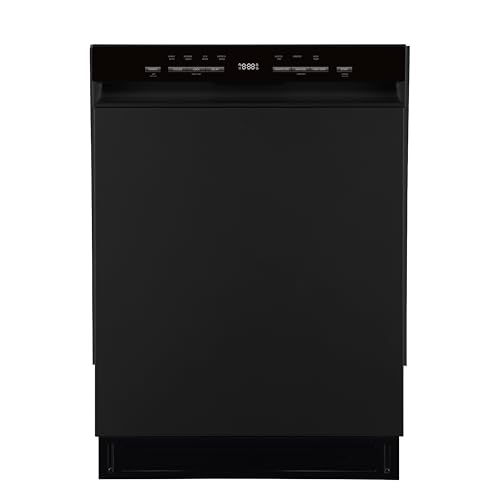
The second Kenmore in this guide differs from its sibling in construction and in spirit. Its listing describes a hybrid tub, twelve place settings, a 54 DBA figure, and features named MoreSpace adjustable rack, UltraWash and SmartWash, with high-temperature options and Energy Star certification. Hybrid tub construction, part stainless and part engineered material, is the industry’s honest middle path: it keeps much of stainless’s durability where it matters while trimming cost where it does not, and in a value-led black machine that trade is made openly.
The 54 DBA figure places this machine plainly: it is the loudest in this guide, suited to a closed kitchen or a utility-adjacent layout, and it should not be bought for an open-plan room on the strength of its finish. Within its territory it offers a great deal, an adjustable rack that adapts to tall items, a wash system with a confident name and the sense behind it, and twelve settings that cover a family of four without ceremony. Many households will rationally choose exactly this balance and spend the difference on the kitchen around it.
The adjustable rack deserves its sentence, because in black-suite family kitchens the daily frustration is rarely noise or shade; it is the tall glass that will not stand and the pan that will not lie. A rack that moves to meet the load removes a daily negotiation, and over a decade that is worth more than several decibels in a room with a door. Specification sheets rank features by novelty; households rank them by frequency, and rack flexibility wins the frequency contest easily.
The black finish here plays a supporting role rather than a starring one, completing a suite at a friendlier point in the range. Match it by the usual audition, keep the wipe habit, and judge it as what it is: the pragmatic dark machine for buyers whose priorities are loads and racks first, acoustics second, and whose kitchen architecture makes that ordering sensible.
Verdict on value: the rational black buy for closed kitchens, where its compromises are inaudible and its strengths are used daily.
A hybrid tub should not be read as a lesser tub by reflex. The materials are placed where heat, water and abrasion actually act, and for a household whose budget is shared across a whole suite, the saving funds the lighting and handles that make the black scheme succeed.
A 54 DBA machine in a closed kitchen still deserves a soft-close habit on its own door at night, because in a sleeping house the loudest dishwasher sound is often the one the user makes, not the pump.
The adjustable rack and the black finish meet in one scenario: a household that entertains with tall stemware and serving boards, where the rack earns its keep weekly and the front earns its compliments nightly.
- Format: full-size built-in finished in black
- Published figure on listing: 54 DBA
- Capacity: 12 place settings
- Tub: hybrid tub per the listing
- Features on listing: MoreSpace adjustable rack, UltraWash, SmartWash; ENERGY STAR Certified
Strengths
- Adjustable rack solves the daily tall-item problem
- Hybrid tub balances durability and cost openly
- Twelve settings suit a family of four comfortably
Trade-offs
- 54 DBA is the loudest figure in this guide
- Hybrid tub is a compromise beside full stainless
- Black finish still needs the regular wipe habit
Best for: closed kitchens wanting black with rack flexibility
Not suited for: open-plan rooms where noise carries
How Do the Six Dark Finishes and Specifications Compare?
Finish first, because that is the purchase, with the working specification beside it so a shade is never bought blind.
| Pick | Format | Capacity note | Standout trait |
|---|---|---|---|
| BLACK+DECKER BDW200MB Black | Full-size built-in, black finish | 12 place settings | Six programs, delay start |
| BLACK+DECKER BDW100MB Black | Full-size built-in, black finish | 12 place settings | Smart Wash, five programs |
| Cosmo Tall Tub, Matte Black | 24-inch tall tub, matte black | 45 dBa published | Three racks |
| Kenmore 15-Setting Black | Full-size built-in, black finish | 15 place settings | 49 DBA published |
| Seasons Front Control Black | Full-size built-in, black finish | Full-size class | Front controls |
| Kenmore Hybrid Tub Black | Full-size built-in, black finish | 12 place settings | Hybrid tub, adjustable rack |
The table’s real lesson is that black is not a specification. Within one colour word sit three finishes, three tub stories, capacities from twelve to fifteen settings and published figures spanning nine decibels. A buyer who shops the word alone is gambling; a buyer who shops the rows is choosing. Use the finish to build the shortlist, then let tub, racks and sound order it.
Notice, too, the two pairs. The BLACK+DECKER siblings let a household choose its program philosophy without changing its shade, and the Kenmore pair lets it choose its capacity and tub philosophy the same way. Suites are built from such pairs in practice, because real kitchens compromise one axis at a time.
What Is the Real Difference Between Black Stainless, Black and Matte Black?
Black stainless begins as stainless steel and receives a dark coating, often with fingerprint resistance engineered in. It keeps a metallic depth: light moves across it, the tone can read charcoal in one light and near-black in another, and the surface feels like an appliance material because it is one. Its weakness is the coating’s edge cases; a deep scratch can reveal bright metal beneath, and that bright line on a dark ground is conspicuous, so households with belt buckles, ringed hands and enthusiastic toddlers should know the risk they are accepting.
Plain black, the finish of most picks in this guide, is a dark finish applied as the machine’s colour rather than as a metal treatment. It reads more uniformly, photographs flatter, and sits happily beside the long tradition of black appliances, which is a genuine advantage for suite matching: black fridges, ranges and microwaves have been made for decades, and a new black dishwasher joins a well-populated family. Its scratch behaviour depends on the underlying construction, and its fingerprint behaviour is middling, better than stainless, worse than matte.
Matte black removes the sheen entirely. It is the most architectural of the three, the least appliance-like, and the most sensitive to pale deposits precisely because its flatness shows contrast so honestly. It is also the most forgiving of fingerprints and the most demanding about water spots. None of the three is best; each is a different material with a different temperament, and the buyer’s district water, household traffic and neighbouring finishes should decide among them.
How Should You Match a Black Dishwasher Into an Existing Suite?
Never match from a photograph. Screens lie about black more than about any other colour, because black’s information lives in undertone and sheen, exactly what a camera and a display handle worst. Match instead in person and in your own light: a dealer’s sample, a neighbour appliance’s door in daylight and lamplight, or the delivered machine checked against the suite before installation is booked and while exchange is still simple.
Decide what must match and what may merely harmonise. A dishwasher flanked by a black fridge and range should match closely, because three dark planes in a row invite comparison. A dishwasher alone on an island or in a run of pale cabinets needs only to harmonise, and there a matte or a deeper black can be chosen freely as the room’s single dark accent. Most failed suites are failures of this distinction: money spent matching what stood alone, and a shrug given to what stood in a row.
Handles and hardware are the diplomats of a mixed suite. A black dishwasher whose handle echoes the range’s handle in shape or finish can sit happily beside a fridge of a slightly different black, because the eye reads the hardware as the suite’s signature. When a perfect shade match proves impossible, matching the metal of the handles across appliances is the professional’s fallback, and it works because kitchens are read as compositions, not as paint charts.
How Do You Keep a Dark Finish Looking Designed Rather Than Dirty?
Dark finishes fail by accumulation, not by disaster: a faint tide of dust, a constellation of pale spots, a handle polished shiny by hands while the door stays matte. The counter-routine is small and specific. A microfibre wipe as part of the unload, a monthly pass with a cleaner the maker approves for the finish, and prompt attention to detergent drips, which are alkaline and will mark dark coatings left to dry, keep the plane of colour the designer intended.
Water is the main antagonist in hard districts. Where spots form, a final wipe of the door after the evening’s last use prevents the overnight drying that sets them, and a water softener, where the household already runs one, quietly improves every dark surface in the kitchen at once. Matte owners should add one rule: no abrasive pads, ever, because a polished patch on a matte door cannot be unpolished and will catch light forever.
Lighting is the other half of maintenance, though it is installed rather than performed. Dark kitchens live or die by their lighting design: under-cabinet light that washes the worktop, a warm source that gives black its depth rather than its gloom, and no single harsh downlight that turns every fingerprint into a headline. A household investing in black appliances should reserve a little of the budget for the light that will present them, because the finish they fell for in the showroom was, in part, the showroom’s lighting.
Which Kitchens Should Not Choose a Black Dishwasher?
A small kitchen with little natural light and no budget for better artificial light should hesitate, because a large black plane absorbs what light exists and the room’s working mood suffers for a decade. A household that knows it will not wipe a front should also hesitate, since dark finishes publish neglect more honestly than pale ones. And a buyer matching an existing true black stainless suite should not let a plain black bargain talk them into a mismatch they will see at every meal.
There is a fourth hesitation: the undecided remodel. If the kitchen’s whole scheme may change within two years, a black dishwasher is a commitment device the future designer did not ask for. Stainless travels between schemes with an ease black cannot match, and households mid-journey are often better served by the neutral metal until the room’s final colours are known. Black rewards conviction; give it a kitchen that has some.
How Long Will a Black Finish Stay in Fashion, and Does It Matter?
Black appliances cycle through fashion roughly once a decade, returning each time in a slightly different material: gloss, then coated metal, now matte. A buyer worried about dating should notice that the machines themselves outlast the cycle’s peak either way, and that black, unlike the stronger colours that occasionally sweep kitchen design, has never fully left; it merely rotates between starring and supporting roles in the room.
The practical conclusion is liberating. Choose black because your kitchen, your light and your other appliances argue for it, not because a showroom says it is this year’s direction. A dishwasher chosen on those grounds will look right in the years when black is fashion’s headline and in the years when it is merely a classic, which, across a decade of service, is the only kind of right that matters.
How Should a Dark Dishwasher Be Lit and Placed in the Run?
Placement within the run changes a black machine’s effect as much as its shade. At the end of a pale run it becomes a full stop, a deliberate punctuation that designers use to anchor a wall. In the middle it becomes a shadow band that can visually lower a tall room’s energy in a welcome way. Beneath a window it will catch raking light that reveals every wipe mark, while in a sheltered inner position the same finish looks uniformly deep with half the effort.
Task light should be planned to skim rather than strike the front. A light aimed at the worktop in front of the machine presents the black as a calm ground to work against, while a downlight aimed at the door itself turns the front into an inspection panel. The difference costs nothing at the design stage and everything at the retrofit stage, which is why this guide raises lighting in a dishwasher review without embarrassment.
What Mistakes Do Buyers of Black Dishwashers Make?
The signature mistake is ordering black stainless by name and receiving, or buying, plain black by assumption, in either direction. The two finishes differ in material, sheen and scratch behaviour, and the time to discover which one a listing describes is while reading it, not while unwrapping it. This guide has named every pick’s finish as its listing does; extend the same discipline to any model you consider beyond the list.
A second mistake is matching the suite under showroom light. Fluorescent and display lighting flatter dark finishes and hide undertone differences that a kitchen’s warm evening light will expose cruelly. Any shade decision that matters should be re-checked in light resembling the room’s own, ideally at the hour the kitchen is most used, because that is the light the suite will actually live in.
Third, buyers forget that a black dishwasher is a large dark object in a room that must still be lit for work. A black machine in a north-facing kitchen with one small window can tip the room from moody to murky, and the remedy, better task lighting, is far cheaper planned alongside the appliance than retrofitted in disappointment. Buy the light with the machine and the colour will keep its promise.
Finally, do not let the finish outrank the machine. A dishwasher is bought for a decade of evenings, and the household will forgive a shade half a tone from perfect long before it forgives a tub that stains, a rack that fights tall glasses, or a wash that leaves the pans to the sink. Choose the finish from the heart by all means, then choose among the finalists with the head, in the order this guide’s comparison table invites.
A fifth mistake is treating the dishwasher’s black as the suite’s reference colour when it should be the other way round. The fridge and range are larger, older or more expensive to change, so the dishwasher, as the most replaceable member, should be matched to them, never they to it. Buyers who reverse that order end up repainting a kitchen around its cheapest appliance.
Final Recommendation
For most black-suite kitchens the headline choice is between the two BLACK+DECKER machines: the BDW200MB when you want six programs and a delay start over a stainless tub, and its sibling when you would rather the machine judged the load itself. Design-led rooms should start instead with the Cosmo Tall Tub, whose matte finish, third rack and 45 dBa figure make it the most complete dark machine here.
Big families in black should look at the fifteen-setting Kenmore, households who read their appliances at a glance at the front-control Seasons, and closed kitchens on a budget at the hybrid-tub Kenmore Hybrid Tub. Each is the right answer to a different room, which is exactly how a finish category should resolve.
Buy the black you have actually seen, in light like your own, over the tub and racks your cooking actually needs, and the darkest appliance in the kitchen will also be the easiest to live with. Shade fades as a novelty within a month; a well-chosen machine keeps its side of the bargain for years.
Frequently Asked Questions
Is black stainless the same as a black dishwasher?
No. Black stainless is stainless steel with a dark coating, keeping a metallic depth and often resisting fingerprints. A black dishwasher wears a black finish that reads more uniformly, and matte black removes sheen altogether. They differ in sheen, scratch behaviour and care, so check which finish a listing actually describes before matching it to a suite.
Do black dishwashers show scratches more than stainless ones?
On coated black stainless, a deep scratch can reveal bright metal and show clearly, which is its known weakness. Plain black and matte finishes mark differently: matte hides fingerprints best but displays pale water spots, while gloss black sits between the two. The right choice depends on whether your household produces more scratches, prints or spots.
Can I mix a matte black dishwasher with black appliances?
Yes, if the contrast is intended. Matte reads as a material beside cabinetry, while glossy black appliances read as machines, and a kitchen can be designed around that difference. What fails is an accidental mixture, where the buyer expected a match; audition the finishes together in your own light before committing.
Will a black dishwasher make my kitchen look smaller?
A single dark appliance in a pale run usually reads as an accent and does not shrink the room. A whole dark suite in a small, dim kitchen can feel enclosed, and the remedy is lighting: strong under-cabinet task light and warm ambient light keep black kitchens looking designed rather than dark.
How do I clean a black or matte black dishwasher front?
Use a soft microfibre cloth and a cleaner the maker approves for the finish, wipe drips promptly, and never use abrasive pads, which can polish a permanent shiny patch into a matte surface. In hard-water areas, a quick wipe after the evening’s last use prevents the pale spots dark finishes show most.
Does a black dishwasher cost more to run or maintain?
No. The finish lives on the door’s outer face and has no effect on water, energy or washing. Maintenance differs only cosmetically: a soft cloth, prompt attention to drips, and no abrasives on matte surfaces. The running costs are set by the machine’s efficiency and your household’s habits, exactly as with a stainless model.
Related Guides
If the dark suite is part of a wider appliance refresh, or the premium end of the market is next on the list, continue with Best Bosch Dishwashers Best 10,000 BTU Window Air Conditioners Best 9,000 BTU Split System Air Conditioners.


