What's inside
- Key Takeaways
- Quick Picks
- How We Chose These Picks
- How Do the Six Machines Compare Side by Side?
- Will a Portable Dishwasher Fit the Way Your Kitchen Actually Works?
- How Does the Faucet Hookup Work in Daily Practice?
- What Should You Load, and What Should Stay in the Sink?
- Which Wash Program Will You Actually Use Most?
- How Noisy Is a Portable, Really?
- What Maintenance Keeps a Portable Running for Years?
- What Mistakes Do First-Time Portable Owners Make?
- How Much Water and Energy Does a Portable Really Use?
- What About Apartments, Landlords and Lease Rules?
- How Do You Handle a Load When Guests Descend?
- What Should You Check in the First Week of Ownership?
- How Does a Portable Compare With a Countertop Model?
- What Will You Spend Beyond the Purchase?
- How Should You Winterise, Move or Store a Portable?
- Which Detergent and Rinse Aid Combination Works Best?
- How Do You Keep the Machine Smelling Fresh?
- What If Your Floor Is Uneven or Your Doorway Is Narrow?
- How Long Should a Good Portable Last?
- What About Using the Top as Extra Counter Space?
- How Do You Teach a Household the New Routine?
- What Happens on Delivery Day?
- Why Do Owners Keep These Machines Longer Than Planned?
- Final Recommendation
- Frequently Asked Questions
- Related Guides
As an Amazon Associate I earn from qualifying purchases. This post may contain affiliate links at no extra cost to you.
cottageverdict.com is reader-supported. When you buy through links on our site, we may earn an affiliate commission.
Where to buy: each of the best portable 18 inch dishwashers below is sold on Amazon, and the model names in the Quick Picks table, the detailed reviews and the comparison table all link to the matching listing, where you can check price on Amazon and confirm dimensions, hose fittings and warranty terms before you order. A portable dishwasher exists because of a specific frustration: a kitchen too small, too old or too rented for a built-in machine, paired with a household that produces far too many dishes for cheerful hand washing. The eighteen-inch width is the sweet spot of that compromise. It rolls into a gap beside a counter, parks against a wall between runs, and still swallows a full day of plates, pans and glasses for a small household.
Understand what portable really demands before falling for any single model. These machines live on casters, connect to a kitchen faucet with a quick-coupling adapter while they run, and drain into the sink. Nobody plumbs them in permanently, although many owners later do exactly that with a conversion kit. The sink is occupied for the length of a cycle, the hose must reach comfortably, and the machine needs a parking spot that does not block a doorway or a fridge swing. Measure all three realities — floor space, faucet distance, storage corner — and the category becomes simple. Ignore them and even an excellent dishwasher becomes an obstacle on wheels.
Capacity is the other quiet truth. Every machine in this guide holds eight place settings, which in practice means dinner for four with cooking gear, or a couple’s entire day plus a mixing bowl or two. That is a genuinely useful load, provided you load it like a dishwasher rather than a cupboard. What separates the six picks is not raw size but wash programs, tub material, noise manners, control layout and how gracefully each one rolls, parks and connects night after night.
Key Takeaways
- Eighteen inches wide is the narrow format that still takes eight place settings, enough for a small household’s full day of dishes.
- Every portable connects to a faucet and drains into the sink during a run, so hose reach and a parking spot matter as much as wash power.
- Stainless tubs resist staining and odours better over years of tomato sauce and curry than plastic interiors do.
- Six wash programs cover most real needs; extra cycles help only when they match how your household actually cooks.
- Colour is a genuine decision here, because a portable lives visibly in the kitchen rather than hiding behind cabinetry.
- Roll the machine to the sink, not the dishes to the machine: a clear rolling path saves more daily effort than any feature.
Quick Picks
| Pick | Badge | Why it earns its place |
|---|---|---|
| BLACK+DECKER 18 Inch Portable Dishwasher Black BPD8B | Best Black Finish | The familiar eight-place portable in a black finish that suits darker kitchens and hides scuffs from rolling. |
| BLACK+DECKER 18 Inch Portable Dishwasher White BPD8W | Best White Finish | The same proven layout in white, easier to match with older appliances and lighter rental kitchens. |
| SPT 18 Inch Portable Dishwasher Stainless SD-9263SS | Best Stainless Look | Six wash programs and a stainless front for cooks who want the portable to echo built-in styling. |
| HAMILTON BEACH Portable Dishwasher with Wheels | Best Simple Roller | A straightforward white machine on wheels, nineteen inches wide, aimed at households wanting minimal fuss. |
| HAMILTON BEACH Portable Dishwasher SS Platinum | Best Platinum Finish | The Hamilton Beach portable formula in a stainless-platinum finish for a more finished look. |
| Honeywell 18 Inch Dishwasher 8 Place Settings | Best Stainless Tub | Six washing programs with a stainless steel tub, the interior material long-term owners tend to prefer. |
How We Chose These Picks
Width came first, because the whole category exists for narrow kitchens. Five of the six sit at eighteen inches; the two Hamilton Beach models measure nineteen, a single extra inch that matters only in the tightest parking spots, and each review says so plainly. Any machine wider than that stops being a narrow-kitchen answer and starts competing with full-size portables, which are a different guide entirely.
Wash flexibility came second. Households buying a portable rarely run one kind of load: there are pasta pots on Sunday, delicate glasses after guests, and the daily churn of mugs and cereal bowls. Six-program machines earned their places by covering heavy, normal, light and quick work without forcing everything through a single cycle. Simpler models stayed on the list only where their straightforward controls suit people who genuinely run one program forever.
Interior material and certification formed the third filter. Stainless tubs shrug off stains and hold heat that helps drying; plastic tubs cost less and weigh less. Energy Star recognition, where a listing claims it, signals efficient water and energy use across a year of daily cycles — meaningful in a machine bought precisely because a household runs it constantly. Finally, we favoured names with real service networks, because a portable’s pump, hose and caster wheels are wear parts, and a dishwasher you cannot get a hose for becomes furniture.
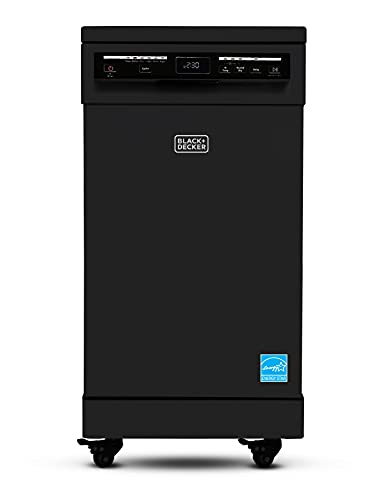
BLACK+DECKER 18 Inch Portable Dishwasher Black BPD8B — Best Black Finish
Black appliances divide kitchens, and this machine commits happily to the dark side. The BPD8B takes the standard eighteen-inch portable layout — eight place settings, Energy Star recognition, caster wheels, faucet hookup — and wraps it in a black finish that reads deliberate beside dark cabinets, black stoves and the moody little kitchens of older city apartments. In a white rental box it looks like a statement; in a charcoal scheme it simply belongs.
Beyond colour, the appeal is familiarity. The BPD8B follows the portable pattern owners have used for years: roll it to the sink, snap the unicouple onto the faucet adapter, choose a cycle, and let the machine empty itself into the sink while you do something better with your evening. Racks arrange for the standard eight settings with a cutlery basket, and the upper rack handles glasses and mugs while plates and pans take the lower level. Nothing about the layout asks you to learn a new religion of loading.
Black also forgives the portable lifestyle. A machine that rolls daily collects scuffs on its lower edges, drips on its front and fingerprints everywhere; the dark finish hides the small marks that a white door announces. Wipe it with a damp cloth rather than abrasives, keep the casters free of hair and grit, and the finish keeps its dignity far longer than owners expect.
- Format: 18-inch portable on casters, faucet connection
- Capacity: 8 place settings
- Certification: Energy Star
- Finish: Black
- Model: BPD8B
Strengths
- Black finish disguises the scuffs and drips that rolling life inevitably produces.
- Standard, well-understood portable layout with no learning curve for first-time owners.
- Energy Star recognition keeps daily running costs sensible for heavy users.
Trade-offs
- Dark finish shows flour dust and pale limescale splashes more than white would.
- Eight settings still means daily runs for families who cook three full meals.
- Like every portable here, it occupies the sink for the whole cycle.
Best for: small households in darker kitchens who want the portable to look intentional. Not suited for: anyone whose parking spot measures under eighteen inches of clear width.
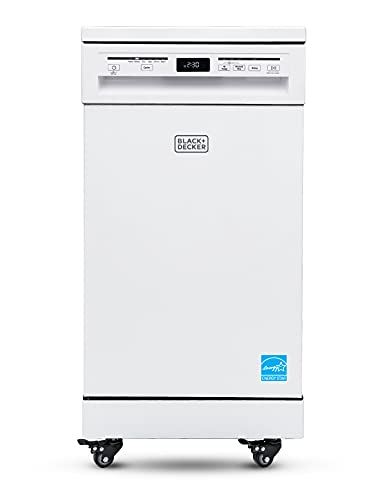
BLACK+DECKER 18 Inch Portable Dishwasher White BPD8W — Best White Finish
The BPD8W is the same machine wearing the other classic colour, and for a great many kitchens white remains the right answer. Rental flats with white stoves and fridges, bright cottage kitchens, basement suites and in-law units all tend to run pale, and a white portable blends into that world instead of arguing with it. Under-cabinet lighting bounces kindly off it, and the room feels less crowded than a dark box would make it.
Mechanically, expect the portable routine in its most ordinary, dependable form: eight place settings across two racks, Energy Star recognition, a faucet adapter that stays on the tap, and casters that roll the machine from its parking corner to the sink in seconds. The BPD8W suits households moving up from a countertop unit who want real plate capacity without surrendering floor space to a twenty-four-inch model.
White’s weakness is honesty: it shows every drip trail and rolling scuff. Owners who wipe the door during the weekly kitchen clean never notice a problem, while owners who never wipe anything should choose the black sibling above. Beyond that cosmetic bargain, the two machines ask the same of you — a level parking spot, a faucet within hose reach, and a habit of scraping plates rather than rinsing them, which modern detergents prefer anyway.
- Format: 18-inch portable on casters, faucet connection
- Capacity: 8 place settings
- Certification: Energy Star
- Finish: White
- Model: BPD8W
Strengths
- White finish matches the pale appliances most small kitchens already own.
- Proven eight-place layout that countertop graduates find transformative.
- Bright door reflects light and keeps a small room feeling open.
Trade-offs
- Shows drip marks and scuffs sooner than the black version does.
- White door needs regular wiping to keep its bright look.
- Casters need a reasonably smooth floor to roll without a fight.
Best for: bright kitchens and rental flats where white appliances already rule. Not suited for: owners who know they will never wipe a door front.
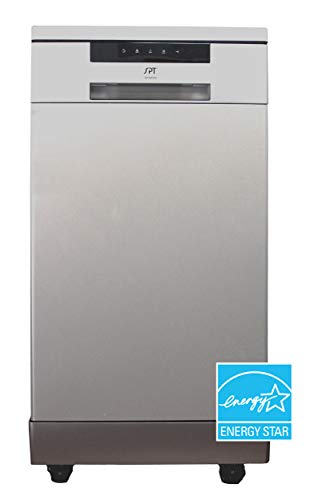
SPT 18 Inch Portable Dishwasher Stainless SD-9263SS — Best Stainless Look
SPT has sold compact appliances to apartment dwellers for decades, and the SD-9263SS shows that focus. The stainless front gives a portable the visual manners of a built-in, which matters in open-plan spaces where the machine parks in sight of the sofa. Six wash programs headline the specification, covering the spread from baked-on casserole work to a fast rinse-and-wash for breakfast things before guests arrive at noon.
Eight place settings sit inside, arranged for households that cook properly rather than reheating politely. The program variety earns its keep when loads vary: heavy cycles for roasting tins, gentler treatment for the good glasses, economy runs for lightly soiled daily ware. The SD-9263SS carries Energy Star recognition as well, so the extra flexibility does not arrive with wasteful water habits.
Stainless asks for a particular cleaning ritual — wipe with the grain, dry after wiping, and fingerprints surrender. In exchange the front resists the yellowing that older white portables develop and shrugs off the tomato splashes of an enthusiastic cooking household. For a machine bought to work daily for years in full view, that durability of appearance is a real feature rather than vanity.
- Format: 18-inch portable, faucet connection
- Capacity: 8 place settings
- Programs: 6 wash programs
- Certification: Energy Star
- Finish: Stainless steel front
Strengths
- Six programs handle the widest range of real loads in this guide.
- Stainless front suits open-plan kitchens where the machine stays visible.
- Backed by a brand specialising in compact and apartment appliances.
Trade-offs
- Stainless shows fingerprints until wiped with the grain.
- Program choice can overwhelm people who only ever run one cycle.
- Still a faucet machine: the sink is busy while it runs.
Best for: keen cooks in small open-plan homes who vary their loads. Not suited for: anyone wanting the absolute simplest two-button experience.
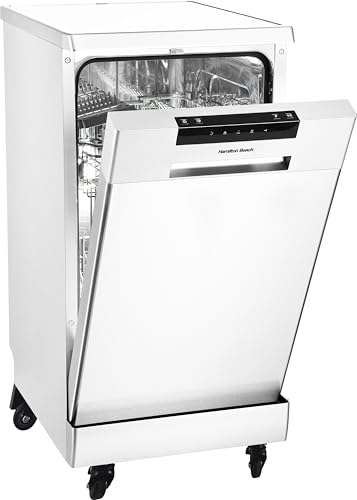
HAMILTON BEACH Portable Dishwasher with Wheels — Best Simple Roller
Hamilton Beach built its name on appliances that do the job without theatre, and this portable follows the family tradition. It is a white machine on wheels with eight place settings of capacity and a width of nineteen inches — one inch beyond the strict eighteen of its rivals, a difference that only matters if your parking gap is truly exact. In an ordinary kitchen corner, that inch disappears.
The pitch here is straightforward ownership. Roll it out, couple it to the faucet, load the day’s dishes, run it, roll it back. Households furnishing a first apartment, a granny flat or a staff kitchen often value that plainness over program libraries they will never open. A machine everyone in the house understands gets used properly; a complicated one gets used resentfully, and dishes quietly return to the sink.
Because the specification is simple, judge this pick on the fundamentals: does the rack layout take your tallest glasses, do the wheels roll sweetly over your floor’s transitions, and does the hose reach your faucet from the parking spot you actually have? Answer those three honestly and you know whether this uncomplicated roller is your machine. Treat it to a monthly filter rinse and it will repay you in uneventful years.
- Format: Portable on wheels, faucet connection
- Width: 19 inches
- Capacity: 8 place settings
- Finish: White
- Brand focus: Simple, everyday controls
Strengths
- Unfussy design that every member of a household can operate.
- Full eight-place capacity despite the back-to-basics brief.
- White finish suits utility rooms, rentals and secondary kitchens.
Trade-offs
- Nineteen-inch width needs a slightly wider parking gap than rivals.
- Fewer refinements for cooks who love specialised cycles.
- Newer listing, so long-term owner history is still accumulating.
Best for: first apartments and secondary kitchens wanting a plain, capable roller. Not suited for: a parking slot measured at exactly eighteen inches.

HAMILTON BEACH Portable Dishwasher SS Platinum — Best Platinum Finish
Think of this as the white Hamilton Beach after a wardrobe consultation. The SS Platinum finish gives the same wheeled, eight-place portable a stainless-platinum face, lifting it from utility appliance to something that can park beside a stainless fridge without apologising. In kitchens where the portable cannot hide — and most cannot — that visual upgrade is the entire point, and it is a legitimate one.
Daily life with it mirrors its sibling: faucet hookup, sink draining, a roll-away presence between runs. The nineteen-inch width applies here too, so the same measuring advice holds. Where the platinum finish earns its keep is in homes that entertain from the kitchen itself; guests see a coherent wall of metal rather than a white box that wandered in from the laundry.
Care follows stainless rules. Microfibre cloth, wipe along the finish rather than across it, and avoid powdered scouring products that cloud the surface. Owners who treat the door like the fridge door — which is to say, barely at all beyond a weekly wipe — report the finish holding up perfectly well to ordinary family traffic, children and the occasional bumped hip during a crowded cooking session.
- Format: Portable on wheels, faucet connection
- Width: 19 inches
- Capacity: 8 place settings
- Finish: SS / Platinum
- Brand focus: Everyday controls, upgraded look
Strengths
- Platinum finish coordinates with stainless stoves and fridges.
- Same simple operating routine as the white model.
- Eight settings cover a small household’s daily output comfortably.
Trade-offs
- Finish upgrade is cosmetic; wash hardware mirrors the simpler sibling.
- Nineteen inches wide, so tight gaps need checking first.
- Fingerprints appear on the platinum face between wipes.
Best for: style-conscious small kitchens where the portable parks in view. Not suited for: buyers hoping the finish signals extra wash programs.

Honeywell 18 Inch Dishwasher 8 Place Settings — Best Stainless Tub
The Honeywell entry directs attention inward: a stainless steel tub rather than plastic. That single specification changes long-term ownership more than any program list. Stainless resists the orange staining that tomato sauces leave in plastic, sheds odours instead of storing them, and its heat-holding walls help dishes dry as the cycle ends. Open this machine after a curry night and the interior smells of nothing, which is the highest praise a dishwasher tub can earn.
Six washing programs surround that tub, giving the Honeywell the joint-broadest cycle menu in this guide alongside the SPT. Eight place settings, UL listing and Energy Star recognition complete a specification aimed squarely at buyers who read spec sheets. The Honeywell name itself arrives under licence on home appliances, and the machine competes on hardware rather than heritage.
Choose this one if your cooking leans saucy, spicy and frequent, because that is where plastic tubs age fastest and stainless earns its premium in kind. The exterior follows the category pattern — roll, couple, run, park — while the interior quietly outclasses most rivals. For households planning to keep a portable for many years rather than bridging a short rental, the tub argument often settles the decision on its own.
- Format: 18-inch portable, faucet connection
- Capacity: 8 place settings
- Programs: 6 washing programs
- Tub: Stainless steel
- Certification: UL / Energy Star
Strengths
- Stainless tub resists stains and odours across years of heavy cooking.
- Six programs match the broadest menus in this category.
- Hot stainless walls support better end-of-cycle drying.
Trade-offs
- Licensed branding means support runs through the appliance maker, not the parent name.
- Specification focus may exceed what light users need.
- Same sink-occupation compromise as every faucet portable.
Best for: heavy cooks planning long ownership who hate stained tubs. Not suited for: short-term renters who will leave the machine behind.
How Do the Six Machines Compare Side by Side?
| Pick | Width | Capacity | Signature point |
|---|---|---|---|
| BLACK+DECKER BPD8B | 18 in | 8 settings | Black finish, Energy Star |
| BLACK+DECKER BPD8W | 18 in | 8 settings | White finish, Energy Star |
| SPT SD-9263SS | 18 in | 8 settings | 6 programs, stainless front |
| HAMILTON BEACH with Wheels | 19 in | 8 settings | Simple white roller |
| HAMILTON BEACH SS Platinum | 19 in | 8 settings | Platinum finish |
| Honeywell 18 Inch | 18 in | 8 settings | Stainless tub, 6 programs |
Read the table as a map of priorities rather than a ranking. Finish divides the two BLACK+DECKER twins and the two Hamilton Beach siblings; programs unite the SPT and Honeywell; the tub separates the Honeywell from everyone. Width splits the field into true eighteen-inch machines and the one-inch-wider Hamilton Beach pair. Your kitchen’s measurements and your cooking habits point at one row each; the table just makes the pointing easier.
Will a Portable Dishwasher Fit the Way Your Kitchen Actually Works?
Walk the route before buying. The machine will travel from parking spot to sink hundreds of times, over thresholds, rug edges and the mysterious raised tile every old kitchen hides. A route with a sharp turn around an island defeats casters and tempers alike. Ideally the dishwasher parks within a straight, short roll of the sink, close enough that connecting it feels like nothing — because a chore that feels like nothing gets done nightly, while a production gets postponed until the sink overflows.
Then examine the faucet. Portable adapters fit standard taps; fancy pull-down sprayers and designer faucets sometimes refuse the coupling, or accept it only with the spray head removed. Test the idea early: if your faucet cannot take an adapter, a portable is not impossible, but it becomes a project involving a separate aerator fitting or a faucet change. Renters should also glance at their lease and their landlord’s temperament, since the adapter lives on the tap permanently even though the machine visits only at night.
Storage deserves equal honesty. Eighteen inches of width sounds slim until it stands in a galley kitchen eating the walkway. Some owners park the machine at the end of a counter and gain a bonus worktop — many portables wear a laminate top that serves as extra prep space. Others roll it into a wide doorway alcove, a pantry corner or beside the fridge. Decide the spot now, tape its outline on the floor, and live with the tape for two days. That small experiment has saved more returns than any review.
How Does the Faucet Hookup Work in Daily Practice?
The unicouple is the heart of portable life. One fitting carries water in from the faucet and returns drain water to the sink through a second hose, both bundled in a single connector that snaps onto an adapter screwed in place of the faucet aerator. Connecting takes seconds once the adapter lives on the tap: pull the hoses from the machine’s rear compartment, click, turn on the hot water fully, and start the cycle.
Details separate smooth routines from wet ones. Run the hot tap until water is genuinely hot before connecting, so the machine starts with hot water rather than warming the pipes. Keep the drain hose positioned so its outlet cannot slip out of the sink mid-cycle. After the run, press the pressure-release button on the coupler before disconnecting, or the trapped water will remind you why the button exists — usually down a sleeve. Coil hoses back into their compartment while they are still warm and pliable.
Water pressure and temperature both matter more than brochures admit. Portable dishwashers fill on household pressure and heat internally, but a home with feeble pressure or a water heater set very low will see longer, weaker cycles. None of this is difficult; it is simply a routine, and like all routines it becomes invisible after the first fortnight of use.
What Should You Load, and What Should Stay in the Sink?
Eight place settings is a defined test load: dinner plates, side plates, bowls, cups, glasses and cutlery for eight, plus serving pieces squeezed by optimism. Real households load differently. A couple who cooks from scratch may fill the machine with fewer, dirtier items — a saucepan, a sheet pan that fits diagonally if the machine allows, mixing bowls, chopping boards standing at the sides. Judge capacity by your own worst evening, not the standard’s tidiest one.
Some things should never ride. Cast iron loses its seasoning, carbon-steel knives dull against racks, wooden boards crack in the heat, and delicate crystal risks etching into permanent cloudiness. Aluminium baking sheets discolour harmlessly but alarmingly. Everything else — everyday ceramics, glassware, stainless cutlery, plastic containers on the top rack — handles machine washing happily, especially when loaded with space for water to move. A dishwasher cleans with circulation; a packed-solid rack is just a warm cupboard with sprayers.
Loading well is a learnable geometry. Plates face the centre, bowls angle downward, cups rest between tines rather than over them so they cannot flip and fill. Large items belong at the sides and back where they cannot shield smaller ones from the spray arm’s path. Spend one week loading thoughtfully and the arrangement becomes muscle memory, after which the machine quietly does better work for the same water and time.
Which Wash Program Will You Actually Use Most?
Most households settle on one everyday cycle and visit the others on special occasions. The normal program balances temperature and time for mixed daily loads; heavy cycles add heat and duration for baked-on pans; light or eco runs trade time for gentleness and efficiency; quick washes rescue a forgotten load of lunch boxes. Six-program machines like the SPT and Honeywell simply widen the menu for households whose cooking swings between extremes.
Detergent choice influences results as much as program choice. Pods simplify dosing in hard-working machines, powder lets you adjust for water hardness, and rinse aid transforms glass drying in homes with mineral-heavy water. A portable’s small tub concentrates detergent, so overdosing causes residue and film rather than extra cleanliness. Start with less than instinct suggests, then adjust upward only if soil survives the cycle.
Drying deserves a sentence of realism. Portables dry by residual heat and evaporation, sometimes helped by opening the door after the cycle. Plastic tubs hold less heat than stainless, so plastics emerge wetter in them — one more quiet argument for the Honeywell’s metal interior, and a reason to crack the door open while you make tea regardless of model.
How Noisy Is a Portable, Really?
A portable stands in the room with you rather than hiding inside cabinetry, so its sound arrives unmuffled. Expect conversation-level noise during wash action and a louder moment when the pump drains into the sink — that splashing is plumbing, not machinery, and a folded towel under the drain stream softens it surprisingly well. Small apartments where the kitchen opens onto the sleeping space should plan cycles for waking hours.
Placement changes perception. A machine parked on a hollow floor section broadcasts vibration; moving it a foot onto a solid area, levelling its casters and keeping loads balanced all reduce the drum of operation. Running the dishwasher while a film plays in the next room is normal life for thousands of owners, so treat noise as a scheduling consideration rather than a deal-breaker — unless your home is a studio, in which case run it before bed and let it finish as you wind down, not after lights-out.
What Maintenance Keeps a Portable Running for Years?
Filters first: portable dishwashers trap food debris in a filter assembly at the tub floor, and a clogged filter is the leading cause of dishes emerging gritty. Rinse it under the tap weekly if you cook daily. Wipe the door gasket monthly, because the fold where door meets tub collects a grey biofilm that perfumes the machine if ignored. Run an empty hot cycle with a dishwasher cleaner or a cup of vinegar in an open bowl every month or two to dissolve grease and limescale from the hidden plumbing.
Hoses and casters are the portable-specific wear points. Inspect hose connections for drips each time you couple up; a weeping fitting caught early is a washer replaced in minutes, while one ignored becomes a floor problem. Keep caster wheels free of hair and string, which wind around axles and make rolling heavy. Park the machine level, store hoses loosely coiled rather than kinked, and the unglamorous hardware will outlast the electronics in most homes.
What Mistakes Do First-Time Portable Owners Make?
Buying before measuring the parking spot is the classic error, closely followed by never checking whether the faucet accepts an adapter. Both mistakes announce themselves on delivery day, which is the worst day to learn carpentry. A third error is rinsing dishes clean before loading: modern enzymes need soil to work on, and pre-rinsed loads can emerge with detergent residue and etched glass over time. Scrape, do not rinse.
Overloading ranks next. A portable’s eight settings assume spacing; cramming twelve settings of ware into the racks guarantees the middle emerges dirty and the owner concludes the machine is weak. Two honest loads beat one dishonest one. Finally, owners forget the sink is occupied and plan a cycle right before they need to strain pasta or wash salad. Run the machine after the cooking is done, or before it starts, and domestic peace survives.
How Much Water and Energy Does a Portable Really Use?
Far less than the sink it replaces. A hand-washing session for a full day of dishes can run the tap for twenty minutes or more, while a dishwasher meters its fills in small, heated batches and reuses that water through filter cycles. Energy Star recognition, carried by several picks here, certifies that the machine meets efficiency thresholds for both water and electricity. For households paying their own utility bills in small flats, the portable often reduces the monthly total compared with conscientious hand washing — and compared with careless hand washing, it is not close.
The savings depend on full loads. Running a half-empty machine nightly wastes the advantage, which is another reason the eight-setting size suits small households so well: it fills naturally by dinner. Eco programs stretch efficiency further by washing longer at lower temperatures, trading clock time for energy. Since a portable usually runs while the household does other things, that trade is painless, and owners who adopt the eco cycle as their default see the gentlest bills the category can offer.
What About Apartments, Landlords and Lease Rules?
A portable dishwasher is usually the renter-friendliest appliance in existence because it changes nothing permanent. The faucet adapter is the only fixture touched, and it unscrews in a minute when you move out, restoring the tap exactly. No cabinets are cut, no plumbing is opened, and the machine leaves on its own wheels. Many landlords who would refuse a built-in installation shrug at a portable, although the polite renter asks first and mentions the leak-safety habits they practise.
Those habits matter. Stay home during the first few runs of any new machine to learn its sounds and check its fittings. Keep the hoses inspected, never run a portable while away on holiday, and place a water alarm on the floor behind the parking spot if you want cheap insurance. Buildings with old plumbing sometimes ask residents to avoid running machines overnight, when a leak would go unnoticed longest — a fair request, easily honoured by running the evening cycle while you are awake and nearby.
How Do You Handle a Load When Guests Descend?
Entertaining exposes the eight-setting ceiling faster than any weekday. The working strategy is rotation: run a first load of prep bowls, boards and cooking tools while the meal is still being served, empty it during a natural pause, then load tableware once guests drift toward coffee. Two smaller loads keep the kitchen resetting itself instead of collapsing into a single midnight mountain. The quick program earns its existence on exactly these evenings.
Glassware deserves its own plan. Delicate stems stay home in the sink for hand washing, while everyday tumblers ride the top rack. Serving platters that refuse to fit can soak in the machine’s downtime and wash by hand in minutes once the machine has taken the greasy majority. Hosts who think in waves rather than in one heroic clean-up finish the night with a tidy kitchen and a machine humming through its final load — the portable’s finest social trick.
What Should You Check in the First Week of Ownership?
Treat week one as a shakedown. Check under the coupler after every run for drips. Learn which of your regular items fit badly — the tall vase, the wide pasta bowl — and decide their permanent strategy rather than improvising nightly. Test each program once, including the heavy cycle on a genuinely baked-on dish, so you know what the machine can rescue and what still needs a soak. Note how the racks handle your actual plates, because plate diameter, not place-setting count, decides whether the lower rack feels roomy.
Also verify the boring logistics: the hoses reach without strain, the power cord reaches an outlet without crossing a wet zone, and the parked machine does not block a drawer you use daily. Small frictions found in week one get solved with a moved parking spot or a different loading habit. The same frictions discovered in month three simply become resentment, which is why the shakedown week deserves a little deliberate attention.
How Does a Portable Compare With a Countertop Model?
Countertop dishwashers sit beside the sink, hold roughly six settings of smaller items, and often fill from a jug or a faucet diverter. They suit one-person households whose dishes are mostly mugs, bowls and side plates. The eighteen-inch portable doubles down on reality: full-size dinner plates stand upright, saucepans fit, and a family-sized cooking day disappears in one load. The price of that capacity is floor space and a rolling routine instead of a permanent perch.
Households graduate between the formats in both directions. Couples who start cooking seriously outgrow countertop machines within a year; empty-nesters sometimes downsize the other way. If your sink currently hosts a daily pile of full-size plates and pans, the portable format answers the actual problem. If your pile is three mugs and a cereal bowl, save the floor space and read the countertop guide linked at the end of this one.
What Will You Spend Beyond the Purchase?
Running costs stay modest: detergent, rinse aid, electricity for heating water, and the water itself. Pods cost more per wash than powder but remove dosing guesswork; either way the per-load total is small against the value of the time returned. Budget occasionally for the wear items unique to portables — a replacement unicouple seal, a hose after years of flexing, a caster that finally gives up on a rough floor. None are expensive, and all are cheaper than the service call a neglected built-in eventually demands.
The hidden saving is replacement crockery. Hand washing breaks glasses and chips plates at a rate most households never count; a rack holds items still while water does the work. Owners routinely report that their everyday ware lasts longer once the machine takes over, which quietly offsets a slice of the purchase across a few years of unbroken tumblers.
How Should You Winterise, Move or Store a Portable?
Moving house is where the format shines: drain the hoses, coil them into the rear compartment, and roll the machine onto the truck like a tall suitcase. For storage in an unheated space, run a short drain cycle, empty the filter trap, and leave the door ajar so residual moisture escapes instead of perfuming the tub. A machine stored sealed and damp greets its owner with a smell that takes three hot cycles to forgive.
In daily winter life, cold kitchens slow nothing except drying; crack the door after cycles and let room air finish the job. If the machine parks against an exterior wall in a freezing climate, keep the room’s minimum heat sensible, because standing water in any appliance’s pump dislikes a hard freeze. These are small attentions, but portables reward them with the long, uneventful service that makes owners oddly loyal to a box on wheels.
Which Detergent and Rinse Aid Combination Works Best?
Hard water decides more than brand loyalty does. In mineral-heavy areas, a powder or pod with built-in softening agents plus a filled rinse-aid dispenser produces clear glasses, while in soft-water districts the same dose can leave a soapy film that owners misread as dirt. The portable’s compact tub concentrates everything, so begin with the smallest recommended dose, inspect the first three loads, and adjust in small steps. Keep a simple log for the first fortnight if your water is notoriously difficult; two weeks of notes end years of guessing.
Rinse aid deserves its reputation in this format. Because portables often dry by residual heat alone, the sheeting action that rinse aid gives water is the difference between glasses that air-dry clear and glasses that wear spots into every dinner. Refill the dispenser when the indicator says so rather than when spots appear, and store detergent dry and sealed — pods that absorb kitchen humidity clump, dissolve unevenly and quietly sabotage otherwise good machines.
How Do You Keep the Machine Smelling Fresh?
Odour in a dishwasher is almost always a food trap problem wearing a disguise. The filter holds yesterday’s scraps in warm damp darkness, so rinse it before it announces itself. Wipe the door seal’s lower fold, where a line of grey residue collects unseen. Leave the door cracked between runs so the tub dries; a sealed, wet interior is a terrarium. Once a month, run the hottest empty cycle with a cleaner tablet or a bowl of vinegar on the top rack, and the machine resets to neutral.
Loading habits help more than perfumes. Scrape plates into the bin rather than rinsing them into the filter. Keep strongly spiced leftovers’ containers for the first load after cooking rather than letting them sit closed inside a warm machine overnight. Dishwasher-safe does not mean odour-proof, and a machine treated like a sealed cupboard will eventually smell like one.
What If Your Floor Is Uneven or Your Doorway Is Narrow?
Old houses tilt, and casters forgive more tilt than built-in feet do, but a machine that leans visibly will pool water oddly and may rock during the drain pump’s vibration. Park on the most level patch available, shim a caster if one corner floats, and test with a spirit level during the first week. Doorways matter on the delivery route too: measure the narrowest opening between street and kitchen, including any tight hallway turn, before ordering, because an eighteen-inch machine still travels inside packaging that adds inches in every direction.
Thresholds between rooms deserve a practice roll with a loaded laundry basket before the machine arrives. If a raised saddle defeats small wheels, a thin transition ramp solves it permanently for a few coins. Owners in Victorian conversions and farmhouse kitchens manage these quirks daily; the trick is discovering them on your schedule rather than the delivery driver’s.
How Long Should a Good Portable Last?
Treat it like the full appliance it is and a portable commonly serves for many years of daily cycles. The pump, heater and controls share their basic engineering with built-in machines; the portable extras — hoses, couplers, casters — are the parts that age first, and they are also the cheapest to renew. A household that rinses the filter, keeps seals clean and stores hoses without kinks is effectively running a small, disciplined maintenance program that costs minutes per month.
Signs of age arrive gradually: cycles lengthen, a caster develops a flat spot’s thump, the coupler drips a bead it never used to. Each has a modest fix, and addressing them early keeps the machine in the economical phase of its life. When electronics finally fail on a very old unit, replacement usually beats repair — but most owners reach that crossroads far later than they feared on delivery day, which is why the format inspires such practical affection.
What About Using the Top as Extra Counter Space?
Many portables wear a worktop-style lid, and in a small kitchen that square of surface is too valuable to waste. Owners park cutting boards, fruit bowls, cookbook stands and the morning’s coffee station on top, turning dead appliance into furniture. Respect two limits: keep heavy items modest, because the lid is a cover rather than a butcher’s block, and slide nothing gritty across it, since the surface scratches like any laminate. A machine that earns counter rent as well as washing dishes justifies its floor space twice over, and several households in tiny flats choose the parking spot by the usefulness of the top as much as by the roll to the sink.
How Do You Teach a Household the New Routine?
Every home has one person who loads scientifically and one who loads by faith. A portable survives both if the basics are agreed aloud during the first week: scrape into the bin, glasses up top, nothing wooden, nothing cast iron, and the filter gets rinsed on a chosen day. Write nothing down, laminate nothing; simply repeat the five rules while unloading together twice and they become house law. Children old enough to carry plates are old enough to learn rack geography, and most enjoy the mild puzzle of fitting a day’s dishes into a finite grid.
Guests need one instruction only: where to scrape, and permission to leave the rest to the host. A small sign is unnecessary; a host who loads calmly teaches by example. Within a month the machine stops being a novelty and becomes infrastructure, noticed only on the rare evening it is not run and the sink fills by morning — the surest proof of how much work it quietly absorbs.
What Happens on Delivery Day?
Clear the rolling route and the parking outline before the box arrives, and keep a towel, a bucket and the faucet adapter within reach for the first supervised run. Unpack where there is room to turn the machine around; its packaging is bulkier than the appliance and every hallway corner will test your planning. Run the first cycle empty with detergent, watch every connection through the fill and the drain, and only then load real dishes. That unhurried hour converts a stranger on wheels into a known quantity, and it is when small discoveries — a hose that prefers the left side, a caster that dislikes one tile — are cheapest to solve.
Why Do Owners Keep These Machines Longer Than Planned?
Many portables are bought as a bridge — a year in a rental, a season before a kitchen renovation — and then refuse to leave. The renovation happens and the plans quietly redraw themselves around the machine that already works, or the rental becomes a purchase and the portable becomes permanent by affection rather than by plumbing. The format earns that loyalty honestly: it asked for nothing, changed nothing structural, and returned an hour of every single day. Appliances that give time back tend to be forgiven their wheels, their hoses and their occupation of the sink, and to be replaced, when age finally insists, by a younger sibling of exactly the same kind.
Final Recommendation
Start with the finish your kitchen wants and the tub your cooking deserves. The BLACK+DECKER twins deliver the standard portable experience in black or white with Energy Star manners; the SPT adds six programs and a stainless face for open-plan rooms; the Hamilton Beach pair keep operation plain, in white or platinum, at the cost of one extra inch of width; and the Honeywell’s stainless tub makes it the long-ownership choice for sauce-heavy households. Every one of them converts an hour of nightly hand washing into minutes of loading, which is the entire argument for the category.
Measure your parking outline on the floor tonight, check the faucet adapter idea against your tap tomorrow, and the right row of the comparison table will choose itself — because a portable that fits your kitchen’s real geometry will still be earning its floor space long after a fancier misfit has been sold on.
Frequently Asked Questions
Can a portable dishwasher be installed permanently later?
Often, yes. Many owners eventually connect portables to a water line and drain with a conversion kit or a plumber’s help, keeping the machine in one spot. Check the model’s manual for whether the maker supports conversion, and remember that renters need permission before any permanent plumbing change.
Does the faucet adapter fit every kitchen tap?
Standard threaded faucets accept the adapter readily. Pull-down sprayer faucets and some designer taps do not, or need an additional fitting. Identify your faucet type before ordering, and keep the original aerator somewhere safe for the day the machine leaves.
How long does a typical cycle take?
Everyday programs generally run between one and two hours depending on soil level and options, with quick cycles shorter and heavy cycles longer. The sink is occupied throughout, so most owners run the machine after dinner or first thing in the morning.
Will an eighteen-inch machine handle sheet pans and big pots?
Half-sheet pans and stockpots are the honest limit. Some fit diagonally on the lower rack if spray arms clear them; many households wash the largest pans by hand and let the machine take everything else, which still removes most of the burden.
Is hot water from the tap important?
Yes. Run the tap until it is hot before connecting, so the fill starts hot and the cycle’s heating stays efficient. Homes with very low water-heater settings see weaker cleaning across every dishwasher type, portable or built-in.
Related Guides
Counter space suits some kitchens better than floor space, so readers comparing formats should look at Best Portable Countertop Dishwashers next. Small-kitchen mornings run on coffee as much as clean plates, which makes Best Hand Can Openers a surprisingly practical companion read, and anyone planning a bigger cold-storage corner will find Best Chest Freezers for Garage worth an evening.


