What's inside
- Key Takeaways
- Quick Picks
- How We Chose These Picks
- How Do the Six Garage Freezers Compare at a Glance?
- What Does Garage Ready Actually Mean for a Freezer?
- How Much Chest Freezer Capacity Does Your Household Need?
- How Should You Organise a Deep Chest So Food Does Not Get Lost?
- Where in the Garage Should a Chest Freezer Stand?
- How Do You Defrost a Chest Freezer Without Losing the Food?
- How Long Will a Full Chest Freezer Stay Safe in a Power Cut?
- How Should You Package Food So It Survives Months in a Chest?
- What Does a Chest Freezer Cost to Run in a Garage?
- Chest or Upright: Why Does the Garage Favour a Chest?
- How Do You Care for the Lid Seal and Hinges?
- How Does a Garage Freezer Change the Way a Household Shops?
- How Do You Move and Install a Large Chest Freezer Safely?
- Which Foods Actually Benefit Most From Chest Freezing?
- What Mistakes Do Garage Freezer Buyers Make Most Often?
- Final Recommendation
- How Do You Keep a Garage Freezer Working Through a Heatwave?
- Frequently Asked Questions
- How Do You Decide Between One Big Freezer and Two Smaller Ones?
- Related Guides
As an Amazon Associate I earn from qualifying purchases. This post may contain affiliate links at no extra cost to you.
cottageverdict.com is reader-supported. When you buy through links on our site, we may earn an affiliate commission.
Where to buy: all six freezers below are listed on Amazon, and each pick links to its own product page where you can double-check the footprint, the lid style and the delivery terms. Garage appliances live or die by dimensions, so confirm the width against your parking layout before anything else catches your eye.
The best chest freezers for garage life solve a problem the kitchen cannot: overflow. A side of beef from a farm share, a hunting season’s worth of venison, the summer glut of garden produce and the warehouse-club run that made sense at the time all need somewhere cold to land. A chest freezer in the garage absorbs that surplus quietly for years, provided you choose one that tolerates the garage itself — the summer heat, the winter cold snaps, the dust and the occasional bump from a bicycle handlebar.
Garage placement changes the buying rules. A freezer that thrives in a climate-controlled pantry can struggle against a July heatwave in an uninsulated outbuilding, running constantly and still losing the fight at the margins. Capacity matters too, but in a different way than showroom logic suggests: the right size is the one that stays mostly full, because a full chest of frozen food holds its temperature through a power cut far longer than a half-empty one full of cold air. The six picks below run from a nimble 7 cubic feet to a 30 cubic foot Hamilton Beach that borders on small-room territory.
Key Takeaways
- Garage duty means temperature swings, so favour models sold as garage ready or convertible and check the stated operating range.
- Buy the capacity your household will keep mostly full; frozen food mass is your insurance during an outage.
- Double lids on the biggest models cut cold loss when you only need one side of the chest.
- Leave breathing room around the cabinet and keep the lid seal clean, or any freezer works harder than it should.
- A simple freezer thermometer inside the chest tells you the truth the dial never will.
- Measure the garage door path and the parking clearance before ordering the 21, 25 or 30 cubic foot models.
Quick Picks
| Pick | Badge | Why it earns its place |
|---|---|---|
| Midea 7.0 Cu Ft Chest Freezer Convertible | Best All-Round Garage Chest | Convertible between fridge and freezer, lit inside, with a removable basket at the size most garages actually need. |
| FRIGIDAIRE 7 Cu Ft Chest Freezer Black | Best Simple 7 Cu Ft | A black cabinet, an adjustable thermostat and a vinyl-coated wire basket, with no features you did not ask for. |
| Hamilton Beach 30 Cu Ft Garage Ready Chest Freezer | Largest Capacity Here | Thirty cubic feet of garage-ready storage for farm shares, bulk buying clubs and serious preserving households. |
| COWSAR 10.0 Cu Ft Chest Freezer Garage Ready | Best Mid-Size Step Up | Ten cubic feet, garage-ready positioning and three removable baskets for households outgrowing a 7 cubic foot chest. |
| 25 Cu Ft Garage Ready Convertible Chest Freezer | Best Convertible Giant | A 25 cubic foot convertible chest with a double door lid, so bulk storage can become cold storage when the season turns. |
| Hamilton Beach 21 Cu Ft Double Lid Garage-Ready Chest Freezer | Best Double-Lid Design | Twenty-one cubic feet under two lids with vinyl-coated baskets, built for sorted, high-volume freezing. |
How We Chose These Picks
Garage suitability led the shortlist. We favoured freezers whose listings speak directly to garage use — garage-ready positioning or convertible fridge-freezer designs that tolerate a wider working life — and we treated plain indoor-only language as a warning for unheated spaces. Where a listing gives dimensions, we used them; the Hamilton Beach 30 cubic foot model’s stated footprint is in its review below, because at that size the tape measure is the review.
Capacity spread came second. A useful guide to this category has to serve the apartment dweller with a corner of a shared garage and the rural household freezing a whole animal, so the six picks climb from 7 to 30 cubic feet with honest steps between. Lid design, basket count and convertibility were the tie-breakers, since those are the features you touch weekly, long after the capacity number has faded into the background of daily use.
Every pick was checked against the live catalogue entry held for this site, and only confirmed models received links. Specifications quoted here come from those listings or from widely known characteristics of the format; where a listing is silent, the review says so instead of filling the gap with a guess.

Midea 7.0 Cu Ft Chest Freezer Convertible — Best All-Round Garage Chest
Seven cubic feet is where garage freezing starts making sense for most homes, and this Midea is the most flexible way to buy it. The convertible design switches between freezer and refrigerator modes, which sounds like a party trick until the first holiday week, when drinks, platters and leftovers need cold space more urgently than the frozen peas do. An interior LED light ends the era of fishing for a lost bag of berries by phone torch, and the removable basket keeps the small, slippery items from migrating to the bottom of the chest.
In freezer mode, load it the way chest freezers reward: flat packs stacked like files, air squeezed from bags, the basket holding the odd shapes. The adjustable temperature control is a simple dial arrangement, so verify the internal temperature with an inexpensive freezer thermometer after the first day and mark the dial position that holds your target. That small ritual, done once, is the difference between owning a convertible appliance and actually knowing what it is doing in February and in August.
- Capacity: 7.0 cu ft chest
- Modes: convertible fridge and freezer
- Interior: LED light, removable basket
- Control: adjustable temperature dial
Strengths
- Convertible modes cover holiday overflow as well as deep freezing
- Interior light makes a deep chest genuinely searchable
- Size suits a single garage bay without crowding a car
Trade-offs
- One basket only, so small-item organisation is partly DIY
- Dial control needs a thermometer check to set precisely
- Too small for whole-animal or farm-share households
Best for: most households adding their first garage freezer. Not suited for: bulk preservers who already know 7 cubic feet will overflow.

FRIGIDAIRE 7 Cu Ft Chest Freezer Black — Best Simple 7 Cu Ft
Frigidaire’s black 7 cubic foot chest is the pick for buyers who distrust convertible anything. It freezes, it holds an adjustable thermostat setting, and it comes with a removable vinyl-coated wire basket for the items that otherwise vanish. The black finish is a practical garage choice: dust, scuffs and the faint grime of a working outbuilding show far less than on the traditional white cabinet, and the whole appliance reads as a deliberate purchase rather than a kitchen exile.
Simplicity cuts both ways, and the review should say so. There is no interior light listed and no fridge mode to rescue a crowded holiday kitchen. What you get instead is a single-purpose machine from a brand with a long refrigeration history, sized for a couple or small family that buys meat in modest bulk and freezes garden produce in season. Set the thermostat conservatively, keep the chest reasonably full, and this is the sort of appliance that disappears into the background of a household for years at a time.
- Capacity: 7 cu ft chest
- Finish: black
- Control: adjustable thermostat
- Interior: removable vinyl-coated wire basket
Strengths
- Single-purpose design keeps operation foolproof
- Black cabinet hides garage dust and scuffs well
- Basket keeps small packages from sinking out of sight
Trade-offs
- No convertible fridge mode for overflow weeks
- No interior light mentioned in the listing
- Same capacity ceiling as the Midea with fewer tricks
Best for: buyers who want a straightforward freezer and nothing else. Not suited for: households that need seasonal fridge overflow space.

Hamilton Beach 30 Cu Ft Garage Ready Chest Freezer — Largest Capacity Here
Thirty cubic feet is not a bigger freezer so much as a different category of household infrastructure. Hamilton Beach lists this garage-ready chest at 29 inches deep, 79 inches wide and 38 inches high, which means it occupies the better part of a garage wall and demands a delivery route to match. In exchange, it swallows the output of a serious preserving operation: a whole beef share, a season of sweetcorn, the bread flour and butter reserves of a home bakery, all in one cold place.
At this scale, organisation stops being a preference and becomes the product. Work in zones — one end for meat, the middle for vegetables, the far end for prepared meals — and keep a written inventory on the lid, because a 30 cubic foot chest can hide a forgotten roast for an embarrassingly long time. The adjustable thermostat and easy-defrost positioning in the listing suit the set-and-monitor rhythm this size requires. Buy it when your household genuinely produces or purchases food at this volume; bought speculatively, it is simply a large, cold, mostly empty room that costs money to chill.
- Capacity: 30 cu ft chest
- Stated size: 29″D x 79″W x 38″H
- Positioning: garage ready
- Control: adjustable thermostat; easy-defrost design
Strengths
- Enormous capacity for farm shares and bulk preserving
- Garage-ready design brief suits unheated spaces
- One appliance replaces a scatter of smaller freezers
Trade-offs
- Footprint claims serious garage wall space
- Needs a written inventory system to stay manageable
- Half-empty running wastes energy at this scale
Best for: rural households, hunters and bulk-buying families. Not suited for: anyone whose garage already struggles to fit the car.
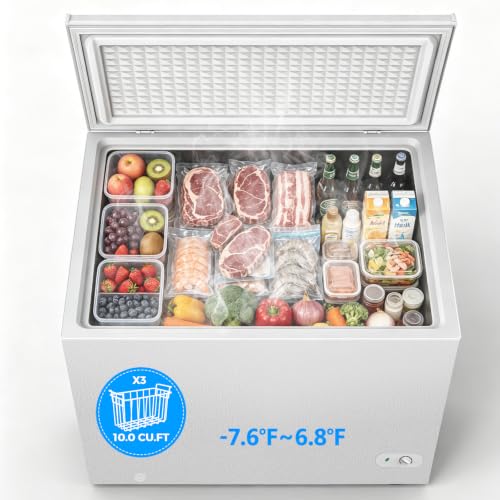
COWSAR 10.0 Cu Ft Chest Freezer Garage Ready — Best Mid-Size Step Up
Ten cubic feet is the step households take when the 7 cubic foot chest starts playing Tetris with every grocery run. COWSAR’s garage-ready model adds the detail that makes the size usable: three removable baskets riding on top of the main well. Baskets change chest freezer life more than any other accessory, because the top layer of a deep chest is where tonight’s dinner lives, while the bottom becomes the archive. Three baskets let you sort that top layer by household logic — proteins, produce, ready meals — instead of by whatever was bought last.
The freestanding, top-opening format is standard chest practice, and the garage-ready billing suits the unheated-space brief of this guide. As with every dial-controlled freezer here, spend the first week with a thermometer inside and learn where your setting truly lands across a hot afternoon. Ten cubic feet also hits a sweet spot for outage resilience: kept reasonably full, the frozen mass inside rides through a long power cut with the lid shut, which is exactly the scenario garage freezers are bought for.
- Capacity: 10.0 cu ft chest
- Positioning: garage ready deep freezer
- Interior: 3 removable baskets
- Format: freestanding, top door opening
Strengths
- Three baskets make the top layer properly sortable
- Capacity step suits growing bulk-buying habits
- Garage-ready design brief for unheated spaces
Trade-offs
- Baskets still leave the deep well to your own system
- Lesser-known brand than Frigidaire or Hamilton Beach
- Thermostat setting needs thermometer verification
Best for: households outgrowing a first small chest freezer. Not suited for: buyers who prefer the longest-established brand names.

25 Cu Ft Garage Ready Convertible Chest Freezer — Best Convertible Giant
This unbranded-in-title 25 cubic foot chest pairs the two ideas that dominate the top end of the category: garage-ready construction and a convertible chest-or-deep-freezer brief, under a double door lid. The double lid is the feature to linger on. On a chest this wide, opening one side while the other stays shut keeps the cold pool where it belongs, and it lets two people work the freezer at once during a preserving day without holding a single huge lid between them.
Convertibility at 25 cubic feet opens seasonal strategies smaller freezers cannot offer. Run the whole cabinet as a deep freezer through harvest and hunting season, then convert it to cold storage for drinks, produce and party food when the calendar turns social. The listing mentions two removable baskets, which at this scale are a starting point rather than a system; add your own crates or bins below them. Verify the brand, warranty and service details on the listing page before ordering, since the title leads with specifications rather than a maker name.
- Capacity: 25 cu ft chest
- Modes: convertible chest / deep freezer
- Lid: double door lid
- Interior: 2 removable baskets; adjustable thermostat
Strengths
- Double lid limits cold loss on a very wide cabinet
- Convertible modes suit seasonal swings in storage needs
- Capacity approaches the largest pick at a step down in size
Trade-offs
- Listing leads with specs, so check brand and warranty carefully
- Two baskets are sparse for 25 cubic feet of space
- Still a major footprint commitment in any garage
Best for: preserving households whose needs swing with the seasons. Not suited for: small garages or buyers who want a single fixed purpose.

Hamilton Beach 21 Cu Ft Double Lid Garage-Ready Chest Freezer — Best Double-Lid Design
Hamilton Beach’s 21 cubic foot model is the considered middle of the big three in this guide: large enough for a serious household reserve, organised enough to stay usable. The double door lid splits the cabinet into two working halves, and the vinyl-coated baskets ride above each side, so a household can dedicate one half to raw ingredients and the other to finished meals without the two ever mingling. The listing’s space-saving language refers to the format’s efficiency for its capacity, not to any claim that 21 cubic feet is small.
Garage-ready positioning puts it squarely in this guide’s brief, and the established brand behind it will reassure buyers wary of the unbranded giant above. Running costs at this size reward the full-chest habit: if your household’s frozen reserve genuinely lives between fifteen and twenty-one cubic feet, this cabinet keeps that mass cold efficiently and accessibly. If your reserve is really a 7 cubic foot lifestyle wearing ambition, the smaller picks will serve you better and cheaper.
- Capacity: 21 cu ft chest
- Lid: double door lid
- Interior: vinyl-coated baskets
- Positioning: garage-ready, model HBFRF2129
Strengths
- Two lids let the cabinet work as two sorted zones
- Established brand at a genuinely large capacity
- Coated baskets resist rust in a damp garage atmosphere
Trade-offs
- Still far more freezer than most homes will fill
- No convertible fridge mode listed
- Delivery and placement need planning at this width
Best for: large households wanting organised bulk storage from a known brand. Not suited for: occasional overflow freezing or tight garage corners.
How Do the Six Garage Freezers Compare at a Glance?
| Model | Capacity | Lid | Standout trait |
|---|---|---|---|
| Midea 7.0 Cu Ft Chest Freezer Convertible | 7.0 cu ft | Single | Convertible fridge-freezer with interior light |
| FRIGIDAIRE 7 Cu Ft Chest Freezer Black | 7 cu ft | Single | Simple black cabinet, wire basket |
| Hamilton Beach 30 Cu Ft Garage Ready Chest Freezer | 30 cu ft | Wide single format | Largest capacity, stated 79 inch width |
| COWSAR 10.0 Cu Ft Chest Freezer Garage Ready | 10.0 cu ft | Single top door | Three removable baskets |
| 25 Cu Ft Garage Ready Convertible Chest Freezer | 25 cu ft | Double door | Convertible at giant scale |
| Hamilton Beach 21 Cu Ft Double Lid Garage-Ready Chest Freezer | 21 cu ft | Double door | Two-zone organisation, coated baskets |
What Does Garage Ready Actually Mean for a Freezer?
A garage is the harshest room in the house for a refrigeration appliance. Summer afternoons can push an uninsulated garage far beyond kitchen temperatures, and winter nights in cold regions can drop it below freezing for weeks. A standard freezer built for a steady indoor climate may run without pause in the heat, wearing its compressor, or behave oddly in deep cold, when the ambient air confuses simple thermostat designs. Garage-ready models are built and tested to keep freezing across that wider swing of surrounding temperatures, which is why the phrase matters in this category more than almost any feature printed beside it.
Read the claim with care, though. Garage ready describes tolerance, not invincibility. A freezer baking in direct sun through a south-facing garage window, or standing against a wall that radiates stored heat all evening, still works harder than one in a shaded corner with air moving around it. Placement is the owner’s half of the bargain: out of direct sun, off any heat source, with the clearances the manual asks for. Give a garage-ready chest that placement and it will hold its temperature through weather that would defeat a kitchen-spec appliance.
Also note what garage ready does not promise. It says nothing about capacity, insulation thickness or outage endurance, and it does not excuse a half-empty cabinet. Judge it as the entry ticket for this location, then compare the picks on the things you will live with: lids, baskets, convertibility and the honesty of their stated dimensions.
How Much Chest Freezer Capacity Does Your Household Need?
A working rule treats one cubic foot of chest space as holding roughly a week’s frozen reserve for one person when the freezer is the household’s main cold store, but rules matter less than an honest audit of your habits. Count what actually arrives: the warehouse club meat run, the garden’s August output, the bread and butter stockpile, the prepared meals you batch on Sundays. Then look at how much of your current freezer sits untouched for months. The right purchase covers the real flow with a little headroom, not the imaginary flow of a household you do not quite live in.
Oversizing has a hidden cost beyond the purchase. Cold air is not what keeps food safe during an outage; frozen mass is. A 21 cubic foot cabinet holding 8 cubic feet of food behaves, in a blackout, like a poorly filled small freezer with a large air problem, and it costs more to run every ordinary day as well. Undersizing has the opposite failure: a chest crammed so tightly that air cannot circulate and the lid barely closes will freeze unevenly and frost aggressively. Both errors come from buying the brochure version of your life instead of the audited one.
Growth is the legitimate exception. A household expecting a garden expansion, a new hunting licence in the family, a baby whose food will be batched, or a side business in baked goods can reasonably buy one size up. Everyone else should let the audit speak, and remember that the 7 and 10 cubic foot picks in this guide cover the honest needs of most homes.
How Should You Organise a Deep Chest So Food Does Not Get Lost?
Every chest freezer develops an archaeology problem unless the owner imposes a system in the first month. The reliable method is zoning by depth and container. The baskets on top hold the current fortnight: this week’s proteins, the open bag of peas, the ice cream that must be defended. Below them, stack flat-frozen packs in upright files inside crates or sturdy bags grouped by category, so pulling one pack does not require excavating three others. Liquids freeze flat in bags; solid items go into square containers, because round tubs waste the corners of a rectangular chest.
Labelling is the other half of the system, and it must include a date. Write the contents and the month on every package in marker, on tape that survives cold, facing outward where the format allows. Then keep a simple inventory — a notebook on the lid, a phone note, whatever you will actually maintain — and cross items off as they leave. The households that waste the least from a big chest are not the most disciplined people alive; they are the ones whose system makes the old food visible before it becomes a mystery.
Rotate without mercy. New purchases go to the bottom or the back of their zone, older stock rises to the top, and anything unidentifiable after honest inspection leaves. A chest freezer is a savings account for food, and like any account it only pays out when someone keeps the ledger.
Where in the Garage Should a Chest Freezer Stand?
Choose the coolest wall that still lets you live with the car. North-facing and interior walls swing least in temperature; spots beside a boiler, a tumble dryer vent or a sun-blasted door swing most. Keep the cabinet level so the lid seals evenly, and respect the clearance the manual specifies around the sides and back, because a chest freezer sheds heat through its walls and suffocates politely when boxed in by stored clutter. Garages accumulate clutter exactly where freezers stand, so mark the clearance zone mentally as part of the appliance.
Power deserves the same forethought. Plug the freezer into a dedicated, properly grounded outlet rather than a shared strip already feeding chargers and power tools, and know which breaker serves it. Many owners add an inexpensive temperature alarm after their first scare; a small sensor that complains when the interior warms is cheap insurance for a cabinet holding a season of food. Keep the cord where it cannot be pinched by the lid, chafed by a car door or tripped over daily, and check the plug’s fit once a year when you clean the seal.
Finally, think about water. Garages flood at the margins — a driven rainstorm under the door, a burst pipe, meltwater from a car in winter. Raising the freezer slightly on a suitable platform where the manual allows, or at least keeping the area graded and drained, protects the cabinet base from the rust that quietly shortens a garage appliance’s life.
How Do You Defrost a Chest Freezer Without Losing the Food?
Frost is the tax a manual-defrost chest collects for its simplicity and reliability. A thin layer is normal; once frost thickens enough to steal space, lift baskets out of true or stop the lid sealing cleanly, schedule the defrost on a cool day when the frozen mass is at its lowest, ideally just before a big shop rather than just after one. Move the food into cool boxes, insulated bags or a neighbour’s freezer, packed tightly together so the items keep each other cold.
Unplug the cabinet, leave the lid open and let patience do the work, helping with bowls of warm water placed inside and changed as they cool. Never chip at ice with a knife or screwdriver: the interior walls hide refrigerant lines, and one puncture converts a chore into a replacement. Wipe the cabinet dry, clean the seal, restart the freezer and let it reach temperature before the food returns, then reload with your zones restored and the inventory updated. Most households that defrost once or twice a year find the job takes an afternoon at a stroll, and the recovered space and sealing pay for the effort immediately.
While the chest stands empty, inspect the things you never see: the drain plug, the seal’s corners, the hinge alignment and the power cord. A defrost is the one scheduled moment when the whole appliance can be checked calmly, and catching a perishing seal in October beats discovering it through a soft Christmas turkey.
How Long Will a Full Chest Freezer Stay Safe in a Power Cut?
Longer than almost any other appliance in the house, if you leave it alone. A full, unopened chest freezer commonly holds safe freezing temperatures for around two days, sometimes more in a cool garage, because the frozen food itself is the battery. A half-full cabinet may give you half that time or less, since the air inside warms quickly and there is less mass to absorb the change. This is the practical core of the capacity advice in this guide: the freezer you keep full is the freezer that protects you when the grid fails.
Discipline during the outage matters more than any trick. Every lid opening spends cold you cannot replace, so decide what you need before opening, take it out in one visit and close the lid promptly. If the outage stretches, dry ice placed on top of the food can extend the safe window, and grouping items tightly together in the middle of the chest helps the mass behave like one large block rather than scattered pieces. Keep a thermometer inside permanently; when power returns, that thermometer, not the smell test, tells you whether the food stayed at a safe temperature.
Afterwards, judge honestly. Food that still holds ice crystals or reads at refrigerator-safe temperatures can generally be cooked and eaten promptly or refrozen with some quality loss, while food that sat warm for hours belongs in the bin however expensive it was. The chest freezer buys you time and margin, not magic, and the owners who fare best in outages are the ones who planned the cabinet’s fullness long before the storm arrived.
How Should You Package Food So It Survives Months in a Chest?
Freezer burn is dehydration wearing a disguise, and packaging is the whole defence. Squeeze air from bags before sealing, wrap portions tightly, and choose containers sized to their contents so there is no pocket of air travelling with the food. Portion before freezing rather than after: a flat one-pound pack of mince thaws in a fraction of the time of a solid block, stacks like a book in the chest and lets you take exactly what dinner requires instead of defrosting a monument.
Blanch garden vegetables before freezing them, cool cooked dishes quickly and freeze them in the portions your household actually eats, and keep raw proteins in the coldest, lowest zone away from the lid’s warmer air. Sauces and soups freeze flat in bags once solid on a tray, then file upright. Bread keeps well double-wrapped. None of this requires special equipment beyond bags, wrap, a marker and the habit of freezing food at its best rather than as a rescue mission for ingredients already fading in the fridge.
Date discipline completes the craft. Frozen food does not become dangerous on a schedule so much as it slowly loses texture and flavour, so the date on the package is a quality promise to your future self. Eat in rotation, keep the inventory honest, and the chest will return food that tastes like the day it went in, which is the entire point of owning one.
What Does a Chest Freezer Cost to Run in a Garage?
Chest freezers are among the cheapest cold appliances to run, because the design itself is frugal: cold air sinks, so opening a top lid spills far less of it than opening a front door, and the thick walls of a chest insulate well. Garage conditions tax that efficiency at the extremes. A cabinet fighting a hot garage in August runs longer cycles, and one standing in deep cold may run oddly if it is not built for the range, which loops back to the garage-ready question that opened this guide.
Owners control more of the running cost than the specification sheet does. A full chest cycles less dramatically than an empty one. A clean, intact seal keeps the cold pool inside. Clearance around the cabinet lets it shed heat. A sensible temperature setting — cold enough for food safety and ice cream that scoops rather than pours, not cranked to the dial’s limit out of anxiety — avoids paying for degrees nobody eats. Set the temperature with a thermometer once, verify it across a hot week, then leave the dial alone.
The honest summary is that a well-sited, well-filled chest freezer costs a household a modest, predictable amount to run, and returns it in avoided waste, bulk prices and one fewer weekly shop. The expensive freezer is the oversized, half-empty, sun-baked one, and every factor in that description was a choice.
Chest or Upright: Why Does the Garage Favour a Chest?
Upright freezers win on shelving and lose on physics. Every opening of a front-hinged door pours the cold pool onto the floor, and the door bins that make uprights feel organised also place food in the warmest part of the cabinet. A chest keeps its cold where gravity puts it, tolerates being opened for a rummage with less loss, and offers one uninterrupted well that swallows awkward shapes — a whole turkey, a side of salmon, a tray of unbaked pies — that defeat fixed shelves.
The upright’s honest advantages are retrieval and footprint: less floor, more eye-level finding. In a kitchen or utility room those advantages often decide the purchase. In a garage, where the freezer is visited in batches rather than grazed from daily, the chest’s efficiency, capacity per footprint and outage endurance usually matter more. Households that freeze in bulk and cook from a plan will feel at home with a chest within a month; households that freeze leftovers in single portions and expect to browse should think carefully before giving up shelves.
Whichever format a household chooses, the garage rules in this guide still apply: temperature tolerance, honest capacity, a thermometer inside and a system for knowing what is in there. Format is a preference; those four are the substance.
How Do You Care for the Lid Seal and Hinges?
The seal is the hardest-working cheap part on the appliance. It flexes at every opening, traps crumbs and moisture along its folds, and quietly decides whether the compressor rests or runs. Wipe it monthly with warm water and a mild cleaner, working into the folds where mould likes to start, and dry it fully so the rubber stays supple. A seal coated in sticky spills will grab, tear and leak cold in patches long before it fails outright.
Test the seal with a sheet of paper trapped in the lid at several points around the rim. Firm resistance as you pull suggests a healthy grip; a spot where the paper slides freely marks a leak worth investigating. Check that nothing stored on top of the freezer bows the lid, that the hinges hold the lid level, and that children have not been using the rim as a step, a habit garages seem to encourage. A replacement seal, fitted early, costs little beside a season of overwork for the compressor.
Hinges earn a glance at the same time. A lid that drops the last inch instead of lowering smoothly will eventually warp its own seal, and a lid that will not stay open makes loading a two-person job. Keep hinge screws snug, keep the area behind the cabinet clear so the lid opens to its full stop, and the top of the appliance will serve as quietly as the cold well below it.
How Does a Garage Freezer Change the Way a Household Shops?
Ownership quietly rewrites the grocery list. With cold reserve space available, buying shifts from weekly need to opportunity: the meat offer worth taking in quantity, the market glut of berries at the end of a summer Saturday, the bakery discount at closing time. Households commonly find the freezer pays for its running costs in avoided waste alone, because the leftovers, the half-used ingredients and the too-much-cooked all gain a future instead of a bin.
The discipline that makes this work is freezing food at its best. A chest freezer preserves quality; it does not restore it. Ingredients heading downhill in the fridge will emerge from the freezer exactly as diminished as they entered, only colder. Shop with the freezer in mind, process purchases promptly on arrival — portion, wrap, label, freeze — and treat the cabinet as a pantry with a very long memory rather than a hospice for forgotten food.
There is a resilience dividend too. A household with a stocked garage freezer weathers a storm week, a sick week or a supply hiccup with a calm that neighbours notice. That calm, more than any single bargain, is what owners of the big double-lid models in this guide are actually buying.
How Do You Move and Install a Large Chest Freezer Safely?
Big chests punish improvisation. The 25 and 30 cubic foot models in this guide are wide enough that doorways, garage side doors and internal turns need measuring with the cabinet’s diagonal in mind, not just its width. Plan the route, recruit enough hands or a proper dolly, and keep the cabinet upright in transit; a freezer laid on its side needs a standing rest before it is switched on, so the oil in the compressor can settle back where it belongs. Check the maker’s guidance for the exact waiting period rather than borrowing a number from folklore.
Once placed, let the cabinet stand level and undisturbed, then run it empty until it reaches temperature before food crosses the rim. That first empty run proves the seal, the thermostat and the power supply in one calm test, and it gives you the moment to fit the thermometer and mark the dial position that holds your target. Loading a warm cabinet with a season of food asks the compressor to perform its hardest shift on day one, with the food warming while it waits; the empty run avoids the whole scenario for the price of a few patient hours.
Keep the packaging and transit bolts until that first run is complete. If a cabinet arrives dented near a corner or with a lid that sits crooked, photograph it before signing anything, because a compromised seal line is a lifetime sentence of frost and overwork. Delivery day is the cheapest moment to solve problems the household would otherwise pay for monthly.
Which Foods Actually Benefit Most From Chest Freezing?
Proteins bought well are the headline act: beef, pork, poultry, firm fish and shellfish all freeze with minimal quality loss when wrapped tightly and frozen fresh. Butter, hard cheeses in blocks, bread and baked goods follow close behind, which is why baking households love a garage chest. Garden produce rewards blanching and flat packing — peas, beans, corn, berries and tomato sauces emerge months later tasting like the season they came from, which no January supermarket reliably offers.
Prepared food is the quiet winner. A doubled soup, a spare lasagne, a tray of meatballs or a batch of stock converts one cooking session into several dinners, and the chest’s deep, cold stability suits those meals better than a frost-free kitchen freezer that cycles its temperature. Label these with reheating notes as well as dates, and a tired future evening becomes a decision instead of a project.
Some foods should stay out. Leafy salad leaves, raw cucumber and other high-water vegetables collapse on thawing; eggs in shells crack; soft cheeses turn grainy. Freeze those ingredients as part of a cooked dish instead, and keep the chest for the long list of foods it genuinely flatters.
What Mistakes Do Garage Freezer Buyers Make Most Often?
Buying an indoor-only freezer for an unheated garage leads the list, followed by choosing capacity from optimism rather than an audit of what the household freezes. Placement errors come next: cabinets wedged into sun traps, vents and sides smothered by stored boxes, cords trailing across walkways to shared power strips. Then there is the organisational failure — no zones, no dates, no inventory — which converts a money-saving appliance into a very cold storage unit for food nobody will ever identify again.
Two quieter mistakes deserve naming. Owners forget the thermometer, trusting a dial that was never verified, and discover the truth through soft ice cream in a heatwave. And owners skip the defrost until frost owns a fifth of the cabinet, then rush it with a sharp tool and risk the one injury a chest freezer cannot forgive. Every one of these errors is avoidable with the habits in this guide, and none of them requires spending more — only deciding earlier.
Final Recommendation
Most garages should start with the Midea 7.0 Cu Ft Chest Freezer Convertible, whose fridge mode earns its keep at holidays, or the FRIGIDAIRE 7 Cu Ft Chest Freezer Black when simple, single-purpose freezing is the whole brief. Households stepping up will find the COWSAR 10.0 Cu Ft Chest Freezer Garage Ready and its three baskets genuinely useful, while bulk preservers should choose between the double-lid Hamilton Beach 21 and the two giants by how their storage needs swing with the seasons.
Whichever cabinet earns the wall space, site it in shade, keep it honestly full and write the inventory on day one. A garage freezer rewards that small discipline by quietly turning gluts into reserves and bargains into next month’s dinners. It is the rare appliance that asks almost nothing weekly — a glance at the thermometer, a basket returned to its zone — and in exchange stands ready for the feast, the storm and the ordinary Tuesday when nobody wants to shop. Buy the size your real life fills, and the chest will repay you in the least dramatic way imaginable: by simply always being cold, full and exactly where you left it.
How Do You Keep a Garage Freezer Working Through a Heatwave?
Heatwaves test every decision made earlier in the year. The freezer that stands in shade, with its clearances open and its seal clean, rides out a hot week with longer cycles and no drama. The freezer boxed in by stored paint tins and garden furniture, baking beside a sunlit door, may lose the fight at the edges, with food near the walls softening first. Before a forecast heatwave, resist opening the lid to check anxiously; verify temperature once, then leave the cold pool undisturbed, and move any planned bulk shop to the cooler side of the weather.
If the garage regularly becomes an oven, small changes help more than worry. A vent or a fan that moves the hottest air out at ceiling level lowers the cabinet’s working burden, and keeping vehicles out of the garage while they radiate engine heat after a drive removes a surprising heat source. None of this replaces choosing a garage-ready model in the first place; it simply lets a well-chosen machine do the job it was built for under the worst conditions your climate offers.
Frequently Asked Questions
Can any chest freezer live in an unheated garage?
Not safely as a blanket rule, and the difference between a model that copes and one that quietly struggles is the whole subject of this guide. Freezers are built for a range of surrounding temperatures, and an unheated garage in a hot or cold climate can sit outside a kitchen-spec model’s range for weeks. Choose a model positioned as garage ready, place it out of direct sun with proper clearance, and verify the interior temperature with a thermometer across the seasons.
Is a chest freezer cheaper to run than an upright?
Generally yes, for two structural reasons that hold across every brand in this guide and every size from the compact chests to the giants. Cold air stays pooled inside when a top lid opens, instead of spilling out of a front door, and chest cabinets are typically insulated like a box rather than fitted with door shelving. Real running cost still depends on size, fullness and garage temperature more than on format alone.
How cold should I set a garage chest freezer?
Set it to hold zero degrees Fahrenheit or slightly below at the food, verified with a thermometer placed inside rather than trusted from the dial. That temperature keeps food safely frozen and ice cream firm. Recheck after the first serious heatwave or cold snap, since garage conditions test a setting that seemed perfect in spring.
Do I need to defrost a chest freezer?
Most chest freezers are manual defrost, so yes, plan on it once or twice a year depending on frost build-up and how often the lid opens. The job is simple if scheduled when stocks run low: cool boxes for the food, warm water bowls for the ice, no sharp tools anywhere near the walls, and a seal inspection while the cabinet stands empty.
Should I lock a garage chest freezer?
If small children play in the garage, a lock or latch is a sensible precaution, and many households in that position simply keep the garage itself closed to unsupervised play. A lock also deters casual theft in shared or street-facing garages. What a lock must never do is trap the cold in with a failed seal unnoticed, so pair it with the thermometer habit this guide keeps recommending.
Can I run a chest freezer on a garage circuit with other tools?
A freezer draws modest power while running but a noticeable surge at compressor start-up. Sharing a circuit with heavy workshop tools invites nuisance breaker trips, and a tripped breaker discovered a day late is a freezer full of loss. A dedicated outlet, or at least a circuit that does not feed saws and heaters, is the arrangement this class of appliance deserves.
What size should a family of four buy?
For most families of four, the 7 to 10 cubic foot range covers weekly bulk shopping and seasonal produce without leaving the cabinet chronically half empty. Step up to the large double-lid models only when a farm share, hunting, a big garden or a home food business genuinely produces food at that volume. If the family is still growing, or a second household’s shopping is about to merge into the same garage, buying one step up is a reasonable hedge — as long as the cabinet will be filled within the first season rather than admired half empty for years.
How Do You Decide Between One Big Freezer and Two Smaller Ones?
Some households reach the big capacities in this guide by a different route: two mid-size chests instead of one giant. The two-cabinet strategy buys redundancy — a failure costs half the reserve, not all of it — and lets one machine rest or defrost while the other carries the essentials. It also lets a household separate raw proteins from everything else completely, which keen cooks and hunters often prefer.
The single giant counters with simplicity: one seal to maintain, one inventory, one footprint planned once, and the outage endurance of a single large frozen mass. It also tends to be the cheaper route into a given total capacity. Choose by your failure tolerance and your garage geometry. A long wall suits one cabinet; two awkward corners may suit the pair. Either way, the deciding should happen on paper with a tape measure, not in the delivery doorway.
Related Guides
If the garage project is part of a wider cold-storage plan, our companion guides cover Best Chest Freezers 5 Cu Feet for smaller spaces, Best Cordless Handheld Vacuums for Pet Hair and Cars for the vehicle that shares the garage, and Best Ducted Range Hoods Under Cabinet for the kitchen at the other end of the house.


