What's inside
- Key Takeaways
- Quick Picks
- What Makes a Computerized Machine Worth Choosing?
- Which Stitches Will You Actually Use Every Month?
- How Does Each Machine Fit a Different Sewing Life?
- Comparison Table
- How Long Should a Basic Computerized Machine Last?
- Which Features Actually Matter in a Basic Computerized Machine?
- What Should Your First Three Projects Be?
- How Do You Get Cleaner Seams From a Computerized Machine?
- What Happens When Several People Share One Machine?
- How Does Computerized Control Change the Sewing Itself?
- What Mistakes Do New Computerized Sewing Machine Owners Make?
- How Should You Set Up a Sewing Space That Invites Use?
- Final Recommendation
- What Is the Real Difference Between the Two Brother Models Here?
- How Should You Match a Machine to Your Fabrics?
- What Does a Sensible First-Year Accessory Kit Look Like?
- Frequently Asked Questions
- Related Guides
As an Amazon Associate I earn from qualifying purchases. This post may contain affiliate links at no extra cost to you.
cottageverdict.com is reader-supported. When you buy through links on our site, we may earn an affiliate commission.
Where to buy: all six machines below are available through Amazon, and each name links to its listing so you can check price on Amazon and confirm which feet and tables ship in the box. Shoppers comparing the best basic computerized sewing machines usually arrive with the same worry — that “computerized” means fragile menus and a manual written in riddles. In practice, the current generation of entry machines uses the electronics to remove the fiddly parts of sewing: stitch length and width set themselves sensibly, the needle stops where you tell it to, and a buttonhole comes out the same size on the eighth shirt as on the first. What follows is a set of machines for people who sew garments, curtains, and quilts at home and want that quiet assistance without paying for embroidery modules they will never open.
Key Takeaways
- Computerized controls earn their keep through repeatability — saved stitch settings and one-step buttonholes matter more than raw stitch counts.
- A wide table transforms quilting comfort, and three of these six machines include one in the box.
- Needle up/down positioning and a speed slider are the two electronic features beginners actually use every session.
- Metal internal frames hold alignment better over years of use than all-plastic chassis at similar prices.
- Start with the projects you truly sew: garment makers need buttonholes and stretch stitches, quilters need throat space and feed control.
- Every machine here sews well out of the box, but a walking foot and fresh needles improve results more than any accessory bundle.
Quick Picks
| Pick | Badge | Why it earns its place |
|---|---|---|
| Brother CS7000X Sewing and Quilting Machine | Best Overall | Balances stitch range, table size, and friendly controls better than anything else at its level. |
| SINGER Quantum Stylist 9960 Computerized Sewing Machine | Best Feature Set | A deep stitch library with lettering, an extension table, and a hard case for storage. |
| Janome 3160QDC-T Computerized Sewing and Quilting Machine | Best for Traveling Quilters | Featherweight body, confident feeding, and a bonus quilt kit aimed at classes and retreats. |
| Janome MOD-50 Computerized Sewing Machine | Best Simple Start | Fifty well-chosen stitches and calm controls that never intimidate a first-time owner. |
| EverSewn Charlotte Computerized Sewing Machine | Best for Growing Skills | Eighty stitches with free-motion friendliness for sewists moving toward quilting. |
| Brother XR9550 Computerized Sewing Machine | Best Stitch Library Value | One hundred sixty-five stitches and a wide table for decorative work on a budget. |
What Makes a Computerized Machine Worth Choosing?
We evaluated these machines the way a home sewist actually uses them: hemming curtains on a Saturday, piecing quilt blocks across a winter, and repairing the same pair of jeans for the third time. The computerized label mattered only where it changed those jobs. Automatic needle threading saves eyes and tempers. A clear LCD that shows the recommended foot for the selected stitch prevents the classic beginner error of sewing a zigzag with a straight-stitch plate mindset. Memorized needle position — ending with the needle down — lets you pivot corners on a quilt block without the fabric creeping sideways.
Feed quality separated the field more than stitch counts did. Machines that pull fabric evenly from front to back produce seams that lie flat without coaxing, and that quality shows up in Janome’s box feed designs and in the better Brother models alike. We also looked at how each machine handles the extremes of a home workload: two layers of quilting cotton are easy for anything, but a rolled denim hem or a slippery rayon seam tells the truth about presser foot pressure and motor torque at low speed.
Ownership costs rounded out the judging. Standard low-shank feet and common bobbin classes keep accessory spending low, and every machine here uses widely available needles and bobbins you can buy anywhere. A first machine should also be liftable onto a dining table and back into a cupboard without drama, so weight and carrying handles counted, especially for readers sewing in shared spaces.
Brother CS7000X Sewing and Quilting Machine — Best Overall
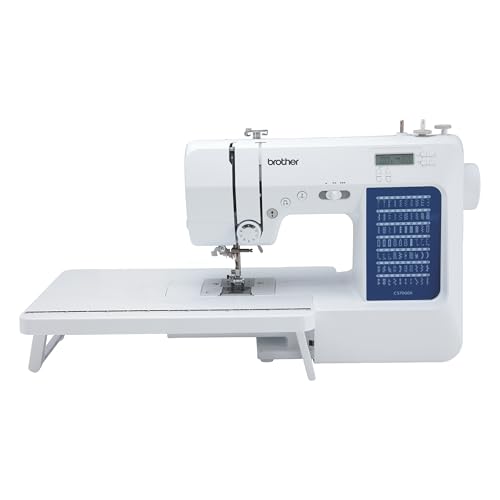
The CS7000X is the machine we would hand to a friend who asked for one recommendation and no homework. Its seventy built-in stitches cover the honest workload of a home studio — straight and stretch stitches for garments, a useful spread of decorative patterns, and buttonholes that size themselves to the button you slide into the foot. The LCD is plain and legible, the stitch selection dial behaves predictably, and the included wide table clicks on to give quilt blocks and curtain panels a flat, supportive surface that stops fabric dragging off the edge and distorting seams.
Daily manners are where it quietly wins. The needle threader works without a wrestling match, the bobbin drops in from the top with a clear cover so you can watch thread run low, and the machine starts seams gently instead of lunging. Ten included feet is a generous count at this level, covering quilting, appliqué, and zipper work before you spend anything extra. It will not sew sailcloth, and it does not pretend otherwise; within the cotton, linen, and light denim world most homes inhabit, it is composed and accurate.
- Stitches: 70 built-in including decorative and quilting patterns
- Display: LCD with stitch and foot guidance
- Table: wide table included for quilting support
- Feet: 10 included presser feet
- Threading: automatic needle threader, drop-in bobbin
A detail new owners notice within the first project is how the CS7000X handles seam starts. The machine eases into motion rather than jerking the fabric, so the first stitches land where the needle was placed instead of a millimeter behind it. That gentleness, multiplied across every seam of a quilt top or a shirt, is the difference between work that looks placed and work that looks chased. It is the kind of virtue that never appears in a stitch count, and the kind owners mention first when recommending the machine to a friend.
Strengths
- Wide table included, which most rivals at this level sell separately or omit.
- Friendly control layout that a nervous beginner can learn in one afternoon.
- Balanced stitch set sized for real projects rather than brochure padding.
Trade-offs
- Throat space is adequate rather than generous for large quilts.
- Heavy upholstery layers push the motor beyond its comfort zone.
- Lettering is absent, so monogram fans should look at the SINGER or XR9550.
Best for: most home sewists wanting one dependable machine for garments and quilts. Not suited for: heavy-duty upholstery work or buyers needing built-in lettering.

SINGER Quantum Stylist 9960 Computerized Sewing Machine — Best Feature Set
If the CS7000X is the sensible recommendation, the Quantum Stylist 9960 is the generous one. Six hundred stitches sounds like a parlor trick until you realize what the library enables: heirloom patterns for a christening gown, dense decorative bands for cushion edges, and five alphabets for labeling quilts and school uniforms. Thirteen one-step buttonholes mean a coat, a shirt, and a duvet cover each get a properly shaped opening, and the machine mirrors and elongates patterns in ways that keep a creative sewist occupied for years.
The hardware backs the software. A metal frame keeps the machine planted at speed, the extension table and hard case come in the box, and thirteen presser feet cover everything from rolled hems to cording. It is the heaviest machine in this guide, which reads as stability at the table and as commitment when you carry it to a cupboard. New owners should expect a learning weekend rather than a learning hour — the manual deserves a read, and the stitch chart deserves a home on the wall beside the machine.
- Stitches: 600 built-in with 5 alphanumeric fonts
- Buttonholes: 13 one-step styles
- Frame: metal internal frame
- Included: extension table, hard case, 13 presser feet
- Lighting: bright LED work light
The 9960’s mirror-image and elongation functions deserve more than a line, because they quietly multiply the library further. A single scallop becomes a border system; a simple vine runs in both directions around a quilt edge. Owners who sew for children discover the machine’s playful register — rows of motifs across a plain dress transform fabric-store cotton into something that looks commissioned. The depth is real, and it explains why this model keeps appearing in sewing rooms a decade after its introduction.
Strengths
- Stitch and lettering library outclasses everything else in this roundup.
- Extension table and hard case included, saving two immediate extra purchases.
- Metal frame keeps stitch quality composed at higher speeds.
Trade-offs
- Weight makes it a poor choice for sewists who must pack up after every session.
- The sheer option count can overwhelm absolute beginners at first.
- Menus reward manual-reading; casual tinkerers may underuse its range.
Best for: ambitious sewists who sew weekly and love decorative range. Not suited for: minimalists who want the lightest possible setup.

Janome 3160QDC-T Computerized Sewing and Quilting Machine — Best for Traveling Quilters
Quilters who sew at retreats, guild days, and friends’ kitchen tables measure machines in pounds, and the 3160QDC-T was designed for exactly that life. It is strikingly light for a full-featured computerized model, yet it does not feel hollow: Janome’s feed system grips fabric with an evenness that keeps long seams honest, and the stitch quality on pieced cotton is the benchmark the rest of this guide quietly chases. The bonus quilt kit bundled with this version adds the feet and accessories quilters actually pack, so the machine arrives retreat-ready.
At home it behaves like a precision instrument rather than a starter toy. The start/stop button and speed slider let you sew without the foot pedal during long piecing sessions, needle up/down is memorized, and the thread cutter snips both threads at a touch — a small luxury that saves minutes across a quilt top. Sixty stitches is a modest count on paper, but they are the right sixty, chosen for piecing, appliqué, and garment basics rather than inflated with near-duplicates. Owners who later buy a larger stationary machine often keep this one as the travel and class companion, which says plenty about its manners.
- Orientation: lightweight computerized quilting and sewing model
- Kit: bonus quilt kit included in this bundle
- Controls: start/stop button, speed slider, memorized needle position
- Convenience: built-in thread cutter and needle threader
- Character: exceptionally portable for its capability
Retreat sewists tell a consistent story about the 3160QDC-T: it is the machine that never becomes the story. It arrives, it sews accurately for three days among twenty other machines, and it goes home without a drama, a skipped stitch saga, or a borrowed-foot incident. That reliability under travel conditions — car boots, folding tables, unfamiliar lighting — is a designed quality, not luck, and it is why guild members recommend it to each other with unusual unanimity.
Strengths
- Travels to classes and retreats without punishing your shoulder.
- Feeding is even and calm, producing flat seams with little guidance.
- Thread cutter and pedal-free sewing suit long piecing sessions beautifully.
Trade-offs
- Costs more than the Brother models while offering fewer decorative stitches.
- Compact throat limits whole-quilt maneuvering on king-size projects.
- No lettering fonts for labels or monograms.
Best for: quilters who sew in more than one place and value precision. Not suited for: buyers shopping purely on stitch count per dollar.

Janome MOD-50 Computerized Sewing Machine — Best Simple Start
The MOD-50 is Janome’s answer to a fair question: how basic can a computerized machine be before the electronics stop helping? Its fifty stitches cover garment construction, home décor, and simple quilting, selected from a backlit LCD that shows settings in plain figures rather than coded icons. Three one-step buttonholes handle shirts and pillow closures, drop feed allows free-motion experiments and button sewing, and the seven-piece feed dog arrangement keeps fabric moving straight without the wandering that discourages new sewists.
What recommends it most is temperament. The machine starts slowly when asked, stops where it should, and never presents a menu tree between you and a straight seam. For a teenager’s first machine, a returning sewist after a twenty-year gap, or a household machine that several people share, that calm is worth more than a hundred extra decorative stitches. It lacks a wide table and an automatic thread cutter, and large quilts will test your patience at its modest throat — but as a foundation machine that teaches good habits, it is honestly specified and pleasantly built.
- Stitches: 50 built-in stitches
- Buttonholes: 3 one-step styles
- Feed: drop feed for free-motion work and button sewing
- Display: backlit LCD with clear setting readouts
- Threading: built-in needle threader, top-loading bobbin
Households that bought the MOD-50 for a beginner often report a second act: it becomes the mending and utility machine that stays set up when a fancier model joins the house. Its virtues — instant familiarity, honest stitches, no menus — suit the ten-minute repair exactly. A machine that remains useful after it is outgrown has justified its price twice, and the MOD-50’s calm competence gives it that staying power in sewing rooms that have seen several generations of equipment.
Strengths
- Calm, uncluttered controls that shared households pick up quickly.
- Drop feed included, opening free-motion quilting from day one.
- Janome build quality and feeding at an entry-level specification.
Trade-offs
- No wide table, so quilt support must be improvised or purchased.
- Fifty stitches will eventually limit decorative ambitions.
- Manual thread trimming; no automatic cutter at this level.
Best for: beginners and returning sewists who want calm, quality basics. Not suited for: quilters regularly finishing large quilts at home.
EverSewn Charlotte Computerized Sewing Machine — Best for Growing Skills
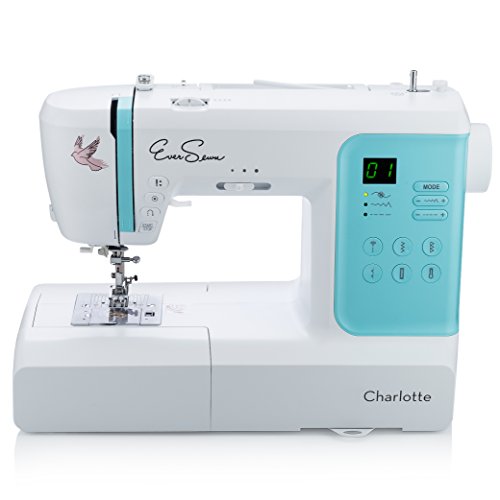
EverSewn built the Charlotte for the sewist in transition — past the first tote bag, eyeing a first quilt, and curious about free-motion work. Eighty stitches include the utility core plus decorative patterns with genuine charm, and the machine’s free-motion credentials are more than a checkbox: the feed dogs drop smoothly, the presser foot pressure suits layered cotton, and the throat lighting is bright enough to follow a stippling line without squinting. A thread cutter button and needle up/down control, features beginners do not know to ask for, are present and correctly placed.
The Charlotte also looks after the unglamorous details. Its accessory set covers quilting and general feet sensibly, the bobbin system is the familiar drop-in style, and the body has a designed, modern look that sits happily in a visible craft corner. Dealer support is thinner than Brother’s or Janome’s simply because the brand is younger, so buyers who prize a local service bench above all may hesitate. For everyone else, it occupies a sweet middle ground: more quilting intent than the MOD-50, less bulk than the 9960, and a personality that encourages experimentation.
- Stitches: 80 built-in stitches
- Quilting: free-motion capable with drop feed
- Controls: thread cutter button, needle up/down
- Lighting: bright LED needle area light
- Audience: beginner-to-intermediate sewists growing into quilting
The Charlotte’s design coherence shows in small decisions: the stitch selection is logical rather than encyclopedic, the quilting accessories feel chosen rather than bundled, and the machine’s lighting and sightlines suit the close work of free-motion stitching where the operator watches a line develop in real time. EverSewn aimed at the sewist becoming a quilter, and the aim is visible in every session — the machine keeps suggesting the next skill at exactly the moment the current one settles.
Strengths
- Free-motion setup is genuinely usable, not just advertised.
- Thoughtful controls include the cutter and needle positioning rivals skip.
- Modern design and lighting suit a permanent craft-corner setup.
Trade-offs
- Smaller dealer and service network than the legacy brands.
- No wide table included for larger quilt support.
- Stitch library, while charming, is smaller than the Brother XR9550’s.
Best for: growing sewists ready to try quilting and free-motion work. Not suited for: buyers who want a local dealer bench for servicing.

Brother XR9550 Computerized Sewing Machine — Best Stitch Library Value
The XR9550 is Brother’s value play for sewists who browse stitch charts the way cooks browse spice racks. One hundred sixty-five built-in stitches include decorative, heirloom, and quilting patterns plus lettering for names on stockings, labels on quilts, and the occasional smug tote bag. A wide table is in the box — still the single most useful quilting accessory at this level — and eight presser feet cover the core techniques. The LCD keeps selection simple, and the machine shares Brother’s familiar bobbin and foot ecosystem, so accessories bought later remain cheap and plentiful.
Compared with its sibling CS7000X, the XR9550 trades a little refinement for a lot of range. The controls feel a touch busier, and the extra stitches include some you will use twice a decade, but garment sewists who embellish children’s clothes and quilters who finish edges decoratively will mine the library weekly. It handles everyday fabrics with the same composed feeding as the CS7000X and shares its limits at the heavy end of the fabric shelf. Households choosing between the two should ask whether they value calm simplicity or creative breadth; this one is unapologetically breadth.
- Stitches: 165 built-in including lettering
- Display: LCD stitch selection
- Table: wide table included
- Feet: 8 included presser feet
- Threading: automatic needle threader, drop-in bobbin
What the XR9550 does for a sewing room’s morale should not be underestimated. Projects that would be plain — a pillowcase, a tote, a curtain hem — gain a stitched signature that makes them feel finished and giftable. For sewists whose output goes largely to other people, that embellishment is not decoration for its own sake; it is the difference between a useful object and a keepsake, and this machine delivers it at the friendliest price in the guide.
Strengths
- Largest stitch library here relative to its price class, lettering included.
- Wide table included, supporting quilts and large décor panels.
- Shares Brother’s inexpensive, widely stocked accessory ecosystem.
Trade-offs
- Many stitches are decorative duplicates most owners rarely touch.
- Interface feels busier than the CS7000X’s calmer layout.
- Like its sibling, it is not built for heavy upholstery fabrics.
Best for: embellishers and garment sewists who love decorative range. Not suited for: sewists who prefer the fewest possible choices.
Which Stitches Will You Actually Use Every Month?
Stitch libraries read like menus at a restaurant with ambitions, but home sewing runs on a short order. The straight stitch does eighty percent of all work: seams, topstitching, piecing, hems. The zigzag finishes raw edges, attaches appliqué, and sews the occasional button. Stretch stitches — the lightning bolt and triple straight patterns — keep knit garments from popping their seams at the first wear, and any machine bought for family clothing must handle them gracefully. A blind hem stitch keeps dress pants and curtains looking bought rather than made, and one good buttonhole style, honestly sized, covers shirts and duvet covers for a decade.
Everything beyond that core is seasoning, valuable exactly in proportion to your projects. Decorative stitches earn their memory space on children’s clothing, quilt borders, and holiday sewing; heirloom patterns matter to sewists making christening gowns and fine linens; lettering justifies itself the first time you label a school uniform or sign a quilt. This is why this guide refuses to rank by count alone. The MOD-50’s fifty stitches are a complete working set for most households, while the 9960’s six hundred serve a sewist whose projects genuinely roam — and both statements can be true in different houses on the same street.
A practical test before buying: list your last ten sewing projects, or the ten you honestly intend. Count how many distinct stitches they needed. Most households land between six and twelve. Then choose the machine whose strengths — table, feeding, portability, lettering — match the projects themselves, and let the stitch count be the tiebreaker rather than the headline.
How Does Each Machine Fit a Different Sewing Life?
The CS7000X belongs to the household generalist: school uniforms hemmed in September, a quilt top pieced across winter, curtains shortened when the sofa moves. Its wide table migrates on and off as projects demand, and nothing about it punishes the occasional user who sews in bursts. The Quantum Stylist 9960 suits the sewist whose calendar fills with makes — garment sewing with proper buttonholes, decorative work for gifts, lettering on everything the grandchildren own. It rewards frequency; a monthly sewist will underuse it, and it knows.
The 3160QDC-T lives in a tote bag as much as on a table. Its owner sews at guild days and retreats, pieces at home, and values the machine’s calm precision over decorative breadth. The MOD-50 is the diplomat of shared households and first apartments: several people use it, nobody fights it, and its limits arrive gently, months in, as skills grow. The Charlotte marks the transition studio — a sewist who has discovered quilting and free-motion work and wants a machine that encourages the new direction without abandoning garment basics.
The XR9550, finally, is the embellisher’s value play. Its owner decorates the edges of ordinary projects until they stop being ordinary: a plain tote gains a patterned band, pillowcases gain heirloom stitching, and the lettering function names everything in the linen cupboard. None of these lives is the correct one; the guide’s job is matching, and the reviews above are written so each reader can recognize their own sewing life in exactly one machine.
Comparison Table
| Machine | Stitches | Wide table | Best suited to |
|---|---|---|---|
| Brother CS7000X | 70 | Included | All-round home sewing |
| SINGER Quantum Stylist 9960 | 600 | Extension table included | Decorative range and lettering |
| Janome 3160QDC-T | 60 | No | Travel and class quilting |
| Janome MOD-50 | 50 | No | Calm first machine |
| EverSewn Charlotte | 80 | No | Growing into free-motion |
| Brother XR9550 | 165 | Included | Stitch library value |
How Long Should a Basic Computerized Machine Last?
With ordinary care, the honest answer is measured in decades rather than seasons. The mechanical heart of these machines — motor, feed system, needle bar — is mature technology with no appetite for obsolescence, and the electronics, having no moving parts and no fashion cycle, age more gracefully than the phones owners replace without thinking. What ends a home machine’s life is usually neglect economics: a lint-choked, needle-bent decade that makes a service visit look expensive against a shiny replacement, rather than any failure that was truly inevitable.
The brands in this guide support that horizon. Brother and Janome parts and feet circulate for models long discontinued, SINGER’s service footprint is global, and EverSewn’s growing network reflects its ambitions. Choosing among established ecosystems is therefore not brand superstition; it is buying the probability that a ten-year-old machine can be repaired in an afternoon. Keep the manual, keep the accessory box, brush the lint, and a basic computerized machine becomes one of the longest-serving tools in the house.
Which Features Actually Matter in a Basic Computerized Machine?
Ignore the stitch count arms race first. Beyond a solid utility set, the features that change daily sewing are needle up/down memory, a speed control slider, and an easy top-loading bobbin you can monitor at a glance. The Janome 3160QDC-T adds a thread cutter that quietly saves minutes on every project. A start/stop button matters if you sew long seams or have mobility reasons to skip the foot pedal. Adjustable presser foot pressure, present on the better models here, rescues both chiffon and fleece from feeding trouble.
Lighting deserves more respect than it gets. A bright LED over the needle plate reduces eye strain during evening sewing and makes dark fabrics manageable; dim machines push owners toward desk lamps and awkward shadows. Similarly, check how the machine behaves at very low speed. Piecing corners and sewing curves demand a motor that creeps smoothly rather than stalling then surging, and that quality separates the Janome and Brother models here from cheaper computerized pretenders.
Finally, consider the unglamorous economics of bobbins and feet. Every machine in this guide uses common consumables, which keeps a decade of ownership cheap. Proprietary bobbin systems are the trap to avoid in this category generally, because a Sunday-evening project should never depend on a specialty part ordered last week.
What Should Your First Three Projects Be?
Choose the first project to teach the machine’s basics without punishing mistakes: a simple tote or a pair of cushion covers in quilting cotton covers straight seams, corners, and topstitching, and forgives everything. The second project should introduce one new demand — a zipper, a buttonhole, or a knit fabric — because skills layer best singly. A garment with a button placket makes an ideal second act on the computerized models here, since the one-step buttonhole performs its small miracle repeatedly and builds the owner’s trust in the machine’s automation.
Let the third project be the one you actually wanted when you bought the machine, whether that is a quilt top, a set of curtains, or a dress. By then the threading path is muscle memory, the needle sizes live in your head, and the manual has become a reference rather than a companion. Sewists who begin with the dream project first often stall against three new skills at once and blame the machine; the staged approach exists so that the machine gets a fair trial and the sewist gets a finished object early, which is the fuel every later project runs on.
How Do You Get Cleaner Seams From a Computerized Machine?
Start each project by matching needle, thread, and stitch to the fabric, in that order. A fresh universal needle handles most wovens; switch to a stretch or ballpoint needle for knits and watch skipped stitches vanish. Let the machine choose stitch length when you select a stitch — computerized defaults are sensible — then test on a scrap sandwich of your actual layers and adjust from evidence rather than hope. Sew a sample buttonhole on scrap too, especially on the SINGER Quantum Stylist 9960, where the range of styles invites experimentation.
Guide fabric rather than steering it. Rest your hands lightly either side of the foot, let the feed dogs set the pace, and keep the fabric supported level with the needle plate — a wide table or even a stack of books at table height prevents the drag that bends seams. When pivoting corners, stop with the needle down, lift the foot, turn, and lower it again; the computerized needle memory makes this a two-second habit instead of a wrestling match.
Maintenance is the third leg. Brush lint from the bobbin area after every project, change needles far more often than feels necessary — roughly every project or two — and keep the machine covered against dust when it lives out on a table. Computerized machines forgive a great deal, but they cannot sew through a felted pad of lint, and most “timing problems” brought to repair benches are really housekeeping problems.
What Happens When Several People Share One Machine?
Shared machines live harder lives and teach clearer lessons. Settings wander as each user adjusts for a project, bobbins multiply in unmarked colors, and the manual migrates to a drawer nobody opens. Households that share well adopt three treaties: the machine is left threaded in a neutral thread with the standard foot fitted, each user keeps personal bobbins in a labeled tin, and the stitch settings for ongoing projects live on a card tucked under the machine rather than in the machine’s memory alone. These small courtesies prevent the low-grade friction that makes shared equipment feel haunted.
Computerized models have an underappreciated advantage here: their defaults are recoverable. A beginner can experiment freely, because selecting a stitch resets its length and width to the manufacturer’s sensible values — the machine forgives exploration in a way a purely manual model’s stray dial settings do not. For a family machine passing between a parent’s repairs, a teenager’s costume, and a grandparent’s quilt blocks, that forgiveness is a genuine feature, and it is one reason the calm mid-range models in this guide serve shared households better than either extreme of the market.
Sharing also argues for buying the machine the least experienced regular user can operate confidently. A flagship that one household member fears will sit idle between that member’s projects, while a friendly machine accumulates hours from everyone. Utilization, in the end, is the metric that justifies any of these purchases, and it is maximized by welcome rather than by specification.
How Does Computerized Control Change the Sewing Itself?
It helps to understand what the electronics are actually doing, because the word computerized covers three distinct gifts. The first is memory: the machine remembers stitch length and width settings, needle position preferences, and sometimes entire stitch combinations, so returning to a project after a week does not begin with reconstructing your setup. The second is precision at the extremes — a computerized machine meters out its slowest stitches evenly, where a purely mechanical machine’s pedal control turns creeping around a collar curve into a negotiation between stall and surge.
The third gift is consistency in the operations humans perform worst. A one-step buttonhole measures the button and sews four sides to match, identically, down a whole shirt front; a human with a four-step buttonhole and rising impatience produces a gradient of quality visible across the same placket. Automatic tension regulation, present in some form across this guide, forgives the fabric changes within a project — the seam that crosses from two layers to four at a pocket corner emerges without the operator touching a dial.
None of this removes the sewist from the sewing. Fabric choice, cutting accuracy, pressing, and patience remain stubbornly analog, and a computerized machine will sew a badly cut seam with perfect, repeatable fidelity. The technology’s promise is narrower and more valuable: it removes the machine from the list of things that can go wrong, so the project’s success depends on the parts of sewing that are actually yours.
What Mistakes Do New Computerized Sewing Machine Owners Make?
The most common is sewing for a month on the needle that shipped in the machine, then blaming the machine for shredded thread. The second is pulling fabric through from behind, which bends needles and defeats the feed system the electronics are coordinating. A third is ignoring the manual’s threading diagram: computerized tension systems assume the exact thread path shown, and one missed guide produces loops that look like a bobbin fault but are not.
Owners also underselect machines by shopping for the projects they imagine rather than the ones they finish. A modest machine used weekly beats a flagship gathering dust, which is why the calm MOD-50 and CS7000X satisfy so many households. Conversely, quilters who know they will finish bed quilts should not talk themselves into the smallest throat here; support and space shape finishing stamina more than stitch variety ever will.
How Should You Set Up a Sewing Space That Invites Use?
The best machine in this guide will gather dust in a home where using it requires clearing a table, hunting an extension lead, and repacking everything by dinner. Design for the burst, not the marathon: a surface the machine can reach in two minutes, light that falls on the needle rather than behind it, and storage for the current project’s pieces so an interrupted session resumes instead of restarting. Sewists who sew weekly almost always have a semi-permanent station, even if it is one end of a desk defended by treaty with the rest of the household.
Chair height and table height conspire quietly. Your forearms should rest roughly level with the needle plate, and the fabric should travel on a surface flush with the machine’s bed — a wide table achieves this for quilting, while a stack of heavy books at the machine’s left rescues large garment pieces from dragging. Keep the iron closer than feels necessary; pressing is half of sewing, and a seam pressed at the moment it is sewn behaves differently from a seam pressed apologetically at the end.
Finally, corral the small chaos: a magnetic dish for pins, a bin within dropping distance for thread ends, and the current project’s bobbins in a labeled box. These arrangements sound like housekeeping, but they are really session-lengtheners — every minute not spent hunting the seam ripper is a minute the project moves, and projects that move get finished.
Before the final section, a word about buying with a project in hand. The most reliable predictor of satisfaction in this category is not the machine’s specification but the existence of a first project waiting for it — fabric bought, pattern chosen, a date imagined. Machines purchased against a project get unboxed the same day and threaded within the hour; machines purchased against an abstraction wait for a motivation that may take months to arrive. If no project is waiting, let choosing one be part of the purchase, and let its fabric and techniques cast the deciding vote between two finalists.
It is also worth deciding where the machine will be serviced before it needs to be. Note the nearest authorized bench, save the receipt somewhere findable, and register the warranty if the maker offers one. These errands take ten minutes on the day of arrival and save a week of archaeology in year four. A basic computerized machine is a long relationship conducted mostly in pleasure; a little administration at the start keeps it that way.
Gift-giving deserves a brief protocol, because a sewing machine is a common and commonly mishandled present. Give the machine that matches the recipient’s next project, not the giver’s admiration: a returning sewist wants the calm competence of the MOD-50 or CS7000X, a teenager wants the friendliness of the Brother models, and only a demonstrated enthusiast should receive the 9960’s magnificent complexity as a surprise. Include the first project’s fabric and a pack of correct needles with the box, and the gift becomes an invitation rather than an assignment. Given well, a basic computerized machine is the rare present that manufactures its own occasions for years afterward.
One more habit separates satisfied owners from frustrated ones in the first month: sew something small every week rather than saving the machine for a heroic monthly session. Short, frequent use builds the threading and control familiarity that makes larger projects feel easy, and it surfaces small questions — a bobbin that winds unevenly, a foot that would help — while they are still cheap to answer. The machine that is used weekly becomes a household tool; the machine reserved for occasions remains a piece of equipment, and equipment intimidates where tools invite.
Keep the receipt, the manual, and one spare needle in the same drawer, and the machine’s first year will ask nothing else of you. Ownership of a good basic machine is mostly the absence of incidents, punctuated by finished projects — and that quiet ratio is exactly what the six households above are buying.
That drawer, humble as it sounds, is where good sewing years are quietly made, one uneventful and productive session at a time, in homes exactly like yours.
Final Recommendation
Buy the Brother CS7000X if you want the balanced default, the Quantum Stylist 9960 if decorative range excites you, the 3160QDC-T if your sewing travels, the MOD-50 if calm simplicity is the priority, the Charlotte if free-motion quilting is your next skill, and the XR9550 if a big stitch library at a friendly price makes you happiest. The right basic computerized machine is the one whose controls disappear under your hands by the third project, leaving only you, the fabric, and the quiet satisfaction of a seam that came out exactly where you aimed it.
What Is the Real Difference Between the Two Brother Models Here?
Sibling rivalry deserves a direct answer, since the CS7000X and XR9550 will be the shortlist for many readers. They share a platform’s virtues — feeding, bobbin system, needle threading, accessory ecosystem — and divide on temperament. The CS7000X is curated: seventy stitches chosen so that every one has a plausible project, a calmer interface, and the sense of a machine that has been edited. The XR9550 is abundant: more than twice the stitches, lettering included, for the sewist who experiences a stitch library as a palette rather than a menu.
Neither is the upgrade of the other, which confuses buyers trained by phone pricing. Choose the CS7000X if your projects are garments and quilts executed cleanly; choose the XR9550 if your projects lean decorative and you light up at the prospect of a new stitch on a plain project. Households that choose by temperament rather than by count report the curious outcome that both groups believe they bought the better machine — and both are right, which is the definition of a successful product family.
How Should You Match a Machine to Your Fabrics?
Quilting cotton is the friendliest fabric in the house and every machine here sews it beautifully, which is why it proves so little. The informative fabrics are the difficult regulars: stretchy jersey that wants to ripple, slippery rayon that creeps under the foot, and the rolled hem of a pair of jeans where four layers meet at the side seam. For knits, the recipe is a ballpoint needle, a stretch stitch, and a lighter hand — let the feed dogs move the fabric rather than stretching it through yourself. For slippery fabrics, a walking foot or tissue paper beneath the seam steadies the layers until confidence arrives.
Denim deserves its own honesty. Flat denim seams are within every machine in this guide when fitted with a denim needle and a slower pace. The intersection ridges on jeans hems are the true test, and the technique matters more than the motor: trim and grade the seam allowances, use a leveling shim under the foot at the ridge, and hand-crank the two stitches that cross the summit. Owners who learn that shim trick stop blaming machines that were never the problem.
Delicates invert the problem — the machine must be gentle rather than strong. Fine needles, reduced foot pressure where the model allows it, and a test on an inside seam keep chiffon and silk from puckering or being chewed into the feed dogs. A machine with smooth low-speed control, which the Janome models here demonstrate particularly well, turns delicate work from a gamble into a procedure.
What Does a Sensible First-Year Accessory Kit Look Like?
Resist the giant accessory bundle; buy against a list. Extra bobbins of the correct class come first, because winding mid-project breaks rhythm and tempers. A variety pack of quality needles — universal, ballpoint, denim, and a quilting or topstitch size — covers the fabric shelf. A walking foot transforms both quilting and knit sewing and is the single highest-value foot most owners ever buy. Good thread in neutral colors outperforms a rainbow of bargain thread that sheds lint into the bobbin area and snaps at seams.
Cutting and marking tools quietly decide seam quality before the machine is even threaded: a rotary cutter and mat that are not warped, a clear ruler, and marking tools that wash out. A small screwdriver and the brush that shipped with the machine handle weekly housekeeping. Everything else — specialty feet, fancy rulers, decorative thread collections — should be bought at the moment a project demands it, which keeps the sewing corner stocked with tools that have jobs rather than souvenirs of intentions.
Frequently Asked Questions
Is a computerized machine harder to maintain than a mechanical one?
Day-to-day care is identical: lint removal, fresh needles, and an occasional drop of oil only where the manual specifies. The electronics themselves need no servicing in normal home use. What changes is diagnosis — a computerized machine may refuse to sew with the presser foot up or the bobbin winder engaged, which is protection, not malfunction.
Can these machines sew quilts, or only garments?
All six can piece and quilt, with differences in comfort rather than capability. Wide tables on the Brother models and the SINGER ease large work, while the Janome 3160QDC-T feeds layered cotton with particular evenness. For very large quilts, any domestic machine asks for patience and good basting; the sewing itself is well within these models.
What does needle up/down actually do?
It tells the machine where to park the needle each time you stop: down into the fabric, or up clear of it. Needle-down parking holds your place at corners and during appliqué turns, preventing the small shifts that make points wander. Once you have sewn with it for a week, sewing without it feels oddly careless.
Do I need special thread or bobbins?
No specialty thread is required; quality all-purpose polyester or cotton thread suits every machine here. Bobbins must match the class your manual specifies, and that detail matters — the wrong bobbin class causes more mysterious tension trouble than any other single cause. Buy a pack of the correct class when you buy the machine.
Will a basic computerized machine handle denim?
Flat denim seams, yes, with a denim needle and a slower pace. Crossing four-layer hem intersections is the honest limit of this class; ease the machine over the ridge by hand-cranking or use a leveling tool under the foot. For regular heavy upholstery or canvas production, a dedicated heavy-duty model is the right tool instead.
Can a computerized machine sew leather or vinyl?
Light garment leather and craft vinyl, yes, within limits: a leather or non-stick needle, a walking or roller foot, longer stitches, and clips instead of pins, since pin holes in leather are permanent. Thick upholstery leather and multi-layer bag construction belong to heavier machines. Test every setting on a scrap of the actual material, because vinyl in particular punishes unpicking — each needle hole is a small, permanent decision.
What should I do when the machine’s stitches suddenly look wrong?
Work the boring checklist in order: rethread the machine completely with the presser foot raised, replace the needle, reseat the bobbin, and clean the lint from the bobbin area. That sequence resolves the overwhelming majority of sudden stitch problems, because most are threading or needle issues wearing a tension costume. Touch the tension dial last, and return it to its marked default before concluding anything is broken.
Related Guides
If your interest leans further toward quilting-specific machines, continue with Best Basic Sewing and Quilting Machines, where straight-stitch specialists join the computerized models. When sale season approaches, our planning guide to Best Black Friday Washing Machines shows how to judge appliance deals without invented discounts, and home bakers should not miss Best Affordable Pizza Ovens for weeknight pies from a small kitchen.



[…] with a capable sewing setup for aprons, café curtains, and cushion covers, so our guide to Best Basic Computerized Sewing Machines is a natural next read. When the drinks are for a crowd rather than a couple, step up to Best […]