What's inside
- Key Takeaways
- Quick Picks
- How We Chose These Picks
- Why does pizza need its own oven at all?
- Comparison Table
- Indoor or outdoor: which pizza life is yours?
- Which affordable pizza oven fits your kind of pizza night?
- How do you get a crisp crust from an affordable pizza oven?
- What Are the Most Common Mistakes?
- Final Recommendation
- Frequently Asked Questions
- Related Guides
As an Amazon Associate I earn from qualifying purchases. This post may contain affiliate links at no extra cost to you.
cottageverdict.com is reader-supported. When you buy through links on our site, we may earn an affiliate commission.
Pizza is the rare food where the oven is half the recipe, which is why the best affordable pizza ovens split into two honest families. Five of our six picks live indoors on the counter — rotating trays, lidded griddles, stones and combos — and one, the Ooni Koda 2, is a deliberate step-up to outdoor gas heat for readers whose pizza habit has outgrown the kitchen. We flag that difference wherever it matters rather than pretending the six are interchangeable.
Affordable here means the total cost of a good pizza night: the oven, the tools it should include, and the learning it demands. A stone and peel in the box can be worth more than a discount, and a machine matched to frozen pizza will serve most households better than a fiercer oven matched to a hobby they do not have.
Ordering notes: every pick below links to its Amazon listing, where you can check price on Amazon and confirm dimensions and included accessories. Read your own habits first — fresh dough or frozen, weekly or monthly, kitchen or garden — because in this category the honest answer to that question chooses the oven for you.
One more ground rule: no oven here, at any temperature, rescues bad dough or drowned toppings. The reviews below judge the machines on heat, evenness, tools and temperament, and leave the artistry where it belongs — with you.
We should also say what this guide is not. It is not a ranking of maximum temperatures, because the best frozen-pizza machine here runs cooler than the best fresh-dough one and both are excellent. It is a matching exercise — six good answers to six different versions of pizza night — and the reviews are written to help you recognise your version quickly.
Key Takeaways
- Decide indoor or outdoor first: only the Ooni Koda 2 cooks outside, and it is the step-up pick, not the budget one.
- Fresh-dough crusts need stored heat — a stone, as in the Chefman and Gourmia, or the Ooni’s fierce gas heat.
- Frozen pizza is its own discipline, and the rotating Presto serves it better than hotter ovens do.
- The Betty Crocker earns its place by cooking far more than pizza on its griddle plates.
- A peel included in the box (Chefman) saves beginners from the folded-pizza disaster of improvising.
- Combos like the Gourmia trade peak pizza heat for covering a whole week’s cooking in one footprint.
Quick Picks
| Pick | Badge | Why it earns its place |
|---|---|---|
| Ooni Koda 2 Propane Gas Pizza Oven 14 Inch | Step-up outdoor pick | The one true outdoor oven here: gas-fired, 14-inch stone, temperatures up to 950°F for leopard-spotted crusts in about a minute. |
| Presto Pizzazz Plus Rotating Pizza Oven | Frozen-pizza specialist | An open rotating tray with separately controlled top and bottom elements — the cult favourite for frozen and leftover pizza. |
| Betty Crocker Pizza Maker Plus 12 Inch | More than a pizza maker | A 12-inch nonstick electric griddle with a lid — pizza, quesadillas, nachos and tortillas from one red countertop clam. |
| CHEFMAN Indoor Pizza Oven | Real indoor pizza heat | A countertop electric oven that reaches 800°F with a stone and peel included — the affordable route to a proper indoor crust. |
| Gourmia Electric Indoor Pizza Oven | Pizza plus air fryer combo | Six pizza presets and seven cooking functions in one countertop oven with a cordierite stone — the combo for kitchens counting appliances. |
| Wisco 421 Pizza Oven | Snack-bar style warmer-cooker | A compact commercial-style oven with LED display, built to cook and hold snack pizzas steadily — the concession-stand approach at home. |
How We Chose These Picks
We built this list around the pizzas households actually make. Frozen and reheated pizza dominate real consumption, so two picks — the Presto and the Wisco — specialise there without apology. Fresh dough is the enthusiast’s path, served by the Chefman’s 800°F stone oven and, at full stretch, the Ooni. The Betty Crocker and Gourmia cover the households in between, where pizza shares an appliance with quesadillas, wings and toast.
Every pick was checked against its manufacturer’s listing for size, temperature claims and included accessories, and we describe only what those listings support — the Ooni’s 375–950°F range, the Chefman’s included stone and peel, the Gourmia’s function count. Where a design has a ceiling, the review says so in plain words.
Price honesty shaped the order. The Ooni leads because it is the best pizza oven here, but it is labelled a step-up in its badge, its review and these notes, so no reader mistakes it for the budget choice. Affordable guidance means showing the ladder, not hiding its top rung.
Why does pizza need its own oven at all?
A domestic oven tops out around the temperature a pizza merely tolerates. Pizza wants the opposite arrangement: a fierce, stored-heat base that crisps the crust in minutes while the toppings are still vivid. That is why pizza stones, steels and dedicated ovens exist — they concentrate heat where the dough sits, instead of warming a large box of air and hoping the pizza forgives it.
The dedicated designs here attack the problem from different angles. The Ooni surrounds the pizza with near-commercial heat. The Chefman and Gourmia store heat in a stone. The Presto sidesteps storage entirely, rotating the pizza through close elements. The Betty Crocker presses heat from both sides at once. Each method can produce a good pizza; they produce different pizzas, which is why matching machine to taste matters more than matching it to a budget line.
There is also the question of rhythm. A main oven commits you to a long preheat and a hot kitchen; a countertop pizza oven is ready when the dough is, cooks in minutes, and lets pizza night happen on a Tuesday. Frequency changes everything — households that make pizza weekly develop opinions, and this guide is written for the opinions they will actually form.
Finally, pizza ovens teach. Because the cook watches the crust and turns the pizza, skills form quickly: how much flour the peel needs, when a base is ready to top, how a minute changes cheese. The best affordable oven is partly the one whose lessons you will enjoy learning.
There is an economics lesson baked into this category. A household that makes pizza weekly at home spends a fraction of the takeaway habit’s cost, and the oven — even the Ooni — pays for itself in a season of Fridays. Affordable, in pizza, is therefore not really about the ticket price; it is about how many Friday nights the machine will serve, and every pick here is built for years of them.
The social economics matter too. Pizza made at home is an activity as much as a meal: children top their own, guests gather around the hot oven, and the cook’s mistakes are eaten laughing. The machines in this guide are, in that sense, not appliances but excuses — and the best excuse is the one matched to the household that will actually use it.

Ooni Koda 2 Propane Gas Pizza Oven 14 Inch — Step-up outdoor pick
Every affordable pizza guide needs one honest stretch pick, and the Koda 2 is ours — flagged plainly rather than smuggled in. It is an outdoor propane oven, not a countertop appliance, and it costs more than everything else on this page; check price on Amazon and treat it as the step-up for readers who already know they love making pizza and want the real thing. What the extra money buys is heat no indoor electric oven here can approach: a stone that climbs toward 950°F and cooks a Neapolitan-style pizza in about a minute.
That heat changes the crust entirely. At those temperatures the base crisps before the toppings dry, the rim puffs into the leopard-spotted cornicione that defines the style, and a pizza night stops tasting like a compromise against the takeaway. The 14-inch stone is the sensible size, too — large enough for a proper sharing pizza, small enough that the oven stays portable between patio, garden and a friend’s driveway.
Gas is the forgiving fuel for beginners. There is no fire to build or feed, the temperature answers the dial within minutes, and the included regulator and hose mean the box contains what a first cook needs besides the bottle. Preheat is measured in tens of minutes rather than the electric ovens’ few, but the stone’s stored heat is exactly what the crust has been waiting for.
The boundaries deserve the same plainness as the praise. This oven lives outdoors, needs a propane bottle and a stable surface, and offers nothing to the cook whose pizza night happens in a fourth-floor flat. Storage, weather and the British-style rain shower all enter the calculation. It is a garden appliance, and gardens are its condition.
Running costs are modest — a bottle lasts through many pizza nights — but the first setup should be unhurried: leak-check the connection, season the stone with a first empty heat, and expect the first two pizzas to be tuition. Everyone’s first high-heat pizza teaches the same lessons about launching and turning; the Koda simply teaches them at professional temperatures.
Technique matters more here than in any indoor pick. A light hand with flour on the peel, a confident launch, one turn halfway — the oven rewards practice visibly, pizza by pizza, which is part of its hold on people. Affordable indoor ovens forgive; this one improves you.
It also anchors the top of the category honestly. Readers who start indoors often end up here within a year, and knowing the destination helps the first purchase make sense: buy the indoor oven for winter, graduate to the Koda for summer, and the two together still cost less than many single premium outdoor ovens.
For households with outdoor space and a genuine pizza habit, this is the pick that ends the search rather than postponing it. The crust it produces is the argument, and the argument is not close.
Choose it if pizza night is a hobby, not an event — and if your garden, not your countertop, is where the oven will live.
A practical word on siting: the Koda wants a sturdy, level, heat-proof surface with room behind it for the bottle and room in front for the peel’s swing. A rickety garden table undermines the confidence the launch requires, so budget the oven a proper stand or a solid bench from the start. Enthusiasts treat the setup as part of the ritual — oven, peel, flour, toppings laid out in order — and the ritual is half the pleasure they paid for.
Ownership, finally, tends to reorganise a household’s Fridays around it. Friends learn to bring dough instead of wine, children request turns at the peel, and the garden gains a hearth it never had. Appliances that reorganise a social life are rare at any price; that this one also makes the best pizza in the guide is almost a footnote.
- Fuel: propane gas, 28 mBar regulator and hose included
- Pizza size: up to 14 inch
- Temperature range: 375°F to 950°F
- Use: outdoor only
- Style: portable countertop for garden or patio
- Brand: Ooni Koda line
Strengths
- True high-heat crusts no indoor pick matches
- Gas control suits beginners to the style
- 14-inch stone is the versatile size
Trade-offs
- Outdoor only, needs propane and storage
- Costs more than the indoor picks
- First pizzas are a learning curve
Best for: Garden owners ready to step up to real pizza heat.
Not suited for: Flat dwellers needing an indoor countertop oven.

Presto Pizzazz Plus Rotating Pizza Oven — Frozen-pizza specialist
The Pizzazz Plus looks like a flying saucer that wandered into the kitchen, and it has survived for decades because the odd design solves a real problem. Frozen pizza — the pizza most households actually eat — needs its base crisped and its cheese melted at different rates, and this machine attacks the problem with a rotating tray and heating elements above and below that you can run together or separately. The pizza turns constantly through the heat, so it cooks evenly without a preheated stone or a hot oven.
There is no preheat to speak of and no oven cavity to heat a small kitchen in summer. You set the frozen pizza on the tray, choose your elements, and watch it cook in the open air like a tiny fairground ride. For teenagers feeding themselves, students in shared houses and anyone reheating slices, that immediacy is the whole appeal — pizza as a snack appliance, not a project.
The open design is also its limit. Without an enclosed hot cavity there is no fierce top heat, so fresh dough pizzas emerge cooked but pale compared with a stone oven’s work, and the machine’s talents point firmly at the frozen and leftover end of the repertoire. Presto has never pretended otherwise, and owners love it precisely because it does its one job without ceremony.
Element control is the detail to learn. Bottom only crisps a soggy base, top only rescues cheese that is lagging, and both together handle the standard frozen disc. A few pizzas teach the settings better than any chart, and the rotating view means you can see doneness arriving rather than guessing through a door.
Cleanup is almost unfairly easy: the pan lifts off, the crumbs brush away, and there is no stone to season or scrape. In a rental kitchen or a games room, where the pizza oven shares space with everything else, that simplicity keeps the appliance in use instead of in a cupboard.
Energy use is modest because nothing is heated but the pizza itself — no litre of oven air, no stone to bring to temperature. For a single frozen pizza on a weeknight, it is arguably the most proportionate machine on this page.
Its following is genuinely a following: owners replace like with like when one finally dies, often after years of weekly service. Affordable appliances rarely inspire loyalty; the Pizzazz does, by being exactly as good as its promise and no more complicated.
It will not make a pizza-night host famous, and it is not trying to. It will make a frozen pizza on a Tuesday taste like someone cared, in minutes, with a washing-up load of one pan.
Pick it if frozen pizza is your real diet and fresh dough is a rare guest. Nothing else here serves that diet as directly.
It is worth understanding why the rotation matters, because it explains the results. A frozen pizza in a static oven cooks where the elements dictate, and home ovens dictate unevenly; the Pizzazz simply moves the pizza through every zone in turn, averaging the heat the way a rotisserie averages a roast. The cheese melts in a continuous, observable progress, and the cook becomes a supervisor rather than a gambler — which, on a tired weeknight, is a genuine luxury.
Its second career, in many homes, is as the reheating champion. Leftover slices — the saddest food in most kitchens — come back with crisp bases and lively cheese because the bottom element and the rotation work together. A machine that improves leftovers as much as it cooks frozen pizza earns its counter space twice over.
- Design: open rotating tray
- Elements: upper and lower, separately selectable
- Pizza size: up to 12 inch
- Use: indoor countertop
- Speciality: frozen and reheated pizza
- Cleaning: nonstick pan removes
Strengths
- No preheat, cooks frozen pizza fast
- Separate top and bottom elements
- Pan lifts off for easy cleaning
Trade-offs
- Fresh dough crusts stay pale
- Open tray suits one pizza at a time
- Counter footprint is wide and round
Best for: Frozen-pizza households, students and snackers.
Not suited for: Fresh-dough purists chasing blistered crusts.
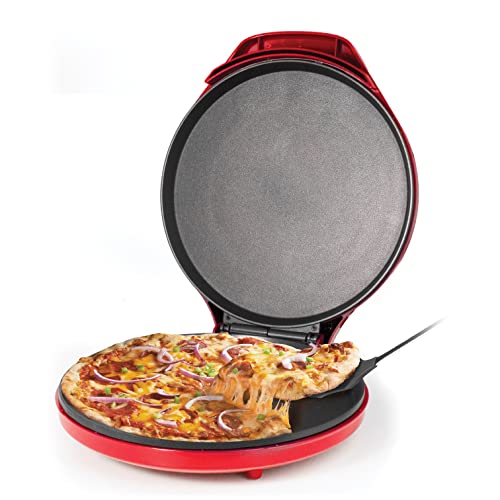
Betty Crocker Pizza Maker Plus 12 Inch — More than a pizza maker
The Betty Crocker Pizza Maker Plus is not really an oven, and understanding that is the key to loving it. It is a lidded electric griddle — two hot nonstick plates that close over a 12-inch pizza — and what it loses in oven drama it gains in versatility and speed. The same plates that crisp a pizza base will press a quesadilla, warm tortillas, bake nachos into submission and turn out pancakes, which in a small kitchen is a serious argument: one appliance, five weeknight jobs.
Pizza from it is its own style: evenly cooked, crisp-bottomed, with cheese melted by the top plate’s proximity rather than by radiant fierceness. Fresh dough works if rolled thin; tortilla and flatbread pizzas work brilliantly; a deep, pillowy Neapolitan rim is beyond its brief and it would be dishonest to pretend otherwise. Within the thin-and-crispy school, results are consistent and quick, with no preheated stone to manage.
The nonstick surface defines the ownership experience. A wipe while warm handles most messes, there are no accessories to lose, and the whole unit stores upright in a cupboard like a sandwich press. For a family kitchen where the pizza maker competes for space with everything else, that storability decides whether it gets used weekly or annually.
Power is a healthy 1440 watts, so the plates come to temperature quickly and recover between pizzas — useful when children queue with different topping demands. The indicator lights are the whole control system, which limits finesse but eliminates hesitation; there is nothing to programme and nothing to mis-set.
It is also, quietly, a kind appliance for new cooks. Nothing in it gets hot enough to be frightening, the lid contains splashes, and a first quesadilla succeeds on the first attempt. Households teaching children to cook will find it earns counter space far beyond pizza night.
The limits are physical: twelve inches is twelve inches, the lid height caps thick toppings, and two pizzas for a crowd means cooking in sequence. Plan for that rhythm — first pizza sliced and shared while the second cooks — and the machine’s pace stops feeling like a constraint.
Betty Crocker’s name carries a particular promise of unfussy, tested home cooking, and this appliance keeps it. Nothing here is artisanal, and everything here works on the first try, which is its own school of quality.
As a pizza purist’s oven it would fail; as a small kitchen’s hardest-working hot plate that also makes good pizza, it is genuinely hard to beat at an affordable level.
Choose it if your kitchen needs a multi-tasker and your pizza style runs thin, crispy and family-friendly.
Breakfast deserves a mention in this review, because the plates that crisp a pizza base also produce excellent hash browns, reheated waffles and griddled sandwiches. In a household counting appliances, a machine that covers breakfast, snacks and pizza night has effectively tripled its value before dinner is discussed. That breadth is why this unassuming red clam keeps appearing in small kitchens whose owners have no patience for single-purpose gadgets.
Parents report a use the designers may not have foreseen: it is the appliance children graduate to. The closed lid, the moderate temperatures and the instant success of a quesadilla make it a safe first cooker, and a child who can make their own snack has taken a real step. Family kitchens run on such steps, and this machine provides them cheaply.
- Size: 12 inch cooking surface
- Power: 1440W
- Surface: nonstick griddle pan
- Use: indoor countertop, lidded
- Also cooks: quesadillas, tortillas, nachos
- Model: BC-2958CR
Strengths
- Griddle plates cook far more than pizza
- Nonstick surface wipes clean in seconds
- Stores upright like a sandwich press
Trade-offs
- No high-heat crust or puffy rim
- Lid height limits thick toppings
- One 12-inch pizza at a time
Best for: Small families wanting one appliance for many snacks.
Not suited for: Neapolitan-style pizza seekers.

CHEFMAN Indoor Pizza Oven — Real indoor pizza heat
The Chefman is the pick for readers who want the outdoor style of crust without the outdoors. Its headline is honest and unusual at this level: up to 800°F on a countertop, with a pizza stone and a peel in the box, so a 12-inch fresh pizza cooks in minutes with a properly crisped, spotted base. That temperature is the whole story — it is what separates pizza ovens from toaster ovens with pizza settings, and the Chefman is the affordable indoor machine that actually reaches it.
Five touchscreen presets translate the heat into decisions a beginner can make: styles from Neapolitan-leaning to thin crust, each with a tested time and temperature, plus manual control for cooks who have formed their own opinions. The learning curve is therefore gentle at the start and unnecessary to outgrow, which is exactly how an affordable specialist should behave.
Including the stone and peel matters more than it sounds. The peel is not an accessory but the tool the whole technique depends on — building the pizza on a floured peel, launching it onto the stone, retrieving it without incident — and bundles that omit it send beginners to improvise with baking trays, which ends in folded pizzas and oven mitts in the sauce.
Indoor high heat comes with indoor responsibilities. The oven needs counter space with clearance, the stone needs a full preheat to do its work, and the kitchen will know you are making pizza — a little smoke from flour on a hot stone is part of the theatre. Ventilation on, window open, and the theatre stays enjoyable.
Fresh dough is where it earns its keep, but it is no one-trick machine: frozen pizzas cook with a crispness the rotating and griddle designs cannot match, because the stone stores heat and gives it back to the base. Leftovers, too, revive properly on a hot stone in a way that shames the microwave.
The stainless cabinet is sized like a serious countertop oven rather than a novelty, so measure before ordering. In return you get the only indoor pick here whose results can be served, without apology, to a friend who owns an outdoor oven.
Stone care is the one discipline it asks: let it cool in the oven, brush it clean, never soak it or soap it, and accept that it will stain into a map of your pizza history. That staining is cosmetic and, veterans insist, a badge of honour.
Against the Ooni above, the trade is clear — a lower ceiling of heat and a 12-inch limit, in exchange for cooking indoors in January. For most households in flats and cold climates, that trade is not a compromise but the entire point.
Choose the Chefman if fresh-dough pizza is the goal and your kitchen, not your garden, is the venue. It is the affordable indoor oven that takes crust seriously.
The presets repay a brief apprenticeship. Run the Neapolitan-leaning setting with a light hand on the sauce, then the New York setting with a fuller topping load, and you will learn more about your own dough in two pizzas than a manual can teach in an evening. The oven’s ceiling of heat forgives beginners more than cooler machines do, because a properly hot stone rescues timing errors that a lukewarm base would turn into sogginess.
Against its indoor rivals, the Chefman’s identity is focus. It does not air fry your wings or toast your breakfast; it makes pizza, at temperatures the combos cannot reach, with the tools included. Specialisation is a risk in a small kitchen and a virtue at the table — and the table, on pizza night, is where this oven argues its case.
- Top heat: up to 800°F
- Pizza size: 12 inch
- Presets: 5 touchscreen presets
- Included: pizza stone and peel
- Use: indoor countertop, electric
- Finish: stainless steel
Strengths
- 800°F heat crisps fresh dough properly
- Stone and peel included in the box
- Presets help beginners, manual mode grows
Trade-offs
- Needs preheat time and counter clearance
- Stone stains and must never be soaked
- 12-inch ceiling on pizza size
Best for: Indoor cooks who want a real crust from fresh dough.
Not suited for: Anyone short on counter space or patience for preheating.

Gourmia Electric Indoor Pizza Oven — Pizza plus air fryer combo
Some kitchens cannot justify a single-purpose appliance, and the Gourmia is built for exactly those kitchens. It is a countertop air fryer toaster oven that takes pizza seriously — six dedicated pizza presets and a cordierite stone in the box — while also air frying, broiling and baking the rest of the week’s food. The question it answers is not how to make the world’s best pizza, but how one affordable box can cover pizza night and everything around it.
The pizza performance is the pleasant surprise. A cordierite stone behaves as a stone should, storing heat and crisping a base, and the presets remove the guesswork for the common styles. It will not reach the Chefman’s fierce ceiling, and head-to-head on a Neapolitan brief the Chefman wins; but for the frozen, the thin-and-crispy and the family-style pizza that most households actually make, the Gourmia’s results are properly satisfying.
The other six functions are not padding. Air frying handles the sides that pizza night demands — wings, fries, garlic bread — in the same appliance, in sequence, without heating the main oven. For a small household, a combo that covers this much ground can retire two other appliances from the counter, which is a saving of space no discount can match.
Combos ask for honest accounting, though. Jack-of-all-trades ovens carry more controls to learn, more accessories to store and more surfaces to clean than a specialist, and the air fryer basket and stone will compete for cupboard room. Buyers who only ever make pizza should buy the specialist; buyers whose cooking is varied will use every function here.
The stainless format sits like a toaster oven because it is one — familiar proportions, a door you can watch through, and a footprint most counters already know how to host. That familiarity lowers the household learning curve to nearly nothing, which matters when the appliance must serve everyone.
Presets deserve a word of method: run each pizza style once, note the result, and adjust a minute either way for your dough and your toppings. Combo ovens reward that small calibration because their presets are written for an average pizza that nobody actually makes.
Cleaning is the combo tax in daily form — crumbs from toast, splatter from air frying, flour from pizza all share one cavity. A crumb tray and a weekly wipe keep it civilised, but fastidious cooks should know the specialist ovens ask less of them.
Judged as a pizza oven alone it places mid-field; judged as the one box a small kitchen buys this year, it may be the smartest money on the page. Context, as ever in this category, is the specification that matters.
Choose the Gourmia if pizza is one of several jobs your countertop oven must do, and do them all in one footprint.
Think of the Gourmia’s week as a roster: toast at breakfast, air-fried leftovers at lunch, a pizza on Friday, garlic bread beside Sunday’s pasta. No single performance needs to be the best on this page for the roster to be the best value — versatility compounds daily, while a specialist’s advantage appears only on its one night. Households honest about their roster choose better ovens than households shopping for a single perfect pizza.
The Gourmia’s stone deserves explicit credit, because combo ovens often treat pizza as a setting rather than a system. Including a cordierite stone signals that the pizza function was engineered, not appended, and the bases it produces — crisp, evenly coloured, properly baked through — confirm the signal every Friday.
- Functions: 7 cooking functions including air fry, broil, bake
- Pizza: 6 pizza presets
- Stone: cordierite pizza stone included
- Use: indoor countertop, electric
- Format: air fryer toaster oven combo
- Finish: stainless steel
Strengths
- Seven functions replace several appliances
- Cordierite stone crisps pizza bases
- Six presets simplify pizza night
Trade-offs
- Peak pizza heat below the Chefman
- More accessories to store and clean
- Controls take longer to learn
Best for: Small kitchens needing one oven for many jobs.
Not suited for: Single-purpose pizza perfectionists.

Wisco 421 Pizza Oven — Snack-bar style warmer-cooker
The Wisco 421 comes from a different world than the others: not the home-kitchen catalogue but the concession stand, the bowling alley, the petrol-station counter where a frozen pizza must cook predictably for whoever is on shift. Its compact cavity and LED display are built for repetition — the same snack pizza, cooked the same way, hour after hour — and that foodservice DNA is its charm for the right buyer.
At home, that translates into an oven for the games room, the den, the home bar or the teenager-dominated household where frozen pizzas are less a meal than a utility. It asks little counter space, heats without ceremony and holds its results steadily, which is why you will find its cousins keeping snacks warm in small venues everywhere.
The cooking itself is honest snack-bar cooking: frozen pizzas emerge evenly done and properly hot, fresh artisan dough is not its language, and no one who has seen a concession stand would expect it to be. Judged on throughput and predictability rather than on crust artistry, it is excellent at what it is.
Controls are correspondingly plain. The LED display tells you what you need, the cavity takes the standard snack sizes, and there is no programme library to learn. Staff-proof, in foodservice language, means a new user cannot really get it wrong — a quality that transfers surprisingly well to households with rotating cooks.
Build expectations should follow the heritage: these are working appliances, finished for function, and the Wisco looks like what it is. Kitchens styled for photographs may prefer the stainless theatre of the Chefman or Gourmia; utility rooms and dens will find the Wisco’s honesty refreshing.
Energy and heat suit its role — it is not trying to reach pizza-oven temperatures, so it does not heat the room or demand special clearance theatre. It warms up, cooks the snack, and waits for the next one, which is a rhythm many homes actually live by.
There is also a durability argument from its day job. Appliances designed for light commercial repetition are built to be opened a hundred times a week, and home use is gentle by comparison. Bought for a busy household’s snack traffic, the Wisco is likely to outlast fashion-driven rivals.
It is the narrowest pick here, and deliberately so: a specialist in the frozen, the quick and the repeated. Every guide benefits from one product that knows exactly what it is.
Choose the Wisco if your pizza reality is frozen snacks served often, in a room that is not really a kitchen.
There is a particular household this oven understands: the one with a basement bar, a pool table or a film room where snacks appear in waves and nobody wants to climb to the kitchen between rounds. Parked on a side counter with a stack of frozen pizzas in the freezer below, the Wisco turns that room into a self-sufficient snack station. It is a modest ambition, completely fulfilled, which is more than many grander appliances manage.
Second-hand and surplus buyers meet the Wisco often, a by-product of its commercial life, and it is one of the safer used buys in this guide: simple mechanics, a working heritage, and a mug-of-nothing test — just run it empty and watch the display and the heat. New or used, it remains the snack specialist’s snack specialist.
- Style: compact countertop snack oven
- Display: LED
- Use: indoor, home or light commercial
- Speciality: frozen and snack pizzas, holding
- Brand: Wisco, foodservice heritage
- Format: drawer-style cavity
Strengths
- Foodservice design built for repetition
- Compact footprint suits dens and bars
- Simple controls anyone can run
Trade-offs
- Not designed for fresh artisan dough
- Functional looks over kitchen styling
- Narrower repertoire than rivals
Best for: Games rooms, home bars and heavy frozen-pizza traffic.
Not suited for: Fresh-dough cooks and styled kitchens.
Comparison Table
| Pick | Headline trait | Watch out for |
|---|---|---|
| Ooni Koda 2 | True high-heat crusts no indoor pick matches | Outdoor only, needs propane and storage |
| Presto Pizzazz Plus | No preheat, cooks frozen pizza fast | Fresh dough crusts stay pale |
| Betty Crocker Pizza Maker Plus | Griddle plates cook far more than pizza | No high-heat crust or puffy rim |
| CHEFMAN Indoor Pizza Oven | 800°F heat crisps fresh dough properly | Needs preheat time and counter clearance |
| Gourmia Electric Indoor Pizza Oven | Seven functions replace several appliances | Peak pizza heat below the Chefman |
| Wisco 421 Pizza Oven | Foodservice design built for repetition | Not designed for fresh artisan dough |
Indoor or outdoor: which pizza life is yours?
The indoor picks share one great virtue: pizza night survives the weather. Rain, dark evenings and cold gardens cancel nothing when the oven sits on the counter, and for households in flats the question answers itself. Indoor ovens also integrate with the rest of cooking — the salad is made beside them, the wine is already open, the cook is not exiled to the patio.
The outdoor step-up offers a different social shape. Cooking outside becomes the gathering point, guests watch pizzas launch and blister, and the kitchen stays cool and clean. The Ooni’s heat is the headline, but the occasion it creates is half its value — which is why enthusiasts rarely regret graduating.
Plenty of households end up owning both rhythms across a year: the countertop oven for Tuesdays, the garden oven for summer Saturdays. If you are choosing the first one, choose for the season and the room you will use most, and let the second wait until the habit proves itself.
Which affordable pizza oven fits your kind of pizza night?
Start with the dough question, because it eliminates half the page. If your pizzas arrive frozen, the Presto and Wisco were designed for you and the stone ovens’ virtues are mostly wasted. If you make or buy fresh dough, the stone is non-negotiable — Chefman indoors, Ooni outdoors — because no element-only design crisps a raw base the way stored heat does.
Then count the mouths and the minutes. One pizza at a time is the rhythm of every pick here, so a household of five is really buying a sequence, not a single cook. Ovens that recover heat quickly between pizzas — the gas Ooni above all — serve a crowd with less sag in quality from first pizza to last.
Weigh the counter honestly. The Chefman and Gourmia claim toaster-oven footprints and preheat time; the Presto claims width but no preheat; the Betty Crocker stores upright and multitasks. In a small kitchen, the oven that also presses quesadillas or air-fries wings may serve pizza night better than a specialist that spends its off-days in a cupboard.
Accessories close the decision. A peel, a stone that fits, a brush for the stone — buying the oven without its tools is buying half a system. The Chefman’s included stone and peel and the Gourmia’s included stone are worth real money in the comparison, and the Ooni’s appetite for a turning peel should be budgeted by enthusiasts from the start.
Fuel and running costs separate the families quietly. The indoor electrics cost pennies per pizza and ask nothing but a socket; the Ooni asks for propane, which is still cheap per pizza but adds a bottle to store, exchange and keep an eye on. Neither is a burden, yet the household that hates errands should notice which side of that line it prefers.
Noise and heat belong in the same calculation. Indoor ovens warm the kitchen and fill it with the smell of baking — a pleasure in January, a negotiation in August. The outdoor oven keeps both outside, at the price of the cook’s company. Pizza night is social either way; the question is where the society happens.
How do you get a crisp crust from an affordable pizza oven?
Respect the preheat wherever a stone is involved. A stone that has not absorbed heat is a cold plate with good publicity; give the Chefman, Gourmia or Ooni the full preheat their manuals ask for, and the base will crisp instead of steaming. The stone’s stored heat is the product you bought — let it accumulate.
Flour the peel, not the pizza. Build the pizza on a lightly floured or semolina-dusted peel, shake it gently before launching to confirm it slides, and commit to the launch in one motion. Hesitation folds pizzas; confidence lands them. Cornmeal works too and adds a pleasant crunch at the rim.
Go lighter on toppings than instinct suggests. Affordable ovens, especially the indoor ones, reward restraint: a thin sauce layer, cheese with gaps for steam to escape, toppings patted dry. A drowned pizza steams its own base soggy in any oven ever made, and most disappointing results blamed on machines are really topping decisions.
Turn the pizza once, halfway, wherever the design allows it. Even good heat has a hot side, and a single confident turn equalises the rim’s colour. Then let the finished pizza rest a minute on a rack — not a plate, where its own steam softens the base you worked for — before slicing.
Rest the dough at room temperature before stretching. Cold dough fights back, tears, and bakes into a dense disc in any oven on this page; an hour on the counter makes it cooperative. Stretch by hand from the centre outward, leaving the rim untouched, and even an affordable oven will reward you with a crust that has structure.
Slice on a board, rest on a rack, and cut with confidence. A pizza cutter dragged timidly tears cheese across the surface; one firm pass per line keeps the topping where it was placed. Small rituals like these are the difference between pizza that looks made and pizza that looks assembled.
What Are the Most Common Mistakes?
Judging every oven by Neapolitan standards
Frozen-pizza households do not need 950°F, and buying it anyway buys preheat time and learning curve they never wanted. Match the oven to the pizza you actually eat.
Skipping the stone’s preheat
A rushed preheat is the most common cause of the pale, soft base that gives indoor pizza ovens a bad name. The stone is the oven; heat it properly.
Overloading the toppings
Wet, heavy toppings steam the base and slide in the launch. Restraint produces better pizza in every design on this page.
Soaking or soaping a pizza stone
Stones are porous and drink detergent. Brush them clean, let heat burn off residue, and accept honest staining as the record of good pizzas.
Improvising without a peel
Fresh pizza built on the stone or slid from a baking tray folds, tears and teaches despair. The peel is not an accessory; it is half the technique.
Final Recommendation
For most readers the Chefman is the sweet spot of this guide: genuine indoor heat, a stone and peel in the box, and crusts that need no apology. Frozen-pizza households should save their money and take the Presto, whose rotating honesty has satisfied owners for decades, while the Betty Crocker and Gourmia serve the kitchens that need their pizza oven to hold down other jobs as well.
And then there is the Ooni, waiting at the top of the ladder for the reader who has stopped pretending this is casual. If pizza has become your hobby, its gas-fired heat is where this road leads, and buying the step-up once is cheaper than buying every rung. Whichever rung you choose, choose it for the pizza night you actually have — the right affordable oven is the one still in use, weekly, a year from now.
A closing thought for the undecided: your first pizza oven teaches you what your second one should be. Buy for your current dough, your current room and your current Fridays, and let the lessons accumulate. Every pick here can be the right teacher — the art is choosing the one whose lessons you will enjoy.
Start your shortlist with the Ooni Koda 2, weigh it against the Presto Pizzazz Plus, and keep the Betty Crocker Pizza Maker Plus in view before you decide.
Frequently Asked Questions
Can an affordable pizza oven really beat a takeaway?
With fresh dough and a properly heated stone, yes for freshness and customisation — the pizza is minutes old and topped exactly as you like. Takeaway still wins on effort, which is why the frozen-pizza picks exist for the other kind of evening.
How long does a countertop pizza oven take to preheat?
The stone ovens need a real preheat — plan on a quarter of an hour or more for the stone to store serious heat. The Presto and Betty Crocker, with no stone to charge, are ready in a few minutes, which is their weeknight superpower.
What size pizza do these ovens make?
Mostly 12-inch pizzas indoors, with the Ooni Koda 2 stretching to 14 inches outdoors. Twelve inches feeds two moderate appetites or one committed one, and two pizzas in sequence is the standard rhythm for a family.
Can I cook anything else in a pizza oven?
The Betty Crocker and Gourmia are built to — quesadillas, flatbreads, wings, toast and more. The specialist ovens will happily bake flatbreads, warm pittas and roast vegetables on the stone, but their talents narrow quickly beyond the flat and the fast.
Do I need special flour or dough for high-heat ovens?
Strong bread flour or dedicated pizza flour rewards the hot ovens with a puffier rim, but ordinary fresh dough still improves dramatically on a hot stone. Technique — preheat, light toppings, a confident launch — matters more than flour shopping.
How do I stop pizza sticking to the peel?
Dust the peel with flour or semolina, build the pizza quickly so the dough does not soak the dusting damp, and shake the peel gently before launching to be sure the pizza moves. If it sticks, lift an edge and blow a little flour underneath.
Is a pizza steel better than a stone in these ovens?
Steels transfer heat faster and suit lower-temperature ovens, but the picks here are designed around their included stones or elements. Use what the oven was built for first; aftermarket steels are an enthusiast’s later experiment, not a first purchase.
Related Guides
Pizza night connects to the rest of the countertop story in our neighbouring guides: Best Air Fryer Ovens covers the ovens that handle pizza’s favourite sides and much more, Best 36 Gas Ranges steps up to full-size cooking for households outgrowing the counter, and Best Basic Top Loading Washing Machines applies the same honest-value thinking to laundry day.


