What's inside
- Key Takeaways
- Quick Picks
- How Did We Choose the Best 16 Quart Electric Roaster Ovens?
- Comparison Table
- How Big a Roaster Do You Actually Need for Your Bird?
- How Do You Roast a Turkey in a Countertop Roaster, Step by Step?
- What Are the Most Common Roaster Oven Mistakes?
- Final Recommendation
- Roaster, Slow Cooker or Main Oven: Which Appliance Should Cook What?
- How Does a Roaster Earn Its Keep at Parties and Buffets?
- What Should You Check When a Roaster Comes Down From the Shelf?
- Can a Roaster Oven Replace a Slow Cooker for Weeknight Cooking?
- How Do You Adapt an Oven Recipe to a Roaster?
- What Accessories and Habits Make a Roaster Easier to Live With?
- Frequently Asked Questions
- Related Guides
As an Amazon Associate I earn from qualifying purchases. This post may contain affiliate links at no extra cost to you.
cottageverdict.com is reader-supported. When you buy through links on our site, we may earn an affiliate commission.
Where to buy: every roaster below is sold through Amazon, and the names in the Quick Picks table, the detailed reviews and the comparison table link to their listings so you can check price on Amazon before the holiday rush. One clarification belongs at the very top of any guide to the best 16 quart electric roaster ovens: the class does not stop at sixteen. The roasters that actually compete for your counter span 16 to 22 quarts, and the six verified picks in this guide run from 18 quarts up to a 22-quart Hamilton Beach — so read the capacity in each review as the real number, because the difference between an 18 and a 22 is the difference between a turkey that fits and a holiday morning you would rather forget.
Why does this appliance exist at all? Because the main oven is a bottleneck with excellent public relations. On the days a roaster earns its storage space — Thanksgiving, Christmas, a christening, a harvest supper — the oven is demanded by three dishes at once, all at different temperatures, while a large bird occupies the entire cavity for hours. A countertop roaster removes the bird, or the ham, or the second casserole, from that negotiation entirely. It roasts with the gentle, enclosed, moisture-holding heat that makes this format beloved, it does so on any counter with a socket, and it frees the oven for everything that actually needs it.
The format has a personality worth understanding before you choose. A roaster oven is not a small oven and does not behave like one: its heating element wraps the sides rather than blasting from above, so food cooks in a humid, even envelope — wonderful for poultry, roasts and braises, less wonderful for anything whose glory is a crisp, browned top. Owners who learn that personality cook spectacular holiday birds in these machines. Owners who expect a second conventional oven spend the first holiday puzzled, and the reviews below are written to put you in the first group.
Capacities, stated once and plainly: the Oster, the Nesco, the Proctor Silex and the Rival are all 18-quart roasters. The AROMA steps up to 20 quarts. The Hamilton Beach tops the list at 22 quarts, rated for a bird up to 28 pounds. Every spec box in this guide repeats its own model’s true size, and the buying sections will teach you to translate quarts into the only unit that matters — the weight of the largest bird or roast your family actually cooks.
Key Takeaways
- The “16 quart” class really spans 16–22 quarts; the six picks here run 18, 18, 22, 18, 18 and 20 quarts respectively.
- Roasters cook with moist, enclosed, side-wrapped heat — superb for turkey and roasts, less suited to crisp browning.
- Self-basting lids on the Oster, Hamilton Beach and Proctor Silex return moisture to the bird as it cooks.
- The Hamilton Beach 22-quart is the pick for the largest birds, rated up to a 28 lb turkey.
- A roaster’s real job is freeing the main oven on the days three dishes compete for it.
- Measure your bird and your counter together; capacity and storage are the two honest constraints.
Quick Picks
| Pick | Badge | Why it earns its place |
|---|---|---|
| Oster 18-Quart Roaster Oven with Self-Basting Lid | Best all-round roaster | An 18-quart classic whose self-basting lid keeps poultry moist through a long holiday roast. |
| Nesco MWR18-47 Electric Roaster Oven | Best heritage pick | From the brand that popularised the roaster oven, an 18-quart model in the classic mould. |
| Hamilton Beach 22-Quart Roaster Oven | Best for the biggest birds | The largest capacity here at 22 quarts, rated for a turkey up to 28 lb, with a self-basting lid. |
| Proctor Silex 18 Quart Electric Roaster Oven | Best straightforward value | An 18-quart roaster for birds up to 24 lb with a wide temperature range and a self-basting lid. |
| Rival 18-Quart Roaster Oven RO180 | Best simple classic | The long-running RO180 in white: 18 quarts of uncomplicated roasting from a veteran name. |
| AROMA 20 Quart Roaster Oven | Best step-up size | Twenty quarts that fit a 24 lb turkey, with a keep-warm setting for serving-paced meals. |
How Did We Choose the Best 16 Quart Electric Roaster Ovens?
We began with the translation that governs this whole category: quarts into birds. Manufacturers rate roasters by the weight of turkey they hold, and those ratings are the honest comparison — an 18-quart roaster typically handles a bird in the low-to-mid twenty-pound range depending on its shape, the 20-quart AROMA is rated for 24 pounds, and the 22-quart Hamilton Beach stretches to 28. We checked every pick’s rating against its true quart capacity and favoured models whose claims were consistent with their dimensions, because a roaster bought for a bird that does not fit fails in the most public way a kitchen appliance can.
Heat behaviour came second. The better roasters distribute heat evenly around the cooking well, hold their set temperature without wild cycling, and offer a range wide enough for both slow braising and proper roasting — the Proctor Silex’s span from low warming temperatures up to 450 degrees is the kind of breadth we rewarded. Lids mattered more than marketing suggests: a self-basting lid, whose underside is shaped to collect condensation and rain it back over the food, measurably helps poultry through a four-hour roast, and three of the six picks carry one.
Finally, the practicalities of a seasonal appliance: a removable cooking pan that can go to the sink, a rack that lifts a bird out without a wrestling match, handles that stay cool enough to move the unit, and a size that a real cupboard or garage shelf can absorb for the forty-eight weeks a year the roaster is not performing. A roaster is a holiday employee. We chose the six that a household can store, lift, wash and trust when the whole family is watching.
Every model in the final six was verified against the manufacturer’s listing data through this site’s own product feed before it was written about, and the capacities quoted in this guide are the verified figures for each model — the 18-quart ratings of the Oster, Nesco, Proctor Silex and Rival, the AROMA’s 20 quarts and the Hamilton Beach’s 22 — rather than the rounded language of the category name. In a class where a single misunderstood number can strand a family’s centrepiece on the morning of the feast, that verification is not bureaucratic caution. It is the whole point of publishing the guide.
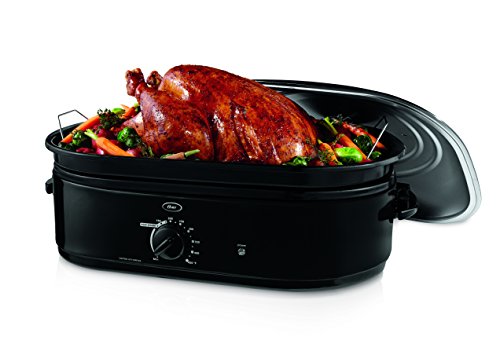
Oster 18-Quart Roaster Oven with Self-Basting Lid — Best all-round roaster
The Oster is the roaster most households picture when the category is mentioned, and its endurance at the top of gift lists and holiday tables is earned by one feature executed properly: the self-basting lid. Its underside is contoured so that the moisture rising from a roasting bird condenses and drips back across the surface continuously, a quiet circulation that does the work of the cook who opens an oven every half hour to spoon juices — except it never opens anything, never drops the temperature, and never forgets during the third hour when the cook is busy with everything else.
At 18 quarts, this is the class’s natural size: large enough for the holiday birds most families actually buy, small enough to store without a dedicated shelf negotiation. The removable roasting pan lifts out for washing and can carry the bird to the table for serving, the included rack raises the roast off the pan floor so heat circulates beneath it, and the temperature dial covers the working range from gentle warming to a proper roast. In use it behaves like the appliance equivalent of a reliable relative — it arrives for the big occasions, does its one job thoroughly, and asks for a wash and a cupboard afterwards.
Its boundaries are the format’s boundaries, honestly worn. Skin browns less fiercely than in a hot conventional oven, so cooks who prize a deep mahogany finish often give the bird a brief blast in the main oven at the end — a legitimate technique, since by then the oven is free. The black finish shows every splash of a working holiday kitchen, and the unit is wide enough that small counters should be measured before purchase. Within those truths, the Oster is the roaster this guide hands to a first-time buyer without a moment’s hesitation.
- Capacity: 18 quarts
- Lid: self-basting design for continuous moisture return
- Pan: removable roasting pan with lift-out rack
- Controls: adjustable temperature dial
- Finish: black
Strengths
- Self-basting lid keeps poultry moist unattended
- The class’s most natural, storable size
- Removable pan makes washing and serving simple
Trade-offs
- Browning is gentler than a conventional oven
- Wide footprint needs a measured counter
- Black finish shows holiday splashes
Best for: first-time roaster buyers and households cooking mid-size holiday birds.
Not suited for: cooks chasing the very largest turkeys or fierce skin browning.

Nesco MWR18-47 Electric Roaster Oven — Best heritage pick
Nesco is not merely a brand in this category; it is close to being the category’s inventor, the name attached to the roaster ovens that American families have handed down since the format’s early decades. The MWR18-47 is an 18-quart continuation of that line, finished in silver, built around the same proposition that made the originals indispensable on farms and in church kitchens: a deep, even-heating well that cooks a large bird or a batch of almost anything with almost no attention, at a temperature the dial holds faithfully for hours.
That heritage shows in the priorities. Nesco roasters have always been bought by people who cook for gatherings repeatedly — the family that hosts every holiday, the volunteer who feeds the hall — and the design serves repetition: straightforward controls, a cooking well that wipes clean, and a shape that has stayed compatible with decades of accumulated roasting wisdom, recipes and replacement racks. When your grandmother’s roasting times were written for a Nesco-style roaster, a Nesco-style roaster is what those times still describe.
Choose it clear-eyed about its traditionalism. The feature list is short by modern standards — no elaborate programmes, no serving theatrics — and buyers who want the self-basting lid’s extra moisture management should look to the Oster or Hamilton Beach. What the Nesco offers instead is the deepest bench of experience in the category and a machine built for the cook who already knows what they are doing and wants equipment that respects that. Heritage, in a roaster, is not nostalgia; it is a hundred thousand holiday dinners of field testing.
- Capacity: 18 quarts
- Maker: Nesco, the format’s heritage brand
- Model: MWR18-47
- Finish: silver
- Controls: traditional temperature dial
Strengths
- Deepest category heritage and owner knowledge base
- Even, faithful heat for long unattended roasts
- Simple design that suits experienced cooks
Trade-offs
- No self-basting lid feature
- Short, traditional feature list
- Styling is functional rather than festive
Best for: experienced hosts and families continuing a roaster tradition.
Not suited for: buyers wanting the newest convenience features.
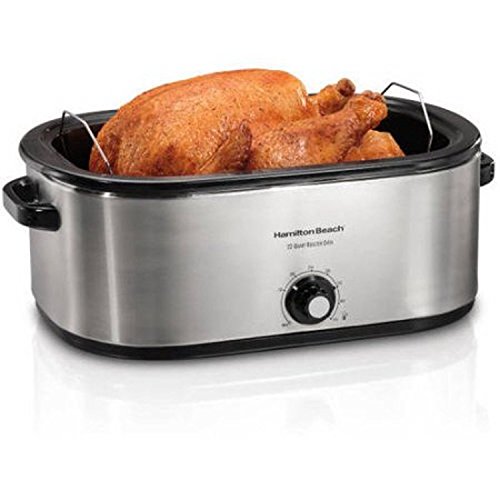
Hamilton Beach 22-Quart Roaster Oven — Best for the biggest birds
When the family’s turkey habit runs large — the bird that makes the butcher raise an eyebrow — this is the roaster the guide points to. Twenty-two quarts, the biggest vessel in this list, rated by Hamilton Beach for a turkey up to 28 pounds, wrapped in stainless steel with a self-basting lid to keep that enormous bird’s breast moist through the long roast its size demands. Size at this level is not a vanity specification; a big bird in a too-small roaster cooks unevenly, steams where it should roast and presses against the lid, and the extra quarts are what stand between a feast and a compromise.
The self-basting lid matters more here than in any other pick, because a 28-pound bird roasts for a long time and its breast meat — furthest from the bone, most exposed to the heat — is exactly what dries first. The lid’s continuous moisture return is the quiet insurance policy on the most expensive ingredient of the holiday. The removable pan and rack scale up with the vessel, and the stainless exterior wipes down after the event without the staining a lighter finish can take from a day of splashing service.
Now the honest arithmetic of ownership. A 22-quart roaster is a large object: measure the counter it will work on, the cupboard or shelf that will store it, and consider honestly how often your family’s birds truly exceed what an 18-quart handles. For the household that hosts the extended clan every year, the answer justifies the shelf space many times over. For the couple who cooked one giant turkey in 2021 and tell the story annually, the Oster is the wiser purchase and this machine is a monument. Buy the size of your real tradition, and if your tradition is genuinely enormous, buy this one with confidence.
- Capacity: 22 quarts — the largest in this guide
- Bird rating: turkey up to 28 lb
- Lid: self-basting design
- Finish: stainless steel
- Pan: removable pan with roasting rack
Strengths
- Handles the biggest holiday birds properly
- Self-basting lid protects a long roast
- Stainless exterior cleans up well after events
Trade-offs
- Largest storage footprint in the list
- Oversized for ordinary family birds
- Heavy to move when loaded
Best for: big-family hosts whose turkeys run to the mid-twenties in pounds.
Not suited for: small households or storage-poor kitchens.

Proctor Silex 18 Quart Electric Roaster Oven — Best straightforward value
Proctor Silex approaches the roaster the way it approaches urns and kettles: as a job to be done properly at a fair position in the market, without decorative ambition. This 18-quart model handles birds up to 24 pounds, carries a self-basting lid, and offers a variable temperature range running from 125 to 450 degrees Fahrenheit — a span worth pausing on, because the low end turns the roaster into a gentle holder and slow cooker for the hours around the main event, while the top end is a genuine roasting heat that many rivals do not reach.
That breadth quietly expands the appliance’s year. A roaster that only roasts is a November purchase; a roaster that also slow-braises a shoulder on a Sunday, holds a casserole at serving temperature through a long lunch, and warms rolls while the oven is busy begins to justify its shelf in March as well. The self-basting lid, shared with the Oster and the Hamilton Beach, puts this value pick in the first rank for poultry specifically — the feature a turkey cook would choose if they could choose only one — and the 18-quart size keeps it storable in a way the 22-quart cannot match.
The compromises are presentational rather than functional. The styling is plain, the control is a dial rather than anything digital, and the brand does not carry Nesco’s heritage or Oster’s ubiquity in this category. Buyers who cook by recipe times handed down through a family may need a first season of small adjustments. But judged as an appliance — capacity, lid, temperature range, price position — this is the pick for the household that wants maximum roasting competence per unit of fuss, and it earns that description without caveats.
- Capacity: 18 quarts
- Bird rating: up to 24 lb
- Temperature range: 125 to 450 degrees Fahrenheit, variable
- Lid: self-basting design
- Controls: single temperature dial
Strengths
- Widest temperature range in this guide
- Self-basting lid at a value position
- Low settings extend it into slow cooking and holding
Trade-offs
- Plain styling and a basic dial control
- Less category heritage than Nesco or Oster
- No digital timer or programmes
Best for: value-focused cooks wanting one versatile roaster for holidays and beyond.
Not suited for: buyers who want digital controls or a showpiece finish.

Rival 18-Quart Roaster Oven RO180 — Best simple classic
The RO180 has been the white roaster on the counter in so many family photographs that it reads less like a product than like a piece of the holiday furniture. Eighteen quarts, a straightforward temperature dial, a removable pan, a rack — the formula was settled long ago and Rival has seen no reason to unsettle it. There is a real argument for that conservatism in a seasonal appliance: the machine you use four times a year should present no learning curve at all when it comes down from the shelf, and the RO180 can be operated by a cook who last touched it eleven months ago, in the middle of the busiest morning of the year, without a single glance at a manual.
Its white finish is a practical choice disguised as a plain one. White shows splashes honestly, which sounds like a flaw and is actually a cleaning prompt — a roaster whose day’s work is visible gets wiped properly before storage, and the machines that develop baked-on archaeology are usually the dark ones whose grime hides until it perfumes the next bird. The 18-quart capacity places it in the class’s centre, suitable for the birds most families roast, and its long production run means racks, pans and accumulated advice are easy to find.
What it does not offer is the self-basting lid of the Oster, Hamilton Beach and Proctor Silex, and the turkey cook should price that honestly: a cook who bastes manually a few times through the roast will close most of the gap, at the cost of opening the lid and losing heat each time. Nor does it reach the Proctor Silex’s temperature breadth. The RO180 is the pick for the household that values the known over the new — the same roaster, doing the same dependable job, holiday after holiday, asking nothing new of anyone.
- Capacity: 18 quarts
- Model: RO180, a long-running design
- Finish: white
- Pan: removable pan with rack
- Controls: simple temperature dial
Strengths
- Zero learning curve, year after year
- Long production run and easy accessories
- White finish prompts honest cleaning
Trade-offs
- No self-basting lid
- Narrower temperature range than the Proctor Silex
- Traditional styling only
Best for: traditionalists who want the classic roaster exactly as remembered.
Not suited for: cooks who want unattended self-basting.

AROMA 20 Quart Roaster Oven — Best step-up size
AROMA’s contribution to this list is the size the others skip. At 20 quarts — squarely between the 18-quart crowd and the 22-quart Hamilton Beach — it fits a turkey up to 24 pounds while staying meaningfully easier to store and move than the largest class. That middle position is not a compromise but a match: the family whose birds run to the low twenties in pounds is too big for an 18-quart’s comfort and does not need the 22’s full stretch, and for them the AROMA is the roaster sized by someone who measured the same birds they cook.
The feature set leans toward the serving end of the day. A keep-warm setting holds the finished roast at a safe, appetising temperature while the rest of the meal catches up — the gravy finished, the vegetables rescued from the oven, the guests gathered from wherever guests hide when dinner is announced. Adjustable temperature settings cover the roasting work itself, and AROMA’s listing draws attention to its even-heating design, which matters in a vessel this size where a hot spot would cook one end of a long bird faster than the other.
As a brand, AROMA is known to most households for rice cookers, and its roaster carries that company’s talent for straightforward, family-priced appliances rather than a roaster specialist’s heritage. Buyers should therefore do what this guide recommends for any newer entry: read the listing’s full specification, confirm the capacity and bird rating, and note the warranty terms. On its numbers — twenty quarts, a 24-pound rating, keep-warm for service — it fills the one genuine gap in this line-up, and households in that gap will be glad it exists.
- Capacity: 20 quarts
- Bird rating: fits a turkey up to 24 lb
- Settings: adjustable temperatures plus keep warm
- Heating: designed for even heat across the well
- Position: the step-up size between 18 and 22 quarts
Strengths
- The only 20-quart option in this guide
- Keep-warm setting suits real serving rhythms
- Easier to store than the 22-quart class
Trade-offs
- Brand heritage here is in rice cookers, not roasters
- No self-basting lid feature listed
- Still a large item for small kitchens
Best for: families whose birds outgrow 18 quarts but not the cupboard.
Not suited for: the very largest turkeys, which belong in the Hamilton Beach.
Comparison Table
| Pick | True capacity | Standout trait | Watch out for |
|---|---|---|---|
| Oster 18-Quart Roaster Oven with Self-Basting Lid | 18 quarts | Self-basting all-rounder | Gentle browning |
| Nesco MWR18-47 Electric Roaster Oven | 18 quarts | Category heritage | No self-basting lid |
| Hamilton Beach 22-Quart Roaster Oven | 22 quarts | Turkey up to 28 lb | Storage footprint |
| Proctor Silex 18 Quart Electric Roaster Oven | 18 quarts | 125–450 degree range | Plain styling |
| Rival 18-Quart Roaster Oven RO180 | 18 quarts | Timeless simplicity | Manual basting needed |
| AROMA 20 Quart Roaster Oven | 20 quarts | Keep-warm serving setting | Newer roaster name |
How Big a Roaster Do You Actually Need for Your Bird?
Work from the bird backwards, and be honest about the bird. Weigh last year’s turkey — or admit its size from the butcher’s label you photographed — and note the trend of your family’s gatherings rather than their peak. Most households discover their real bird lives between fourteen and twenty pounds, squarely inside an 18-quart roaster’s comfort, and that the one legendary twenty-six-pounder was a story, not a habit. The roaster bought for the story will spend its life too big for the counter and too empty for its heat to behave, while the roaster bought for the habit cooks beautifully forty holidays running.
Remember also that the bird is not the only tenant. A roaster’s well takes roasts, hams, twin chickens, a mountain of braised short ribs, a batch of pulled pork for a party — and for those duties, depth and shape matter as much as the headline quarts. Long, low roasts suit the wide wells of this whole class; tall items need the lid clearance checked, since a domed lid’s usable height is less than its dramatic silhouette suggests. If your roaster will spend as many Sundays braising as holidays roasting, choose by the well’s shape as much as by the turkey rating.
Finally, apply the storage test before the capacity test seduces you. Stand where the roaster will live for fifty weeks a year and look at the space with a tape measure in hand: the 22-quart Hamilton Beach is a magnificent tool and a substantial piece of furniture, and it earns its place only in homes that can house it without resentment. A roaster that must be fetched from a neighbour’s garage will quietly stop being used, and the holiday will return to the old oven bottleneck — the exact problem this purchase exists to solve.
How Do You Roast a Turkey in a Countertop Roaster, Step by Step?
Begin the day before, with the bird seasoned and resting uncovered in the refrigerator if your method calls for dry-brining — the roaster changes the heat source, not the principles of good poultry. On the morning, take the bird out in good time, set the roaster on a clear, heat-safe counter near a socket, and preheat it empty with the lid on; a roaster’s well holds heat well but climbs to temperature more gently than an oven, and a bird lowered into a cold well starts its day steaming in its own juices rather than roasting.
Set the bird on the rack, breast up, inside the removable pan — the rack is not an accessory but the mechanism that lets hot air reach the underside and keeps the bird out of the accumulating juices. Season, add a modest amount of stock or water to the pan if your recipe uses it, and put the lid on with ceremony, because from this moment the discipline of the roaster is simply this: leave the lid on. Every lift of the lid releases the moist envelope that is the roaster’s whole advantage and costs you a quarter hour of recovered heat. Check the temperature with a probe thermometer through the thigh in the final stretch rather than by repeatedly peeking, and trust the thermometer over any timetable, including the ones printed on the turkey’s packaging.
When the thigh reads its safe temperature and the juices run clear, lift the bird out on its rack and rest it, tented, for a full half hour while the roaster’s pan juices become gravy on the hob. If your family demands deeply bronzed skin, the bird can take a short, fierce blast in the now-empty main oven before resting — the roaster has done the cooking; the oven is merely doing the cosmetics. Carve at the table or in the kitchen according to your family’s theatre preferences, and notice, as you do, that the oven behind you is free, the sides are hot, and the most contested appliance of the holiday was never contested at all.
What Are the Most Common Roaster Oven Mistakes?
The first is buying by the keyword rather than the capacity — ordering a “16 quart class” roaster for a bird that needs the 22, because the shopper read the category name instead of the spec box. This guide has repeated the true capacities in every review precisely because that mistake ruins holidays in a way that cannot be improvised around at nine in the morning. The second is its mirror image: buying the 22-quart for a household of four and spending a decade storing a boat.
Third, cooks treat the roaster as a second oven for everything and are disappointed by the dishes it was never shaped for — the crisp-topped gratin, the pizza, the sheet of roast potatoes whose glory is dry, fierce heat. The roaster’s moist envelope is a specialisation, not a limitation, and it should be deployed where moisture wins: poultry, roasts, braises, hams, batch chilli, mulled drinks kept warm for a party. Fourth, owners store the machine dirty after the holiday, exhausted, meaning to wash it tomorrow; the baked residue of November becomes the flavour of December. Wash it the same evening, dry it with the lid ajar, and let it go to its shelf clean.
The last mistake is subtler: forgetting the roaster exists outside the holidays. A machine that slow-braises, batch-cooks and keeps a buffet warm can work monthly, and the households that use theirs monthly are the ones whose holiday bird comes out flawless — because they know their machine’s temperament the way you only learn an appliance by cooking in it when nothing is at stake. Buy the roaster for November, by all means. Then practise on a chicken in February, and let November take care of itself.
Final Recommendation
For the majority of households, the Oster 18-Quart Roaster Oven with Self-Basting Lid is the answer: the class’s natural size, the self-basting lid doing quiet work through the whole roast, and a removable pan that respects the cook at washing-up time. It is the roaster this guide would buy for a family cooking its first roaster holiday, and it will not embarrass that family at its twentieth.
Size up only with evidence. The Hamilton Beach 22-Quart Roaster Oven is there for the genuinely large-bird tradition, the AROMA 20 Quart Roaster Oven for the household in between, and the Nesco, Rival and Proctor Silex each serve their cook — the traditionalist, the classicist and the value-minded all-rounder. Choose by your bird, your counter and your cupboard, in that order, and the machine you bring down from the shelf each holiday will feel less like an appliance and more like the keeper of a family ritual — the quiet vessel in the corner, holding the centrepiece, while the whole bright chaos of the day swirls around it.
Roaster, Slow Cooker or Main Oven: Which Appliance Should Cook What?
The three overlap just enough to confuse a holiday cook, so let the food decide. The main oven keeps everything that needs dry heat and browning: roast potatoes, gratins, pastry, the Yorkshire puddings, anything whose surface is its glory. It is also the only one of the three that bakes properly, which settles the desserts. Plan the oven’s day around those dishes and it stops being a bottleneck, because the items that merely need long, gentle, enclosed cooking can leave.
The roaster takes the centrepiece and the big batch work. Its well is deeper and wider than any slow cooker, its temperature range runs far hotter, and its rack lifts a bird clear of its juices in a way neither rival can. Roasts, hams, poultry, ribs destined for a sauce, the party-sized chilli — these are roaster dishes. The slow cooker, by contrast, wins on true set-and-forget cooking across a whole working day, on soups and on anything whose recipe is measured in eight unattended hours; its gentle ceiling is a safety feature there and a limitation at a holiday table where the centrepiece must arrive roasted, not merely cooked.
Households that own all three sometimes ask why the roaster earns its shelf when the slow cooker exists, and the holiday answers it: no slow cooker takes a twenty-pound bird, holds a ham for carving, or keeps a buffet’s worth of meatballs at serving temperature in a vessel that can travel to the table. The appliances are cousins, not rivals. The cook who assigns each dish to the machine shaped for it — oven for browning, roaster for the centrepiece and the batches, slow cooker for the all-day pot — will find the whole meal arriving hot at the same moment, which is the entire quiet ambition of holiday cooking.
How Does a Roaster Earn Its Keep at Parties and Buffets?
Beyond the holidays, the roaster’s second career is as the buffet’s engine room. Its wide temperature range — on the Proctor Silex, from a gentle 125 degrees upward — turns the well into a holding vessel of serious capacity: meatballs in sauce for fifty, a vat of mulled cider kept at drinking warmth through an evening, pulled pork held safely while guests graze across hours rather than sitting down at once. Serving from the roaster itself, with the pan in place and a ladle resting beside it, is the pattern of every church hall and family party that has ever run smoothly, and it works because the vessel was designed to cook and present in the same body.
Batch cooking is the quieter version of the same virtue. A free afternoon and an 18-quart well produce a month of weeknight foundations — a shoulder becoming pulled pork, a double batch of ragu, stock from the carcasses the freezer has been saving — in a single unattended session on the counter, without heating the whole oven cavity for hours. Households that meal-prep seriously often find the roaster they bought for Thanksgiving working two weekends a month by spring, and its cost per use falling to the level where the purchase stops needing the holiday to justify it.
There is even an energy argument, modest but real. Heating a roaster’s well to roast a chicken uses a fraction of the energy of heating a full-size oven cavity to do the same job, and in summer the difference is doubled in comfort: the roaster’s heat stays in its vessel instead of warming the kitchen the cook must stand in. None of this makes the roaster a daily appliance for most homes. It makes it a monthly one with a holiday peak — and a monthly appliance that also saves the biggest cooking day of the year is an appliance that has thoroughly earned its cupboard.
What Should You Check When a Roaster Comes Down From the Shelf?
Give the machine a ten-minute recommissioning before its big day, ideally the weekend before rather than the morning of. Wash the pan, rack and lid even if they went away clean — cupboard dust and the faint ghost of storage settle on everything — and run the empty roaster at a moderate temperature for twenty minutes to burn off shelf smell while you watch it behave. Check that the temperature dial still turns smoothly, that the indicator cycles as the well reaches heat, and that the cord and plug survived their year of coiling without damage at the flex points.
Inspect the parts that age in the dark. The pan’s enamel or non-stick surface should be sound, because a chipped pan under a holiday bird is a problem discovered at the worst hour; the rack’s welds should be firm; the lid should seat evenly all the way around, since a warped lid leaks the moist envelope the whole format depends on. If your roaster uses a separate temperature probe or a liner habit, confirm those are in the box now, not on the morning when the shops are shut and the bird is already seasoned.
Finally, rehearse the geography. Set the roaster where it will work on the day and walk the route from refrigerator to counter to table with the empty pan in your hands, noting the socket, the trivet, the carving board’s home. Holiday cooking fails on logistics more often than on recipes, and the roaster — a big, hot, heavy vessel that will be moved exactly twice, once empty and once full of the most important dish of the year — rewards the cook who has already walked its path. Do this small rehearsal, and on the day itself the machine will feel less like equipment and more like a colleague who has done this with you for years.
Can a Roaster Oven Replace a Slow Cooker for Weeknight Cooking?
For many dishes, yes, with one adjustment of expectation. A roaster set to its low temperatures braises, stews and slow-cooks on the same principles as a dedicated slow cooker, and its larger well swallows batches a slow cooker cannot — the double stew, the whole chicken that becomes three meals, the ribs for a crowd. The Proctor Silex’s range, beginning at 125 degrees, makes it the most natural crossover machine in this guide, and households short on storage have retired a slow cooker in its favour without missing it at the stew pot.
The honest differences are about unattended time and sealing. A slow cooker’s heavy, tight lid and low, steady ceiling are engineered for eight or ten hours of completely forgotten cooking while the house is empty. A roaster’s lid is lighter, its well evaporates a little more across a very long cook, and its temperatures reward the cook who is somewhere in the house rather than out of it. For a Sunday braise started at noon and served at six, the roaster is superb. For a casserole assembled at dawn and trusted until dark, the dedicated slow cooker remains the specialist. Most families find their real pattern is the Sunday one — which is why the crossover works, and why the roaster’s year keeps quietly expanding beyond the holidays it was bought for.
How Do You Adapt an Oven Recipe to a Roaster?
Start with temperature parity and time generosity. Set the roaster to the temperature the oven recipe specifies — the dial means what it says — and then allow the dish a little more time than the oven version, checking by thermometer and tenderness rather than by the clock, because the roaster’s moist heat cooks large joints gently and its recovery after the lid is lifted is slower than an oven’s. Liquids need the cook’s judgement in the opposite direction: the enclosed well traps moisture that an oven would evaporate, so braises and casseroles often want slightly less added liquid than the oven recipe calls for, or a final few minutes with the lid ajar to let a sauce find its consistency.
Browning is the adaptation that requires a decision rather than an adjustment. Dishes that enter the roaster already browned — meat seared in a pan on the hob first, onions cooked down before they join a stew — arrive at the table with the depth that the roaster’s gentle heat cannot create on its own. Build that step into the recipe rather than mourning its absence, and the roaster’s contribution becomes what it should be: the long, even, unattended cooking after the stove work is done. Cooks who keep a small notebook of their adaptations — this bird, this weight, this setting, this long — find their second year with the machine dramatically easier than their first, and that notebook, grease-spotted and brief, becomes the most valuable roasting manual their kitchen owns.
What Accessories and Habits Make a Roaster Easier to Live With?
The roaster arrives with its essentials — pan, rack, lid — and asks for very little more, but three additions repay themselves quickly. A probe thermometer, ideally one whose cable lets the display sit outside the closed lid, ends the guesswork that causes more dry birds than any appliance flaw; poultry doneness is a temperature, not a time, and the probe states it without lifting the lid. A pair of sturdy lifting forks or wide spatulas sized to a turkey turns the transfer from pan to carving board from a two-person anxiety into a calm manoeuvre. And a large, shallow storage box that takes the roaster and its parts as one unit keeps the shelf tidy and the rack from vanishing into the general population of kitchen metalwork.
Habits matter as much as hardware. Keep the roaster’s cord with the roaster, not in the household drawer of anonymous cables. Store a folded card inside the well with your own numbers written on it — last year’s bird weight, the setting used, the hours it took, what you would change — because the cook who writes that card in December is giving a gift to the cook who opens the box next November, and they are the same person at different levels of forgetfulness. Wash the pan the evening of the event, however tired the day has made you, and let the machine go back to its shelf clean, dry and complete.
One last habit separates the roaster’s happy owners from its occasional ones: a rehearsal bird. Sometime in the quiet months, roast a chicken in the machine for an ordinary Sunday, noting how its heat behaves with a small load, how the lid’s moisture shows on the skin, how the pan washes afterwards. That single low-stakes cook teaches more than any manual, and it converts the holiday performance from a debut into a revival — the same show, staged before, by a cast that knows its lines.
Frequently Asked Questions
Is a 16 quart roaster big enough for a turkey?
The class named for sixteen quarts actually spans sixteen to twenty-two, and the picks in this guide start at eighteen. An 18-quart roaster handles the birds most families buy, typically into the low twenty-pound range depending on the bird’s shape; the AROMA’s 20 quarts is rated for 24 pounds and the Hamilton Beach’s 22 quarts for up to 28. Match the roaster to your bird’s actual weight rather than to the category name.
Does a roaster oven brown a turkey like a regular oven?
Not as fiercely. A roaster’s heat wraps the sides of the cooking well and its enclosed, moist environment is gentler on surfaces than a conventional oven’s dry blast, so skin emerges tender and golden rather than deeply bronzed. Cooks who want the darker finish give the rested bird a short blast in a hot oven at the end — easy, because the roaster has left the oven empty all day.
What else can I cook in a roaster oven besides turkey?
A great deal of the slow, moist repertoire: hams, beef and pork roasts, twin chickens, braised short ribs, pulled pork, large batches of chilli or stew, and casseroles for a crowd. Wide-temperature models like the Proctor Silex, with settings from 125 to 450 degrees, can also hold finished dishes at serving temperature, which makes the roaster a buffet appliance as much as a cooking one.
Why does a self-basting lid matter?
Its contoured underside collects the moisture that rises from the food and returns it as a continuous light rain over the surface, doing automatically what manual basting does intermittently — without opening the lid and dumping the heat each time. On a long poultry roast the difference shows up as breast meat that stays moist through hours of cooking, which is why three of the six picks here carry the feature.
Can I use a roaster oven as my only oven?
For roasting, braising and batch cooking, largely yes; as a complete replacement, no. It will not bake a layer cake evenly, crisp a pizza or grill anything, and its temperature ceiling and shape limit baking generally. Think of it as a specialist that outperforms the main oven at its own repertoire while leaving the oven free — in small kitchens it can be the second oven, but it should not be asked to be the only one.
Can I cook two smaller items side by side in a big roaster?
Yes, and it is one of the format’s underused pleasures. Two chickens, a pair of small hams, or a roast beside a foil-wrapped parcel of vegetables all cook happily in the wide well, provided air can circulate between them and their combined weight stays within the roaster’s rating. Items of similar size finish together; a large and a small partner will not, so either start the larger one earlier or choose companions of a size. A probe thermometer in each piece removes the guesswork entirely.
Where should a roaster sit while it cooks?
On a level, heat-safe counter with room around it for air and for you, close to a socket so its cord is not stretched across a walkway, and away from the edge where a sleeve or a child could catch it. The exterior grows hot in service, so give it clearance from walls, paper and the plastic clutter of a busy kitchen, and plan its position before the bird is seasoned — a full roaster is not an object to relocate mid-roast, and the counter it starts on should be the counter it finishes on.
How do I clean and store a roaster after the holidays?
Let it cool, then wash the removable pan, rack and lid in hot soapy water, wipe the well and exterior, and dry everything thoroughly with the lid left ajar so no moisture is sealed inside. Store the rack and cord inside the pan, the pan inside the well, in a dry cupboard or shelf. The same-evening wash matters: holiday residue left for a month bakes into next season’s first roast.
Related Guides
If a built-in oven is part of the same kitchen project, our Best Basic Electric Ovens covers the compact 24-inch wall ovens for small kitchens. For smarter countertop cooking, see Best Air Fryer Smart Ovens, and for the range itself, Best Affordable Gas Ranges compares the value end of the market.



[…] and capacity questions that matter for bulky bedding. For the kitchen side of a sewing weekend, Best 16 Quart Electric Roaster Ovens handles feeding a crowd hands-off, and Best Air Fryer Ovens rounds up countertop ovens that crisp […]
[…] the cooking side of a big household weekend, our Best 16 Quart Electric Roaster Ovens compares the countertop roasters that free up your main oven. See also Best Air Fryer Ovens for […]