What's inside
- Key Takeaways
- Quick Picks
- How We Chose These Picks
- The Best 36 Gas Ranges Worth Your Money, Reviewed One by One
- How Do the Six Compare Side by Side?
- What Does the Extra Six Inches Actually Buy?
- How Should You Read Burner BTU at This Size?
- Why Does Ventilation Become Non-Negotiable?
- What Is the Difference Between Sealed and Open Burners?
- How Do You Install a 36-Inch Gas Range Properly?
- What Does a Gas Oven Need Convection For?
- How Should You Maintain a Professional-Style Range?
- Which Kitchens Should Not Buy 36 Inches?
- How Does a 36-Inch Range Change Kitchen Design?
- What Does the First Month of Ownership Teach?
- How Should You Budget the Whole Purchase?
- Which Cooking Ambitions Does This Width Serve Best?
- How Do You Choose Between the Six Without a Showroom?
- What Should You Verify on Delivery Day?
- How Does a Big Gas Range Behave in a Heatwave or a Cold Snap?
- What Is the Resale and Longevity Story at This Size?
- How Do Grates, Griddles and Wok Cooking Work at This Width?
- What Should a Landlord or a Chef-Host Choose Differently?
- How Do You Keep a Wide Stainless Range Looking Like the Photographs?
- Which Errors Haunt 36-Inch Range Projects?
- Final Recommendation
- Frequently Asked Questions
- Related Guides
As an Amazon Associate I earn from qualifying purchases. This post may contain affiliate links at no extra cost to you.
cottageverdict.com is reader-supported. When you buy through links on our site, we may earn an affiliate commission.
Thirty-six inches is where a home range stops being an appliance and becomes a piece of kitchen architecture. The best 36 gas ranges give you six burners with room to breathe, ovens that swallow feasts, and a presence that reorganises the room around the cooking. This guide reviews six of them — statement pieces, professional workhorses and one cheerful rebel in white — and argues honestly about what the extra width does and does not buy.
Where to buy: each range below is sold through Amazon, and the names in the Quick Picks table and the detailed reviews link to the listings so you can check price on Amazon and confirm the exact fuel version before ordering. A 36-inch gas range is also a ventilation purchase and a gas-fitting purchase; the sections below treat both with the seriousness they deserve, because at this width the installation is half the product.
They are not six versions of one idea. Between the ZLINE’s design theatre, THOR’s professional workhorse brief, Cosmo’s feast-sized oven, KUCHT’s sealed restraint, Frigidaire’s fitted mainstream and Forno’s white abundance, the only shared traits are the width, the fuel and the seriousness — everything else is an argument about how a household cooks.
Key Takeaways
- Six burners at 36 inches means real spacing — two large skillets and a stockpot can genuinely coexist.
- Oven capacity runs from 5.2 to 6.1 cu. ft.; the Cosmo Lumin holds the most for feast cooking.
- Sealed burners (Cosmo, KUCHT) contain spills; open professional tops demand more cleaning commitment.
- Total BTU figures — the Forno’s 83,000 across six burners — size your ventilation, not your dinner.
- Every range here needs extraction to match; a pro top under a weak hood is a purchase half made.
- The Frigidaire is the slide-in with true convection and the widest service network of the six.
Quick Picks
| Pick | Badge | Why it earns its place |
|---|---|---|
| ZLINE Autograph 36 Inch Paramount Gas Range | Best Statement Piece | A 5.2 cu. ft. convection gas oven under six burners, in Autograph Edition dress — the 36-inch slot as a design event. |
| THOR Kitchen 36 Inch Professional Gas Range LRG3601 | Best Professional Workhorse | The LRG3601U — THOR’s freestanding professional formula in stainless steel, built for households that cook like a small restaurant. |
| Cosmo Lumin 36 Inch 6 Burner Gas Range | Best Oven Capacity at 36 Inches | The Lumin collection’s 6.1 cu. ft. oven — the largest here — under six sealed burners with convection, model COS-GRC366KB. |
| KUCHT Professional 36 Inch Natural Gas Range | Best Sealed-Burner Pro | A 5.2 cu. ft. Natural Gas professional range with sealed burners and a convection oven in stainless steel. |
| Frigidaire Professional 36 Inch Gas Range | Best Slide-In With True Convection | Model PCFG3670AF — six burners in a slide-in body with true convection, from a badge every engineer knows. |
| Forno Massimo 36 Inch Gas Range | Best Colour and Total Output | The Massimo in white: six burners totalling 83,000 BTU, a 5.36 cu. ft. oven, air fryer function and a griddle included. |
How We Chose These Picks
We required the full professional grammar at the full width: six burners, a convection oven in most cases, and construction that treats the range as equipment. Every pick is a genuine 36-inch gas range from a maker with a real presence in the category, and the set spans the honest spread of the class — design-led, workhorse, capacity-led, sealed-practical, slide-in mainstream and maximalist.
Fuel versions were checked with care, because pro-style listings multiply variants. The KUCHT here is its Natural Gas model; the Forno’s figures are its combined burner total, and the review says so rather than letting a headline number impersonate a single burner. A guide at this price level owes its readers that precision, since the appliance will outlast most of the kitchen around it.
Finally, we treated ventilation as a selection criterion rather than a footnote: any model whose top would overwhelm a sensibly sized domestic hood lost standing in our estimation, whatever its other virtues. A range and its extraction are one system at this width, and a guide that scores them separately would be grading half a purchase.
The Best 36 Gas Ranges Worth Your Money, Reviewed One by One
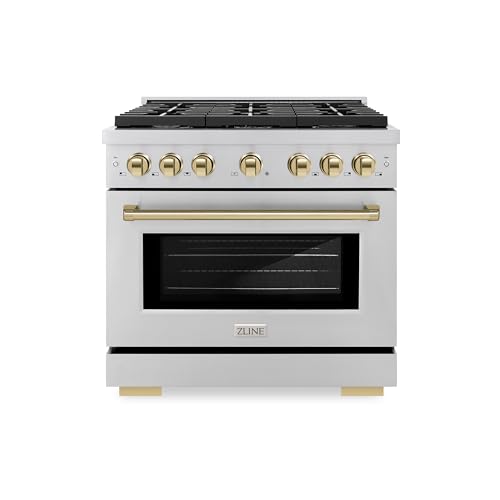
ZLINE Autograph 36 Inch Paramount Gas Range — Best Statement Piece
The Paramount is ZLINE’s Autograph Edition argument at 36 inches: six burners over a 5.2 cu. ft. convection gas oven, presented with the finish and detailing of a range that expects to be photographed. Dismiss that as vanity at your peril — a 36-inch range is the largest object in the kitchen, and the Paramount simply accepts the role and dresses for it. Under the presentation, the specification is serious: a convection oven for even roasting and a six-burner top with genuine elbow room between pans.
What the extra six inches buy, versus a 30-inch range, is simultaneity. Two large skillets and a stockpot can coexist without annexing each other; a griddle’s worth of breakfast does not queue. The Paramount suits the renovated kitchen where the range is the altar — cooking happens there, guests gather there, and the appliance’s presence is part of the hospitality. If your kitchen has the slot and the ambition, this is the centrepiece candidate.
Owners who build the kitchen around the Paramount tend to cook more publicly: the range faces the room, guests perch nearby, and the six burners become a stage the household genuinely uses. ZLINE’s Autograph detailing — the kind of finish work usually reserved for heritage brands — holds up under that scrutiny. It is a range that understands it will be looked at while it works, and has arranged to deserve both kinds of attention. Its convection oven also makes it the design pick that bakers need not apologise for — beauty and even browning in one body.
- Width: 36 inches, gas range
- Cooktop: 6 burners with real pan spacing
- Oven: 5.2 cu. ft. convection gas oven
- Edition: Autograph, design-led finish
- Role: centrepiece for a renovated kitchen
Strengths
- Six burners with space to use them
- Convection oven evens out gas heat
- Statement design anchors a renovation
Trade-offs
- Presence overwhelms a modest kitchen
- Six burners tempt more ventilation demand
- Design premium over plainer workhorses
Best for: Renovated kitchens built around the range as centrepiece.
Not suited for: Small kitchens where the cooker should disappear.
For the ZLINE Autograph 36 Inch Paramount Gas Range as specified here, check price on Amazon — then verify the fuel version on the listing before committing.
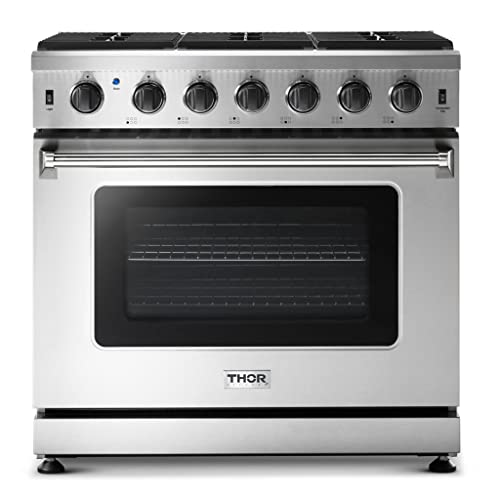
THOR Kitchen 36 Inch Professional Gas Range LRG3601 — Best Professional Workhorse
THOR Kitchen built its following by selling professional grammar — heavy grates, assertive burners, stainless everywhere — at prices that undercut the heritage pro brands, and the LRG3601U is that formula at 36 inches. It is a freestanding professional gas range that assumes its owner cooks seriously and often: big pans, high heat, multiple burners in simultaneous earnest use. The stainless body is unadorned in the commercial manner, which ages gracefully in a working kitchen.
The professional format brings professional expectations. Ventilation must match the top’s appetite, the grates are heavy because they are meant to be, and the whole machine rewards an owner who maintains it like equipment rather than furniture. For the household that cooks like a small restaurant — because it loves to, or because it feeds a crowd weekly — the THOR is the workhorse pick, chosen for output and honesty rather than ornament.
The THOR’s character emerges under load: three burners running hard, a fourth holding a sauce, the oven working below, and nothing about the machine feeling extended. That composure is the professional inheritance — equipment designed for service, scaled for a home. Households that cook for a crowd weekly will recognise the feeling within the first month and stop being able to imagine the old range’s apologies. Rental landlords of high-end homes favour this format for a reason: it reads as luxury and repairs as equipment.
- Width: 36 inches, freestanding professional
- Model: LRG3601U, stainless steel
- Cooktop: professional gas burners, heavy grates
- Format: commercial-style home range
- Character: output first, ornament last
Strengths
- Professional output for serious home cooking
- Heavy grates take the largest pans calmly
- Commercial styling ages well in working kitchens
Trade-offs
- Demands serious ventilation to match
- Heavy components are a cleaning commitment
- Utilitarian finish beside design-led rivals
Best for: High-volume home cooks who treat the range as equipment.
Not suited for: Occasional cooks who want a gentle, decorative appliance.
The THOR Kitchen 36 Inch Professional Gas Range LRG3601 listing carries today’s details — check price on Amazon and confirm the configuration matches this review.

Cosmo Lumin 36 Inch 6 Burner Gas Range — Best Oven Capacity at 36 Inches
Cosmo’s Lumin entry leads this guide on the number that matters most at holiday scale: 6.1 cu. ft. of oven. That is a cavity that swallows the largest bird in the shop and a second dish in genuine comfort, served by convection to keep the load honest. Above it, six sealed burners — the COS-GRC366KB’s sealed design keeps spills out of the burner wells, which anyone who has cleaned an unsealed pro top will recognise as a daily mercy.
Cosmo has built its name on giving the professional silhouette a domestic conscience, and the Lumin shows it: the looks say restaurant, the sealed burners and convection say family kitchen. For the household whose cooking peaks at gatherings — the big roast, the double batch, the feast that justifies the width — the Lumin’s oven is the argument, and it is a strong one. Capacity is the feature you cannot retrofit.
The Lumin’s oven changes party mathematics. A host who can roast the main and hold the sides in the same cavity stops juggling oven timings on paper and starts cooking in the present tense. Cosmo’s sealed burners then return the favour after the feast, when the top that hosted six burners of ambition wipes down without a excavation. Capacity plus cleanability is a rare pairing, and it is this range’s whole argument. For a household upgrading from a 30-inch range, the first feast in this oven is the moment the renovation justifies itself.
- Width: 36 inches, gas range
- Model: COS-GRC366KB, Lumin collection
- Oven: 6.1 cu. ft., largest in this guide
- Burners: six, sealed design
- Oven heat: convection for even large loads
Strengths
- Largest oven here for feast-scale cooking
- Sealed burners keep spills out of the wells
- Convection manages big loads evenly
Trade-offs
- Big cavity is slower for a single small dish
- Six burners need a hood with real capacity
- Cosmo’s service network is smaller than giants’
Best for: Gathering households whose year peaks at feast cooking.
Not suited for: Couples who rarely fill even a standard oven.
When the Cosmo Lumin 36 Inch 6 Burner Gas Range reaches your final two, check price on Amazon for the current listing terms.

KUCHT Professional 36 Inch Natural Gas Range — Best Sealed-Burner Pro
KUCHT’s professional 36-inch range specifies itself plainly: Natural Gas fuel, sealed burners, a 5.2 cu. ft. convection oven, stainless steel. Each of those choices is the pragmatic one. Sealed burners contain the boil-over instead of feeding it to the burner well; natural gas is the standard supply the majority of pro-style homes already have; convection disciplines the gas oven’s natural hot spots; and the capacity matches the six-burner top’s ambition without the Lumin’s feast-scale excess.
KUCHT sells to owners who cook professionally at home and maintain their equipment accordingly, and the range’s stance reflects it — substantial, unadorned, ready. It lacks the Autograph’s jewellery and the THOR’s brand theatre, and for a certain buyer that restraint is the recommendation. If your shortlist values are sealed practicality, honest capacity and a maker’s focus on this single category, the KUCHT is the connoisseur’s quiet choice.
KUCHT’s restraint reads differently after a year: no finish to baby, no unsealed wells to excavate, no feature competing for attention with the cooking. The range simply works, in the manner of equipment bought by people who maintain equipment. For the serious home cook who distrusts ornament on principle, that sustained plainness is not the absence of a selling point — it is the selling point, renewed daily. Its natural gas specification suits the majority of pro-style installations without conversion conversations.
- Width: 36 inches, professional gas range
- Fuel: Natural Gas, as specified
- Burners: sealed burners across the top
- Oven: 5.2 cu. ft. with convection
- Finish: stainless steel
Strengths
- Sealed burners make pro cooking cleanable
- Convection tames the gas oven’s hot spots
- Focused maker with a single-category reputation
Trade-offs
- Natural Gas version — confirm your supply
- Restrained styling beside design-led rivals
- Pro format expects pro-level ventilation
Best for: Serious cooks who value sealed practicality over ornament.
Not suited for: Propane households without a confirmed conversion path.
For the KUCHT Professional 36 Inch Natural Gas Range as specified here, check price on Amazon — then verify the fuel version on the listing before committing.

Frigidaire Professional 36 Inch Gas Range — Best Slide-In With True Convection
Frigidaire’s Professional entry is the slide-in of this guide, and that format changes the kitchen’s geometry: front controls, a top that meets the counters, and no backguard interrupting the splashback line. The PCFG3670AF pairs its six burners with true convection in the oven — fan plus dedicated element — which is the strongest evenness technology a gas-format kitchen can borrow from the electric world, and it shows in traybakes and roasts alike.
The other argument is the badge’s infrastructure. Frigidaire Professional appliances are serviced everywhere, by engineers who know the platform, with parts that do not require archaeology. At 36 inches, where a range is a decade-plus commitment and a significant object to move, that infrastructure is a feature with a cash value. Choose the Frigidaire when you want the pro width with mainstream ownership — the slide-in looks, the true convection, and a support network as wide as the country’s.
The Frigidaire’s slide-in geometry quietly improves the whole kitchen’s hygiene: no gap between range and counter for crumbs to colonise, no backguard ledge collecting grease behind the pans. Add true convection’s evenness and a service network that answers in every postcode, and the Professional becomes the range for owners who think in decades. It is the least theatrical pick here and, for many households, the wisest. True convection also shortens the big oven’s effective preheat behaviour — the fan starts evening the air from the first minutes.
- Width: 36 inches, slide-in gas range
- Model: PCFG3670AF, Professional series
- Burners: six across the cooktop
- Oven: true convection
- Controls: front, slide-in format
Strengths
- Slide-in fit gives a built-in, seamless look
- True convection for even baking and roasting
- National service network behind the badge
Trade-offs
- Slide-in needs accurate counter heights
- Front controls within reach of small children
- True convection fan adds a moving part to service
Best for: Renovators wanting a fitted look with mainstream support.
Not suited for: Homes that prefer a freestanding, backguarded silhouette.
The Frigidaire Professional 36 Inch Gas Range listing carries today’s details — check price on Amazon and confirm the configuration matches this review.

Forno Massimo 36 Inch Gas Range — Best Colour and Total Output
Forno’s Massimo refuses the stainless consensus: it arrives in white, and in a kitchen tired of grey metal that single decision refreshes the whole room. The specification beneath the colour is maximalist — six burners with a combined 83,000 BTU, a 5.36 cu. ft. oven, an air fryer function and a griddle in the package. This is the range for the cook who wants every option present and the household that cooks breakfast on a griddle as a weekend religion.
Total BTU deserves its usual translation: 83,000 across six burners is a statement about the top’s collective appetite, useful for judging ventilation, while individual burner behaviour decides daily cooking. The Massimo’s spread gives the big pans their heat and the small ones their place, and the white enamel-style finish wipes down with a cheerfulness stainless owners secretly envy. Choose it for abundance — of heat, of features, and of personality.
The Massimo’s griddle deserves its own paragraph because it changes weekends: pancakes for six without batch rotation, smash burgers with room to work, a flat top for the kind of breakfast that gathers a household. The white finish, meanwhile, proves easier to live with than sceptics expect — splashes show, certainly, and therefore get wiped, and the range stays bright by the same psychology that keeps a white shirt honest. Check the griddle’s storage before ordering; a piece that size needs a home, and the Massimo’s owners recommend deciding on day one.
- Width: 36 inches, gas range
- Finish: white, a deliberate break from stainless
- Burners: six, 83,000 BTU combined
- Oven: 5.36 cu. ft. with air fryer function
- Included: griddle for the cooktop
Strengths
- White finish transforms a stainless-weary kitchen
- Griddle included for breakfast-scale cooking
- Air fryer function adds a second oven talent
Trade-offs
- White shows every splash until wiped
- 83,000 BTU demands serious extraction
- Feature abundance may exceed simpler needs
Best for: Abundance seekers who want heat, features and colour.
Not suited for: Minimalists who prefer stainless and a short spec sheet.
When the Forno Massimo 36 Inch Gas Range reaches your final two, check price on Amazon for the current listing terms.
How Do the Six Compare Side by Side?
Side by side, the six divide by intent: ZLINE on design, THOR on professional output, Cosmo on oven volume, KUCHT on sealed practicality, Frigidaire on fitted mainstream ownership, and Forno on colour and abundance. The table fixes those essentials in one view.
| Pick | Badge | Standout trait |
|---|---|---|
| ZLINE Autograph 36 Inch Paramount Gas Range | Best Statement Piece | A 5.2 cu. ft. convection gas oven under six burners, in Autograph Edition dress — the 36-inch slot as a design event. |
| THOR Kitchen 36 Inch Professional Gas Range LRG3601 | Best Professional Workhorse | The LRG3601U — THOR’s freestanding professional formula in stainless steel, built for households that cook like a small restaurant. |
| Cosmo Lumin 36 Inch 6 Burner Gas Range | Best Oven Capacity at 36 Inches | The Lumin collection’s 6.1 cu. ft. oven — the largest here — under six sealed burners with convection, model COS-GRC366KB. |
| KUCHT Professional 36 Inch Natural Gas Range | Best Sealed-Burner Pro | A 5.2 cu. ft. Natural Gas professional range with sealed burners and a convection oven in stainless steel. |
| Frigidaire Professional 36 Inch Gas Range | Best Slide-In With True Convection | Model PCFG3670AF — six burners in a slide-in body with true convection, from a badge every engineer knows. |
| Forno Massimo 36 Inch Gas Range | Best Colour and Total Output | The Massimo in white: six burners totalling 83,000 BTU, a 5.36 cu. ft. oven, air fryer function and a griddle included. |
What Does the Extra Six Inches Actually Buy?
Counter-intuitively, the width buys space rather than power. A 30-inch six-burner top is a contradiction — the burners fit, the pans do not — while at 36 inches each burner gets its territory and a 30 cm skillet stops annexing its neighbours. The practical dividend is simultaneity: the big pot, the wide pan and the sauce can all be on the top, attended, at once. For households that cook several dishes in parallel, that is the entire argument.
The oven tells the same story in volume: 5.2 to 6.1 cu. ft. across these six, against a typical 30-inch cavity’s five or so. The difference materialises at feasts and in batch cooking — two trays side by side, the bird plus its retinue — rather than on ordinary Tuesdays. Buy the width for the cooking you actually do at scale; if your largest regular load is a single tray, the honest savings of a 30-inch range buy a great deal of cookware.
How Should You Read Burner BTU at This Size?
A combined figure like the Forno Massimo’s 83,000 BTU describes the whole top drinking at once — a number for sizing gas supply and ventilation, not a promise about any single pan. What cooks dinner is the spread: one or two high-output burners for searing and fast boils, honest mediums for daily work, and at least one burner that can fall to a true, patient simmer without scorching a sauce or needing a relight dance.
Read each model’s burner map the way you would read your own menu. Wok households need the hero burner and a grate that holds a wok steady; sauce households need the simmer; breakfast households need the griddle position. The reviews above argue in those terms deliberately, because at 36 inches every top is powerful in aggregate — the differences that matter are in the distribution, and distribution is a menu question, not a numbers contest.
Why Does Ventilation Become Non-Negotiable?
Six gas burners and a household cooking at full tilt produce heat, moisture, combustion by-products and a plume of grease-laden air that a decorative hood cannot govern. A 36-inch pro-style range needs extraction sized to its top, ducted outside wherever the building permits, with makeup air considered in tight modern homes. Run the hood whenever the burners run — the habit matters more than the hardware’s peak figure.
Under-ventilating is the classic expensive mistake of this category: the range performs, the kitchen suffers, and ceilings and cabinets collect the evidence for years. Budget the hood as part of the range purchase — several makers in this guide sell both — and treat a kitchen that cannot vent as a kitchen that should choose a different range. The cooking will be better in the house that breathes.
What Is the Difference Between Sealed and Open Burners?
Sealed burners, as on the Cosmo and the KUCHT, sit in a contained well: a boil-over pools where you can wipe it instead of draining into the burner’s interior. Open professional burners, in the commercial tradition, lift apart for deep cleaning and shrug off enormous heat, at the cost of letting spills travel. Neither is superior in the abstract — restaurants choose open, most homes live happier with sealed — but the choice decides your Sunday cleaning for a decade.
Consider also the grate question that travels with it. Heavy continuous grates let you slide pans between burners without lifting, a genuine ergonomic gift with a full stockpot, and they are heavy precisely because they must not flex under that load. If your cooking moves pans constantly, continuous grates are a feature worth paying for; if your pans stay planted, lighter grates make the weekly lift-and-clean kinder.
How Do You Install a 36-Inch Gas Range Properly?
Begin months early: the slot must be a true 36 inches, the gas supply sized for the top’s combined draw and fitted by a licensed engineer with a shut-off at the appliance, and the floor level enough that a wide, heavy range sits without rocking. Delivery routes deserve measurement too — a 36-inch professional range is a large, heavy object that must turn through doors designed, often, for smaller ambitions.
Clearances to combustible surfaces, anti-tip provisions and the hood’s duct route all come from the chosen model’s manual, not from convention. Photograph the existing installation before the old range leaves, and book the gas work before the delivery, not after it. At this size, installation is a small building project wearing an appliance’s clothes, and the households that treat it that way are the ones cooking on schedule.
One more installation truth belongs in writing: the gas supply that fed a modest four-burner range may not feed a six-burner professional top at full draw, and discovering that at the first feast is a special kind of disappointment. A competent fitter calculates the load in advance and upsizes the line if the arithmetic demands it. Ask for that calculation by name — it is the cheapest insurance in the entire project, and it separates the installations that merely work from the ones that work at full song.
What Does a Gas Oven Need Convection For?
A gas oven heats from below, and without help it stratifies: fierce at the floor, lazy at the top, with a hot signature near the burner. A convection fan redistributes that heat so roasts brown evenly and two racks behave like citizens. Most ranges in this guide include it, and the Frigidaire goes further with true convection — a fan carrying its own element — borrowing the electric oven’s discipline for a gas cavity.
The practical gains appear in exactly the cooking this width is bought for: multiple trays, large joints, loads that would expose a still oven’s geography. Delicate bakes sometimes prefer the fan off, and a model that allows the choice respects both the feast and the soufflé. When you compare ovens here, convection is not a garnish on the specification; it is the technology that makes a big gas oven behave like a precise one.
How Should You Maintain a Professional-Style Range?
Pro-style equipment assumes an owner who maintains equipment. Grates and caps come off for a soak; sealed wells wipe out; stainless wants a grain-following cloth and no scouring enthusiasm. Burner ports stay clear with a soft brush, and the oven gets wiped while its spills are still recent rather than archaeological. None of this is heavy work, but it is regular work, and the range repays it by looking and cooking like new for a very long time.
Schedule the deeper tasks with the seasons: a gasket check, a ventilation filter clean, a look at the igniters before the holiday peak rather than during it. Keep the manual, the model plate photograph and the gas certificate together. Professional ranges fail rarely and ordinarily — an igniter, a thermostat — and the owner with paperwork and a clean machine gets the quick, cheap repair instead of the diagnostic saga.
Which Kitchens Should Not Buy 36 Inches?
Honesty requires the negative case. A small kitchen loses more to a 36-inch range than the range returns: the six inches come out of counter or storage, the visual mass shrinks the room, and the burners’ spacing advantage evaporates when the household cooks one pan at a time. Rental kitchens with standard slots cannot host one at all without building work that no tenancy justifies.
Likewise the occasional cook: a professional range’s virtues are throughput virtues, wasted on a household that roasts twice a month. Such kitchens are better served by an excellent 30-inch range and the counter space, and this guide’s sister reviews cover that width in both gas and dual fuel. Buy the width your cooking fills weekly — the feast days can borrow capacity, but the ordinary Tuesday cannot borrow counter.
There is also the household that cooks rarely but hosts enormously — the holiday house pattern — to consider. For it, the width can still be right, because its cooking is concentrated into a dozen feast days a year when every burner earns its place. The honest test is not frequency but peak: if your biggest cooking days are genuinely big, a range sized for them is not an extravagance, it is the tool the house exists to hold.
How Does a 36-Inch Range Change Kitchen Design?
A range this size is a planning gravity well. Worktops run to meet it, the hood becomes a major visual element, and the triangle between range, sink and refrigerator deserves redrawing around the cooking you actually do — because the cook will now work at a six-burner station, prep space beside it matters more than prep space anywhere else. Designers call the flanking counters the landing zones, and at this width both sides deserve them in full.
Lighting and sightlines follow. Task light over the top, a splashback that can take heat and wiping, and nothing combustible stored within the manual’s clearances. Get these decisions onto the first drawings and the range looks inevitable; retrofit them and even a beautiful appliance looks inserted. The Paramount and the Frigidaire reward opposite ends of this planning — statement versus seamlessness — but both punish a kitchen that was designed without them in mind.
What Does the First Month of Ownership Teach?
New owners of pro-style ranges learn heat geography first: which burner is the sprinter, which is the marathon simmerer, where the oven’s honest hot corner lives. The toast test maps the oven; a week of pans maps the top. They also learn the hood’s voice — when to run it at a murmur and when the full roar is the price of a proper sear — and the cleaning rhythm that keeps sealed wells or open burners ahead of the grime curve.
By the second month the range’s scale becomes ordinary, which is the quiet miracle of all good equipment. The six burners stop being a specification and become simply how cooking works in this house. Keep the manual’s burner map and your own notes together; the next decade of dinners is cooked on that knowledge, and it is knowledge no review can give you — only the first month can.
How Should You Budget the Whole Purchase?
The range’s ticket is the beginning of the invoice, not the total. Add the hood sized to the top, the gas work by a licensed engineer, any cabinet or worktop alteration the width demands, delivery that includes placement rather than a doorstep, and haul-away of the old appliance. In many projects the honest total runs well beyond the range alone, and discovering that in advance is the difference between a plan and a grievance.
Against that total, weigh the appliance’s lifespan: a 36-inch professional range is a twelve-to-fifteen-year citizen of the kitchen, and its cost per cooked dinner is small change. The false economy is the under-bought installation — the weak hood, the undersized gas line — because those economies tax every meal the range ever cooks. Spend on the system, and the centrepiece earns its place nightly.
Which Cooking Ambitions Does This Width Serve Best?
Batch cooking is the width’s secret triumph: a Sunday session that fills a freezer uses every burner and the big oven in rotation, and the 36-inch station turns it from an endurance event into a pleasure. Preserving households feel the same dividend at harvest — the stockpot, the blanching pan and the sauce all have territory. And the multi-dish cuisines of the world, the ones that assume three pans moving at once, finally get the stage they were written for.
It also serves the teaching kitchen: two cooks working side by side without the elbow negotiation a 30-inch top imposes. Households where cooking is a shared craft — partners, parents and teenagers, friends at a weekend house — will use the width socially as much as culinarily. Judge the purchase by those sessions, not by the solitary Tuesday; the width exists for company, in every sense.
How Do You Choose Between the Six Without a Showroom?
Most of these ranges will be bought unseen, which makes the decision method matter. Reduce it to three questions in order. First, the oven: feast households take the Cosmo’s 6.1 cu. ft., everyone else is served by the 5.2 to 5.36 class. Second, the format: slide-in for the Frigidaire’s fitted line, freestanding for the rest, decided by your counters rather than your taste. Third, the top’s temperament: sealed for easy years, open professional for the restaurant ritual, griddle included if weekends demand it.
Then let one soft factor break any remaining tie — the finish you want to look at, the badge your local engineer knows, the bundle that simplifies the project. Soft factors are not irrational at this scale; they are the texture of a decade’s daily contact with an object. A decision made in that order — capacity, format, temperament, texture — survives contact with ownership, which is the only test a buying guide ultimately answers to.
What Should You Verify on Delivery Day?
Inspect before the crew leaves: every burner lit and observed, the oven run to temperature, the door’s swing and seal checked, the finish examined in daylight for transit damage, and the griddle and accessories counted against the listing. Photograph the model plate. A 36-inch range is too large for casual returns, so delivery day is the cheap moment to discover anything wrong — after the signature, every problem becomes a negotiation.
Keep the packaging until the first full cooking day has passed without incident, and register the warranty while the paperwork is still on the counter. Confirm the anti-tip fitting and the gas shut-off’s location with the installer and show every adult in the house where that shut-off lives. These are fifteen minutes of diligence that stand guard over fifteen years of dinners.
How Does a Big Gas Range Behave in a Heatwave or a Cold Snap?
A six-burner gas top is a heating appliance whether you intend it or not: in summer, a long session warms the kitchen measurably, which is why experienced owners shift roasting to the morning and let the hood earn its keep. The oven’s insulation on these professional models is generally good, but no range cooking a feast in July is climate-neutral, and menu planning that respects the season is a mark of the width’s mature owner.
Winter reverses the pleasure — the range becomes the kitchen’s hearth, and its warmth is welcome. Cold affects performance at the margins: a very cold pan or a kitchen at refrigerator temperatures lengthens preheats slightly, and propane systems in outbuildings deserve their own supply conversation with the fitter. None of this is a defect; it is the physics of cooking with fire at scale, and the 36-inch household simply meets more of it.
What Is the Resale and Longevity Story at This Size?
Professional-style 36-inch ranges hold their place in a kitchen’s value unusually well, because the slot itself is a renovation feature: a house with a genuine 36-inch installation, a proper hood and the paperwork to prove both advertises a kitchen built by someone who cooks. Recognised badges — Frigidaire Professional, ZLINE, THOR — carry that signal furthest in listings, which is a legitimate secondary argument for choosing a name your market knows.
Longevity follows maintenance, as the earlier section argued, but it also follows ordinariness of failure. Igniters, thermostats and fan motors are the wear items across this class, all replaceable without replacing the range. The expensive death is neglect of the small things — a perished seal cooking the controls with escaping heat for years. Buy the range as a fifteen-year system, service its small failures promptly, and the width will outlast the kitchen’s fashion cycle twice over.
How Do Grates, Griddles and Wok Cooking Work at This Width?
The wide top’s furniture decides whole cuisines. Continuous grates let a full pan travel from a fierce burner to a gentle one without a lift — the move that saves sauces and wrists alike. A griddle, included with the Forno and available in the class generally, converts two burners into a flat-top for breakfasts, smash burgers and the kind of teppan-style cooking that gathers an audience. Check any griddle’s storage before it charms you; a cast plate needs a permanent home.
Wok cooking is the sterner test: a round-bottomed wok wants a ring or a grate that cradles it over the strongest burner, and the flame should lick the sides rather than sulk beneath. Households for whom the wok is a weekly instrument should interrogate the hero burner’s grate design specifically, and consider a flat-bottomed wok as the pragmatic domestic compromise. The width gives you the heat and the room; the furniture decides whether your favourite pan can use them.
What Should a Landlord or a Chef-Host Choose Differently?
A high-end rental or a holiday house argues for durability under stranger’s hands: sealed burners, a badge the local engineer stocks parts for, and controls that explain themselves. On those criteria the Frigidaire Professional and the KUCHT lead this set, with the THOR close behind as equipment that shrugs off use. The design-led and maximalist picks earn their place in owner-occupied kitchens, where the person who chose the quirks is the person who lives with them.
The chef-host — the owner whose dinner parties are the house’s social engine — should weight simultaneity and oven volume first, which points to the Cosmo’s cavity or the Paramount’s stage, and should size the hood for guests’ comfort as much as the cook’s: extraction that can run hard without shouting is a hosting feature. Different households, same six ranges, different winners — which is what a shortlist is for.
How Do You Keep a Wide Stainless Range Looking Like the Photographs?
Stainless steel’s care is a technique, not a product: wipe with the grain, use a soft cloth, dry after cleaning so minerals do not map the surface, and reserve anything abrasive for never. Spills addressed the same day are a cloth’s work; spills addressed monthly become a chemistry project, on stainless as on the Forno’s white finish, which shows everything and therefore, paradoxically, tends to get wiped most faithfully.
The top’s blackened grates and caps are not dirt but seasoning — the honest patina of equipment in use — and owners who accept that distinction stop fighting the appliance’s nature. A professional range that looks slightly worked-in reads as confidence in a kitchen; the showroom gleam is for the first month, and chasing it for a decade is a misery of your own manufacture. Clean it properly, let it look cooked-on, and it will look right.
Which Errors Haunt 36-Inch Range Projects?
- Sizing the hood to the kitchen’s looks instead of the cooktop’s combined output.
- Reading a total BTU figure as one burner’s power and planning the menu around the misunderstanding.
- Ordering the range before confirming the slot, the gas supply size and the delivery route.
- Choosing open burners for the restaurant look, then resenting the cleaning they honestly require.
- Filling a small kitchen with 36 inches of range and losing the counter the cooking needed.
- Skipping the anti-tip and clearance requirements in the manual because the range feels too heavy to move.
Final Recommendation
If the renovation is built around the range, the ZLINE Paramount is the centrepiece with the specification to defend the attention. If the kitchen is a workplace first, the THOR LRG3601U and the sealed, sensible KUCHT argue between themselves — theatre of output versus quiet practicality — while the Cosmo Lumin waits for the household whose calendar is a series of feasts and whose oven must hold them all.
The Frigidaire is the choice when you want the width without the worry: slide-in fit, true convection, and a service network that treats a 36-inch range as an ordinary appliance. And the Forno Massimo, in white and at full abundance, is for the cook who looked at stainless restraint and chose joy instead. Thirty-six inches is a commitment of space, money and ventilation — spend it on the range whose strengths match your cooking, and the kitchen will organise itself around the decision happily for years.
One practical benediction: order the hood with the range, book the gas engineer before the delivery, and keep the first month free of dinner parties while you learn the machine. A 36-inch range mastered calmly becomes the kitchen’s engine for a decade; the same range debuted under pressure becomes a story you tell about yourself, at yourself, forever.
Measure twice, vent honestly, and let the first feast be a rehearsal rather than a premiere — the range will reward the patience for fifteen years.
Start the shortlist at ZLINE Autograph 36 Inch Paramount Gas Range, THOR Kitchen 36 Inch Professional Gas Range LRG3601, Cosmo Lumin 36 Inch 6 Burner Gas Range — design, workhorse and capacity — and let your kitchen’s priorities arbitrate between them.
Frequently Asked Questions
Is a 36-inch range worth it over a 30-inch model?
For households that cook in parallel — several pans, large batches, regular gatherings — yes: the spacing and oven volume change what a meal can be. For one-pan households, the extra width buys presence rather than capability, and a fine 30-inch range plus counter space is the better purchase. Count your simultaneous pans honestly before deciding. Presence, honestly priced, is still a legitimate reason — you will look at this appliance every day for a decade.
How much ventilation does a 36-inch gas range need?
Extraction sized to the cooktop’s combined output, ducted outside where possible, and used whenever the burners run. The exact figure belongs to the hood maker’s sizing for your model, but the principle is fixed: pro-style tops overwhelm decorative hoods. Budget the hood as part of the range purchase, not as an accessory afterwards. A window alone is not a strategy at this output; it is the emergency backup for a hood that should exist.
Can a 36-inch gas range run on propane?
Some models offer a manufacturer conversion kit, fitted by a qualified engineer — it is model-specific and never a DIY adjustment. The KUCHT in this guide is specified as a Natural Gas range, so propane households must confirm the exact variant and kit before ordering rather than assuming convertibility. Ask the question before ordering, in writing — fuel conversions discovered at installation are the expensive kind.
Are six burners hard to clean around?
Sealed designs — the Cosmo and KUCHT here — contain spills and wipe down quickly. Open professional burners take longer and reward a routine: grates off, parts soaked, wells wiped. Either way, the weekly commitment is measured in minutes if spills are handled while recent, and in hours if they are allowed to carbonise. A soft brush for burner ports and a seasonal gasket check complete the routine; the rest is wiping.
Does a bigger oven cook a small meal badly?
It cooks it more slowly to preheat and with more air to heat, which is an efficiency footnote rather than a quality problem. Households that mostly cook small can use a countertop oven for tiny jobs and keep the big cavity for its proper work. The Cosmo’s 6.1 cu. ft. is a feast tool; nobody is obliged to heat all of it for two jacket potatoes. A sheet of foil on the oven floor is not the answer either — it interferes with heat and voids warranties; use the right-sized tray.
Will a 36-inch range fit a standard kitchen?
Only a kitchen with a genuine 36-inch slot, or one being renovated to create it. Measure the opening, the delivery route and the door swings, and confirm the gas supply can feed the top’s combined draw. In a standard 30-inch kitchen without building work, the answer is no — and the dual fuel and electric guides at that width are the right detour. Remember the hallway and the front door in that measurement; more ranges are defeated by the route than by the slot.
Related Guides
A range of this size usually arrives with a full kitchen project — these guides cover the decisions that share the drawings. Best Affordable Gas Ranges Best Battery Operated White Noise Sound Machines Best Basic Electric Ovens



[…] arrives with a renovation in tow — these guides cover the purchases that share the project. Best 36 Gas Ranges Best Basic Top Loading Washing Machines Best 16 Quart Electric Roaster […]