What's inside
- Key Takeaways
- Quick Picks
- How Did We Compare Battery Sound Machines?
- What Is the Difference Between White, Pink, and Fan Noise?
- How Do the Six Machines Split the Sleeping World?
- Comparison Table
- How Do You Choose for a Shared Bedroom?
- Which Sound Actually Masks Noise Best?
- What Volume Is Right, and Where Should the Machine Sit?
- How Do You Use a Sound Machine Away From Home?
- What Should Renters and Light Sleepers in Thin-Walled Homes Know?
- What Is the History Inside These Small Machines?
- How Do Sound Machines Serve Different Kinds of Sleepers?
- What Mistakes Do Sound Machine Buyers Make?
- How Do You Care for a Machine That Works Every Night?
- Final Recommendation
- How Should You Introduce a Sound Machine to a Household?
- What Should You Pack Alongside a Travel Sound Machine?
- Frequently Asked Questions
- Related Guides
As an Amazon Associate I earn from qualifying purchases. This post may contain affiliate links at no extra cost to you.
cottageverdict.com is reader-supported. When you buy through links on our site, we may earn an affiliate commission.
Where to buy: each sound machine below is sold through Amazon, and every name links to its listing so you can check price on Amazon and confirm the current power options in the box. The best battery operated white noise sound machines solve a specific problem: the noises you cannot control. A hallway conversation, a partner’s early alarm, a hotel ice machine, a neighbor’s dog greeting the dawn — a steady, pleasant sound at the bedside smooths those interruptions into background, wherever you happen to be sleeping. Battery power is what makes the category useful, because the places you sleep worst are rarely the places with a free outlet beside the bed. These six machines run on cells, USB, or rechargeable packs, and we describe their endurance in honest, practical terms rather than invented hour counts.
Key Takeaways
- Fan-based and electronic fan sounds mask speech and household noise more evenly than nature recordings with gaps.
- Non-looping sound generation avoids the repeating pattern your ear learns to hear at three in the morning.
- Power flexibility matters: AAA and AA machines sip from any travel kit, while USB models recharge beside your phone.
- Volume range matters more than sound count; a machine must reach masking level without distortion.
- Physical buttons beat touch controls in the dark, every single night of the year.
- These machines mask sound — they do not treat any medical condition, and we make no such promise for them.
Quick Picks
| Pick | Badge | Why it earns its place |
|---|---|---|
| Yogasleep Rohm Portable White Noise Machine | Best Overall | Three deeply soothing fan-style sounds in a palm-size body that runs on AAA cells or USB. |
| LectroFan Micro2 White Noise Machine | Best for Travelers | Eleven non-looping sounds plus a Bluetooth speaker, in the smallest serious package here. |
| Dreamegg Portable Noise Machine | Best for Babies and Adults | Twenty-one sounds and a strong rechargeable battery for nursery and travel duty. |
| HoMedics SoundSleep White Noise Machine | Best Simple Home Unit | Six relaxing nature sounds with an auto-off timer, at home on any nightstand. |
| Dreamegg Portable White Noise Machine 1000mAh | Best Truly Tiny | An egg-sized USB-C machine with sixteen sounds that clips into a diaper bag or carry-on. |
| HoMedics SoundSpa Mini Portable Sound Machine | Best Budget | AA-powered simplicity for occasional travelers and spare-room duty. |
How Did We Compare Battery Sound Machines?
Sound quality came before sound quantity. A white noise machine’s job is to produce an even, unbroken wash of sound that the ear can settle into, so we favored machines whose fan tones and noise colors stay smooth at bedside volume, without hiss artifacts, mechanical clicking, or an audible loop point. Recorded nature sounds earned their places only where they serve a real audience — many parents and light sleepers prefer surf or rain to fan tones, and a varied library helps a machine survive months of nightly use without becoming irritating.
Power arrangements were the second axis, and the reason this guide exists. We noted exactly how each machine runs away from the wall: replaceable AAA or AA cells, USB power from any port or power bank, or a built-in rechargeable pack. We deliberately describe endurance qualitatively — through the night, across many nights — because battery life swings with volume, and a precise hour figure printed here would be a guess dressed as a fact. What we can promise is which machines sip and which drink, relative to their class.
Finally, we judged the midnight interface. Buttons findable by touch, a volume control that cannot jump to full blast, and a timer for those who want sound only while falling asleep all matter more at 2 a.m. than any specification printed on a box. Portability claims were checked against reality: a machine earns travel status by surviving a carry-on and running untethered, not by being photographed beside a suitcase.

Yogasleep Rohm Portable White Noise Machine — Best Overall
The Rohm comes from the family that built its reputation on the classic mechanical fan-tone machine, and that heritage is audible. Its three sounds — a bright fan, a deeper fan, and a gentle surf — are the distilled essence of what most sleepers actually want: an even, warm wash with no loop seam and no novelty. There is no library of forty tracks here, and that restraint is the design’s confidence. You choose the tone that suits your room, set the volume with a simple control, and the machine disappears into the nightstand scenery.
Power flexibility seals the overall pick. The Rohm runs on AAA batteries for untethered travel or from USB at home, so the same unit covers the nursery shelf, the guest room, and the hotel drawer without a second purchase. Its body is small and rounded, with a lanyard-friendly shape that hangs from a stroller handle or a doorknob in a pinch. Volume is ample for masking hallway noise in a typical home. Travelers who fly weekly and parents who move between rooms will both find it the easiest machine here to simply live with.
- Sounds: 3 fan-style and surf tones
- Power: AAA batteries or USB
- Controls: simple dial-style volume and sound selection
- Body: compact, rounded, hangable design
- Character: even, non-repetitive sound from a heritage maker
There is a reason the Rohm’s three sounds have survived in a market addicted to abundance: each is tuned rather than merely included. The brighter fan suits masking speech through a door; the deeper fan settles under traffic rumble; the surf setting serves listeners who find pure tones clinical. Owners typically audition all three across the first week, choose one, and never touch the selector again — the highest compliment a sound machine’s library can receive is being forgotten.
Strengths
- Fan tones mask voices and household noise with unusual evenness.
- Dual AAA and USB power suits both travel and permanent nightstands.
- Dead-simple controls that never confuse a sleepy hand.
Trade-offs
- Only three sounds; variety seekers will want a larger library.
- No built-in rechargeable pack, so USB or spare cells must travel with it.
- No timer for listeners who want sound only at sleep onset.
Best for: most sleepers wanting one dependable machine for home and travel. Not suited for: listeners who rotate through many nature soundscapes.

LectroFan Micro2 White Noise Machine — Best for Travelers
The Micro2 is what happens when a serious sound-machine maker shrinks its flagship ideas into a travel format. LectroFan’s specialty is electronically generated, non-looping sound — fan tones and noise colors synthesized continuously, so there is no recording and therefore no loop for your ear to catch. Eleven sounds in a body this small is generous, and the generation quality shows at low volume, where lesser machines turn grainy. For consultants, flight crew, and anyone whose office is a hotel room, it is the connoisseur’s travel pick.
Its second job is equally deliberate: the Micro2 doubles as a Bluetooth speaker, so the same puck that masks the corridor at night plays a podcast while you work at the desk by day. It recharges over USB, which keeps it in the same cable ecosystem as your phone and earbuds. The honest limits are size-related — maximum volume suits personal space rather than a large shared room, and the speaker, while perfectly listenable, is a convenience rather than a hi-fi. As a two-purpose travel companion that does its primary job superbly, it earns its badge.
- Sounds: 11 non-looping fan and noise options
- Power: rechargeable via USB
- Extra: Bluetooth speaker function for daytime use
- Body: puck-size, genuinely pocketable
- Character: synthesized sound with no loop point
Hotel staff and flight crews, who sleep professionally in strange rooms, are the Micro2’s quiet constituency. Its generated sound survives the two failure modes of travel recordings — the loop the ear finds on night three of a trip, and the distortion that appears at the volume a thin hotel wall demands. Add the speaker function covering the working hours, and the Micro2 becomes the rare travel gadget that earns its space in both halves of the day.
Strengths
- Non-looping generated sound stays seamless through the whole night.
- Bluetooth speaker duty makes it two travel gadgets in one.
- USB recharging matches the rest of a traveler’s kit.
Trade-offs
- Small body limits maximum volume in big or noisy rooms.
- Speaker quality is functional, not a replacement for a real speaker.
- Fewer nature sounds than the Dreamegg models offer.
Best for: frequent travelers and light sleepers sensitive to loop seams. Not suited for: buyers wanting one machine to fill a large shared bedroom.

Dreamegg Portable Noise Machine — Best for Babies and Adults
Dreamegg designed this portable around the nursery first, and the decisions show in the right places. Twenty-one soothing sounds span white noise colors, fan tones, and gentle nature options, giving parents a real chance of finding the one a particular baby settles to — a search every parent knows is empirical, not theoretical. The built-in rechargeable battery is the headline for travel: it carries the machine through nights away from outlets, in strollers, hotel rooms, and grandparents’ houses, without a cable hunt at bedtime.
Adult travelers benefit from the same formula. The body is compact and clip-friendly, the controls are simple enough for a grandparent handed the machine mid-visit, and the sound library’s breadth means the office-nap and red-eye use cases are covered too. We make no promises beyond masking here — no machine in this guide treats anything — but as a consistent sound environment that travels with a child, this Dreamegg is the most complete package in the roundup. Volume reaches properly useful levels for masking a television through a wall, which nursery-adjacent-to-living-room households will appreciate.
- Sounds: 21 soothing options across noise, fan, and nature
- Power: built-in rechargeable battery
- Audience: babies, children, and adults alike
- Body: portable with travel-friendly controls
- Character: broad library for finding a sleeper’s preferred tone
Parents comparing the two Dreamegg models often miss this one’s defining trait: it was sized for the nightstand-to-stroller circuit of real family life, substantial enough to anchor a nursery shelf and portable enough to relocate without a decision. Its sound library’s breadth serves the experimental phase of parenthood, when nobody yet knows which tone a particular newborn will accept as the sound of safety, and the household is grateful for options at 2 a.m.
Strengths
- Twenty-one sounds give the best odds of matching a fussy sleeper.
- Rechargeable battery frees it from outlets for many nights of travel.
- Simple controls that babysitters and grandparents manage easily.
Trade-offs
- Larger library means more button cycling to find favorites.
- Rechargeable pack cannot be swapped when it eventually ages.
- Bigger than the egg-size Dreamegg below for ultralight packing.
Best for: parents and travelers wanting one rechargeable machine for everyone. Not suited for: minimalists who want exactly one sound and one button.

HoMedics SoundSleep White Noise Machine — Best Simple Home Unit
The SoundSleep is the machine that has sat on nightstands for years without anyone writing songs about it, and that is its charm. Six relaxing sounds — white noise plus nature staples like rain, ocean, and summer night — cover what most home sleepers rotate through, an auto-off timer lets the machine retire after you have drifted off, and it runs from an adapter at home or batteries when the outlet situation changes. The silver, travel-aware body is small enough for a guest room drawer yet substantial enough to feel like furniture rather than a toy.
Choose it when the machine’s home is a home. The nature recordings loop, as recordings do, though the loops are long and gentle enough that most listeners never notice them; the fan-tone purists should look at the Rohm or LectroFan instead. What the SoundSleep offers is the classic, proven formula at a friendly price, from a brand whose sound machines fill more spare rooms than any rival here. For a guest room, a rental cottage, or a first experiment with bedside sound, it is the low-risk answer.
- Sounds: 6 relaxing options including nature recordings
- Power: AC adapter or batteries
- Timer: auto-off timer for sleep-onset use
- Body: small travel-aware size in silver
- Character: classic, proven nightstand formula
The SoundSleep’s timer deserves its own appreciation, because it serves a philosophy of sleep the all-night machines ignore: sound as a bridge rather than a destination. Many sleepers want masking only until sleep takes over, after which silence is the preference and a partner’s different schedule matters. The auto-off serves them precisely, and the machine’s adapter-at-home, batteries-away flexibility makes it the set designers’ choice for guest rooms everywhere.
Strengths
- Timer function suits sleepers who want silence later in the night.
- Adapter and battery operation cover home and travel alike.
- Long-proven design with an interface anyone can run.
Trade-offs
- Nature sounds are recordings with loop points, however gentle.
- Six sounds is a modest library beside the Dreamegg models.
- Fan-tone depth does not match the Rohm’s heritage tuning.
Best for: guest rooms, first-time buyers, and timer lovers at home. Not suited for: loop-sensitive listeners wanting generated fan sound.

Dreamegg Portable White Noise Machine 1000mAh — Best Truly Tiny
This is the machine for the diaper bag’s side pocket and the carry-on’s last corner. Genuinely egg-sized, the little Dreamegg packs sixteen sounds, a timer, and a 1000mAh rechargeable battery charged over USB-C — the same cable as a modern phone — into a body that disappears into a palm. The cream finish and simple face make it nursery-friendly, while the size makes it the only machine here you will carry speculatively, just in case the hotel is noisy.
Tiny brings honest trade-offs, and Dreamegg does not hide them. Maximum volume is scaled to cribside and personal space rather than whole-room masking, and the battery, sized for portability, asks for more frequent charging than its larger sibling — still comfortably through nights of typical use, but not a forget-it-for-a-month device. Within its intended radius, though, the sound quality is clean and the library generous for the size. Parents who clip a machine to a stroller for walks and naps will understand this product instantly.
- Sounds: 16 options in an egg-sized body
- Power: 1000mAh rechargeable battery, USB-C charging
- Timer: built-in auto-off timer
- Finish: cream, nursery-friendly styling
- Character: the smallest full-featured machine in this guide
Do not let the little Dreamegg’s size write it off as a toy; its engineering priorities are simply ordered differently. Every cubic centimeter went to sound and battery rather than presence, and the result serves the moments other machines miss entirely — the nap in the car seat, the overtired hour at a restaurant-adjacent hotel, the walk that must end in sleep. Parents measure its value in rescued afternoons, a currency the larger machines cannot mint.
Strengths
- Truly pocketable size that travels without a second thought.
- USB-C charging matches modern phone cables exactly.
- Sixteen sounds is a remarkable library at this size.
Trade-offs
- Volume suits personal and cribside use, not large rooms.
- Small battery needs charging more often than the bigger Dreamegg.
- Tiny controls demand a fingertip rather than a sleepy palm.
Best for: stroller walks, diaper bags, and ultralight travelers. Not suited for: masking loud shared spaces or week-long outlet-free trips alone.
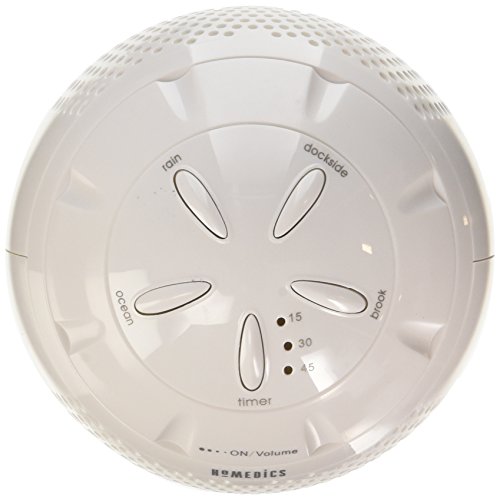
HoMedics SoundSpa Mini Portable Sound Machine — Best Budget
The SoundSpa Mini is the honest budget entry: a small, simple machine that runs on AA batteries, offers a handful of classic sounds, and costs little enough to live permanently in a suitcase or a spare room without justifying itself. HoMedics’ SoundSpa line has been the default first sound machine for a generation of buyers, and the Mini keeps that formula at its most portable — no charging cables to remember, no menus, just sound where you need it and silence where you do not.
Expect the compromises the price implies. Sound fidelity is pleasant rather than rich, the library is small, and there is no rechargeable sophistication — though AA power has its own virtue, since a fresh pair of cells from any airport shop restores the machine instantly, a trick no sealed battery can match mid-trip. For occasional travelers, office-desk masking, and households testing whether bedside sound helps them at all, the Mini answers the question at the lowest cost of entry in this guide.
- Sounds: a compact set of classic sound options
- Power: AA batteries — replaceable anywhere
- Body: mini portable format for bags and desks
- Controls: deliberately simple
- Character: the budget staple of the SoundSpa line
The SoundSpa Mini’s endurance in the market is its own review. Designs without merit do not survive a decade of cheaper imitations, yet this small machine persists because its proposition is perfectly legible: classic sounds, replaceable batteries, no instructions worth the name. It is the machine bought in multiples — one for the suitcase, one for the spare room, one for the office — and that pattern tells you exactly what it is for.
Strengths
- Lowest-commitment way to try bedside sound masking.
- AA cells are replaceable anywhere in the world, instantly.
- Small and light enough to live in a travel bag permanently.
Trade-offs
- Sound richness and library size trail the rest of this guide.
- No rechargeable option, so cells are an ongoing errand.
- Volume and depth suit personal space only.
Best for: budget buyers, occasional travelers, and first experiments. Not suited for: nightly heavy users wanting the richest sound.
What Is the Difference Between White, Pink, and Fan Noise?
White noise spreads its energy evenly across frequencies, which the ear perceives as a bright hiss — effective at masking, fatiguing to some listeners at length. Pink noise softens the higher frequencies, sounding more like steady rain or a waterfall, and many sleepers find it easier company through a whole night. Brown noise leans further into the low end, a rumble closer to distant surf or a strong wind, prized by people whose disturbance is bass-heavy: traffic, a boiler, a neighbor’s music through the floor.
Fan sounds occupy their own category because they carry the slight irregularities of moving air that pure tones lack. A real fan’s sound breathes almost imperceptibly, and the best electronic fan tones imitate that quality. This is why the heritage fan machines and their electronic descendants satisfy listeners who find laboratory noise colors sterile. None of these profiles is objectively superior; they are different textures against different disturbances, and the match between your noise problem and the machine’s tone matters more than the number of options on the box.
A practical way to choose: identify the sound that wakes you. Voices and television call for the even coverage of fan or white tones. Plumbing, footsteps, and street rumble answer better to pink and brown weight. Snoring — irregular, close, and personal — usually needs the machine near your ear at a volume that smooths the pattern without drowning the room, plus the honesty that no bedside machine performs miracles at pillow distance.
How Do the Six Machines Split the Sleeping World?
The Rohm belongs to the traditionalist sleeper: one good sound, every night, at home and in hotels, with batteries that forgive any charging routine. Its owner does not browse sounds any more than they browse mattress settings; the machine is furniture that happens to hum. The Micro2 serves the professional traveler whose sleep happens in other people’s buildings — generated sound that never loops, a speaker for the working day, and a charging cable shared with everything else in the bag.
The larger Dreamegg is the young family’s machine, migrating between nursery and parents’ room as circumstances demand, its library wide enough that each child seems to choose a different favorite. The SoundSleep is the guest room’s quiet hospitality and the first machine of households testing whether sound helps them at all; its timer respects the sleeper who wants help falling asleep and silence thereafter. The tiny Dreamegg owns the mobile margins of life — stroller naps, car journeys, the grandparents’ spare room — where a full-size machine would never be packed at all.
The SoundSpa Mini, finally, is the pragmatist’s spare: the machine in the suitcase, the office drawer, the rental cottage’s shelf. It asks nothing, costs little, and works anywhere AA cells exist. Read together, the six are less a ranking than a map of sleeping lives, and the correct choice is the one whose habits match the nights you actually live.
Comparison Table
| Machine | Power | Sounds | Best suited to |
|---|---|---|---|
| Yogasleep Rohm | AAA or USB | 3 | Overall fan-tone masking |
| LectroFan Micro2 | USB rechargeable | 11 non-looping | Travel plus Bluetooth speaker |
| Dreamegg Portable | Rechargeable | 21 | Babies and family travel |
| HoMedics SoundSleep | Adapter or batteries | 6 | Simple home and guest rooms |
| Dreamegg 1000mAh | USB-C rechargeable | 16 | Tiny stroller and bag duty |
| HoMedics SoundSpa Mini | AA batteries | Compact set | Budget and backup use |
How Do You Choose for a Shared Bedroom?
A shared room turns a personal appliance into a treaty. Begin by auditioning sounds together in daylight, at the volume each partner actually sleeps under, and eliminate any tone either person describes with a negative adjective — endurance beats enthusiasm at 3 a.m. Machines with several noise colors, like the Dreamegg pair and the LectroFan, give a couple more treaty terms to negotiate with, while the Rohm’s three tones settle households whose tastes already agree. Placement can split the difference: a machine nearer the more sensitive sleeper, at a volume the other barely registers, resolves many standoffs without a second purchase.
Different schedules add the final clause. The earlier sleeper may want the machine running before the later partner’s bedtime routine begins; timers and simple controls that a half-asleep hand can operate without light become relationship infrastructure. Households that treat the sound machine as shared equipment — chosen together, placed deliberately, adjusted by consent — report it fading into the marriage furniture within a month, which is precisely where this category does its best work.
Which Sound Actually Masks Noise Best?
Masking works by raising the background floor so intruding sounds stop standing out, and steady, broad-spectrum sound does that job best. Fan tones and pink-leaning noise colors cover speech frequencies kindly, which is why the Yogasleep Rohm and the LectroFan generation approach satisfy so many listeners. Nature recordings charm at bedtime but mask unevenly — a rain track’s quiet moment is exactly when the hallway conversation walks through. If your problem is a snoring partner or a thin apartment wall, choose a fan or noise tone first and treat nature sounds as the pleasant alternative for quieter rooms.
Placement rivals sound choice in importance. Put the machine between you and the noise source when you can — on the nightstand nearest the door, or the side of the bed facing the street — and closer to your ears than to the disturbance. Volume should be just loud enough that the intruding sound stops drawing attention; louder is not better, and a machine straining at maximum will distort in ways that keep a light sleeper aware of it.
Consistency finishes the lesson. The same sound, at the same volume, in the same place becomes part of the room’s furniture within a few nights, and novelty is the enemy of that process. This is why a three-sound machine used nightly often outperforms a forty-sound machine browsed like a menu — your ear is trying to forget the machine exists, and familiarity is how it succeeds.
What Volume Is Right, and Where Should the Machine Sit?
Think in terms of the conversation test: at the correct volume, a normal speaking voice at the doorway should blur into the background rather than compete with the machine. Louder than that and the machine becomes the room’s dominant sound, which defeats its purpose of being ignorable; quieter and the intrusions it exists to soften remain distinct events. Most households find the setting in the middle of the dial and leave it there permanently, because consistency — the same wash at the same level — is what allows the ear to file the sound under furniture.
Placement follows the noise. For street sound, the machine belongs on the window side of the bed; for a partner’s snoring, between the two pillows’ latitudes but closer to the listener; for a baby’s room, across the room from the crib at a moderate level, never inside the sleeping space itself. Hard surfaces reflect and can add a metallic edge at higher volumes, so a machine that sounds harsh on a glass-topped table may sound perfect on wood or a folded cloth. Experiment on a weekend afternoon, when adjustments are cheap, rather than at midnight, when they are not.
How Do You Use a Sound Machine Away From Home?
Pack the machine where you can reach it before the first night, not buried under the shoes. In a hotel, place it on the nightstand between your head and the door or the connecting wall, and run it for ten minutes while you unpack so your ear accepts it as the room’s baseline before sleep is at stake. The LectroFan Micro2 earns its travel badge here: it recharges from the same USB ecosystem as everything else in a modern carry-on, so a forgotten proprietary cable never silences it.
Mind the power plan. Replaceable-cell machines like the Rohm and the SoundSpa Mini forgive any charging failure — fresh cells exist in every airport and petrol station — while rechargeable models reward a nightly top-up habit alongside your phone. For camping and cabins, decide before departure which machine’s endurance matches the trip’s length, and treat a small power bank as the shared insurance policy for everything battery-powered in the bag.
For babies away from home, recreate the home setup as closely as travel allows: same sound, similar volume, machine placed at a consistent distance from the crib or travel cot, and never inside the cot itself. Familiarity is the entire product for an infant; the strange room becomes acceptable because one element of it sounds exactly like home.
What Should Renters and Light Sleepers in Thin-Walled Homes Know?
Thin walls create a particular acoustic poverty: every sound arrives as an event, because the building provides no background of its own. A sound machine manufactures that missing background, and renters — who cannot insulate, rehang doors, or choose their neighbors — are this category’s most grateful constituency. The battery models here suit rental life specifically, since they ask for no installation, no outlet negotiations in oddly wired rooms, and they leave with you when the lease does.
Manage expectations about direction, though. A machine in your room masks what reaches your ears; it does nothing for the neighbor’s experience of your television, and courtesy still runs both ways. Place the machine on your side of the shared wall and it will feel, within a week, as though the wall thickened. That small illusion, honestly understood, is one of the best-value comforts a renter can buy.
What Is the History Inside These Small Machines?
The bedside sound machine is older than its electronics. The original concept was mechanical — a small fan inside an adjustable housing, whose rushing air could be tuned by rotating vents — and it was sold to light sleepers, travelers, and offices seeking speech privacy decades before a microchip entered the story. Yogasleep’s Rohm descends from that lineage, which is why its fan tones carry an authenticity that synthesized imitations chase: the company spent generations learning exactly what moving air should sound like at a pillow’s distance.
Electronic generation changed the category’s portability rather than its purpose. LectroFan’s synthesized approach removed the moving parts, shrank the machine to puck size, and made the sound mathematically seamless. Recorded libraries arrived with cheap memory, offering rain forests and thunderstorms to listeners who found fan tones austere. The Dreamegg and HoMedics models in this guide are the modern synthesis of those threads — recorded breadth, rechargeable power, nursery-aware design — and understanding the lineage helps a buyer read any sound machine’s claims: ask first whether its sound is generated, recorded, or mechanical in spirit, and most of its character follows from the answer.
What has never changed is the underlying transaction. The sleeper trades a small, chosen sound for freedom from a hundred unchosen ones, and the machines that honor that trade — steady, simple, and forgettable — are the ones still on nightstands when their trendier contemporaries have been donated.
How Do Sound Machines Serve Different Kinds of Sleepers?
The light sleeper who wakes at a floorboard’s opinion needs consistency above all: a fan tone without variation, at a volume set once and never revisited, from a machine like the Rohm whose entire design assumes the listener wants to forget it exists. For this sleeper, features are friction — every additional option is a decision between them and the one sound that works. The partner of a snorer needs something subtly different: masking that rises close to the ear without filling the room, which rewards small machines placed precisely and volumes tuned to the pattern of the snoring rather than its peaks.
Shift workers invert the problem, sleeping against a household at full daylight volume. Their machines work harder and sit closer, and the rechargeable models earn their keep in rooms where the outlet belongs to the alarm clock that rules their schedule. Babies, as this guide has noted, are consistency extremists: the machine is a place as much as a sound, and moving it between rooms nightly undoes the association everyone is paying for. Two modest machines often serve a young family better than one excellent machine in transit.
The anxious mind at 3 a.m. is the final audience, and honesty matters here: a sound machine gives the ear somewhere neutral to rest, which many people find genuinely settling as part of a wind-down routine. It is a comfort tool, not a clinical one, and this guide recommends it in exactly those terms — as the acoustic equivalent of a cool, dark room, valuable for what it is and silent about what it is not.
What Mistakes Do Sound Machine Buyers Make?
Buying by sound count is the first. Forty tracks mean nothing if the three you use loop audibly or distort at masking volume, and several machines here prove that a small, well-made library beats a padded one. The second mistake is placing the machine across the room for tidiness, then compensating with volume; a nearby machine at moderate level masks better and bothers a partner less.
Third, buyers expect a sound machine to silence a household. It will not, and honest guides should say so: masking softens intrusion, it does not delete a television through a wall or a toddler at dawn. Expecting erasure leads to maximum-volume disappointment; expecting smoothing leads to the satisfaction these machines genuinely deliver. Finally, travelers forget the power question until the first night — check how your machine runs untethered before the trip, not during it.
How Do You Care for a Machine That Works Every Night?
Nightly devices age differently from occasional ones: buttons wear smooth, charging ports loosen, and dust settles into speaker grilles with geological patience. A monthly wipe with a dry cloth, a gentle brush across the grille, and a check that cables sit without strain keep the machine sounding as it did in its first month. Rechargeable models appreciate being neither permanently plugged in nor repeatedly drained to silence; a rhythm of regular use and regular charging suits their batteries best.
Replaceable-cell machines ask a different discipline: remove cells during long storage so an aging battery never leaks into the compartment, and keep the spare pair in the same drawer as the machine rather than in the kitchen’s battery wilderness. For nursery machines, add a periodic check of cords and placement as the child grows — the machine that sat safely on a shelf at three months should be re-audited by the time small hands explore at a year.
When a machine’s sound changes — a new rattle, a thinning tone — treat it as information rather than decline. Dust, a loosened grille, or a surface resonance usually explains it, and the fix is housekeeping. These are simple devices built for years of nightly service, and the owners who get those years are the ones who treat the machine like the furniture it aspires to be.
A final calibration note for households buying their first machine: judge it after a week, not after a night. The first night measures novelty, and novelty is precisely what a sound machine is designed to abolish. By the fourth or fifth night the sound has become the room’s weather, and the correct question is no longer whether you notice the machine but whether you notice the disturbances less. Buyers who grant that week almost never return these devices; buyers who judge on night one are grading the wrong exam.
It is also worth keeping the box and receipt for the first month, not from doubt but from the category’s one genuine uncertainty: tone preference is personal in a way no review can fully predict. This guide has ranked faithfully by sound quality, power sense, and design honesty, yet the last five percent of the decision lives in your own ears. The right machine is the one whose sound your household stops hearing — and that verdict, uniquely, can only be delivered by your own nights.
Parents ask one question often enough to deserve its own answer here: when should the nursery machine stop? There is no universal age, because the machine’s job was never developmental — it was acoustic. Families taper it when the child’s sleep survives ordinary household noise without it, often by moving the machine to the hallway side of the door for a transitional month, then to the parents’ own room, where it frequently takes up permanent residence. A machine bought for a newborn ending its career serving the parents’ sleep is not mission creep; it is the product working exactly as designed, for whoever in the house currently sleeps lightest.
That migratory pattern explains the quiet wisdom of buying a good machine rather than a disposable one at the nursery stage. The Rohm bought for a baby’s room in one decade is the same Rohm masking a teenager’s exam-week sleep in the next, because nothing about its job description expires. Few nursery purchases can make that claim, and it is worth weighing when the budget conversation happens.
Workplaces have quietly become this category’s second home, and the logic mirrors the bedroom’s: a steady sound at a desk softens the corridor, the neighboring call, and the office kitchen’s percussion into a background the mind can release. Battery operation matters here more than expected, because desks are outlet-poor and hot-desking punishes anything that must be plugged in and reclaimed. The Micro2’s speaker duality and the Mini’s drawer-sized indifference to infrastructure explain their office followings — the machine simply goes where the worker goes, and the workday sounds smaller around it.
Sleep, in the end, is a household’s shared infrastructure, and a small machine that improves it for one member usually improves it for all — the partner no longer woken by the same door slam, the baby whose nap survives the doorbell, the traveler who arrives rested enough to be pleasant. That compounding return on a modest purchase is why this unglamorous category endures, and why choosing the right small machine deserves the same care as choosing a mattress.
Buy it once, buy it well, and let the nights take care of themselves from that evening forward, in every room the household sleeps in.
Few purchases this small touch every night of a household’s year, and fewer still ask so little in return for the calm they quietly deliver.
Choose the one your household will forget the fastest, and it will have done its work perfectly.
Final Recommendation
Start with the Yogasleep Rohm if you want the surest all-round masking, the Micro2 if your life is lived in hotels, the larger Dreamegg if a baby shares your travels, the SoundSleep for a simple home or guest room, the tiny Dreamegg for stroller and carry-on duty, and the SoundSpa Mini when budget rules. A good sound machine does not perform; it recedes, night after night, until the room simply sounds like rest — and the best compliment any of these six can earn is that you stopped noticing it weeks ago.
How Should You Introduce a Sound Machine to a Household?
Start on a weekend, at moderate volume, with the machine in its permanent place. The first nights are calibration, not verdict: adjust the tone before adjusting the volume, and give each candidate sound at least two nights before judging it, because the ear’s first reaction to any new background is to notice it — the opposite of the eventual effect. Partners sharing a room should choose together; a sound one sleeper loves and the other endures is a negotiation, not a solution, and the libraries in this guide exist partly to settle exactly that negotiation.
For children, introduce the machine as part of the bedtime sequence rather than as a response to a bad night, so it becomes a cue rather than a remedy. Keep the sound, volume, and placement consistent; the developing association between that particular wash of sound and sleep is the entire mechanism, and it strengthens with repetition. When traveling, bringing the same machine preserves the cue in a strange room, which is why portable models punch so far above their size in family life.
Set expectations with the honesty this guide has tried to keep: a sound machine smooths the acoustic edges of a home. It will make the refrigerator’s hum, the early bin lorry, and the neighbor’s television stop feeling like personal addresses to you. It will not rebuild thin walls, and it is not a treatment for any sleep disorder — persistent sleep problems deserve a clinician, not a louder machine.
What Should You Pack Alongside a Travel Sound Machine?
Power first: spare cells for the battery models, the correct cable for the rechargeable ones, and a small power bank if the trip includes trains, campsites, or long delays. A short extension lead rescues hotel rooms whose only outlet hides behind the bed frame, letting the machine sit where it works rather than where the building allows. Earplugs make a sensible backup for the nights when a machine alone cannot carry a wedding party in the corridor — layering a machine’s room tone with plugs at a lower volume is a veteran traveler’s trick.
Consider the room itself. A machine placed on a hard nightstand can buzz sympathetically at certain volumes; a folded hand towel beneath it silences the furniture’s contribution. In shared rooms, agree the sound and volume before lights out rather than negotiating in whispers at midnight. And keep the machine in the same bag pocket every trip — the five minutes spent hunting a small white puck in a dark hotel room at midnight is the tax on every disorganized packing system.
Frequently Asked Questions
How long do the batteries last on these machines?
It depends heavily on volume, which is why we describe endurance practically rather than printing hour figures we cannot guarantee. Replaceable-cell models like the Rohm run for extended stretches on a set of AAA cells, rechargeable models comfortably cover nights of typical use between charges, and higher volume always shortens any of these spans. For long trips, carry spare cells or a power bank matched to your machine’s power type.
Is white noise safe to use all night?
Used at sensible volumes, bedside sound masking is a routine part of many households’ sleep habits, and every machine here offers a wide volume range so you can keep levels moderate. Place machines at a reasonable distance from the sleeper — especially for infants, where the machine belongs across the room or on a shelf, never in the crib — and choose the lowest volume that does the masking job.
What is the difference between generated sound and recordings?
Generated machines synthesize fan and noise tones continuously, so there is no loop for your ear to learn. Recorded machines play captured nature sounds, which offer variety and realism but repeat on a cycle. Loop-sensitive listeners should choose a generated model like the LectroFan or the Rohm’s fan tones; variety lovers often prefer the recorded libraries.
Can a sound machine help in an office?
Yes, for the same masking reason: a steady sound at your desk softens nearby conversation and corridor noise, making concentration easier and your own calls less audible to neighbors. The Micro2 and the SoundSpa Mini suit desks particularly well, and the Micro2’s Bluetooth speaker function covers background music duty when the workday calls for it instead.
Which machine is best for a baby’s nursery?
The larger Dreamegg portable is our nursery pick for its broad library and rechargeable battery, with the tiny Dreamegg as the travel and stroller companion. Keep whichever you choose at a distance from the crib, at moderate volume, and consistent from night to night — babies settle to the familiar, and the machine’s real nursery job is being boringly identical every evening.
Can I use a sound machine for a dog or cat?
Many owners do, particularly for pets unsettled by storms, fireworks, or a suddenly empty house, and the same principles apply: moderate volume, a steady tone, placement away from the animal’s bed rather than beside its ears, and observation of whether the pet actually relaxes. Animals vote clearly with their feet. A machine is a comfort experiment for a pet, never a substitute for addressing the underlying anxiety with a veterinarian when it persists.
Do sound machines use much power?
Very little — they are among the smallest electrical loads in a home, sipping either from cells over long stretches or from USB and adapters at a trickle. Battery models exist precisely because the draw is modest enough for portable power to be practical for many nights. Running one nightly costs a negligible amount compared with any appliance that heats, cools, or spins.
Related Guides
Coffee is the other half of many readers’ sleep arithmetic, and our bean-to-cup roundup at Best Bean to Cup Cappuccino Machines covers the morning side of the ritual. For the kitchen projects that fill a restful home, see Best 30 Inch Self Cleaning Gas Range Ovens, and for outdoor cooking weekends, Best Backyard Pizza Ovens gathers the ovens worth gathering around.


