What's inside
- Key Takeaways
- Quick Picks
- How Did We Judge Heavy Duty Claims on a Budget?
- How Do the Six Compare on Frame, Power and Control?
- What Does Heavy Duty Actually Mean at This Price?
- Which Fabrics Can These Machines Really Handle?
- Why Does the Needle Matter More Than the Motor?
- How Should You Set Up for a Thick Seam?
- Mechanical Dials or Computerized Control: Which Suits Thick Work?
- What Maintenance Keeps a Hard-Working Machine Honest?
- How Do You Test One of These Machines in Its First Week?
- Which Accessories Actually Earn Their Drawer Space?
- How Does Speed Control Change the Way Thick Sewing Feels?
- What Should You Verify on the Listing Before You Order?
- How Do You Sew Webbing, Straps and Other Awkward Heavy Items?
- When Should a Household Step Up Beyond This Class?
- How Do You Keep Seams Straight When Fabric Gets Heavy?
- What Does a Sensible First Project Look Like?
- How Should You Store and Transport a Heavy Duty Machine?
- Which Repairs Pay Back the Purchase Fastest?
- How Do Tension and Thread Behave Differently on Thick Stacks?
- What Is the Sensible Way to Compare These Machines in a Shop or Online?
- What Mistakes Do Buyers Make With Affordable Heavy Duty Machines?
- Final Recommendation
- Frequently Asked Questions
- Related Guides
As an Amazon Associate I earn from qualifying purchases. This post may contain affiliate links at no extra cost to you.
cottageverdict.com is reader-supported. When you buy through links on our site, we may earn an affiliate commission.
Where to buy: all six machines below are sold through Amazon, and their names in the Quick Picks table, the detailed sections and the comparison table link to their listings so you can check price on Amazon and confirm the current bundle contents before ordering. This guide to the best affordable heavy duty sewing machines starts from a simple observation: the work that destroys ordinary machines is rarely exotic. It is hemming jeans week after week, shortening canvas curtains, stitching webbing straps, repairing a dog lead, running a seam through four layers of upholstery fabric where two layers cross. Affordable heavy duty machines exist for exactly that diet of work.
Heavy duty, at this end of the market, is a construction claim before it is a speed claim. The listings gathered here lean on three recurring features: a metal internal frame that keeps the needle bar and feed dogs aligned when the motor is working hard, a motor with more punching power than a standard domestic model, and a top speed near eleven hundred stitches a minute on the SINGER mechanical models. None of that turns a home machine into an industrial unit, and this guide will not pretend otherwise. What it buys you is a machine that does not shudder, skip or stall when the fabric stack gets thick, at a price a home sewer can justify.
The six picks divide into two camps. Five are SINGER Heavy Duty family machines, mechanical and computerized, spanning 11 to 100 built-in stitches. One is Brother’s Strong and Tough entry, included because its approach to thick seams — reinforced needle handling and a metal chassis attitude in a Brother control layout — gives SINGER-averse buyers a genuine alternative rather than a token. Within the SINGER camp the differences are real: stitch counts, buttonhole style, bundled extras and one computerized model that changes how you select and adjust everything.
Affordable also means honest about limits. These machines will sew denim, canvas, duck cloth and lighter leather with the right needle, but they are not built for all-day production runs, saddle-weight hides or the continuous thick work of an upholstery shop. Read the trade-offs under each pick; they are written per machine, not pasted across the group, because where a 4411 gives up ground is not where an HD6600C gives it up.
One more framing note before the picks: affordable in this category should mean inexpensive to own, not merely inexpensive to buy. A machine whose accessories are common, whose manual is clear and whose platform is widely serviced will cost its household less over a decade than a marginally cheaper orphan with exotic bobbins. Every pick below was chosen with that total-ownership lens applied.
Key Takeaways
- A metal internal frame is the single feature that separates this class from ordinary domestic machines; every pick here is built around one or an equivalent reinforced chassis.
- Motor power claims in the listings run from 50% more power on the mechanical SINGERs to 60% more on the computerized HD6600C — that headroom is what pushes a needle through crossed denim seams.
- Stitch count is the weakest reason to pay more in this class: the 11-stitch 4411 covers most repair work, while the 100-stitch HD6600C earns its place through computerized control, not through stitch variety alone.
- The 4452 bundle’s extension table matters more than its extra stitches for anyone sewing large, heavy pieces that need supporting.
- Needle choice does more for thick-fabric success than any setting on these machines; a fresh denim or leather needle prevents most skipped stitches.
Quick Picks
| Pick | Badge | Why it earns its place |
|---|---|---|
| SINGER 4423 Heavy Duty Sewing Machine | Best All-Round Mechanical Workhorse | The reference point of the class: metal frame, an 1,100-per-minute top speed and a one-step buttonhole in the Meltwater Blue finish. |
| SINGER 4452 Heavy Duty Sewing Machine Bundle | Best Bundle for Large Heavy Projects | Adds an extension table and extra presser feet to the heavy duty formula, with 32 stitches for 110 applications. |
| SINGER HD6600C Heavy Duty Computerized | Best Computerized Heavy Duty Pick | One hundred stitches, an LCD screen and a 60% more power claim bring computer control to the heavy duty line. |
| Brother ST150HDH Strong and Tough Sewing Machine | Best Non-SINGER Alternative | Brother’s Strong and Tough model brings 50 stitches and a thick-seam focus for buyers who prefer the Brother layout. |
| SINGER 4411 Heavy Duty Sewing Machine Pink | Best Simple Repair Machine | Eleven stitches, a metal frame and full heavy duty speed in a pink finish — the stripped-back repair tool of the group. |
| SINGER Heavy Duty 4552 Next Evolution | Best Smooth-Running Evolution | A newer DC motor promises smoother, stronger sewing across 32 stitches, with bonus presser feet in the box. |
How Did We Judge Heavy Duty Claims on a Budget?
We weighted the frame and motor first, because a heavy duty badge on a plastic-framed machine is decoration. Each pick’s listing was checked for an explicit metal frame or reinforced construction claim, for a stated power advantage over standard models, and for a top speed figure, which is a rough proxy for motor gearing. Machines that offered only a macho colour scheme were left out.
Second came seam-crossing realism. Affordable heavy duty machines earn their keep at the moment a seam allowance doubles the fabric stack, so we favoured models whose listings speak directly to denim and canvas work, and we noted presser-foot and accessory bundles that help thick work — extension tables, walking-friendly feet, heavy needle assortments — rather than decorative stitch libraries.
Finally, value was judged per household job, not per feature count. A machine with 23 well-chosen stitches and a one-step buttonhole can be the smarter buy for a repair-focused home than a 100-stitch computerized model, and the recommendations below say so where that is true.
We also read owner experience for pattern failures rather than anecdotes: repeated complaints about skipped stitches at seam crossings, cracked plastic gearing, or buttonholes wandering on thick fabric counted heavily against a model, while long runs of uneventful denim work counted in favour. A single dramatic review, good or bad, moved nothing; the boring consensus moved everything.

SINGER 4423 Heavy Duty Sewing Machine — Best All-Round Mechanical Workhorse
The 4423 is the machine most people picture when this category is mentioned, and its listing explains why: 23 built-in stitches covering 97 stitch applications, a metal frame, a motor rated with 50% more power for denim and canvas, and a top speed of 1,100 stitches per minute. In practice that combination covers the full household heavy roster — jeans hems, canvas tote seams, curtain blackout lining, webbing — without asking you to learn a computer interface first.
Its one-step buttonhole is the detail owners appreciate most over time, because buttonholes on thick shirt plackets and coat fabric are where cheap machines wander. Dial-based stitch selection keeps gloves-on, mid-repair adjustments simple, and the Meltwater Blue finish distinguishes this listing from the grey versions of the same platform. Choose it as the default recommendation when the budget is fixed and the work list is broad.
Ownership details are unglamorous and good. Bobbins and feet follow the common SINGER pattern, so replacements sit in every sewing shop; the accessory kit in the box covers the first months of work; and the machine’s weight is enough to stay planted on the table at speed without being a burden to lift into a cupboard. For a first heavy duty purchase, predictability is a feature, and the 4423 is the most predictable machine here.
Resale and hand-me-down value quietly favour this model too: because the platform is so common, a 4423 is easy to sell, easy to gift and easy to find a service technician willing to touch. None of that appears on a specification sheet, yet over a ten-year ownership span it may matter more than two extra stitches.
- 23 built-in stitches, 97 stitch applications
- Metal internal frame
- Top speed 1,100 stitches per minute
- One-step buttonhole
- Motor rated 50% more power for denim and canvas
- Meltwater Blue finish with accessory kit
Strengths
- Proven platform with deep accessory compatibility
- One-step buttonhole outperforms the 4-step style on thick fabric
- Fast top speed shortens long straight seams on curtains and covers
Trade-offs
- Mechanical dials give no stitch memory between sessions
- No extension table in the box for supporting large heavy pieces
- Louder at full speed than the DC-motor 4552 below
Best for: households wanting one mechanical machine for jeans, canvas and general repairs.
Not suited for: sewers who want computerized stitch selection or a bundled extension table.
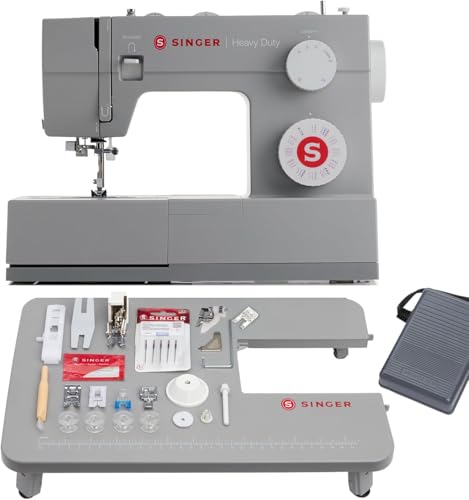
SINGER 4452 Heavy Duty Sewing Machine Bundle — Best Bundle for Large Heavy Projects
The 4452 bundle answers the most common complaint about sewing heavy fabric at home: the material, not the machine, becomes unmanageable. The included extension table gives curtains, quilted throws and canvas drop cloths a flat runway so their weight stops dragging the seam sideways, and the two extra presser feet in the kit widen what you can attempt on day one. Underneath, the platform keeps the family formula — 32 built-in stitches delivering 110 applications and the same 50% more power claim for thick fabrics.
Pick this over the 4423 when your projects are physically large rather than merely thick. A repair-only household gains little from the table, but anyone reupholstering chair seats, hemming room-length drapes or making outdoor cushion covers will feel the difference in every long seam, because supported fabric feeds straighter and the needle spends its power on penetration instead of fighting drag.
One caution belongs with the praise: bundle listings change. The extension table and the two extra feet are the entire reason to choose this package, so confirm both appear in the listing’s contents before ordering, and photograph the box contents on arrival. With the table fitted, the machine’s working footprint grows considerably — measure the sewing table with the extension in place, not the bare machine, before deciding where it will live.
Sewers who quilt heavy throws or assemble layered outdoor gear will also notice the bundle’s quieter benefit: the table reduces the micro-drags that accumulate into wavy seams over a two-metre run. Straightness on long work is mostly a support problem, and this package is the only one in the group that ships the solution in the same box.
- 32 built-in stitches, 110 applications
- Extension table included in bundle
- Two extra presser feet in accessory kit
- Heavy duty motor, 50% more power claim
- Metal frame construction
Strengths
- Extension table transforms handling of bulky heavy items
- Broader stitch set than the 4423 for decorative reinforcement
- Bundle pricing usually beats buying the table separately
Trade-offs
- Table needs storage space when not in use
- Still a mechanical dial machine with no memory functions
- Bundle contents vary by listing run, so verify before ordering
Best for: sewers tackling cushions, drapes and other large heavy pieces at home.
Not suited for: small desks where an extension table has nowhere to live.

SINGER HD6600C Heavy Duty Computerized — Best Computerized Heavy Duty Pick
The HD6600C is where the heavy duty family grows a brain. Its listing promises 100 built-in stitches, an LCD screen, LED lighting and a motor with 60% more power — the strongest power claim in this group — while keeping the 1,100 stitches per minute top speed and the one-step buttonhole. Computerized selection means stitch length and width become precise, repeatable numbers rather than dial guesses, which matters when you return to a half-finished canvas project a week later and need the exact same topstitch.
The black Sterling finish and screen make it feel a generation newer than its mechanical siblings, because it is. The honest cost is complexity: menus replace dials, and a sewer who values glove-friendly simplicity may genuinely prefer the 4423. But for mixed work — heavy seams in the morning, decorative stitching on lighter fabric in the afternoon — this is the most versatile machine on the page.
The screen also changes how beginners learn the machine: stitch numbers, length and width are displayed rather than inferred from dial positions, so a tutorial’s settings can be copied exactly. Experienced sewers sometimes dismiss that as hand-holding; in a household where two people share one machine, it ends the quiet sabotage of the previous user’s dial settings still being active. That shared-household argument, more than the stitch count, justifies the HD6600C for many buyers.
One more practical point: computerized machines remember settings, but they also remember mistakes — a width left at maximum from a decorative experiment will greet your next denim seam if you do not glance at the screen. Build the glance into your routine and the HD6600C’s precision becomes pure advantage; skip it and the mechanical dials’ physical obviousness starts to look wise.
- 100 built-in stitches
- Computerized selection with LCD screen
- Motor rated 60% more power
- Top speed 1,100 stitches per minute
- One-step buttonhole
- LED work light, black Sterling finish
Strengths
- Repeatable digital stitch settings across sessions
- Strongest stated power claim in this line-up
- LED lighting helps on dark denim and canvas
Trade-offs
- Menu navigation slows simple mid-repair changes
- Electronics add a failure mode mechanical models lack
- Priced at the top of this affordable group
Best for: mixed heavy and decorative sewing where repeatable settings matter.
Not suited for: purists who want purely mechanical controls and nothing to configure.

Brother ST150HDH Strong and Tough Sewing Machine — Best Non-SINGER Alternative
Brother’s entry is named for the job: Strong and Tough, 50 built-in stitches, and a design brief aimed at handling thick seams without the needle deflection that makes home machines skip. Its value in this group is partly philosophical — some households simply get on better with Brother’s control layout, bobbin system and accessory ecosystem — and partly practical, since 50 stitches is a generous library for a machine bought mainly to survive denim.
Against the SINGERs it trades headline top speed for a calmer, more guided experience, and its listing keeps the specification story short, which cuts both ways: fewer numbers to hide behind, but also less detail to compare. Shortlist it if you already own Brother feet and bobbins, or if the SINGER dial layout has never suited your hands.
Consider also what the Brother asks of you: its strengths show on guided, steady work — long seams on layered cotton, steady denim runs — rather than on brute-force bursts. Owners coming from lighter Brother models will find the transition gentle, with familiar threading and bobbin behaviour. Owners expecting the SINGER machines’ headline speed figures should calibrate expectations; this is the control-and-confidence entry in the group, and judged on that basis it holds its place comfortably.
For households splitting time between garment repairs and craft projects, the Brother’s fifty stitches include enough decorative range to keep it interesting beyond utility work, which protects the purchase against the common fate of single-purpose tools: being forgotten in a cupboard. A machine that is enjoyed gets oiled, dusted and used; that is a durability argument no laboratory can measure.
- 50 built-in stitches
- Strong and Tough thick-seam positioning
- Brother bobbin and accessory ecosystem
- Computerized-style stitch selection panel
- Reinforced needle handling for layered fabric
Strengths
- Generous stitch count for a toughness-first model
- Familiar layout for existing Brother owners
- Accessory compatibility with a wide Brother range
Trade-offs
- Listing states fewer hard specifications than the SINGER rivals
- No bundled extension table in this configuration
- Power advantage is described qualitatively, not as a percentage
Best for: Brother households wanting a thick-seam capable machine.
Not suited for: buyers who comparison-shop on stated speed and power figures.

SINGER 4411 Heavy Duty Sewing Machine Pink — Best Simple Repair Machine
The 4411 strips the heavy duty idea to its essentials and then paints it pink. Eleven built-in stitches deliver 69 applications, the frame is metal, the motor carries the same 50% more power claim, and the top speed is the full 1,100 stitches per minute. What you surrender is refinement: the buttonhole is the older four-step style, and there are no decorative stitches to speak of. What you gain is a machine with almost nothing to learn and nothing superfluous to maintain.
That honesty makes it the right buy for a specific household: one that sews in bursts of necessity — torn jeans, a ripped backpack strap, hems before a trip — and wants the machine to start, sew straight through the thick part, and go back in the cupboard. The pink finish is not a lesser specification; the listing’s numbers match its grey sibling’s role in the range.
The pink finish deserves one practical note rather than a joke: visibility. A brightly coloured machine is easy to spot in a shared craft room, quick to identify in a classroom set and, for younger sewers, simply more inviting to use — and a machine that gets used gets maintained. Mechanically nothing is held back for the colour; the specification in the listing matches the model’s role as the lean, fast, simple end of the heavy duty range.
Budget the small extras honestly with this one: a walking foot and a packet of denim needles, bought alongside, turn the 4411 from a strong basic into a genuinely capable thick-fabric station for still-modest total outlay. The machine’s leanness is an invitation to choose your own upgrades rather than a sign that upgrades are unavailable.
- 11 built-in stitches, 69 applications
- Metal internal frame
- Maximum speed of 1,100 stitches a minute
- Four-step buttonhole
- Motor rated 50% more power for denim and canvas
- Pink finish with accessories included
Strengths
- Simplest control set in the group to learn
- Full heavy duty speed and frame at the leanest specification
- Ideal second machine for a repair corner or teen sewer
Trade-offs
- Four-step buttonhole demands more operator attention
- Eleven stitches leave little room to grow into decorative work
- No computerized aids for consistency
Best for: repair-focused homes wanting maximum simplicity with real thick-fabric ability.
Not suited for: beginners planning to expand into varied garment sewing quickly.

SINGER Heavy Duty 4552 Next Evolution — Best Smooth-Running Evolution
The 4552 Next Evolution is SINGER reworking its own formula: 32 built-in stitches, the metal frame, a one-step buttonhole, and a newer DC motor that the listing credits with more power, more speed and smoother sewing. DC motors deliver their torque more evenly at low speed, which is precisely where thick work is hardest — starting a seam on a folded jeans hem is a low-speed, high-resistance moment, and smoothness there means fewer broken needles and less fabric creep.
Bonus presser feet in the box sweeten a package aimed at owners upgrading from an earlier heavy duty model who found it a little agricultural at slow speeds. If your thick sewing involves careful starts, tight corners on bags and straps, or slow manoeuvring around hardware, this is the mechanical pick tuned for your style rather than for outright pace.
Treat the 4552 as the connoisseur’s mechanical choice. Its improvements do not photograph well — motor character never does — but they are felt in the first minute of sewing a folded hem start. Buyers cross-shopping it against the 4423 should decide by sewing style: fast, confident, straight-line work favours the older model; slow, precise, hardware-heavy projects favour this one’s smoother delivery. The bonus feet simply widen the margin.
The DC motor also tends to run with less vibration at working speeds, and vibration is fatigue — for the operator’s hands and for the work surface in a small flat. If your sewing happens at a kitchen table in the evening, that calmness is not a luxury; it is the difference between a hobby that fits your home and one that annoys it.
- 32 built-in stitches
- Metal internal frame
- New DC motor for power, speed and smoothness
- One-step buttonhole
- Bonus presser feet included
Strengths
- Smoother low-speed torque for careful thick starts
- One-step buttonhole at a mid-range specification
- Bonus feet widen the out-of-box repertoire
Trade-offs
- Newer model with a shorter track record than the 4423
- Mechanical dials still offer no setting memory
- Smoothness gains are subtle on plain straight seams
Best for: careful sewers who start thick seams slowly and value control.
Not suited for: buyers who prefer the longest-proven platform regardless of refinement.
How Do the Six Compare on Frame, Power and Control?
Read the table by columns rather than by row order. The frame story is nearly uniform — metal where it counts — so the real separators are control style (dials, DC-motor mechanical, or full computer), buttonhole type, and what arrives in the box.
| Pick | Badge | Specification snapshot | Power and speed notes |
|---|---|---|---|
| SINGER 4423 Heavy Duty Sewing Machine | Best All-Round Mechanical Workhorse | 23 stitches, metal frame, 1-step buttonhole | Top speed 1,100/min, 50% more power claim |
| SINGER 4452 Heavy Duty Sewing Machine Bundle | Best Bundle for Large Heavy Projects | 32 stitches, extension table bundle | 110 applications, extra presser feet included |
| SINGER HD6600C Heavy Duty Computerized | Best Computerized Heavy Duty Pick | 100 stitches, computerized, LCD screen | 60% more power claim, top speed 1,100/min |
| Brother ST150HDH Strong and Tough Sewing Machine | Best Non-SINGER Alternative | 50 stitches, Strong and Tough build | Brother accessory ecosystem, thick-seam focus |
| SINGER 4411 Heavy Duty Sewing Machine Pink | Best Simple Repair Machine | 11 stitches, metal frame, 4-step buttonhole | Top speed 1,100/min, pink finish |
| SINGER Heavy Duty 4552 Next Evolution | Best Smooth-Running Evolution | 32 stitches, DC motor, metal frame | 1-step buttonhole, bonus presser feet |
What Does Heavy Duty Actually Mean at This Price?
It means the machine’s skeleton and motor are specified for resistance, not that the machine is industrial. A metal frame holds alignment when the needle meets a hard stack; alignment is what keeps stitches formed instead of skipped. A stronger motor maintains needle penetration speed as layers build. Consumer listings express that as percentage power claims — 50% more on the mechanical SINGERs here, 60% more on the HD6600C — measured against each brand’s standard models, so treat them as within-brand signals, not cross-brand absolutes.
Everything else on these machines remains domestic: domestic needles, domestic presser feet, domestic duty cycles. Sew a wedding dress’s worth of canvas in a weekend by all means, but give the machine the pauses a home motor expects, keep it clean, and it will repay you for years. Expect it to run a production line eight hours a day and the definition has been stretched past breaking.
Which Fabrics Can These Machines Really Handle?
Denim is the benchmark and all six are listed with denim in mind: two layers for hems, four at a crossed seam, more at a flat-felled join. Canvas and duck cloth for bags, aprons and outdoor covers sit comfortably in range, as do upholstery fabrics of home weight, curtain interlinings and webbing for straps. Multiple layers of quilting cotton with batting are routine work.
The honest edges are very thick leather, many-layer sailcloth corners and anything that must be forced under the foot by hand. A walking foot, a fresh heavy needle and a slower speed extend the range considerably; brute force shortens machine life. If a project makes the motor labour audibly on every stitch, that project belongs on a heavier class of machine.
Why Does the Needle Matter More Than the Motor?
Most thick-fabric failures blamed on weak machines are needle failures. A standard needle flexes as it enters a dense stack, deflects off the needle plate’s ideal path and produces the classic skipped stitch. A denim needle’s reinforced shaft and sharp point, or a leather needle’s cutting point for hides, changes the physics of entry entirely. Every pick here accepts standard home needle systems, so upgrading the needle is the cheapest performance modification available.
Build the habit: fresh needle for every substantial project, matched to the fabric, replaced the moment stitches start skipping. Keep the machine’s power for penetration; let the needle do the piercing it was ground to do.
How Should You Set Up for a Thick Seam?
Start by reducing bulk where design allows: grade seam allowances, press folds crisply, and use a hump jumper or a folded scrap behind the foot when climbing onto a thick crossing so the foot stays level. A level foot feeds evenly; a tilted foot lets the top layer creep and the seam wander. Lengthen the stitch slightly on heavy stacks — around three millimetres is a sensible starting point for denim — because very short stitches perforate fabric and add thread bulk.
Test on scraps of the actual stack, not on a single layer of cotton. Two minutes of testing reveals the right needle, tension and stitch length, and it costs a few centimetres of offcut instead of a ruined hem.
Mechanical Dials or Computerized Control: Which Suits Thick Work?
Dials win on immediacy. Mid-seam, with fabric in both hands, a mechanical knob you can nudge without looking is genuinely useful, and there is nothing to reboot, update or misconfigure. The 4423, 4452, 4411 and 4552 all keep faith with that philosophy, differing in motors, bundles and buttonholes rather than in spirit.
Computer control, represented here by the HD6600C and in spirit by the Brother’s panel layout, wins on repeatability. Numbers return exactly; decorative and utility stitches sit one selection away; the screen confirms what the machine thinks it is doing. Households sewing varied projects weekly tend to exploit that. Households sewing repairs monthly tend to forget menus between sessions — and for them the dial machines are not a compromise at all.
What Maintenance Keeps a Hard-Working Machine Honest?
Lint is the enemy, and thick natural fabrics manufacture it enthusiastically. Brush out the bobbin area after heavy sessions, oil only where the manual directs, and keep the feed dogs clear so fabric advances instead of being chewed. A machine that sounds increasingly strained is usually a machine asking for cleaning, a fresh needle, or both, long before it is asking for repair.
Cover the machine between uses, store it away from damp, and run it briefly every month or two even in quiet periods; mechanisms prefer motion. Annual servicing is worthwhile for machines in weekly heavy service, and it is far cheaper than the repair that follows a seized, lint-packed hook assembly.
How Do You Test One of These Machines in Its First Week?
Do not test with the prettiest fabric you own. Cut a denim stack that imitates a jeans hem crossing — two layers folded to four at the seam — and sew it slowly, then at working speed, watching for skipped stitches and listening for the motor’s note changing under load. A healthy machine in this class punches through with a steady rhythm; hesitation or a rising whine tells you to change the needle first, then reconsider the project.
Next, sew the buttonhole. On thick fabric it is the most mechanically demanding routine these machines perform, and it exposes feed and tension behaviour that straight seams hide. Finish the week with an ordinary lightweight task — a cotton hem — to confirm the machine behaves at the gentle end too. A week of such tests, inside the return window, is worth more than a month of reading about specifications.
Keep notes as you go: needle used, stitch length, tension setting, result. Heavy sewing rewards households that record what worked, because the same jeans weight returns every season and the winning combination should not have to be rediscovered each time.
Which Accessories Actually Earn Their Drawer Space?
A walking foot leads the list for layered work, evening the feed between top and bottom layers so quilts and matched plaids arrive at the seam’s end together. A hump jumper — a small wedge that levels the foot at thick crossings — costs almost nothing and prevents the classic cluster of tiny stitches where a seam climbs onto a folded hem. Heavy-duty needles in several sizes, a spare bobbin case and a seam ripper you actually like complete the working kit.
Beyond those, buy against projects rather than against catalogues. A zipper foot earns its place the first time a cushion cover needs one; an edge-stitching foot pays off for topstitched bags. The bundles in this group — the 4452’s table and feet, the 4552’s bonus feet — are valuable precisely because they front-load the useful end of that list instead of the decorative end.
Storage matters more than owners expect. Needles belong in their labelled cases, feet in a divided box, and the manual within reach of the machine rather than in a filing cabinet across the house; heavy sewing sessions stall when a five-minute search interrupts them, and stalled sessions are where mistakes creep in.
How Does Speed Control Change the Way Thick Sewing Feels?
Raw top speed is the headline, but control at the bottom of the range decides how thick work feels. Starting a seam on a folded stack asks for two or three slow, full-power penetrations before the feed dogs take over; a machine that surges or stalls at pedal-light pressure makes that moment anxious. This is where the 4552’s DC motor character and the HD6600C’s electronic regulation earn their keep, and where basic mechanical models ask more skill of the operator’s foot.
Practise the start deliberately: hand-crank the first two stitches if a crossing looks brutal, then let the motor work. There is no prize for a powered start that snaps a needle into the plate. Equally, learn to use speed as a tool on long seams — the 1,100-stitch pace of the SINGER mechanicals turns a set of curtain hems from an afternoon into an hour, provided the fabric is supported so it cannot drag.
Speed also interacts with fabric weight in your hands: heavy material moving fast needs both hands guiding and your eyes ahead of the needle, not on it. New owners should build pace over several projects rather than treating the pedal as a test of nerve on day one.
What Should You Verify on the Listing Before You Order?
Confirm the exact model number in the listing title against the manufacturer’s range, because heavy duty families reuse colours and near-identical shells across different stitch counts. Check the stated buttonhole type — one-step or four-step — since it is moulded into the machine and cannot be upgraded later. Read the accessories list line by line on bundle listings such as the 4452, where the table and feet are the purchase’s whole point.
Check which feet and needles are included, whether a hard or soft cover is supplied, and the machine’s weight if it will travel between rooms or to classes. Finally, confirm the voltage and plug suit your country; these listings are written for the North American market, and a bargain imported across regions can arrive electrically incompatible with your home.
Keep the listing page saved until the machine has passed its first-week tests. If the delivered box disagrees with the saved contents list, that record resolves the conversation with the seller quickly and politely.
How Do You Sew Webbing, Straps and Other Awkward Heavy Items?
Straps defeat machines through thickness at folds and through hardware, not through the flat runs. Fold webbing ends under twice, pin or clip outside the stitch line, and sew a boxed X pattern for strength, pivoting with the needle down at each corner. Slow down before any buckle or ring; if the foot cannot pass the hardware, hand-crank those stitches or reposition the work so the hardware sits behind the foot rather than beneath it.
Use a longer stitch than instinct suggests — dense perforations weaken webbing — and a needle rated for the material. Backstitch or lock the seam ends thoroughly, because strap seams live under cyclic load: a dog lunging, a bag swinging, a tie-down flexing in wind. Test the finished strap with a hard pull before trusting it with anything that matters.
Where a strap joins fabric, spread the load with a patch or a wider seam allowance so the machine’s strong seam does not simply tear the weaker partner material. Strength in a repair is a property of the whole joint, never of the thread alone.
When Should a Household Step Up Beyond This Class?
Step up when the work changes character, not when ambition flatters you. Signs include: sewing thick assemblies daily rather than weekly, regular work in heavy leather or many-layer technical fabrics, production runs for sale where an hour of downtime costs money, or projects whose thickness physically exceeds the space under these machines’ feet. An industrial or serious semi-industrial machine answers those needs with different motors, feet and service expectations — and a different budget.
Until those signs appear, this affordable class covers a remarkable share of real household sewing, and money saved here buys fabric, notions and the occasional professional service that keeps the machine honest. Many households run one of these machines for a decade without meeting its limits; the limits described in this guide are honest, but they sit further out than most sewing lives ever reach.
The wisest upgrade path is often lateral: keep the heavy duty machine for thick work and add a lighter, feature-rich machine later for embroidery or delicate garments, rather than replacing a faithful workhorse with a single expensive compromise.
How Do You Keep Seams Straight When Fabric Gets Heavy?
Weight drags. A canvas panel sliding off the table’s edge pulls the seam sideways with real force, and no feed dog system fully compensates. Support the work: sew at a table large enough to hold the whole piece, use the 4452-style extension surface or improvised level support from books and boxes, and let the machine feed while your hands merely steer. The moment you find yourself hauling fabric through, stop and rearrange the support instead.
Mark the seam line on heavy fabric rather than trusting the foot’s edge guides, which vanish under bulky layers. Chalk or a fabric marker gives your eyes a target that survives thickness, and on dark denim a light-coloured line is the difference between confidence and squinting. Remove pins well before the needle reaches them; bent pins and heavy stacks are a needle-breaking partnership.
Finally, sew heavy seams in daylight or under the machine’s best light — the HD6600C’s LED earns its mention here — because thick work punishes guesswork. Most crooked heavy seams were sewn half-blind by tired eyes at midnight.
What Does a Sensible First Project Look Like?
Choose something thick, flat and forgiving: a canvas tote, a set of outdoor cushion covers, or the classic rite of passage, hemming two pairs of jeans. Each teaches the core skills — supporting weight, crossing seams, choosing needles — without demanding curves, zips or precision fitting. Finish it fully, including pressing, because completion teaches the machine’s setup sequence end to end.
Resist the souvenir trap of starting with the hardest item you own, such as a leather bag repair with hardware in the seam path. Early failure on an unfair project convinces households that the machine is at fault, and the machine then sits unused while perfectly sewable work piles up beside it. Sequence projects by difficulty the way you would sequence exercises, and the machine’s real limits will reveal themselves gradually and honestly.
Keep the scraps from that first project. They become your permanent test stack for needle and tension experiments, sparing future garments from serving as guinea pigs.
How Should You Store and Transport a Heavy Duty Machine?
These are among the heavier domestic machines, and their frames prefer to stay put. Give the machine a permanent station if space allows; repeated lifting by the spool pin or the handwheel — both forbidden grips — is how alignment gets knocked out of true. Lift by the body or the built-in handle, keep the presser foot down with a scrap of fabric under it during moves, and remove the needle for any journey longer than room to room.
At rest, a cover keeps dust and pet hair out of the tension discs and bobbin area, where both do quiet damage. Store accessories with the machine rather than in a separate craft box across the home; the walking foot you cannot find during a Saturday project might as well not exist. Machines that live ready get used; machines that live as puzzles get avoided.
If the machine must travel to classes or a second home regularly, a padded case with a rigid base protects the investment far better than the cardboard box it arrived in, which was engineered for one journey, not fifty.
Which Repairs Pay Back the Purchase Fastest?
Jeans hemming leads the arithmetic: a tailor’s fee per pair, multiplied by a family’s yearly pairs, retires a meaningful share of an affordable machine’s cost within the first year. Curtain shortening follows closely, especially in homes with many windows or a move to a house whose ready-made lengths all miss. Outdoor gear — cushion covers, grill and furniture covers, awning patches — adds seasonal savings that shops charge handsomely for.
Children’s clothing repairs multiply quietly: knees, backpacks, lunch bags, sports kit. Each is a ten-minute job on a capable machine and an annoying expense or a thrown-away item without one. The 4411’s entire existence is justified by this arithmetic, and the more capable picks simply widen the list of repairs that stay in-house.
Count also the non-cash returns: clothes that fit because you altered them, gear repaired the same evening it tore, and the peculiar satisfaction of a seam you sewed yourself holding for years. Households consistently report those, not the savings, as the reason the machine earned its counter space.
How Do Tension and Thread Behave Differently on Thick Stacks?
Thick fabric compresses under the foot, and that compression changes thread geometry: loops that formed perfectly on quilting cotton may sit loose or tight on denim at identical settings. Expect to adjust tension slightly for heavy work, test on the scrap stack, and return settings afterwards — or, on the HD6600C, note the digital values that worked so the return is exact. Mechanical owners can photograph dial positions; it sounds trivial and saves real frustration.
Thread weight matters too. Standard all-purpose thread is engineered for general sewing and handles most heavy household work, but topstitching thread for jeans styling is thicker, needs a larger needle eye and often a small tension change. Forcing thick thread through a standard needle produces shredding that masquerades as a machine fault.
Bobbin thread should normally match the top thread’s class on heavy seams; mixing a heavy top thread with a fine bobbin thread invites loops and weak seams. When in doubt, wind a bobbin from the same spool and keep the system balanced.
What Is the Sensible Way to Compare These Machines in a Shop or Online?
Ignore the stitch-count column first and read the frame, motor and buttonhole lines; those decide the machine’s working life. Then compare what is in the box, because bundles like the 4452’s table shift real value between listings that look similar at headline level. Finally, weigh control style against your own habits honestly — the best machine is the one whose interface you will still enjoy in year three.
Online, read owner reports for the failure words that matter in this class: skipped stitches on denim, timing problems after forcing fabric, broken needle plates. A pattern of those complaints outweighs a dozen happy unboxings. In a shop, bring your own denim stack and sew the crossing yourself; thirty seconds of that tells you more than an hour of demonstration on poplin.
Whichever route you take, decide the return-window tests in advance — the first-week routine described earlier — so the machine is judged on evidence while returning it is still painless.
What Mistakes Do Buyers Make With Affordable Heavy Duty Machines?
The machines in this class are forgiving, but five habits defeat them reliably.
- Believing the badge and skipping the needle change — running a ballpoint or universal needle into six layers of denim, then blaming the motor for skipped stitches that a denim needle would have prevented.
- Forcing fabric through by pulling from behind, which bends needles, shifts timing over time and produces the very uneven seams the owner then attributes to the machine.
- Choosing by stitch count alone, paying for a hundred decorative stitches while the actual work — hems and repairs — needed a frame, a motor and a decent buttonhole.
- Ignoring the buttonhole style: on coat-weight fabric, the difference between the one-step buttonholes on most picks here and the 4411’s four-step version is real working time and consistency.
- Expecting industrial duty cycles from a domestic motor, running hour-long continuous thick seams without pauses until heat and lint combine to stop the machine mid-project.
Final Recommendation
Match the machine to the household’s real sewing, and every pick here will feel well bought. The SINGER 4423 Heavy Duty Sewing Machine remains the default: proven, fast and complete for mixed repairs and projects. Large-piece sewers should step to the SINGER 4452 Heavy Duty Sewing Machine Bundle for its extension table, while those who sew often and variedly will extract the most from the SINGER HD6600C Heavy Duty Computerized and its repeatable digital settings.
Buy the frame and the motor first, the bundle second and the stitch library last, keep a packet of denim needles beside whichever machine comes home, and thick fabric stops being the reason projects wait in a pile.
Frequently Asked Questions
Can an affordable heavy duty machine sew leather?
Light and medium garment leather, yes, with a leather needle and a longer stitch length, taking corners slowly. Thick belt or saddle leather is beyond this class; the machines here are reinforced domestic models, not industrial leather equipment.
Is a top speed of 1,100 stitches a minute actually useful?
On long straight runs — curtain hems, duvet covers, canvas panels — yes, it shortens the job noticeably. On short repair seams you will rarely use full speed, which is why the 4552’s smoother low-speed DC motor behaviour matters to careful sewers.
What is the difference between the 4423 and the 4452?
Both share the heavy duty platform and power claim. The 4452 adds stitches — 32 against 23 — and, more importantly, arrives as a bundle with an extension table and extra presser feet aimed at large projects.
Do these machines need special thread?
Good-quality all-purpose thread handles most work; heavier topstitching thread is available for jeans styling and works in these machines with a suitable needle and slightly adjusted tension. Avoid old, brittle thread, which breaks regardless of machine strength.
Will a heavy duty machine also sew light fabrics well?
Yes, with the right needle and gentler settings, though very sheer fabrics reward a lighter touch and sometimes a stabiliser. The HD6600C’s finer digital control gives it an edge at the delicate end of the range.
How long should one of these machines last?
With cleaning, fresh needles and sensible duty cycles, a metal-framed machine in this class should serve a household for many years of regular use. Abuse — forced feeding, wrong needles, no maintenance — shortens that dramatically.
Related Guides
If your sewing plans reach beyond thick-fabric work, these companion guides cover the neighbouring decisions: Best Automatic Threading Sewing Machines Best Alarm Clock Coffee Machines Best Baby Sound Machines


