What's inside
- Key Takeaways
- Quick Picks
- How Did We Rank Brothers as Teachers, Not Just Machines?
- How Do the Six Compare as a Beginner’s First Brother?
- What Should a Beginner Learn in the First Month?
- Why Does Staying Within One Brand Help a Learner?
- How Do You Choose Between a Dial and a Display as a Beginner?
- What Errors Will Every Beginner Make, and How Do These Machines Forgive Them?
- How Should a Beginner Practise Without Spending on Fabric?
- What Is the Right First Project for a New Brother Owner?
- How Do Feet and Accessories Fit Into a Beginner’s Budget?
- How Should Parents Choose a Brother for a Young Sewer?
- What Does a Beginner Need Beside the Machine Itself?
- How Do You Build a Sewing Habit That Survives Busy Weeks?
- When Should a Beginner Upgrade, and to What?
- How Does Learning to Sew Change What a Household Buys?
- What Should a Beginner Know About Tension Before It Frightens Them?
- How Do You Read a Stitch Before You Sew It Into a Project?
- Why Do Beginners Quit, and How Does the Right Machine Prevent It?
- How Should a Beginner Care for the Machine That Teaches Them?
- What Does Progress Look Like at Three Months and at a Year?
- How Can Sewing Together Strengthen the Learning?
- How Do You Set Up a Beginner-Friendly Sewing Space at Home?
- What Vocabulary Should a Beginner Learn First?
- How Should a Beginner Approach Their First Garment?
- Why Does Community Matter More Than Specifications for Beginners?
- How Do You Keep a Beginner’s Confidence Intact After a Bad Session?
- What Mistakes Do Brother Beginners Make Most Often?
- Final Recommendation
- Frequently Asked Questions
- Related Guides
As an Amazon Associate I earn from qualifying purchases. This post may contain affiliate links at no extra cost to you.
cottageverdict.com is reader-supported. When you buy through links on our site, we may earn an affiliate commission.
Where to buy: the six Brother machines below are sold through Amazon, and their names in the Quick Picks table, the detailed reviews and the comparison table link to their listings so you can check price on Amazon and confirm what arrives in each box before ordering. The best Brother sewing machines for beginners share more than a badge: they share an ecosystem of manuals written for first-time owners, feet and bobbins that stay consistent across the range, and a ladder of models that lets a beginner climb without relearning everything at each step.
That ecosystem is the real subject of this guide. A first machine is never bought alone; it is bought with its instructions, its demonstrations, its accessory tray and the accumulated advice of millions of earlier beginners who asked the same questions in the same order. Brother’s beginner range has been refined by that feedback for years, which is why its models keep appearing in classrooms, starter kits and family sewing corners.
The six picks form a curriculum. Two mechanical models teach the craft’s grammar through dials and printed charts. One adds a screen that shows beginners exactly where they stand. Two widen into quilting tables and larger stitch libraries for learners who progress quickly. One opens the door to embroidery for beginners whose imagination already includes personalised, stitched designs. Every rung keeps the same basic grammar, so skills compound instead of resetting.
Choose by the learner you are, not the sewer you fantasise about becoming by Christmas. Honest beginners finish more projects on a machine matched to their current patience, and finishing is what turns a purchaser into a sewer. The reviews below read each model as a teacher: what it explains well, what it forgives, and what it will ask of you next.
Key Takeaways
- Brother’s beginner advantage is its ecosystem: consistent feet, bobbins, manuals and model-to-model familiarity.
- The XM2701 remains the classic first Brother, removing threading and cuff struggles from the learning curve.
- Printed guidance matters: the GX37 carries its stitch chart on its body, where a beginner’s eyes already rest.
- A display can be a teacher — the CS5055 and CS7000X show settings instead of expecting beginners to memorise them.
- Progression is built in: a beginner can climb from mechanical basics to quilting or embroidery without changing brands.
Quick Picks
| Pick | Badge | Why it earns its place |
|---|---|---|
| Brother XM2701 Sewing Machine 27 Stitches | Best First Brother Overall | The classic starting Brother: 27 stitches, an automatic needle threader and a free arm arranged exactly where a beginner’s difficulties live. |
| Brother GX37 Sewing Machine | Best Brother for Decorative Beginners | Its 37 stitches are printed on the machine, so a beginner learns decorative sewing from a chart that is always open at the right page. |
| Brother CS5055 Computerized Sewing Machine | Best Brother With a Screen for Beginners | The LCD display narrates the machine’s state — stitch, length, width — turning guesswork into reading for a new sewer. |
| Brother CS7000X Sewing and Quilting Machine | Best Brother to Grow Into | Seventy stitches, a wide table and ten feet mean the beginner who progresses quickly never has to change machines mid-education. |
| Brother XR3774 Sewing and Quilting Machine | Best Brother for Beginner Quilters | A wide table and eight feet introduce quilting inside a beginner-friendly mechanical machine with 37 stitches. |
| Brother SE700 Sewing and Embroidery Machine | Best Brother for Embroidery-Curious Beginners | It sews with 103 stitches, then embroiders from 135 designs through a touchscreen and wireless transfer when a beginner’s imagination asks. |
How Did We Rank Brothers as Teachers, Not Just Machines?
We judged each model on the quality of its instruction, broadly defined: how clearly the machine itself communicates, how much equipment arrives to support the first projects, and how forgiving the design is of the standard beginner errors — mis-threading, wrong settings, forgotten feet. A machine that prevents an error teaches more than a manual that explains it afterwards, so visible charts, automatic threading and displays scored as teaching features, not luxuries.
We also mapped each model to a stage of the beginner journey and checked that the stages connect. Feet bought for one pick should fit the next; skills learned on a dial should survive the move to a display; the embroidery model should still sew like a Brother when the hoop is off. Where a model repeats from other guides, its review here is written from the learner’s seat — what it feels like to meet this machine with no experience at all.

Brother XM2701 Sewing Machine 27 Stitches — Best First Brother Overall
Meet the XM2701 as a teacher and its curriculum is beautifully sequenced. Lesson one is threading, and the machine halves its difficulty with an automatic needle threader, so the student’s first success arrives within minutes. Lesson two is the seam, taught on a stitch dial whose 27 options are few enough to explore completely in a fortnight. Lesson three is the garment repair, where the free arm turns a sleeve from an advanced manoeuvre into an early win. Each lesson removes the obstacle that stops beginners at that exact stage.
Six included feet extend the syllabus without homework: the class can proceed from seams to zips to buttonholes as projects demand, with the equipment already in the tray. What the machine withholds is equally instructive — no embroidery, no vast decorative library, nothing to browse instead of sewing. Beginners consistently underestimate how much that focus protects them. The XM2701 is recommended so widely to first-time buyers because its designers understood the order in which confidence is built.
Its other teaching asset is the crowd that owns it. A beginner stuck on a bobbin question at midnight will find the answer demonstrated for this precise model within moments, because the XM2701’s installed base is enormous. That communal memory functions as an unofficial faculty beside the manual. Learning any craft is easier inside a crowd that has already made your mistakes, and no beginner Brother carries a bigger crowd than this one.
- Curriculum size: 27 built-in stitches, explorable within weeks
- First-lesson aid: automatic needle threader fitted as standard
- Garment lesson: free arm for sleeves, cuffs and trouser legs
- Class kit: 6 sewing feet included for core techniques
- Format: portable mechanical machine for home learning
Strengths
- Learning sequence removes obstacles in the right order
- Huge owner community answers beginner questions fast
- Focused stitch set protects attention for real projects
Trade-offs
- No display to confirm settings for the uncertain
- Quilting table absent for larger flat projects
- Keen learners may want more stitches within a year
Best for: true beginners who want the most-supported first machine in the range.
Not suited for: learners who already know they want embroidery or quilting tables.
Brother GX37 Sewing Machine — Best Brother for Decorative Beginners
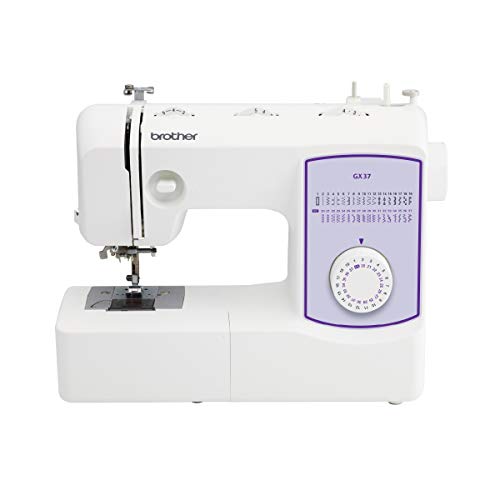
The GX37 teaches by proximity. Its 37 built-in stitches are printed on the machine itself, and that chart becomes a quiet tutor: every session begins with the whole vocabulary visible, inviting the beginner to try one new pattern on a scrap before the real project starts. Decorative stitches, which on other machines hide inside menus or manuals, here sit in plain sight like keys on a piano — and beginners play more when the keys are visible.
Six sewing feet keep the practical lessons equipped, and mechanical selection keeps every choice deliberate: turn the dial, see the number, sew the sample. For learners whose motivation is decorative — embellished children’s clothes, stitched table linen, gifts with patterned edges — this visibility matters more than automation. The machine assumes curiosity and feeds it daily, which is a fine assumption to build a first year of sewing around.
Parents buying for a creative teenager often land here, and the reasoning is sound. The chart invites experimentation without a screen’s distractions, the stitch count feels generous without becoming a library to get lost in, and the skills transfer cleanly to any mechanical machine the young sewer meets later. It is the Brother for beginners who learn by touching everything in order — and who want the order printed where they can touch it.
- Curriculum size: 37 built-in stitches including decorative work
- Tutor on board: stitch chart printed directly on the machine
- Class kit: 6 included sewing feet
- Selection style: mechanical dial for deliberate choices
- Format: full-size machine for garments and embellished crafts
Strengths
- Visible chart encourages daily experimentation
- Decorative range rewards creative beginners early
- Mechanical choices build transferable understanding
Trade-offs
- Settings must be remembered rather than displayed
- No quilting table for large flat work
- Embroidery-curious learners should consider the SE700
Best for: creative beginners and teenagers who learn by exploring visible options.
Not suited for: beginners who want a screen to confirm every setting.

Brother CS5055 Computerized Sewing Machine — Best Brother With a Screen for Beginners
Some beginners fear dials the way others fear screens, and the CS5055 exists for them. Its LCD display states the selected stitch and its settings in figures a beginner can read, copy from a tutorial, and return to tomorrow with certainty. That legibility converts the most anxious beginner question — “is it set right?” — into a glance. Lessons proceed faster when verification is free, and early projects survive because settings errors get caught before fabric is committed.
As a teaching tool, the display introduces the vocabulary of sewing numerically: stitch length becomes a number with visible effects, width a figure to record in a project notebook. Beginners who learn this way build precise habits early, and their notes become genuinely reusable instructions. Underneath the electronics sits a full-size Brother for everyday garments and crafts, so the screen is a tutor added to a machine, not a gadget replacing one.
Shared households benefit in a way beginners rarely anticipate. When a parent and teenager alternate on one machine, the display announces how it was left, and the house rule — return it to straight stitch when finished — can actually be verified at a glance. Small social features like this decide whether a first machine becomes a family instrument or a source of low-grade friction, and the CS5055 handles the politics of sharing unusually well.
- Tutor on board: LCD display showing stitch and settings
- Selection style: computerized, verified at a glance
- Notebook value: numeric settings can be recorded and repeated
- Format: full-size machine for garments and crafts
- Household angle: current setup is legible to every user
Strengths
- Verification is instant, which calms new sewers
- Numeric settings make project notes truly reusable
- Shared use stays friction-free between family members
Trade-offs
- Electronics replace the simplicity some learners prefer
- No quilting table in its headline specification
- Heavy-fabric work is not its teaching speciality
Best for: methodical beginners and shared households who value visible settings.
Not suited for: learners who want purely mechanical controls to master first.
Brother CS7000X Sewing and Quilting Machine — Best Brother to Grow Into
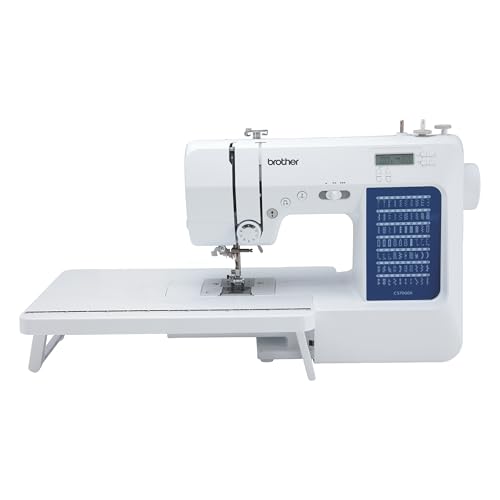
Every beginner class contains one student who finishes early and asks what is next. The CS7000X is the machine bought in anticipation of that student. Seventy built-in stitches stretch the syllabus across a year or more, the wide table introduces quilting and large projects properly, and ten included feet — the richest bundle in this guide — mean new techniques rarely wait on deliveries. The LCD display keeps the enlarged library manageable for someone still learning.
Buying to grow into is a gamble this guide usually warns against, and the exception is instructive: the growth here stays inside one coherent machine whose basics are as friendly as any pick’s. A beginner is not asked to master seventy stitches; they are asked to master five, with sixty-five in reserve as rewards. The table similarly serves cushion covers today and quilts next winter. For learners with evident momentum, that headroom prevents the expensive second purchase that interrupts so many second years.
It also suits the beginner who is really two beginners: the adult buying for a household where a partner or older child will sew too, at a faster pace. One machine covers both curricula. Keep a shared project notebook, let the faster learner annotate settings for the slower, and the CS7000X becomes less a purchase than a small family school — with a table wide enough for its ambitions and feet enough for its faculty.
- Curriculum size: 70 built-in stitches for a longer syllabus
- Display: LCD screen keeping the library navigable
- Table: wide table included for quilting and large work
- Class kit: 10 included feet, the richest bundle here
- Format: computerized sewing and quilting machine
Strengths
- Headroom prevents a second purchase in year two
- Ten feet equip techniques as curiosity reaches them
- Table introduces quilting from the first large project
Trade-offs
- More machine than a cautious beginner may use
- Larger presence on a small sewing table
- Price of admission is the highest among the mechanical-minded picks
Best for: fast-progressing beginners and households with two learners at different speeds.
Not suited for: cautious starters who want the smallest possible first step.

Brother XR3774 Sewing and Quilting Machine — Best Brother for Beginner Quilters
Beginners whose first love is quilting need a teacher who speaks both languages: the plain sewing of seams and the layered logistics of quilts. The XR3774’s wide table is its first quilting lesson — fabric rests level, layers feed calmly, and the student learns that most quilting difficulty is gravity in disguise. Thirty-seven stitches cover piecing and appliqué while keeping the curriculum finite, and mechanical dials keep attention on the quilt rather than the interface.
Eight included feet give the quilting syllabus its tools early, from accurate piecing toward walking and free-motion experiments as confidence arrives. For a beginner, that completeness changes the first quilt from a shopping expedition into a sewing project. The machine’s sewing side remains entirely suitable for garments and mending, so a student whose quilting enthusiasm cools still owns a proper household machine — a hedge other specialised starters cannot offer.
Treat its first quilt as coursework: a small throw, straight-line quilting, machine-finished binding, and notes taken throughout. The XR3774 rewards that structure, because each stage maps to equipment already in the box. By the second quilt, most owners have stopped calling themselves beginners in any anxious sense — they are quilters with a practice, which is precisely the graduation this machine was designed to deliver.
- Curriculum size: 37 built-in stitches for piecing and appliqué
- Table: wide table included, the quilting essential
- Class kit: 8 included sewing feet
- Selection style: mechanical dials for undivided attention
- Format: sewing and quilting machine for learners
Strengths
- Quilting begins properly from the first project
- Eight feet postpone accessory purchases for months
- Remains a complete household machine if tastes change
Trade-offs
- Harp space still moderates the largest quilts
- No display for decorative setting previews
- Dedicated garment features are fewer than flagship models
Best for: beginners whose sewing ambition is quilting from the start.
Not suited for: beginners focused on dressmaking details and embroidery.
Brother SE700 Sewing and Embroidery Machine — Best Brother for Embroidery-Curious Beginners
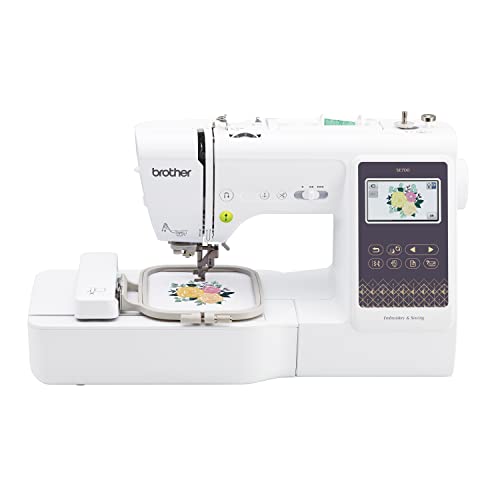
The SE700 is the beginner machine for learners whose project lists already contain names stitched on towels, motifs on children’s clothes and labels on quilts. Its sewing side is a complete Brother education — 103 built-in stitches is a generous curriculum by any measure — and its embroidery side adds 135 built-in designs, a 4 by 4 inch hoop and a 3.7 inch touchscreen that previews designs before a single stitch commits. Wireless LAN moves designs from computer to machine without the cable rituals older embroidery demanded.
As a teacher it asks more and gives more. Embroidery introduces stabilisers, hooping and design files — a second syllabus beside sewing’s own — and beginners should expect to learn it in stages, sewing first and embroidering second. The reward is a capability no other pick here can imitate: personalisation as a native feature. For the right beginner, that reward justifies the tuition gladly, and Brother’s shared feet and logic keep the sewing half reassuringly familiar throughout.
Start embroidery on the machine’s built-in designs before collecting files, because they are digitised to behave well and their sizes suit the hoop. Embroider labels, then a motif on a cushion, then a name on a towel, and the technique sequence — hoop, stabilise, preview, stitch — becomes routine. Beginners who pace it this way describe the SE700 less as two machines than as one machine with a second, delightful gear they engage when a project deserves it.
- Sewing curriculum: 103 built-in stitches
- Embroidery library: 135 built-in designs to learn from
- Hoop: 4 x 4 inch embroidery area for labels and motifs
- Display and transfer: 3.7 inch touchscreen, wireless LAN
- Class kit: 8 included feet for its sewing work
Strengths
- Embroidery personalisation arrives in the first machine
- Touchscreen preview prevents orientation mistakes
- Wireless transfer keeps design handling modern
Trade-offs
- Two syllabuses to learn instead of one
- Hoop size limits design scale for now
- No wide table headline for large quilting
Best for: beginners who already dream in personalised, embroidered projects.
Not suited for: beginners who want the plainest possible first syllabus.
How Do the Six Compare as a Beginner’s First Brother?
| Pick | Badge | Distinguishing detail |
|---|---|---|
| Brother XM2701 Sewing Machine 27 Stitches | Best First Brother Overall | 27 stitches sequenced kindly for a first-time owner |
| Brother GX37 Sewing Machine | Best Brother for Decorative Beginners | 37 stitches printed on the body as a permanent chart |
| Brother CS5055 Computerized Sewing Machine | Best Brother With a Screen for Beginners | LCD narration of stitch and settings for learners |
| Brother CS7000X Sewing and Quilting Machine | Best Brother to Grow Into | 70 stitches, wide table and 10 feet of headroom |
| Brother XR3774 Sewing and Quilting Machine | Best Brother for Beginner Quilters | Wide table and 8 feet introducing quilting kindly |
| Brother SE700 Sewing and Embroidery Machine | Best Brother for Embroidery-Curious Beginners | 103 stitches plus embroidery with touchscreen and Wi-Fi |
What Should a Beginner Learn in the First Month?
Month one has a natural syllabus. Week one: threading, winding a bobbin, sewing straight lines on scraps, and the test-seam habit. Week two: seams with allowances, corners, curves and a first finished object — a drawstring bag or cushion cover. Week three: the zigzag family, a stretch stitch on an old T-shirt, and one genuine repair from the household basket. Week four: a buttonhole sampler and a project that uses one, so the famous fear of buttonholes dies early and quietly.
Every machine in this guide can teach that month, which is the point of the range. What differs is the teaching style: dials and charts, displays, tables or a hoop. Keep the month’s projects small and finishable, write down settings that worked, and resist buying accessories until a project requests them. A beginner who completes month one owns something more valuable than equipment — evidence that they finish things.
Why Does Staying Within One Brand Help a Learner?
Consistency compounds. Bobbins interchange, feet fit across models, manuals use the same diagrams and vocabulary, and a skill learned on one Brother — threading logic, tension intuition, the feel of its feed — transfers to the next with minimal translation. Classrooms and families exploit this deliberately: several learners, several models, one shared grammar, and anyone can sit at any machine and begin.
The accessory economy follows. A walking foot bought for a first machine serves the second; a tin of bobbins never becomes obsolete; the project notebook’s settings stay meaningful. None of this locks a sewer in forever, but during the learning years, when confidence is the scarcest resource, a stable ecosystem spends nothing on relearning and everything on progress.
How Do You Choose Between a Dial and a Display as a Beginner?
Choose by how your mind checks its work. Dial learners like physical certainty: the stitch is where the pointer points, the setting is a position their fingers remember, and the machine’s state can be read across the room. Display learners like numerical certainty: settings as figures to verify, record and repeat exactly, with the machine narrating its own configuration to anyone who sits down.
Neither is the beginner option in the abstract — the CS5055’s screen and the XM2701’s dial both carry generations of successful beginners. Visit your own habits honestly: if you love checklists and numbers, take the display; if you love knobs and visible mechanics, take the dial. Motivation follows comfort, and a first machine’s deepest job is to be sat at willingly, evening after evening.
What Errors Will Every Beginner Make, and How Do These Machines Forgive Them?
You will thread with the presser foot down and meet a nest of loops. You will sew with yesterday’s settings into today’s fabric. You will dull a needle and blame the machine, forget to lower the foot and wonder at the skating stitches, and unpick at least one seam sewn with great confidence in the wrong place. These are not signs of unsuitability; they are the curriculum’s practical examinations, sat by every sewer alive.
Forgiveness is engineered where it can be: needle threaders shorten the recovery from threading errors, displays expose wrong settings before they cost fabric, printed charts answer questions at the speed of a glance, and generous feet bundles mean the right tool is present when a project reveals the need. Choose the machine whose forgiveness matches your likeliest errors, and the first year becomes a story of recoveries rather than defeats.
How Should a Beginner Practise Without Spending on Fabric?
The practice fabric is already in your house: worn sheets, outgrown shirts, single socks’ partners, the towel with the frayed edge. Cut them into squares and treat them as seriously as bought cloth — lines drawn, seams measured, samplers labelled. Paper teaches steering without thread; old T-shirts teach stretch handling; a retired duvet cover contains enough yardage for a dozen experimental projects and one real tote bag.
Keep a practice folder beside the machine with your labelled samplers and settings notes. It becomes the most personal manual you own, written in your own stitches. Beginners who practise on household textiles spend their fabric money later, on projects their skills can honour, and that sequencing — skills first, shopping second — is the financial wisdom at the heart of every long sewing life.
What Is the Right First Project for a New Brother Owner?
The right first project finishes in one sitting, uses straight seams, and emerges useful: a drawstring bag from a pillowcase, an envelope cushion cover, a simple tote from canvas offcuts. Each teaches cutting, seaming, pressing and turning without demanding a new technique at every step. Avoid, for the debut, anything with a zip, a buttonhole, stretch fabric or a pattern’s sizing — not because they are hard, but because stacking novelties is how first projects become unfinished legends.
Wear or use the finished object visibly. A tote that goes shopping weekly advertises competence to its maker every time, and that advertisement fuels the second project. Sewers are made by finished things, in ascending order of difficulty, and the six machines here were chosen because each can carry a beginner through that ascent without changing the rules mid-climb.
How Do Feet and Accessories Fit Into a Beginner’s Budget?
Begin with what the box provides — these picks include six to ten feet, which is a faculty, not a token — and let projects nominate additions. A zipper foot arrives when cushions do, a walking foot when quilting layers begin, specialty feet when a beloved technique demands them. Bought in that order, every accessory has a job waiting and a lesson attached; bought as a complete set in advance, most would still be sealed when the machine’s first year ends.
Brother’s shared accessory ecosystem keeps this discipline cheap: feet are widely stocked, bobbins are standard across the beginner range, and a foot bought for today’s machine serves tomorrow’s. Keep feet in their tray, labelled if the tray is not, and the collection stays an asset instead of a drawer of mysteries. Organisation, like pressing, is a beginner skill disguised as housekeeping.
How Should Parents Choose a Brother for a Young Sewer?
Match the machine to the child’s patience rather than their ambition. Younger sewers thrive on visible, mechanical simplicity and a stitch list short enough to explore completely — the XM2701 and GX37 teach in that register, with the chart on the GX37 doubling as a poster the child can read unaided. Supervision, a steady table and speed kept gentle matter more than any feature, and projects should be sized to a child’s sitting: doll clothes, scrunchies, simple bags.
For teenagers, consider where their interest points: decoration toward the GX37, quilting toward the XR3774, personalisation toward the SE700 when maturity supports its second syllabus. A machine that matches a young sewer’s actual fascinations gets used; a machine bought as an improving influence gets stored. The family’s second consideration is inheritance — a Brother bought for a child today becomes the household’s spare machine for a decade.
What Does a Beginner Need Beside the Machine Itself?
A short, honest kit: fabric scissors used for nothing else, pins or clips, a seam ripper that will become a close friend, spare needles in universal and ballpoint types, extra bobbins, thread in neutrals, and a tape measure that has not been stretched by years of service. Add an iron and a surface to press on, because pressing is half of sewing’s finish, and a small brush for the lint that every machine gathers.
Notice how little of that list is glamorous, and how completely it determines early success. Dull scissors and a missing ripper have ended more first projects than any machine limitation. Assemble the kit before the machine arrives if possible, gather practice fabric from the household’s worn textiles, and the first evening can be spent sewing rather than shopping — the correct opening chapter for any beginner.
How Do You Build a Sewing Habit That Survives Busy Weeks?
Leave the machine reachable. A Brother that lives set up, threaded and covered on a corner table gets used in twenty-minute fragments; one that must be fetched from a cupboard and assembled gets used on holidays. Keep a current project beside it in a tray, so sitting down resumes rather than starts. Small, frequent sessions teach more than rare marathons, because hands remember what they did yesterday better than what they did last month.
Attach sewing to existing rhythms: mending on Sunday evenings, a project night with a friend, alterations while laundry runs. Track finished things, not hours — a notebook list of completed projects is the most motivating document a beginner owns. The machines in this guide support the habit with quick setup and forgiving controls; the sewer supplies the calendar, and the calendar, in the end, is the curriculum.
When Should a Beginner Upgrade, and to What?
Upgrade when a real, recurring project asks for something your machine cannot do — not when a feature list flatters you. The common honest triggers are quilting scale, which asks for table and harp; embroidery desire, which asks for a hoop; and decorative range, which asks for stitches. Notice that this guide’s own ladder answers each trigger inside the same brand, preserving feet, bobbins and habits — the CS7000X for growth, the SE700 for embroidery, the XR3774 for quilting focus.
Keep the first machine when you climb, if space allows. It becomes the mending station, the teaching machine for the next beginner in the family, and the backup that keeps a project moving during a service. A beginner Brother retired to those duties has not been replaced; it has been promoted, and households that think this way build sewing rooms the way gardeners build soil — layer upon useful layer.
How Does Learning to Sew Change What a Household Buys?
Clothes get bought differently first: fit becomes repairable, quality becomes recognisable, and a loose hem stops being a reason to discard a garment. Household textiles follow — curtains are shortened instead of replaced, cushion covers rotate with seasons made from remnants, and gifts acquire the dangerous charm of the handmade, which recipients keep far longer than bought equivalents.
Eventually the beginner’s eye changes the fabric shop itself into a project library: every remnant bin holds future bags, quilts and costumes. That transformation — from consumer of finished things to maker of them — is what these six machines are really selling, at six different speeds. The stitch counts will be forgotten within a year. The first finished project will not.
What Should a Beginner Know About Tension Before It Frightens Them?
Tension is simply the balance between the top thread and the bobbin thread, and on a healthy machine sewing ordinary cotton, the factory setting is correct far more often than beginners fear. Balanced stitches lock inside the fabric; loops on the underside usually mean the top thread missed its path, not that a dial needs turning. The beginner’s rule is absolute: rethread first, test on scrap second, touch tension last — and then by a small step, recorded in the notebook.
Brother’s beginner models keep tension controls visible and conventional, so advice from any tutorial applies directly. Change one variable at a time and keep the test scraps labelled, and tension demotes itself from mystery to minor adjustment within the first month. Most lifelong sewers adjust tension rarely; they thread carefully always, which is the actual secret the manuals have been telling all along.
How Do You Read a Stitch Before You Sew It Into a Project?
Build a personal stitch dictionary: for each stitch on your machine, sew a labelled sample on plain cotton at the default settings, then again longer, then wider where the machine allows. Note the needle and thread used. The exercise takes one evening and pays for it forever, because choosing a stitch from a sample you sewed is a different act from choosing it from a picture — you know its texture, its stretch and its temper on real cloth.
Decorative beginners on the GX37 and XR9550-scale libraries benefit most, but even the XM2701’s 27 stitches reveal surprises under this treatment. Keep the dictionary in the practice folder and add to it whenever a new fabric teaches a stitch new behaviour. It is the beginner’s homemade reference, and it marks the moment a machine stops being an appliance and becomes an instrument whose range you personally know.
Why Do Beginners Quit, and How Does the Right Machine Prevent It?
Beginners rarely quit because sewing is hard; they quit because their early experience was a sequence of small humiliations — tangles, jams, a first project too ambitious to finish, a machine whose settings felt like secrets kept from them. Each humiliation is preventable by design: threading aids, visible settings, complete feet bundles, honest stitch counts and a project ladder that starts with finishable things. The picks in this guide were ranked substantially on this prevention.
The social layer helps too: a brand with an enormous beginner population means every frustration has been survived publicly and its cure written down. When you choose a first machine, you are also choosing whose footsteps to walk in. Choose well-trodden paths for the first year; the wilderness will still be there, and far more enjoyable, when your skills can meet it.
How Should a Beginner Care for the Machine That Teaches Them?
Care is the final lesson, and the simplest: brush the bobbin area after projects, change needles before they teach you why you should have, keep the machine covered, and sew it regularly, because mechanisms and owners both stiffen in disuse. Keep the manual, the feet tray and the practice folder together, so the machine’s whole world lives in one place and any session can begin within minutes.
Treat the first service, when it eventually comes, as tuition rather than failure — a technician’s adjustments and advice extend the machine’s teaching life for years. A beginner machine cared for this way commonly teaches its second and third owners too, passing down a family with its chart, feet and patience intact. That longevity is the quiet final argument for buying a proper first machine instead of a toy.
What Does Progress Look Like at Three Months and at a Year?
At three months, expect fluency in the basics: threading without thought, seams that run straight, a mending pile that no longer accumulates, and two or three finished projects with their small imperfections worn proudly. The machine’s controls will have become handwriting — automatic, personal, unexamined. Most beginners also discover their taste by then: garments, quilts, decoration or repair, and the discovery matters more than the skill count.
At a year, the sampler folder is thick, the project list is ambitious, and the machine’s limits — if they are felt at all — are specific and nameable, which means any upgrade can be chosen precisely. That arc, from anxious unboxing to articulate ownership, is what a beginner machine is for. The six Brothers here simply walk it at different speeds and in different directions, all of them honestly.
How Can Sewing Together Strengthen the Learning?
A second chair at the table halves every difficulty. Sewing with a friend, a parent or a class turns threading mysteries into conversation, makes sampler exercises social, and supplies the witness that finishing loves. Households where two people learn together report the same pattern: each catches the other’s setup errors before fabric pays for them, and projects get finished because someone else is expecting to see them.
Brother’s consistent range quietly supports the arrangement — two learners on different models can still share feet, bobbins, vocabulary and advice. If no partner is available locally, the vast owner community around these models provides the conversation online, with the advantage that its members have photographed every beginner mistake in existence, usually beside its cure.
How Do You Set Up a Beginner-Friendly Sewing Space at Home?
Begin with the table, not the machine: a surface at elbow height, stable enough not to vibrate at sewing speed, with room on the left for fabric to rest instead of dangling. Add light that falls on the needle without glare, a chair that supports an hour’s sitting, and a small tray for scissors, pins and the seam ripper. Keep the iron and a pressing surface within a few steps, because a beginner who must cross the house to press will simply stop pressing.
Store the machine covered but connected where possible, with its feet tray, manual and practice folder together. The goal is a space where beginning a session takes two minutes, because beginners sew in the fragments of busy days. Every Brother in this guide rewards that accessibility — they are quick to thread and forgiving to resume — but the room must meet the machine halfway.
What Vocabulary Should a Beginner Learn First?
Learn the words that unlock tutorials: seam allowance, the distance from stitching to edge; feed dogs, the toothed tracks that move fabric; presser foot and its pressure; bobbin and its case; grain, the fabric’s directional weave that decides how a garment hangs; and bias, the diagonal whose stretch both troubles and delights sewers. Ten such terms convert most beginner instructions from fog into directions.
Brother’s manuals use this vocabulary consistently, which is another quiet ecosystem benefit — the words learned in the XM2701’s booklet are the words in the CS7000X’s. Keep a notebook page for each term with a scrap sewn beside it, and the glossary becomes physical. Language is a sewing tool like any other, and it is the only one that fits every machine you will ever own.
How Should a Beginner Approach Their First Garment?
Choose a garment with few pieces, forgiving fit and no closures more complex than elastic or a simple tie: pyjama trousers, a gathered skirt, an apron with ambitions. Read the pattern’s instructions fully before cutting, underline every term you do not know, and sew a practice version from a sheet if the fabric matters to you. Fit as you go, pressing every seam, and let the garment teach at its own pace across several evenings.
Finish it even when the fit is imperfect, because a worn, imperfect garment teaches more than a perfect, abandoned one. Note what you would change — a waistband method, a hem depth, a fabric choice — and the second garment inherits the wisdom. Every Brother here can sew that first garment; the difference between models is how much guidance surrounds you while you do it.
Why Does Community Matter More Than Specifications for Beginners?
A specification sheet cannot answer a question at midnight, demonstrate a bobbin’s direction with moving hands, or reassure you that the noise is normal. Communities do those things, and Brother’s beginner community is among the largest in home sewing — classes teach on these models, owners document their quirks exhaustively, and every beginner error has been photographed beside its solution by someone who survived it cheerfully.
When choosing between near-equal machines, weigh that population honestly. The model with ten thousand experienced owners carries an invisible faculty the model with ten does not. Beginners do not need the most advanced machine; they need the most accompanied one. On that measure, the familiar names in this guide justify their familiarity every single evening.
How Do You Keep a Beginner’s Confidence Intact After a Bad Session?
End every difficult session with a small success: a neat seam on a scrap, a bobbin wound perfectly, a repair completed on something humble. The last experience of the evening is the one motivation remembers, and a machine put away after a victory gets taken out again sooner. When a project defeats you, reduce it — finish one seam, one hem, one corner — rather than abandoning the whole cloth to the cupboard of guilt.
Remember also that every sewer you admire has a bin of failures and a drawer of first attempts. The difference between them and a beginner is not talent; it is the number of evenings they returned after a bad one. These Brother machines are built to make returning easy — quick to thread, honest to read, ready in minutes — and returning, repeated, is the entire secret of becoming a sewer.
What Mistakes Do Brother Beginners Make Most Often?
The signature beginner mistake on any brand is sewing over the manual: skipping the threading diagram because a video looked simpler, then meeting the tangle the diagram existed to prevent. Next comes accessory impatience — buying feet and gadgets before the included bundle has been explored — followed by needle neglect, the dull point blamed for a dozen imaginary machine faults. Beginners also hide their first projects instead of finishing them, which breaks the confidence cycle this guide keeps describing.
The remedies are unglamorous and complete: follow the printed threading path, rethread before adjusting, change needles like they are the consumables they are, finish small things completely, and write settings down. A Brother forgives a beginner almost everything except being ignored — read what it tells you, on its chart, display or manual, and it will teach you the rest.
Final Recommendation
Start where your confidence honestly is. Most beginners should begin with the Brother XM2701, the range’s best-supported first step. Those who learn visually and decoratively will thrive with the Brother GX37 and its printed chart, while fast movers can buy the Brother CS7000X once and grow inside it for years.
Whichever Brother comes home, thread it the same evening, sew something small before the week ends, and finish it completely. The first finished object — however humble, however wobbly its seams — is the true beginning of a sewing life, and everything after it is just practice with better fabric.
Frequently Asked Questions
Which Brother is best for an absolute beginner with no experience?
The XM2701 is the safest answer for most people: its automatic needle threader removes the first hurdle, its 27 stitches form a complete but finite curriculum, and the enormous number of existing owners means help for any question is easy to find. If you think in numbers and like verifying settings, the CS5055’s display may suit you better. Either is a genuine first machine rather than a toy.
Are Brother machines good for teaching children to sew?
Yes, with the usual supervision and sensible pacing. The mechanical models suit younger learners because their controls are visible and their stitch lists can be fully explored, and the GX37’s printed chart lets a child choose stitches independently. Keep speed gentle, projects short and fingers taught to respect the needle area. Many family machines in this range begin as a child’s first machine and end as the household’s permanent mending station.
Will I outgrow a beginner Brother within a year?
You will outgrow its novelty quickly and its capability slowly, which is the correct order. The core work of sewing — garments, mending, household textiles — stays within these machines for years. Specific ambitions outgrow specific models: quilting scale points to the XR3774 or CS7000X, embroidery to the SE700. Because feet and bobbins carry across the range, climbing later costs less than starting over.
What is the difference between the CS5055 and the CS7000X for a beginner?
Think of them as two class sizes. The CS5055 teaches the core curriculum with a display, in a full-size machine without a quilting table. The CS7000X expands the curriculum to 70 stitches, adds the wide table and ten feet, and anticipates quilting and faster progress. A beginner who expects to sew garments and crafts can stop at the CS5055 happily; one already dreaming of quilts should start at the CS7000X.
Do Brother beginner machines share feet and bobbins?
Broadly, yes — the beginner range is built on shared standards, so feet and bobbins bought for one model commonly serve others in this guide, and skills transfer with them. Always confirm a specific accessory against your model’s manual before ordering, but the ecosystem is deliberately consistent. That consistency is a major reason this guide recommends learning inside one brand’s range for the first years.
How long does it take to learn the basics on one of these machines?
Most beginners sew a confident straight seam in the first evening, finish a simple project in the first week, and handle the core repertoire — seams, zigzag finishing, a stretch stitch, a buttonhole — within the first month of regular short sessions. Mastery is a longer, happier road, but competence arrives quickly when projects are sized kindly and the machine’s guidance is actually read.
Related Guides
A beginner’s sewing corner connects onward to embroidery ambitions, reliable coffee and compact laundry care: Best Affordable Embroidery Machines Best 10-Cup Home Coffee Machines Best Apartment Washing Machines


