What's inside
- Key Takeaways
- Quick Picks
- What Must a Machine Survive to Work a Mobile Pitch?
- Best Coffee Machines for a Mobile Business, Split by Power World
- How Many Shots Does a Pitch Actually Sell, and What Follows From That?
- What Does the Power Plan Look Like for Each Format?
- What Changes When One Pitch Becomes Two?
- How Should a Mobile Menu Be Designed Around Portable Machines?
- How Does Cleaning Work When There Is No Sink?
- What Do Permits, Water Rules, and Pitch Logistics Ask of the Operator?
- Which Mistakes Strand New Mobile Coffee Businesses?
- How Should an Operator Choose Between the Four Portables?
- Final Recommendation
- Frequently Asked Questions
- Related Guides
As an Amazon Associate I earn from qualifying purchases. This post may contain affiliate links at no extra cost to you.
cottageverdict.com is reader-supported. When you buy through links on our site, we may earn an affiliate commission.
A mobile coffee business lives or dies on what it can carry, charge, and clean. The best coffee machines for a mobile business are therefore a different species from café equipment: four of the six picks below are portable espresso makers that heat water from a battery and pull a shot wherever the pitch happens to be — a market stall, a festival field, a building-site gate at dawn — and the remaining two are compact countertop machines included for the one mobile format that has mains power, the wired cart or trailer with a proper counter. One clarification before anything else, because search results blur it constantly: a coffee cart is furniture. Wheels and a countertop do not make coffee. This guide covers the machines that go on the cart, in the van, or in the operator’s hand, and nothing else.
On buying channels for a business that moves: all six machines are sold through Amazon, each linked to its own listing, which suits mobile operators well — a replacement can be ordered from the pitch, and a second unit can be added the week a second pitch opens, without a distributor’s lead time entering the story. The operator’s homework is electrical rather than commercial. Battery machines live on charging discipline, and countertop machines live on the pitch’s power supply, so read the charging and wattage lines in the spec boxes as operating costs, not trivia.
The numbers rule for this guide mirrors the rest of the series: a figure appears only where the listing title states it. Bar pressure, heating time, battery capacity, reservoir size — quoted from titles. Where a title is silent about the number a mobile operator most wants, which is usually shots per charge, the spec box says so in plain words instead of estimating, because an operator who plans a market day around an invented battery figure will run out of coffee in front of a queue, and no guide should be the cause of that.
Key Takeaways
- Four picks are genuinely portable: the OutIn Nano, the Fanttik Cafein 11, the CANDY portable, and the kejector — all battery or hand-carried espresso makers for pitches without mains power.
- The Fanttik states the most complete portable specification in its title: 20 bar pressure, 135-second rapid heating, IP65 weather resistance, and a battery described as 4500mAh ×3.
- The CANDY is the cold-brew outlier — its title claims up to 60 cups of rechargeable cold brew per run, with heating available in plug-in mode.
- The De’Longhi Classic and Chefman CraftBrew are countertop machines for powered carts and trailers only; neither pretends to run from a battery.
- No title on this page states a shots-per-charge figure for the espresso portables — plan pitch capacity around water and workflow, and verify endurance on the listing before a big event.
Quick Picks
| Machine | Pitch it suits | What earns it a place in the van |
|---|---|---|
| OutIn Nano Portable Espresso | Unpowered pitches, anywhere | Self-heating, USB-C charged, and takes both ground coffee and NS capsules. |
| Fanttik Cafein 11 Portable Espresso | Weather-exposed markets | 20 bar extraction, 135-second heating, and an IP65 rating stated in the title. |
| CANDY Portable Espresso Maker | Cold-brew-led stalls | Up to 60 cups of cold brew per charge by its title, with a carry strap and one-touch operation. |
| kejector Portable Espresso | Second unit / backup duty | Ground coffee and capsule compatibility in a travel-format machine. |
| De’Longhi Classic Espresso Machine | Powered carts and trailers | Rapid heat-up and preset single and double shots in a compact countertop body. |
| Chefman CraftBrew Espresso Machine | Powered pitch, milk drinks | 15-bar pump, steam wand, and a 1.5L removable reservoir for a trailer counter. |
What Must a Machine Survive to Work a Mobile Pitch?
The first test was power honesty. A mobile machine’s specification is really a statement about where its energy comes from, and the titles here divide cleanly: battery machines that heat and extract from stored charge, and countertop machines that assume a socket. Any machine whose title blurred that line was excluded, because an operator who discovers the blur at a pitch without power has not bought a machine — they have bought a story to tell the queue. The two countertop picks are labelled as powered-cart equipment everywhere they appear in this guide, and the four portables are never credited with countertop abilities they do not claim.
The second test was the working day. Mobile service is a sequence of small frictions — filling water from a jerry can, dosing coffee in a breeze, cleaning a portafilter basket with no sink — and machines earn their place by reducing the count. Capsule compatibility, one-touch operation, straps, and removable reservoirs all appear in these titles because each one deletes a friction. The same logic governs the fixed-site world, incidentally: the break-room buyer’s version of this checklist appears in Best Coffee Machines for an Office, where the frictions are different but the principle — count the daily annoyances before the features — is identical.
A fourth, quieter test ran underneath the others: could the machine’s consumables be bought without drama? Capsules in standard formats, ground coffee from any roaster, charging from the USB ecosystem the business already owns — a mobile operation dies by a thousand supply errands, and machines that feed from common shelves and common cables keep the errand count survivable for a one-person business.
The third test was weather and knocks. A pitch machine lives in a van, gets rained on at markets, and is handled with cold hands at 6 a.m. Only one title here states a weather rating, and this guide credits it precisely because the others do not. Durability claims without a rating were treated as decoration. Portability, similarly, was judged by what the title describes — straps, travel formats, car use — rather than by photographs of machines looking small next to large fruit.

OutIn Nano Portable Espresso — Self-heating espresso, charged by USB-C
The OutIn Nano is the machine that defines this category for most mobile operators, and its title states the essentials without flourish: a portable electric espresso machine and travel coffee maker, self-heating, charged by USB-C, usable as a car coffee maker, accepting both ground coffee and NS capsules, in Forest Green, pitched at camping, RV, hiking, and office use. Translate that into business language and it reads: no kettle, no generator, no gas ring. The machine heats its own water from its battery, which removes the single most awkward piece of equipment in off-grid coffee — the separate water-heating step that slows service and eats pitch space.
The dual fuel system, grounds and capsules, is a menu decision disguised as a specification. Grounds give the operator a signature coffee and a lower cost per shot; capsules give speed, consistency, and a clean pitch with no loose grounds blowing across the stall. A market trader can run capsules at the Saturday rush and grounds for the regulars who come early and talk — same machine, two service modes. Few product titles on this page contain as much business strategy as that one “and” between ground coffee and capsules.
USB-C charging is the third quiet advantage. The machine tops up from the same ecosystem as the card reader, the phone, and the van’s power bank, which means the charging plan for the whole business is one plan rather than four. Operators should still treat endurance honestly: the title states no shots-per-charge figure, so the prudent pattern is a charged spare battery routine or a second unit for long events, proven at a small pitch before it is trusted at a festival.
Who is it for? The solo operator at unpowered pitches — markets, trailheads, site gates, event fields — who sells espresso drinks in dozens per outing and wants the machine to disappear into a backpack-sized footprint between customers. It is not a café replacement and does not claim to be; it is the machine that makes espresso possible in places where espresso was previously a rumour.
- Format: portable electric espresso machine, self-heating
- Charging: USB-C, per the listing title
- Coffee formats: ground coffee and NS capsules
- Colour listed: Forest Green
- Shots per charge: the listing title gives no figure — verify endurance on the product page before planning a long pitch
- Buying line: the OutIn Nano Portable Espresso — Amazon stocks this model for delivery to the pitch, the depot, or home.
Strengths
- Self-heating removes the kettle from the pitch kit entirely.
- Grounds-plus-capsules flexibility lets one machine run two service speeds.
- USB-C charging folds the machine into the business’s existing battery routine.
Trade-offs
- Battery endurance is unstated in the title, so long events need a proven plan B.
- Portable extraction serves a queue one shot at a time; festival rushes will test patience.
- Milk drinks require a separate frothing answer the title does not provide.
Best for: solo mobile operators selling espresso where there is no socket. Not suited for: high-volume event bars where a queue forms faster than a portable can pour.

Fanttik Cafein 11 Portable Espresso — The weather-rated sprinter
The Fanttik Cafein 11 has the most businesslike title in the portable group: a portable espresso maker at 20 bar with USB-C, described as portable and compact, with 135-second rapid heating, a “golden-cup” extraction claim, an IP65 rating, and a battery specified as 4500mAh ×3, aimed at travel, fishing, hiking, parties, the gym, and the office. Mobile operators should read that title the way a contractor reads a tool specification — every clause is a working condition. Twenty bar is the extraction claim; 135 seconds is the service-speed claim; IP65 is the weather claim; and the triple-cell battery figure is the endurance claim, stated in capacity rather than in shots.
The IP65 rating deserves the spotlight, because it is the only weatherproofing figure anywhere in this guide. Dust-tight and resistant to water jets is a meaningful promise for a machine that will work farmers’ markets in November and festival fields in August. It does not make the machine submersible or immortal, but it moves rain from a service-ending event to an inconvenience, and for an outdoor business that difference is measured in trading days per year.
Heating speed is the second commercial virtue. A 135-second heat-up, as titled, means the machine is ready before the first customer’s order is finished being taken, and it recovers between shots fast enough that a small queue experiences service rather than delay. Portable espresso’s historical weakness has never been the shot itself; it has been the wait wrapped around the shot. Titles that attack the wait are titles written by people who have stood in the queue.
The battery description — 4500mAh ×3 — invites arithmetic the title does not complete, since no shots-per-charge figure is given. Treat the capacity as a relative signal (a substantial pack, three cells deep) and prove the absolute number at your own pitch, with your own water temperature and drink sizes, before an event depends on it. That discipline is not a criticism of the Fanttik; it is the operating manual for every battery machine in this guide.
- Format: portable espresso maker with USB-C charging
- Pressure: 20 bar, per the listing title
- Heating: 135 seconds rapid heating, per the title
- Weather resistance: IP65 as stated
- Battery: described in the title as 4500mAh ×3; shots per charge not stated
- Buying line: the Fanttik Cafein 11 Portable Espresso — its Amazon page carries the full specification.
Strengths
- The only stated weather rating in the guide — a genuine asset for outdoor trading.
- Rapid heating attacks the portable format’s real weakness: the wait.
- A fully specified title lets an operator plan around real figures.
Trade-offs
- Endurance is given as battery capacity, not shots, so pitch testing is mandatory.
- Weather resistance covers the machine, not the operator’s other kit or the coffee itself.
- Single-shot portable rhythm still caps service speed at busy events.
Best for: outdoor market and event traders who work in real weather. Not suited for: indoor high-volume bars that happen to want a small machine.

CANDY Portable Espresso Maker — The cold-brew specialist with a strap
The CANDY makes the boldest capacity claim of any portable here, and it makes it about cold brew: a portable espresso machine with a strap, a 3-in-1 coffee maker with one-touch operation, rechargeable, claiming up to 60 cups of cold brew, for ground coffee, aimed at camping, RV and outdoor use, and home, with heating available in plug-in mode. Read the claim carefully and it describes a genuinely different business model. Cold brew is batched, forgiving, and served fast; a machine that produces it in quantity from a rechargeable unit lets a stall sell cold coffee all day without ice management dominating the pitch or a generator humming behind the counter.
The strap is a small word with a large meaning. Equipment designed to be carried on the body — or slung over a shoulder between pitches — belongs to the walking trades: the festival roamer, the beach and park vendor, the operator whose pitch is a route rather than a square. One-touch operation belongs to the same world. When the other hand holds the cup, the money, or the umbrella, a machine that asks for a sequence of presses is a machine asking to be dropped.
The plug-in heating mode defines the machine’s honest boundary, and this guide will state it as plainly as the title implies it: heating is a plug-in feature. Off-grid, this is a cold-brew and portable espresso unit whose hot-water story depends on the mode described in the listing. Operators whose menu is hot espresso at unpowered pitches should weight the OutIn and Fanttik above it; operators whose menu is cold-led — summer markets, festivals, sports events — may find the CANDY the most commercially interesting machine on the page.
Sixty cups is a title claim, quoted as such, and cold-brew “cups” will vary with serving size; the operator’s own test batch settles the real number. What the claim usefully signals is intent: this unit was designed for volume within the portable class, not for the single ceremonial shot. In a category full of travel gadgets, that commercial intent is exactly what a mobile business is shopping for.
- Format: portable espresso machine with carry strap, 3-in-1
- Operation: one-touch, per the listing title
- Cold brew claim: up to 60 cups per charge cycle, as titled
- Heating: available in plug-in mode, per the title — plan off-grid hot drinks accordingly
- Coffee format stated: ground coffee
- Buying line: the CANDY Portable Espresso Maker — available on Amazon, where serving-size details sit.
Strengths
- Cold-brew volume is a real menu strategy for summer and event trading.
- Strap and one-touch design suit roving, one-person operation.
- Plug-in heating gives the unit a second life at powered pitches and at home base.
Trade-offs
- Hot-drink service off-grid is not this machine’s stated strength.
- The 60-cup figure is a title claim whose real value depends on serving size.
- Cold-led menus are seasonal in many climates; winter traders should plan a second act.
Best for: cold-brew-led stalls, roving vendors, and summer event circuits. Not suited for: hot-espresso menus at unpowered winter pitches.

kejector Portable Espresso — The understudy every solo operator needs
The kejector’s title is the plainest of the portable four: a portable coffee maker and espresso machine for travel, a nano car coffee maker, compatible with ground coffee and capsules, for RV, hiking, camping, and office use. Plainness, in a backup machine, is a virtue. The kejector’s role in a mobile business is not to headline the menu but to make the business survivable — the second unit in the van that turns a breakdown, a flat battery, or an unexpectedly long queue from a closed pitch into a slower pitch.
Professional operators in every trade learn the same lesson: the cost of a backup is small, and the cost of not having one is a day’s trading plus the reputation of the pitch that closed early. A portable espresso machine is cheap insurance by catering standards, light enough to carry without thinking, and — because it accepts both grounds and capsules, like the OutIn — it can mirror the main machine’s menu without a separate supplies system. Two machines, one coffee inventory, no improvisation when unit one falters.
It also serves as the queue valve. At a pitch where demand spikes for twenty minutes — the train arriving, the match ending, the market tour descending — a second portable lets the operator split the line: capsules on one machine for speed, grounds on the other for the regulars. That tactic does not require a bigger business, only a second pair of hands for twenty minutes, which at events is often a partner, a friend, or the neighbouring stallholder’s teenager pressed into honest work.
Judged as a headline machine, the kejector’s title claims less than its rivals — no pressure figure, no heating time, no weather rating is stated — and this guide will not promote it beyond its evidence. Judged as the understudy, which is how a business should buy it, those silences matter far less than its compatibility and format. Every mobile coffee business eventually buys this machine or wishes it had; buying it first, deliberately, is the cheaper order.
- Format: portable espresso machine for travel and car use
- Coffee formats: ground coffee and capsules, per the listing title
- Pressure and heating time: neither figure appears in the listing title — check the product page if they drive your decision
- Intended settings per title: RV, hiking, camping, office
- Role in this guide: second unit and backup for a one-machine operation
- Buying line: the kejector Portable Espresso — sold through Amazon with the rest of the portable kit.
Strengths
- Grounds-and-capsule compatibility mirrors a main machine’s menu without new supplies.
- Travel format makes it a no-regret permanent resident of the van.
- Second-unit economics: it insures the whole pitch for the price of a gadget.
Trade-offs
- The title states fewer performance figures than its portable rivals.
- As a sole machine it asks the operator to accept unquantified speed and endurance.
- Backup duty means it must be charged and tested, not forgotten in a crate.
Best for: mobile operators adding resilience, and beginners equipping a first pitch cheaply. Not suited for: buyers who need stated performance figures before committing to a headline machine.

De’Longhi Classic Espresso Machine — For the cart that has a socket
Everything changes when the pitch has power, and the De’Longhi Classic is this guide’s representative of that happier world: a matte black espresso machine with an easy-to-use milk frother, rapid heat-up, preset single and double espresso, and a compact design, from the maker its title calls the worldwide number one in espresso machines. It belongs on the wired cart, the trailer counter, the market hall stall with a metered supply — anywhere a standard outlet exists and a small business wants countertop espresso without café-scale equipment around it.
Presets are the commercial heart of the proposition. A powered cart is often staffed by whoever the rota provides, and preset single and double shots turn espresso from a craft performance into a repeatable service step. Rapid heat-up matters in the same direction: a cart that opens at seven cannot spend its first trading quarter of an hour warming a boiler, and a machine ready quickly lets the operator sell from the moment the shutters rise. The frother extends the menu to the milk drinks that carry mobile coffee’s margins.
Compactness is the third term, and on a cart it is measured in centimetres of counter that remain for the till, the cups, and the cake stand. The Classic’s title leans on its compact design, and cart operators should honour that by measuring their counter run with everything else in place before ordering — the machine that fits the empty cart may not fit the working one. Water, likewise, is a cart discipline: a countertop machine drinks from its own reservoir, and the operator’s jerry-can maths should include the machine’s appetite across a full trading day.
What this machine must never be asked to do is work unpowered. It has no battery story in its title and this guide invents none for it. Operators choosing between a generator, a leisure-battery inverter setup, and a pitch with mains should make that decision at the business-plan level, not discover it at setup. For the powered formats — and they are a large, profitable share of mobile coffee — the Classic is the guide’s straightforward recommendation: a known maker’s compact machine, with the two presets a cart menu actually uses.
- Format: compact countertop espresso machine — mains powered, for wired carts and trailers
- Shots: preset single and double espresso, per the listing title
- Heat-up: described as rapid in the title, no timed figure given
- Milk: frother described as easy to use
- Finish: matte black
- Buying line: the De’Longhi Classic Espresso Machine — Amazon’s listing confirms the current package.
Strengths
- Preset shots make cart service consistent across whoever is staffing it.
- Rapid heat-up protects the first, most profitable hour of trading.
- Compact countertop body respects the cart’s scarcest resource: counter run.
Trade-offs
- Mains power is assumed; there is no battery operation to fall back on.
- Reservoir-fed water makes the operator the plumbing, all day.
- Milk frothing is a manual skill here, unlike the hands-free systems on café machines.
Best for: wired coffee carts, trailers, and market-hall stalls with a metered supply. Not suited for: any pitch where the power plan is optimism.
Chefman CraftBrew Espresso Machine — The trailer counter’s milk-drink machine
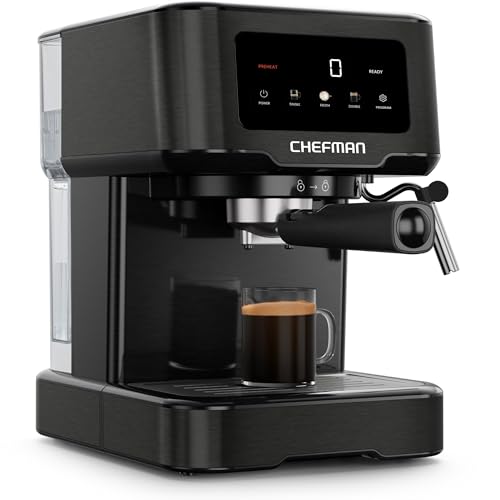
The Chefman CraftBrew closes the list as the second powered-cart option, with a differently weighted title: a 15-bar pump digital espresso maker with a steam wand for lattes and cappuccinos, a compact espresso coffee machine with a 1.5-litre removable water reservoir, in stainless black. Where the De’Longhi leads with presets and brand, the Chefman leads with the steam wand and the reservoir — the two features a milk-drink menu on a trailer counter actually consumes. Fifteen bar is the stated pump figure, quoted as the title gives it.
The removable reservoir deserves more respect than it usually gets. On a cart or trailer, refilling a fixed tank means carrying water to the machine and pouring it into a counter’s most spill-sensitive neighbourhood, usually mid-service. A removable 1.5-litre reservoir walks to the jerry can instead, fills under no time pressure, and clicks back — a small ergonomic mercy repeated a dozen times a day until it adds up to the difference between a calm pitch and a wet one. Size it honestly, though: 1.5 litres is a modest tank for a busy trailer, and the refill rhythm should be planned into the service pattern rather than discovered by it.
The steam wand defines the menu ceiling. Lattes and cappuccinos are named in the title because the wand makes them the machine’s home turf; a trailer selling milk drinks as its headline act gets more from a competent wand than from any number of presets. The skill, however, is the operator’s — a wand rewards practice and punishes the untrained during a rush, so carts staffed by rotating casuals should weigh the De’Longhi’s preset path seriously before choosing the Chefman’s manual one.
Digital controls and the stainless-black finish round out a machine aimed at looking professional on a small counter, which on a trailer is not vanity: customers buy coffee from equipment that looks like a business. Between the two powered picks, the choice is philosophical — presets and brand reassurance against wand and reservoir practicality — and either equips a powered pitch credibly. Neither equips an unpowered one at all, and this guide’s last word on both is the same as its first: they are cart machines, and the cart must bring the electricity.
- Format: compact countertop espresso machine — mains powered
- Pump: 15-bar, per the listing title
- Milk: steam wand for lattes and cappuccinos, per the title
- Reservoir: 1.5L, removable
- Controls and finish: digital, stainless black
- Buying line: the Chefman CraftBrew Espresso Machine — find it on Amazon alongside the other cart kit.
Strengths
- A proper steam wand makes milk drinks the menu’s headline rather than its apology.
- The removable reservoir turns refilling into a walk instead of a spill risk.
- Compact digital format reads as professional equipment on a small counter.
Trade-offs
- A 1.5L reservoir needs a planned refill rhythm on a busy trailer.
- Wand skill sits with the operator; rotating casual staff will vary the drinks.
- Mains powered only — no role at unpowered pitches.
Best for: powered trailers and carts whose menu leads with milk drinks. Not suited for: unpowered pitches or carts staffed by a different novice every weekend.
Best Coffee Machines for a Mobile Business, Split by Power World
| Machine | Energy source | Headline title claim | Trading style |
|---|---|---|---|
| OutIn Nano Portable Espresso | Battery, USB-C | Self-heating; grounds and NS capsules | Solo unpowered pitches |
| Fanttik Cafein 11 Portable Espresso | Battery, USB-C | 20 bar, 135s heating, IP65 | Outdoor markets in weather |
| CANDY Portable Espresso Maker | Battery; heating in plug-in mode | Up to 60 cups cold brew | Cold-led stalls and roving |
| kejector Portable Espresso | Battery / travel format | Grounds and capsule compatible | Backup and second unit |
| De’Longhi Classic Espresso Machine | Mains | Rapid heat-up, preset shots | Wired carts, preset service |
| Chefman CraftBrew Espresso Machine | Mains | 15-bar, steam wand, 1.5L tank | Trailers leading with milk drinks |
How Many Shots Does a Pitch Actually Sell, and What Follows From That?
New mobile operators consistently overestimate volume and underestimate rhythm. A good market pitch might sell sixty drinks across five hours — a gentle average that conceals a twenty-minute surge when the tour bus, the train, and the school run arrive together. Portable machines serve the average beautifully and the surge painfully, which is why the honest planning question is not “how many drinks a day” but “how many drinks in the worst quarter hour, and what do I do while they wait.” A second portable, a capsule fast lane, or a cold-brew offer that pours instantly are all surge strategies; each costs less than the reputation of the stall that kept a queue standing in the rain.
Water is the second capacity nobody plans. Every shot consumes water for the drink, the rinse, and the purge, and an unpowered pitch carries every drop in and out. Operators should measure a home rehearsal’s true water usage per drink and multiply by the pitch plan, then add the hand-washing and cleaning allowance the food-safety rules assume. The machine is rarely the binding constraint on a mobile business; the jerry can is.
Seasonality bends all three capacities at once. Summer pitches sell more drinks, colder drinks, and longer hours; winter pitches sell fewer drinks to hardier customers who value heat above novelty and will forgive a short menu anything except a cold cup. A business planned only for its summer shape will own the wrong stock by November, and a business planned only for winter will leave its best trading months under-equipped. The portable fleet’s low unit cost is the hedge: capacity can be added for a season — a second portable, a cold-brew unit for the hot months — without the capital commitment that makes café owners dread their own growth.
The third capacity is the operator. One person can sell, make, and clean in rotation at a pace that two people double rather than merely improve, because the tasks interleave instead of queueing. Before buying a faster machine, a solo operator should cost a helper for the surge hours — the same labour-versus-equipment arithmetic that governs fixed kitchens, right down to the way a bakery’s oven choice, as in Best Wall Ovens for Roasting Vegetables, is really a decision about whose hands are free at the moment the trays come out.
What Does the Power Plan Look Like for Each Format?
For the battery four, the plan is a charging rota with the seriousness of a delivery schedule. Machines charge overnight from the business’s base supply; spares and power banks ride in the van, labelled; and the pitch itself is run so that a flat battery at hour three is an inconvenience, not a closure — a second unit charged, a cold-brew offer that needs no power at all, a kettle-free menu by design. USB-C’s universality helps enormously here, since the card reader, phone, lights, and coffee machines can share one charging shelf and one set of cables.
For the powered two, the plan is the pitch contract. Metered mains at a market hall, a trailer hookup at a festival, a generator whose noise and fuel the neighbours have agreed to — each is a legitimate answer with a different cost shape, and each must be settled before the machine is bought, because the machine cannot negotiate. Operators should also check the pitch’s rules about generators and cables with the same care they check its rules about signage; more mobile coffee businesses are undone by site regulations than by bad espresso.
Hybrid operations — battery portables for weekday pitches, a powered cart for weekend markets — are where this guide’s six picks combine most naturally. The business buys capability in the order its calendar grows, and each machine keeps working in the format it was bought for instead of being stretched into a role its title never claimed.
What Changes When One Pitch Becomes Two?
Success in mobile coffee usually arrives as an invitation: a second market, a regular event booking, a pitch that wants you on the days you are already somewhere else. Scaling a mobile business is therefore an equipment question before it is a staffing one, because the second pitch needs a second complete kit — machine, water, power, cups, and the hundred small items whose absence closes a stall as surely as a broken pump. The portable format scales gracefully here: a second OutIn or Fanttik kit costs a fraction of a second café fit-out, travels in a car, and can be staffed by a trained partner rather than a hired barista.
The discipline is standardisation. Two pitches running different machines with different capsules, different routines, and different failure modes double the owner’s mental load and halve the value of experience, because nothing learned at one pitch transfers cleanly to the other. Buy the second kit as a copy of the first — the kejector-as-understudy logic, promoted to a fleet — and let the menu, the charging rota, and the spares box be written once and used twice. Businesses that standardise early can add a third pitch by photocopying their own system; businesses that improvise each kit become the bottleneck at every one of them.
There is also a honest ceiling to name. Portable fleets serve the events-and-markets economy superbly, but a pitch that grows into a daily, high-volume, fixed location has quietly become a café site, and it should be re-equipped as one — powered countertop machines first, café equipment when the lease allows. Recognising that graduation, rather than stretching portables past their design, is the mark of an operator who will still be trading in five years. The machines in this guide are a beginning and a backbone, and for many businesses they are also, happily, the whole story.
How Should a Mobile Menu Be Designed Around Portable Machines?
A mobile menu should be short enough to memorise and structured so that every drink has a fast path. The classic error is importing a café menu wholesale — fourteen drinks, three milks, two sizes — onto equipment that makes drinks one at a time. The portable format rewards a menu of five or six drinks engineered for overlap: the same shot, the same milk routine, the same cup sizes, so that the operator’s hands learn one choreography and repeat it at speed. Variety can live in the beans, the syrups, and the cold offer rather than in the machinery’s workload.
Cold drinks deserve a deliberate place in that design, and not only in summer. A cold-brew line — the CANDY’s home ground — pours in seconds, needs no heating, and keeps selling during the exact surge when the espresso queue is longest. It also travels through a trading day gracefully: brewed at base, carried cold, served until it is gone, with none of the waste pattern of milk drinks made speculatively. Mobile operators who treat cold coffee as a garnish on a hot menu consistently underrate their most surge-proof product.
Pricing follows the format’s honesty. Portable service is slower per drink than café service, so the menu should be priced for the labour it actually consumes, and the operator should resist discounting against the café on the corner whose two-group machine amortises differently. The mobile product is not the same product: it is coffee where coffee otherwise would not be — at the trailhead, the site gate, the village fête — and that location premium is real, legitimate, and the entire premise of the business.
How Does Cleaning Work When There Is No Sink?
Field cleaning is a designed routine, not an improvisation, and it should be rehearsed before the first paying pitch. The kit is simple: a rinse bottle, a waste-water container with a lid, cloths in a sealed bag, a brush for baskets and shower screens, and a hand-washing arrangement that satisfies the local rules. Portable machines help by being small — a brew head that can be wiped and rinsed over a bucket, a drip tray that empties in seconds — but no machine cleans itself, and coffee oils go rancid in a warm van with an enthusiasm that will announce itself in the next morning’s first shot.
The working pattern that successful operators converge on is clean-as-you-go in miniature: knock out the puck immediately, rinse the basket between customers rather than between hours, wipe every milk contact surface the moment it is used, and never let the day’s last task at the pitch be the first cleaning of the day. Back at base, the deeper clean — descaling on the water’s schedule, battery contacts checked, seals inspected — belongs to a fixed weekday slot, because equipment maintained by calendar survives, and equipment maintained by memory retires early.
Waste is part of the same system. Spent grounds, rinse water, and grey water all leave the pitch with the operator, and venues remember which traders left a clean square of ground behind. In a business where next season’s pitch allocation is decided by this season’s reputation, the cleaning routine is not hygiene overhead; it is marketing with a mop, and it deserves its line in the business plan beside the machines themselves.
What Do Permits, Water Rules, and Pitch Logistics Ask of the Operator?
Mobile food trading is regulated as food trading, and coffee is not exempt because it feels simple. Pitch licences, food-hygiene registration, hand-washing arrangements, and wastewater disposal all apply to a one-person espresso stall, and they shape the equipment list as surely as the menu does: water must be carried in food-safe containers, grey water must leave with the operator, and the cleaning routine must be possible with the water actually on board. Machines with removable reservoirs and simple, wipeable geometries — the Chefman’s tank, the portables’ minimalism — are quietly easier to keep compliant than plumbed café equipment adapted to a field.
Pitch logistics are the other half of the discipline. Arrival time, setup footprint, queue space, and the direction customers approach from all decide whether a good machine has a good day. A portable setup that assembles in ten minutes from a car boot beats a superior machine that needs forty minutes and a level pitch, because the first trading hour at most events is the profitable one and setup eats it directly. Operators should time their own setup at home, in the rain if the pitch will have weather, and treat the result as a specification of the business just as real as bar pressure.
Finally, the van is part of the machine. Machines travel in crates or padded cases, batteries travel charged and labelled, water travels sealed, and everything is loaded in the order it will be unloaded at the pitch. The operators who look effortless at 7 a.m. are not faster people; they are people whose loading order was decided once, written down, and never renegotiated at dawn. Mobile coffee rewards that kind of boring excellence more than it rewards any single product on this page.
Which Mistakes Strand New Mobile Coffee Businesses?
The founding mistake is buying the machine before the pitch. Power, water, pitch size, and customer flow all precede equipment, and every one of them can veto a machine the operator has already fallen for. The second mistake is its mirror: falling for the cart — the beautiful fitted trailer, the vintage van — and leaving whatever budget remains for the machine that is supposedly the point. Customers drink the coffee, not the cart, and this guide’s silence about vehicles is deliberate: they are premises, not picks.
Under-buying redundancy ranks next. One machine, one grinder arrangement, one battery, one of everything is a business with a single point of failure at every station, and mobile trading multiplies failure’s cost because there is no storeroom to raid. The kejector’s presence in this guide as a designated understudy is the cheapest version of the lesson. Finally, new operators neglect the unglamorous consumables — the food-business equivalents of the bread machine owner’s flour discipline in Best Hamilton Beach Bread Machines: stock counted, spares carried, and the boring supplies treated as seriously as the headline equipment, because a stall that runs out of cups has exactly the same problem as a stall whose machine broke.
How Should an Operator Choose Between the Four Portables?
With the four battery machines side by side, the decision tree is mercifully short. Ask first about heat: if the menu is hot espresso and the pitch has no power, the choice narrows to the self-heating OutIn and the fully specified Fanttik, and between them the weather decides — outdoor and wet argues Fanttik, mixed indoor-outdoor with a capsule fast lane argues OutIn. Ask second about temperature of the menu rather than the machine: a cold-led offer makes the CANDY the headline act and demotes the espresso portables to support. Ask third about risk: whichever machine headlines, the kejector’s compatibility makes it the natural second unit, and an operator who can only afford one machine today should buy the headline first and the understudy with the first month’s profits, before the first breakdown buys it at a worse price — a lost weekend.
Notice what the tree does not ask: it does not ask which machine is most powerful in the abstract, because portable espresso has converged on adequacy — all four will make a respectable shot for a customer who is delighted to find espresso at a trailhead at all. The differences that decide a business are operational: heating source, weather rating, format compatibility, and the honesty of the title’s figures. Buy on operations, and the coffee takes care of itself.
Final Recommendation
Start from the pitch, not the product page. Unpowered and outdoor, take the Fanttik for its weather rating and heating speed, or the OutIn for its self-heating flexibility between grounds and capsules; cold-led and roving, the CANDY is the interesting business; every operation, whatever its headline machine, should carry the kejector as the understudy that keeps a bad morning from becoming a closed day. Powered carts should choose between the De’Longhi’s presets and the Chefman’s wand by asking who will actually staff the counter. Buy the machine your power supply, your menu, and your worst quarter hour agree on, then spend the money you did not spend on a bigger machine on the unglamorous kit that decides trading days: spare batteries, a labelled spares box, water containers that seal, and a cleaning routine rehearsed before it is needed. A mobile business is a promise kept in public, one pitch at a time, and the right machine is simply the one that never makes you break it.
Frequently Asked Questions
What is the difference between a travel coffee maker and a mobile-business machine?
Intent, mostly. A travel maker is designed to please its owner on holiday — a good shot, occasionally, with no queue watching. A mobile-business machine must please strangers repeatedly, in weather, against a clock, with money changing hands. Several picks here are sold for travel and earn their business place on specification — weather ratings, heating speed, format compatibility — rather than on marketing. Judge any portable by whether its title answers business questions, and the travel machines that belong in a business will identify themselves.
Can a portable espresso machine really run a business?
Yes, at portable scale — dozens of drinks per outing, served one at a time, at pitches where no alternative exists. The format’s ceiling is surge capacity, not shot quality, and operators respect it by adding a second unit or a fast-pouring cold offer for the rush rather than by pretending the ceiling is not there.
Why does this guide not recommend a coffee cart?
Because a cart is furniture — premises, not a coffee machine. Carts matter enormously to a mobile business, but they are bought on size, weight, and local rules, and they make no coffee at all. This guide covers the machines that give a cart, a van, or a market table something to sell.
Grounds or capsules for a mobile pitch?
Both, if the machine allows it, as the OutIn and kejector do. Grounds carry the signature drink and the margin; capsules carry the surge and the consistency. Operators who must choose should let their queue decide: the faster the pitch’s peaks, the stronger the capsule case.
How should I plan battery endurance for an event?
By rehearsal, not by arithmetic on a title. No portable here states shots per charge, so run the machine at home exactly as you will at the pitch — same drinks, same water, same pace — and count. Then plan the event at eighty percent of that number, with a charged backup or a no-power menu item behind it.
What should a mobile operator carry as spares?
Seals, a spare basket or capsule adapter where the machine uses them, charging cables, a second water container, and the cleaning kit the machine’s manual assumes — all in one labelled box that lives in the van permanently. Spares bought after the first failure are tuition; spares bought before it are insurance, and insurance is cheaper.
Is a generator a good answer for a countertop machine?
Sometimes — it unlocks the De’Longhi and Chefman class at unpowered sites — but it brings noise, fuel, fumes, and site-rule questions that must be settled with the pitch organiser first. Many operators find a battery portable plus a cold-brew offer is the quieter business.
Related Guides
Operators curious about the hand-powered end of portable coffee — the lever and manual machines that need no battery at all — will find their natural next read, and a useful reality check on what hand power can and cannot do across a long trading day, in Best Manual Coffee Machines, where the no-electricity tradition is covered in full.


