What's inside
- Where to buy these six hot tubs for cold climates
- Quick picks at a glance
- How these picks were chosen
- Side-by-side comparison
- How do you choose a hot tub that will survive your winter?
- The cover is the winter: insulation physics for owners
- Water care when the air is below freezing
- The winter soak itself: getting in, staying in, getting out
- Draining and storing an inflatable through the deepest cold
- What about the shoulder seasons?
- Common mistakes cold-climate buyers make
- A word on guests, children, and winter house rules
- Final recommendation
- Frequently asked questions
As an Amazon Associate I earn from qualifying purchases. This post may contain affiliate links at no extra cost to you.
As an Amazon Associate, cottageverdict.com earns from qualifying purchases.
The best hot tubs for cold weather climates earn that title the hard way: not in a showroom, but in January, with wind worrying the cover and the thermometer sulking below freezing. This guide evaluates six tubs for that assignment under a strict evidentiary rule, and the rule deserves stating before any product is praised: the only cold-weather evidence admitted here is what each listing’s own title states — an insulated cover named in the text, an energy-efficient design claimed by the maker, a heater or Freeze Shield feature the listing itself puts in words. Where a title offers none of that evidence, the review says so plainly and judges the tub on its other merits instead of inventing a winter résumé for it. And one boundary holds across every pick: no tub in this guide is promised to defeat freezing conditions on its own. A hot tub in a cold climate is a system — machine, cover, power, placement, and an owner who pays attention — and any listing language about efficiency or freeze features describes one part of that system, in the maker’s own words, not a guarantee this guide can sign.
The six picks divide by construction before they divide by anything else. One is a rigid acrylic two-person spa with a serious pump. One is a rigid four-adult plug-and-play spa whose title leans on included extras, cover among them. The remaining four are inflatable spas — a category that has matured well beyond the pool toy, with heater pumps, insulated or energy-efficient covers, filter systems, and in two cases a named freeze-protection technology in the title — offered by makers who clearly intend them for shoulder-season and winter yards. That mix is honest to the market: cold-climate buyers genuinely choose between a permanent rigid spa and a far cheaper inflatable that asks to be supervised more carefully when the deep cold arrives. This guide keeps both families in view, keeps each listing’s evidence separate from the other’s glow, and keeps the winter advice — siting, covers, power outages, water care in the cold — in its own sections where it belongs.
Where to buy these six hot tubs for cold climates
The Jocisland acrylic spa leads on hardware: a two-person outdoor hot tub with 15 stainless steel jets, 110V plug-and-play power, an LED waterfall and lights, a double lounger layout, two filters, and a 2HP pump in charcoal gray — a rigid, permanent answer whose title, notably, makes no insulation or freeze claim at all. Aqualife’s Current follows as the four-adult plug-and-play option whose title promises free extras and a free included cover, the cover being the cold-relevant item in its short spec. Then the inflatables begin. SunSwell’s 73-inch square spa seats four to six with 130 air jets, a heater pump, an insulated cover, and a filter system in leak-proof PVC. Bestway’s SaluSpa Hot Springs round spa adds the category’s most explicit cold vocabulary: an EnergySense energy-efficient cover and Freeze Shield, both named in the title, with Wi-Fi control, 140 air jets, and heating to 104 degrees. The SaluSpa Hawaii repeats the Freeze Shield technology with built-in insulation and 140 bubble jets in a 71-inch round. INTEX’s PureSpa closes the list as the six-person veteran format: an 85-inch bubble massage spa with an energy efficient cover stated in the title and a saltwater-ready system.
Quick picks at a glance
| Pick | Best for | Cold-weather evidence in the title |
|---|---|---|
| Jocisland Acrylic Hot Tub 2 Person | Permanent rigid soaking for two | No insulation or freeze claim in title; rigid acrylic build |
| Aqualife Current Outdoor Hot Tub | Four adults, simple setup | Free cover included, per title |
| SunSwell Inflatable Hot Tub Insulated | Square inflatable with stated insulation | Insulated cover and heater pump named in title |
| SaluSpa Hot Springs 4-6 Person Wi-Fi | Most explicit cold features | EnergySense energy-efficient cover and Freeze Shield named |
| Bestway SaluSpa Hawaii Energy-Efficient | Energy-focused inflatable | Built-in insulation and Freeze Shield technology named |
| INTEX PureSpa Bubble Massage 28427 | Six-person inflatable value format | Energy efficient cover named in title |
How these picks were chosen
Cold evidence came first and was graded strictly. A title naming an insulated cover outranks one naming an ordinary cover; a title naming an energy-efficient cover system or a freeze feature outranks both; and a title naming nothing cold-specific — two picks here — was recorded as exactly that, not as a disqualification but as a fact the buyer must weigh with the guide’s general winter guidance. Construction came second: rigid acrylic shells carry inherent advantages in insulation mass and permanence, while inflatables counter with price, portability, and the option to drain and store the tub through the worst weeks — a legitimate cold strategy in itself, and one this guide treats respectfully rather than as surrender.
Capacity and jet format formed the third lens. The list spans two rigid loungers to six inflatable seats, and water-jet systems on the rigid spa versus the air-jet bubble systems of the inflatables — different sensations, both honestly described in the reviews. Power format was fourth: plug-and-play 110V appears across the list, which matters in cold climates because it lowers installation barriers while asking more patience of heaters working against winter air. Fifth came the extras that titles actually state — filters included, pumps sized, Wi-Fi control, saltwater readiness — because winter ownership is a maintenance relationship and the included equipment defines its first season. Finally, this guide admitted no evidence from prices, star ratings, or review counts, and no cold claim from anywhere but the six titles themselves. Where winter performance depends on owner behavior — and it always does — the advice sections say what the behavior is.

1. Jocisland Acrylic Hot Tub 2 Person
The Jocisland is the only fully rigid, lounger-style spa in this guide, and its review begins with the honesty this article promised: its title makes no cold-weather claim whatsoever — no insulated cover named, no efficiency language, no freeze feature. What the title offers instead is hardware: an acrylic two-person outdoor hot tub with 15 stainless steel jets, 110V plug-and-play power, an LED waterfall and lights, a double lounger seat layout, two filters, and a 2HP pump, in charcoal gray. The cold-climate case for this tub is therefore structural rather than stated. A rigid acrylic shell with a fitted cabinet is the format that, as a class, holds heat with the least drama through a winter, because the vessel’s insulation lives in its construction rather than in an accessory — but that is a statement about the format, and this guide will not upgrade it into a claim about this specific product’s winter performance, which its own listing does not make.
Within its stated facts, the spec is coherent for a couple’s permanent spa. Fifteen stainless jets across two loungers is a generous per-person allocation, the 2HP pump gives those jets a real engine, and two included filters mean the maintenance rotation starts equipped rather than with a shopping trip. The double lounger layout is the romantic’s floor plan — two reclined seats, side by side — and also the inflexible one: this tub seats two people in one posture, and a household that hosts soaking friends should count that honestly. Plug-and-play 110V power lowers the installation barrier as it does across this list, with the standing caveat that 110V heating works patiently rather than quickly, a trait winter air will test. The LED waterfall is atmosphere, pleasant and irrelevant to January. Buyers choosing this tub for a cold climate are buying the rigid format and accepting that its winter specifics — cover quality above all — must be confirmed on the full listing, because the cover is where a rigid spa’s winter is won or lost and this title does not describe one.
- Spec snapshot: 2-person acrylic outdoor hot tub, charcoal gray
- Jets and pump stated: 15 stainless steel jets; 2HP pump
- Power: 110V plug and play, per the listing
- Cold evidence in title: No insulation, cover, or freeze claim stated
Strengths
- Rigid acrylic lounger format — the permanent-installation end of this guide
- Strong stated hardware: 15 steel jets, 2HP pump, two filters included
- Double lounger layout is the couple’s ideal soaking geometry
Trade-offs
- No cold-weather feature is claimed in the title — winter buyers must verify cover and insulation on the listing
- Two loungers means two bathers, in one posture, forever
- 110V heating is patient, and winter will test that patience
Position this tub correctly and it is a strong purchase: a permanent backyard spa for two people who soak together year-round and will confirm the cover and insulation details before ordering. Position it as a certified winter warrior on the strength of its silhouette alone, and you have done exactly what this guide exists to prevent.
Best for: Couples wanting a permanent rigid spa who will verify its cover and insulation details on the full listing. Not suited for: Groups, or buyers who need stated freeze or insulation features before anything else. Check the Jocisland acrylic spa on Amazon

2. Aqualife Current Outdoor Hot Tub
Aqualife’s title is the shortest in this guide, and the review follows its lead: this is a plug-and-play outdoor spa that fits four adults, sold with free extras, with a free cover included. The cover is the sentence that matters for this guide’s subject. In cold-climate ownership, the cover is not an accessory; it is the primary insulation system, the snow load surface, the heat bill’s largest single variable — and a listing that includes one from day one has equipped its buyer with the essential winter component rather than leaving it as an aftermarket research project. Whether that included cover is insulated, and to what standard, the title does not say, and this guide will not guess: cover construction is the first detail a cold-climate buyer should confirm on the full listing, ahead of any other feature on any tub in this article.
What else can be said stays within the title’s four facts. Four-adult capacity in a plug-and-play format makes this the rigid list’s social option — the spa a household buys when the soaking circle is a family or two couples rather than a pair of loungers. Plug and play implies the 110V-class convenience this category uses the phrase for, with its familiar patience in heating; the title does not state voltage, jet count, or dimensions, and each of those is a verification errand for the buyer rather than a gap this review will fill with atmosphere. The free extras are unspecified in the title as well — a phrase that promises value without itemizing it. None of this makes the Current a weak pick; it makes it a listing whose buyer must do the most page-level homework in the rigid half of this guide, in exchange for a four-adult format and the all-important included cover.
- Spec snapshot: Outdoor hot tub spa, fits 4 adults
- Format: Plug and play, per the title
- Included: Free cover and free extras, per the title
- Cold evidence in title: Cover included; insulation standard not stated
Strengths
- Cover included — the essential cold-climate component arrives in the box
- Four-adult capacity is the social format in the rigid half of the list
- Plug-and-play setup keeps installation simple
Trade-offs
- Jets, dimensions, voltage, and cover insulation are all unstated in the title
- Free extras are promised without being itemized in the title
- Cold-climate confidence here rests on homework the listing leaves to the buyer
The fair summary is that the Current is a format in search of its verification: four adults, easy power, cover included. A buyer who confirms a genuinely insulated cover and acceptable jet and size figures on the product page may find this the most straightforward family spa in the guide. A buyer who orders on the title alone is buying three facts and a promise — and winter is a season that collects on promises.
Best for: Families wanting four-adult plug-and-play capacity with a cover included from the start. Not suited for: Buyers who want cold-weather specifications stated in full before they commit. See the Aqualife Current on Amazon

3. SunSwell Inflatable Hot Tub Insulated
The inflatable half of the guide opens with the pick whose name carries its winter argument: SunSwell’s 73-inch square spa, for four to six people, with 130 air jets, a heater pump, an insulated cover, and a filter system, built in leak-proof PVC in gray. Two title facts do the cold-weather work here, and both are stated outright. The insulated cover is named as such — not merely included, but insulated — which puts this listing one evidentiary rung above the Aqualife’s unspecified cover. And the heater is a heater pump, the integrated unit that inflatables live by, circulating and warming the water through the same apparatus that runs filtration. In an inflatable, those two components plus the owner’s habits are the entire winter story, because the walls themselves are air and PVC: the cover holds the top, the pump holds the temperature, and the season tests both.
The square format deserves its own sentence, because most inflatables are round and the difference is social geometry. A 73-inch square gives corners — and corners in a four-to-six-person spa are seats with backs, legroom that radiates rather than tangles, and a footprint that sits against a fence or a house wall with less wasted yard than a circle of similar capacity. The 130 air jets describe the bubble system inflatables use: air blown through perimeter ports, producing the effervescent, all-over massage feel rather than the directed pressure of water jets. It is a genuinely pleasant sensation and a different one, and buyers crossing from rigid spas should expect the difference rather than discover it. Leak-proof PVC is the maker’s construction assurance in the title; the practical translation is that the material is presented as durable for its class, while the standing inflatable disciplines — a level, debris-free base, care around sharp objects, respect for the pump’s duty cycle in extreme cold — still apply in full.
- Spec snapshot: 73 inch square inflatable spa, 4-6 person, gray
- Jets stated: 130 air jets
- Cold evidence in title: Insulated cover named; heater pump included
- System: Filter system included; leak-proof PVC per the listing
Strengths
- Insulated cover is stated, not implied — real cold evidence in the title
- Square shape seats bathers with corners and backs, unlike round inflatables
- Complete system in the box: heater pump and filtration included
Trade-offs
- Inflatable walls insulate modestly compared with rigid shells — the cover and pump carry the winter
- Air jets bubble rather than press; rigid-spa veterans should recalibrate expectations
- Deep-freeze weeks may still argue for draining and storing, as with any inflatable
SunSwell’s buyer is the cold-climate pragmatist: a household that wants real winter soaking without a permanent installation, that will site the tub thoughtfully, keep the insulated cover closed like a religion, and accept the inflatable’s terms — including the possibility that the very coldest stretch of the year is met with a drained, stored tub and a clear conscience. On those terms, this is the most honestly winter-equipped inflatable opening the group.
Best for: Pragmatic households wanting stated insulation and a complete inflatable system for cold seasons. Not suited for: Buyers wanting rigid-shell permanence or directed water-jet pressure. Look at the SunSwell insulated spa on Amazon

4. SaluSpa Hot Springs 4-6 Person Wi-Fi
This round inflatable carries the most explicit cold-weather vocabulary of any title in the guide, and the review will quote it precisely: an EnergySense energy-efficient cover, and Freeze Shield — both named features of this SaluSpa Hot Springs model — alongside Wi-Fi app control, plug-and-play 110-120V power, 140 air jets, and heating to 104 degrees, for four to six people. Take the two named features in turn, with this guide’s standing discipline. EnergySense is the maker’s name for its energy-efficient cover system; the listing presents it as an efficiency feature, and efficiency claims in this category are the maker’s own, repeated here with attribution rather than adopted as measured fact. Freeze Shield is likewise the maker’s name for a freeze-protection feature — a system intended to guard the spa’s components in cold conditions. Its presence in the title is the strongest freeze-related evidence any listing here offers, and it still does not convert into a promise, from this guide, that the tub can be left to face any freeze unattended: the feature’s exact behavior, limits, and conditions live in the product’s documentation, and a cold-climate owner should read them there before the first hard frost.
The supporting spec is the richest in the inflatable group. Wi-Fi app control is a genuinely cold-relevant convenience — starting the heat cycle or checking temperature from inside the house, rather than lifting a freezing cover in the dark, is the kind of feature that decides whether a tub gets used in February. The stated 104-degree maximum is the category’s familiar ceiling, and 140 air jets put this spa at the effervescent end of the bubble spectrum. Four-to-six-person round seating is the classic inflatable circle: sociable, legroom negotiated, best at four. Plug-and-play voltage keeps installation at the outlet level. Assembled, this is the inflatable for the buyer who wants the maker’s cold-weather engineering named, feature by feature, and is willing to do the documentation reading that named features deserve.
- Spec snapshot: Round inflatable spa, 4-6 person, Wi-Fi
- Jets and heat stated: 140 air jets; heats to 104°F
- Cold evidence in title: EnergySense energy-efficient cover; Freeze Shield — both maker-named features
- Power: Plug and play 110-120V, per the listing
Strengths
- Most explicit cold feature set in the guide, named in the title itself
- Wi-Fi control is a real winter convenience, not a gadget
- Full bubble count and stated maximum temperature complete the spec
Trade-offs
- Efficiency and freeze features are maker-named; their limits must be read in the product documentation
- Round inflatable seating is coziest at four despite the six-person rating
- Named features do not repeal winter discipline — covers, power, and attention still rule
If the inflatable half of this guide has a flagship, this is it — the model whose maker looked at the cold-climate brief and answered it in the title, feature by feature. The correct response from a buyer is not blind faith but informed use: learn what Freeze Shield actually does, keep the EnergySense cover doing its job, and let the app keep your fingers warm while the pump works.
Best for: Cold-climate buyers who want freeze and efficiency features named outright, with app control. Not suited for: Anyone expecting named features to replace reading the manual or minding the cover. Check the SaluSpa Hot Springs Wi-Fi spa on Amazon

5. Bestway SaluSpa Hawaii Energy-Efficient
The Hawaii is the Hot Springs’ close relative with a different emphasis, and its title leads with the energy story: an energy-efficient inflatable for four to six people, with built-in insulation, Freeze Shield technology, 140 bubble jets, in a 71 by 28 inch round format, using a Smart AirJet system. The name Hawaii on a cold-weather product is marketing weather of the opposite kind — picture the water, not the yard — and this guide will let the irony pass with a nod, because the spec beneath it is serious. Built-in insulation is the phrase that distinguishes this model in the family: where its sibling names an energy-efficient cover, this title claims insulation in the spa’s own construction, plus the same Freeze Shield technology name. As with every such phrase in this guide, these are the listing’s stated features, attributed to the maker, and their real-world degree is a matter for the product documentation and the owner’s thermometer — not for adjectives here.
At 71 inches across, this is the most compact of the four-to-six inflatables, which cuts two ways in winter. A smaller water volume heats faster and asks less of its pump in cold air — a real operational virtue when the heater fights the season — while the seating circle tightens correspondingly, making four the honest comfort number and six a friendly squeeze. The 140 bubble jets match its sibling’s count, and the Smart AirJet name describes the same air-driven effervescence. Buyers choosing between the two SaluSpa models are really choosing an emphasis: the Hot Springs leads with its cover system and Wi-Fi, the Hawaii with built-in insulation and a smaller footprint. Neither emphasis is a verdict; they are two distributions of the same engineering budget, and the documentation for each is where a careful buyer confirms which distribution suits a colder yard.
- Spec snapshot: Round inflatable spa, 4-6 person, 71 x 28 in
- Jets stated: 140 bubble jets, Smart AirJet
- Cold evidence in title: Built-in insulation; Freeze Shield technology; energy-efficient positioning
- Format note: Most compact of the large inflatables here
Strengths
- Insulation claimed in the construction itself, not only in the cover
- Freeze Shield technology named, as on its sibling
- Smaller volume heats faster — an operational plus in cold air
Trade-offs
- Efficiency and insulation claims are the maker’s; degree must be judged from documentation
- Six-person rating in 71 inches is a squeeze; four is the comfort figure
- No Wi-Fi control is named in this title, unlike its sibling
The Hawaii suits the smaller yard and the energy-minded owner: the household that tracks its bills, sites its tub in the most sheltered corner it owns, and wants the insulation argument built into the walls rather than only laid over the top. Its winter, like every winter in this guide, will still be decided by cover discipline and attention — but it starts that contest with its insulation story in the right places.
Best for: Energy-conscious owners with smaller yards who want built-in insulation and named freeze technology. Not suited for: Buyers wanting app control, or six adults soaking in genuine spaciousness. See the SaluSpa Hawaii on Amazon
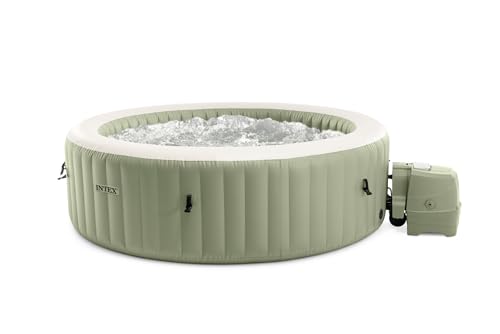
6. INTEX PureSpa Bubble Massage 28427
INTEX closes the list with the veteran: the PureSpa Bubble Massage set, model 28427 in the title, an 85-inch round inflatable for six people, with an energy efficient cover included and a system described as saltwater ready. The cold evidence here is specific and singular — the title names an energy efficient spa cover — and this guide grades it exactly there: a stated efficiency claim for the cover, from the maker, without the insulation-in-construction language of the Hawaii or the named freeze technology of the two SaluSpas. That makes the PureSpa the inflatable whose winter case rests most heavily on the owner’s system: siting, cover discipline, and honest judgment about when the season turns from cold to dangerous for an inflatable left running. Its compensating virtues are scale and ecosystem. At 85 inches it is the largest tub in the entire guide, rigid or inflatable — a true six-person circle with room for legs — and INTEX’s long presence in this category means its accessories, filters, and replacement ecosystem are the most established a buyer can choose.
Saltwater ready deserves a clarifying sentence, because the phrase misleads some shoppers: it describes compatibility with a saltwater sanitation system — the tub can work with that water-care approach — not that the spa arrives as a saltwater system or that salt is involved out of the box. Water care is a genuine winter variable, since cold slows some sanitation chemistry and owners test less eagerly with numb fingers; a buyer drawn to the saltwater route should confirm what additional equipment that route requires on the full listing. The bubble massage format repeats the category’s air-jet character: enveloping effervescence rather than targeted pressure. For a six-person social tub, that is arguably the right tool — nobody at a six-person soak is receiving a personal hydro-massage, and the bubbles serve the gathering rather than the individual.
- Spec snapshot: 85 inch round inflatable spa set, 6 person
- Model in title: 28427EG PureSpa Bubble Massage
- Cold evidence in title: Energy efficient spa cover included, per the listing
- System note: Saltwater system ready, per the listing
Strengths
- Largest capacity and footprint in the guide — a genuine six-person circle
- Energy efficient cover is included and stated in the title
- The category’s most established maker ecosystem for parts and accessories
Trade-offs
- No freeze feature or built-in insulation is named in the title
- The largest water volume here asks the most of its heater in cold air
- Saltwater readiness is compatibility, not an included saltwater system
The PureSpa’s buyer is the social cold-climate household with a big yard and a bigger friend group, willing to run the most disciplined winter operation in this guide — sheltered siting, cover always, chemistry kept, and a storage plan ready if a true polar week arrives. That buyer gets the roomiest soak on the list and a maker whose parts shelf will still exist in five years. Winter forgives preparation and punishes optimism; this tub rewards the former completely.
Best for: Social households wanting the largest inflatable format from the category’s veteran maker. Not suited for: Buyers who need named freeze protection, or who will not run a disciplined winter routine. View the INTEX PureSpa set on Amazon
Side-by-side comparison
| Tub | Type | Capacity | Cold evidence stated in title |
|---|---|---|---|
| Jocisland Acrylic | Rigid | 2 person | None stated |
| Aqualife Current | Rigid plug and play | 4 adults | Cover included, insulation unstated |
| SunSwell | Inflatable, square | 4-6 person | Insulated cover, heater pump |
| SaluSpa Hot Springs | Inflatable, round | 4-6 person | EnergySense efficient cover, Freeze Shield |
| SaluSpa Hawaii | Inflatable, round | 4-6 person | Built-in insulation, Freeze Shield |
| INTEX PureSpa | Inflatable, round | 6 person | Energy efficient cover |
How do you choose a hot tub that will survive your winter?
How cold is your cold, honestly?
Cold climates are not one climate. A yard that sees a dozen nights at freezing and a yard that sees sixty nights below it are different assignments wearing the same name. The first can be served by nearly every tub here with ordinary discipline. The second pushes buyers toward the rigid formats, toward the inflatables whose titles name insulation and freeze features, and toward a written plan for the worst week of the year rather than the average one. Name your climate’s real numbers — the typical January night, the record stretch, the wind exposure of your yard — before shopping, because every honest decision in this category is downstream of those numbers.
Where exactly will it sit?
Siting is free insulation. A tub placed against a house wall or fence, out of the prevailing wind, under any overhead shelter the property offers, loses less heat, loads its cover with less wind-blown snow, and asks less of its heater than the same tub centered in an open yard. Ground matters too: a level, solid base — a pad, pavers, a deck verified for the filled weight — keeps inflatable walls evenly stressed and rigid cabinets level. Add the human geography: the path from the back door to the tub will be walked barefoot in January, and every extra meter of icy path subtracts soaks from your winter. The best site is close, sheltered, level, and strong, in that order of daily importance.
What is your power-outage plan?
Winter storms cut power, and a hot tub without power in a freeze is a clock ticking toward ice in its plumbing. Owners in outage-prone areas should know their tub’s behavior in advance: how long the water mass holds above freezing under a closed cover (longer than panic suggests, shorter than hope), what the maker’s documentation advises for outages, and at what point draining becomes the right call. This is precisely the scenario freeze-named features are designed around, and precisely why this guide insists on reading their documented limits rather than trusting their names. A plan written in October is worth a plumber’s emergency visit in January.
Who else uses the yard in winter?
A hot tub in a cold yard shares its season with snow shovels, plow piles, firewood stacks, and children building forts. Site the tub where the snow-clearing workflow will not bury it or its access path, where the plow’s pile does not become March’s meltwater lake at its base, and where its cover locks and controlled access make sense in a yard that children treat as a playground in every season. The pump and electrical connections deserve a thought as well: cords and outlets in a winter yard want protection from meltwater and ice, arranged as the product’s documentation directs. These are unglamorous paragraphs in a buyer’s guide, and they are the difference between a tub that integrates into a winter household and one that spends the season in an argument with it.
Rigid permanence or inflatable flexibility?
The rigid tubs commit: a place, a pad, a household that soaks year-round for years. The inflatables negotiate: they can chase the sheltered corner, come indoors to a garage or sunroom in some households’ arrangements, or drain and store through the worst weeks and return in March — a flexibility that is itself a cold-climate strategy. Neither answer is the serious one and the toy one; they are two different contracts with winter. Choose the contract your property, budget, and temperament can actually honor.
The cover is the winter: insulation physics for owners
Heat leaves a hot tub mostly upward. The water surface is where evaporation and radiation do their work, which is why every serious cold discussion in this category returns to the cover — and why this guide graded titles by their cover language before anything else. An insulated, well-fitted cover, closed whenever the tub is unoccupied, is the difference between a heater that cycles occasionally and one that fights the sky all night. Covers age: their foam cores waterlog over seasons, growing heavier and less insulating, and a cover that has become a sodden slab is silently taxing every component downstream of it. Owners should lift with suspicion — a cover that has doubled in heft has retired in place — and budget its eventual replacement as part of ownership rather than as a surprise.
Snow is the cover’s second job. A cleared cover insulates; a snow-loaded cover insulates too, in its way, but it also strains seams, bows the cover’s structure, and hides the lid’s condition from its owner. The winter rhythm that works is unglamorous: brush snow off after storms, keep the cover’s straps and locks functional against wind, and never let meltwater pool and refreeze into an ice sheet that must be pried. None of the listings’ efficiency language — EnergySense, energy efficient, insulated — repeals any of this. Those phrases describe how the system starts; the owner’s broom decides how it finishes the season.
Water care when the air is below freezing
Cold changes the maintenance relationship in small, compounding ways. Test strips are read with numb fingers, so testing migrates indoors and happens less often unless the owner builds the habit into the soaking routine itself — test before the soak, adjust after, every time, rather than on a separate chore trip nobody makes in a storm. Filters work harder in winter because the tub works harder; the two filters included with the Jocisland and the filter systems named across the inflatables deserve their cleaning rhythm kept, not stretched. Bathers track in less debris in winter but the chemistry drifts with temperature swings, and an inflatable’s pump, running its cycles in cold air, should be listened to the way a driver listens to a car in January — a new strain in the sound is information, delivered early.
The season’s end deserves planning too. Owners who store an inflatable through the deepest cold should drain, dry, and fold it before the dangerous weeks rather than during them, and owners who run all winter should schedule their water changes for the mild windows the forecast occasionally grants, since draining and refilling in a hard freeze is the one maintenance task winter genuinely forbids. Spring will audit every decision; the owners who planned are the ones whose audit is boring.
The winter soak itself: getting in, staying in, getting out
Cold-climate soaking is a small expedition with three phases, and veterans plan all three. The approach: a cleared, gritted or matted path from door to tub, footwear that can be kicked off at the edge and found again in the dark, and a robe or towel staged where it will stay dry — under the cover’s overhang, in a lidded box beside the tub, anywhere but draped over a railing collecting the weather. The soak: shorter than summer’s, usually, because the body’s contrast between water and air is sharper; many winter soakers keep a hat on, a genuinely functional tradition, since the head is the only part of the body in the weather. A warm drink in an unbreakable cup, a timer nobody resents, and the discipline to leave while it still feels wonderful rather than when it stops feeling safe — these are the marks of a household that will still be soaking in February.
The exit is where winter collects its toll from the unprepared: wet skin, freezing air, a longer-than-remembered path. The robe goes on before the feet touch the ground, the cover goes back on before the robe is even belted — heat discipline and personal comfort in one motion — and the house’s warmth does the rest. Households build small infrastructure around this minute over their first winter: the hook by the door, the mat that never migrates, the outdoor light on the right switch. None of it is purchasable as a feature, and all of it decides whether the tub is a January habit or a January memory. The listings in this guide sell the water; the ritual around the water is yours to build, and it is worth building deliberately.
Draining and storing an inflatable through the deepest cold
For inflatable owners in severe climates, the mid-season storage decision is a strategy, not a defeat, and it deserves a proper method. Choose a mild window — a day above freezing with another behind it — because every step goes better unfrozen: drain fully through the tub’s outlet with the pump’s help where the design allows, run the air system briefly to clear its passages as the documentation directs, and let the shell dry genuinely dry, since a PVC tub folded damp returns in spring with mildew as its first accessory. Deflate, fold loosely rather than in hard creases, and store indoors — a garage corner, a basement shelf — away from rodents, sharp storage neighbors, and the deep cold itself, which stiffens PVC and makes a frozen tub brittle to handle. The pump unit stores beside it, hoses drained, filter removed and either cleaned for spring or replaced on the spring list.
The owners who store well also write the spring note in the autumn: what the chemistry was when they closed, what the filter’s age is, which small part looked worn. That note, taped to the stored tub, converts March’s recommissioning from archaeology into routine. And the decision itself should be made by the calendar and the forecast rather than by optimism — a tub drained a week early loses a week of soaking; a tub caught full in a polar plunge can lose everything. In cold climates, the conservative date is the correct one, and the households that thrive with inflatables are the ones that treat storage as a season of ownership rather than an interruption of it.
What about the shoulder seasons?
Spring and autumn are when cold-climate tubs quietly justify themselves most. The first cold snap of October, met from inside 102 degrees of water under a darkening sky, is the experience that sells this entire category to its owners’ friends; the last soaks of April, with the yard thawing and the cover finally staying dry, close the season like a ceremony. Shoulder seasons also forgive the category’s weaknesses: heaters keep pace easily, inflatables face no storage dilemma, chemistry behaves, and the path from the door is merely chilly. Buyers deciding whether the winter commitment is worth it should count the shoulders in the asset column — for many households they contribute as many soaks as the deep winter itself, at a fraction of the operational effort. A tub bought for January that also owns October and April is a different value proposition than its winter specification suggests, and it is the honest whole picture of cold-climate ownership.
Common mistakes cold-climate buyers make
Reading a freeze feature’s name as a guarantee. Freeze Shield and similar phrases are makers’ names for protective systems with documented behaviors and limits. This guide credits them as the strongest title evidence available — and still instructs you to read the documentation, because January does not accept marketing as a defense.
Buying the tub and improvising the cover. The cover is the primary insulation. A tub whose title names an insulated or energy-efficient cover starts ahead; a tub bought without cover research starts in debt, whatever its jets.
Siting for the summer photograph. The open, picturesque spot is usually the windiest. Winter rewards the sheltered corner near the door, and the photograph looks fine from there too.
Assuming plug-and-play means weather-proof planning is optional. Easy power is not easy winter. The 110V tubs here heat patiently, and cold air tests patience; siting and cover discipline matter more for them, not less.
Letting the water chemistry drift because testing is unpleasant in the cold. Build the test into the soak itself. A tub that goes green in February has usually been neglected since December, one skipped strip at a time.
Making therapy the reason for purchase. No claim in any of these listings, and none in this guide, promises treatment of anything. Buy the tub for heat, buoyancy, and winter evenings reclaimed — reasons that need no exaggeration.
A word on guests, children, and winter house rules
A winter hot tub becomes a social magnet precisely when conditions are least forgiving, so house rules deserve writing before the first guest night. Guests arrive without the owner’s instincts: they leave the cover open during a long conversation on the deck, they soak longer than the cold air on their shoulders should allow, and they do not know the path’s icy patch. A host’s quiet systems — cover closed the moment the last bather exits, a stated soak length, towels and robes counted before anyone gets in — keep the evening pleasant and the equipment respected. Children need the strictest version of the rules in every season and winter adds its own: no child in the tub without an adult in the water, sessions kept short, temperatures moderated on a clinician’s guidance rather than a thermostat’s maximum, and a latched cover treated as part of the house’s childproofing. Written rules sound stiff until the first crowded Saturday; afterward they sound like hospitality.
Final recommendation
Start with the evidence ladder this guide built. Buyers who want cold features named in writing should look first at the two SaluSpa models — the Hot Springs for its efficient cover, freeze feature, and Wi-Fi oversight, the Hawaii for insulation built into its construction in a smaller footprint — and at the SunSwell for its stated insulated cover in a square, corner-friendly shape. The INTEX suits the large social household prepared to run the most disciplined winter around the biggest inflatable here. The rigid pair serve permanence: the Jocisland for a couple’s lounger spa whose cover details must be confirmed, the Aqualife for four adults with a cover included and homework attached. Whichever you choose, spend as much thought on the site, the cover, and the outage plan as on the tub — in a cold climate, those are not accessories to the purchase; they are the purchase. Readers furnishing the rest of a winter-ready home might next browse Best Mens Vegan Slippers for the dash back indoors, Best Sheepskin Rugs for the floor where the towels drop, or Best Salon Towels for the stack waiting by the door.
Frequently asked questions
Can an inflatable hot tub really be used in winter?
Yes, within its design and documentation — the inflatables here are sold with heaters, covers, and in two cases named freeze features for cold conditions. Winter use is a discipline: sheltered siting, a closed insulated cover, power kept on, and honest judgment about extreme stretches, when draining and storing remains a legitimate choice.
What does an energy-efficient cover claim actually mean?
It is the maker’s claim that the cover system is designed to reduce heat loss compared with a basic cover. This guide reports such claims with attribution — EnergySense, energy efficient — and treats the cover’s fit, condition, and the owner’s closing habits as the variables that decide real bills.
Will Freeze Shield let me ignore a hard freeze?
No feature name earns that trust. Freeze Shield is a maker-named protective system whose documented behavior and limits you should read in the product’s own materials. It is evidence a maker engineered for cold — the strongest such evidence in these titles — not a substitute for power, covers, and attention.
Rigid or inflatable for a very cold climate?
Rigid construction is the lower-drama format for severe, sustained cold, and the two rigid picks here serve buyers who confirm their cover and insulation details. Inflatables with stated insulation serve milder cold climates and flexible households well. Match the format to your climate’s worst month, not its average one.
How hot do these tubs get?
One listing here states a maximum of 104 degrees; others do not state a ceiling in their titles. Whatever the equipment allows, soak at a temperature you can sit in comfortably and clear-headedly, and let children and anyone with health considerations follow a clinician’s guidance rather than a thermostat’s maximum.
How much snow load can a hot tub cover take?
Less than a roof, and it should never be asked to prove otherwise. Covers in this category are insulation and vapor barriers, not structures; the winter habit that protects them is brushing snow off after storms rather than letting it accumulate, compact, and refreeze. Owners in lake-effect and mountain snow belts sometimes add a simple cap or board arrangement over the cover for the worst months — an owner-side adaptation, not a feature of any listing here, and a sensible one where snowfall is measured in feet.
Is it cheaper to keep an inflatable running or to store it for winter?
Running costs electricity, chemistry, and attention through the coldest months; storing costs the soaks and demands a proper drain-and-dry weekend on each end of the season. The honest answer depends on your electricity rates, your climate’s severity, and — decisively — whether you will actually use it in January. A tub run all winter and used twice a week is money well spent; a tub run all winter and used twice is a heated monument. Count your likely soaks before you count your costs.
Can I put one of these inflatables on a deck?
Only a deck verified for the filled weight — water for four to six people plus the bathers is a load measured in tons, concentrated on a small circle. Ground-level pads are the default recommendation in this category for a reason. If a deck is the dream site, the verification belongs to a contractor or engineer, not to optimism, and the rigid tubs deserve the same scrutiny with interest.
What should I check first on delivery day in cold weather?
For inflatables, let cold-stiffened PVC warm indoors before unfolding and inflating — material forced while brittle is material at risk — and inspect seams before the first fill. For every tub here, photograph the delivered condition, confirm the cover’s fit while the season is young, and run the first heat cycle as a supervised test rather than overnight. Winter forgives preparation; delivery week is when preparation is cheapest.
When should a cold-climate buyer order?
Early enough that delivery, siting, and the first supervised heat cycle all happen before the season’s first hard freeze — autumn, in most cold regions, rather than December. A tub commissioned calmly in October teaches its owner its habits while the weather still forgives mistakes; a tub rushed into service in a January cold snap teaches the same lessons at tuition rates nobody enjoys.
What is the first sign a winter tub is struggling?
Usually the heater’s behavior: longer recovery after a soak, a temperature that drifts downward during use, or a cover heavier than it was in autumn. Each is information delivered early, while the response is still cheap — check the cover’s fit, clean the filter, and read the manual’s cold-weather section before the season deepens.
The best winter hot tub is not the one with the boldest claim — it is the one still steaming, cared for and covered, on the coldest night of the year.


