What's inside
- Key Takeaways
- Quick Picks
- How We Chose These Picks
- How Do the Six Sets Compare on Pattern Honesty?
- How Can You Tell Real Woven Damask From a Print Before You Buy?
- Why Does a Woven Pattern Outlast Every Other Kind of Decoration?
- How Should You Wash Patterned and Sateen Sheets Without Dulling Them?
- Which Mistakes Do Damask Shoppers Make Most Often?
- How Do You Style a Room Around a Patterned Sheet?
- What Should You Decide Between Cotton, Microfiber and Flannel?
- How Does Damask Behave in a Guest Room Versus a Primary Bedroom?
- What Is the History Hiding Inside the Word Damask?
- How Should You Judge the Thread Count on a Damask Listing?
- What About Ironing, Starching and the Formal Bed?
- How Do You Store Woven and Patterned Bedding Between Seasons?
- When Does a Patterned Sheet Set Make a Small Bedroom Feel Larger or Smaller?
- What Should Newlyweds and Registry Buyers Take From This Guide?
- How Do You Match Damask Sheets With Duvets, Throws and Curtains?
- What Is the Sensible First Damask Purchase for a Household New to It?
- How Does Damask Suit Bedrooms Shared With Pets and Children?
- How Do You Keep White Damask White Without Wrecking It?
- A Final Practical Note on Pillowcases and Pattern Direction
- Final Recommendation
- Frequently Asked Questions
- Related Guides
As an Amazon Associate I earn from qualifying purchases. This post may contain affiliate links at no extra cost to you.
cottageverdict.com is reader-supported. When you buy through links on our site, we may earn an affiliate commission.
Where to buy: each set below is sold on Amazon, and the names in the Quick Picks table, the review headings and the comparison table link to the matching listing so you can check price on Amazon and verify fibre, pocket depth and piece count for yourself. The best damask sheet sets promise the most romantic surface in bedding, a pattern that appears and disappears as the light moves, and the category also contains more impostors per listing than almost any other, which is why this guide begins with a definition.
True damask is a weave, not a print. On a jacquard loom, the pattern is built into the cloth itself by alternating two weave structures: areas woven with warp threads floating on the surface reflect light one way, areas woven with weft threads floating reflect it the other way, and the design emerges purely from that contrast of matte and sheen. Turn a true damask sheet over and the pattern appears in reverse, negative where the front was positive, because the same threads make both faces. The effect is tone-on-tone, woven, and permanent for the life of the cloth.
Damask-style is the imitation, and it wears several costumes. Some sets print a damask motif onto plain cloth, where it sits on the surface, can fade unevenly and shows the same face on both sides. Some microfiber sets weave or emboss a stripe and borrow the damask name for its elegance, delivering a striped sheen effect that is attractive but structurally different. Neither is a crime; both become a problem only when a listing lets a buyer believe they are purchasing woven jacquard. This guide therefore labels every pick, in its review, as woven damask, damask-stripe effect or, in one case, not damask at all.
That last case deserves its sentence now. Two sets in this guide are plain sateen with no damask pattern, included deliberately because many shoppers searching this keyword actually want the smooth, lustrous hand that damask fabrics have, rather than the motif itself. They are labelled as the plain alternatives, and a buyer who wants the woven pattern above all should pass them by for the URBANHUT or the Feather & Stitch, where the stripe is genuinely woven into cotton.
Fibre divides the field as sharply as pattern does. Cotton damask carries the tradition, the breathability and the price; microfiber damask-style sets cost less, resist wrinkles fiercely and sleep warmer; and one pick here is cotton flannel, where the damask motif is softened under a brushed nap into something barely there and entirely cosy. Read each review for its pattern verdict first and its comfort verdict second, and the right set will identify itself.
Key Takeaways
- True damask is woven on a jacquard loom, its pattern formed by contrasting matte and glossy weave areas, reversible front to back.
- Printed damask-style motifs sit on the cloth surface, show identically on both sides and can fade faster than the sheet wears out.
- Microfiber damask stripe sets offer a sheen-stripe effect and easy care, but they are not cotton jacquard damask.
- This guide labels every pick’s pattern honestly, including two plain sateen sets included for their hand rather than any motif.
- Woven patterns cannot wash off, which makes true damask the longest-lived way to wear a design on a bed.
- Pocket depth and piece count still decide fit and completeness, whatever the pattern’s pedigree.
Quick Picks
| Pick | Badge | Why it earns its place |
|---|---|---|
| URBANHUT 600 TC Cotton Damask Sheets King | Best True Woven Damask | Cotton damask in a sateen weave with a hotel stripe, certified fabric and sixteen-inch pockets. |
| Elegant Comfort Damask Stripe Sheets King Burgundy | Best Burgundy Stripe Effect | Six pieces of microfiber with a damask stripe look in a deep burgundy that dresses a room instantly. |
| Elegant Comfort Damask Sheets King Gray | Best Grey Stripe Effect | The same six-piece microfiber formula in grey, wrinkle resistant and easy to live with. |
| RUVANTI Cotton Flannel Damask Sheets King | Best Cosy Flannel Motif | Double-brushed cotton flannel carrying a softened damask pattern for cold bedrooms. |
| Feather & Stitch 500 TC Cotton Sateen Sheets King | Best Woven Stripe Cotton | Cotton sateen with a woven damask stripe, all-around elastic and eighteen-inch pockets. |
| Casa Platino King Sheet Set 500 TC Sateen | Best Plain Sateen Alternative | No damask pattern at all, honestly labelled: six pieces of smooth cotton sateen in dark grey. |
How We Chose These Picks
Pattern construction was the first and hardest sieve, because it is the keyword itself. Listings were sorted into three honest piles: woven damask or woven damask stripe in cotton, damask-style effects in microfiber, and plain cloth borrowing the search term. All three piles are represented in the final six, because all three are what a shopper will actually meet, but no pick is allowed to wear a higher pile’s clothes in its review.
Fibre came second. Cotton damask is the tradition this category descends from, and the guide gives it the top positions; microfiber earns its places on price, piece count and wrinkle resistance, with its warmth and its stripe-effect status stated plainly; flannel earns its place as the winter interpretation, where the motif is a whisper under the nap rather than a statement across the bed.
Fit and completeness were checked as in every bedding guide here: pocket depths from fifteen to eighteen inches across the six, piece counts of four and six, and elastic design credited where a listing describes it. A woven masterpiece that pops off the mattress at midnight is a failed sheet, and the reviews keep one eye on the corners throughout.
Finally, the set was balanced for real shopping behaviour. Some readers will leave with the true woven article, some with a microfiber stripe at a gentler price, and some will realise the pattern was never the point and take the plain sateen. A guide that serves all three honestly has done more work than one that pretends only the first reader exists.

URBANHUT 600 TC Cotton Damask Sheets King — Best True Woven Damask
Pattern verdict first, as promised: this is the genuine construction. The URBANHUT listing describes one hundred percent cotton damask in a sateen weave with a hotel stripe, which in textile terms means the stripe is woven into the cloth by alternating the surface floats, exactly the mechanism that defines damask. In white, the effect is at its most classic: a bed that looks plain from across the room and reveals its striped architecture as you approach and the light changes its angle.
The supporting specifications are grown-up ones. Six hundred thread count sits at the top of the plausible range, and whatever ply generosity the figure contains, the cloth it describes is a dense cotton sateen with the weight and drape the count implies. Sixteen-inch elasticised pockets fit the mainstream of king stacks, and the listing carries an OEKO-TEX certification, which speaks to the fabric’s testing for harmful substances, a credential none of the other picks here can match.
White damask is a commitment as well as a pleasure. The woven stripe cannot fade, since it is structure rather than dye, but the white ground will record the household’s life, and keeping it bright is a laundry discipline of warm washes and prompt stain treatment. Households willing to keep that discipline get the most authentic object in this guide: a patterned sheet whose pattern will outlast every printed rival in the category, on a bed that rewards a second look.
- Pattern: woven cotton damask stripe, true jacquard construction
- Fibre: 100 percent cotton, sateen weave
- Stated count: 600 thread count
- Pocket depth: 16 inches, elasticised
- Certification: OEKO-TEX certified per the listing
Strengths
- Genuinely woven pattern that can never wash or fade off.
- Cotton breathes and ages with the grace damask is known for.
- Certification adds substance testing none of the rivals claim.
Trade-offs
- White ground demands a confident, prompt laundry routine.
- Sixteen-inch pockets may strain over the deepest toppers.
- Four pieces; the second pillowcase pair is a separate purchase.
Best for: buyers who want authentic woven damask in classic white. Not suited for: households wanting pattern that hides marks and effort.

Elegant Comfort Damask Stripe Sheets King Burgundy — Best Burgundy Stripe Effect
Pattern verdict: damask-style, worn openly. This Elegant Comfort set is microfiber, six pieces in burgundy, with a damask stripe treatment that gives the cloth its alternating bands of sheen. Microfiber cannot be woven into cotton’s jacquard tradition, and this is not that; it is a stripe effect in a synthetic knit-free weave that imitates damask’s light play at a fraction of the cost, and judged as an effect rather than as the real weave, it is a handsome one.
Burgundy is the boldest colour decision in this guide, and for the right room it is a complete decorating act in a single box: a deep wine ground that makes white pillows glow, flatters dark wood furniture and turns a plain king bed into the room’s deliberate centrepiece. Six pieces dress the bed fully, with four king pillowcases for the four-pillow arrangement, and pockets rated to sixteen inches cover most king stacks.
Microfiber’s terms are well known and apply in full. It resists wrinkles to a degree cotton cannot match, dries quickly, and feels silky-smooth in a way some sleepers adore and others find slippery and warm. It will not breathe like the cotton picks, and its stripe is a surface character rather than a woven architecture. Buy it for colour, completeness and easy care, with eyes open about fibre, and it delivers exactly the dramatic, low-effort bed its photographs promise.
- Pattern: damask stripe effect in microfiber, not woven jacquard
- Fibre: microfiber per the listing
- Pieces: 6, including four king pillowcases
- Pocket depth: fits up to 16 inches
- Colour: burgundy
Strengths
- Six pieces dress a four-pillow king completely in one box.
- Burgundy transforms a plain bedroom with a single purchase.
- Wrinkle resistance keeps the made bed looking deliberate.
Trade-offs
- Stripe is an effect, not a woven damask structure.
- Microfiber sleeps warmer and breathes less than cotton.
- Deep colour can fade unevenly under harsh washing.
Best for: dramatic bedrooms and complete, easy-care dressing on a budget of effort. Not suited for: damask purists or hot sleepers who need cotton’s breath.

Elegant Comfort Damask Sheets King Gray — Best Grey Stripe Effect
Pattern verdict: the same damask-style stripe as its burgundy sibling, translated into grey, and the translation changes the set’s whole temperament. Where burgundy performs, grey composes. The alternating sheen bands read as quiet texture rather than decoration, the colour hides the minor marks of real life, and the six-piece completeness, flat sheet, fitted sheet and four king pillowcases, dresses a king bed in one purchase with nothing left to match later.
Grey is also the diplomat of bedding colours. It sits calmly under white, navy, blush or patterned duvet covers, suits the grey-washed palette of most contemporary bedrooms and does not demand that the room be redecorated around the sheets. For a guest king, where the bed must look finished for whoever arrives and the laundry must be uncomplicated, this combination of neutral colour, wrinkle resistance and full piece count is close to a default answer.
The microfiber terms from the burgundy review apply unchanged, and this guide will not launder them into something softer: the stripe is an effect rather than a woven structure, the fibre breathes less than cotton and can feel warm and slightly slippery to sleepers raised on natural cloth. What the grey set offers instead is the easiest ownership in the guide, a bed that looks composed straight from the dryer, in the colour least likely to argue with anything you already own.
- Pattern: damask stripe effect in microfiber, not woven jacquard
- Fibre: microfiber per the listing
- Pieces: 6, including four king pillowcases
- Pocket depth: fits up to 16 inches
- Colour: gray
Strengths
- Neutral grey coordinates with nearly any existing bedding.
- Six pieces complete the bed, ideal for guest rooms.
- Wrinkle-resistant microfiber looks made with minimal effort.
Trade-offs
- Damask name describes a stripe effect, not a weave.
- Synthetic hand will not convert committed cotton sleepers.
- Warmth of microfiber counts against it in summer bedrooms.
Best for: guest kings and neutral bedrooms wanting effortless polish. Not suited for: buyers seeking authentic woven cotton damask.
RUVANTI Cotton Flannel Damask Sheets King — Best Cosy Flannel Motif
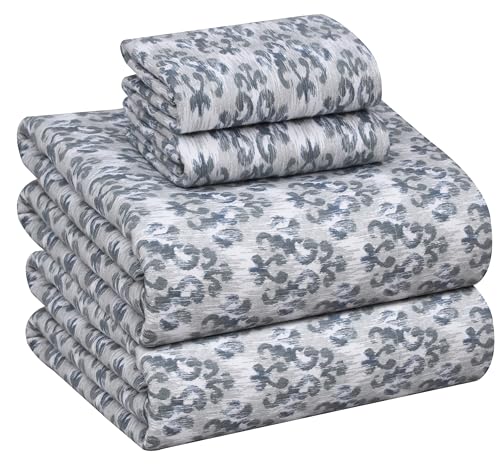
Pattern verdict: a real damask motif in the cloth, deliberately softened almost to invisibility. RUVANTI’s set is one hundred percent cotton flannel, double brushed on its surfaces, and flannel’s brushed nap stands up from the weave like frost on a window, muting whatever pattern the cloth carries beneath. The damask here is a texture you feel and glimpse rather than a design you admire from the doorway, and in a winter bedroom that whisper of pattern under the warmth is exactly the right register.
Flannel rewrites the priorities of this entire guide. Nobody buys it for sheen; they buy it for the moment of getting into a bed that does not greet them with cold cloth, in a room where the heating rests overnight. Double brushing raises the nap on both faces, trapping air and giving the sheet its characteristic soft, almost suede-like hand. The listing promises sixteen-inch deep pockets and all-season language, though honest owners will retire flannel to the cupboard in high summer whatever the box says.
Care is flannel’s tax. It sheds lint in its early washes, as loose nap fibres leave, and it prefers gentle cycles and low heat to keep its surface from pilling into roughness. Wash it separately at first, expect the dryer filter to tell the story, and the set settles into years of winter service. As the only warm-blooded pick in a guide of cool sateens, the RUVANTI earns its place by serving the season the others cannot.
- Pattern: damask motif in cotton flannel, muted by brushing
- Fibre: 100 percent cotton flannel, double brushed
- Size and pieces: king, 4 pieces
- Pocket depth: 16 inches
- Season: cold-weather bedding first
Strengths
- Double-brushed warmth transforms a cold winter bed.
- Cotton fibre breathes better than synthetic winter bedding.
- Muted motif adds texture without visual fussiness.
Trade-offs
- Pattern is subdued; damask display seekers will be underwhelmed.
- Early washes shed lint and demand separate laundering.
- Too warm for summer use in most bedrooms.
Best for: cold bedrooms and winter beds that need warmth with texture. Not suited for: anyone wanting damask’s light-and-shadow show on display.
Feather & Stitch 500 TC Cotton Sateen Sheets King — Best Woven Stripe Cotton
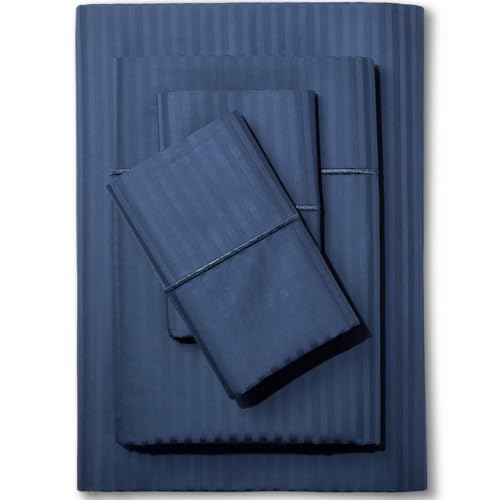
Pattern verdict: genuinely woven. Feather & Stitch’s listing names the pattern a damask stripe, and in this set the stripe is created the honest way, by the weave itself in cotton sateen, so the bands of sheen are structure rather than surface. It is a stripe damask rather than a floral jacquard, tailored and architectural instead of romantic, and in dark blue it reads like good shirting scaled up to a bed, which is a compliment this guide does not hand out often.
Where the URBANHUT leads on pattern purity and certification, this set leads on the mechanics of staying on the bed: eighteen-inch pockets and elastic that runs the full perimeter of the fitted sheet. A woven stripe is a pleasure only while the sheet stays seated, and the full elastic keeps the corners where the pattern can be seen. Five hundred count cotton sateen supplies the dense, smooth ground the stripe needs to show its contrast.
The dark blue deserves a practical note. It hides wear, forgives the occasional missed stain treatment and anchors a pale room, while showing light lint more readily than the white picks. Households choosing between this and the URBANHUT are really choosing between two honesties: tailored stripe in colour with superior elastic, or classic white damask with certification. There is no wrong answer, only a bedroom’s character to consult.
- Pattern: woven damask stripe in cotton sateen
- Fibre: 100 percent cotton, sateen weave
- Stated count: 500 thread count
- Pocket depth: 18 inches, all-around elastic
- Colour: dark blue stripe
Strengths
- Woven stripe is structural and will not fade off the cloth.
- Full-perimeter elastic is the best fit engineering here.
- Dark blue stripe looks tailored and hides everyday wear.
Trade-offs
- Stripe damask is architectural, not floral or ornate.
- Dark ground shows pale lint and pet hair readily.
- Four pieces only, as with the other cotton picks.
Best for: buyers wanting woven pattern plus the securest fit in the guide. Not suited for: romantics seeking a floral jacquard motif.

Casa Platino King Sheet Set 500 TC Sateen — Best Plain Sateen Alternative
Pattern verdict, in the plainest words this guide owns: there is no damask in this set. The Casa Platino is a six-piece king set of one hundred percent cotton sateen at five hundred thread count, in dark grey, with fifteen-inch pockets, and its surface is smooth, lustrous and entirely unpatterned. It appears in this guide because the search that brought you here is often, underneath, a search for that sateen hand, and because an honest plain alternative is worth more than a sixth set pretending to a pattern it does not have.
Judged as plain sateen, it is a well-shaped purchase. Six pieces dress the bed completely, the dark grey is the forgiving, coordinating colour this guide has praised elsewhere, and five hundred count cotton gives the close, buttery drape the listing describes. Without a motif to protect, it is also the least precious set here: the one you can wash, use and lend to the guest room without a thought for preserving a pattern’s contrast.
The fifteen-inch pocket is its one hard boundary, excluding the deepest mattress-and-topper stacks, which should take the eighteen-inch Feather & Stitch instead. And if your heart is genuinely set on watching a woven pattern shift in the evening light, this set will not scratch that itch at all, and you should buy the URBANHUT and be happy. If the itch was really about smooth cotton and a complete, dark, easy set, the Casa Platino is the guide’s honest answer.
- Pattern: none; plain sateen, included as the honest alternative
- Fibre: 100 percent cotton, sateen weave
- Stated count: 500 thread count
- Pocket depth: 15 inches
- Pieces: 6, dark grey
Strengths
- Six pieces of real cotton sateen complete the bed in one box.
- Dark grey plain surface coordinates with patterned duvets.
- No motif to preserve makes care entirely unceremonious.
Trade-offs
- Not damask in any sense; pattern seekers should look elsewhere.
- Fifteen-inch pockets exclude the deepest bed stacks.
- Plain surface offers less visual texture than woven rivals.
Best for: shoppers who wanted sateen’s hand more than damask’s motif. Not suited for: anyone whose brief is a visible woven pattern.
How Do the Six Sets Compare on Pattern Honesty?
| Set | Pattern verdict | Fibre | Pocket and pieces |
|---|---|---|---|
| URBANHUT 600 TC Cotton Damask Sheets King | Woven damask stripe | Cotton sateen | 16 in, white |
| Elegant Comfort Damask Stripe Sheets King Burgundy | Damask stripe effect | Microfiber | 16 in, 6 pieces, burgundy |
| Elegant Comfort Damask Sheets King Gray | Damask stripe effect | Microfiber | 16 in, 6 pieces, gray |
| RUVANTI Cotton Flannel Damask Sheets King | Motif muted under flannel nap | Cotton flannel | 16 in, 4 pieces |
| Feather & Stitch 500 TC Cotton Sateen Sheets King | Woven damask stripe | Cotton sateen | 18 in, 4 pieces, dark blue |
| Casa Platino King Sheet Set 500 TC Sateen | No pattern, plain sateen | Cotton sateen | 15 in, 6 pieces, dark grey |
No other table in this batch of guides sorts its own products by how truthful their names are, and that is precisely why this one exists. Two woven, two effects, one whisper and one honest plain: the field is a fair map of what the keyword actually buys in today’s market. Choose your row by the verdict column first, and every other column will fall into place behind it.
How Can You Tell Real Woven Damask From a Print Before You Buy?
Use the reverse side, even in photographs. A woven damask shows its pattern on the back in negative, glossy where the front was matte, because one set of threads makes both faces. A print shows a paler, blurrier ghost of the design on the reverse, or nothing at all, since the pigment never passed through the cloth. Listings that show the reverse, or use words like jacquard and woven alongside the fibre, are describing a structure; listings long on elegance and short on construction are describing a look.
Then read the fibre line as a cross-examination. Traditional damask in this market is cotton, sometimes linen; a set whose fibre is microfiber is offering a damask effect by definition, whatever its title says, because the category’s woven heritage does not exist in that material at these prices. That does not make the microfiber sets bad purchases, as their reviews above argue, but it settles what they are before the box arrives.
Price whispers the same truth. Jacquard looms run slower and cost more per metre than plain weaving or printing, so a very inexpensive king set wearing the damask name is almost always an effect or a print. None of this requires expertise, only the habit of asking one question of every listing: is the pattern in the cloth, or on it? The answer organises the entire category.
Why Does a Woven Pattern Outlast Every Other Kind of Decoration?
Because there is nothing applied to lose. A print is a film of pigment resting on fibres, and every wash flexes that film, every abrasion scrapes it, and sunlight edits it season by season. An embossed effect relaxes as the material ages. A woven pattern, by contrast, is the cloth’s own architecture: the design persists as long as the threads do, and when the sheet finally wears out it will be the ground fabric that thins, pattern and all, together.
This longevity has a styling consequence worth enjoying. Tone-on-tone woven pattern cannot clash with the next duvet cover, the next paint colour or the next decade’s taste, because it never introduces a colour, only a play of light. Printed motifs date; woven damask simply continues. Households furnishing for the long term, rather than for this season’s photograph, have always understood that the quietest pattern in the room is the one still there in ten years.
The flannel pick is the honourable exception that proves the mechanism. Its motif fades from view not because it is applied but because the brushed nap rises over the weave, a change in the cloth’s surface rather than a loss of its structure. Even softened to a whisper, the pattern is still in the threads, which is more than any printed set in the world can claim.
How Should You Wash Patterned and Sateen Sheets Without Dulling Them?
The enemy of damask’s light play is residue and abrasion. Detergent left in the cloth coats the floats that create the sheen contrast, flattening matte and gloss into one dull middle, so measure detergent modestly and favour an extra rinse over an extra scoop. Wash patterned sateen inside out where practical, on a gentle-to-normal cycle in warm water, with its own kind rather than with towels whose loops sand the surface floats that the pattern depends on.
Skip fabric softener for the same reason given throughout these bedding guides: it coats fibres to imitate smoothness and, on damask, it irons out the contrast that is the entire design. Dry on low heat or on the line, since high heat is unkind to elastic and to cotton’s surface alike, and shake the sheets out before drying so the weave settles flat. Ironing, for those who still do it, restores damask beautifully, the press sharpening the boundary between the matte and glossy fields.
Microfiber stripe sets ask for the opposite temperament: they forgive nearly everything except high heat, which can glaze their fine fibres, and fabric softener, which they do not need. Flannel asks for patience, separate early washes, a lint filter checked without fail, and low heat to protect the nap. Three fibres, three laundry personalities, one principle: the wash should serve the cloth’s structure, not the household’s haste.
Which Mistakes Do Damask Shoppers Make Most Often?
Buying the word instead of the weave leads the list: paying a jacquard expectation into a printed or microfiber purchase and feeling cheated by a product that never claimed, in its fine print, to be anything else. The second mistake is the mirror image, dismissing the microfiber effects as frauds when, bought knowingly for colour and easy care, they are perfectly satisfactory bedding. Knowledge, not fibre snobbery, is the dividing line between the two experiences.
Third is pattern scale blindness. A bold, large motif that sings in a listing photograph can shout across a king bed in a small room, while the subtle stripe that looked like nothing online becomes the most elegant surface in the house. Judge pattern by your room’s size and light, remembering that north-facing rooms flatten contrast and evening lamplight deepens it, and that damask of every kind is a creature of light before it is a creature of thread.
Fourth comes neglecting fit for beauty, the old bedding error in a patterned dress: a woven masterpiece on a fifteen-inch pocket will not stay on an eighteen-inch stack, and no jacquard ever woven can be admired from the floor where the corner landed at midnight. Measure the stack, then fall in love, in that order, and the romance will survive contact with the bed.
How Do You Style a Room Around a Patterned Sheet?
Let the sheet be the room’s quietest pattern, not its loudest. Damask’s tone-on-tone nature makes it a background instrument: it enriches a bed dressed with plain duvets, adds architecture under a folded throw, and never competes with a patterned cover the way a printed sheet would. Households that love bold duvet covers should choose the woven whites and stripes here, whose designs will harmonise with anything placed above them.
The burgundy microfiber set reverses the arrangement and becomes the colour event of the room, asking for calm around it: pale pillows, plain walls, restraint in the curtains. Styled that way it looks intentional and rich; surrounded by competing patterns it looks like an argument. The grey sibling, and the dark grey plain sateen, occupy the diplomatic middle, present enough to dress a bed alone and quiet enough to disappear under layers.
Light is the final styling tool, and damask is its favourite material. A bed placed where morning sun rakes across it will perform its matte-and-gloss alternation daily, while the same sheet in a dim corner stays politely plain. If your bedroom has one good shaft of light, aim the bed at it and let the weave do the decorating; few surfaces in a home repay light so reliably.
What Should You Decide Between Cotton, Microfiber and Flannel?
Decide by climate and temperament together. Cotton damask and sateen breathe, age gracefully and suit the widest range of sleepers and seasons; they ask for gentler laundry and a higher initial outlay, and they repay it in years. Microfiber asks for almost nothing, dries in a blink and resists wrinkles completely, while sleeping warmer and carrying a synthetic hand that divides every household that tries it into converts and refusers.
Flannel is not a year-round candidate at all but a seasonal specialist, and should be bought the way one buys a winter coat: for the months it will be worn, in the knowledge that it transforms them. A household in a cold house with a cold bedroom will get more nightly happiness from the RUVANTI set in January than from any jacquard in this guide, and less from it in July than from a bare mattress.
The mature answer for many homes is a small wardrobe: woven cotton for most of the year, flannel for the cold quarter, and the microfiber or plain sets as the rotation and guest-room workhorses. Bedding is clothing for the bed, and nobody sensible owns one outfit. Build the wardrobe in that order and every set in this guide finds the season and the sleeper it was honestly made for.
How Does Damask Behave in a Guest Room Versus a Primary Bedroom?
The guest room is damask’s natural theatre. A woven pattern bed, made once and admired on arrival, delivers its whole effect in the first evening’s light, and the sheet’s life between guests is restful storage rather than nightly labour. White woven damask in a guest room reads as deliberate hospitality, the bed equivalent of the good towels, and it asks only for a wash after each visit and a cupboard that keeps it smooth.
The primary bedroom makes the harder demand: the same surface, performing nightly, washed weekly, judged by people who know exactly how it felt last month. Here the woven construction earns its premium in the only currency that matters, unchanged appearance across hundreds of nights, while the microfiber effects earn theirs in laundry speed during busy weeks. Many households run both, jacquard for the room they sleep in and the easy sets for the room they lend, and that division of labour is this guide in miniature.
What Is the History Hiding Inside the Word Damask?
The name travels from Damascus, the Syrian city whose weavers and merchants made patterned silk famous along the trade routes a thousand years ago. The technique crossed into Italy and France, migrated from silk to linen and then to cotton as fibres cheapened, and spent centuries as the cloth of formal tables and serious beds, valuable precisely because the pattern could not rub, print or wash away from goods meant to be inherited.
That inheritance logic survives in the modern category’s best products. A woven cotton damask sheet is still, at heart, a buy-it-for-a-decade object in a market of seasonal textiles, and its price relative to printed rivals is the price of the loom time that made it. Knowing the history does not oblige anyone to buy the tradition, but it explains why the word carries a premium, and why borrowing it for a printed effect is such reliable marketing.
How Should You Judge the Thread Count on a Damask Listing?
With the same scepticism this batch’s thread-count guide applies everywhere, plus one damask-specific wrinkle. Counts above five or six hundred in cotton are generally reached with multi-ply yarns, so the URBANHUT’s six hundred should be read as a dense cloth claim rather than a fineness measurement. The weave matters more than the figure here in any case, because jacquard patterning needs a substantial ground cloth to hold its contrast, and a well-built five hundred count damask will show its design better than a flimsy cloth wearing a bigger number.
Microfiber listings play a different game entirely, often omitting count or substituting fineness language of their own, which is one more reason the fibre line is the first thing to read. Let the count be the last specification you consider on any set in this guide, after pattern construction, fibre, pocket and pieces have all had their say, and it will rarely lead you wrong.
What About Ironing, Starching and the Formal Bed?
Damask is the one modern sheet that actively rewards ironing. Heat and pressure sharpen the boundary between the matte and glossy weave fields, and a pressed damask bed has a formality that no un-ironed sheet of any fibre can imitate. Households that enjoy a formal bed, for holidays, for guests, for the pleasure of the ritual itself, will find the woven cotton picks respond to the iron like the table linen their ancestors were.
Starch is the optional extra, best kept light and occasional. A whisper of it in the final rinse gives pillowcases a hotel crispness; a heavy hand makes the bed feel armoured and can dull the very contrast the ironing sharpened. The microfiber sets want neither iron nor starch and would be damaged by a hot iron, so the formal-bed ritual belongs to the cotton rows of the comparison table, which is where it has always lived.
How Do You Store Woven and Patterned Bedding Between Seasons?
Clean, fully dry and loosely folded, in a breathable cotton bag or an open shelf rather than a sealed plastic box. Cotton stored with any damp left in it will mildew in the dark, and patterned whites stored against coloured textiles can pick up dye transfer across a summer. A sprig of nothing at all is the best scent strategy; fragranced sachets can stain pale damask where they touch it, a heartbreak this guide has seen described too often to omit.
Flannel stores by the opposite calendar, coming out as the cotton damask goes in, and the rotation keeps both wardrobes aired. Refold stored sets once mid-season to move the crease lines, since a fold held for six months in dense cotton can set like a hem. These are small, old housekeeping disciplines, and they are the difference between bedding that emerges ready and bedding that emerges tired.
When Does a Patterned Sheet Set Make a Small Bedroom Feel Larger or Smaller?
Scale and contrast decide. A tone-on-tone woven stripe adds depth without adding visual objects, so a small room reads it as texture rather than clutter and the bed gains presence without shrinking the walls. A large, high-contrast printed motif does the opposite, advancing toward the viewer and filling the visual field, which is why the boldest prints belong in the largest rooms and why this guide’s woven and muted picks are the small-bedroom diplomats.
Direction helps too. Stripes running lengthwise stretch the bed visually, a useful trick in a short room, while the burgundy set’s saturated colour pulls the bed toward the eye and makes it the room’s anchor, wonderful in a spacious primary and overwhelming in a box room. Pattern is furniture you sleep in; size it to the room with the same care you would give a wardrobe.
What Should Newlyweds and Registry Buyers Take From This Guide?
Buy the weave once and the colours twice. A registry built on one woven cotton set in white, the URBANHUT’s formula, plus one complete six-piece set in a forgiving colour for the rotation, covers a marriage’s first years of beds, guests and laundry backlogs better than three fashionable prints. Bedding is among the most-used objects a couple will own, and the unglamorous specifications, pocket depth measured against the actual mattress, pieces counted against the actual pillows, decide more anniversaries than any motif.
It is also the rare registry item where the honest mid-priced choice outperforms the splurge chosen for its label. Spend the difference on the second set rather than on a bigger thread-count number, and the household gains the rotation that doubles both sets’ lives. That advice, unromantic as it sounds in a gift context, is the most loving sentence in this guide.
How Do You Match Damask Sheets With Duvets, Throws and Curtains?
Work in textures before colours. A woven damask sheet under a plain matte duvet creates a layered bed where the pattern appears at the folded-back cuff and the pillowcase edges, a glimpse of architecture rather than a shout. Pair it with a chunky throw and the contrast of smooth jacquard against rough knit gives the bed the depth that flat, single-texture bedding never achieves, whatever its thread count.
Curtains enter the negotiation through light rather than pattern. Heavy curtains dim the raking light damask performs in, so rooms dressed for darkness should not pay jacquard prices for an effect they will rarely see; sheer or light curtains, by contrast, turn the bed into a morning instrument. Choose the sheet for the room’s actual light, and let the soft furnishings follow the sheet’s lead instead of competing with it for the window’s attention.
What Is the Sensible First Damask Purchase for a Household New to It?
One woven set, in the bedroom where the best light lives, washed and slept on for a season before any second purchase is contemplated. A season teaches everything the listing cannot: whether the household enjoys the formality, whether the laundry routine protects the contrast, whether the pattern’s scale suits the room at dawn and at lamplight. If the season delights, the wardrobe-building of this guide’s earlier section begins; if it merely satisfies, the effect sets and plain sateen will cover the rest of the house without regret.
Resist completing the look in a single order. Matching everything at once, sheets, cases, covers and curtains in one dye lot and one motif, produces a room that cannot evolve and dates as a single object. Beds that grow piece by piece, the woven set this year and the flannel next winter, stay interesting for as long as the house does, which is the deepest lesson damask’s own eight-hundred-year career has to teach a modern shopper.
How Does Damask Suit Bedrooms Shared With Pets and Children?
Practically, and with one warning. Woven cotton damask tolerates frequent washing better than any printed rival, since there is no surface design to crack or fade, and its smooth sateen ground releases hair more readily than flannel’s nap or a rough weave. A household whose bed doubles as the dog’s afternoon territory will find the white woven set a surprisingly durable choice, provided the laundry keeps pace with the paw prints.
The warning is snagging. Small claws and the hardware of children’s pyjamas can pull at the long surface floats that create damask’s sheen, and a pulled float is a visible line in the pattern’s field. Households in that season of life often run the microfiber or plain sets on the everyday bed and keep the woven damask for the guest room and for later, when the bed’s population calms down. Sequencing, again, is the grown-up answer.
How Do You Keep White Damask White Without Wrecking It?
Brightness is a routine, not a rescue. Wash whites separately and promptly, since soil left sitting in cotton sets into the fibre and greys it permanently; treat the specific stain before the wash rather than boiling the whole sheet for one coffee splash; and dry in daylight when you can, because sunlight is the oldest brightener in laundry and it costs nothing. Reserve the strongest brightening treatments for occasional use, since the same chemistry that lifts greyness also works on the fibres themselves, and a damask bought for a decade should not be spent in a year of aggressive whitening.
Rotation is the other half of the secret, again. A white set rested between uses, washed half as often as a lone set, holds its brightness simply by encountering the drum less. Hotels learned this with fleets of identical linen; a household with two white sets owns the same advantage at domestic scale, and the second set will look less like a duplicate purchase with every passing year.
A Final Practical Note on Pillowcases and Pattern Direction
Turn a damask pillowcase in the light before the first wash and note which way its sheen runs, then dress both pillows the same way. Matched direction makes a pair of cases read as one design across the bed; mismatched direction looks like two different sets arguing. Thirty seconds of attention, once, and the bed photographs like a hotel’s for years.
Final Recommendation
Buy the pattern in the cloth if the pattern is the point: the URBANHUT 600 TC Cotton Damask Sheets King for classic white woven damask with certification behind its fabric, or the Feather & Stitch 500 TC Cotton Sateen Sheets King for a woven stripe with the best elastic in the guide. Buy the effect knowingly if colour and ease lead, and buy the Casa Platino King Sheet Set 500 TC Sateen without a flicker of guilt if the hand was the real desire all along.
Stand in your bedroom doorway tonight and look at the bed the way the evening light does, raking and honest, and choose the surface that light deserves to play on. A woven pattern chosen with open eyes will still be answering that light, unchanged, on an evening years from now, and few purchases in a home keep a promise that quietly or that long.
Frequently Asked Questions
What is the difference between damask and damask stripe?
Classic damask carries a full motif, traditionally floral or ornamental, woven across the cloth. Damask stripe uses the same jacquard mechanism to weave bands of contrasting sheen instead of a pictorial design. Both are genuine woven constructions when the pattern is in the threads; the stripe is simply the tailored, architectural member of the family.
How can I tell if a damask sheet is printed?
Check the reverse side. Woven damask shows the design in negative on the back, while a print shows a faint, blurred ghost or nothing. Also read the fibre and construction lines: jacquard and woven language signals structure, while a microfiber set is by definition offering a damask-style effect rather than the traditional weave.
Is microfiber damask a bad purchase?
Not when bought knowingly. The Elegant Comfort sets here deliver strong colour, six complete pieces and fierce wrinkle resistance at an easy-care level cotton cannot match. They become bad purchases only when a buyer expects woven cotton jacquard from them. Judge them as stripe-effect microfiber and they are honest value.
Does damask patterning affect how a sheet feels?
Slightly, and pleasantly. The alternating weave areas create a subtle texture the hand can detect, a faint topography across the surface, while the overall hand remains that of the base weave, usually sateen’s smoothness. In the flannel set the nap overwhelms the pattern’s feel entirely, which is its own kind of comfort in winter.
Will the woven pattern fade in the wash?
The pattern itself cannot fade, because it is structure rather than dye. What can dull is the contrast, if detergent residue coats the fibres or abrasion roughens the surface floats. Gentle washing, modest detergent and no softener keep the matte and glossy fields distinct, and the design will outlast the sheet’s ground fabric itself.
What pocket depth do these king sets offer?
The range here runs from fifteen inches on the plain Casa Platino to eighteen on the Feather & Stitch, with the rest at sixteen. Measure your mattress plus topper stack and choose with an inch or two of margin. Fit failures are the commonest cause of returned sheets in every pattern and fibre, and they are entirely preventable with a tape measure.
Related Guides
Three companion guides continue the household tour from here: Best Home Water Coolers and Dispensers leaves textiles for the kitchen’s hardest-working appliance, Best Alarm Clocks for Peaceful Wakeup softens the other end of the night, and Best Sleeper Sofas and Loveseat Sleepers finds the guests somewhere handsome to sleep, perhaps under a damask sheet of their own.



[…] the rest of the bed and beyond, three companion guides pair naturally with this one: Best Damask Sheet Sets explores the woven, patterned end of the sheet world, Best Alarm Clocks for Hard Sleepers handles […]