What's inside
- Key Takeaways
- Quick Picks
- How We Chose These Picks
- How Do the Six Sets Compare Where It Counts?
- What Does Thread Count Actually Measure, and Where Does the Trick Enter?
- Why Does Staple Length Predict a Better Sheet Than the Count Does?
- How Should You Measure Your King Bed Before Choosing a Pocket Depth?
- How Do You Wash Dense Cotton Sateen Without Ruining Its Hand?
- Which Mistakes Do High Thread Count Shoppers Make Most Often?
- How Does Sateen Age Compared With the Hotel Sheets It Imitates?
- How Can You Test a New Set Properly in Its First Month?
- What Should Guest-Room and Second-Home Buyers Prioritise?
- Why Do Two Sets From the Same Listing Sometimes Feel Different?
- How Do You Choose Between White, Grey and Coloured King Sets?
- What Does the Pillowcase Situation Say About a Set?
- When Is It Time to Replace a King Sheet Set?
- How Should Couples With Different Temperature Preferences Compromise?
- What Role Does Ironing and Presentation Play in the Hotel Effect?
- How Do You Read Reviews of Sheet Sets Without Being Misled?
- How Do You Spot a Multi-Ply Count From the Listing Alone?
- What Should Couples Setting Up a First King Bed Budget Beyond the Sheets?
- How Should You Handle a Set That Arrives Feeling Nothing Like Its Description?
- What Is the Environmental Ledger of a King Sheet Set?
- Final Recommendation
- Frequently Asked Questions
- Related Guides
As an Amazon Associate I earn from qualifying purchases. This post may contain affiliate links at no extra cost to you.
cottageverdict.com is reader-supported. When you buy through links on our site, we may earn an affiliate commission.
Where to buy: every set below is sold through Amazon, and the names in the Quick Picks table, the review headings and the comparison table link to the matching listing so you can check price on Amazon and confirm pocket depth, piece count and colour before ordering. The hunt for the best high thread count king sheet sets begins with a number that deserves suspicion, because thread count is the most successfully marketed figure in the entire bedding aisle.
Here is the plain truth this guide will keep returning to. Thread count means the number of threads woven into one square inch of fabric, warp plus weft. With single-ply yarns of ordinary thickness, physics runs out of room somewhere around four to five hundred threads; beyond that the threads simply do not fit. Figures of eight hundred, a thousand or twelve hundred are usually reached by counting multi-ply yarns, where two or three fibres are twisted together and each strand is counted as if it were a separate thread, or by creative arithmetic that no standard enforces. A 1,200 thread count sheet is therefore not three times finer than a 400. It is often the same cloth, counted three times.
That does not make the high-number sets below bad sheets. Several are genuinely pleasant, well-finished bedding from long-staple Egyptian cotton, and they earn their places on fibre, weave and construction rather than on arithmetic. It does mean the number should be read as the least reliable line in any listing, and this guide will say, for each pick, what actually matters about it: the staple length of its cotton, whether its weave is sateen or something else, how deep its pockets run, how its corners are elasticated and how many pieces the set contains.
King bedding adds its own practical traps. A king mattress with a pillow top or a separate topper can swallow a standard fitted sheet whole, and pocket depth is the specification that decides whether the corners stay on at three in the morning. Piece counts vary too: four-piece sets carry one pair of pillowcases, six-piece sets carry two pairs or extra pillow shams depending on the maker, and households with four pillows should count before they buy. The reviews below flag both details for every set.
Colour and finish get the same honest treatment. Sateen weaves deliver the silky, hotel-adjacent surface most high-thread-count shoppers are imagining, with a gentle sheen and a warmer hand than percale’s crisp matte finish. None of the six picks is a percale; all lean sateen or sateen-style, which suits the brief. What separates them is fibre honesty, construction care and fit, and those are the grounds on which the verdicts are given.
Key Takeaways
- Thread counts beyond roughly five or six hundred are mostly multi-ply marketing; the fibres are counted, not the fineness.
- Long-staple cotton matters more than the headline number, because longer fibres spin smoother, stronger, less pill-prone yarn.
- Sateen weave gives every pick here its silky hand; the differences lie in fibre, finish and fit, not in weave family.
- Pocket depth decides king fit: measure mattress plus topper, then add margin before choosing a set.
- Six-piece sets solve the four-pillow household; four-piece sets leave a second pair of cases to buy separately.
- A well-made 400 to 500 count set from honest single-ply yarn can out-feel and outlast a padded four-figure claim.
Quick Picks
| Pick | Badge | Why it earns its place |
|---|---|---|
| TWK 1200 TC Egyptian Cotton Sheets King | Best Long-Staple Claim | Egyptian long-staple cotton named in the listing, with deep eighteen-inch pockets in a mineral tone. |
| THREAD SPREAD Egyptian Cotton Sheets King | Best Honest Number | A modest 400 count in sateen from an established bedding label, white, four pieces, no inflated arithmetic. |
| Feather & Stitch 500 TC Cotton Sateen Sheets King | Best All-Around Elastic | Five hundred count sateen with elastic running the full perimeter and eighteen-inch pockets. |
| Ivellow Egyptian Cotton Sheets King 1200 TC | Best Six-Piece Grey Set | A six-piece grey set with deep pockets for households running four pillows on the bed. |
| LANE LINEN Egyptian Cotton Sheets King | Best Silky Sateen Finish | Egyptian cotton in a silky sateen weave, white, with a snug sixteen-inch pocket fit. |
| Casa Platino King Sheet Set 500 TC Sateen | Best Six-Piece Value Shape | Six pieces of 500 count cotton sateen in dark grey with fifteen-inch pockets. |
How We Chose These Picks
The brief demanded high thread count king sets, so the shortlist began with listings whose stated counts ran from four hundred upward. Within that field, selection favoured named fibre: sets that state Egyptian cotton, and ideally long-staple fibre, were preferred over anonymous cotton claims, because staple length is the specification that predicts smoothness and resistance to pilling far better than the count does.
Weave came next. Every surviving pick is a sateen or sateen-led construction, the weave that produces the lustrous, draping hand this category’s shoppers are actually picturing when they type the keyword. Percale sets, however excellent, answer a different search and were left for a different guide.
Fit was the third sieve, and the least forgiving. King mattresses in real homes wear toppers, protectors and occasionally both, so pocket depths below fifteen inches were treated as specialist rather than general recommendations. Elastic design was read closely too: full-perimeter elastic holds corners through the night in a way that corner-only elastic simply does not, and the reviews credit it where it appears.
Finally, the set was balanced by honesty of positioning. The guide deliberately includes the modest 400 count set beside the four-figure claims, because a shopper deserves to see what the honest end of this market looks like and to judge whether the bigger numbers buy anything beyond themselves.

TWK 1200 TC Egyptian Cotton Sheets King — Best Long-Staple Claim
Read past the four figures and the TWK listing contains the most useful fibre sentence in this guide: one hundred percent Egyptian long-staple cotton. Long staple is the specification that survives scrutiny. Longer fibres spin into yarn with fewer exposed ends, which means a smoother surface, less pilling across washes and a cloth that keeps its hand instead of roughening by spring. If any part of a 1,200 count set justifies its price, it is that fibre, not the arithmetic.
The count itself should be filed under multi-ply counting, as with every four-figure claim here. Twisted strands inflate the number without adding fineness, and a buyer who understands that can enjoy this set for what it is: dense, hotel-styled bedding in a mineral shade that suits grey and stone colour schemes, with eighteen-inch pockets that swallow a pillow-top king and its topper without a wrestling match at the corners.
Density has a temperament. A heavy sateen-leaning cloth drapes closely, feels substantial in winter and can sleep warmer than a lighter weave in an uncooled summer bedroom. Hot sleepers in warm climates should weigh that honestly against the luxury of the hand. For everyone else, and for guest rooms meant to impress, the TWK’s combination of named long-staple fibre and genuinely deep pockets makes it the most complete of the big-number sets.
- Fibre: 100 percent Egyptian long-staple cotton per the listing
- Stated count: 1,200 thread count, multi-ply counting assumed
- Pocket depth: 18 inches
- Style: hotel style, mineral colourway
- Set size: king
Strengths
- Long-staple fibre is named, the specification that predicts longevity.
- Eighteen-inch pockets fit deep mattresses and toppers together.
- Dense cloth gives a substantial, hotel-like drape and weight.
Trade-offs
- The headline count reflects ply counting rather than finer yarn.
- Heavy cloth can sleep warm for hot sleepers in summer.
- Mineral colourway will not suit every bedroom palette.
Best for: deep king mattresses and buyers who value fibre over figures. Not suited for: hot sleepers wanting the lightest possible summer sheet.

THREAD SPREAD Egyptian Cotton Sheets King — Best Honest Number
In a guide about inflated numbers, the THREAD SPREAD set is the control sample: Egyptian cotton, sateen weave, four hundred thread count, stated without embroidery. Four hundred single-ply threads per square inch is close to the practical ceiling of what honest yarn can weave, which means this modest figure likely describes a cloth as fine as several rivals claiming three times as much. Shoppers who have absorbed this guide’s opening lesson will recognise the 400 as a credibility signal rather than a compromise.
The set is a four-piece in white with sixteen-inch pockets, positioned by its maker around cooling, breathable sateen. Sateen’s longer surface floats give it the sheen and the smooth first touch; the relatively sane density keeps the cloth from the heaviness that four-figure sets can bring, which warm sleepers and summer bedrooms will appreciate. White is the hotel choice and the bleach-friendly choice, at the cost of showing every coffee splash and pet paw the bed collects.
THREAD SPREAD has sold bedding under this label for years, and that history matters in a category flooded with disposable brands: construction, hems and elastic tend to be executed to a repeatable standard. Choose this set if your priority is a fine, honest cloth from an established maker and your mattress, at sixteen inches of pocket, sits in the mainstream of king depths. Households needing eighteen inches or four pillowcases should look at the neighbours in this guide instead.
- Fibre: Egyptian cotton per the listing
- Stated count: 400 thread count, sateen weave
- Pocket depth: 16 inches
- Pieces: 4, white colourway
- Positioning: cooling and breathable hotel bedding
Strengths
- Honest count suggests single-ply yarn and a genuinely fine cloth.
- Lighter density sleeps cooler than the four-figure rivals.
- Established label with a long bedding track record.
Trade-offs
- Sixteen-inch pockets may strain over thick toppers.
- Four pieces means one pair of pillowcases only.
- White shows marks and demands a confident laundry routine.
Best for: shoppers who want fineness without the inflated arithmetic. Not suited for: extra-deep mattresses or four-pillow households.
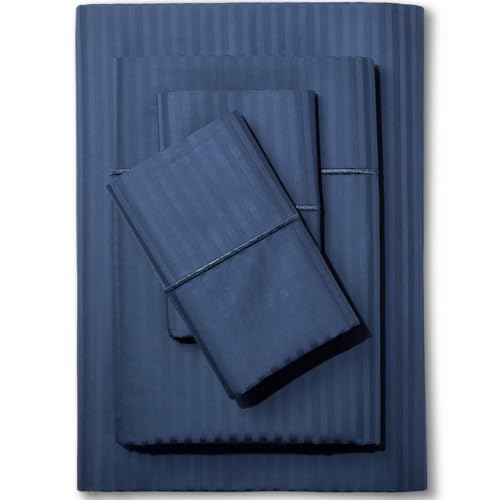
Feather & Stitch 500 TC Cotton Sateen Sheets King — Best All-Around Elastic
Five hundred is the count where honest weaving and marketing begin to blur, and Feather & Stitch’s set sits at that boundary with its construction in order: one hundred percent cotton sateen, eighteen-inch deep pockets and, the detail this guide wishes every maker copied, elastic that runs all the way around the fitted sheet rather than gathering only at the corners. Anyone who has remade a king bed at midnight because a corner popped will understand why that single line earns this set its badge.
All-around elastic changes the nightly physics. The fitted sheet tensions evenly, resists the diagonal pull of a restless sleeper and stays seated when the mattress is lifted for turning. Combined with the deep pocket, it makes this the set most likely to fit the widest range of real king beds, including the pillow-top-plus-topper stacks that defeat lesser elastic in a week.
The cloth itself is a smooth sateen in a dark blue stripe, a damask-style woven stripe that reads tailored rather than plain. Five hundred count in this construction should be understood as a dense, substantial sheet, with the warmth that density brings. Feather & Stitch positions the set around durability and easy care, and the full elastic plus generous pocket suggests a maker thinking about the second year of ownership, not just the first photograph. For fit security above all else, this is the guide’s recommendation.
- Fibre: 100 percent cotton, sateen weave
- Stated count: 500 thread count
- Pocket depth: 18 inches, all-around elastic
- Pieces: 4, dark blue stripe
- Pattern: woven damask stripe
Strengths
- Full-perimeter elastic keeps corners seated through restless nights.
- Deep pockets cover pillow tops and toppers together.
- Dense sateen offers a smooth, substantial, tailored hand.
Trade-offs
- Density sleeps warmer than the lighter 400 count set.
- Dark blue stripe limits palette flexibility in pale bedrooms.
- Four pieces only; second pillowcase pair bought separately.
Best for: restless sleepers and deep beds where corners keep escaping. Not suited for: buyers wanting a pale, minimal, all-white bed.

Ivellow Egyptian Cotton Sheets King 1200 TC — Best Six-Piece Grey Set
Ivellow’s set pairs the guide’s joint-highest headline count with its most practical piece count: six pieces, in grey, with eighteen-inch pockets. Apply the standing discount to the 1,200 figure, which reflects multi-ply counting as surely as any in this field, and judge the set on what remains: Egyptian cotton, a deep fitted sheet and enough pillowcases for the four-pillow arrangement that most king beds actually wear.
That piece count is a quiet budget saver. Four-piece sets look cheaper until the second pair of cases is bought separately, often at a worse price and occasionally in a dye lot that almost matches. A six-piece set in a single box removes both problems, and grey is the forgiving colour for it: slower to show wear, kinder to mixed laundry habits and compatible with nearly every duvet cover a household already owns.
The maker’s language leans on hotel quality and cooling, and the honest reading is that a dense Egyptian cotton sateen will feel smooth and substantial rather than airy; cooling claims for any dense sateen should be received politely. What the set genuinely offers is completeness and fit at the deep end of the market. Households furnishing a king bed from scratch, or replacing a whole worn set at once, will find the Ivellow the most administratively simple purchase in this guide.
- Fibre: 100 percent Egyptian cotton per the listing
- Stated count: 1,200 thread count, multi-ply counting assumed
- Pocket depth: 18 inches
- Pieces: 6, grey colourway
- Positioning: hotel quality, breathable claims
Strengths
- Six pieces cover four pillows without extra purchases.
- Deep pockets suit tall mattress and topper combinations.
- Grey hides wear and pairs with most existing bedding.
Trade-offs
- Headline count is ply arithmetic, not finer cloth.
- Dense sateen will not feel cool to warm sleepers.
- Less established label than the THREAD SPREAD name.
Best for: furnishing a king bed completely in one purchase. Not suited for: shoppers who rank brand heritage above piece count.

LANE LINEN Egyptian Cotton Sheets King — Best Silky Sateen Finish
LANE LINEN’s listing is a study in this category’s habits: the product name speaks of silky sateen and Egyptian cotton, while the set’s description carries a one thousand thread count that, by now, readers of this guide will translate automatically into multi-ply counting. What remains after translation is a white, four-piece Egyptian cotton set in a sateen weave with sixteen-inch deep pockets and a promised snug fit, aimed squarely at the master-suite look.
Sateen is the right weave for the promise being made. Its surface floats catch light and give the cloth the liquid first touch that shoppers describe as silky, and in white it delivers the crisp hotel photograph that sells this entire category. The snug-fit emphasis matters for standard-depth kings, where an over-deep fitted sheet wrinkles under the sleeper; sixteen inches over a fourteen-inch mattress is a tailored fit rather than a baggy one.
Weigh the trade-offs plainly. The same sateen surface that feels silky can show body oils and wear sooner at fold lines than a matte weave, and white doubles that visibility. Households that rotate two sets and wash gently will keep it glorious; households that wash hot and infrequently will watch it age faster than the plainer picks. As a finish-first choice for a primary bedroom that is cared for properly, though, the LANE LINEN set understands its assignment.
- Fibre: 100 percent Egyptian cotton per the listing
- Stated count: 1,000 thread count in the set description
- Weave: silky sateen
- Pocket depth: 16 inches, snug fit positioning
- Pieces: 4, white colourway
Strengths
- Sateen finish delivers the silky hand the category promises.
- Snug sixteen-inch fit suits standard-depth king mattresses.
- White master-suite look pairs with any duvet or throw.
Trade-offs
- Headline count is marketing arithmetic, as across this field.
- White sateen shows oils and wear sooner than matte weaves.
- Pockets may strain over thick separate toppers.
Best for: primary bedrooms chasing the hotel look on standard-depth beds. Not suited for: very deep mattresses or low-maintenance laundry habits.

Casa Platino King Sheet Set 500 TC Sateen — Best Six-Piece Value Shape
Casa Platino takes the sensible middle road of this entire guide: five hundred thread count cotton sateen, six pieces, dark grey, fifteen-inch pockets. Nothing in that specification is trying to dazzle, and that is its charm. The count sits at the boundary where a dense, smooth cloth is plausible without heroic ply claims, the piece count covers a fully dressed king bed, and the colour forgives the realities of family laundry.
The fifteen-inch pocket is the one figure to measure before buying. On a standard king mattress, even with a slim protector, fifteen inches is a clean fit with elastic doing honest work. Add a thick pillow top or a plush topper and the margin evaporates; those households should step to the eighteen-inch picks above. Fit is binary in bedding, and this set is best understood as the tailored option for the large population of kings that are not unusually deep.
As a second set, the household rotation set that lets the primary bedding rest between washes, the Casa Platino shape is hard to argue with: complete, smooth, dark and undemanding. Its sateen hand will feel buttery against the skin in the maker’s phrase, and more soberly, smooth and close-draping in the way of all decent sateen. Buyers furnishing a guest king, where the bed must look complete and feel kind without ceremony, should start here.
- Fibre: 100 percent cotton, sateen weave
- Stated count: 500 thread count
- Pocket depth: 15 inches
- Pieces: 6, dark grey colourway
- Positioning: everyday comfort, buttery hand
Strengths
- Six pieces dress a king bed completely in one box.
- Sensible count promises density without fantasy arithmetic.
- Dark grey forgives marks and suits guest rooms well.
Trade-offs
- Fifteen-inch pockets exclude deep pillow-top combinations.
- Sateen warmth applies here as across the whole guide.
- Finish is pleasant rather than luxurious beside the TWK.
Best for: standard-depth kings, guest beds and rotation sets. Not suited for: extra-deep mattresses wearing thick toppers.
How Do the Six Sets Compare Where It Counts?
| Set | Stated count | Pieces and colour | |
|---|---|---|---|
| TWK 1200 TC Egyptian Cotton Sheets King | 1,200, ply-counted | 18 in | Mineral, king set |
| THREAD SPREAD Egyptian Cotton Sheets King | 400, honest range | 16 in | 4 pieces, white |
| Feather & Stitch 500 TC Cotton Sateen Sheets King | 500 | 18 in, all-around elastic | 4 pieces, dark blue stripe |
| Ivellow Egyptian Cotton Sheets King 1200 TC | 1,200, ply-counted | 18 in | 6 pieces, grey |
| LANE LINEN Egyptian Cotton Sheets King | 1,000, ply-counted | 16 in | 4 pieces, white |
| Casa Platino King Sheet Set 500 TC Sateen | 500 | 15 in | 6 pieces, dark grey |
Sorted by the count, the table flatters the wrong sets. Sorted by what predicts satisfaction, fibre honesty, elastic design, pocket fit and piece count, the order reshuffles: the Feather & Stitch leads on construction, the TWK on named fibre, the THREAD SPREAD on candour, and the two six-piece sets on completeness. Read the table as a fit chart first and a luxury chart a distant second.
What Does Thread Count Actually Measure, and Where Does the Trick Enter?
The honest definition is simple: count every warp thread running lengthwise and every weft thread running across in one square inch, and add them together. With single-ply yarn spun from decent cotton, each thread has a physical thickness, and the loom runs out of space at roughly four to five hundred threads per inch of cloth. That ceiling is geometry, not opinion, and it has not moved in decades.
The trick enters through ply. Twist two or three fine strands into one working yarn and some sellers count each strand as a thread, doubling or tripling the figure while the cloth on the bed stays exactly as fine as it was. Nothing about the sheet improves when the counting changes; only the box does. Some markets have moved to restrict the practice in labelling, but online listings remain a frontier where the biggest number wins the click.
So the shopper’s rule is translation. Treat any count above six hundred as a claim about counting, not about cloth, and demote it below fibre, weave and construction in your decision. A count between three and five hundred from a maker who names the fibre and the weave is the most informative specification in this category, because it suggests the numbers were written by someone describing a sheet rather than selling a superlative.
Why Does Staple Length Predict a Better Sheet Than the Count Does?
Staple is the length of the individual cotton fibres before spinning. Short fibres make yarn the way short hairs make a rope: with countless ends poking out, each one a future pill, a roughness and a weak point. Long-staple fibres, the pride of Egyptian and Pima varieties, overlap across far greater distances, spinning into yarn that is smoother, stronger and markedly more resistant to the bobbling that makes a two-year-old sheet feel elderly.
The difference compounds across washes. Every cycle works loose ends free; short-staple cloth sheds them as lint and pills, thinning as it roughens, while long-staple cloth holds its surface. This is why a well-made long-staple set at an honest count can feel better in year three than a padded-count set felt in month three, and why this guide credits the TWK for naming its staple and treats unnamed cotton claims with polite reserve.
There is a softness paradox worth knowing. Some new sheets feel silky because of surface finishes that wash away within a month, revealing the true cloth beneath. Long-staple cotton shows the opposite curve: good on arrival, better after several washes as the fibres relax and the weave settles. Judge any set at the fifth wash rather than the first night, and buy the fibre that improves rather than the finish that evaporates.
How Should You Measure Your King Bed Before Choosing a Pocket Depth?
Measure the whole stack, not the mattress alone. Stand at the side of the bed and measure from the base of the mattress to its top with the protector and topper in place, exactly as the bed is slept on. That full height is the minimum pocket the fitted sheet needs, and adding an inch or two of margin lets the elastic seat under the mattress instead of gripping its edge like a hat in wind.
Then check the elastic’s design against the measurement. A deep pocket with corner-only elastic on a restless sleeper’s bed will still walk; a slightly shallower pocket with all-around elastic often holds better in practice. The Feather & Stitch set’s full-perimeter elastic is the benchmark in this guide for that reason. Households between sizes should size up in pocket and rely on elastic to take up the slack, since excess cloth tucks away while insufficient cloth simply leaves.
One more measurement catches people out: king is not one size everywhere. A standard king and a California king swap their length and width, and a fitted sheet cut for one will not forgive the other. Every set here is sold for the standard king brief; owners of the California variant must confirm dimensions on the listing before ordering, because no thread count, honest or otherwise, stretches a sheet by four inches.
How Do You Wash Dense Cotton Sateen Without Ruining Its Hand?
Warm water, a moderate detergent dose and a wash load that gives the big king sheets room to move: that is most of the craft. Overloading the drum is the commonest laundry error with king bedding, because a wadded sheet neither washes evenly nor rinses clean, and detergent residue left in dense sateen reads on the skin as a strange, coated roughness that owners misdiagnose as the cloth failing.
Skip fabric softener on these weaves. Softeners coat fibres to fake smoothness, and on a cloth whose smoothness is structural they only add a film that dulls the sheen, reduces absorbency and can trap odours across washes. If the hand needs help, a thorough rinse and line drying, or a low tumble finished slightly damp, will do more than any additive. Sateen also appreciates being shaken out before drying; its surface floats smooth out beautifully when they are not dried in a crease.
Wash sheets separately from towels and anything with zips or hooks. Towel loops abrade sateen’s floats, and hardware snags them, and the resulting pulls and pills get blamed on thread count by owners who never suspect the wash load. Cotton sateen is not fragile, but it rewards being treated as clothing rather than as rags, and the reward is measured in years of surface.
Which Mistakes Do High Thread Count Shoppers Make Most Often?
Paying for the number is the founding error: choosing the 1,200 over the 400 as if fineness tripled, when the fibre, weave and finishing may be identical or worse. The second error is ignoring fit until the first night, discovering that a beautiful sheet with a fifteen-inch pocket cannot stay on an eighteen-inch stack of mattress and topper, and concluding the brand is bad rather than the measurement skipped.
Third is the single-set household. One set, washed and replaced the same day forever, ages at double speed and leaves no margin for illness, guests or a laundry backlog. Two mid-priced sets rotated weekly will outlast and out-feel one flagship set run alone. Fourth is judging on the first night, when factory finishes flatter every cloth, instead of at the fifth wash when the sheet has become itself.
The final mistake is expecting thread count to fix temperature. Dense sateen sleeps warm because it drapes close and breathes less than a crisp weave, whatever number is printed on the band. Hot sleepers who love the sateen hand should choose the lighter sets here and lighter duvets above them; hot sleepers who do not should be shopping percale guides instead, where this entire category’s promises are politely irrelevant.
How Does Sateen Age Compared With the Hotel Sheets It Imitates?
Hotels choose sateen and high-count cotton for reasons beyond luxury: the cloth launders industrially, releases stains under aggressive washing and feels premium to a guest who will sleep on it twice. Home ownership is a longer relationship. Across a hundred home washes, sateen’s floats, the long surface threads that create its sheen, are its vulnerability, gradually dulling where bodies turn and where the fold lines fall.
Rotation is the hotel trick worth copying. Properties never run one set per bed; they run three or four in rotation, each resting between uses. A home that copies even a two-set rotation will watch both sets age at half the expected pace, because fibres recover elasticity and surface when they are not asked to perform nightly. The six-piece sets in this guide make rotation thinking easy by completing the bed in one purchase, ready to be joined by a second set when budget allows.
Expect, realistically, several good years from any pick here under gentle care, with the long-staple and established-label sets ageing most gracefully. When a sateen set finally dulls, it usually remains perfectly serviceable as the guest or spare set, which is the correct demotion path for bedding that was honestly made: down the hall, not into the bin.
How Can You Test a New Set Properly in Its First Month?
Wash it before the first night, always. Finishes and sizing from the factory flatter the hand and can irritate skin, and a set judged unwashed is being judged in fancy dress. Then sleep on it for a week before forming the verdict, because sateen’s character emerges as the weave relaxes: the first night is the stiffest the sheet will ever be, and the fifth wash is a fairer portrait than the first.
Inspect the fitted corners under daylight after the first fortnight. Corners that have crept, elastic that has slackened or hems that twist in the wash are early reports about construction that will only amplify. Photograph the surface against a window if you want an honest pilling record; memory flatters old bedding and slanders new, and a dated photograph settles arguments with yourself six months later about whether the cloth has changed.
What Should Guest-Room and Second-Home Buyers Prioritise?
Guests sleep on a set a handful of nights a year, so the economics invert: first-touch impression matters more than decade-long durability, and completeness matters most of all. A six-piece set that dresses the bed fully, in a forgiving colour, washed and ready without a scavenger hunt for matching cases, is the correct guest-room purchase. The Casa Platino and Ivellow sets fit that administrative brief precisely.
Second homes add the storage question. Bedding left folded for months in a closed house can take on a stale note that no thread count prevents; breathable storage, a wash on arrival and a spare set in rotation keep the bed welcoming. Dense sateen stores well and irons, if anyone still irons sheets, beautifully. For a house used six weekends a year, buy for the wash-and-remake cycle rather than for nightly endurance.
Why Do Two Sets From the Same Listing Sometimes Feel Different?
Natural fibre varies. Cotton is an agricultural product, and bolls from different harvests, gins and spinning runs produce yarn with subtly different character even under one label. Dye lots shift colour by a shade, finishing baths vary, and a set bought in spring may not be the identical twin of the same set bought in autumn. This is normal textile reality rather than evidence of a scam, and it is why households building a matched rotation should buy both sets in the same order when they can.
Construction tolerances play their part too. Elastic tension, hem widths and pocket cuts all have acceptable ranges, and two fitted sheets at opposite ends of a range will behave differently on the same mattress. If one set of a pair fits notably worse, that is a defect worth raising with the seller promptly, with the good set as your comparison evidence. Keeping the packaging until the first wash settles the fit question is a small, wise superstition.
How Do You Choose Between White, Grey and Coloured King Sets?
White is the hotel language: it signals cleanliness, tolerates hot washing and bleaching when life demands it, and coordinates with everything while showing absolutely everything. It suits households with confident laundry habits and beds that are made daily. Its ageing is honest, a gradual softening of brightness that regular rotation and occasional brightening washes manage well.
Greys and deeper colours are the pragmatists. They hide the minor marks of real life, forgive a mixed wash day and make a bed look dressed with less effort, which is why both six-piece sets in this guide wear them. Their cost is subtler: dark sateen shows lint and light pet hair, and deep dyes can fade unevenly at fold lines across years of washing. Choose by your household’s actual habits, the pets, the coffee in bed, the children’s feet, rather than by the showroom photograph.
What Does the Pillowcase Situation Say About a Set?
More than shoppers expect. King pillows are longer than standard, and a set whose cases are cut generously, with a deep envelope or a proper hemmed opening, keeps the pillow dressed instead of escaping nightly. Cases are also the highest-friction component of any set, taking face oils, hair products and nightly abrasion, so they age first; a set with four cases lets you rotate the wear across two pairs and doubles the dressed life of the whole purchase.
Read the listing’s piece list with a detective’s eye. Four-piece king sets carry two cases, six-piece sets here carry four, and any set that counts a decorative sham among its pieces should be valued accordingly. If your household sleeps with four pillows and the set carries two cases, the true price of the set includes the second pair bought separately, in a dye lot you will hope matches. Arithmetic again, but this time the honest kind.
When Is It Time to Replace a King Sheet Set?
Thinning is the honest signal: hold the flat sheet to the light and look for patches where the weave has worn translucent, usually where heels and hips work hardest. Pilling that survives a fabric shaver, elastic that no longer grips, and a fitted corner that tears at the seam complete the picture. A set retired at that point has given full value; a set replaced merely because a bigger number appeared in an advertisement has been wasted.
Demote before you discard. A faded but intact set serves the guest bed, then the air mattress, then the painting drop-cloth years, in the long afterlife of well-made cotton. The picks in this guide, bought for fibre and construction, are exactly the sets that earn that afterlife. The padded number on the band will be forgotten by then, which is the final proof of what mattered all along.
How Should Couples With Different Temperature Preferences Compromise?
The shared king bed often houses two climates. Sateen’s close drape pleases the partner who runs cold and can oppress the one who runs hot, and no thread count negotiates between them. The working compromises are structural: a lighter set from this guide, the 400 count above all, a duvet split into two singles in the Scandinavian manner, or a breathable top sheet arrangement that lets each sleeper regulate their own layer.
What not to do is buy the heaviest, densest set in the hope that luxury will convert the hot sleeper. It will not; it will produce a beautifully made bed that one partner kicks apart nightly, and the kicked-apart bed then gets blamed on the fitted sheet’s elastic. Choose the cloth for the warmer sleeper and add warmth on the cold side with a throw, because warmth can be added per person while coolness cannot.
What Role Does Ironing and Presentation Play in the Hotel Effect?
More than the thread count does. The hotel look that sells this category is mostly process: sheets laundered, pressed and changed by professionals, on a bed made with hospital corners by someone who makes forty beds a day. A home set of honest 400 count, washed well, dried smooth and put on the bed with care will photograph and feel closer to that ideal than a neglected four-figure set dragged from a crumpled drawer.
Few households will iron king sheets, and none should feel obliged. Shaking sateen out before drying, smoothing it by hand on the bed and folding the top sheet’s band down crisply achieves most of the visual effect for a fraction of the labour. Presentation is a habit, not a specification, and it is the cheapest luxury in this entire guide.
How Do You Read Reviews of Sheet Sets Without Being Misled?
Weight the reviews written after months, not the ones written on delivery day. Sheets are the product most flattered by first impressions and most honestly judged at the twentieth wash, so look for reviewers who mention pilling timelines, elastic survival and how the cloth changed. A review that says the set still fits and feels smooth after a year is worth fifty that praise the packaging.
Discount the thread-count arguments in both directions. Reviewers who worship the number and reviewers who despise it are both reviewing an idea; the useful reports describe fibre feel, warmth, fit on a stated mattress depth and laundry behaviour. Translate every review into those terms before letting it move your decision, and the signal rises out of the noise remarkably fast.
How Do You Spot a Multi-Ply Count From the Listing Alone?
Look for the company the number keeps. A count in the high hundreds or beyond, paired with vague fibre language and a suspiciously gentle price, is ply arithmetic almost every time, because genuine fineness costs money at the mill before it costs anything at retail. Listings that name long-staple fibre, specify the weave and keep the count in the honest band are describing a supply chain; listings that lead with a four-figure number and follow with adjectives are describing a spreadsheet.
Weight is the second witness. A truly dense, fine cloth is heavy in the hand, and king sheets of substance arrive as a substantial parcel. A set claiming a huge count that feels light and papery on arrival is telling you, physically, what its counting method was. Trust the parcel over the packaging: your hands are measuring the cloth, while the band was measuring the marketing department’s ambitions.
What Should Couples Setting Up a First King Bed Budget Beyond the Sheets?
The sheet set is the visible purchase and rarely the whole one. A protector that fits the same depth, pillowcases in the right king length for the pillows actually owned, and a second set for rotation together cost roughly what the first set did, and skipping them is how a beautiful bed becomes a weekly laundry emergency. Budget the system, not the item, and the bed will behave like the calm centrepiece it was bought to be.
Measure the mattress before any of it, because the king in the showroom and the king delivered may differ in depth by the height of a pillow top nobody mentioned. Every figure in this guide, pocket, pieces, fit, depends on that one measurement, and it costs ninety seconds with a tape measure at the bedside. Do it before the first order, not after the first return.
How Should You Handle a Set That Arrives Feeling Nothing Like Its Description?
Wash it once before judging, since factory finishes can make a good cloth feel coated and a poor one feel silky, and the first wash is the sheet’s honest introduction. Then judge it against the specifications you can verify yourself: pocket depth against your mattress, piece count against the listing, fibre feel against the category. A set that fails a measurable promise is a return with evidence; a set that merely feels different from an imagined luxury is a lesson in reading listings, and this guide exists to make the second experience rarer.
Keep the packaging until that first wash and fit check are done, and photograph the band and labels as they arrived. In a category where numbers are elastic, your own documentation is the firmest ground in any conversation with a seller, and it costs nothing but a minute of foresight.
What Is the Environmental Ledger of a King Sheet Set?
Longevity is the greenest specification in this guide. A cotton set that serves six years, then demotes to the guest bed and the painting years, spreads its growing, weaving and shipping across thousands of nights, while a flimsy set replaced annually multiplies every one of those costs. Buying fibre that lasts is therefore not merely a comfort decision; it is the single most effective environmental choice available in this aisle, ahead of any label or certification printed on the band.
Laundry writes the second line of the ledger. Warm rather than hot water, full loads rather than half, and line drying when the season allows all shrink the running footprint of any set here, and they happen to be the same habits that preserve sateen’s hand and elastic. Virtue and self-interest, unusually, point down the same path: care for the sheet gently and it will cost the household, and everything else, less.
Final Recommendation
Buy the fibre and the fit, and let the number entertain you. The Feather & Stitch 500 TC Cotton Sateen Sheets King is this guide’s construction pick, on the strength of its all-around elastic and deep pockets. The TWK 1200 TC Egyptian Cotton Sheets King suits buyers who want named long-staple fibre and a substantial hand, while the THREAD SPREAD Egyptian Cotton Sheets King remains the connoisseur’s choice precisely because its number is the smallest in the guide.
Measure the bed before you measure the marketing, wash gently, rotate if you can, and judge the set at its fifth wash rather than its first night. A king bed dressed with that much sense will feel expensive every single night, whatever figure was printed on the band, and that feeling, not the figure, was the thing you were actually shopping for.
Frequently Asked Questions
Is 1,200 thread count really better than 400?
Not in the way the numbers suggest. Counts that high are reached by counting multi-ply strands individually, so the cloth is rarely finer than a well-made 400 to 500 count sheet. Judge the fibre, especially staple length, the weave and the construction instead; those predict how the sheet feels in year two, which the count cannot.
What thread count should I actually aim for in cotton?
The honest sweet spot for single-ply cotton sits roughly between three hundred and five hundred, where fineness, durability and breathability balance. Below that range cloth can feel coarse unless the fibre is excellent; above it, you are mostly reading marketing. Every pick in this guide sits in or near that honest band once ply counting is translated.
Why do my high-count sheets feel warm at night?
Density and drape. Sateen weaves at higher counts produce a heavier cloth that sits close to the body and passes less air than a crisp percale. Lighter sets, lighter duvets and a cooler room restore the balance. The number is not malfunctioning; it is describing a winter-weight hand that summer sleepers should choose knowingly.
How deep are the pockets on a typical king mattress?
Standard kings run roughly ten to fourteen inches deep before toppers; pillow tops and plush toppers push the stack toward sixteen or eighteen. Measure your own stack with everything on it, then choose pockets with an inch or two to spare. The fifteen to eighteen inch range across these picks covers nearly every real bed once measured honestly.
Do six-piece sets include anything besides extra pillowcases?
In this guide, the extra pieces are additional pillowcases, which is exactly what four-pillow king beds need. Always read the listing’s piece breakdown before ordering, since some makers count shams or a second flat sheet instead. The Ivellow and Casa Platino sets here were chosen because their six pieces solve the common pillowcase shortage directly.
Will Egyptian cotton shrink, and should I size up?
Cotton relaxes and can shrink slightly in its first hot washes, which is why makers cut fitted sheets with margin and why warm rather than hot washing is advised. Buy your true size, wash as directed, and the set should settle into its intended fit. Sizing up creates a loose sheet that wrinkles under the sleeper, a worse fault than snugness.
Related Guides
Bedding questions tend to travel together, so three companion guides may help: Best Jersey Sheet Sets No Pilling covers the stretchy, t-shirt-soft alternative to sateen, Best Air Fryers with Stainless Steel Basket leaves the bedroom for the kitchen’s hardest-working appliance, and Best Area Rugs 9 x 12 finishes the room from the floor up.



[…] neighbouring guides extend the clean-air and clean-home theme: Best High Thread Count King Sheet Sets is for the bedroom the purifier guards, Best Glass Blenders for Smoothies covers a kitchen machine […]