What's inside
- Key Takeaways
- Quick Picks
- How Did We Compare These Airplane Blanket and Pillow Sets?
- Comparison Table
- What Should You Prioritise in Airplane Blankets and Pillows?
- How Do You Use a Travel Set Well From Door to Door?
- Which Travel Blanket Mistakes Should Flyers Avoid?
- How Do Travel Sets Serve Beyond the Flight Itself?
- How Do Travel Sets Change When Children Join the Flight?
- What Does a Business Traveller Need From a Cabin Set?
- How Does a Travel Set Age, and When Should It Be Replaced?
- Why Is a Travel Set Such an Unusually Safe Gift?
- How Should Colour and Visibility Influence a Cabin Set?
- How Can You Test a Travel Set at Home Before Its First Flight?
- What Etiquette Governs a Blanket in a Shared Cabin Row?
- Final Recommendation
- Frequently Asked Questions
- Related Guides
As an Amazon Associate I earn from qualifying purchases. This post may contain affiliate links at no extra cost to you.
cottageverdict.com is reader-supported. When you buy through links on our site, we may earn an affiliate commission.
Where to buy: the linked names open Amazon in a new look at each set, where prices are displayed together with the facts that decide a purchase: how large the blanket opens, how small the set packs, and precisely which accessories are riding inside. The last entry travels without a link, since it covers a basic blanket style that shops everywhere carry; styles get weighed on their shared merits, not on one seller’s page.
The best airplane blankets and pillows solve a problem created by two modern facts: cabins are cold at altitude, and the blanket an airline hands you, if it hands you one at all, has an unknown biography. Airplane blankets and pillows that you own arrive clean, smell like your own laundry, and pack into shapes designed by people who have actually carried a bag through an airport. The sets in this guide divide into two philosophies. Some bundle a separate neck pillow with a blanket and small comforts. Others perform a neater trick, folding the blanket into a soft bag that becomes the pillow, so one object does both jobs and clips to your luggage between flights.
Packability is the first virtue, because cabin baggage is a zero-sum game measured in centimetres. A travel blanket that unfolds to genuine coverage, forty-three by sixty inches in one case here, yet compresses into a bag with a luggage sleeve, earns its place in a way a merely soft blanket cannot. The second virtue is the pillow itself, since a traveller’s neck keeps the score of every flight for days afterward. Foam density, shape and whether the pillow exists independently or only when the bag is stuffed all separate these five linked sets from one another.
Hygiene and habit form the quiet third argument. Your own blanket can be washed after every trip, carried onto trains and into airport chairs at midnight, and lent to a cold child without a second thought. It also travels beyond the flight: the same set that civilises a red-eye becomes the car blanket, the festival layer and the guest-room spare. Judge these sets as travel equipment you will own for years, not as single-flight purchases, and their differences become worth reading about carefully.
Key Takeaways
- Two designs dominate: separate neck pillow kits, and blankets that fold into their own pillow bag.
- urnexttour bundles the most accessories, including an eye mask and earplugs, around a foam pillow.
- EverSnug and the Compact 2 in 1 both use the bag-as-pillowcase trick with luggage sleeves.
- KAWAHOME adds a phone pocket and an integrated storage approach for long-haul organisation.
- Proglobe pairs a memory foam pillow with a fleece blanket for travellers who prioritise neck support.
- Wash your own set after each trip; that simple habit is the core hygiene argument.
Quick Picks
| Pick | Badge | The case for it |
|---|---|---|
| urnexttour Travel Pillow and Blanket Set | Best Complete Kit | Foam neck pillow, full blanket, eye mask and earplugs in one pink package. |
| Travel Blanket and Pillow Compact 2 in 1 | Best Bag-to-Pillow Design | The soft bag becomes the pillowcase, with a luggage sleeve and backpack clip. |
| EverSnug Travel Blanket and Pillow | Best Established 2 in 1 | A proven fold-away blanket and pillow combination in light pink. |
| KAWAHOME Travel Blanket Set with Neck Pillow | Best Long-Haul Organisation | Neck pillow, eye mask and a phone pocket inside an integrated storage bag. |
| Proglobe Neck Pillow and Travel Blanket Set | Best Memory Foam Focus | A memory foam pillow leads, with a fleece blanket and sleep accessories following. |
| Simple Woven Airline-Style Travel Blanket | Best Pillow-Free Option | A budget-tier blanket alone for travellers who already own a pillow they love. |
How Did We Compare These Airplane Blanket and Pillow Sets?
We judged each set as a system rather than as a blanket with extras. The questions were sequential. How small does it pack, and how does it attach to the rest of your luggage? How large is the blanket when the cabin reaches its coldest at three in the morning over an ocean? What exactly supports your head, a dedicated pillow with real foam, or a bag whose softness depends on how the blanket was folded? And what small mercies, masks, earplugs, pockets, clips, separate the merely adequate from the genuinely considered?
Blanket dimensions were read with a traveller’s scepticism. A plane blanket must cover a seated adult diagonally, shoulders to knees in a reclined seat, without requiring the wearer to choose which limb to sacrifice. Sets stating their unfolded size plainly, as the urnexttour does at forty-three by sixty, earned trust. Sets vaguer about dimensions were judged on their packed format and design instead, and their reviews note where a traveller is buying a promise rather than a measurement.
Pillow philosophy split the field honestly. A dedicated foam neck pillow supports a sleeping head in a way no stuffed bag fully matches, and travellers who sleep seriously on long-haul flights should weight that heavily. The bag-pillow designs answer with elegance: one object, no separate pillow to forget in a seat pocket, and a softness the user controls by folding. Neither philosophy is wrong. They serve different travellers, and the reviews below keep asking which traveller you are.
Finally, we considered the set’s life between flights. A travel blanket that only travels is a poor use of a drawer. These sets variously become car blankets, office layers for aggressive air conditioning, festival seating and the spare produced when a guest underestimates a house’s night temperature. Versatility after landing is part of value, and the sets that fold, clip and wash easily tend to live the longest second lives.
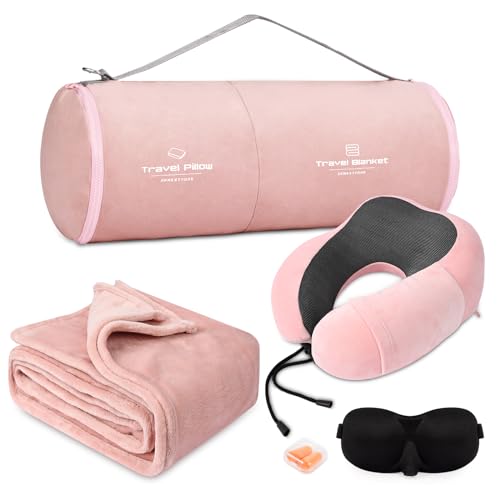
urnexttour Travel Pillow and Blanket Set — Best Complete Kit
The urnexttour set is the maximalist entry: a foam neck pillow, a blanket stated at forty-three by sixty inches, a storage bag, an eye mask and earplugs, gathered in a pink finish that is easy to spot in an overhead bin. For a traveller building a cabin kit from nothing, this single purchase closes the subject. The blanket’s dimensions are the headline, since genuine shoulder-to-knee coverage in an economy seat transforms the cold hours of a long flight from an endurance event into something resembling rest.
The separate foam pillow is the set’s other serious argument. Unlike bag-pillow designs, it supports the neck with shaped foam whether or not the blanket is deployed, which matters on the flights where you want the pillow for a doze but not the blanket’s warmth. The mask and earplugs, small as they are, complete a sensory kit that addresses the cabin’s three insults, cold, light and noise, in one bag. Travellers who have assembled such a kit piecemeal over years will recognise the convenience of buying it coherent.
Maximalism has a packing cost. A separate pillow plus a full-size blanket occupies more cabin-bag volume than any 2-in-1 rival here, and the pink finish, while findable, will not suit every traveller’s taste. Ultralight packers and one-bag devotees should look at the EverSnug or the Compact design instead. For everyone else, especially long-haul travellers in economy who feel the cold and value sleep, this is the most complete single answer in the guide.
- Blanket size: forty-three by sixty inches per listing
- Pillow: separate foam neck pillow
- Extras: storage bag, eye mask and earplugs
- Colourway: pink in the version reviewed
- Role: complete long-haul cabin kit
Strengths
- Largest stated blanket coverage in this guide
- Dedicated foam pillow works independently of the blanket
- Mask and earplugs complete the sleep kit in one purchase
Trade-offs
- Bulkiest packing footprint among the linked sets
- Single bright colourway limits taste matching
- More components means more items to keep track of
Best for: long-haul economy travellers assembling a full comfort kit at once.
Not suited for: one-bag ultralight packers counting every litre.

Travel Blanket and Pillow Compact 2 in 1 — Best Bag-to-Pillow Design
This compact set performs the category’s neatest trick with unusual completeness. The blanket folds into its own soft bag; the bag then serves as a pillowcase, giving you a pillow whose firmness you set by how you fold. A hand luggage sleeve slides the whole unit over a suitcase handle for the airport transit, and a backpack clip covers the journeys where the suitcase stays home. In checkered black, it also wins the discretion prize: nothing about it announces nap time to a departure lounge.
The design’s intelligence is logistical. There is no separate pillow to abandon in a seat pocket, no loose blanket to drag through security, and the transition from walking to sitting to sleeping happens with one object changing shape. For short and medium flights, where a full foam pillow’s support matters less than convenience, this is arguably the correct engineering answer, and frequent short-haul travellers will feel the design was drawn by someone who shares their route map.
The compromise lives in the pillow itself. A stuffed bag, however cleverly folded, gives a softer, less shaped support than dedicated foam, and side-sleepers who lean hard into a pillow may find it yielding where they want resistance. The blanket, once it becomes the pillow, is also no longer a blanket, so on the coldest flights you choose between covering and cushioning unless you carry a layer to stuff the bag with instead. Know that trade, and the design’s elegance survives it.
- Design: blanket folds into bag that serves as pillowcase
- Carry: hand luggage sleeve plus backpack clip
- Colourway: checkered black in the version reviewed
- Extras: pillow function built into the storage bag
- Role: short and medium flights, minimalist packing
Strengths
- One object covers blanket, pillow and carrying case
- Luggage sleeve makes airport transit effortless
- Discreet finish suits business and leisure travel alike
Trade-offs
- Stuffed-bag pillow lacks shaped foam support
- Blanket and pillow cannot both be deployed fully
- Firmness depends on the user’s folding patience
Best for: frequent short-haul travellers who pack light and move fast.
Not suited for: dedicated side-sleepers needing firm neck support.

EverSnug Travel Blanket and Pillow — Best Established 2 in 1
EverSnug is the name many travellers meet first in this category, and its design explains the incumbency. A premium-feel blanket folds into a soft bag that doubles as a pillowcase, a hand luggage sleeve handles the airport, and a backpack clip handles everything else. The light pink finish reviewed here is the brand’s recognisable signature, though the design’s appeal is mechanical rather than chromatic: it is the 2-in-1 idea executed by a company that has refined it across enormous numbers of flights.
Compared with the checkered Compact set above, the EverSnug leans a little more toward blanket quality and brand assurance, and a little less toward stealth styling. The blanket’s hand is the selling point in person, a softness that makes the bag-pillow feel less like a compromise when the blanket is folded inside it. For travellers buying a gift for a nervous or first-time flyer, that combination of proven design and pleasant materials carries a reassurance that newer labels have to argue for.
The shared 2-in-1 limitations apply unchanged: the pillow is a stuffed bag, supportive in proportion to your folding, and deploying the pillow fully means the blanket is inside it. The light pink colourway, while charming, shows travel’s evidence sooner than the checkered black rival and will ask for washing after trips a darker set might postpone. None of this dethrones the design. It simply defines the buyer: someone who values a proven, pleasant blanket system over maximal neck support or minimal visibility.
- Design: blanket and pillow in one fold-away system
- Carry: hand luggage sleeve plus backpack clip
- Colourway: light pink in the version reviewed
- Extras: soft bag doubles as the pillowcase
- Role: dependable all-round travel set
Strengths
- Established design with a long track record
- Blanket softness elevates the bag-pillow experience
- Complete carry system for suitcases and backpacks
Trade-offs
- Pale colour shows travel marks quickly
- Pillow support depends on folding, not foam
- Blanket and pillow share one body of fabric
Best for: gift buyers and travellers who trust proven designs.
Not suited for: travellers who need a dark, mark-hiding finish.

KAWAHOME Travel Blanket Set with Neck Pillow — Best Long-Haul Organisation
KAWAHOME’s set thinks like a long-haul passenger who has been hurt before. Alongside the blanket and a neck pillow, the integrated storage bag includes a phone pocket, a small feature that reveals a designer who understands the modern seat pocket’s chaos: phone, passport, earbuds and a boarding pass all migrating toward the floor at the first turbulence. An eye mask joins the kit, and the whole assembly packs into its own bag rather than dispersing across your luggage like a spilled drawer.
The black finish is the other deliberate choice. Long-haul travel soils light fabrics with a thoroughness that surprises first-time buyers of pink sets, and black simply declines to report most of it between washes. For travellers chaining several flights, or mixing flights with trains and night buses, that discretion keeps the set looking respectable across a whole itinerary. The neck pillow, being a separate component, also supports a proper doze in an airport chair during a layover, when the blanket may be doing duty as a seat layer instead.
Organisation has a weight, literal and figurative. This is not the smallest pack in the guide, and travellers on strict personal-item dimensions should check the packed size against their airline’s limits before assuming it rides free. The feature list also means more pieces to inventory at each boarding call. For the long-haul organiser, those are acceptable taxes. For the short-hop minimalist, the Compact 2 in 1 above remains the leaner answer, and this guide is content to let route length arbitrate between them.
- Design: blanket, neck pillow and integrated storage bag
- Extras: eye mask and a dedicated phone pocket
- Colourway: black in the version reviewed
- Carry: packable set for multi-leg itineraries
- Role: long-haul and multi-modal travel organisation
Strengths
- Phone pocket solves a real seat-side storage problem
- Black finish hides multi-leg travel wear
- Separate pillow supports layover dozing anywhere
Trade-offs
- Packed size needs checking against strict cabin limits
- More components to track at every boarding call
- Heavier system than minimalist 2-in-1 rivals
Best for: long-haul travellers and multi-leg itineraries.
Not suited for: strict personal-item-only flyers.

Proglobe Neck Pillow and Travel Blanket Set — Best Memory Foam Focus
Proglobe leads with the pillow and lets the blanket follow, a priority order that suits a particular traveller precisely: the one who arrives with a stiff neck and remembers it for two days. The memory foam neck pillow is the set’s reason to exist, moulding to the head’s weight and holding a sleeping posture that stuffed bags cannot imitate. A deluxe soft fleece blanket covers the warmth side of the contract, and an eye mask with earplugs rounds out the sleep kit for car as well as cabin use.
The set’s framing for both airplane and car travel is honest, because a good foam pillow is vehicle-agnostic. It serves the passenger seat on a long drive, the train’s window lean, and the economy seat’s upright doze with the same moulded support. Travellers whose journeys mix modes, or whose neck has strong opinions, will get more total value from this set than from a design optimised for one aircraft seat. The blanket, while not the largest here, is sized for seated coverage, which is the coverage that matters in any vehicle.
Memory foam brings its own logistics. It compresses for packing but prefers not to live compressed forever, so the pillow should be stored out of its tightest roll between trips. The set also lacks the elegant single-object trick of the 2-in-1 designs; pillow and blanket are separate citizens, each capable of being left somewhere. Travellers who accept those terms gain the best head support in this guide, and for the neck-first buyer that exchange is not a compromise at all but the entire point.
- Pillow: memory foam neck pillow as the centrepiece
- Blanket: deluxe soft fleece, seated coverage
- Extras: eye mask and earplugs included
- Use span: airplane, car and train travel
- Role: neck-support-first comfort kit
Strengths
- Memory foam gives the most serious neck support here
- Set works across planes, cars and trains equally
- Sleep accessories complete the kit without extras
Trade-offs
- Separate pieces can be left behind individually
- Foam prefers uncompressed storage between trips
- Blanket coverage is seated-scale, not the largest
Best for: travellers whose neck judges every journey afterward.
Not suited for: minimalists wanting one self-contained object.
Simple Woven Airline-Style Travel Blanket — Best Pillow-Free Option
Some travellers already own a neck pillow they would not trade for anything in this guide, and for them every bundled pillow is dead weight. The simple woven travel blanket, sold at a budget tier by countless labels in the style airlines themselves use, answers that traveller directly. No brand owns this style, so the entry below treats it in general terms: a light woven blanket, modest in size, indifferent to rough washing, and cheap enough to live permanently in a car boot or a work bag without ceremony.
Its virtues are the virtues of simplicity. It folds to almost nothing, layers over any other warmth, and can be sacrificed to a delayed night on an airport floor without a pang. Travellers who run warm, fly short sectors, or simply want a personal layer between themselves and a seat of unknown history will find it entirely sufficient, especially paired with their own trusted pillow and a downloaded film’s worth of patience.
The limits are equally plain. Woven airline-style blankets are thin, sized for laps rather than shoulders, and offer no pillow, mask or pocket of any kind. They are a component, not a kit. Buy one as the blanket half of a system you already own, or as the expendable spare in a family travel bag, and it performs with honour. Buy one expecting the urnexttour’s completeness and the disappointment will be total, immediate and entirely predictable from this paragraph.
- Form: single woven blanket, no pillow included
- Tier: budget positioning across most sellers
- Feel: light and thin, a layer rather than a cocoon
- Care: machine washable without ceremony
- Role: blanket component for pillow owners
Strengths
- Packs to almost nothing in any bag
- Cheap enough to dedicate to cars and work bags
- Pairs with a traveller’s existing favourite pillow
Trade-offs
- Thin coverage suits laps more than shoulders
- No accessories of any kind included
- Comfort ceiling is low on genuinely cold flights
Best for: pillow owners and warm-running short-haul travellers.
Not suited for: anyone expecting a complete sleep kit.
Comparison Table
| Pick | Pillow type | Carry method | Defining trait |
|---|---|---|---|
| urnexttour Travel Pillow and Blanket Set | Separate foam pillow | Storage bag | Most complete kit, largest blanket |
| Travel Blanket and Pillow Compact 2 in 1 | Stuffed bag pillowcase | Luggage sleeve and clip | Neatest single-object design |
| EverSnug Travel Blanket and Pillow | Stuffed bag pillowcase | Luggage sleeve and clip | Proven brand execution |
| KAWAHOME Travel Blanket Set with Neck Pillow | Separate neck pillow | Integrated storage bag | Phone pocket organisation |
| Proglobe Neck Pillow and Travel Blanket Set | Memory foam pillow | Compact travel combo | Neck support leads |
| Simple Woven Airline-Style Travel Blanket | None | Folds flat anywhere | Budget blanket component |
What Should You Prioritise in Airplane Blankets and Pillows?
Begin with your flight profile, because it decides almost everything. Count your typical sectors in a year and their lengths. A traveller flying two long-haul returns annually needs sleep engineering: real pillow support, full blanket coverage, a mask. A traveller flying monthly short hops needs speed and packability, where the 2-in-1 designs shine. Buying for the flights you actually take, rather than the expedition you fantasise about, is the difference between a set that lives in your bag and one that lives in a cupboard.
Packed size comes next, measured against your real bag. Personal-item dimensions on budget airlines are unforgiving, and a set that technically fits but consumes the bag’s entire soft allowance will be resented by the third trip. Luggage sleeves and clips matter more than they appear to, because they move the set outside the bag’s volume entirely during transit, riding on the suitcase handle through the airport and only entering the cabin as a carried comfort item.
Then judge the blanket as a blanket. Unfolded dimensions, fabric hand and edge finishing decide whether the cold hours at altitude feel managed or merely survived. A soft, adequately sized blanket also earns its keep in the terminal, across knees in an air-conditioned departure lounge, where more travel discomfort accumulates than airlines like to admit. The sets that treat the blanket as a serious textile, rather than as the pillow’s packing material, repay their price on every trip.
Finally, inventory the small things with a cold eye. An eye mask is worth having; earplugs are worth having; a phone pocket is worth having if your seat organisation genuinely fails you. What is not worth having is a bundle of accessories you will leave at home, adding imaginary value to a listing. The best set for you is the one whose every component you can picture using on your next actual flight, and the reviews above are written to make that picture easy to test.
How Do You Use a Travel Set Well From Door to Door?
The set’s work begins before the airport. Pack it last, on top or clipped outside, because the first place you will want it is the terminal, not the aircraft. During the journey to the airport it serves in cars and trains; during a delay it becomes the difference between a miserable plastic chair and a tolerable one. Travellers who treat the set as journey equipment rather than flight equipment extract twice the value from the same purchase, and they arrive at the gate already glad they own it.
On board, deploy in stages. The pillow earns its place from takeoff, since even an awake head appreciates support during a long climb and a film. The blanket’s moment usually arrives after the meal service, when the cabin cools and the lights fall; having it already at your seat, rather than in the overhead bin, is the entire point of the luggage-sleeve carry. Keep the mask and earplugs in the set’s own pocket so the sleep kit assembles in the dark without a search through three bags.
Hygiene is a rhythm rather than an event. Your set should be washed after each trip, or at minimum after each long-haul, and dried fully before being packed away, because a blanket stored damp in a bag will announce itself on the next journey. That rhythm is precisely the advantage over airline-issue blankets: you know this textile’s entire biography, because you wrote it. A small laundry habit, maintained without exception, keeps the set’s promise fresh for years.
Between trips, give the set a life. The blanket that only flies will be forgotten, borrowed permanently by a car, or discovered stiff and strange before a holiday. The blanket that serves as the office layer, the guest spare and the festival seat stays familiar, washed and ready, and packing it becomes a reflex rather than a project. Equipment that lives in your ordinary week travels better, because you already know everything about how it behaves.
Which Travel Blanket Mistakes Should Flyers Avoid?
Trusting the airline to provide is the classic error, and it fails in both directions: some carriers provide nothing on sectors where the cabin turns genuinely cold, and others provide a blanket whose cleanliness you cannot verify. Even a traveller who accepts airline blankets happily should note that availability varies by route, class and the day’s logistics. Your own set removes the variable entirely, which is worth more than the blanket itself on the one flight where it matters.
Buying pillow support by photograph is the second trap. A stuffed-bag pillow and a memory foam pillow can look identical in a listing’s hero image while behaving like different species at thirty thousand feet. Read for the pillow’s actual construction, as this guide’s reviews insist, and match it to how you sleep: upright dozer, window leaner, or tray-table folder. Each posture has a correct answer, and none of them is visible in a photograph.
Ignoring packed dimensions completes the trio of common errors. A set that delights at home and then fails a personal-item sizer has not been bought; it has been borrowed from your future checked-baggage fees. Check the packed measurements against your most restrictive regular airline, not your most generous one, and let that unforgiving number arbitrate between the maximal kit and the compact design.
A subtler mistake is forgetting the set’s components in the seat. Separate pillows, masks and small accessories evaporate into seat pockets and footwells during the drowsy archaeology of arrival. The integrated designs in this guide exist partly as a cure: fewer pieces, one bag, a mental checklist of one. Travellers who choose component kits should build the counter-habit of a seat sweep before standing, every flight, without exception, because the best pillow in this guide is worthless on a plane that has left without you.
How Do Travel Sets Serve Beyond the Flight Itself?
Night trains and long-distance buses reward the same equipment for the same reasons: cold air conditioning, dubious provided bedding, and hours that pass better asleep. The Proglobe’s car-and-plane framing generalises across every vehicle with a seat and a schedule, and many travellers find their set’s busiest season is a summer of festivals and family visits rather than any flying at all. A blanket with a pillow built in is, in the end, a portable nap, and portable naps are valuable everywhere wheels or wings are involved.
Hospitals and long appointments form an unexpected chapter. A familiar blanket and pillow set brought to a day procedure, a long infusion or a partner’s bedside vigil carries home into a clinical room in a way that measurably steadies the person under it. Families who own a good set discover this use without being told, usually during the first long wait, and afterward the set lives nearer the front door. Comfort equipment earns its name in such rooms far more than at altitude.
Guests close the argument. The household travel set, washed and folded, is the spare bedding produced when a visitor underestimates a spare room’s temperature, and its pillow has rescued more sofa sleepers than any purchase made for that purpose. A set that flies four times a year and serves guests twelve times has not been overbought; it has been correctly bought, and its cost divides across so many small rescues that the original flight almost becomes the excuse rather than the reason.
How Do Travel Sets Change When Children Join the Flight?
A child in a cabin seat converts a personal comfort kit into a family utility, usually within the first hour. The blanket becomes the child’s nest, the spill catcher, the makeshift curtain for a nap, and the layer that makes an unfamiliar seat smell like the sofa at home. Parents quickly learn to pack one set per adult plus a shared spare, because a blanket monopolised by a sleeping four-year-old is a blanket nobody else is using, whatever the original plan said. The 2-in-1 designs earn special favour here, since their pillow can entertain a child as a cushion long before it supports anyone’s neck.
Familiarity does for children what hygiene does for adults. A blanket that has travelled before, and that lives at home between trips on the child’s own bed or chair, tells a small traveller that this strange metal room is an extension of their world rather than a departure from it. Nervous flyers of any age benefit, but children show the effect most plainly: the known textile comes out, the shoulders drop, and the flight becomes an occasion rather than an ordeal. That alone justifies dedicating one bright, findable set, the urnexttour’s pink being the obvious candidate, to the family’s youngest passenger.
Practicalities multiply, of course. Children’s sets need washing after every single flight without exception, should be cheap enough to survive being left in a terminal without a family crisis, and benefit from living in the child’s own backpack so responsibility and comfort travel together. The simple woven blanket type, dismissed earlier as a mere component, becomes a hero in this context: a child’s spare layer that can be sacrificed to juice, altitude sickness or a holiday’s mud without a single adult tear being shed.
What Does a Business Traveller Need From a Cabin Set?
The business traveller’s constraints are social as much as physical. The set must disappear into a bag that also holds a laptop and a change of shirt, emerge without making its owner look like they are moving house, and perform on a red-eye before a morning meeting where the traveller’s face will be audited. The checkered Compact 2 in 1 was practically designed in this meeting’s waiting room: discreet, single-object, quick to deploy and quicker to repack during the drowsy choreography of arrival.
Sleep quality carries a professional price on such trips. Arriving two hours of real sleep richer can be the difference between a negotiation conducted and a negotiation survived, which moves pillow support from comfort to equipment. Business travellers with sensitive necks often accept the Proglobe’s separate foam pillow as a professional tool and defend its bag space accordingly, while those who sleep easily upright take the bag-pillow’s elegance and spend the saved space on shoes. Both are rational; the diary decides.
Appearance after landing matters too. A blanket that sheds fibres onto a dark suit will be left behind by the second trip, and a set that wrinkles its owner’s clothes in the bag fails a test no listing mentions. Dense, smooth fabrics that shake out cleanly, dark finishes that hide the cabin’s evidence, and bags that keep the set separate from clothing all serve the traveller who walks from gate to meeting. Judge a set by the arrival you need, and the correct choice usually identifies itself without further argument.
How Does a Travel Set Age, and When Should It Be Replaced?
The blanket half of a set ages like any good textile: gradually, visibly, and mostly at the edges. Fleece thins where it is folded, colours soften, and the bag’s zip or fastening usually complains before the blanket itself does. None of this is failure until the blanket stops performing its one essential trick, which is making a cold seat feel personally warm within a minute of unfolding. A set washed after every trip and stored dry will deliver that trick for years, and its gradual softening often makes it more beloved rather than less.
Pillows age on a different clock. Stuffed-bag designs age with their blanket and ask nothing separate. Foam pillows slowly lose their spring, taking longer to recover their shape after compression and offering a little less support each season. A memory foam pillow that stays dented after a night out of its bag is announcing its retirement, and replacing the pillow alone, while keeping a blanket you love, is a perfectly rational maintenance move that bundled marketing rarely mentions.
Replacement, when it comes, benefits from the traveller you have become rather than the one who bought the first set. Route maps change, bags shrink, necks develop opinions. The set that served a decade of long-haul may be succeeded by a compact design for a new life of short hops, and the veteran blanket retires to the car, where its service continues at a lower altitude. Equipment that has travelled honestly deserves that kind of pension, and a household that rotates its travel textiles this way rarely feels it has wasted money on any of them.
Why Is a Travel Set Such an Unusually Safe Gift?
Travellers are notoriously difficult to buy for, because their hobby punishes bulk and rewards precision, yet a blanket and pillow set threads that needle. It is personal without being intimate, useful without requiring the recipient to reorganise a bag around it, and sized by nobody’s body. The giver’s real decision is the recipient’s route map: the EverSnug for the holiday flyer who values a proven, pleasant design, the urnexttour for the long-haul relative who feels every cold cabin, the Compact in checkered black for the colleague whose travel is all business and brevity.
The gift also improves with a small act of honesty from the giver: ask about the pillow question before buying. A traveller who already owns a beloved neck pillow needs the blanket-only route or a set whose pillow will genuinely upgrade theirs, and discovering that preference in advance converts a good present into a perfect one. Where asking would spoil a surprise, the 2-in-1 designs are the safer gamble, since their pillow asks for no bag space of its own and offends no existing loyalties.
There is a final, underappreciated virtue: the gift gets used in the giver’s presence more often than most. Travel sets appear on shared journeys, family holidays and the drive home from the airport itself, quietly demonstrating their worth. Few presents offer that recurring proof of usefulness, and fewer still do it while making a cold relative warmer at thirty thousand feet.
How Should Colour and Visibility Influence a Cabin Set?
A travel set lives in two visual worlds. In the airport it should look like luggage, unremarkable and adult. In the cabin’s dim blue light it should be findable by touch and by half-open eyes, because the moment you most need the blanket is the moment you are least able to hunt for it. Bright finishes like the urnexttour’s pink solve the second world brilliantly and accept attention in the first. Dark finishes like KAWAHOME’s black and the Compact’s checkered pattern solve the first and rely on the bag’s known place to solve the second.
Visibility also protects against loss. A pale or vivid set left on a seat announces itself during the cabin sweep in a way a grey blanket folded into a grey seat never will, and cabin crew returning a forgotten item can only work with what they can see. Travellers who habitually leave things should weight this heavily; the best blanket is the one that comes home. A distinctive finish is therefore not a style indulgence but a small insurance policy, priced at zero and paying out at the exact moment of maximum drowsiness.
Between those poles, choose by temperament and itinerary. Multi-leg journeys through many hands favour dark and discreet. Family travel favours bright and findable. Solo long-haul favours whatever helps its owner sleep, since the cabin at three in the morning has no audience worth dressing for. The sets in this guide cover the whole spectrum deliberately, so that the colour decision can be made on honest grounds rather than by default.
How Can You Test a Travel Set at Home Before Its First Flight?
A travel set can be auditioned honestly without leaving the house, and the audition predicts the flight better than any listing photograph. Begin with the chair test: choose the least comfortable upright chair you own, sit in it at the hour you would normally be asleep, and attempt a forty-minute rest with the set deployed. The pillow’s support, the blanket’s coverage and the mask’s darkness will all file their reports under conditions close enough to economy to be useful, and any component that annoys you in a quiet room will enrage you over an ocean.
Next, run the packing rehearsal. Fold the blanket into its bag exactly as the design intends, time yourself kindly, then attach the set to your actual suitcase or backpack and walk around the house, up the stairs if you have them. A design that feels elegant in a product video and adversarial in your hallway is telling you the truth early, when returns are still possible. The 2-in-1 sets generally win this rehearsal, which is why frequent travellers forgive their pillow compromise; the foam kits win the chair test, which is why long-haul sleepers forgive their bulk. Knowing which test your travel values more is the entire purchase, rehearsed.
Wash the set before the rehearsal ends. Travel textiles meet skin for hours, and the first wash removes manufacturing finishes, reveals the blanket’s settled softness, and confirms that colours stay where they belong. A set that emerges from its first wash diminished has saved you from discovering the fact at altitude. A set that emerges softer, as good fleece does, begins its service with your confidence already earned, and that confidence is part of what you will be sleeping under.
Finally, store the set where the next journey begins: with the bag it will travel in, not in a distant linen cupboard. Equipment stored at the point of departure gets packed; equipment stored elsewhere gets remembered at the airport. That single organisational decision, made once, quietly guarantees that every future flight benefits from a purchase already made, which is the definition of travel gear that has truly paid for itself.
What Etiquette Governs a Blanket in a Shared Cabin Row?
A blanket in economy is a small exercise in diplomacy. Its territory is your seat’s footprint, and a well-sized travel blanket respects that border, warming its owner without colonising a neighbour’s armrest or draping into the aisle where trolleys rule. The sets in this guide are cut for seated coverage rather than bed coverage partly for this reason: a blanket that fits the seat is a blanket that starts no border disputes at altitude, and its owner sleeps with a clearer conscience as well as warmer knees.
Sharing follows its own customs. A spare corner offered to a shivering seatmate is one of travel’s small kindnesses, and a blanket big enough to share briefly, as the urnexttour’s dimensions allow, earns social interest on its size. The reverse also holds: a traveller’s own set should never become a reason to decline an offered kindness or to perform superiority over the airline’s provision. Equipment is meant to make its owner comfortable and pleasant company, in that order of operations but with both boxes ticked.
Repacking is the final courtesy. During descent, folding a blanket back into its bag rather than leaving it in a soft landslide across two seats speeds everyone’s exit and returns the row to the crew in decent order. The traveller who masters the drowsy repack, ideally rehearsed at home, is the traveller these sets were designed by and for, and the cabin is fractionally better every time such a person flies.
Final Recommendation
Match the set to your route map. Long-haul sleepers should take the urnexttour kit for its coverage and complete accessories, or the Proglobe when the neck’s verdict matters most. Frequent short-haul travellers belong with the Compact 2 in 1 or the EverSnug, whose single-object elegance respects a small bag. Multi-leg organisers will appreciate KAWAHOME’s pockets and black discretion, and pillow loyalists can add the simple woven blanket without a flicker of guilt. Whichever you choose, wash it after every trip and let it work between journeys, and the first cold cabin of your next flight will find you already settled, already warm, and quietly sorry for everyone still negotiating with the seat pocket.
One last scenario deserves a sentence of planning: the overnight delay, when a flight becomes a night in a terminal and a travel set becomes bedding in earnest. Travellers who have slept, after a fashion, on an airport bench under their own blanket, with their own pillow and mask, describe the experience as the moment the set stopped being an accessory and became insurance. No one buys a cabin set hoping for that night, yet the set that handles it gracefully has justified itself in a single use, and every subsequent flight is pure dividend on a purchase already proven.
Frequent flyers on the same route develop one more refinement worth borrowing: the set lives packed, permanently, rather than being assembled before each trip. A dedicated set that never leaves the travel bag’s orbit cannot be forgotten, and its mask, plugs and clip remain in their assigned pockets across months. Buy a second inexpensive woven blanket for the car if the main set’s absence tempts you, and protect the packed system’s completeness as the small, reliable luxury it is.
Window, middle and aisle seats each bend the choice slightly: window leaners gain most from foam, aisle sitters from a blanket that deploys without elbow warfare, and middle-seat travellers from any set at all, since they drew the cabin’s shortest straw and deserve its warmest possible compensation, every single time.
Frequently Asked Questions
Is it better to bring your own blanket on a plane?
For comfort and hygiene, yes. Your own set is clean by your own standards, sized and shaped for real coverage, and guaranteed to exist, which airline provision is not. It also serves in terminals, cars and trains along the way. The only cost is packing space, which the luggage-sleeve and clip designs in this guide are built to minimise.
Which is better, a separate neck pillow or a pillow bag?
A separate foam pillow supports serious sleep better, especially for window leaners and travellers with sensitive necks. A pillow bag wins on elegance, weight and never being left behind separately. Short flights and light packers suit the bag; long-haul sleepers and neck-first travellers suit the foam. Both answers are correct for different route maps.
Can a travel blanket set count as a personal item?
Rules vary by airline, and many carriers treat a blanket and pillow carried for use in flight leniently, while strict personal-item dimensions can still catch a bulky packed set at the gate. Check your airline’s current policy and the set’s packed measurements before travelling, and favour clip and sleeve designs that keep the set attached to your main bag during boarding.
How should a travel blanket be washed?
After each trip is the rhythm that keeps the hygiene argument true. Use ordinary machine washing according to the label, dry fully before packing away, and store the set where air can reach it rather than sealed while damp. Memory foam pillows usually want spot cleaning or a removable cover wash rather than a full immersion, so read the pillow’s own instructions.
What size blanket is enough for an economy seat?
Around forty-three by sixty inches covers a seated adult from shoulders to knees with a little to tuck, which is why the urnexttour’s stated size stands out in this guide. Smaller blankets can still serve laps and shoulders adequately, particularly in warmer cabins, but travellers who feel the cold should treat unfolded dimensions as a headline specification rather than a detail.
Related Guides
Travel warmth has a wheeled chapter as well as a winged one. Compare heated options for the car in Best Battery-Operated Heated Blankets, prepare for the destination’s bed with Best Hotel-Quality Blankets, and appreciate the toughest travel textile tradition in Best Army Surplus Wool Blankets. For warmth powered by the vehicle itself on road trips, see Best 12-Volt Heated Blankets.



[…] blanket collection connects to journeys and to the wider household. For travel days, compare Best Airplane Blankets and Pillow Sets; for small-animal households sharing the same living room, see Best Blankets for Rabbits and […]