What's inside
- Key Takeaways
- Quick Picks
- How Did We Choose These Picks?
- Comparison Table
- What Are the Safety Rules That Govern Every 12-Volt Blanket?
- How Should You Use a Heated Blanket Across a Winter Journey?
- How Do Electric Vehicles and Hybrids Change the Picture?
- What Should an Emergency Kit Version of This Setup Look Like?
- Which Journeys Benefit Most, and Which Barely Benefit at All?
- How Do You Keep the Blanket Itself in Good Condition?
- What Are the Most Common Mistakes with 12-Volt Blankets?
- What Do Passengers Actually Notice After a Month of Use?
- How Do You Choose the Right Size and Length of Cord?
- How Do You Test a New Blanket Before Trusting It?
- What Is the Honest Place of a Heated Blanket in a Modern Car?
- How Should You Brief Children and Elderly Passengers on Using One?
- Final Recommendation
- Frequently Asked Questions
- Related Guides
As an Amazon Associate I earn from qualifying purchases. This post may contain affiliate links at no extra cost to you.
cottageverdict.com is reader-supported. When you buy through links on our site, we may earn an affiliate commission.
Where to buy: each linked blanket below leads to its Amazon listing, where you can check price on Amazon and confirm the plug type, cord length, timer behaviour and dimensions before ordering. The final two entries sell nothing. They compare, generically, the heated throw against the heated seat, so you can decide which form of warmth your journeys actually need before spending on either.
The best 12-volt heated blankets solve a very specific misery: the first twenty minutes of a winter drive, a passenger who runs cold while the driver runs warm, a child asleep in the back of an RV, a long wait in a parked car that should not become an idling engine’s shift. These blankets plug into the vehicle’s accessory socket and draw their warmth from its electrical system, which makes them gloriously portable and honestly limited in equal measure. A 12-volt blanket will never match a household electric blanket plugged into a wall, and any review pretending otherwise is selling you a disappointment with a plug on it.
It helps to picture the blanket’s customer honestly. Nobody buys one for a car that lives in a heated garage and travels two mild miles to a station. These blankets are bought for real winters, real distances and real people whose comfort in a vehicle is not a luxury but the difference between a journey endured and a journey enjoyed, between an elderly passenger willing to travel and one who quietly stops accepting invitations until spring.
Safety runs through this guide like a heating element, because a device that draws current from a car battery demands respect. Battery drain, auto shut-off timers, the difference between running with the engine turning and running parked, and the rule about never leaving a heated blanket operating unattended are covered in their own section and inside the individual reviews. Read those parts even if you skim the rest; warmth is the product, but judgement is what makes it safe to enjoy.
Key Takeaways
- A 12-volt blanket warms a person, not a cabin, and should be judged on that honest brief.
- The HOMLYNS leads on control, with multiple heat settings and an auto-off timer.
- Stalwart’s two colourways offer simple, proven warmth for trips and emergency kits.
- Engine running versus parked changes the battery maths completely; know which you are doing.
- Auto shut-off is the single most valuable safety feature in this category.
- Heated throws and seat heaters, compared prose-only, suit different travellers entirely.
Quick Picks
| Pick | Badge | Why it earns its place |
|---|---|---|
| Stalwart 12V Heated Car Blanket Black Plaid | Best Classic Pick | The long-running plaid staple for road trips, camping and winter emergency kits. |
| Stalwart 12V Heated Car Blanket Navy | Best Understated Twin | The same trusted formula in a plain navy that suits work vehicles and tidy interiors. |
| IHEALTHCOMFORT 12V Car Heated Blanket | Best with Timer and Bag | A timer, settings and an included storage bag make it the organised traveller’s choice. |
| HOMLYNS 12V Heated Car Blanket | Best Control and Care | Ten heat settings, an auto-off timer and machine washability lead the category on refinement. |
| 12V Heated Throws, Discussed Generically | Knowledge Pick | Portable, shareable warmth that follows the passenger rather than the vehicle. |
| Seat Heaters, Discussed Generically | Knowledge Pick | Installed warmth that heats the driver directly, with fitting and wiring considerations. |
How Did We Choose These Picks?
We also considered the sociology of the purchase, because these blankets are disproportionately bought by one person for another: a partner who feels the cold, a parent driving an elderly parent, an adult child equipping a new driver’s first car. Models were favoured when a giver could hand them over without a lecture, when the controls explained themselves and the safety behaviour was built in rather than dependent on the recipient’s reading habits.
We began with the electrical brief rather than the fabric. Every candidate had to be a genuine 12-volt accessory-socket product, sized as a throw a passenger can actually use, from a maker whose listing describes its controls and safety behaviour in plain language. Blankets that hid their timer arrangements, exaggerated their heating power or blurred the line between vehicle and household use were set aside, because honesty about limits is this category’s first safety feature.
Control formed the second gate. A single unregulated heat setting is yesterday’s answer; travellers differ, journeys differ, and a blanket warming a sleeping child needs a gentler hand than one thawing a driver’s knees at dawn. Timers mattered just as much, since the most common 12-volt accident is not dramatic at all: a blanket left drawing current in a parked car until the battery can no longer start the engine. Models with auto-off behaviour therefore rank with an advantage no fabric softness can offset.
Durability evidence mattered as well, in a category flooded with anonymous listings that vanish between winters. Makers with a track record, replaceable presence and listings that survive long enough to accumulate a history were favoured over novelty, because a heated blanket is a safety-relevant electrical textile, and the maker’s continued existence is part of its specification whether or not it appears in the feature list.
The final four divide sensibly. Stalwart’s pair are the proven, simple staples in two colourways. The IHEALTHCOMFORT adds a timer and storage discipline. The HOMLYNS brings the fullest control set and washability. Around them, the prose entries settle the throws-versus-seats question, and the safety section states the rules that apply whichever blanket you bring home.
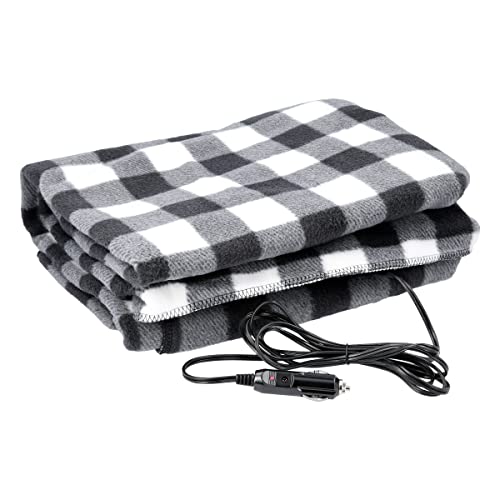
Stalwart 12V Heated Car Blanket Black Plaid — Best Classic Pick
Some products become the category in the public mind, and Stalwart’s plaid blanket is that product for 12-volt warmth. It has been the default recommendation for road trips, winter emergency kits and cold-weather camping for years because its proposition is so legible: a fleece-style throw in a cheerful black plaid, a cord ending in the familiar accessory plug, and warmth that arrives within minutes of the engine turning. No menus, no ceremony, just heat where a passenger’s legs used to be cold.
Its natural home is the passenger seat and the back bench. Drivers should keep any blanket clear of pedals and controls, which in practice means these throws earn their keep warming the people not driving, or warming a driver before departure while the vehicle is stationary and being prepared. In an emergency kit the plaid earns a second living: a car stranded in cold weather with the engine run in careful intervals becomes a far more survivable place with a heated throw over the occupants.
Judge it as the simple end of the market and it looks excellent. Control sophistication belongs to later picks in this guide, and like every blanket here it must be treated with the battery discipline the safety section describes. But for a known quantity at a friendly tier, bought for a trip next weekend rather than a research project, the plaid Stalwart remains the category’s front door.
Think about who actually receives this blanket as a gift, because it is one of the category’s commonest routes into a car. New drivers facing their first winter, students commuting in elderly hatchbacks, grandparents whose circulation complains before the cabin warms: for all of them a simple blanket with no learning curve is the difference between equipment used nightly and equipment returned to its box. The plaid’s simplicity is not a lack of ambition; it is the feature its audience most needs.
The plaid pattern does quiet practical work too. Road-trip blankets live hard lives among crumbs, dog hair and boot prints, and a busy check pattern forgives the marks that a plain pale fabric would announce to the world. It also reads unmistakably as the car blanket rather than a household throw, which reduces the odds of it migrating indoors and being absent on the one freezing morning it was bought for.
- Format: 12-volt heated throw, accessory-socket plug
- Pattern: black plaid fleece-style finish
- Controls: simple plug-in warmth, minimal adjustment
- Best use: passengers, camping, winter emergency kits
- Ownership note: friendly tier; store dry and coiled loosely — check price on Amazon
Strengths
- Proven, legible design trusted across many winters.
- Pattern hides the marks of road-trip life gracefully.
- Doubles as emergency-kit equipment in stranded cars.
Trade-offs
- Basic control set beside newer rivals here.
- Warmth depends on the vehicle’s electrical supply.
- Not a driver’s in-motion accessory; keep clear of controls.
Best for: passengers and emergency kits wanting the category’s classic, simple answer.
Not suited for: travellers wanting fine heat adjustment and washability.

Stalwart 12V Heated Car Blanket Navy — Best Understated Twin
The navy Stalwart is the plaid’s sibling in a quieter coat, and it earns a separate review because the audience differs more than the engineering. Plain navy suits the work truck, the family estate that doubles for client visits, and the driver who wants warmth without the picnic aesthetic. Everything else follows the family formula: accessory-socket power, a throw sized for a seated passenger, and warmth that takes the edge off a cold cabin while the vehicle’s own heater catches up.
That last role deserves respect. A modern car’s heater is powerful but slow, drawing on engine warmth that does not exist for the first miles, while a 12-volt throw begins helping almost immediately. Passengers who feel the cold most, older relatives, children, anyone recovering from illness and travelling gently, benefit disproportionately from those first minutes, and a blanket kept permanently in the car is already there when the need arrives unannounced.
Buy the navy if the plaid’s cheerfulness would grate, if the vehicle earns its living, or if a second blanket in a different colour prevents household arguments about whose is whose. The underlying advice is identical: engine-aware use, timer discipline where fitted, never unattended, and storage somewhere dry rather than balled in a damp boot.
There is a professional angle to the navy worth stating. Carers visiting patients, district nurses, tradespeople eating lunch in the cab between jobs: people whose car is a workplace use warmth differently, in short parked bursts where the engine-off rules in this guide matter most. A plain, durable-looking blanket that lives in the vehicle and asks nothing but a socket suits that working pattern better than a feature-rich model whose controls invite fiddling between appointments.
Fleet and family buyers should note the colour-coding opportunity. Two blankets in two colourways let a household assign one to each vehicle permanently, ending the migration problem where the blanket is always in the other car. It sounds trivial until the first frosty school run, when the navy in the boot turns a miserable wait into a non-event and justifies its entire existence in eight minutes.
- Format: 12-volt heated throw, accessory-socket plug
- Pattern: plain navy finish for understated interiors
- Controls: simple plug-in warmth, minimal adjustment
- Best use: work vehicles, family cars, second-car households
- Ownership note: friendly tier; keep assigned to one vehicle — check price on Amazon
Strengths
- Same proven formula in a discreet, versatile colour.
- Ideal permanent resident for a second family vehicle.
- Immediate warmth while the cabin heater warms up.
Trade-offs
- Shares the simple control set of its plaid sibling.
- Plain fabric shows lint and pale hair more readily.
- Battery discipline remains entirely the user’s job.
Best for: work vehicles and second cars wanting quiet, permanent winter readiness.
Not suited for: shoppers seeking timers, settings and machine washing.

IHEALTHCOMFORT 12V Car Heated Blanket — Best with Timer and Bag
The IHEALTHCOMFORT moves the category’s centre of gravity from warmth alone to warmth managed. Its headline features are a timer and settings, which together address the two human weaknesses of heated accessories: forgetting the blanket is on, and wanting one temperature for the whole journey when bodies actually want strong heat at the start and gentle heat once settled. A timer that ends the session on schedule converts the blanket from a battery risk into a planned comfort, and that conversion is worth real money.
The included storage bag sounds like packaging trivia until you have lived with a loose heated blanket. The cord tangles around everything in the boot, the fabric collects grit from the load floor, and the plug hides when wanted. A bag keeps the kit together, clean and grabbable, which means the blanket actually travels instead of being left behind as too much trouble. Organisation is a feature; this is the pick that understands it.
Dimensions suit a single passenger generously, and the truck, SUV and RV framing in its description matches its natural habitats: long cab journeys, motorhome evenings where the blanket warms a reader while the vehicle’s heating rests, and the passenger seat of a pickup on a January site run. Treat its timer as a seatbelt, always used rather than occasionally remembered, and it may be the most grown-up blanket in this guide.
Long-distance drivers sharing the work in shifts will find another use for the timer discipline. The resting passenger in the back, wrapped for a two-hour sleep while the other drives, needs warmth that ends itself rather than cooking or draining, and a timed blanket delivers exactly that managed rest. Truck crews and rally teams discovered this pattern long ago; family road trips are simply adopting professional practice at a smaller scale.
RV travellers should think carefully about its evening role. A motorhome parked for the night runs its comforts from a leisure battery with finite patience, and a timer-managed blanket that warms the person in the reading chair can spare the vehicle’s main heating for later, stretching the whole electrical budget. Used with that awareness, the IHEALTHCOMFORT stops being an accessory and becomes part of the van’s energy strategy.
- Format: 12-volt heated blanket with timer and settings
- Dimensions: generous single-passenger coverage, storage bag included
- Controls: timed sessions for battery-aware warmth
- Best use: trucks, SUVs, RV evenings, organised travellers
- Ownership note: mid tier; store in its bag between trips — check price on Amazon
Strengths
- Timer turns battery safety into a set-and-forget habit.
- Storage bag keeps cord and blanket together and clean.
- Settings suit changing comfort across a long journey.
Trade-offs
- Timer still requires the user to choose sensible durations.
- Single-passenger sizing will not cover two adults.
- More features mean more to learn before first use.
Best for: RV and truck travellers wanting timed, organised, battery-aware warmth.
Not suited for: anyone wanting the simplest possible plug-and-go throw.

HOMLYNS 12V Heated Car Blanket — Best Control and Care
The HOMLYNS reads like a reply to every complaint the category has collected. Ten heat settings answer the passenger who finds single-heat blankets either timid or tropical. An auto-off timer answers the battery anxiety that haunts parked use. Machine washability answers the road-trip reality of spilled coffee, muddy paws and the mysterious stickiness that vehicle blankets acquire. Any one of those would be a selling point; together they make this the most complete 12-volt blanket in the guide.
Its size suits a seated adult properly, and the dark grey finish splits the difference between the Stalwarts: quieter than plaid, more forgiving than navy of lint and travel marks. For vehicle camping, where the blanket may serve as evening warmth in a converted SUV, the combination of fine heat steps and an auto-off that protects the morning’s engine start feels less like luxury than like correct engineering for the job.
Washability deserves its hygiene footnote. Follow the maker’s washing instructions exactly, since heated textiles contain wiring that resents abuse, and never use the blanket while any part of it remains damp. With that care observed, the HOMLYNS is the pick for households who will use a heated blanket weekly all winter rather than twice a year, and who want the control to prove it.
Washability changes the ownership maths across a season in a way spec sheets never capture. A blanket that cannot be cleaned gets used gingerly, saved for best, and quietly avoided after the first spill, while a washable one gets used daily and forgiven everything. The HOMLYNS will therefore, in most households, deliver several times the warmth-hours of a more delicate rival, simply because nobody is protecting it from the life it was bought to serve.
Consider the passenger spectrum it serves in one family: a teenager who wants tropical heat for the first ten minutes, a grandparent who wants a low steady warmth for two hours, and a driver planning a parked nap at a service area who needs the timer as a chaperone. Ten settings and an honest auto-off let one blanket play all three roles without argument, which is why it tops this guide despite the Stalwarts’ longer fame.
- Format: 12-volt heated blanket, dark grey
- Controls: ten heat settings with auto-off timer
- Care: machine washable per maker’s instructions
- Best use: frequent winter use, vehicle camping, mixed passengers
- Ownership note: mid tier; wash carefully and dry fully — check price on Amazon
Strengths
- Finest heat control available in this line-up.
- Auto-off timer protects the battery by default.
- Washability suits weekly, real-world use.
Trade-offs
- Rich controls invite careless maximum-heat habits.
- Washing must follow instructions to protect wiring.
- Still bound by the vehicle’s electrical limits.
Best for: frequent winter travellers wanting control, safety automation and easy care.
Not suited for: minimalists who prefer a single simple heat setting.
12V Heated Throws, Discussed Generically — Knowledge Pick
The throw’s genius is that it belongs to the passenger rather than the car. It moves between vehicles, wraps a child in the back or a grandparent in the front, covers knees at a frosty football match from a parked car, and goes home in a bag when the journey ends. Its warmth is local and personal, which is precisely its efficiency: heating one human takes a fraction of the energy of heating a cabin’s air, and the human notices immediately.
There is an etiquette to the shared throw worth a sentence. The coldest passenger gets it first, the passenger who runs warm surrenders it without negotiation, and on long journeys it rotates at fuel stops so nobody’s comfort is a permanent sacrifice. Families who establish the rotation early avoid the low-grade blanket politics that can otherwise season an entire winter of car journeys.
The throw’s limits are the same facts reversed. It warms only where it touches, it tangles the unorganised, and it depends entirely on the vehicle’s socket and battery for its living. Two passengers need two blankets or an act of negotiation, and a driver in motion should treat a throw as cargo, not clothing, keeping it clear of pedals, wheel and gear controls at all times.
Choose the throw when your cold problem is personal, portable and passenger-shaped: school runs with a chilly teenager, elderly relatives on winter visits, road trips where the back seat becomes a bedroom. It is the flexible, inexpensive answer, and its second career in the emergency kit gives it a value no installed accessory can claim.
- Form: portable blanket powered from the accessory socket
- Warmth: local, personal and quick to arrive
- Sharing: one blanket serves one passenger well
- Limits: battery-dependent, no cabin-wide effect
- Tier note: generally the most affordable route to warmth
Strengths
- Moves between vehicles and passengers freely.
- Efficient personal warmth with immediate effect.
- Earns a second role inside winter emergency kits.
Trade-offs
- Warms only the area it physically covers.
- Cords and loose fabric need managing in the cabin.
- Useless away from a vehicle power source.
Best for: passengers, children and relatives who feel cold on shared journeys.
Not suited for: drivers wanting warmth integrated with the seat itself.
Seat Heaters, Discussed Generically — Knowledge Pick
The seat heater takes the opposite philosophy: warmth installed into the vehicle, either factory-fitted beneath the upholstery or added as a heated cushion or cover that also draws on the vehicle’s electrics. Its heat arrives through the seat itself, warming the driver’s back and legs in a way no lap blanket can imitate, and it leaves hands, pedals and cabin entirely uncluttered. For the solo driver covering winter miles, it is often the more natural instrument.
Aftermarket heated cushions occupy a middle ground worth knowing about. They sit on the seat, plug into the same socket and warm the occupant from beneath, combining some of the throw’s portability with some of the fitted heater’s posture. Their weakness is movement: a cushion that slides beneath a driver is a distraction, so such designs belong mainly on passenger seats or must be secured exactly as their makers intend.
The costs are commitment and scope. Fitted heaters involve upholstery work and wiring that belong in professional hands, while cushion-style heaters serve only the seat they sit on and still draw from the same battery as everything else. Neither can be carried to a grandstand, lent to a passenger in another car or folded into an emergency kit. The warmth is superb and entirely non-transferable.
The honest verdict is that the categories complement rather than compete. A driver-heavy household may install seat warmth and still keep a throw for passengers; a passenger-heavy household may never need the installation at all. Decide by asking whose cold you are solving, the person behind the wheel or the people behind the windscreen’s other seats, and the answer chooses the technology for you.
- Form: factory-fitted, cushion or cover heating the seat
- Warmth: through the back and seat base, uncluttered
- Fitting: installed versions need professional wiring
- Limits: fixed to one seat and one vehicle
- Tier note: installation costs exceed a throw’s simplicity
Strengths
- Warms the driver directly with nothing loose in the cabin.
- Feels integrated rather than improvised on long drives.
- No fabric to manage, fold or wash.
Trade-offs
- Cannot move between vehicles or passengers.
- Professional fitting adds cost and commitment.
- Draws on the same battery with the same discipline required.
Best for: solo drivers covering regular winter mileage in one vehicle.
Not suited for: families whose cold passengers change from trip to trip.
Comparison Table
| Pick | Type | Control story | Best role | Watch out for |
|---|---|---|---|---|
| Stalwart 12V Heated Car Blanket Black Plaid | 12V heated throw | Simple plug-in warmth | Trips and emergency kits | Basic controls |
| Stalwart 12V Heated Car Blanket Navy | 12V heated throw | Simple plug-in warmth | Work and second vehicles | Shows lint readily |
| IHEALTHCOMFORT 12V Car Heated Blanket | 12V heated blanket | Timer and settings, storage bag | Trucks, SUVs and RVs | Single-passenger size |
| HOMLYNS 12V Heated Car Blanket | 12V heated blanket | Ten settings, auto-off, washable | Frequent use, vehicle camping | Wash with care |
| 12V Heated Throws, Discussed Generically | Knowledge entry | Depends on model chosen | Portable passenger warmth | Battery-dependent |
| Seat Heaters, Discussed Generically | Knowledge entry | Seat controls where fitted | Driver-focused warmth | Fixed to one vehicle |
What Are the Safety Rules That Govern Every 12-Volt Blanket?
Before the rules, a word about why they exist in this form. Nothing in this section is there to frighten anyone away from a product category that has warmed passengers safely for decades. The rules are short because the failure modes are few, ordinary and well understood, and a household that internalises five habits, battery awareness, timers, attendance, clear footwells and honest inspection, has addressed essentially all of them.
Rule one concerns the battery. A heated blanket draws a meaningful current, and a healthy battery in a running vehicle, its alternator replenishing the system, supplies that current happily for hours. The same blanket in a parked, engine-off car spends the battery’s reserve with no income arriving, and an older or smaller battery can be spent past the point of starting the engine in a surprisingly short evening. If you use a blanket parked, use its timer, keep sessions short, and know your battery’s age and health before you test them.
Rule two is that a heated blanket never runs unattended. Not in a parked car while you shop, not over a sleeping passenger for an entire night, not draped across a seat to pre-warm a vehicle you are not sitting in. Timers and auto-off features reduce risk; they do not transfer responsibility. Rule three is physical: keep fabric and cords clear of pedals, seat rails, sharp seat mechanisms and anything that pinches or abrades the wiring, and unplug the blanket when it is not actively warming someone. Rule four is condition: a blanket with a damaged cord, a frayed section or a plug that runs hot is retired, not taped and forgiven.
A fifth rule concerns the socket itself. Accessory sockets and their fuses are rated for a load, and a blanket should be the socket’s only significant tenant while it runs: no splitters feeding a blanket, a phone fast-charger and a tyre inflator in cheerful simultaneity. If the plug or socket grows noticeably hot, stop, unplug and have the circuit checked, because heat at a connection is information, and the information is never good.
Children and pets deserve their own sentence. Use the lowest settings, supervise continuously, and never leave a child or animal alone in a vehicle with a heated blanket running. Warmth is a comfort you provide while present and attentive; the moment it becomes a substitute for presence, it has left its safe territory.
How Should You Use a Heated Blanket Across a Winter Journey?
Pack the blanket where the cold will find it, which is not always where tidiness suggests. A blanket buried beneath luggage warms nobody during the first hour, while one kept on the back seat or in a seat-back pocket is in service before the doors close. On trips where boot space is contested, the blanket earns priority over bulkier comforts precisely because it deploys in seconds and serves the passenger least able to generate their own warmth.
Begin with the engine running and the blanket at a generous setting while the cabin is still cold, since those first minutes deliver most of the comfort the product exists for. As the vehicle’s own heater arrives and bodies settle, step the blanket down to a maintenance warmth rather than leaving it at full draw out of inertia. Passengers who fall asleep should have their blanket on a timer or under the supervision of someone awake, with the setting lowered before sleep rather than after.
Coordinate the blanket with the rest of the winter cabin. Heated seats where fitted, a blanket for the passenger without one, and the cabin heater set for the driver’s comfort rather than at a compromise nobody enjoys: that layered arrangement covers a mixed car more completely than any single device at full blast. Think of the blanket as one instrument in a small orchestra, most effective when it is not trying to play every part.
At stops, make a decision instead of a default. Engine off means blanket off, unless the stop is brief, the timer is set and the battery is known to be strong. At the destination, unplug, let the blanket cool, coil its cord loosely and store it dry. That small closing ritual prevents the two commonest blanket deaths, cord damage from tight coiling and mildew from damp storage, and guarantees the blanket is ready for the next cold morning.
How Do Electric Vehicles and Hybrids Change the Picture?
Electric vehicles complicate the accessory-socket story in a way worth understanding before a winter trip. Many EVs power their cabin accessories from a small auxiliary battery or a converter with its own limits, and leaving accessories drawing while parked can trouble that auxiliary system just as it troubles a petrol car’s battery. The blanket itself neither knows nor cares where its twelve volts originate, yet the owner’s discipline must adapt to the vehicle’s manual rather than to habit formed in another car.
Hybrids sit between the two worlds, their engines cycling on and off to maintain charge, which can make a parked heated blanket perfectly sustainable in one model and unwise in another. The generic rule survives every drivetrain: read what your vehicle says about accessory use while parked, prefer timed sessions, and treat an unfamiliar car, a hire car on a winter trip, with extra conservatism until its behaviour is known.
What Should an Emergency Kit Version of This Setup Look Like?
Build the kit around the blanket rather than tossing the blanket into a pile. The blanket lives in its bag with a torch, a phone charging cable, water, a high-visibility layer and the knowledge of how long the car’s battery can support warmth in timed, engine-assisted intervals. In a genuine stranding, the drill is conservation: run the engine in short periods as conditions and fuel allow, warm the occupants and the blanket together, then switch everything off and let insulation hold the gains.
Rehearse that drill mentally once each autumn when the blanket returns to the car. Check the plug fits the socket, the cord reaches the back seat, and the blanket still warms evenly with no hot spots or dead patches. A five-minute inspection in October is worth more than a perfect blanket discovered faulty on a hard shoulder in January.
Which Journeys Benefit Most, and Which Barely Benefit at All?
There is one more journey type hiding in plain sight: the wait inside a car that is itself the destination. Anglers at dawn, birdwatchers at dusk, parents at training grounds and photographers chasing winter light all sit in parked vehicles for pleasure, and for them the blanket, used in timed sessions with the engine run sparingly and knowingly, converts a cold vigil into a comfortable one. The safety rules in this guide were written with those long parked hours especially in mind.
The school run in January is the blanket’s finest hour: short distance, cold-soaked car, a passenger whose comfort decides the mood of the entire morning. Airport pickups in winter run a close second, with their long parked waits and returning travellers dressed for another climate. Festival and match days, where the car becomes a base camp between events, reward a blanket that warms spectators in rotation while the engine rests between careful, timed sessions.
Short hops in a mild autumn barely benefit, and honesty requires saying so. If the cabin warms before the blanket does, the blanket is luggage. Likewise, a car with strong factory seat heating throughout may need a throw only for the emergency kit. Buy for your actual journey pattern, the five trips you make weekly in the coldest month, rather than for an imagined expedition, and the purchase will justify itself by February.
How Do You Keep the Blanket Itself in Good Condition?
Heated textiles age through their wiring, so treat the blanket like an electrical appliance that happens to be soft. Never fold it sharply along the same creases, never sit heavy luggage on it in the boot, and never run it while it is bunched or folded, because folded operation concentrates heat where the elements double over. Spread it flat in use, let it cool before folding it loosely, and keep it away from pet claws and seat-belt buckles that nick the surface.
Inspect it at the season’s start and end: run your palm slowly over the whole surface while it warms, feeling for hot spots, cold patches or any area that behaves differently from its neighbours. Either symptom retires the blanket. A heated textile that warms unevenly is announcing internal damage, and the correct response is replacement, not monitoring.
Keep the inspection honest by doing it in daylight with the blanket fully spread, because a fold can masquerade as a cold patch and a bunched section can masquerade as a hot spot. Flat, patient and supervised is the only trustworthy test posture, and it takes less time than the first coffee of a winter morning.
What Are the Most Common Mistakes with 12-Volt Blankets?
Leaving a blanket drawing current in a parked car leads the list by a distance, and it usually happens through kindness: keeping the car warm for a passenger while running an errand. The flat battery that follows is the category’s most preventable mishap. Next comes expecting household performance from a vehicle socket, then blaming a good blanket for the laws of physics when it warms gently rather than fiercely.
Buying on size photographs alone creates a quieter disappointment. Listings photograph blankets spread flat and generous, while the seated reality involves knees, seat belts and a passenger’s preferred curl, all of which consume coverage. Read the stated dimensions against a tape measure on your own sofa before ordering, and remember that a blanket shared between a tall adult and a small car will satisfy neither.
Drivers using a throw in motion, draped where it can slide towards pedals, commit the most serious error in the catalogue. Others store blankets damp, coil cords tightly enough to fatigue the wiring, or run damaged plugs because the blanket still works. Each mistake is small, ordinary and entirely avoidable, which is why this guide returns to discipline as often as it returns to products.
What Do Passengers Actually Notice After a Month of Use?
The novelty fades and a routine remains, and the routine is the review that matters. Households report that the blanket migrates from special equipment to default equipment: plugged in without discussion, set by the passenger’s own hand, folded by whoever used it last. The complaints that survive a month are never about warmth, which all four linked blankets deliver adequately, but about logistics, cords that tangle, plugs that hide, blankets that live in the wrong car.
That is why this guide weighted bags, timers and colourways as heavily as heating. The blanket that wins a winter is the one whose logistics disappear, present in the right vehicle, findable in the dark, safe by default through its timer, and clean enough that nobody hesitates to pull it over good clothes. Judge your shortlist by February’s habits rather than December’s excitement and you will choose well.
How Do You Choose the Right Size and Length of Cord?
Measure the journey the blanket must make inside your own car before ordering. The throw should cover a seated passenger from lap to feet without stretching, and its cord must travel from the socket to that passenger’s seat with slack to spare, routed where doors and seat rails cannot pinch it. A cord at full stretch is a cord being damaged slowly, and a blanket that barely covers a tall teenager will be resented by February however efficient its elements are.
Back-seat use deserves a specific check, because many vehicles place their only socket at the front console. A blanket bought for children in the rear needs either a rear socket, a cord genuinely long enough to reach without crossing the driver’s space, or a different plan altogether. Discovering the geometry in the driveway beats discovering it on the motorway with a cold child providing commentary.
How Do You Test a New Blanket Before Trusting It?
Give a new blanket one supervised driveway session before its first journey. Spread it flat across a seat, run it through its settings with the engine on, and pass a palm slowly across the whole surface checking for even warmth, dead patches or any spot that runs noticeably hotter than its neighbours. Test the timer by actually letting it expire, and confirm the plug seats firmly in your vehicle’s socket rather than wobbling at the first corner.
Then rehearse the storage: coil the cord the way it will live, place the blanket where it will ride, and check that doors, seat adjustments and luggage all clear it. A blanket that passes the driveway examination rarely surprises anyone later, while one that skips it tends to conduct its experiments at seventy miles an hour in sleet.
What Is the Honest Place of a Heated Blanket in a Modern Car?
Modern vehicles heat their cabins better than any generation before them, yet the blanket’s niche survives because cabin heating answers a different question. It warms air, eventually, for everyone equally, while journeys are full of people who are not equal in their cold: the passenger in a thin coat collected from a station, the child asleep under a coat that keeps sliding off, the partner whose comfort setting would roast the driver. Personal warmth patches the gaps that communal heating cannot aim at.
There is also the stopped car to consider, the growing share of vehicle life spent waiting: charging stops, ferry queues, school gates, level crossings, the ring-road standstill. A timed blanket turns those waits from endurance into rest without demanding the engine’s constant attention. The category endures not because cars are badly heated, but because journeys are badly heated in patches, and patches are exactly what a throw is shaped to cover.
How Should You Brief Children and Elderly Passengers on Using One?
Give the briefing before the first journey, in daylight, with the blanket spread across a lap at home. Show where the plug goes, which control does what, and the two rules that matter most: the blanket is unplugged when the car stops for more than a moment, and an adult is told if anything feels too hot, smells odd or behaves strangely. Children who understand the equipment treat it with a respect that survives the novelty period.
Elderly passengers may need the opposite reassurance, that the blanket is simple, that its lowest setting is genuinely gentle, and that asking for it is not a fuss. Many older travellers will sit cold in silence rather than request an accessory they perceive as complicated, so the household’s job is to make the offer routine: blanket out, setting low, journey begun. Warmth requested without embarrassment is warmth that actually gets used.
Final Recommendation
One last piece of sequencing advice: buy the blanket before the cold arrives, test it on a mild evening in the driveway, and teach its controls to the passengers who will use it while nobody is shivering. Equipment learned in comfort gets used correctly in hardship, and the first frosty motorway services is a poor classroom for a timer nobody has met before.
For most travellers the HOMLYNS is the blanket to beat, because its settings, auto-off timer and washability answer the category’s real complaints in one product. Organised RV and truck users should examine the IHEALTHCOMFORT closely, while the Stalwart pair remain the honest classics for trips, second cars and emergency kits, in plaid or navy according to taste. Whichever you choose, adopt the safety rules as part of the purchase: engine awareness, timers used, nothing left running unattended. Buy the HOMLYNS if this blanket will work weekly all winter and you want warmth you can fine-tune down to the last degree of a sleeping passenger’s comfort. Then put it in the car this week, while the lesson of this guide is fresh, because a blanket bought in a cold snap and understood in a hurry serves nobody as well as one installed calmly before the weather turns.
Frequently Asked Questions
Will a 12-volt blanket drain my car battery?
With the engine running, the alternator supports the draw comfortably. Parked with the engine off, the same blanket spends the battery’s reserve and can leave an older battery unable to start the car, so parked use should be brief, timed and undertaken with a battery you trust.
Warning signs that you have overdrawn are mundane: a sluggish first crank, dimmer interior lights, a battery warning appearing where none lived before. Treat the first occurrence as the lesson it is, shorten future parked sessions, and have the battery tested before winter deepens, because a battery that complains in November is making an announcement about January.
Can the driver use a heated blanket while driving?
A loose blanket has no place around a driver in motion, where fabric and cords must stay far from pedals and controls. Drivers wanting warmth underway should consider the seat-heater route discussed in this guide, and use throws while parked, preparing the car, or as a passenger.
The same logic applies to anything else loose in the footwell. A heated blanket stored by the driver’s feet between uses is an accident rehearsing itself, so give it a home on the passenger side, in the boot or in its bag behind the seats, anywhere its cord cannot wander towards the pedals uninvited.
How warm does a 12-volt blanket actually get?
Expect gentle, personal warmth rather than household-blanket intensity, because the vehicle’s electrical system sets a modest ceiling. The comfort is real, particularly in the first cold minutes of a journey, but it is measured in taking the chill away rather than creating a sauna.
Placement multiplies the effect without costing a watt. A blanket over the lap and legs, where the body loses comfort fastest in a cold seat, delivers more perceived warmth than the same blanket bunched around shoulders already served by a coat. Tuck the edges so the warmth stays against the body instead of heating the cabin air on its way past.
Is it safe to sleep under one in a parked car or RV?
Only with discipline: lowest suitable setting, a timer or auto-off engaged, a healthy battery or leisure battery whose limits you know, and never as an all-night unattended appliance. When in doubt, warm the bedding before sleep and switch the blanket off as you settle.
Ventilation belongs in the same conversation. A sealed vehicle occupied overnight needs fresh air regardless of heating arrangements, so crack a window as conditions allow and treat any headache or drowsiness as a signal to ventilate and reassess. Comfort systems should always remain the junior partner to basic vehicle safety.
How should I store the blanket between seasons?
Clean and fully dry, cord coiled loosely rather than wound tight, stored somewhere dry away from heavy objects that could pinch the wiring. A dedicated bag, like the one supplied with the IHEALTHCOMFORT, keeps the kit together and makes the first frosty morning a pleasure instead of a search.
Add a note to the bag if the household owns more than one vehicle: which car the blanket belongs to, and the month it was last tested. That tiny label prevents the autumn discovery that both blankets summered in the same boot while the other car, the one facing the January commute, goes without.
Related Guides
By the second winter, most owners say the blanket has stopped being a product and become a habit their passengers plan around, the way travellers plan around a favourite seat, and habits that comfortable rarely need defending to anyone who has ever shared a cold car at six in the morning in February and become part of the car’s furniture, as unremarkable and as essential as the ice scraper in the door pocket, and that ordinariness is the surest sign the purchase was right.
Continue with Best Acoustic Blankets for a very different kind of blanket, detour through Best Bagless Upright Vacuums for Pet Hair if the car carries animals, or read Best Vacuums for Bed Bugs for another guide where honesty about limits matters. The natural companion read is Best 12-Volt Wet Dry Car Vacuums.



[…] next stops might be Best 12-Volt Heated Blankets for the car that ferries the pet, Best Bagged Vacuums for Low Dust for the containment side of […]